Piano Maestro: Vivaldi’s Spring

vivaldi

Vivaldi, one of the greatest baroque composers, has a very interesting story. He ran an orphanage in the 18th century in Italy that became famous all over the western world for its musically talented children. A lot of his pieces were written for specific children in his school. Vivaldi learned the violin from his father, and was trained as a priest. He was nicknamed “the red priest” for his red hair and was apparently somewhat sure of himself, having claimed once he can compose a concerto faster than it can be copied.

Vivaldi wrote over 500 pieces, most of which are lost today. He is considered one of the greatest musical landmarks in history, having inspired many composers that followed him, including J.S.Bach and others.

Other fun facts about Vivaldi can be found here.

Vivaldi’s Spring is available on Piano Maestro, which is available to my students free of charge.

Manuscript of Mozart’s Piano Sonata K331 Discovered in Budapest’s National Széchényi Library

The manuscript of Mozart’s A major piano sonata K331 has recently been discovered in Budapest. Having spent the majority of its life in the Budapest’s National Széchényi Library for decades, the coveted manuscript was rediscovered by Haydn scholar Balazs Mikusi.

“When I first laid eyes upon the manuscript, the handwriting already looked suspiciously ‘Mozartish’,” said Mikusi, who is the head of the music collection at National Szechenyi Library. “Then I started reading the notes, and realised it is the famous A Major sonata … My heart rate shot up.”

The piece was composed in 1783 and contains Mozart’s most popular jam, “Turkish March,” which has become a piano lesson staple all over the world.

Although, unfortunately, Mikusi can’t say how or when these pages found their way to Hungary; they reveal subtle differences from the published editions of the sonata. The key variances are seen in the phrasing, dynamics and occasionally the notes themselves.

“It is very rare that a Mozart manuscript pops up. Moreover the A Major Sonata had no known manuscript, so it is a really big discovery,” he said.

The library has only released teasing images of the manuscript, nothing more.

Take a listen below to the “Turkish March.”

From Manuscript of Mozart’s Piano Sonata K331 Discovered in Budapest’s National Széchényi Library : Classical : Classicalite.

Space calls tune for longest piano | Stuff.co.nz

Wanted: Temporary space for the world’s largest piano. Must have flat access, as requires forklift.

A piano handcrafted in a garage near Timaru, weighing in at 1.4 tonnes and with a length of 5.7 metres, is rolling through Wellington next month and its maker is hunting for a place to show it off.

It took Adrian Mann, 25, four years to build the piano, and he has spent the past few years giving people around New Zealand a chance to play it – he even tried, unsuccessfully, to get Elton John to give it a tinkle.

It all started when, as a curious 15-year-old, he wanted to see how long a piece of piano wire would be if it were not wrapped in copper.


Read the entire article at Space calls tune for longest piano | Stuff.co.nz.

In D.C., a 13-year-old piano prodigy is treated as a truant instead of a star student – The Washington Post

From Today’s Washington Post:

Avery Gagliano is a commanding young pianist who attacks Chopin with the focused diligence of a master craftsman and the grace of a ballet dancer.

The prodigy, who just turned 13, was one of 12 musicians selected from across the globe to play at a prestigious event in Munich last year and has won competitions and headlined with orchestras nationwide.

But to the D.C. public school system, the eighth-grader from Mount Pleasant is also a truant. Yes, you read that right. Avery’s amazing talent and straight-A grades at Alice Deal Middle School earned her no slack from school officials, despite her parents’ begging and pleading for an exception.

http://youtu.be/VC28vsf9cuY

Read more at In D.C., a 13-year-old piano prodigy is treated as a truant instead of a star student – The Washington Post.

Pianos are Popping Up all over Corvallis

Lee Eckroth couldn’t hold back a smile as piano music filled the air Wednesday afternoon on the streets of downtown Corvallis.

The moment marked the culmination of months of work from by Eckroth, Corvallis Imagination Music & Art founder David Lundahl and dozens of volunteers who’d banded together to create the first Play Corvallis, Play.

The art installation features eight theme-decorated pianos, placed at outdoor locations around Corvallis. It is open to the public from 7 a.m. to 10 p.m. daily through Aug. 16 as a prelude event to the Imagination Music and Art festival at Bruce Starker Arts Park on Aug. 15 and 16.

Play Corvallis, Play is intended to inspire appreciation of the arts, and it is just what it sounds like: an invitation to residents to stop and play the piano to showcase local musical creativity and art as a way of drawing attention to the fundraising at Corvallis public schools.

Read the whole article at Pianos are popping up all over Corvallis.

The Evolution of Music Clefs

When my students are first working with the Grand Staff, they are often confused about the placement of the various clefs.

In piano music, we generally use only the G-clef (Treble clef – not “trouble clef” as some think!) and the F-clef (Bass clef)  I try to show students how the curvy part of the G-clef wraps around the G above middle C and the F-clef looks sort of like an F marking the F below middle C.  I draw out G and F on the staff to show how these could have looked.

Originally, instead of a special clef symbol, the reference line of the staff was simply labeled with the name of the note it was intended to bear: F and C and, more rarely, G. These were the most often-used ‘clefs’ in Gregorian chant notation.  Gregorian chant developed mainly in western and central Europe during the 9th and 10th centuries, with later additions and redactions.

Over time the shapes of these letters became stylized, leading to their current versions.


Franz Liszt’s “Hungarian Rhapsody no. 2 in c-sharp minor”

liszt


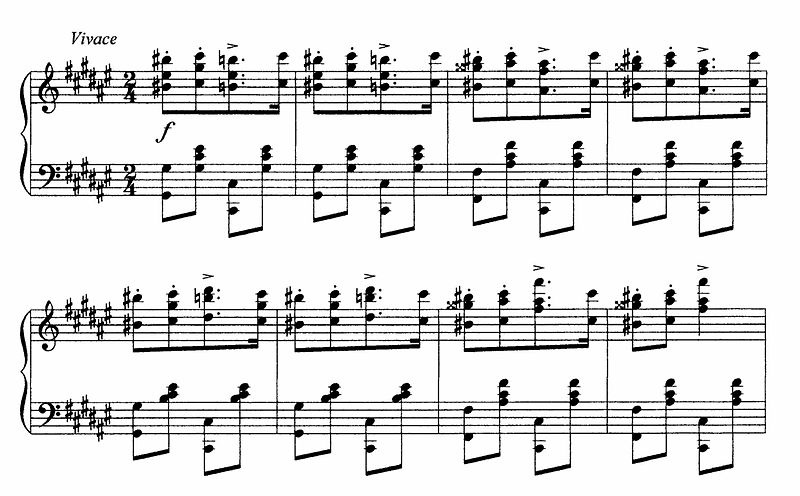
Hungarian Rhapsody No. 2, S.244/2, is the second in a set of 19 Hungarian Rhapsodies by composer Franz Liszt, and is by far the most famous of the set. Few other piano solos have achieved such widespread popularity, offering the pianist the opportunity to reveal exceptional skill as a virtuoso, while providing the listener with an immediate and irresistible musical appeal.

In both the original piano solo form and in the orchestrated version this composition has enjoyed widespread use in animated cartoons. Its themes have also served as the basis of several popular songs.

It is probable that you have heard this piece of music somewhere at one time or another because it is perhaps the most prominent piece of classical (romantic, actually) music featured in animated cartoons across the years.

Now, let the anvils fall and dynamite explode!


And, in real life, Valentina Lisitsa plays Liszt’s Hungarian Rhapsody No. 2

J.S. Bach’s Ornament Table

The following ornament table is a transcription of the one appearing in the Clavier-Büchlein vor Wilhelm Friedemann Bach, written by Johann Sebastian Bach for the keyboard instruction of his eldest son.

A scan of the original manuscript appears at Dave’s J.S. Bach Page.

The German title translates as “Explanation of various signs, showing how to play certain ornaments correctly.”{1} Bach gives the sign for each ornament on the upper of the paired staves, while the lower shows its execution directly beneath.

(This blog has) simply modernized the clefs in my transcription, since Bach’s manuscript uses soprano clefs, as several composers continued to do throughout the 18th century in place of the treble clef now used in all keyboard music.

After the transcription graphic showing the table, there appear clickable buttons which are keyed to AU sound files; you can click on any of the ornaments and hear a sound file play its execution.


ornaments

Read the original blog post with the ornament table and listening files at J.S. Bach’s Ornament Table.