Music theory has never sounded so catchy with this witty remake of the holiday classic The Christmas Song (with apologies to Mel Torme) Try not to laugh at the ending.
Though it is a bit humorous, this version titled ‘Intervals Roasting’, with lyrics by David Rakowski, attempts to encapsulate the fundamentals of music theory in just over two minutes.
It does a good job of explaining the intervals and harmonic structure of the song and also gives you an idea of how to use music theory to analyze or compose music.
The O’Connor Music Studio has a copy if anyone wants to learn this 🙂
“O Come, All Ye Faithful,” originally penned in the reverent Latin tones as “Adeste Fideles,” is a Christmas carol shrouded in mystery and rich in history. This beloved hymn, a staple of holiday celebrations, is thought to have been crafted by a medley of historical figures. Among them are John Francis Wade (1711–1786), John Reading (1645–1692), and even King John IV of Portugal (1604–1656). The hymn’s origins are further mystified by the earliest manuscript bearing King John IV’s name, found nestled in the Ducal Palace of Vila Viçosa’s library.
Initially composed with four verses, the hymn has since blossomed into an eight-verse masterpiece, transcending language barriers and cultural divides. Its verses have been translated into a multitude of languages, spreading its message of faith and joy worldwide. The English rendition by Frederick Oakeley, an English Catholic priest, penned in 1841, has particularly resonated in the hearts of English-speaking audiences globally, becoming a cherished rendition of this classic hymn.
Today, “O Come, All Ye Faithful” stands not just as a carol but as a symbol of Christmas spirit and unity. If you’re drawn to the allure of this timeless hymn and wish to bring its melody into your own celebrations, the O’Connor Music Studio offers a variety of versions for those eager to learn and share in the joy and majesty of this classic Christmas carol. Whether you’re a seasoned musician or a curious beginner, the store provides a gateway to experiencing and sharing the enduring magic of “O Come, All Ye Faithful.”
Gesù Bambino,” composed by the illustrious Pietro Yon, is a melodic treasure that resonates with the warmth and nostalgia of my childhood Christmases. Each note of this enchanting piece takes me back to those magical days when the church choir’s voices would rise in harmony, filling the air with the spirit of the festive season. This song, a staple of my yuletide memories, holds a special place in my heart, reminiscent of the joy and wonder of Christmas celebrated in the hallowed halls of my childhood church.
Though it seemed a hidden gem, known primarily within the circles of my church community, “Gesù Bambino” has recently found a renaissance, emerging in piano books and gaining recognition. Its melody, crafted in the year 1917, has an ethereal quality that transcends time and place.
The song’s enchanting tune was brilliantly adapted by Frederick H. Martens in his English carol “When Blossoms Flowered ‘mid the Snows.” Its chorus, a harmonious blend of melody and lyrics, draws inspiration from the classic carol “Adeste Fideles” (O Come All Ye Faithful), weaving a tapestry of musical heritage and tradition. This fusion of melodies creates a piece that is both familiar and fresh, evoking a sense of time-honored tradition while offering a unique auditory experience.
“Gesù Bambino” is not just a song; it’s a musical journey that captures the essence of Christmas, weaving together the threads of nostalgia, tradition, and the universal joy of the holiday season. Its rising popularity is a testament to its timeless beauty and its ability to touch hearts, just as it has touched mine since childhood.
A piano version
Piano and Organ
Sung by David Archuleta and the Mormon Tabernacle Choir
Carol of the Bells was composed by Mykola Dmytrovych Leontovych (1877-1921) in 1916. Originally titled Shchedryk, this Ukrainian folk song is sometimes called Ukrainian Bell Carol. “Shchedryk” which was associated with the coming New Year, originally celebrated in April.
Leontovych used this tune in 1904 along with lyrics by Peter J. Wilhousky to create the version that everyone knows today. It gained popularity during the 1920s and 1930s, and was introduced to an even wider audience when it was used in the movie “Home Alone”.
It was first performed in the Ukraine on the night of January 13, 1916, on the Julian calendar this is considered New Year’s Eve. In the United States the song was first performed on October 5, 1921 at Carnegie Hall.
This video is from the Christmas special of the Mormon Tabernacle Choir, presented at the BYU channel. The orchestra and choir produce a very beautiful sound.
Not the standard version –
The O’Connor Music Studio has several versions of this Christmas Carol available for loan, including this version from the Mannheim Steamroller:
Isaac Watts wrote the words to “Joy to the World” in 1719, based on Psalm 98 in the Bible. The hymn originally glorified Christ’s triumphant return at the end of the age, rather than a song celebrating His first coming. Only the second half of Watts’ lyrics are still used today.
The music was adapted and arranged to Watts’ lyrics by Lowell Mason in 1839 from an older melody which was then believed to have originated from Handel. The name “Antioch” is generally used for the hymn tune.
As of the late 20th century, “Joy to the World” was the most-published Christmas hymn in North America.
There are versions of Joy to the World available at the O’Connor Music Studio for any level of playing, starting with Pre-Reading, all the way up through Advanced and duets.
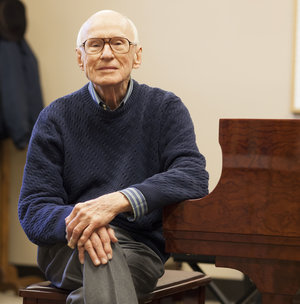
I have always respected Dr. Hinson’s work and his music. So much so that I went to Connecticut to take a class on Piano Pedagogy with him several years ago. I have also attended several local piano teacher workshops with him. At one of them, he claimed to remember me from that Connecticut class. Whether true or not, I treasure that comment and the signature on a piano book he gave me.
We have several of his books at the O’Connor Music Studio and many are available for loan. If you are interested in buying any for yourself, amazon.com has a great selection. In addition to those books he has authored, he has edited the works of many composers. Amazon lists 270 works edited and annotated by Dr. Hinson.
One of America’s most respected authorities on piano literature, Dr. Maurice Hinson received the Lifetime Achievement Award from the Music Teachers National Association at its Washington, D.C. convention in the spring of 1994, the Outstanding Alumni Award from the University of Florida in 1990, and the Outstanding Alumni Award from the University of Michigan in the fall of 1995. Hailed as a specialist in American piano music, some of his articles appear in the New Grove Dictionary of American Music in the United States.
Dr. Hinson received his Bachelor of Arts degree from the University of Florida and his Master of Music and Doctor of Musical Arts degrees from the University of Michigan. He also studied at The Juilliard School and the Conservatoire National in Nancy, France.
While a Senior Professor of Piano in the School of Church Music at the Southern Baptist Theological Seminary in Louisville, Kentucky, Dr. Hinson’s curriculum included teaching piano, piano literature, and piano chamber music. He performed, lectured, and gave masterclasses worldwide. His books and editions have become classic standards in the studios of serious piano teachers and students the world over.
Hinson, Dr. G. Maurice, age 84 died November 11, 2015 in the company of his family. Dr. Hinson was Professor and Senior Professor of Piano at the Southern Baptist Theological Seminary from 1957 to 2015, and a member of Broadway Baptist Church. He was also organist-choirmaster of churches in Florida, Michigan and Kentucky from 1943 to 1980. Dr. Hinson received his BA degree from the University of Florida and his MM and DMA degrees from the University of Michigan, and also studied at The Julliard School and the University of Nancy, France (Conservatoire National).
He was the first president of the Greater Louisville Music Teachers Association, and president of the Kentucky Music Teachers Association as well as the Southern Division of the MTNA. He also taught “The Dorsey Class,” a group of selected piano teachers from 1963 to 2015.
Dr. Hinson is the author of 14 books mostly published by Indiana University Press, plus over 100 articles for music publications. He was a senior editor for The Alfred Publishing Company of California. He edited more than 300 editions of classical piano music and recorded five DVDs of piano music.
As Professor of Piano at the Southern Baptist Theological Seminary for 58 years, he taught and nurtured many pianists who now hold distinguished positions in churches and universities throughout the world.
Dr. Hinson received many awards in piano pedagogy and performance. He was awarded the Liszt Commemorative Medal by the Hungarian Government and the Medal of Excellence by the American Liszt Society for his research on the music of Franz Liszt. He was hailed as a specialist in American Piano music and some of his most recent articles appeared in the NEW GROVE DICTIONARY OF AMERICAN MUSIC. He gave recitals, lectures, and master classes in five continents and 50 states.
Hinson was the founding editor of the JOURNAL OF THE AMERICAN LISZT SOCIETY, past editor of THE AMERICAN MUSIC TEACHER, and contributing editor of THE PIANO QUARTERLY and PIANO AND KEYBOARD.
Night on Bald Mountain refers to a series of compositions by Modest Mussorgsky (1839–1881). Inspired by Russian literary works and legend, Mussorgsky composed a “musical picture”, St. John’s Eve on Bald Mountain on the theme of a witches’ sabbath occurring on St. John’s Eve, which he completed on that very night, June 23, in 1867.
Get a free copy of the sheet music at IMSLP or buy it on amazon.com. There is also an easy version on amazon, with all the note names written in.
Interestingly, the original piece composed by Mussorgsky is not the version you typically hear. That was only published in 1968 and is performed very rarely. The piece we have come to know (and hear in places like Walt Disney’s Fantasia is an arrangement by Rimsky-Korsakov.
From Disney’s Fantasia
Piano version transcribed for solo piano by Konstantin Chernov (1865-1937).
The Ludwig Symphony Orchestra, conducted by Maestro Thomas Ludwig
The Funeral March of a Marionette (Marche funèbre d’une marionnette) is a short piece by Charles Gounod. It was written in 1872 for solo piano and orchestrated in 1879. It is perhaps best known as the theme music for the television program Alfred Hitchcock Presents, which originally aired from 1955 to 1965.
In 1871-72, while residing in London, Gounod started to write a suite for piano called “Suite Burlesque”. After completing one movement, the Funeral March of a Marionette, he abandoned the suite and had the single movement published by Goddard & Co. In 1879 he orchestrated the piece. The instrumentation is: piccolo, flute, 2 oboes, 2 clarinets in A, 2 bassoons, 2 horns in D, 2 trumpets in A, 3 trombones, ophicleide, timpani, bass drum, triangle, strings. The work is in the key of D minor, with a central section in D major. Various arrangements by other hands exist.
There is a program underlying the Funeral March of a Marionette: The Marionette has died in a duel. The funeral procession commences (D minor). A central section (D Major) depicts the mourners taking refreshments, before returning to the funeral march (D minor).
The score contains the following inscriptions in appropriate places:
La Marionnette est cassée!!! (The Marionette is broken!!!)
Murmure de regrets de la troupe (Murmurs of regret from the troupe)
Le Cortège (The Procession)
Ici plusieurs des principaux personnages de la troupe s’arrêtent pour sa rafrâichir (Here many of the principal personages stop for refreshments)
Retour a la maison (Return to the house). (Wikipedia)
Download this music in several versions from IMSLP. Click on Arrangements and Transcriptions. There are also some arrangements for piano at the O’Connor Music Studio, including an advanced level. This is arranged for three levels starting with very easy piano in Piano Maestro.
On Alfred Hitchcock:
From Faber Piano Adventures Performance Book Level 3B No.7 (Also available in the OCMS Library):
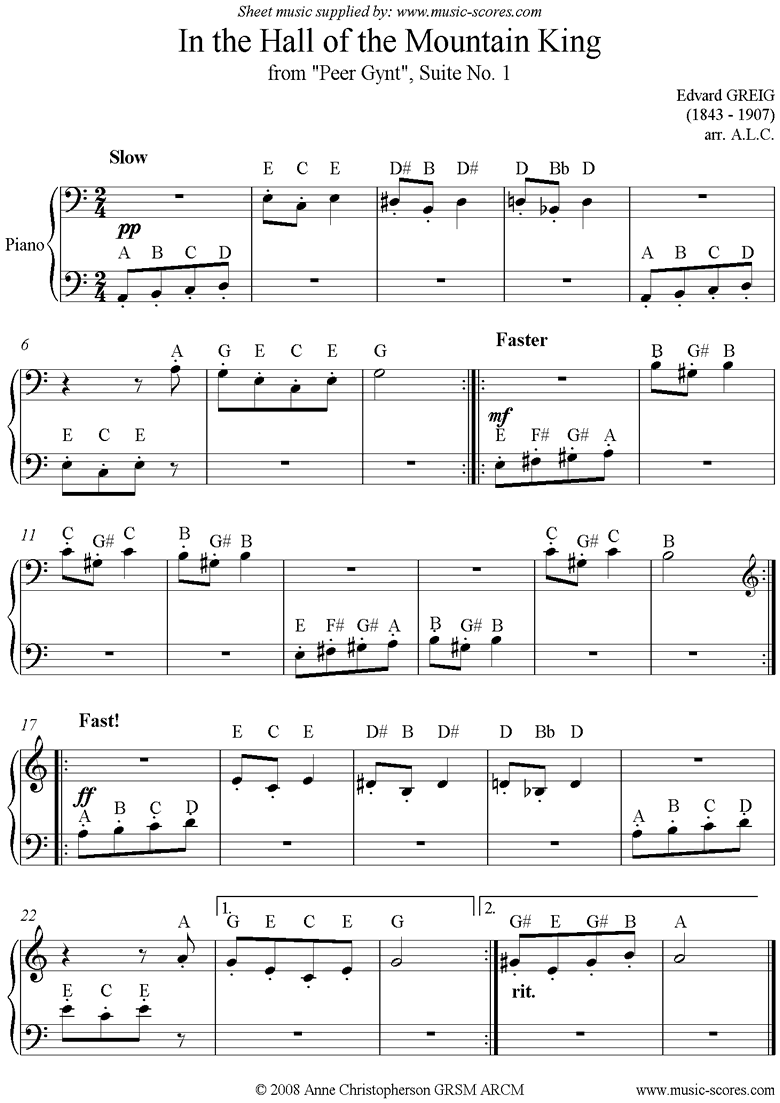
“In the Hall of the Mountain King” is a piece of orchestral music composed for the sixth scene of act 2 in Henrik Ibsen’s 1867 play Peer Gynt by Edvard Grieg. It was originally part of Opus 23 but was later extracted as the final piece of Peer Gynt, Suite No. 1, Op. 46. Its easily recognizable theme has helped it attain iconic status in popular culture, where it has been arranged by many artists, including for the piano.
The translation of the title of this piece from Norwegian isn’t quite literally “mountain king”. The “king” in this instance is actually a troll that Peer Gynt invents in a fantasy. The introduction of this movement is, “There is a great crowd of troll courtiers, gnomes and goblins. Dovregubben sits on his throne, with crown and sceptre, surrounded by his children and relatives. Peer Gynt stands before him. There is a tremendous uproar in the hall.”
Borrow a copy of the sheet music from the O’Connor Music Studio. I have this arranged for piano, duet, 2-piano, simplified…
8 part vocal orchestra (plus a tiny pair of cymbals)
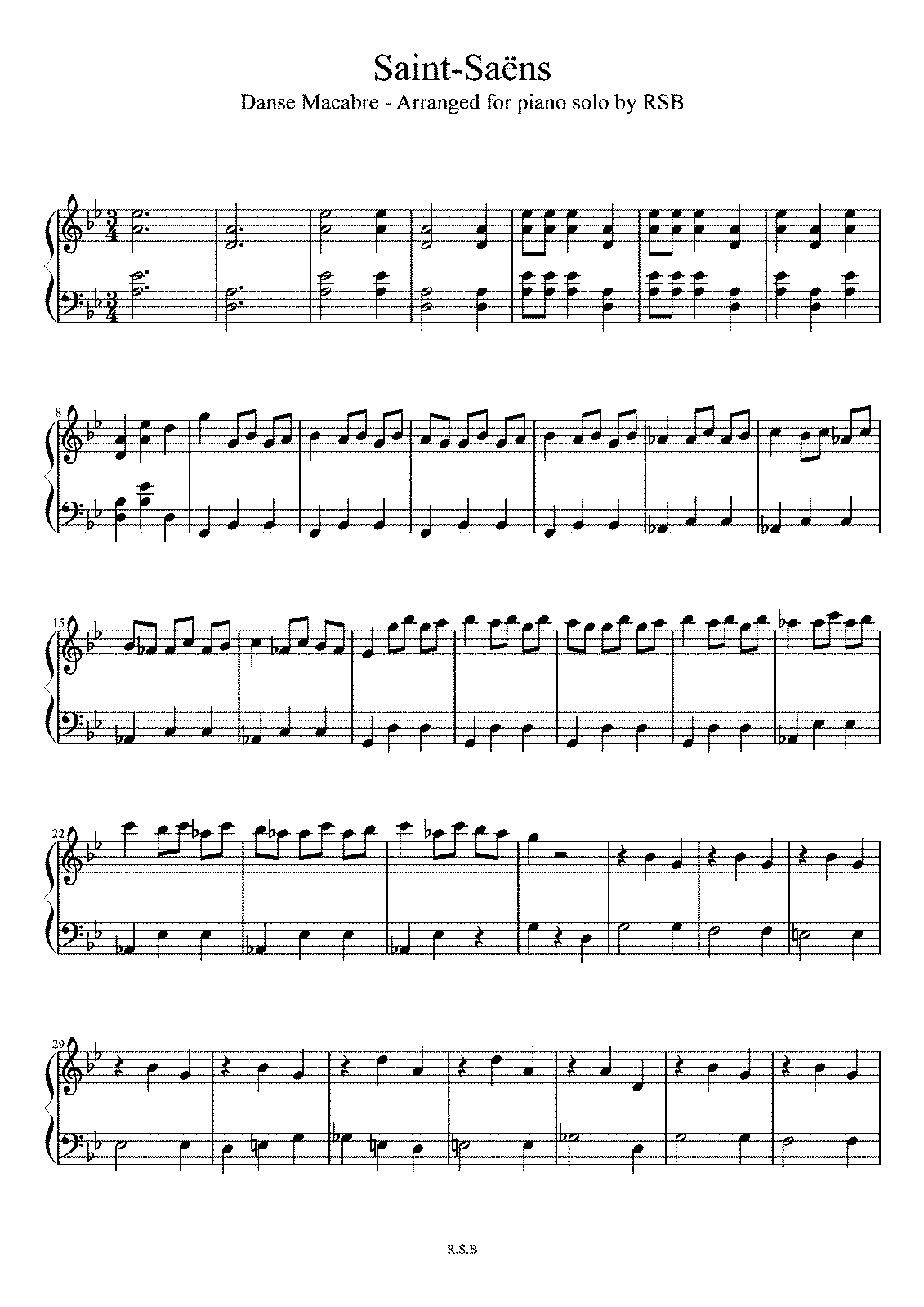
Danse macabre, Op. 40, is a tone poem for orchestra, written in 1874 by French composer Camille Saint-Saëns. It started out in 1872 as an art song for voice and piano with a French text by the poet Henri Cazalis, which is based on an old French superstition. In 1874, the composer expanded and reworked the piece into a tone poem, replacing the vocal line with a solo violin.
With a title that includes the word “macabre”, you can tell it’s a great piece for Halloween. This is by far the most famous work associated with the holiday, and with good reason. It is a tone poem inspired by a French legend that says “Death” appears at midnight on Halloween to call forth the dead from their graves to dance for him. He plays the fiddle while skeletons dance until dawn.
Get a free copy of the sheet music at IMSLP (Look for Arrangements and Transcriptions) or borrow a copy from the O’Connor Music Studio. I have this arranged for organ, piano, duet, simplified…
Amazon has a great Dover edition for solo piano. This splendid compilation features a variety of the composer’s best piano works, all reproduced from authoritative sources. Taking its title from the popular orchestral work “Danse Macabre” (presented here in the brilliant arrangement by Liszt), this collection also includes “Allegro appassionato,” “Album” (consisting of six pieces), “Rhapsodie d’Auvergne,” “Theme and Variations,” plus six etudes, three waltzes, and six etudes for left hand alone.