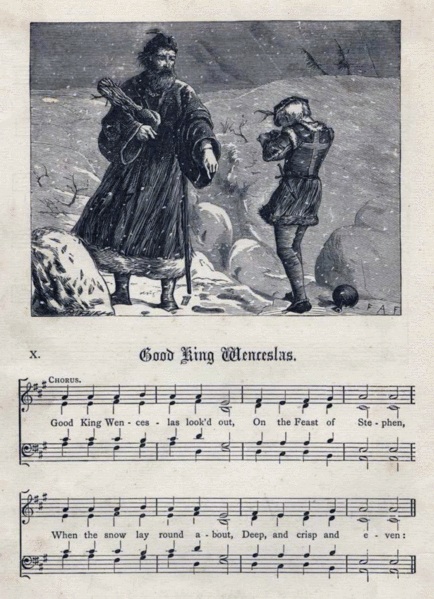
“Good King Wenceslas” is a popular Christmas carol that tells a story of Good King Wenceslas braving harsh winter weather to give alms to a poor peasant on the Feast of Stephen (the second day of Christmas, December 26). During the journey, his page is about to give up the struggle against the cold weather, but is enabled to continue by following the king’s footprints, step for step, through the deep snow. The legend is based on the life of the historical Saint Wenceslaus I, Duke of Bohemia or Svatý Václav in Czech (907–935).
In 1853, English hymnwriter John Mason Neale wrote the “Wenceslas” lyrics, in collaboration with his music editor Thomas Helmore, and the carol first appeared in Carols for Christmas-Tide, 1853. Neales’ lyrics were set to a tune based on a 13th century spring carol “Tempus adest floridum” (“The time is near for flowering”) first published in the 1582 Finnish song collection Piae Cantiones.
Good King Wenceslas looked out
On the feast of Stephen
When the snow lay round about
Deep and crisp and even
Brightly shone the moon that night
Though the frost was cruel
When a poor man came in sight
Gath’ring winter fuel
“Hither, page, and stand by me
If thou know’st it, telling
Yonder peasant, who is he?
Where and what his dwelling?”
“Sire, he lives a good league hence
Underneath the mountain
Right against the forest fence
By Saint Agnes’ fountain.”
“Bring me flesh and bring me wine
Bring me pine logs hither
Thou and I will see him dine
When we bear him thither.”
Page and monarch forth they went
Forth they went together
Through the rude wind’s wild lament
And the bitter weather
“Sire, the night is darker now
And the wind blows stronger
Fails my heart, I know not how,
I can go no longer.”
“Mark my foteps, my good page
Tread thou in them boldly
Thou shalt find the winter’s rage
Freeze thy blood less coldly.”
In his master’s steps he trod
Where the snow lay dinted
Heat was in the very sod
Which the Saint had printed
Therefore, Christian men, be sure
Wealth or rank possessing
Ye who now will bless the poor
Shall yourselves find blessing
“We Three Kings”, also known as “We Three Kings of Orient Are” or “The Quest of the Magi”, is a Christmas carol written by the Reverend John Henry Hopkins, Jr., who wrote both the lyrics and the music.
We three kings of Orient are
Bearing gifts we traverse afar
Field and fountain, moor and mountain
Following yonder star
O Star of wonder, star of night
Star with royal beauty bright
Westward leading, still proceeding
Guide us to thy Perfect Light
Born a King on Bethlehem’s plain
Gold I bring to crown Him again
King forever, ceasing never
Over us all to reign
O Star of wonder, star of night
Star with royal beauty bright
Westward leading, still proceeding
Guide us to Thy perfect light
Frankincense to offer have I
Incense owns a Deity nigh
Prayer and praising, all men raising
Worship Him, God most high
O Star of wonder, star of night
Star with royal beauty bright
Westward leading, still proceeding
Guide us to Thy perfect light
Myrrh is mine, its bitter perfume
Breathes of life of gathering gloom
Sorrowing, sighing, bleeding, dying
Sealed in the stone-cold tomb
O Star of wonder, star of night
Star with royal beauty bright
Westward leading, still proceeding
Guide us to Thy perfect light
Glorious now behold Him arise
King and God and Sacrifice
Alleluia, Alleluia
Earth to heav’n replies
O Star of wonder, star of night
Star with royal beauty bright
Westward leading, still proceeding
Guide us to Thy perfect light
From Mannheim Steamroller, Chip Davis gives this song an “Arabian Nights” feel. A classic song that tells the story of the Gentiles who were quicker to recognize the significance of Christ’s birth than were His own people. Enjoy, and Merry Christmas!
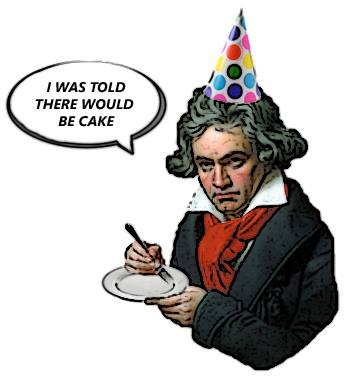
He used the # in unusual places before Twitter… but how would Beethoven have used Facebook? And what would his profile look like? From his likes and dislikes to his friends and love interests, we’ve imagined what the composer might have posted online throughout his life.
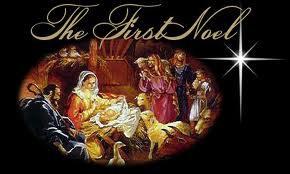
The First Nowell (also written The First Noël) is a traditional classical English carol, most likely from the 18th century, although possibly earlier.
The word Noel comes from the French word Noël meaning “Christmas”, from the Latin word natalis “birthday”.
The melody is unusual among English folk melodies in that it consists of one musical phrase repeated twice, followed by a refrain which is a variation on that phrase. All three phrases end on the third of the scale.
The first Noel the angel did say
Was to certain poor shepherds in fields as they lay;
In fields where they lay tending their sheep,
On a cold winter’s night that was so deep.
Refrain
Noel, Noel, Noel, Noel, Born is the King of Israel.
They lookèd up and saw a star
Shining in the east, beyond them far;
And to the earth it gave great light,
And so it continued both day and night.
Refrain
And by the light of that same star
Three Wise Men came from country far;
To seek for a King was their intent,
And to follow the star wherever it went.
Refrain
This star drew nigh to the northwest,
Over Bethlehem it took its rest;
And there it did both stop and stay,
Right over the place where Jesus lay.
Refrain
Then did they know assuredly
Within that house the King did lie;
One entered it them for to see,
And found the Babe in poverty.
Refrain
Then entered in those Wise Men three,
Full reverently upon the knee,
And offered there, in His presence,
Their gold and myrrh and frankincense.
Refrain
Between an ox stall and an ass,
This Child truly there He was;
For want of clothing they did Him lay
All in a manger, among the hay.
Refrain
Then let us all with one accord
Sing praises to our heavenly Lord;
That hath made Heaven and earth of naught,
And with His blood mankind hath bought.
Refrain
If we in our time shall do well,
We shall be free from death and hell;
For God hath prepared for us all
A resting place in general.
Refrain
The University of Utah Singers perform “The First Noel” arr. by Dan Forrest live in concert, December 11th & 12th, 2009 in Libby Gardner concert hall under the direction of Dr. Brady Allred.
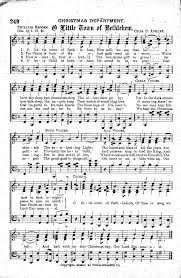
“O Little Town of Bethlehem” is a popular Christmas carol. The text was written by Phillips Brooks (1835–1893), an Episcopal priest, Rector of the Church of the Holy Trinity, Philadelphia. He was inspired by visiting the Palestinian city of Bethlehem in 1865.
Three years later, he wrote the poem for his church and his organist, Lewis Redner, added the music. Redner’s tune, simply titled “St. Louis”, is the tune used most often for this carol in the United States.
The Mormon Tabernacle Choir sings O Little Town Of Bethlehem
I could have turned the Alfred Burt Carols into the next 15 parts of this series but I decided that was a bit too easy on me!
I love this story – it’s a wonderful family tradition from the Burt family.
Starting in 1922, Alfred Burt’s father created a Christmas card for family members and parishioners. On these cards were original Christmas carols, with both the words and music by the Reverend Bates Burt. For the family Christmas card in 1942, Bates asked his son to write the music for that year’s carol, “Christmas Cometh Caroling.”
From then on, Alfred would write the music for the family’s Christmas cards, and the “Alfred Burt carols” were born.
“This Is Christmas” (also known as “Bright, Bright, the Holly Berries”) (1950)
“Some Children See Him” (1951)
“Come, Dear Children” (1952)
“O, Hearken Ye” (1953)
“Caroling Caroling” (1954)
“We’ll Dress the House” (1954)
“The Star Carol” (1954)
Burt finished the last of his carols, “The Star Carol”, on February 5, 1954. He died less than 24 hours later, at the age of 33.
One of the best known of these today is Caroling Caroling (lyrics by the church organist at his father’s church, Wihla Hutson)
The Salt Lake Vocal Artists perform 2 carols; “Caroling, Caroling” and “We’ll Dress the House” by Alfred Burt live in concert on December 17, 2011 in Holy Family Catholic Church, South Ogden, Utah under the direction of Dr. Brady Allred.
• 1843 ~ Charles Dickens published his play “A Christmas Carol”
• 1874 ~ Josef Lhévinne, Russian pianist, teacher. After gaining fame as a soloists in Russia and Europe, he and Rosa came to the U.S.A. in 1919. While they continued to concertize, they both taught at Juilliard; although he had the more prominent concert career, she lived on to become legendary for teaching an endless succession of prominent pianists including Van Cliburn.
• 1925 ~ Dick Van Dyke, American Emmy Award-winning actor and comedian
• 1928 ~ Audiences at Carnegie Hall heard the first performance of George Gershwin’s composition, An American in Paris. The debut was performed by the New York Philharmonic Orchestra under the direction of Walter Damrosch. Advertised as “a tone poem with jazz and sound effects”, it was used as a ballet for Gene Kelly’s 1951 performance in the movie of the same name. Unfortunately, George Gershwin did not live to see his composition being danced to in the Academy Award-winning An American in Paris. It won six Oscars: Best Art Direction/Set Direction [Color], Best Color Cinematography, Best Costume Design [Color], Best Story and Screenplay, Best Picture … and Best Score.
• 1929 ~ Christopher Plummer (Orme), Actor, Sound of Music, Doll’s House
• 1940 ~ The two-sided jump tune, The Anvil Chorus, was recorded by Glenn Miller and his orchestra for Bluebird Records in New York. The 10-inch, 78 rpm record ran six minutes (including flipping).
• 1941 ~ John Davidson, Actor, singer, TV game show host of the Hollywood Squares
• 1948 ~ Jeff ‘Skunk’ Baxter, Guitarist with Steely Dan, The Doobie Brothers
• 1948 ~ Ted Nugent, Guitarist, singer with Amboy Dukes
• 1948 ~ The American Federation of Musicians went back to work after an 11½-month strike. During the strike, there was an 11½-month ban on phonograph records as well.
• 1949 ~ Randy Owen, Guitarist, singer with Alabama
• 1949 ~ Tom Verlaine (Miller), Guitarist, singer with Television
• 1974 ~ Former George Harrison was greeted at the White House. President Gerald R. Ford invited Harrison to lunch. The two exchanged buttons, Ford giving George a WIN (Whip Inflation Now) pin and Harrison gave the President an OM (Hindu mantra word expressing creation) button.
• 2000 ~ Cellist Yo-Yo Ma made a special guest appearance on NBC television’s West Wing. No, he did’t play a partisan leader, but he was featured in some of the music of Bach.
• 2002 ~ Maria Bjornson, a set and costume designer whose work on the hit musical The Phantom of the Opera won critical acclaim, was found dead at her London home. She was 53. Bjornson was born in Paris in 1949 and grew up in London, the daughter of a Romanian woman and a Norwegian father. She went to the French Lycee in London and then studied at the Byam Shaw School of Art and the Central School of Art and Design. Bjornson worked as a theater designer from 1969, and designed 13 productions at the Glasgow Citizens’ Theater. She worked for the Welsh National Opera and its English and Scottish counterparts, and was involved with the Royal Shakespeare Company and the Royal Ballet. Her colorful and grand design for Andrew Lloyd Webber’s musical Phantom of the Opera at Her Majesty’s Theater in London in 1986 won her international acclaim. In 1988, Bjornson’s work on Phantom won two Tony Awards, one for sets and the other for costumes. After Phantom she collaborated with Lloyd Webber again on Aspects of Love, and worked on the Royal Ballet’s production ofSleeping Beauty at Covent Garden in London in 1994 and on Cosi Fan Tutte at Glyndebourne in 1991.
• 2002 ~ Former Lovin’ Spoonful guitarist Zal Yanovsky, who traded in the wild rock star life for a quiet existence as a restaurant owner in Canada, died. The Toronto native died of a heart attack at his home in Kingston, Ontario, six days before his 58th birthday. Famed for such hits as Do You Believe in Magic and Summer in the City, the Lovin’ Spoonful enjoyed a brief reign in the mid 1960s as America’s answer to the Beatles. The quartet, led by singer/guitarist John Sebastian, racked up seven consecutive top 10 singles in 16 months. Yanovsky, a tall Russian Jew who resembled Ringo Starr, joined forces with Sebastian in New York City in 1964. The pair shared a love of folk music, and both had played in the Mugwumps, a short-lived combo that also included future Mamas and Papas members “Mama” Cass Elliot and Denny Doherty. The Lovin’ Spoonful, named after a Mississippi John Hurt song, took shape in 1965 when Yanovsky and Sebastian teamed up with drummer Joe Butler and bass player Steve Boone. The group’s first single, Do You Believe In Magic reached the top 10 that year. Its followup, You Don’t Have To Be So Nice also went top 10 in early 1966. Summer in the City was their sole No. 1. Besides recording five albums, the band also did the soundtracks to Woody Allen’sWhat’s Up, Tiger Lily? and Francis Ford Coppola You’re A Big Boy Now. Yanovsky was the zany member of the group. He was the focal point during live performances, but his biting humor often rubbed his colleagues the wrong way, especially when one of his girlfriends ended up with Sebastian. In 1966, the group’s banner year, Yanovsky was faced with deportation after he and Boone were arrested for marijuana possession in San Francisco. They turned in their dealer, which damaged the band’s hipster credentials. Amid rising tensions, Yanovsky was voted out of the band in 1967, but remained on amicable terms with his colleagues. He recorded a solo album, Alive and Well in Argentina, in 1968. Sebastian, the band’s creative force, left that year, and the band soon broke up. The original members reunited in 1980 to appear in the Paul Simon film One-Trick Pony and then in 2000 when it was inducted into the Rock and Roll Hall of Fame. Yanovsky dabbled in TV before going into the restaurant business. He ran Chez Piggy, an acclaimed eatery in Kingston.
• 2003 ~ Jazz trumpeter Webster Young, who played with greats such as MilesDavis and John Coltrane in the 1950s, died of a brain tumor. He was 71. Young’s career got an early boost when Louis Armstrong took him as a student when he was 10 years old. As a teenager, Young jammed with DizzyGillespie, earning the nickname “Little Diz” in Washington D.C.-area clubs for a style that resembled Gillespie’s. Young broke into the modern jazz scene in New York City in the late 1950s, recording several albums. He returned to Washington D.C. in the 1970s to raise his family. He toured in Europe in the 1980s and performed regularly at jazz clubs until eight months before his death. Young’s career peaked in 1957, when he played coronet with John Coltrane for the album “Interplay for Two Trumpets and Two Tenors” for the Prestige record label.
The holiday season is in full swing. The decorations are up, the presents bought (or in the process of being bought) but there’s no reason why our apps can’t get the same love this holiday.
So, without further ado, I’d like to jump into the updates we’ve made to Piano Maestro for you this holiday season!
Holiday Songs & Graphics
You’ll be able to impress your friends and family with a bunch of FREE holiday songs to play! We also added some new ones to the mix for our veteran Piano Maestro players.
You’ll find 50 free (yes, free!!) songs in this category from Christmas to Hanukkah and even New Year’s too! We just added Mariah Carey’s “All I want for Christmas is You” (because who doesn’t LOVE that Christmas classic).
Also available is the Christmas staple, “Jingle Bell Rock”.
The only thing missing is the ability for our app to make a strong cup of eggnog! We’ll try and work on that for next Christmas
The free holiday songs can be accessed from two places. As mentioned above, you can get there directly from the “Free Holiday Songs” button on the main menu as well as going to Library -> Songs -> and then choosing the “Free Holiday Songs” category.
Make sure to download the latest update of Piano Maestro.
Learning on your own? Don’t forget to download our free iPhone app, Simply Piano, and learn to play “Jingle Bells” in just 30 minutes!
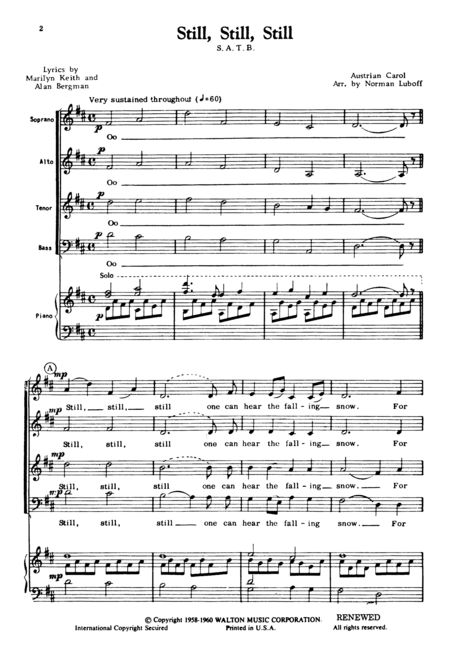
Still, Still, Still is an Austrian Christmas carol and lullaby. In German its first line is “Still, still, still, weil’s Kindlein schlafen will!” (Hush, hush, hush, for the little child wants to sleep!)
The melody is a folk tune (authorship unknown) from the State of Salzburg. The tune appeared for the first time in 1865 in a folksong collection of Maria Vinzenz Süß (1802-1868), founder of the Salzburg Museum; it has changed slightly over the years but remains attributed to G. Götsch.
The words, which run to six verses in German, describe the peace of the infant Jesus and his mother as they sleep. There are various English translations. This is one version:
Still, still, still,
One can hear the falling snow.
For all is hushed,
The world is sleeping,
Holy Star its vigil keeping.
Still, still, still,
One can hear the falling snow.
Sleep, sleep, sleep,
‘Tis the eve of our Saviour’s birth.
The night is peaceful all around you,
Close your eyes,
Let sleep surround you.
Sleep, sleep, sleep,
‘Tis the eve of our Saviour’s birth.
Dream, dream, dream,
Of the joyous day to come.
While guardian angels without number,
Watch you as you sweetly slumber.
Dream, dream, dream,
Of the joyous day to come.







 Hanukkah