December 22 ~ Today in Music History

today


Christmas Music, Parts 19-22 – Johnny Marks

• 1723 ~ Carl Friedrich Abel, German composer of the Classical era. He was a renowned player of the viola da gamba, and composed important music for that instrument.

• 1821 ~ Giovanni Bottesini, Italian Romantic composer, conductor, and a double bass virtuoso

• 1853 ~ Maria Teresa Carreno, Venezuelan pianist, singer, composer, and conductor.

OCMS 1858 ~ Giacomo Puccini, Italian opera composer
More information about Puccini

OCMS 1883 ~ Edgard Varèse, French-born American avant-garde composer
More information about Varèse

• 1874 ~ Franz Schmidt, Austrian composer, cellist and pianist.

• 1885 ~ (Joseph) Deems Taylor, American opera composer and writer, music critic for New York World from 1921 until 1925, New York American from 1931 to 1932, intermission commentator for Sunday radio broadcasts of NY Philharmonic (1936 to 1943), president of ASCAP, married to poet and playwright Mary Kennedy

• 1901 ~ André Kostelanetz, Russian-born American conductor and arranger of Broadway show tunes

• 1939 ~ Gertrude ‘Ma’ Rainey passed away

• 1941 ~ Jimmy Lunceford and his orchestra recorded Blues in the Night on Decca. The song became one of Lunceford’s biggest hits. Between 1934 and 1946 Jimmy Lunceford had more hits (22) than any other black jazz band (except Duke Ellington and Cab Calloway).

• 1944 ~ Barry Jenkins, Drummer with Nashville Teens and also the Animals

• 1946 ~ Rick Nielsen, Guitarist, singer with Cheap Trick

• 1949 ~ Maurice Gibb, Bass, songwriter with the Bee Gees, married to singer Lulu, twin of Robin Gibb
More about Maurice Gibb and the Bee Gees

• 1949 ~ Robin Gibb, Songwriter for Bee Gees, twin of Maurice Gibb
More about the Bee Gees

• 1958 ~ The Chipmunks were at the #1 position on the music charts on this day in 1958 as Alvin, Simon, and Theodore sang with David Seville. The Chipmunk Song, the novelty tune that topped the charts for a month, is still a Christmas favorite today…

Christmas, Christmas time is near
Time for toys and time for cheer
We’ve been good, but we can’t last
Hurry Christmas, hurry fast

Want a plane that loops the loop
Me, I want a hula hoop
We can hardly stand the wait
Please Christmas, don’t be late.

• 1972 ~ Folk singer Joni Mitchell received a gold record for the album, For the Roses. The album included the song, You Turn Me on, I’m a Radio.

• 1981 ~ London was the scene of a rock ’n’ roll auction where buyers paid $2,000 for a letter of introduction from Buddy Holly to Decca Records. Cynthia and John Lennon’s marriage certificate was worth $850 and an autographed program from the world premiere of the Beatles film Help! brought $2,100.

• 1984 ~ CBS Records announced plans for the release of Mick Jagger’s first solo album, set for February,

• 1985 ~ The Rolling Stones went solo after a 20-year career with the self- proclaimed “greatest rock ’n’ roll band in the world.” The album: She’s the Boss.

• 2002 ~ Joe Strummer (John Mellors), who brought punk attitude and politics to one of the most significant bands in rock ‘n’ roll history, the Clash, died of a heart attack at his home in Somerset, England. He was 50. Strummer, a singer, guitarist, songwriter, activist and actor, had been touring with his band the Mescaleros since the release of their second album “Global a- Go-Go” in July 2001; the latest leg of the tour ended in November in Liverpool. The Clash, which formed in 1976, released its first album in ’77 and broke up for good in 1986, will be inducted into the Rock and Roll Hall of Fame in March. The original lineup of Strummer, Mick Jones, Terry Chimes and Paul Simonon was expected to re-form for the induction ceremony and play the band’s first single, “White Riot,” at the ceremony. Although it was written as an advertising tagline, the Clash successfully lived up to its slogan as “the only band that matters.” The son of a diplomat, Strummer was born John Graham Mellor on Aug. 21, 1952, in Ankara, Turkey. He attended boarding schools in London, and as a teenager grew infatuated with reggae, R&B and rock ‘n’ roll. He formed a pub band, the 101ers, in 1974, which he gave up to form the Clash with Jones, Chimes and Keith Levene. The band was playing standard rock ‘n’ roll prior to Strummer’s arrival. He added reggae to the mix and upped the ante in politics and intensity. He took a Jones tune, for example, that was a complaint about a girlfriend and turned it into one of the band’s early anthems, “I’m So Bored With the U.S.A.” “Within the Clash, Joe was the political engine of the band,” British troubadour Billy Bragg said. “Without Joe there’s no political Clash, and without the Clash the whole political edge of punk would have been severely dulled.” Jones and Strummer penned all of the tunes on their debut and often worked as a team, though later albums would have songs attributed solely to Strummer and, for their final two efforts, have all songs attributed to the band.

December 21 ~ Today in Music History

today

Christmas Music, Parts 19-22 – Johnny Marks

• 1810 ~ Ludwig Schuncke, German pianist and composer, and close friend of Robert Schumann.

• 1850 ~ Zdenek Fibich, Czech composer of classical music

• 1913 ~ Andor Foldes, Pianist who played with Budapest Philharmonic at eight years of age

• 1921 ~ Alicia Alonso (Martinez Hoyo), Dancer

• 1933 ~ Freddie Hart, Country singer

• 1940 ~ Frank Zappa, American rock guitarist, composer, arranger and songwriter, with Mothers of Invention, father of Dweezil and Moon Unit Zappa

OCMS 1944 ~ Michael Tilson Thomas, American conductor and pianist, jazz band conductor, led the London Symphony Orchestra and Los Angeles Philharmonic
More information about Tilson Thomas

• 1946 ~ Carl Wilson, Guitarist with The Beach Boys, brother of Brian and Dennis, his original group was Carl and the Passions

• 1953 ~ Andras Schiff, Hungarian pianist

• 1966 ~ The Beach Boys received a gold record for the single, Good Vibrations.

• 1985 ~ Springsteen’s album, Born in the USA, passed Michael Jackson’s Thriller to become the second longest-lasting LP in the top 10. It stayed there for 79 weeks. Only The Sound of Music, with Julie Andrews, lasted longer at 109 weeks.

December 20 ~ Today in Music History

today
Christmas Music, Parts 19-22 – Johnny Marks

• 1728 ~ Franz Xaver Pokorny, Czech Classical era composer and violinist.

• 1783 ~ Padre Antonio Francisco Javier Jose Soler

• 1871 ~ Henry Kimball Hadley, American composer and conductor

• 1898 ~ Irene (Marie) Dunne, Actress in Show Boat, Anna and the King of Siam, Alternate Delegate to the United Nations, Kennedy Center Honors Lifetime Achievement Award in 1985.

• 1909 ~ Vagn Holmboe, Danish composer and music critic

• 1920 ~ An English-born comedian named Leslie Downes became an American citizen. He had lived in the United States since 1908 and became one of the nation’s true ambassadors for show business and charity. We say, “Thanks for the memories,” to Bob Hope.

• 1928 ~ For the first time, a living actress in the United States had a theatre named after her. The Ethel Barrymore Theatre opened in New York City.

• 1932 ~ Al Jolson recorded April Showers on Brunswick Records.

• 1938 ~ John Harbison, American composer and conductor

• 1944 ~ Bobby Colomby, Drummer, singer with Blood, Sweat & Tears

• 1948 ~ Little Stevie Wright, Singer with The Easybeats

• 1949 ~ Harry Belafonte had his second session with Capitol Records. Included in the session were Whispering and Farewell to Arms. With eight tunes then recorded and little enthusiasm from record buyers, Capitol decided to part company with Belafonte by not renewing the singer’s contract. He went to RCA Victor in April, 1952.

• 1952 ~ Jimmy Boyd reached the #1 spot on the record charts with the Christmas song of the year, I Saw Mommy Kissing Santa Claus.

• 1957 ~ Billy (Steven) Bragg, Songwriter, guitarist, singer

• 1966 ~ Chris Robinson, Singer with The Black Crowes

• 1972 ~ Jack Albertson and Sam Levine starred as two retired vaudevillians in Neil Simon’s classic comedy, The Sunshine Boys, which opened at the Broadhurst Theatre in NYC. The play had a run of 538 performances. The movie version later became a box office smash, as well.

• 1973 ~ Singer Bobby Darin passed away following open-heart surgery at the age of 37. He left a legacy of memories in rock ’n’ roll and pop tunes, as well as on television and in movies (even an Oscar nomination for his role in Captain Newman, M.D.). The story of Darin being groomed to replace Frank Sinatra at Capitol Records is absolutely true. Unfortunately, Capitol didn’t think the grooming was going so well, and withheld many of Darin’s songs for many years; releasing them in a compilation CD in 1995. Good stuff to listen to: Splish Splash, Queen of the Hop, Dream Lover, Mack the Knife, Beyond the Sea, If I Were a Carpenter, etc. At the end, Darin, who had recorded for Atco, Capitol and Atlantic Records had just begun recording for Motown.

• 1980 ~ Shirley Temple Black became a grandmother. Her oldest daughter gave birth to a baby girl.

• 1999 ~ Hank Snow passed away

• 2000 ~ Roebuck “Pops” Staples, patriarch of the Staple Singers whose lyrics on “Respect Yourself” and other hits delivered a civil rights message with a danceable soul beat, passed away. “They took this really positive message music and made it contemporary and popular by putting it with electric guitars and inserting a groove,” said Sherman Wilmott, who is helping create a museum in Memphis, Tennessee, honoring the musical stars at Stax Records, the Staple Singers’ principal label. Born in Winona, Mississippi, Staples learned to sing acappella and developed his Delta blues electric guitar style. Starting out as a gospel group in 1948, the Staple Singers with son Pervis and daughters Mavis and Cleotha as singers reached an even wider audience with 1970s soul hits such as Respect Yourself, I’ll Take You There and If You’re Ready (Come Go With Me). Before achieving stardom, Staples resisted taking his family on tour and held jobs in Chicago’s stockyards andsteel mills. Staples came to believe he could contribute in song to the battle for blacks’ civil rights being waged by the Rev. Martin Luther King and others, Wilmott said. “He sang and played guitar. He was extremely well- spoken and calm and intelligent,” he said. Another daughter, Yvonne, told the Tribune: “When Dr. King started preaching, Pops said ‘I think we can sing it.’ That’s what he felt,” she said. “He believed that the world could be made a better place for all of us.” At age 80, Staples won a Grammy Award as a solo artist in 1994 for his album “Father Father.” He also received a National Heritage Fellowship Award at the White House from first lady Hillary Rodham Clinton. The group entered the Rock and Roll Hall of Fame last year. In a 1998 interview with the Tribune, Staples said his musical education began early. “We’d come home and didn’t have anything to do after we eat but go to bed. So we’d go out in the yard and sing.”

• 2000 ~ Rob Buck, lead guitarist for the rock band 10,000 Maniacs, died of liver failure at the age of 42, three weeks after he collapsed at his home in western New York.

OCMS 2004 ~ Blues singer-guitarist Son Seals, one of the most distinctive voices to emerge in the genre during the 1970s, died at the age of 62.
More information about Son Seals

OCMS 2004 ~ Italian soprano Renata Tebaldi, one of the great post-World War II opera divas who Arturo Toscanini said had the “voice of an angel,” died at the age of 82.
More information about Renata Tebaldi

December 19 ~ Today in Music History

today


Christmas Music, Parts 19-22 – Johnny Marks

• 1888 ~ Fritz Reiner, Hungarian-born American conductor who was the musical director of the Pittsburgh Symphony, New York Metropolitan Opera and Chicago Symphony. He died in 1963

• 1915 ~ Edith Piaf (Edith Giovanna Gassion), French chanteuse and songwriter

• 1925 ~ ‘Little’ Jimmy Dickens, Country Music Hall of Famer

• 1928 ~ Galt MacDermot, Composer

• 1940 ~ Phil Ochs, American folk singer, songwriter and guitarist

• 1941 ~ Maurice White, Singer, drummer, founder of the group Earth, Wind & Fire

• 1944 ~ Alvin Lee, Musician with Ten Years After

• 1944 ~ Zal Yanovsky, Guitarist, singer with The Lovin’ Spoonful
More about Zal Yanovsky

• 1952 ~ Jeff Davis, Bass with Amazing Rhythm Aces

• 1952 ~ Janie Fricke, Singer, Country Music Association Female Vocalist of the Year in 1982 and 1983

• 1957 ~ Meredith Willson’s The Music Man opened at the Majestic Theatre in New York City. The Broadway show starred Robert Preston and had a run of 1,375 shows. It also had 76 trombones and 101 cornets in the band…

• 1960 ~ Neil Sedaka’s Calendar Girl was released on RCA Victor Records. The song became Sedaka’s fourth record to make the charts. Other hits from the guy who made money off of a love song for Carole King (Oh, Carol) include The Diary, Stairway to Heaven, Bad Girl, Next Door to an Angel, Happy Birthday Sweet Sixteen, Laughter in the Rain and Breaking Up is Hard to Do.

• 1960 ~ Frank Sinatra recorded his first session with his very own record company. Frank did Ring-A-Ding-Ding and Let’s Fall in Love for Reprise Records.

• 2000 ~ Milt Hinton, a jazz bassist and photographer called “The Judge” by the jazz greats he worked with and photographed during a 70-year career, died at the age of 90. During his career, Hinton performed with almost every luminary of jazz and popular music, from Louis Armstrong, Cab Calloway, Dizzy Gillespie and John Coltrane to Bing Crosby, Frank Sinatra, Barbra Streisand and Paul McCartney. Hinton also documented his world with a camera, compiling close to 60,000 negatives depicting hundreds of jazz artists and popular musicians on the road, in the studio, backstage and at parties.

• 2001 ~ Bill Bissell, a former University of Washington marching band director who helped create “The Wave”, died in his sleep. He was 70. Bissell directed the Huskies’ band with flair, innovation and humor from 1970 until he retired in 1994. He and former Washington yell leader Robb Weller introduced “The Wave,” in which fans stand with arms raised and cheer section by section, to college football 20 years ago. Bissell directed halftime shows at 14 bowl games, including six Rose Bowls and an Orange Bowl, and was awarded a Citation of Excellence from the National Band Association in 1981.

Christmas Music, Part 19-22 – Johnny Marks

Who? You might say.

Johnny Marks  (November 10, 1909 – September 3, 1985) was an American songwriter. Although he was Jewish, he specialized in Christmas songs and wrote many holiday standards, including

“Rudolph, the Red-Nosed Reindeer” (a hit for Gene Autry and others)

“Rockin’ Around the Christmas Tree” (a hit for Brenda Lee)

“A Holly Jolly Christmas” (recorded by the Quinto Sisters and later by Burl Ives)

“Silver and Gold” (for Burl Ives)

“Run Rudolph Run” (recorded by Chuck Berry)


Enjoy!

Christmas Music, Part 18 – The Birthday of a King

The Birthday of a King

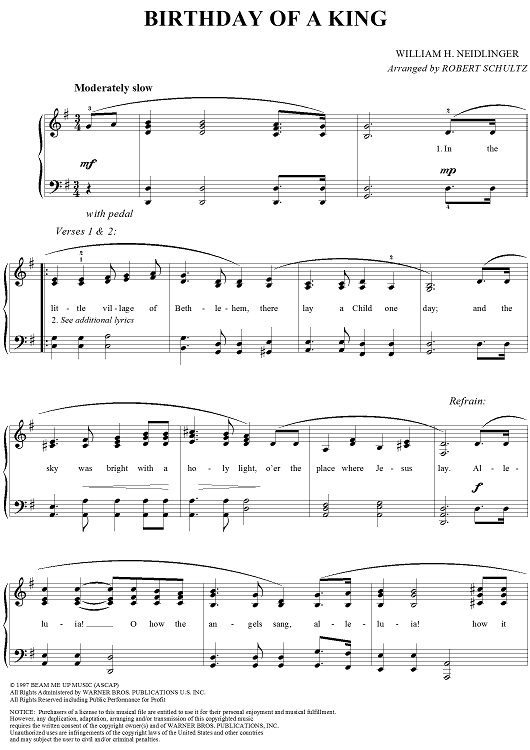
Words and music by William Harold Neidlinger (1863-1924), circa 1890.  Neidlinger was a composer, conductor, organist at St. Michael’s Church, New York City, and voice teacher, but his main interest was working with retarded children, and he founded a school for this purpose in East Orange, N.J. Originally published in 1912 in Neidlinger’s native Brooklyn, the song has been popular ever since, particularly as a baritone solo, since it shows off the voice quite well and is not difficult to sing.

1. In the little village of Bethlehem,
There lay a Child one day;
And the sky was bright with a holy light
Over the place where Jesus lay.

Refrain
Alleluia! O how the angels sang.
Alleluia! How it rang!
And the sky was bright with a holy light
‘Twas the birthday of a King.

2. ‘Twas a humble birthplace,
But O how much God gave to us that day,
From the manger bed what a path has led,
What a perfect, holy way. Refrain

Beautiful song of God’s love for His creation.
Done beautifully by The Brooklyn Tabernacle Choir.

Christmas Music, Part 17 – Good King Wenceslas

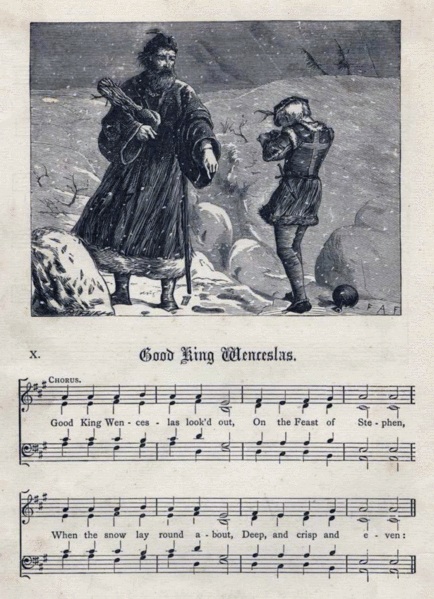
Good King Wenceslas

“Good King Wenceslas” is a popular Christmas carol that tells a story of Good King Wenceslas braving harsh winter weather to give alms to a poor peasant on the Feast of Stephen (the second day of Christmas, December 26). During the journey, his page is about to give up the struggle against the cold weather, but is enabled to continue by following the king’s footprints, step for step, through the deep snow. The legend is based on the life of the historical Saint Wenceslaus I, Duke of Bohemia or Svatý Václav in Czech (907–935).

In 1853, English hymnwriter John Mason Neale wrote the “Wenceslas” lyrics, in collaboration with his music editor Thomas Helmore, and the carol first appeared in Carols for Christmas-Tide, 1853. Neales’ lyrics were set to a tune based on a 13th century spring carol “Tempus adest floridum” (“The time is near for flowering”) first published in the 1582 Finnish song collection Piae Cantiones.

Good King Wenceslas looked out
On the feast of Stephen
When the snow lay round about
Deep and crisp and even
Brightly shone the moon that night
Though the frost was cruel
When a poor man came in sight
Gath’ring winter fuel

“Hither, page, and stand by me
If thou know’st it, telling
Yonder peasant, who is he?
Where and what his dwelling?”
“Sire, he lives a good league hence
Underneath the mountain
Right against the forest fence
By Saint Agnes’ fountain.”

“Bring me flesh and bring me wine
Bring me pine logs hither
Thou and I will see him dine
When we bear him thither.”
Page and monarch forth they went
Forth they went together
Through the rude wind’s wild lament
And the bitter weather

“Sire, the night is darker now
And the wind blows stronger
Fails my heart, I know not how,
I can go no longer.”
“Mark my foteps, my good page
Tread thou in them boldly
Thou shalt find the winter’s rage
Freeze thy blood less coldly.”

In his master’s steps he trod
Where the snow lay dinted
Heat was in the very sod
Which the Saint had printed
Therefore, Christian men, be sure
Wealth or rank possessing
Ye who now will bless the poor
Shall yourselves find blessing

A traditional choir:

Jane Seymour and the Mormon Tabernacle Choir:

The Mannheim Steamroller version:

Christmas Music, Part 16 – We Three Kings

we-three

“We Three Kings”, also known as “We Three Kings of Orient Are” or “The Quest of the Magi”, is a Christmas carol written by the Reverend John Henry Hopkins, Jr., who wrote both the lyrics and the music.

we-three-sheet-white


We three kings of Orient are
Bearing gifts we traverse afar
Field and fountain, moor and mountain
Following yonder star

O Star of wonder, star of night
Star with royal beauty bright
Westward leading, still proceeding
Guide us to thy Perfect Light

Born a King on Bethlehem’s plain
Gold I bring to crown Him again
King forever, ceasing never
Over us all to reign

O Star of wonder, star of night
Star with royal beauty bright
Westward leading, still proceeding
Guide us to Thy perfect light

Frankincense to offer have I
Incense owns a Deity nigh
Prayer and praising, all men raising
Worship Him, God most high

O Star of wonder, star of night
Star with royal beauty bright
Westward leading, still proceeding
Guide us to Thy perfect light

Myrrh is mine, its bitter perfume
Breathes of life of gathering gloom
Sorrowing, sighing, bleeding, dying
Sealed in the stone-cold tomb

O Star of wonder, star of night
Star with royal beauty bright
Westward leading, still proceeding
Guide us to Thy perfect light

Glorious now behold Him arise
King and God and Sacrifice
Alleluia, Alleluia
Earth to heav’n replies

O Star of wonder, star of night
Star with royal beauty bright
Westward leading, still proceeding
Guide us to Thy perfect light

From Mannheim Steamroller, Chip Davis gives this song an “Arabian Nights” feel. A classic song that tells the story of the Gentiles who were quicker to recognize the significance of Christ’s birth than were His own people. Enjoy, and Merry Christmas!

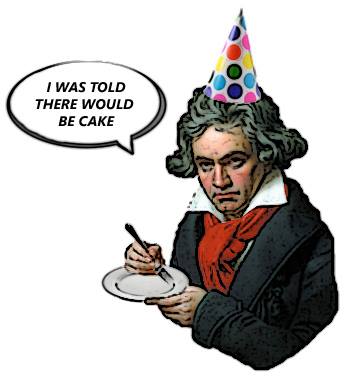
If composers had Facebook: Beethoven’s profile

beethoven-birthday

He used the # in unusual places before Twitter… but how would Beethoven have used Facebook? And what would his profile look like? From his likes and dislikes to his friends and love interests, we’ve imagined what the composer might have posted online throughout his life.

beethovens-facebook

via If composers had Facebook: Beethoven’s profile.

Christmas Music, Part 15 – The First Noel

first-noel

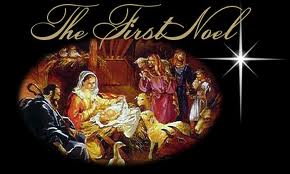
The First Nowell (also written The First Noël) is a traditional classical English carol, most likely from the 18th century, although possibly earlier.

The word Noel comes from the French word Noël meaning “Christmas”, from the Latin word natalis “birthday”.

The melody is unusual among English folk melodies in that it consists of one musical phrase repeated twice, followed by a refrain which is a variation on that phrase. All three phrases end on the third of the scale.

The first Noel the angel did say
Was to certain poor shepherds in fields as they lay;
In fields where they lay tending their sheep,
On a cold winter’s night that was so deep.

Refrain

Noel, Noel, Noel, Noel,
Born is the King of Israel.

They lookèd up and saw a star
Shining in the east, beyond them far;
And to the earth it gave great light,
And so it continued both day and night.

Refrain

And by the light of that same star
Three Wise Men came from country far;
To seek for a King was their intent,
And to follow the star wherever it went.

Refrain

This star drew nigh to the northwest,
Over Bethlehem it took its rest;
And there it did both stop and stay,
Right over the place where Jesus lay.

Refrain

Then did they know assuredly
Within that house the King did lie;
One entered it them for to see,
And found the Babe in poverty.

Refrain

Then entered in those Wise Men three,
Full reverently upon the knee,
And offered there, in His presence,
Their gold and myrrh and frankincense.

Refrain

Between an ox stall and an ass,
This Child truly there He was;
For want of clothing they did Him lay
All in a manger, among the hay.

Refrain

Then let us all with one accord
Sing praises to our heavenly Lord;
That hath made Heaven and earth of naught,
And with His blood mankind hath bought.

Refrain

If we in our time shall do well,
We shall be free from death and hell;
For God hath prepared for us all
A resting place in general.

Refrain

first-noel-sheet-white


The University of Utah Singers perform “The First Noel” arr. by Dan Forrest live in concert, December 11th & 12th, 2009 in Libby Gardner concert hall under the direction of Dr. Brady Allred.