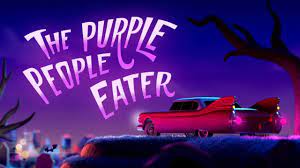
Parents might remember this one – or their grandparents! No one else has captured a monster quite so groovy as the one-eyed, one-horned, flying purple people eater. This is available for students to play in the Halloween Songbook (Easy Piano).
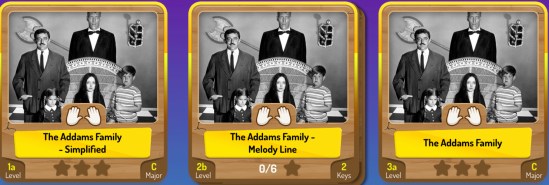
Students always find this piece fun with its finger snaps. There are three versions in Piano Maestro and it’s in several piano books including Halloween Songbook (Easy Piano). There was a a new Addams Family animated movie out in 2019, so your students are going to be snapping all over the place when this Halloween rolls around.
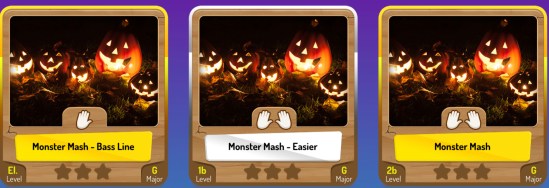
The Monster Mash by Bobby “Boris” Pickett is in Piano Maestro with 3 different levels to play. The song was released as a single in August 1962 along with a full-length LP (record) called The Original Monster Mash, which contained several other monster-themed tunes. The “Monster Mash” single was #1 on the Billboard Hot 100 chart on October 20–27 of that year, just before Halloween. It has been a perennial Halloween favorite ever since.
Jelly Roll Morton, born Ferdinand Joseph La Menthe in 1885, was one of the most influential composers of the jazz era, bridging an important gap between ragtime, blues, and jazz. In a sense, he was the first great jazz composer.
His career began in New Orleans, where he began to experiment with a unique blend of blues, ragtime, Creole, and Spanish music in bordellos as a piano player. Along with being a musician, he also worked as a gambler, pool shark, vaudeville comedian, and was known for his flamboyant personality and diamond front tooth.
Morton became successful when he started making what would be some of the first jazz recordings in 1923 with “the New Orleans Rhythm Kings”. Whether he played on the West Coast, New Orleans, or in Chicago, his recordings were always very popular. He joined the group “the Red Hot Peppers” in 1924 and made several classic albums with the Victor label.
Nothing but success came to him until 1930, when “Hot Jazz” began to die out, and big bands began to take over. Morton died in 1941, claiming that a voodoo spell was the cause of his demise.
Eugene Bertram “Gene” Krupa lived from January 15, 1909 to October 16, 1973. He was an American jazz and big band drummer, actor and composer, known for his highly energetic and flamboyant style.
One of my all-time favorite non-piano songs is Sing Sing Sing. Krupa joined Benny Goodman’s band in 1934, where his featured drum work made him a national celebrity. His tom-tom interludes on their hit “Sing, Sing, Sing” were the first extended drum solos to be recorded commercially.
The Benny Goodman big band playing Sing Sing Sing, featuring Gene Krupa at the end. We get the added benefit of hearing Mr. Harry James play a trumpet solo.
In Scotland, and many countries with Scottish connections, St Andrew’s Day is marked with a celebration of Scottish culture with traditional Scottish food, music and dance. Schools across Scotland hold special St Andrew’s Day events and activities including art shows, Scottish country dancing, lunchtime Ceilidhs, dance festivals, storytelling, reciting and writing poems, writing tall tales, cooking traditional Scottish meals, and bagpipe-playing.
The day is also seen as the start of a season of Scottish winter festivals encompassing St Andrew’s Day, Hogmanay and Burns Night.
In Edinburgh, there is a week of celebrations, concentrating on musical entertainment and traditional ceilidh dancing. A ceilidh is a social event with couples dancing in circles or sets (groups of eight people).
In Glasgow city centre, a large shindig, or party, with traditional music and a ceilidh are held. In Dumfries, songs are performed in the Burn’s night tradition.
In Barbados Saint Andrew’s Day is celebrated as the national day of Independence in Barbados. As the patron saint of Barbados, Saint Andrew is celebrated in a number of Barbadian symbols including the cross formation of the Barbadian Coat of Arms, and the country’s national honours system which styles persons as Knights or Dames of St. Andrew.
. 1787 ~ Franz Gruber, composer of Silent Night. The song was first performed on Christmas Eve 1818 at St Nicholas parish church in Oberndorf, a village in present-day Austria. A young priest, Father Joseph Mohr, had come to Oberndorf the year before. He had written the lyrics of the song “Stille Nacht” in 1816.
The melody was composed by Franz Xaver Gruber, schoolmaster and organist in the nearby village of Arnsdorf. Before Christmas Eve, Mohr brought the words to Gruber and asked him to compose a melody and guitar accompaniment for the Christmas Eve mass. It is unknown what inspired Mohr to write the lyrics, or what prompted him to create a new carol.
. 1896 ~ Virgil Thomson, American composer, conductor and music critic
Read quotes by and about Thomson
More information about Thomson
. 1924 ~ Paul Desmond, was an American jazz alto saxophonist and composer, best known for the work he did in the Dave Brubeck Quartet and for composing that group’s greatest hit, “Take Five”.
. 1925 ~ Derroll Adams, Country singer, played with Jack Elliott
. 1931 ~ Nat Adderley, Musician, cornet, mellophone, French horn, trumpet, brother of Cannonball Adderley
. 1941 ~ Percy Sledge, Singer
. 1949 ~ Rudolph, the Red-Nosed Reindeer, by Johnnie Marks, appeared on the music charts and became THE musical hit of the Christmas season. Although Gene Autry’s rendition is the most popular, 80 different versions of the song have been recorded, with nearly 20,000,000 copies sold.
. 1955 ~ Following a summer at the top of the American pop charts, Rock Around the Clock by Bill Haley and His Comets became the #1 song in Great Britain.
Pender’s Annual Trunk or Treat is returning bigger and better than ever!
Get ready for some fall fun! Join us for the Pender Fall Festival on October 19, from 2-4 pm in the church parking lot.
Here’s what’s in store:
Trunk or Treat – Wear your costumes and collect tons of candy! (Hint – adults can dress up, too) S’mores Station– Snack on ooey-gooey s’mores! Karaoke Station – Show off your singing skills with your favorite tunes! Estimation Station – Test your guessing skills and see how close you get!
Bring your family, friends, and all your fall vibes for an afternoon of fun! You won’t want to miss it!