Night on Bald Mountain refers to a series of compositions by Modest Mussorgsky (1839–1881). Inspired by Russian literary works and legend, Mussorgsky composed a “musical picture”, St. John’s Eve on Bald Mountain on the theme of a witches’ sabbath occurring on St. John’s Eve, which he completed on that very night, June 23, in 1867.
Get a free copy of the sheet music at IMSLP or buy it on amazon.com. There is also an easy version on amazon, with all the note names written in.
Interestingly, the original piece composed by Mussorgsky is not the version you typically hear. That was only published in 1968 and is performed very rarely. The piece we have come to know (and hear in places like Walt Disney’s Fantasia is an arrangement by Rimsky-Korsakov.
From Disney’s Fantasia
Piano version transcribed for solo piano by Konstantin Chernov (1865-1937).
The Ludwig Symphony Orchestra, conducted by Maestro Thomas Ludwig
The Funeral March of a Marionette (Marche funèbre d’une marionnette) is a short piece by Charles Gounod. It was written in 1872 for solo piano and orchestrated in 1879. It is perhaps best known as the theme music for the television program Alfred Hitchcock Presents, which originally aired from 1955 to 1965.
In 1871-72, while residing in London, Gounod started to write a suite for piano called “Suite Burlesque”. After completing one movement, the Funeral March of a Marionette, he abandoned the suite and had the single movement published by Goddard & Co. In 1879 he orchestrated the piece. The instrumentation is: piccolo, flute, 2 oboes, 2 clarinets in A, 2 bassoons, 2 horns in D, 2 trumpets in A, 3 trombones, ophicleide, timpani, bass drum, triangle, strings. The work is in the key of D minor, with a central section in D major. Various arrangements by other hands exist.
There is a program underlying the Funeral March of a Marionette: The Marionette has died in a duel. The funeral procession commences (D minor). A central section (D Major) depicts the mourners taking refreshments, before returning to the funeral march (D minor).
The score contains the following inscriptions in appropriate places:
La Marionnette est cassée!!! (The Marionette is broken!!!)
Murmure de regrets de la troupe (Murmurs of regret from the troupe)
Le Cortège (The Procession)
Ici plusieurs des principaux personnages de la troupe s’arrêtent pour sa rafrâichir (Here many of the principal personages stop for refreshments)
Retour a la maison (Return to the house). (Wikipedia)
Download this music in several versions from IMSLP. Click on Arrangements and Transcriptions. There are also some arrangements for piano at the O’Connor Music Studio, including an advanced level. This is arranged for three levels starting with very easy piano in Piano Maestro.
On Alfred Hitchcock:
From Faber Piano Adventures Performance Book Level 3B No.7 (Also available in the OCMS Library):
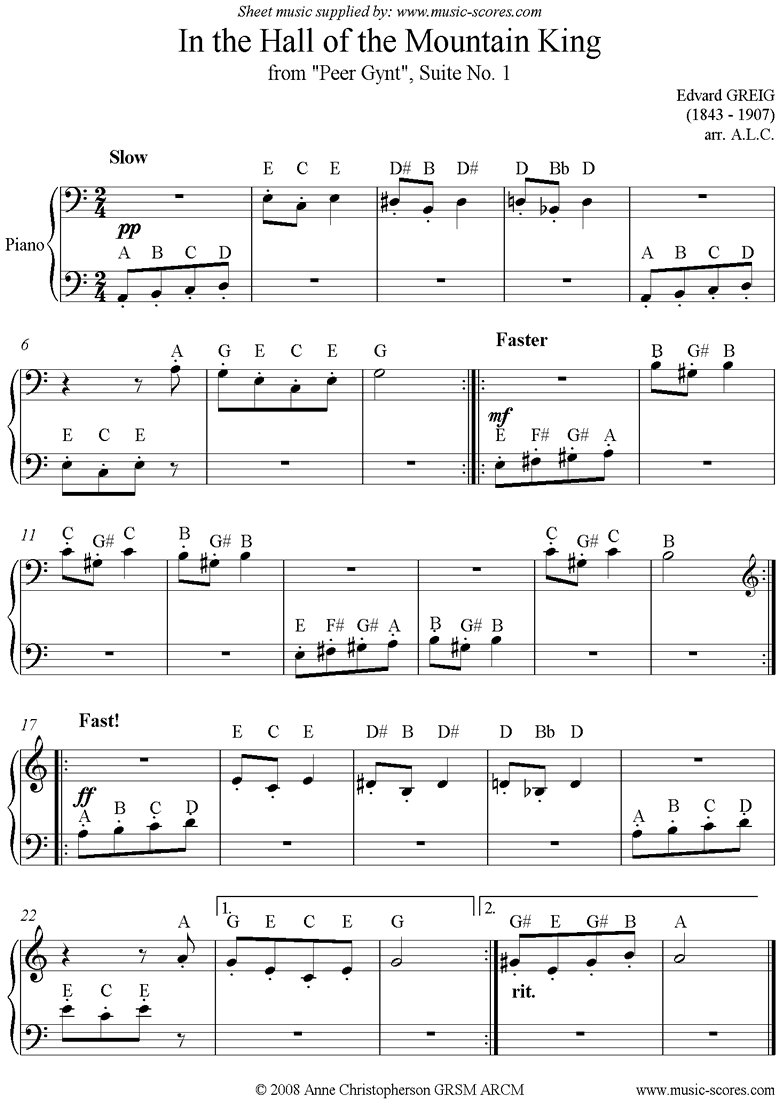
“In the Hall of the Mountain King” is a piece of orchestral music composed for the sixth scene of act 2 in Henrik Ibsen’s 1867 play Peer Gynt by Edvard Grieg. It was originally part of Opus 23 but was later extracted as the final piece of Peer Gynt, Suite No. 1, Op. 46. Its easily recognizable theme has helped it attain iconic status in popular culture, where it has been arranged by many artists, including for the piano.
The translation of the title of this piece from Norwegian isn’t quite literally “mountain king”. The “king” in this instance is actually a troll that Peer Gynt invents in a fantasy. The introduction of this movement is, “There is a great crowd of troll courtiers, gnomes and goblins. Dovregubben sits on his throne, with crown and sceptre, surrounded by his children and relatives. Peer Gynt stands before him. There is a tremendous uproar in the hall.”
Borrow a copy of the sheet music from the O’Connor Music Studio. I have this arranged for piano, duet, 2-piano, simplified…
8 part vocal orchestra (plus a tiny pair of cymbals)
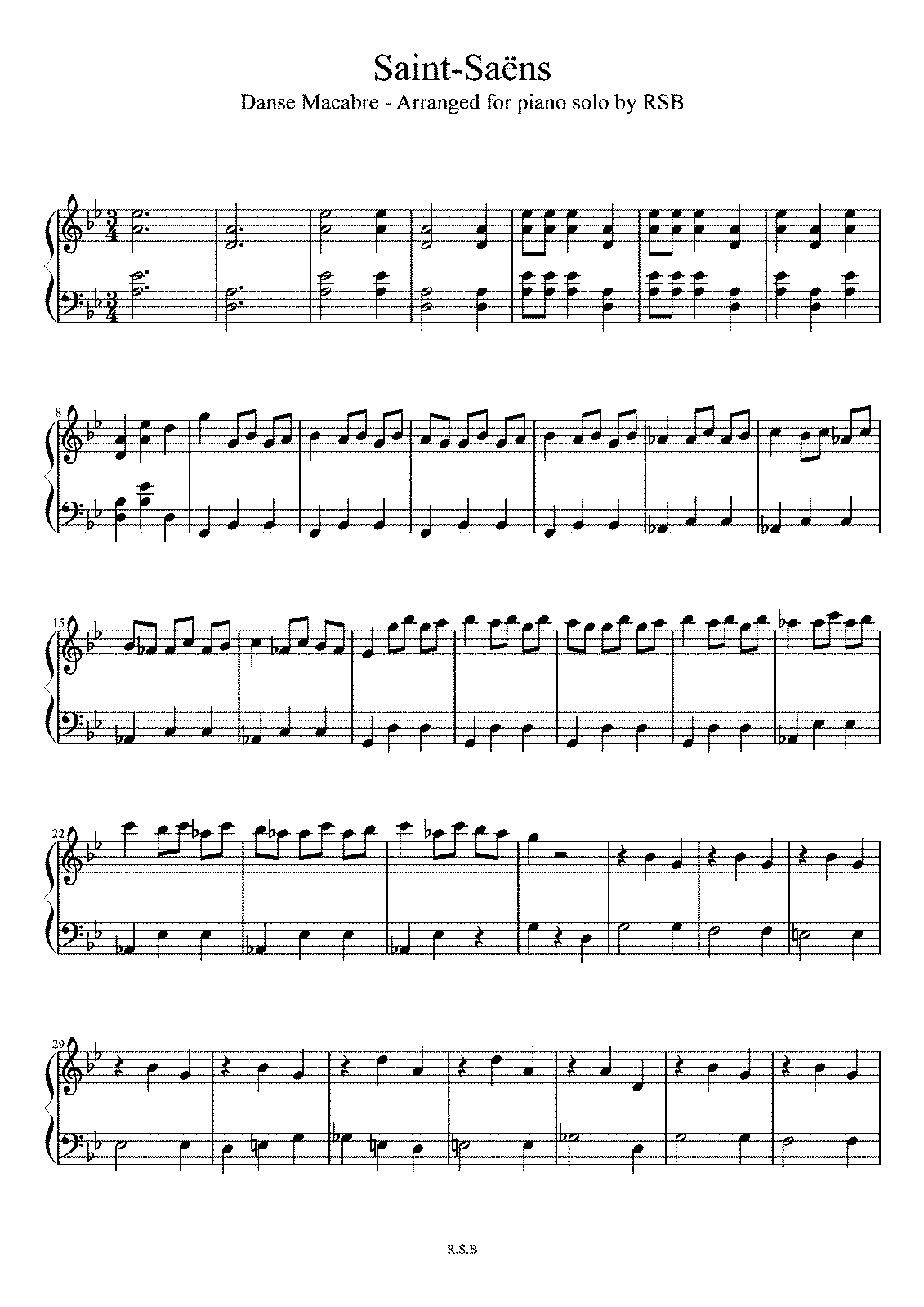
Danse macabre, Op. 40, is a tone poem for orchestra, written in 1874 by French composer Camille Saint-Saëns. It started out in 1872 as an art song for voice and piano with a French text by the poet Henri Cazalis, which is based on an old French superstition. In 1874, the composer expanded and reworked the piece into a tone poem, replacing the vocal line with a solo violin.
With a title that includes the word “macabre”, you can tell it’s a great piece for Halloween. This is by far the most famous work associated with the holiday, and with good reason. It is a tone poem inspired by a French legend that says “Death” appears at midnight on Halloween to call forth the dead from their graves to dance for him. He plays the fiddle while skeletons dance until dawn.
Get a free copy of the sheet music at IMSLP (Look for Arrangements and Transcriptions) or borrow a copy from the O’Connor Music Studio. I have this arranged for organ, piano, duet, simplified…
Amazon has a great Dover edition for solo piano. This splendid compilation features a variety of the composer’s best piano works, all reproduced from authoritative sources. Taking its title from the popular orchestral work “Danse Macabre” (presented here in the brilliant arrangement by Liszt), this collection also includes “Allegro appassionato,” “Album” (consisting of six pieces), “Rhapsodie d’Auvergne,” “Theme and Variations,” plus six etudes, three waltzes, and six etudes for left hand alone.
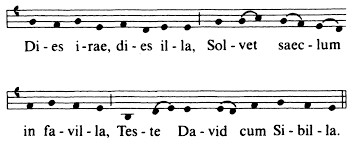
Although not technically a “halloween piece” this very old Gregorian Chant (from the 300s!) is used in a lot of music that sounds spooky. Dies Irae is a Latin term that means “Day of Wrath”.
The words of Dies irae have often been set to music as part of a Requiem service. In some settings, it is broken up into several movements; in such cases, Dies irae refers only to the first of these movements.
The traditional Gregorian melody has been used as a theme or musical quotation in many classical compositions, film scores, and popular works, including:
Marc-Antoine Charpentier – Prose des morts – Dies irae H. 12 (1670)
Thomas Adès – Totentanz
Charles-Valentin Alkan – Souvenirs: Trois morceaux dans le genre pathétique, Op. 15 (No. 3: Morte)
Franz Liszt was born in Raiding, near Ödenburg, October 22, 1811 and died in Bayreuth, July 31, 1886. He was a Hungarian composer and pianist who was a major influence during the romantic period. Liszt was an outstanding pianist at seven, composed at eight and made concert appearances at nine. In addition to being a piano virtuoso, he was also a critic, conductor, city music director, literary writer and transcriber of the works of other composers. He transcribed Beethoven’s Symphonies for the piano.
Franz Liszt began his career as the outstanding concert pianist of the century, who, along with the prodigious violinist Niccoló Paganini (1782-1840), created the cult of the modern instrumental virtuoso. To show off his phenomenal and unprecedented technique, Liszt composed a great deal of music designed specifically for this purpose, resulting in a vast amount of piano literature laden with dazzling, and other technical marvels. In this vein, Liszt composed a series of virtuosic rhapsodies on Hungarian gypsy melodies, the best-known being the all too familiar Hungarian Rhapsody no. 2. Liszt developed the rhapsody as a form of serious music. This kind of music is worlds apart from the generally more introspective, poetic music of pianist-composer Frédéric Chopin.
Liszt was wildly handsome and hugely talented. He was extremely popular in Paris during the 1830’s. It is said that women actually fainted at his piano recitals. He was the first to position the piano so that its lid reflected the sound and the audience could see his profile as he performed.
Liszt was the first to write a tone poem, which is an extended, single-movement work for orchestra, inspired by paintings, plays, poems or other literary or visual works, and attempting to convey the ideas expressed in those media through music. Such a work is Les Préludes, based on a poem in which life is expressed as a series of struggles, passions, and mysteries, all serving as a mere prelude to . . .what? The Romantic genre of the symphonic poem, as well as its cousin the concert overture, became very attractive to many later composers, including Saint-Saëns, Tchaikovsky, Dvorák, Sibelius, and Richard Strauss.
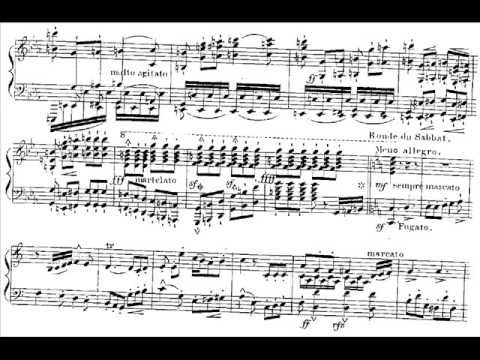
Listen to Liszt’s transcription of Meyerbeer’s Hellish Waltz from Robert du Diable, which probably caused more public commotion than any other piano piece in history.
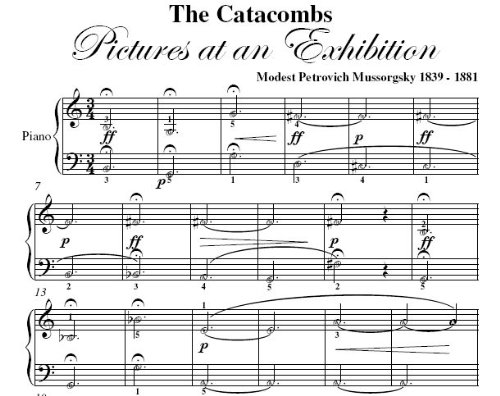
Modest Mussorgsky composed this multi-movement work in memory of his friend, artist Viktor Hartmann. Each movement corresponds to a picture in Hartmann’s gallery, with one pairing with Hartmann’s Paris catacombs. The painting depicts Hartmann and two other men walking through the labyrinthine catacombs, illuminated only by lamplight.
The movement is in two distinct parts. Its two sections consist of a nearly static Largo consisting of a sequence of block chords with elegiac lines adding a touch of melancholy and a more flowing, gloomy Andante that introduces the Promenade theme into the scene.
The first section’s alternating loud and soft chords evoke the grandeur, stillness, and echo of the catacombs. The second section suggests a merging of observer and scene as the observer descends into the catacombs. Mussorgsky’s manuscript of “Catacombs” (shown right) displays two pencilled notes, in Russian: “NB – Latin text: With the dead in a dead language” and, along the right margin, “Well may it be in Latin! The creative spirit of the dead Hartmann leads me towards the skulls, invokes them; the skulls begin to glow softly.”
The final movement is the best known part of the symphony, thanks to its use in the Julia Roberts movie, Sleeping With The Enemy. It features a four-part structure, which Hector Berlioz described in his own program notes from 1845 as follows:
“He sees himself at a witches’ Sabbath, in the midst of a hideous gathering of shades, sorcerers and monsters of every kind who have come together for his funeral. Strange sounds, groans, outbursts of laughter; distant shouts which seem to be answered by more shouts. The beloved melody appears once more, but has now lost its noble and shy character; it is now no more than a vulgar dance tune, trivial and grotesque: it is she who is coming to the Sabbath… Roar of delight at her arrival… She joins the diabolical orgy… The funeral knell tolls, burlesque parody of the Dies irae, the dance of the witches. The dance of the witches combined with the Dies irae.”
The Dies irae melody is one of the most-quoted in musical literature, appearing in the works of many diverse composers.
The traditional Gregorian melody has also been used as a theme or musical quotation in a number of classical compositions, notable among them:
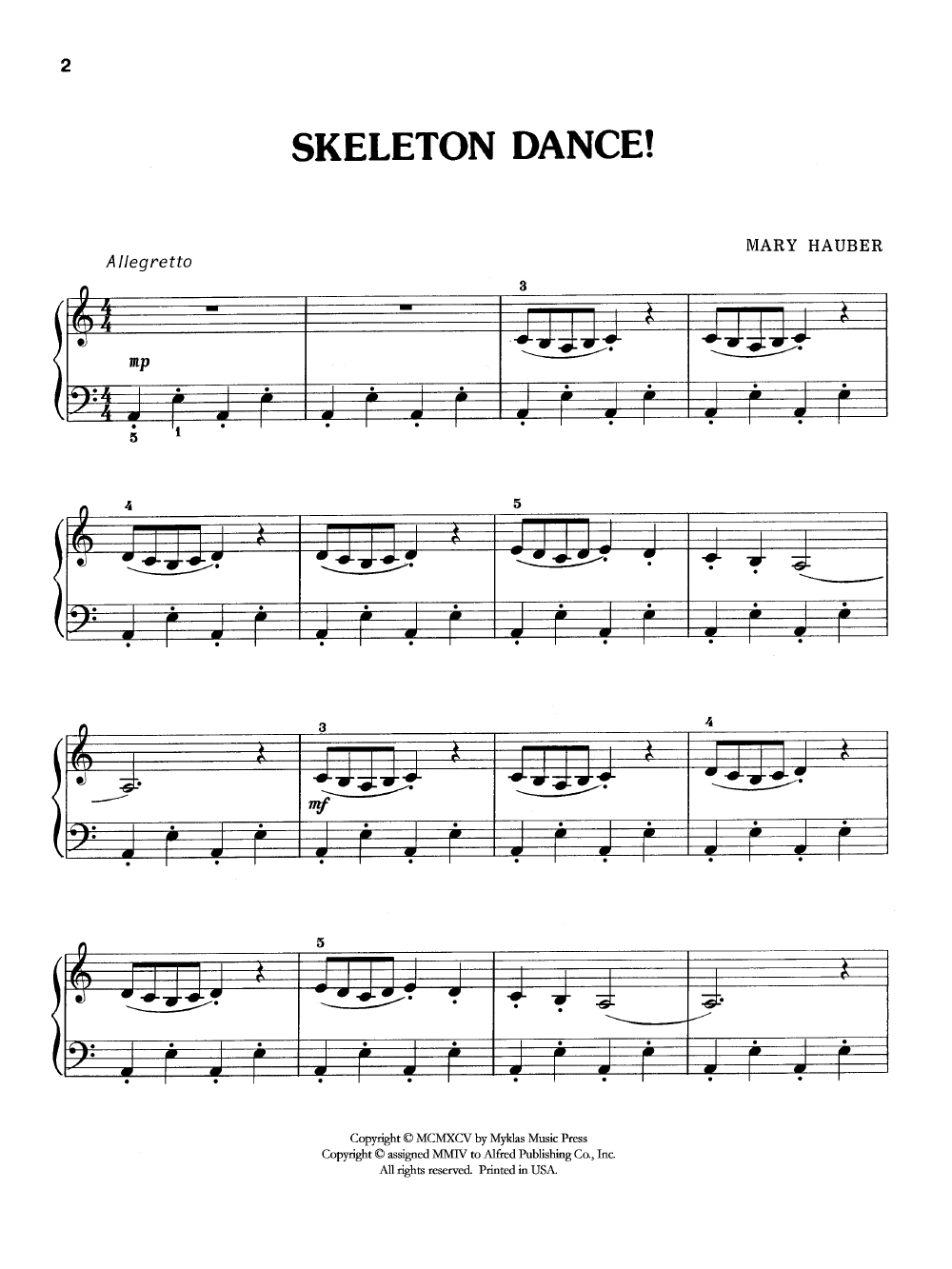
The Skeleton Dance’ comes from a 1929 Disney short film called Silly Symphony, and it’s a perfect example of classical music at its most creative. The light-hearted music scores the dancing skeletons’ movements with various percussion instruments – and one of the skeletons themselves even gets used as a glockenspiel.
As we hear the chimes at midnight and bats flutter from a belfry; as a hound howls at the full moon and black cats brawl on the tombstones; Through the gloom, white skeletons pass, Running and leaping in their shrouds!
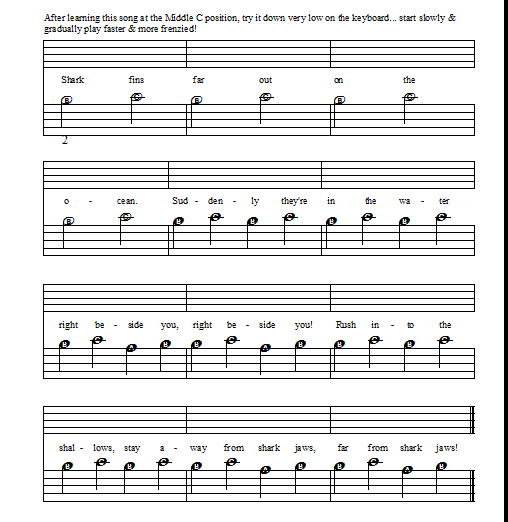
Nearly everyone can figure out the first 2 notes to this spooky piece – just play the B and C notes really low on your keyboard! It doesn’t seem logical that just two notes could cause such a sense of foreboding, but John Williams managed it. His soundtrack to Spielberg’s Jaws has been keeping people out of the sea since 1975. This piece is available in Halloween Favorites (Big-note Piano) and many others.
John Williams conducts his theme from Jaws with the Boston Pops Orchestra at Tanglewood.



 ‘
‘