On July 15 ~ in Music History

today


Be sure your student reads and listens to Today’s Daily Listening Assignment


• 1738 ~ Antonio Maria Pacchioni, Composer, died at the age of 84

• 1779 ~ Clement Moore, Lyricist, author of ’Twas the Night before Christmas (A Visit from St. Nicholas) born

• 1782 ~ Farinelli, Italian singer, died at the age of 77

• 1782 ~ Richard Wainwright, Composer, died at the age of 33

• 1789 ~ Jacques Duphly, Composer, died at the age of 74

• 1795 ~ Marseillaise became the French national anthem

• 1798 ~ Gaetano Pugnani, Composer, died at the age of 66

• 1810 ~ Jean-Baptiste Rey, Composer, died at the age of 75

• 1854 ~ Wincenty Studzinski, Composer, died at the age of 39

• 1857 ~ Carl Czerny, Austrian pianist and Composer, died at the age of 66
More information on Czerny

• 1905 ~ Dorothy Fields born, Composer, lyricist with Cy Coleman of Sweet Charity and Seesaw; with Jimmy McHugh – I Can’t Give You Anything But Love, I’m in the Mood for Love and On the Sunny Side of the Street. She was the daughter of comedian Lew Fields

• 1913 ~ Cowboy (Lloyd) Copas born. He was a country singer who was killed in a plane crash with singer, Patsy Cline

• 1915 ~ Ludwik Grossman, Composer, died at the age of 80

• 1929 ~ Hugo von Hofmannstahl, Austrian author and librettist, died. He was best known for his collaboration with composer Richard Strauss for whom he wrote the libretto to the opera “Der Rosenkavelier.”

• 1930 ~ Leopold von Auer, Hungarian-American violinist, died

• 1933 ~ Julian Bream, British guitarist and lutenist

• 1934 ~ Harrison Birtwistle, British composer

• 1940 ~ Tommy Dee (Thomas Donaldson) Singer and record company executive

• 1942 ~ Glenn Miller and his band recorded the classic Jukebox Saturday Night for Victor Records.


• 1944 ~ Millie Jackson, Rhythm and Blues Singer

• 1945 ~ Peter Lewis, Guitarist, singer with Moby Grape

• 1946 ~ Linda Ronstadt, American singer of rock and popular music

• 1949 ~ “Miss Liberty” opened at Imperial Theater New York City for 308 performances

• 1952 ~ Singer Patti Page made her TV debut in a summer replacement series for Perry Como. The 15-minute program spotlighted Patti three times each week on CBS.

• 1959 ~ Ernest Bloch, Swiss-American Composer, died at the age of 78
More information about Bloch

• 1960 ~ Lawrence Mervil Tibbett, baritone, died after surgery at 63

• 1966 ~ Singer Percy Sledge earned a gold record for When a Man Loves A Woman. It was his only song to make it to number one (5/28/66) and the only one of five to break into the top ten.

• 1967 ~ “Sweet Charity” closed at Palace Theater New York City after 608 performances

• 1972 ~ Elton John landed at the top spot on the Billboard album chart for the first time as Honky Chateau made it to the top for a five-week stay.

• 1978 ~ Bob Dylan performed before the largest open-air concert audience (for a single artist). Some 200,000 fans turned out to hear Dylan at Blackbushe Airport in England.

• 1980 ~ Henri Martelli, Composer, died at the age of 85

• 1982 ~ Bill (William E.) Justis (Jr.) passed away

• 1983 ~ Linda Ronstadt debuted as Mabel “Pirates of Penzance”

• 1984 ~ John Lennon released I’m Stepping Out

• 2000 ~ Canadian baritone Louis Quilico, who sang many of the most famous opera roles, died after complications from surgery. He was 75.

• 2000 ~ Singer Paul Young, who found fame with the band Mike and the Mechanics, died from what might have been a heart attack at the age of 53. The band just finished recording their fifth album and had planned to tour Europe this month.

• 2001 ~ Denes Koromzay, a violist who helped found the Hungarian String Quartet, died at the age of 88. Koromzay studied at the Franz Liszt Academy in Budapest when composer Béla Bartók was on the faculty. Though trained as a violinist, Koromzay was the violist in the group that founded the Hungarian String Quartet in 1935. He remained with the famed ensemble until it disbanded in 1972. For the next seven years, he performed with the New Hungarian Quartet, an ensemble at Oberlin Conservatory in Ohio. Koromzay moved to Boulder in 1962, when the Hungarian String Quartet was named resident ensemble at the University of Colorado. He returned to the university to teach viola and coach chamber music in 1980. He retired from the school in 1996.

July 15, 2019 ~ Daily Listening Assignment


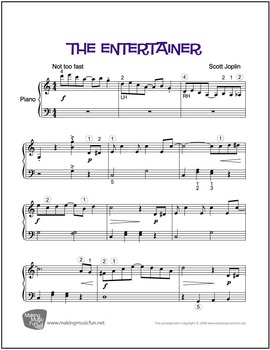
“The Entertainer” is a 1902 classic piano rag written by Scott Joplin. It was sold first as sheet music, and in the 1910s as piano rolls that would play on player pianos.

It was used as the theme music for the 1973 Oscar-winning film The Sting by composer and pianist Marvin Hamlisch.
The Sting was set in the 1930s, a full generation after the end of ragtime’s mainstream popularity, thus giving the inaccurate impression that ragtime music was popular at that time.

Find the sheet music in a variety of levels including Songs I Love to Play, Volume 1 and Alfred Premier Piano Course Book 4.  It’s also available in Piano Maestro and to borrow from the O’Connor Music Studio


As played in The Sting


Adam Swanson


Piano Duet

On an older piano


At Disney


Player piano

Harder than it needs to be

From a 4-year-old

Violin and piano


String Quartet

On guitar


Saxophone quartet

Miss Piggy sang The Entertainer

And, everyone’s favorite – the ice cream truck!

On July 14 ~ in Music History

today


Be sure your student reads and listens to Today’s Daily Listening Assignment


• 1789 ~Bastille Day (France)  This was the day the French Revolution began — at the fall of the Bastille. It is still celebrated in many countries throughout the world and is a public holiday in France; generally called Bastille Day or Fete National. It is considered the day freedom was born in France.


• 1682 ~ Henry Purcell appointed organist of Chapel Royal, London
More information about Purcell

• 1707 ~ Jacques-Philippe Lamoninary, Composer

• 1788 ~ Johann Gottfried Muthel, Composer, died at the age of 60

• 1803 ~ Esteban Salas y Castro, Composer, died

• 1839 ~ Edward Sydney Smith, Composer

• 1844 ~ Oscar Beringer, Pianist

• 1854 ~ Alexander Alexandrovich Kopilov, Composer

• 1855 ~ Richard Samuel Hughes, Composer

• 1873 ~ Ferdinand David, Dutch violinist and composer, died at the age of 63

• 1883 ~ Alexandru Zirra, Composer

• 1895 ~ Alexander Ewing, Composer, died at the age of 65

• 1901 ~ Gerald Raphael Finzi, British composer

• 1906 ~ Arthur James Bramwell Hutchings, Composer

• 1908 ~ William Mason, Composer, died at the age of 79

• 1910 ~ Peter Stadlen, Pianist, critic

• 1912 ~ Woody (Woodrow Wilson) Guthrie born. He was the ‘father of modern American folk music’, American folk singer, songwriter of more than 1,000 original songs and author and father of folk singer Arlo Guthrie

• 1917 ~ Arthur Leavins, Violinist

• 1922 ~ Peter Andrew Tranchell, Composer

• 1923 ~ Louis Ganne, Composer, died at the age of 61

• 1925 ~ Luis Antonio Escobar, Composer

• 1926 ~ Jan Krenz, Composer

• 1927 ~ Alexander Popov, Bulgarian composer

• 1928 ~ Ole Schmidt, Composer

• 1929 ~ George Alan Dawson, Jazz drummer, teacher

• 1930 ~ Eric Norman Stokes, Composer

• 1930 ~ Polly Bergen, Pop Singer

• 1933 ~ Del (Franklin Delano) Reeves, Singer, guitarist

• 1942 ~ Helen O’Connell and Bob Eberly sang their last duet together as they recorded the famous Brazil with the Jimmy Dorsey band.

• 1945 ~ Peter James Leonard Klatzow, Composer

• 1951 ~ “Courtin’ Time” closed at National Theater New York City after 37 performances

• 1951 ~ “Make a Wish” closed at Winter Garden Theater New York City after 102 performances

• 1952 ~ George Louis Francis Lewis, Composer

• 1956 ~ Jaroslav Ridky, Composer, died at the age of 58

• 1962 ~ Bobby Vinton’s Roses are Red became the top song in the U.S. The song stayed at the top for four weeks and was the first of four #1 hits for Vinton. The others were: Blue Velvet, There! I’ve Said It Again and Mr. Lonely. Roses are Red was also Vinton’s first million-seller. He had two others: I Love How You Love Me (#9 in 1968) and My Melody of Love (#3 in 1974.)

• 1973 ~ Clarence White, Guitarist with the Byrds, killed by a car

• 1973 ~ Phil Everly stormed off stage declaring an end to Everly Brothers

• 1975 ~ Tameka Cottle, Rock Singer

• 1975 ~ Zutty Singleton, American jazz drummer, died at the age of 77

• 1982 ~ George Amadee Tremblay, Composer, died at the age of 71

• 1984 ~ Philippe Wynne, American soul singer, died at the age of 43

• 1986 ~ Paul McCartney released “Press”

• 1996 ~ “How To Succeed Business…” closed at Richard Rodgers New York City after 548 performances

• 1996 ~ “Thousand Clowns” opened at Criterion Theater New York City for 32 performances

• 2001 ~ Norman Singer, a teacher and director of several music organizations in New York City, died at the age of 80. Singer began his career in the arts in 1948 as a psychology and sociology teacher at the Juilliard School. Dance played a major role in programming when Singer served as executive director of the City Center of Music and Drama from 1968 to 1975. He was the executive director of the Chamber Music Society of Lincoln Center from 1975 until his retirement in 1981.

On July 13 ~ in Music History

today


Be sure your student reads and listens to Today’s Daily Listening Assignment


• 1668 ~ Van Marco Cesti’s opera “Il Pomo d’Oro,” premiered in Vienna

• 1813 ~ Johann Friedrich Peter, Composer, died at the age of 67

• 1844 ~ Johann Gansbacher, Composer, died at the age of 66

• 1866 ~ C.C. Birchard, Music Publisher

• 1877 ~ Karl Erb, German tenor

• 1884 ~ John Francis Larchet, Composer

• 1889 ~ Carli Zoeller, Composer, died at the age of 49

• 1891 ~ Franco Casavola, Composer

• 1894 ~ Juventino Rosas, Composer, died at the age of 26

• 1898 ~ Guglielmo Marconi patented the radio

• 1903 ~ August Reissmann, Composer, died at the age of 77

• 1906 ~ Harry Sosnik, American orchestra leader of the Jack Carter Show and Your Hit Parade

• 1909 ~ David Branson, Composer

• 1909 ~ Paul Constantinescu, Composer

• 1909 ~ Washington Castro, Composer

• 1913 ~ Ladislav Holoubek, Composer

• 1915 ~ Paul Williams, Jazz saxophonist and bandleader Williams played with Clarence Dorsey in 1946, and then made his recording debut with King Porter in 1947 for Paradise before forming his own band later that year.

• 1921 ~ Ernest Gold, Composer

• 1921 ~ Charles Scribner Jr, Music publisher

• 1923 ~ Asger Hamerik (Hammerich) German composer, died at the age of 80

• 1924 ~ Carlo Bergonzi, Italian tenor

• 1926 ~ Meyer Kupferman, American composer

• 1928 ~ Donal Michalsky, Composer

• 1932 ~ Per Nørgård, Danish composer
More information about Nørgård

• 1934 ~ Roger Reynolds, Composer

• 1936 ~ Izydor Lotto, Composer, died at the age of 91

• 1939 ~ Frank Sinatra made his recording debut with the Harry James band. Frankie sang Melancholy Mood and From the Bottom of My Heart.

• 1942 ~ Roger McGuinn, Musician, guitarist and vocalist with the Byrds (1965 US & UK No.1 single ‘Mr Tambourine Man’). He was the only member of The Byrds to play on the hit, the others being session players. He toured with Bob Dylan in 1975 and 1976 as part of Dylan’s Rolling Thunder Revue, and later worked with fellow ex-Byrds Gene Clark and Chris Hillman to form “McGuinn, Clark and Hillman”.

• 1951 ~ Arnold Schoenberg, Austrian-born composer, died in Los Angeles; he was best known for his 12-note serial method and his composition Verklaerte Nacht and his opera “Moses und Aaron.”
More information about Schoenberg

• 1942 ~ Stephen Jo Bladd, American drummer with the J Geils Band

• 1954 ~ Louise Mandrell, American country singer with the Mandrell Sisters

• 1958 ~ Karl Erb, German tenor, died on 81st birthday

• 1959 ~ Dedicated to the One I Love, by The Shirelles, was released. The tune went to number 83 on the Top 100 chart of “Billboard” magazine. The song was re-released in 1961 and made it to number three on the charts.

• 1961 ~ Lawrence Donegan, Musician, bass with Lloyd Cole & The Commotions

• 1965 ~ Neil Thrasher, Country Singer

• 1973 ~ Martian Negrea, Composer, died at the age of 80

• 1973 ~ The Everly Brothers called it quits during a concert at the John Wayne Theatre in Buena Park, CA. Phil Everly walked off the stage in the middle of the show and brother Don said, “The Everly Brothers died ten years ago.” The duo reunited a decade later for a short time.

• 1976 ~ Max Butting, Composer, died at the age of 87

• 1978 ~ Antonio Veretti, Composer, died at the age of 78

• 1979 ~ George Harrison released Faster

• 1985 ~ Duran Duran took A View to a Kill, from the James Bond movie of the same name, to the top of the record charts this day. The song stayed on top for two weeks. Live and Let Die by Wings and Nobody Does It Better by Carly Simon — both James Bond themes — got only as high as number two on the record charts.

• 1985 ~ Live Aid, a rock concert masterminded by Bob Geldof, took place in London and Philadelphia and raised over 60 million dollars for famine in Africa.

• 1992 ~ Carla van Neste, Belgian violinist, died at the age of 78

• 1994 ~ Eddie Boyd, Blues vocalist and pianist, died at the age of 79

July 13, 2019 ~ Daily Listening Assignment


Will you be going to the Circus this Summer?

Here’s some information about circus music.

WINDJAMMERS

Circus marches are called “screamers” because they are traditionally so high, loud & fast!! Circus Band members are often called “windjammers” because they jam so much wind into their instruments in the process of playing these screamers. Playing the circus requires incredible endurance & skills on your instrument. The windjammers play almost none stop and much of the music is really difficult!

The greatest circus bands were about 100 years ago in the heyday of the circus. At that time the big top band could be 25 or so, plus there were often sideshow musicians as well. Cowboy bands, women’s bands and bands of Blacks were often part of the sideshows.

Contemporary circuses are much smaller all the way around, and some don’t use live musicians at all, just “canned” music (recordings). Others carry 3 musicians, a drummer, a trumpet player and a keyboard (synthesizer) player. A few, like the Big Apple Circus, still have bands. The Big Apple Circus has 8 musicians on its bandstand: a conductor/trumpet, a person who plays alto sax and clarinet, one who plays tenor sax and flute, a violin, a trombone, a bass player, a keyboard player and a drummer.

In the “old days,” being a circus musician was one of the most strenuous jobs a musician could have. In the days before musicians’ unions, the windjammer would be expected to play for the circus parade, play a pre-show free concert for the townspeople, ballyhoo around the grounds before the big top show, play the show itself (nonstop for two or three hours!), play post-show concerts on the grounds or play sideshows. Then after everyone left, they helped take down the tents or do other chores around the grounds. It was a busy day and the pay was not very good, but it was an exciting life with lots of great music, and many musicians loved it!

THE MUSIC

Entry of the Gladiators (Thunder and Blazes) was written in 1897 by, the Czechoslovakian composer, Julius Fucik (1872-1916). This march is a classic circus march & one that just about everyone will think, “Ah, circus!” when they hear it. Thunder and Blazes (as it is most frequently called) and Fucik’s Florentiner March are probably his most well-known marches.

Most circus marches follow the standard American military march form, but often abbreviated (no repeats in the second half):

  • Introduction (a bit longer than military marches)
  • First strain (repeated)
  • Second strain (repeated)
  • Trio (more mellow and the key changes)
  • Breakup strain (often called the dogfight in military marches)
  • Last strain

In a circus march, the last strain is often the same as the trio, but louder, and often the trio, breakup strain and last strain are not repeated like they are in a military march (in military marches, the trio and breakup strain are often reversed & the way they repeat may vary).

The music sets the scene for the performer’s act. Different music is needed for different kinds of acts: the bareback riders galloping around the hippodrome need a lively tune, the trapeze artists want something more peaceful, and of course the clowns need music that sounds humorous (like trombone smears!).

In the early days of the circus, the band masters would take some of the European classical music and arrange it for the circus band. “The most obvious example would be the beautiful, flowing waltz music that is essential to the trapeze artists (‘flyers’ and ‘catchers’). The bandmaster and musicians must be precise in coordinating the music and the timing of the artists, requiring rehearsal with the artists and the musicians.  Similarly, it may be interesting to note that the bareback riders perform in a smaller ring because of the gait of the horses. The centrifugal effect requires a ring of a certain diameter for timing. Thus, the conductor must follow the gait of the horses, whereas the aerialists depend on the tempo of the music for timing their act.”

Modern circuses also play a lot of popular tunes, jazz and other songs that people will recognize. You will likely hear fewer of the standard circus marches at a circus today.

The drummer has a particularly challenging and important role in the circus music. He/she must “play the tricks.” Usually the drummer is situated so that he can see the ring because it is his job to accent and intensify what is happening in the ring. This was true 100 years ago, and it is true today. If the act is getting tense, the drummer will get intense. If someone slides down a rope or vaults off the trampoline, there will be a cymbal crash or drum hit when the performer reaches the floor. Sometimes the cues come from the conductor or from the ringmaster, but sometimes it is the drummer who is really in charge!

Circus bands occasionally play a John Philip Sousa composition during the traditional Center Ring Concert, but his melodic marches are not the right structure for most circus acts.

Sousa’s Stars and Stripes Forever is never part of the regular program. It is reserved for emergency use – sometimes called the “Disaster March”. If a major problem happens — an animal gets loose, a high wind threatens the tent, or a fire breaks out — the band plays the march as a warning signal to every worker on the circus lot that something is wrong.

(Click here for information on the Hartford fire of 1944)

Charles Nelson Reilly – who grew up to be a famous actor, comedian, director and drama teacher – was attending the Ringling Bros. circus, in Hartford, on the day the big top burned to the ground.  Listen as he recalled his memories of the fire.


For lesser problems, the 12th Street Rag was played to alert the clowns to come out and divert attention during the more common mishaps.

Edward F. Shevlin describes what goes on in the circus band as follows:

“Our music is usually by Karl King,  Alexander, Fred Jewell, C. E. Duble and other old time circus bandmasters and musicians.  Much of the music by these circus musician-composers is amenable to quick cut-offs and tempo changes as necessary to fit particular acts. Hence, Windjammers usually play two musicians to a stand so that when the conductor cuts to a new piece and tempo, one musician can quickly move the music to expose the next piece while the other continues without skipping a beat! We might quickly go from a march to a Samba or rhumba or galop; or from a waltz to an up-tempo march or galop for the “come down” when the aerialists quickly descend into the net or slide down a rope at the conclusion of their act . . .followed by that ubiquitous B-flat chord! The old circus bands would play anything from Ragtime to a Polonaise or a tone poem!”

*Information from an email from Edward F. Shevlin, a Windjammer who happened upon this page! Many thanks, Mr. Shevlin!

THE BANDWAGON

ParadeWagon

When the circus came to town, there was always a circus parade — the parade served to get the wagons filled with people, equipment, baggage, tents and animals to the location of the circus, but it also provided some free advertisement. The wagons were very elaborate & were intended to get people interested in the circus so they would come and see the acts. The band road on top of a bandwagon and inside the bandwagon was luggage, tents and other necessities.

Hey, have you ever heard the term, “jump on the bandwagon”? Here’s the story. In 1848, when Zachary Taylor won the Whig party nomination for president, Dan Rice, a famous clown whose attire inspired the image of Uncle Sam, invited Mr. Taylor to ride on the bandwagon that Dan Rice had. When the bandwagon arrived at the center of town, Dan Rice stopped his parade and made a very emotional speech supporting Zachary Taylor’s candidacy. Someone noted that Dan Rice was on Mr. Taylor’s bandwagon and the term stuck, so that to jump on the bandwagon means to get involved with whatever the issue is. “He jumped on the ecology bandwagon.” “She is definitely on the civil rights bandwagon.”

Below you will find some links to pictures of bandwagons.

PT Barnum’s Bandwagon http://www.vintageviews.org/vv-3/t_land/pages/trl02_002.html

Windjammers in a Bandwagon http://www.circusparade.com/album/albmusic.htm

Pawnee Bill Bandwagon No. 80 http://www.circusparade.com/wagons/w_pawnee.htm

The Columbia Bandwagon– purchased by James Bailey for the Barnum & Bailey Circus — and see this wagon hitched to FORTY horses!!! The picture including the wagon & the band is at the bottom of the page.

The Mirror Bandwagon http://www.circusmodelbuilders.org/twohemis.htm

A clown marching band (Baraboo, WI High School) http://www.circusparade.com/album/albpic22.htm


THE CALLIOPE

Most people pronounce this instrument “cal eye’ o pee”. Circus people pronounce it “cal’ ee ope” (last syllable like “rope”). What is a calliope?? It is a huge instrument made of whistles with a steam engine that blows steam through the whistles when you press the key. Most calliopes are played with a keyboard like a piano keyboard & each key controls one whistle. It is LOUD!!!! Some can be heard up to 3 – 5 miles! Don’t stand too close to one!

The calliope traditionally brought up the rear in a circus parade.

Here is a picture of an early calliope – this one is not on wheels like a circus instrument would be. http://mmd.foxtail.com/Calliope/index.html

Go to this site to see an instrument built recently and see how it works. http://mmd.foxtail.com/Calliope/davis.html


SUPERSTITIONS!

Most performing entities have some superstitions. One of the superstitions in circus bands is that you can not play Franz von Suppe’s Light Cavalry March. Quoting from Mr. Beal’s book:

“To play it on the circus lot means disaster and sudden death.”You may not believe this but most circus folks do, at least those who know the facts. Played once in Oklahoma, a train wreck followed and sixteen were killed. Played again, this time while [Merle] Evans was on tour with Miller Bros. 101 Ranch Wild West, a blowdown followed and 38 fatalities resulted. [A blow down is a wind that destroys all or part of the tents.]

“And the last time Merle played it a cornet player died immediately after the performance. That was enough for Evans. He collected the parts, tied them up in a neat bundle, and dropped them over the nearest bridge…

“From that day to this the music of Suppe’s Light Cavalry march is taboo. Even its presence in the music trunk would be considered a serious menace to the life and safety of the circus musicians.”

A second superstition about the music played is that the only time you can play Home Sweet Home is during the very last performance of the season, the very last song. Otherwise, it could mean the immediate closing of the show.

Information from:
Beal, George Brinton. Through the Back Door of the Circus with George Brinton Beal. Springfield, Massachusetts: McLoughlin Bros., Inc., 1938. p. 1-20.

Some important Windjammers and composers of circus music

Links to other Circus Band Websites

Definitions & Explanations

Screamers – Circus marches are called screamers because they are so loud, fast & often very high!

Windjammers – Circus musicians are often called windjammers because they jam so much wind into their instruments in the process of playing these screamers.

Ballyhooing – The dictionary defines the verb “ballyhoo” as a vigorous attempt to win customers. When not playing, the musicians went around the grounds & the town shouting about the circus & trying to get people to come to see it. Ex: “Come to the circus tonight! See flying trapeze artists and the ….”

Hippodrome – The hippodrome is the track around the inside of the ring where the horses were run.

Trombone Smears – Smear refers both to a trombone technique and to a type of music. The technique (officially called a glissando) where the trombonist pulls the slide in or out without tonguing and you get a smearing sound as the notes move up or down, rather than a distinct set of individual notes. Smear also refers to a type of music that includes and features these smear techniques. These pieces are often used as clown music. Henry Fillmore wrote many trombone smears and they had an African-American minstrel sound to them.

Adapted from http://bandnotes.info/tidbits/circus.htm

On July 12 ~ in Music History

today


Be sure your student reads and listens to Today’s Daily Listening Assignment


• 1633 ~ Simon Besler, Composer, died at the age of 49

• 1757 ~ Christian Danner, Composer

• 1773 ~ Johann Joachim Quantz, German royal flautist and composer, died at the age of 76

• 1801 ~ John Hill Hewitt, Composer

• 1802 ~ Charles-Louis Hanssens, Composer

• 1821 ~ Cesare Dominiceti, Composer

• 1839 ~ Christian Traugott Tag, Composer, died at the age of 62

• 1882 ~ Alfred Humphreys Pease, Composer, died at the age of 44

• 1883 ~ Hermann Zopff, Composer, died at the age of 57

• 1885 ~ George Sainton Kaye Butterworth, Composer

• 1895 ~ Kirsten Flagstad, Norwegian soprano, famed for her performances of Wagner and noted for her noble and easy delivery

• 1895 ~ Oscar (Greeley Clendenning) Hammerstein II, American lyricist for the musical theater
More information about Hammerstein

• 1897 ~ Felix Godefroid, Composer, died at the age of 78

• 1906 ~ Henrique Alves de Mesquita, Composer, died at the age of 70

• 1908 ~ Johan Franco, Composer

• 1920 ~ Paul Foster, Singer

• 1926 ~ Charles Wood, Composer, died at the age of 40

• 1927 ~ Conte (Secondo) Candoli, Trumpeter, bandleader; toured with Stan Kenton

• 1934 ~ Van Cliburn (Harvey Lavan), American piano virtuoso, won the Tchaikovsky Competition in 1958

• 1942 ~ Richard Stolzman, clarinet soloist

• 1943 ~ Christine (Perfect) McVie, Singer with Fleetwood Mac

• 1946 ~ Benjamin Britten’s “Rape of Lucretia,” premiered at Glyndebourne

• 1947 ~ James Melvin Lunceford, American jazz dance-band leader, passed away
More information about Lunceford

• 1949 ~ John Wetton, Bassist, singer with Asia

• 1952 ~ Liz Mitchell, Singer

• 1953 ~ Marie-Alphonse-Nicolas-Joseph Jongen, Belgian composer, died at the age of 79

• 1956 ~ Sandi Patti, Gospel Singer

• 1958 ~ “Li’l Abner” closed at St James Theater New York City after 693 performances

• 1958 ~ Yakety Yak, by The Coasters, became the number one song in America according to Billboard magazine. It was the first stereo record to reach the top of the chart.

• 1962 ~ The Rolling Stones first performance, at the Marquee Club, London. The lineup featured Mick Jagger, Keith Richards, Brian Jones, bass player Dick Taylor and drummer Mick Avory. Taylor and Avory were soon replaced.

• 1970 ~ Blues-Rock singer Janis Joplin’s debut, in Kentucky

• 1979 ~ Kalervo Tuukkanen, Composer, died at the age of 69

• 1979 ~ Minnie Ripperton (Andrea Davis) Singer, died at the age of 30

• 1985 ~ “Singin’ in the Rain” opened at Gershwin Theater New York City for 367 performances

• 1990 ~ Les Miserables opened at National Theatre, Washington

• 1993 ~ Andrew Lloyd Webber’s musical “Sunset Promenade” opened in London

• 1995 ~ Alan David Marks, Pianist and composer, died at the age of 49

• 1995 ~ Earl Coleman, Singer, died at the age of 69

• 1995 ~ Ernie Furtado, Bassist, died at the age of 72

• 1996 ~ Gottfried von Einem, Composer, died at the age of 78

• 1996 ~ Jonathan Melvoin, Keyboardist with Smashing Pumpkins, died

• 2000 ~ Ras Shorty I, who fused calypso with an up-tempo beat that he said represented the true soul of calypso, died of bone cancer. He was 59. He was born Garfield Blackman and started singing calypso as Lord Shorty. Dozens of musicians later adopted his up-tempo “soca” beat, which he called the “Indianization of calypso,” bringing together the music of his Caribbean nation’s two major ethnic groups, descendants of African slaves and of indentured laborers from India.

• 2001 ~ James Bernard, who composed the eerie musical scores for some of Britain’s most famous horror films, died at the age of 75. The British composer was best known for his work with Hammer Film studios, which made low-budget gothic horror films featuring actors Peter Cushing and Christopher Lee. During his nearly 40-year career, Bernard composed scores for “The Curse of Frankenstein” (1957), “Dracula” (1958) and “The Devil Rides Out” (1968). He won an Academy Award, but not for his music. Bernard shared an Oscar in 1951 with Paul Dehn for best motion picture story for “Seven Days to Noon.” His last work was the score for “Universal Horror” in 1998, a documentary of Universal Studios’ horror films of the 1930s and 1940s.

On July 11 ~ in Music History

today


Be sure your student reads and listens to Today’s Daily Listening Assignment


• 1768 ~ Jose Melchior de Nebra Blascu, Composer, died at the age of 66

• 1781 ~ Adolph Carl Kunzen, Composer, died at the age of 60

• 1824 ~ Adolphe-Abraham Samuel, Composer

• 1826 ~ Carl Bernhard Wessely, Composer, died at the age of 57

• 1836 ~ Carlos Gomez, Composer

• 1837 ~ Paul Lacombe, Composer

• 1857 ~ Iacob Moresianu, Composer

• 1861 ~ Anton Stepanovich Arensky, Russian composer of Romantic classical music, a pianist and a professor of music.

• 1862 ~ Liza Nina Mary Frederica Lehmann, Composer

• 1892 ~ Giorgio Federico Ghedini, Composer

• 1897 ~ Blind Lemon Jefferson, Singer

• 1914 ~ Ahti Sonninen, Composer

• 1916 ~ Howard Brubeck, Composer

• 1918 ~ Enrico Caruso bypassed opera for a short time to join the war (WWI) effort. Caruso recorded Over There, the patriotic song written by George M. Cohan.

• 1920 ~ Yul Brynner (Taidje Khan), Academy & Tony Award-winning actor in The King and I

• 1925 ~ Mattiwilda Dobbs, American soprano

• 1925 ~ Nicolai Gedda, Swedish tenor

• 1926 ~ Rodolfo Arizaga, Composer

• 1927 ~ Herbert Blomstedt, American-born Swedish conductor of the Oslo Philharmonic from 1954 until 1961

• 1928 ~ Robert Washburn, Composer

• 1929 ~ Hermann Prey, German baritone

• 1931 ~ Thurston Harris, American vocalist

• 1931 ~ Tab Hunter (Arthur Gelien), Singer

• 1932 ~ Alex Hassilev, American vocalist with the Limeliters

• 1937 ~ George Gershwin, Composer of An American Paris, died at the age of 38
More information about Gershwin

• 1938 ~ Terry Garthwaite, American guitarist and singer

• 1944 ~ Bobby Rice, Singer

• 1945 ~ Debbie Harry, Singer

• 1947 ~ Jeff Hanna, Singer, guitarist with Nitty Gritty Dirt Band

• 1950 ~ Patty Pointer, Singer with Pointer Sisters

• 1950 ~ Timotei Popovici, Composer, died at the age of 79

• 1951 ~ Bonnie Pointer, Singer with Pointer Sisters

• 1957 ~ Peter Murphy, Singer with Bauhaus

• 1959 ~ Richie Sambora, Guitarist

• 1964 ~ 18-year-old Millie Small was riding high on the pop music charts with My Boy Lollipop. Rod Stewart played the harmonica. Millie Small was known as the ’Blue Beat Girl’ in Jamaica, her homeland.

• 1967 ~ Kenny Rogers formed The First Edition just one day after he and members Thelma Camacho, Mike Settle and Terry Williams left The New Christy Minstrels. The First Edition hosted a syndicated TV variety show in 1972.

• 1969 ~ David Bowie released Space Oddity in the UK for the first time. It was timed to coincide with the Apollo moon landing but had to be re-released before it became a hit, later in the year in the UK (but not until 1973 in the US).

• 1969 ~ Rolling Stones released Honky Tonk Woman

• 1973 ~ Alexander Vasilyevich Mosolov, Russian Composer, died at the age of 72

• 1980 ~ Boleslaw Woytowicz, Composer, died at the age of 80

• 1984 ~ Karel Mengelberg, Composer, died at the age of 81

• 1993 ~ Mario Bauza, Cuban/American jazz musician ~ died at the age of 82

• 1994 ~ Charles “Lefty” Edwards, Saxophonist, died at the age of 67

• 1994 ~ Lex P Humphries, Drummer, died at the age of 57

• 1996 ~ Louis Gottlieb, Musician, died at the age of 72

• 1999 ~ Big band jazz singer Helen Forrest died

• 2001 ~ Herman Brood, an artist and musician in the Dutch rock scene for 30 years, died at the age of 55. Brood became a sensation with his 1978 hit single Saturday Night, which he wrote as leader of the band Wild Romance. Over 25 years, he recorded nearly 20 albums. He also appeared in Dutch movies.

• 2002 ~ Blues singer Rosco Gordon died of a heart attack. He was 74. Rosco was known for 1950s hits including Booted, No More Doggin’, Do the Chicken and Just a Little Bit, which sold more than 4 million copies in covers by Etta James, Elvis Presley, the Beatles and Jerry Butler. His offbeat, rhythmic style influenced the early sounds of ska and reggae after he toured the Caribbean in the late ’50s. Gordon quit the music business in the 1960s and invested his winnings from a poker game in a dry cleaning business. He started his own record label in 1969 and returned to concert performances in 1981.

July 11, 2019 ~ Daily Listening Assignment


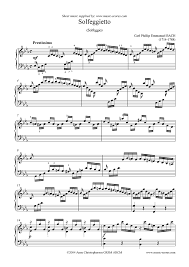
Solfeggietto is a short solo keyboard piece in c minor composed in 1766 by Carl Philipp Emanuel Bach. Carl Philipp Emanuel Bach was a German composer and the son of J.S. Bach.

Solfeggietto” is an Italian word meaning “little study” or exercise.

The work is unusual for a keyboard piece in that the main theme is only one note being played at a time. The piece is commonly assigned to piano students and appears in many anthologies.

This piece is easily Bach’s best-known and is often performed by left-hand alone.


See if you can follow along.  The notes with the stems down (even in the treble clef) are normally played with the left hand.

With just the left hand:

Electric Guitar

Bass Clarinet

Clarinet sextet

Harp

Are you any of these?  This is the first annoying pianist. Too Humble – Solfeggietto in C minor by C.P.E. Bach