When my students are first working with the Grand Staff, they are often confused about the placement of the various clefs.
In piano music, we generally use only the G-clef (Treble clef – not “trouble clef” as some think!) and the F-clef (Bass clef) I try to show students how the curvy part of the G-clef wraps around the G above middle C and the F-clef looks sort of like an F marking the F below middle C. I draw out G and F on the staff to show how these could have looked.
Originally, instead of a special clef symbol, the reference line of the staff was simply labeled with the name of the note it was intended to bear: F and C and, more rarely, G. These were the most often-used ‘clefs’ in Gregorian chant notation. Gregorian chant developed mainly in western and central Europe during the 9th and 10th centuries, with later additions and redactions.
Over time the shapes of these letters became stylized, leading to their current versions.
• 1925 ~ Mike Douglas (Dowd), TV host of The Mike Douglas Show; singer, The Music Show, Kay Kyser’s Kollege of Musical Knowledge
• 1927 ~ Raymond Leppard, British conductor and harpsichordist
• 1941 ~ Glenn Miller and his Orchestra recorded Elmer’s Tune on Bluebird Records.
• 1942 ~ Mike Hugg, Musician, drums with Chapter Three, Manfred Mann
• 1943 ~ Jim Kale, Musician, bass with The Guess Who
• 1943 ~ Guy Vallari, Singer with Regents
• 1949 ~ Eric Carmen, Musician, bass, keyboards, songwriter, singer with The Raspberries
• 1950 ~ Erik Braunn, Musician, guitar, singer with Iron Butterfly
• 1955 ~ Joe Jackson, Singer
• 1958 ~ Elvis Presley received a gold record for the hit, Hard Headed Woman. The song was featured in the movie King Creole.
• 1987 ~ Sgt. Pepper’s Lonely Hearts Club Band by The Beatles was called “the best album made during the last 20 years” by the respected music publication, Rolling Stone magazine.
• 1996 ~ Rafael Kubelik, Czech conductor, died aged 82. He made his debut with the Czech Philharmonic Orchestra in 1934 and went into exile in 1948 and made an emotional return when he conducted the opening concert of the 1990 Prague Spring music festival.
See if a prospective teacher allows a trial lesson to test how the personalities mesh. And be sure to ask lots of questions. What’s the teacher’s background as a musician and as an instructor? What kinds of teaching materials and music does she use? How much practice time is expected for students, and does that vary by the student’s age? Does the teacher have access to student ensembles? What kinds of performance opportunities will he provide? Will the teacher allow the student to record the lesson? This can be a terrific practice aid, especially when it comes to remembering how something is supposed to sound. Does she teach any music theory or composition? What are the expectations for students and for their parents?
A good teacher can be a friendly, encouraging and inspiring presence — even when a student hits rough patches. He will point out the student’s weaknesses without being harsh or dismissive, suggest innovative ways to overcome challenges, and create engaging ways to tackle even rote activities like playing scales or honing fine motor skills. The instructor’s age and experience might or might not be a deciding factor; for example, I’m consistently impressed by the range of tricks my own child’s very youthful private teacher has up her sleeve to turn what could easily be drudgery into fun. Not to mention the huge helpings of good humor and patience she brings to her tiny charges!
1865 ~ Alexander Konstantinovich Glazunov, Russian symphonic composer, conductor and educator. He wrote eight completed symphonies and two piano concertos. One of his last works (1934) was a concerto for saxophone.
• 1895 ~ The first Promenade concert under conductor Henry Wood took place at Queen’s Hall in London. He remained in sole charge of the “Proms”, the annual British classical music festival, until 1940.
• 1928 ~ Jimmy Dean (Seth Ward), Grammy Award-winning singer, TV host of The Jimmy Dean Show, sausage mogul
• 1928 ~ Eddie Fisher, Singer, TV host of Coke Time with Eddie Fisher, father of Carrie Fisher and Tricia Leigh Fisher
• 1940 ~ Bobby Hatfield, Singer with The Righteous Brothers
• 1943 ~ Veronica ‘Ronnie’ Spector (Bennett), Singer with The Ronettes
• 1947 ~ Ian Anderson, Musician: flute, singer with Jethro Tull
• 1954 ~ Eliot Fisk, American guitarist
• 1954 ~ Elvis Presley made one of his first professional appearances, at Overton Park, in his hometown of Memphis, TN. He used the occasion to debut his new record,That’s All Right (Mama), and was a big crowd pleaser.
• 1961 ~ Jon Farriss, Musician, drums, singer with INXS
• 1967 ~ Lorraine Pearson, Singer with Five Star
• 1968 ~ Michael Bivins, Singer with New Edition, Bell Biv DeVoe
• 1985 ~ Madonna’s album Like a Virgin became the first solo album by a female artist to be certified for sales of five million copies.
• 1987 ~ A Chorus Line celebrated its 5,000th performance. It was estimated that 25 million theatre goers had seen the musical since it opened in 1975. An estimated 16.7 million people had seen the show on Broadway, with another 8.3 million taking in the touring production. A Chorus Line became the longest-running show on The Great White Way on September 29, 1983 and ended its Broadway run in 1990.
• 2003 ~ Gregory Hines, Tony Award winner tap-dancing actor who started on Broadway and in movies including “White Nights” and “Running Scared,” died at the age of 57.
The dancer, among the best in his generation, won a 1993 Tony for the musical “Jelly’s Last Jam.”
Hines became internationally known as part of a jazz tap due with his brother, Maurice, and the two danced together in the musical revue “Eubie!” in 1978. The brothers later performed together in Broadway’s “Sophisticated Ladies” and on film in 1984’s “The Cotton Club.”
In “The Cotton Club,” Hines also had a lead acting role, which led to more work in film. He starred with Mikhail Baryshnikov in 1985’s “White Nights” and with Billy Crystal in 1986’s “Running Scared,” and he appeared with Whitney Houston and Angela Bassett in 1995’s “Waiting to Exhale,” among other movies.
On television, he had his own sitcom in 1997 called “The Gregory Hines Show,” as well as a recurring role on “Will and Grace.” March 2003, he appeared in the spring television series “Lost at Home.”
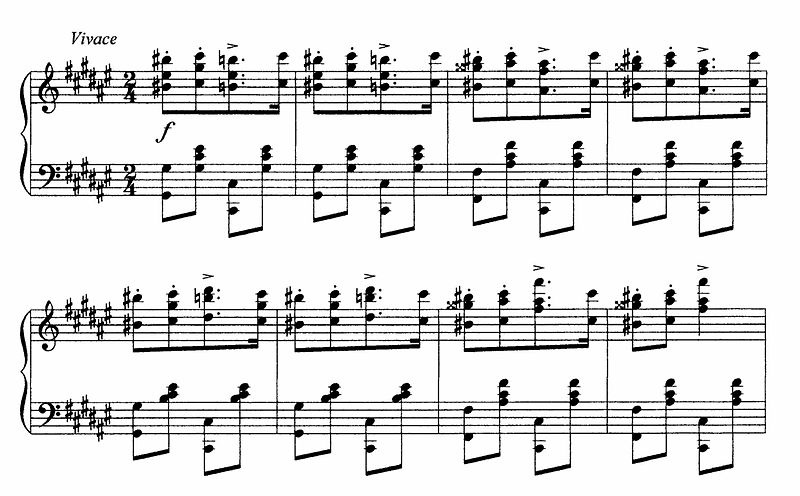
Hungarian Rhapsody No. 2, S.244/2, is the second in a set of 19 Hungarian Rhapsodies by composer Franz Liszt, and is by far the most famous of the set. Few other piano solos have achieved such widespread popularity, offering the pianist the opportunity to reveal exceptional skill as a virtuoso, while providing the listener with an immediate and irresistible musical appeal.
In both the original piano solo form and in the orchestrated version this composition has enjoyed widespread use in animated cartoons. Its themes have also served as the basis of several popular songs.
It is probable that you have heard this piece of music somewhere at one time or another because it is perhaps the most prominent piece of classical (romantic, actually) music featured in animated cartoons across the years.
Now, let the anvils fall and dynamite explode!
And, in real life, Valentina Lisitsa plays Liszt’s Hungarian Rhapsody No. 2
• 1874 ~ Reynaldo Hahn, Venezuelan-born French composer, conductor and music critic
• 1902 ~ Solomon Cutner, Classical pianist. A virtuoso performer, he played Tchaikovsky’s First Concerto at the age of 10. His career was stopped after a stroke in 1965.
• 1902 ~ Zino (Rene) Francescatti, French concert violinist; passed away in 1991
• 1910 ~ A.J. Fisher of Chicago, IL received a patent for an invention that moms, grandmas and single guys certainly came to appreciate: the electric washing machine. Previous to Mr. Fisher’s invention, washing machines were cranked by hand (not easily done) – or you used a washboard (also sometimes used as a musical instrument).
• 1919 ~ Ruggiero Leoncavallo, Italian composer and librettist, died. He is famous for the single opera “Pagliacci” but never repeated the success with his other works.
More information about Leoncavallo
• 1932 ~ Helen Morgan joined the Victor Young orchestra to record Bill, a popular tune from Broadway’s Showboat.
• 1963 ~ The TV program Ready, Set, Go! premiered on the BBC in London, England. The show gave exposure to such music luminaries as Bob Dylan and The Rolling Stones.
• 1964 ~ Joan Baez and Bob Dylan shared the stage for the first time when the singers performed in a concert in Forest Hills, NY.
• 1969 ~ Hot Fun in The Summertime, by Sly and the Family Stone, and Easy to Be Hard, from the Broadway production Hair, were released on this day. Hot Fun made it to number two on the music charts and Easy to Be Hard climbed to number four.
• 1975 ~ Dmitri Shostakovitch, Russian composer, died. He wrote 15 symphonies as well as operas, ballets and film and theater scores.
More information about Shostakovitch
• 2003 ~ Chester Ludgin, a baritone in the New York City Opera for more than 30 years, died at the age of 78.
Ludgin sang a host of lead baritone parts, but was most recognizable in operas including “The Ballad of Baby Doe,” “The Devil and Daniel Webster” and “Susannah.” He debuted at the City Opera in 1957 in JohannStrauss II’s “Fledermaus.”
He also portrayed the part of Sam for Leonard Bernstein’s “A Quiet Place” at the Houston Grand Opera in 1983. He also sang for the San Francisco Opera and other North American companies.
His last appearance at City Opera was in 1991, but he remained on the stage, singing in musical comedies. His most recent lead was in “The Most Happy Fella.”
Many homeowners don’t realize that there are movers available to them who specialize in the transportation and storage of pianos. A piano is a delicate instrument and not something you want to take risks with. By trusting this major job to a piano mover, you can rest easy knowing that one of the most valuable items in your home is being transported with the care it deserves.
But It Weighs 1500 Pounds. How Delicate Can It Be?
This is exactly where many homeowners go wrong. Sure, that piano in your living room is heavy enough to throw out the backs of four or five of your best buddies as you wrestle it out the door and up into the truck, but don’t let that fool you. Despite its bulky appearance, it is also a precision musical instrument with over 1000 moving parts and 200 finely-tuned strings, any number of which can be damaged and require repair if your piano isn’t handled properly in a move.
Your Piano Mover Understands Pianos
These intricate inner workings of a piano are exactly why hiring an expert in piano moving is so important. These professionals understand pianos and moving them, from the safest way to lift and twist a standard upright piano to get it out the door, to how to properly disassemble a grand piano and transport it without causing any damage. And even more importantly, a piano mover understands that when your piano is delivered to your new home, you expect to be able to sit down and play it right away. It’s why many piano movers keep tuners and repairmen on staff, and why the rest will have a trusted list of professionals available on request if you need it.
• 1923 ~ Benny Goodman was 14 years old as he began his professional career as a clarinet player. He took a job in a band on a Chicago-based excursion boat on Lake Michigan.
• 1926 ~ Urbie (Urban) Green, Musician, trombonist who played with Cab Calloway
• 1932 ~ Mel Tillis, Singer, songwriter
• 1933 ~ Joe Tex (Arrington, Jr.), Singer
• 1934 ~ Bing Crosby became the first singer to record for the newly created Decca Records. His songs, Just A-Wearyin’ For You and I Love You Truly, were recorded as Decca number D-100.
• 1939 ~ Philip Balsley, Singer with The Statler Brothers
• 1941 ~ Les Brown and His Band of Renown paid tribute to baseball’s “Yankee Clipper”, Joe DiMaggio of the New York Yankees, with the recording of Joltin’ JoeDiMaggio on Okeh Records. From that time on, DiMaggio adopted the nickname, Joltin’ Joe.
• 1949 ~ Keith Carradine, Actor and composer, whose recording of I’m Easy reached No. 17 on the U.S. charts in 1976.
• 1950 ~ Andy Fairweather-Low, Musician, guitar, singer with Amen Corner
• 1958 ~ Harry (Harry Lillis III) Crosby, Singer and actor, son of Bing Crosby and Kathryn Grant
• 1958 ~ Chris Foreman, Musician, guitar with Madness
• 1960 ~ Tell Laura I Love Her, by Ray Peterson, wasn’t a big hit in Great Britain. Decca Records in England said the song was “too tasteless and vulgar for the English sensibility.” They destroyed 25,000 of the platters this day.
• 1961 ~ The Edge (David Evans), Musician, guitar with U2
• 1974 ~ Roberta Flack received a gold record for the single, Feel Like Makin’ Love. Flack, born in Asheville, NC and raised in Arlington, VA, was awarded a music scholarship to Howard University in Washington, DC at the age of 15. One of her classmates became a singing partner on several hit songs. Donny Hathaway joined Flack on You’ve Got a Friend, Where is the Love and The Closer I Get to You. She had 10 hits on the pop charts in the 1970s and 1980s.
• 1818 ~ Henry Charles Litolff, French pianist, composer and music publisher
• 1921 ~ Karel Husa, Czech-born American composer and conductor
• 1921 ~ Warren Covington, Bandleader, trombone, played with Horace Heidt and His Musical Knights
• 1925 ~ Felice Bryant, Songwriter with husband Boudleaux
• 1931 ~ Bix Beiderbecke, U.S. Jazz musician and composer, died. The first white musician to make an impact on jazz, he died from pneumonia aged 28.
• 1936 ~ Rahsaan Roland Kirk, American jazz musician
• 1937 ~ Bunny Berigan and his orchestra recorded I Can’t Get Started for Victor Records. The song became Berigan’s longtime theme song.
• 1939 ~ Ron Holden, Singer
• 1942 ~ B.J. (Billy Joe) Thomas, Singer
• 1943 ~ Lana Cantrell, Entertainer and singer
• 1952 ~ Andy Fraser, Musician: bass with Free
• 1958 ~ Bruce Dickenson, Singer with Iron Maiden
• 1970 ~ Christine McVie joined Fleetwood Mac as the group’s first female member. McVie was married to bass player John McVie. She quit touring with the group in 1991.
• 1975 ~ The Rolling Stones received a gold album for Made in the Shade.
• 1987 ~ Back to the Beach opened at theatres around the country. The film reunited Frankie Avalon and Annette Funicello, who played middle-aged parents with rebellious kids — kids like Frankie and Annette had played in their Bikini Beach movies in the 1960s.
• 2001 ~ Larry Adler, acknowledged as the king of the harmonica, died at the age of 87 at a London hospital after a long illness.
Adler, born in Baltimore in February 1914, was a musical prodigy whose career covered seven decades during which he worked with a veritable who’s who of the 20th century’s entertainment industry.
From George Gershwin to Elton John, the classically trained Adler had worked with and inspired generations of musicians, touring as late as 1994 and even planning an update of his 1985 biography “It Ain’t Necessarily So.”
“He was without doubt one of the greatest musicians of the 20th century” said musical agent Jonathan Shalit.
“Larry was a man who believed the show must always go on, even to the point of playing from his wheelchair,” he added.
Adler learned to play the piano and mouth organ by ear from listening to records and could not actually read music until 1941.
He won the Maryland Harmonica Championship in 1927 after being expelled from a music conservatory and promptly ran away to New York and got a job playing in film theaters between features.
In 1936 he played harmonica on George Gershwin’s Rhapsody in Blue, prompting the composer to exclaim that it sounded as though he had written the haunting melody specially for Adler.
During World War Two Adler toured extensively in Africa and the Middle East, entertaining troops, and insisting on a non-segregation policy between whites and blacks at concerts.
He also entertained in the South Pacific with artists including comedian Jack Benny, and worked consistently for the war effort and the Allied forces.
In 1945 he went to Berlin where he played The Battle Hymn of the Republic on harmonica on the balcony of Adolf Hitler’s ruined chancellery after Germany capitulated.
He left the U.S. for Britain in the early 1950s after being blacklisted during the McCarthy communist witch hunt.
Adler’s most familiar composition is the music for the film comedy “Genevieve,” but he composed the music for other films.
In 1967 and 1973, gave his services to Israel in aid of those affected by the Six Day and Yom Kippur wars.
After Adler guested on Sting’s 1993 album “Ten Summoner’s Tales,” the rock singer returned the compliment and appeared on Adler’s 80th birthday celebration,The Glory Of Gershwin.
They were joined by other stars from the rock world such as Meat Loaf, KateBush, Peter Gabriel and Sinead O’Connor.
A tennis fanatic, Adler once played in a doubles match with Charlie Chaplin, Greta Garbo and Salvador Dali.
• 2001 ~ Billy Byrd, who once played lead guitar for Ernest Tubb’s Texas Troubadours, died at the age of 81.
William Lewis Byrd was born in Nashville, and taught himself guitar by copying the records of Charlie Christian and Django Reinhardt.
In the 1940s, Byrd backed the Oak Ridge Quartet (predecessor of the Oak Ridge Boys), Little Jimmy Dickens, George Morgan and others.
In 1949, Byrd succeeded Tommy “Butterball” Paige as lead guitarist in Ernest Tubb’s Texas Troubadours.
On many of Tubb’s hit records, Tubb would introduce Byrd’s tight melodic solos by exclaiming, “Aw, Billy Byrd now,” or “Play it pretty, Billy Byrd.” Byrd played on scores of Tubb hits, including Jealous Loving Heart,Two Glasses Joe and Answer the Phone.
Byrd also drove Tubb’s bus during his first tenure with the Texas Troubadours, which lasted a decade. He returned twice to the band, from 1969-70 and 1973-74.
Byrd released three solo instrumental albums, and during a brief stint in California backed Tab Hunter and Tex Ritter. In 1950, Byrd and guitarist Hank Garland designed the popular Byrdland guitar for Gibson Guitars.




 MaryO'Studio