Vivaldi, one of the greatest baroque composers, has a very interesting story. He ran an orphanage in the 18th century in Italy that became famous all over the western world for its musically talented children. A lot of his pieces were written for specific children in his school. Vivaldi learned the violin from his father, and was trained as a priest. He was nicknamed “the red priest” for his red hair and was apparently somewhat sure of himself, having claimed once he can compose a concerto faster than it can be copied.
Vivaldi wrote over 500 pieces, most of which are lost today. He is considered one of the greatest musical landmarks in history, having inspired many composers that followed him, including J.S.Bach and others.
The manuscript of Mozart’s A major piano sonata K331 has recently been discovered in Budapest. Having spent the majority of its life in the Budapest’s National Széchényi Library for decades, the coveted manuscript was rediscovered by Haydn scholar Balazs Mikusi.
The piece was composed in 1783 and contains Mozart’s most popular jam, “Turkish March,” which has become a piano lesson staple all over the world.
Although, unfortunately, Mikusi can’t say how or when these pages found their way to Hungary; they reveal subtle differences from the published editions of the sonata. The key variances are seen in the phrasing, dynamics and occasionally the notes themselves.
“It is very rare that a Mozart manuscript pops up. Moreover the A Major Sonata had no known manuscript, so it is a really big discovery,” he said.
The library has only released teasing images of the manuscript, nothing more.
It will be fun watching your child improve their piano skills all while having fun using Piano Maestro in lessons each week!
As your child’s teacher (or YOUR teacher!), I’m looking forward to seeing the progress they will make when they start using it at home each day. This guide will help you understand how this app will benefit your child and how to get it set up on your own iPad.
Overview What is Piano Maestro?
Piano Maestro is the ultimate piano practice tool that will have students quickly playing their favorite classical, pop, rock, TV and video game songs and themes. It is available in the App Store and works on the iPad.
What skills does it improve?
• Note reading
• Sight reading
• Rhythm
• Inner pulse
• Confidence
What makes it so fun?
• Upbeat background tracks
• Stunning graphics
• Instant rewards and feed back
• Satisfaction of playing REAL music
It works with an acoustic piano?
Yes! Your child practices on your real acoustic or digital piano. Piano Maestro listens from the iPad’s built in microphone. No wires needed.
I’m already paying for lessons and books. What value does this add?
Sometimes I wish I could be there with your child to encourage them to keep practicing daily. I’m sure it’s not always easy, as unforeseen challenges will arise.
Since our time each week is just too short, this app will give me eyes on the ground and it will keep them practicing longer and improving more quickly.
How will it be used in lessons?
I will spend a few minutes of each lesson helping your child master a couple of new songs all while having fun! I will also teach them how to use the practice options at home.
At the end of the lesson, we will choose Home Challenge assignments within the app that will show up in your account at home. I’ll get updates when progress is made.
Getting Started
Wow, this sounds awesome. Now, how do I get started?
1) Download Piano Maestro on your iPad from the AppStore
2) Create a JoyTunes account with a parent’s email, under which, you can have multiple profiles for each member of the family.
3) Create a profile for each family member (that means you too Mom and Dad!) inside the Parent/Teacher zone (top right hand corner of main screen)
4) Connect to your teacher, me! After creating a profile in the “profiles” tab of the parent/teacher zone, select the student’s profile and click “connect to teacher.” Once I approve connection to your child, they will receive full access to all content for FREE! I will then also begin receiving weekly progress reports.
5) Start Playing – I will now start assigning you homework, meanwhile get started on Journey Mode.
There is one change in the video below – when you connect to the O’Connor Music Studio, Piano Maestro is free forever.
Avery Gagliano is a commanding young pianist who attacks Chopin with the focused diligence of a master craftsman and the grace of a ballet dancer.
The prodigy, who just turned 13, was one of 12 musicians selected from across the globe to play at a prestigious event in Munich last year and has won competitions and headlined with orchestras nationwide.
But to the D.C. public school system, the eighth-grader from Mount Pleasant is also a truant. Yes, you read that right. Avery’s amazing talent and straight-A grades at Alice Deal Middle School earned her no slack from school officials, despite her parents’ begging and pleading for an exception.
Lee Eckroth couldn’t hold back a smile as piano music filled the air Wednesday afternoon on the streets of downtown Corvallis.
The moment marked the culmination of months of work from by Eckroth, Corvallis Imagination Music & Art founder David Lundahl and dozens of volunteers who’d banded together to create the first Play Corvallis, Play.
The art installation features eight theme-decorated pianos, placed at outdoor locations around Corvallis. It is open to the public from 7 a.m. to 10 p.m. daily through Aug. 16 as a prelude event to the Imagination Music and Art festival at Bruce Starker Arts Park on Aug. 15 and 16.
Play Corvallis, Play is intended to inspire appreciation of the arts, and it is just what it sounds like: an invitation to residents to stop and play the piano to showcase local musical creativity and art as a way of drawing attention to the fundraising at Corvallis public schools.
When my students are first working with the Grand Staff, they are often confused about the placement of the various clefs.
In piano music, we generally use only the G-clef (Treble clef – not “trouble clef” as some think!) and the F-clef (Bass clef) I try to show students how the curvy part of the G-clef wraps around the G above middle C and the F-clef looks sort of like an F marking the F below middle C. I draw out G and F on the staff to show how these could have looked.
Originally, instead of a special clef symbol, the reference line of the staff was simply labeled with the name of the note it was intended to bear: F and C and, more rarely, G. These were the most often-used ‘clefs’ in Gregorian chant notation. Gregorian chant developed mainly in western and central Europe during the 9th and 10th centuries, with later additions and redactions.
Over time the shapes of these letters became stylized, leading to their current versions.
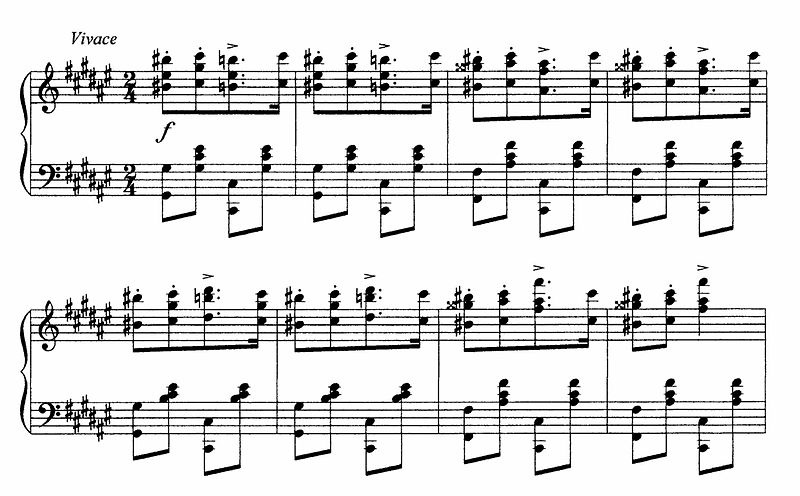
Hungarian Rhapsody No. 2, S.244/2, is the second in a set of 19 Hungarian Rhapsodies by composer Franz Liszt, and is by far the most famous of the set. Few other piano solos have achieved such widespread popularity, offering the pianist the opportunity to reveal exceptional skill as a virtuoso, while providing the listener with an immediate and irresistible musical appeal.
In both the original piano solo form and in the orchestrated version this composition has enjoyed widespread use in animated cartoons. Its themes have also served as the basis of several popular songs.
It is probable that you have heard this piece of music somewhere at one time or another because it is perhaps the most prominent piece of classical (romantic, actually) music featured in animated cartoons across the years.
Now, let the anvils fall and dynamite explode!
And, in real life, Valentina Lisitsa plays Liszt’s Hungarian Rhapsody No. 2