. 1732 ~ Franz Joseph Haydn, Austrian composer
Listen to Haydn’s music
More information about Haydn
. 1872 ~ Sergei Pavlovich Diaghilev. He was a Russian art critic, patron, ballet impresario and founder of the Ballets Russes.
. 1880 ~ Henryk Wieniawski, Polish violist/composer, died at the age of 44
. 1901 ~ John Stainer died. He was an English composer and organist whose music, though not generally much performed today, was very popular during his lifetime.
. 1922 ~ Richard Kiley, American actor and singer (Kismet, Man of La Mancha, Endless Love)
. 1928 ~ Lefty (William Orville) Frizzell, Country Music Hall of Famer
. 1934 ~ Shirley Jones, Singer, actress
. 1935 ~ Herb Alpert, American trumpeter, bandleader (Tijuana Brass), composer, record company executive: the “A” of A&M Records
. 1937 ~ Phil Harris recorded one of his best-known songs in Los Angeles, CA. That’s What I Like About the South was recorded on a 78 RPM disk. Harris would move to TV stardom and continue as a popular vocalist during the 1950s with such hit songs as The Thing.
. 1943 ~ The show, Away We Go, was renamed. The show opened at the St. James Theatre in New York City and, thanks to the talents of stars like Alfred Drake, Joan Roberts and Howard DeSilva, it became an instant hit. The show ran for 2,248 performances, until 1948. The musical, which has grossed millions of dollars on stage and as a blockbuster movie was initially produced for the sum of $75,000. It is still legendary among musical productions – especially after it was retitled Oklahoma!
. 1944 ~ Rod Allen (Rodney Bainbridge), Bass, singer with The Fortunes
. 1944 ~ Mick Ralphs, Guitarist
. 1945 ~ Al Nichol, Guitarist, keyboards with The Turtles
. 1953 ~ Sean Hopper, Keyboards with Clover and Huey Lewis and The News
. 1959 ~ Angus Young, Guitarist with AC/DC
. 1967 ~ Jimi Hendrix burned his guitar for the first time in a public performance at Finsbury Park in London.
. 1985 ~ Tootsie’s Orchid Lounge, long a favorite of country music stars, closed its doors in Nashville, TN.
. 1674 ~ Pietro Antonio Locatelli died. He was an Italian Baroque composer and violinist.
. 1872 ~ Sergei Vasilenko, Russian composer
. 1900 ~ Ted (Edward) Heath, Musician, trombonist, bandleader: played big band concerts every Sunday at the Palladium in the 1940s and 1950s
. 1913 ~ Frankie Laine (Frank Paul LoVecchio), Singer
. 1923 ~ The Audubon Ballroom in New York City was the scene of the first dance marathon. Alma Cummings danced the foxtrot, one-step and waltz with half a dozen partners.
. 1932 ~ Leonard Bernstein participated in his first piano recital at New England Conservatory, performing Brahms’ Rhapsody in G Minor. He was 13.
. 1935 ~ Gordon Mumma, American composer of experimental music
. 1941 ~ Graeme Edge, Drummer with The Moody Blues
. 1942 ~ Bobby Wright, Country artist, actor, son of Johnny Wright of Johnnie and Jack country duo
. 1945 ~ Eric Clapton, British rock guitarist with the Yardbirds; songwriter, Grammy Award-winning singer: Bad Love in 1990
. 1959 ~ Sabine Meyer, German clarinetist
. 1963 ~ The Chiffons began a four-week stay at the top of the pop music charts as their hit single, He’s So Fine, became number one. The song stayed at the top of the top tune tabulation until Little Peggy March came along with I Will Follow Him on April 27th.
. 1964 ~ Tracy Chapman, Grammy Award-winning folk singer-songwriter
. 1964 ~ Willem Andriessen, Dutch composer and pianist (Beethoven), died at the age of 76
. 1968 ~ Celine Dion, Canadian and international superstar singer who has had a number of Number 1 singles in Canada, the Unites States and around the world including “The Power of Love” ( 1993 ), “Because You Loved Me” ( 1995 ). She got her big break following her win 1988 Eurovision Song Contest singing in French “Ne partez pas sans moi” for Switzerland. She is the best selling Canadian artist of all time selling 250 million albums, worldwide. She came from a poor area and poverty-stricken Charlemagne one of 14 children, but when asked has always said her childhood a good time in a happy household.
. 1970 ~ Lauren Bacall starred in Applause which opened on Broadway. The show became one of the hardest tickets to get on the Great White Way. Critics called Bacall “a sensation.” The play, at the Palace Theatre, was an adaptation of the film, All About Eve. It continued for 896 performances. A London version of the show, also starring Bacall, opened in 1972.
. 1971 ~ The Bee Gees received a gold record for the single, Lonely Days. When playing it, they heard the song at a faster speed and said, “Hey, this sounds like disco!” and the rest was Saturday Night Fever music history…
. 1974 ~ John Denver reached the top spot on the music charts with his hit, Sunshine on My Shoulders. It was the singer’s first number one song. Three other singles by Denver reached the top of the music world: Annie’s Song, ThankGod I’m a Country Boy and I’m Sorry. Take Me Home Country Roads made it to the number two position, while Rocky Mountain High just cracked the Top 10 at number 9. Denver wrote Leaving on a Jet Plane for Peter, Paul and Mary and won an Emmy for the TV special, An Evening With John Denver.
. 1788 ~ Charles Wesley, writer of over 5,500 hymns and, with his brother John, the founder of Methodism, died.
. 1871 ~ The Royal Albert Hall in London opened
. 1878 ~ Albert Von Tilzer, Composer. He was the composer of “Take Me out to the Ball Game” among other old favorites.
More information about Von Tilzer
. 1879 ~ “Eugene Onegin”, best-known opera by Russian composer Tchaikovsky, was first performed at the Maliy Theatre in Moscow
. 1947 ~ Bobby Kimball (Toteaux), Singer with Toto
. 1949 ~ Michael Brecker, Jazz musician, reeds with The Brecker Brothers
. 1951 ~ The King and I, the wonderful Rodgers and Hammerstein musical based on Margaret Langdon’s novel, Anna and the King of Siam, opened this night in 1951 on Broadway. The King and I starred Yul Brynner in the role of the King of Siam. The king who, along with his subjects, valued tradition above all else. From this day forward, the role of the King of Siam belonged to Yul Brynner and no other. Brynner appeared in this part in more than 4,000 performances on both stage and screen (the Broadway show was adapted for Hollywood in 1956). Anna, the English governess hired to teach the King’s dozens of children, was portrayed by Gertrude Lawrence. Ms. Lawrence and Mr. Brynner acted, danced and sang their way into our hearts with such memorable tunes as Getting to Know You, Shall We Dance, Hello, Young Lovers, I Whistle a HappyTune, We Kiss in a Shadow, I Have Dreamed, Something Wonderful, A Puzzlement and March of the Siamese Children. The King and I ran for a total of 1,246 outstanding performances at New York’s St. James Theatre.
. 1952 ~ Roy Henderson’s last singing performance was on this date in the role of Christus in Bach’s “St. Matthew Passion” at Southwark Cathedral, the Anglican cathedral on the south bank of the Thames in London.
. 1973 ~ Hommy, the Puerto Rican version of the rock opera Tommy, opened in New York City. The production was staged at Carnegie Hall.
. 1973 ~ After recording On the Cover of ‘Rolling Stone’, Dr. Hook finally got a group shot on the cover of Jann Wenner’s popular rock magazine. Inside, a Rolling Stone writer confirmed that members of the group (Dr. Hook and the Medicine Show) bought five copies of the magazine for their moms – just like in the song’s lyrics!
. 1980 ~ Annunzio Paolo Mantovani, Anglo-Italian conductor and arranger, died. Created the “Mantovani sound” that made him a highly successful recording artist and concert attraction.
. 1982 ~ Carl Orff, German composer of “Carmina Burana,” died.
. 1982 ~ Ray Bloch passed away
. 1999 ~ Legendary U.S. jazz and blues singer Joe Williams died aged 80.
. 2001 ~ John Lewis, a pianist who masterminded one of the most famous ensembles in jazz, the Modern Jazz Quartet, died at the age of 80. The M.J.Q., as the quartet was known, remained mostly unchanged from the mid-1950’s to the 90’s. It began recording in 1952 with Lewis, vibraphonist Milt Jackson, bassist Percy Heath and drummer Kenny Clarke. When Clarke moved to Paris in 1955, Connie Kay replaced him and the quartet continued until Kay’s death in 1994. Lewis contributed the bulk of the group’s compositions and arrangements, including Django and Two Degrees East, Three Degrees West, and he insisted members wear tuxedos to dignify jazz as an art. He was born in LaGrange, Ill., in 1920, and grew up in Albuquerque, N.M. His entree to the jazz world came during World War II, when he met Kenny Clarke, an established drummer in the nascent bebop movement. At Clarke’s urging, Lewis moved to New York after his discharge and eventually replaced Thelonious Monk as Dizzy Gillespie’s pianist. He also performed or recorded with Charlie Parker, Lester Young and Ella Fitzgerald. In 1952 he formed the M.J.Q. with Clarke, Jackson and Heath. The quartet was a steady seller of records and concert tickets well into the 1970’s. Lewis also taught music at Harvard and the City College of New York, and in the late 1950’s helped found the Lenox School of Jazz in Massachusetts.
. 2009 ~ Maurice Jarre, French composer (Doctor Zhivago-Acadamy Award winner in 1966), died at the age of 84
Palm Sunday marks the beginning of Holy Week, the most important week of the church year. At the other end of Holy Week is Easter, the most important day of the church year.
For Christians, this is the big event! And it’s all about the mystery that somehow Jesus Christ makes us one with God.
The days leading up to Easter often have an understandably somber feel to them, particularly as we contemplate Jesus’ arrest, trial, and execution. It’s easy to forget that the week begins with a joyful event: the Triumphal Entry!
Today is Palm Sunday, the first day of Holy Week. On Palm Sunday, we commemorate Jesus’ celebrated entry into Jerusalem just a few days before his arrest, trial, and crucifixion.
The “palm” in Palm Sunday refers to the palm branches waved by the adoring Jerusalem crowds who welcomed Jesus and proclaimed him King. The event is commonly referred to as the Triumphal Entry. Here’s the account from Matthew 21:1-11:
As they approached Jerusalem and came to Bethphage on the Mount of Olives, Jesus sent two disciples, saying to them, “Go to the village ahead of you, and at once you will find a donkey tied there, with her colt by her. Untie them and bring them to me. If anyone says anything to you, say that the Lord needs them, and he will send them right away.”
This took place to fulfill what was spoken through the prophet:
“Say to Daughter Zion,
‘See, your king comes to you,
gentle and riding on a donkey,
and on a colt, the foal of a donkey.’”
The disciples went and did as Jesus had instructed them. They brought the donkey and the colt and placed their cloaks on them for Jesus to sit on. A very large crowd spread their cloaks on the road, while others cut branches from the trees and spread them on the road. The crowds that went ahead of him and those that followed shouted,
“Hosanna to the Son of David!”
“Blessed is he who comes in the name of the Lord!”
“Hosanna in the highest heaven!”
When Jesus entered Jerusalem, the whole city was stirred and asked, “Who is this?”
The crowds answered, “This is Jesus, the prophet from Nazareth in Galilee.”
Chuck Knows Church — Palm Sunday. Have you ever waved a palm branch in a worship service? If so, do you know why? Chuckle along and learn about Palm Sunday with Chuck
Every Palm Sunday, without fail, my father’s church choir in Connecticut sang this. I still know it nearly by heart.
This hymn for Palm Sunday was originally written in French as “Les rameaux” originally published in 1864 by French art collector, operatic baritone and composer Jean-Baptiste Fauré (1830–1914).
Jean-Baptiste Fauré should not be confused with French composer, organist, pianist and teacher Gabriel Fauré (1845-1924) who composed a world-famous Requiem and other works.
An early English translation “Palm-Branches” was published by Oliver Ditson Co., Boston in “Gems of English Song” 1875. A number of other English translations have been made, and it has proved surprisingly difficult to identify the translators. One version is sometimes credited to Harrison Millard (1830-1895) – but other sources say he was simply an arranger.
I think, as a choir, we didn’t sound quite this good
Other Palm Sunday Music:
We sang this at Pender one year at the 9:00 traditional service, but without quite as much ceremony, and in English.
This looks like fun – “Jerusalem, lift up your gates and sing!” Hosanna in the Highest to your King! Note that one person is playing a duet with himself.
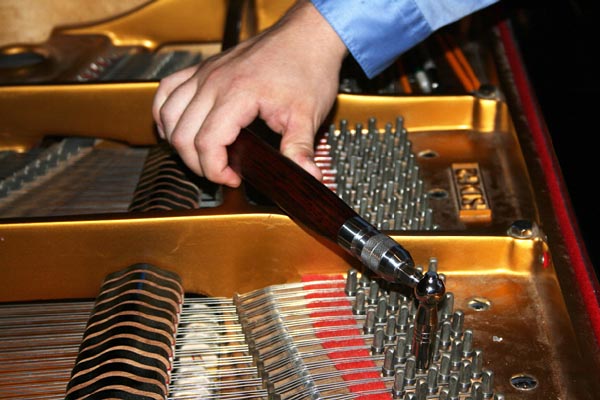
When it comes to tuning, every piano is different, even two pianos of the same style and make are different, and the humidity of the room makes a big difference, he said.
High humidity causes the sound board to swell, stretching the strings and causing the pitch to go sharp, while low humidity has the opposite effect.
In Minnesota, humidity can easily range from 80 percent in the summertime to 10-15 percent in the winter, if the home doesn’t have a humidifier. Wood-heated homes tend to be especially dry, he said.
“Pianos like it between 40 and 50 percent humidity in the house,” he said.
Even places that are supposedly “climate-controlled,” aren’t always. The heat might get turned down substantially evenings and weekends, for example.
A new piano needs a few weeks to settle into its new home before tuning, Fry said.
“If they get a new piano, generally they call us the day before it gets in the house,” he said. “It should sit in the house a couple weeks just to acclimatize it to its new surroundings … brand new pianos stretch for a while. They go out of tune quicker. The wire stretches and they settle into themselves.”
Some people think they have to let a new, or recently moved older piano, sit six months or a year before it gets tuned. That’s not true, Fry said, but it does need a few weeks.
He recommends that pianos be tuned at least once a year (he tunes his own piano once a year, even though he no longer gives lessons) and the busiest time for him is before the holidays — September through December.
“Piano-tuning is something people can put off,” he said. “We noticed a real drop in tuning when gas got over $3 a gallon. I didn’t think it would make that much of a difference, but it did.”
Fry said he is looking for some kind of work to do in the summertime when his other businesses are slow.
He doesn’t give piano or guitar lessons anymore, but does enjoy tuning all types of pianos.
“It takes me a couple of hours. I have time,” Fry said. “I’m going to do the job that I like to do, and do it right.”
Piano Day, an annual worldwide event founded by a group of like-minded people, takes place on the 88th day of the year – in 2024 due to Leap Year it’s the 28th March – because of the number of keys on the instrument being celebrated. More about Piano Day.
. 1880 ~ Rosina Lhevinne, piano teacher
. 1881 ~ Modest Mussorgsky, Russian composer, died from alcoholism. Best known for his “Pictures from an Exhibition” and the opera “Boris Godunov.”
. 1890 ~ Paul Whiteman, Bandleader, Washboard Blues, Ol’ Man River, Felix the Cat, Heartache and Ain’t Misbehavin’
. 1903 ~ Rudolph Serkin, Austrian concert pianist: “An artist of unusual and impressive talents in possession of a crystalline technique, plenty of power, delicacy, and tone pure and full.”
“A masterly musician … a scholar of profound art without pedantry, with the loftiest conceptions of beauty, whose every thought and emotion is for the glory of his art.”
. 1923 ~ Thad Jones (Thaddeus Joseph Jones), Trumpet, cornet, flugelhorn, played with Count Basie, Thelonious Monk; bandleader for Thad Jones-Mel Lewis Orchestra, composer
. 1930 ~ Robert Ashley, American composer
. 1930 ~ Eric Dixon, Saxophonist/flutist with the Count Basie Orchestra
. 1939 ~ Hal Kemp and his orchestra recorded Three Little Fishies for Victor Records.
. 1942 ~ Samuel Ramey, American bass
. 1943 ~ Sergei Rachmaninov, Russian composer and virtuoso pianist, died in California; best known for his piano concertos and his Rhapsody on a theme of Paganini”.
. 1944 ~ WQXR radio in New York City, owned by The New York Times newspaper, banned singing commercials from its airwaves as of this day. Understandable, since the station has always been the classical music voice of Manhattan and there aren’t many classical singing commercials.
. 1945 ~ Chuck Portz, Bass with The Turtles
. 1947 ~ Barry Miles, Musician: keyboardist
. 1949 ~ Milan Williams, Keyboards, drums, trombone, guitar with Commodores
. 1958 ~ W.C. Handy died. He was known as the “Father of the Blues“.
. 1963 ~ Alec A Templeton, composer/pianist (Alec Templeton Time), died at the age of 52
. 1964 ~ Radio Caroline debuted as the first pirate radio station to broadcast off the coast of England. On this day in 1964, the combination of rock music and lively disk jockey patter played to a huge audience in Great Britain; but well out of reach of British authorities. However, that didn’t stop them from trying, albeit unsuccessfully, to shut down the radio station ship. Radio Caroline had become competition to the staid and usually dull British Broadcasting Corporation (BBC). Today, all that is different, as there is licensed radio competition throughout Great Britain. The BBC and the giant, government-owned network has caught up with the times by offering five different services to appeal to wide audiences. They are simply known as ‘Radio 1′ through ‘Radio 5′ … No ‘Zees’, ‘Qs’ or ‘Bees’, just numbers that include a rock channel, a talk channel, a nostalgia/easy listening channel, a classical/fine arts channel and a news channel.
. 1969 ~ Joe Cocker played his first American concert. He entertained fans at Billy Graham’s Fillmore East in New York City.
. 1974 ~ The group, Blue Swede, received a gold record for the single, Hooked on a Feeling.
. 1974 ~ Dorothy Fields passed away
. 1980 ~ Dick (Richard Benjamin) Haymes passed away. He was an Argentine actor and singer. He was one of the most popular male vocalists of the 1940s and early 1950s. He was the older brother of Bob Haymes, an actor, television host, and songwriter
. 1981 ~ The group, Blondie, featuring Debbie Harry, received a gold record for the tune, Rapture. At the time, the pop~rock hit was perched at the top of the pop music charts. Blondie had eight charted hits. Four of them were million sellers, beginning with their first release, Heart of Glass in 1979. Four of the eight hits were number one on the charts, as well.
. 1985 ~ Roger Waters of Pink Floyd made radio history. His Radio City Music Hall concert in New York was broadcast live using a new high-tech sound system called ‘holophonics’. It is said to have recreated the stage experience in amazing detail.
. 1986 ~ More than 6,000 radio stations of all format varieties (even Muzak) played We are the World simultaneously at 10:15 a.m. EST. The promotion became part of the biggest participatory event in history by linking a human chain of millions of people from sea to sea. Ken Kragen was the promotion genius behind the plan that raised millions of dollars and created awareness for the African famine relief project.
USA for Africa musicians
Conductor
Quincy Jones
Soloists (in order of appearance)
Lionel Richie
Stevie Wonder
Paul Simon
Kenny Rogers
James Ingram
Tina Turner
Billy Joel
Michael Jackson
Diana Ross
Dionne Warwick
Willie Nelson
Al Jarreau
Bruce Springsteen
Kenny Loggins
Steve Perry
Daryl Hall
Huey Lewis
Cyndi Lauper
Kim Carnes
Bob Dylan
Ray Charles (Also playing Piano and Keyboards)
Chorus (alphabetically)
Dan Aykroyd
Harry Belafonte
Lindsey Buckingham
Mario Cipollina
Johnny Colla
Sheila E.
Bob Geldof
Bill Gibson
Chris Hayes
Sean Hopper
Jackie Jackson
La Toya Jackson
Marlon Jackson
Randy Jackson
Tito Jackson
Waylon Jennings
Bette Midler
John Oates
Jeffrey Osborne
Anita Pointer
June Pointer
Ruth Pointer
Smokey Robinson
Band
David Paich – synthesizers, musician
Michael Boddicker – synthesizers, programming
Paulinho da Costa – percussion
Louis Johnson – bass
Michael Omartian – keyboards
Greg Phillinganes – keyboards
John Robinson – drums
. 2001 ~ Moe Koffman, one of Canada’s best-known jazz musicians, died of cancer at the age of 72. Koffman, whose best known for his flute piece, Swinging Shepherd Blues, was inducted into the Canadian Music Hall of Fame. He was for decades a regular fixture at the modest Toronto jazz club, George’s Spaghetti House. Koffman, who also played saxophone and clarinet, composed and arranged many of his own pieces. A formidable break in his career came in 1948 after he won a record deal with New York’s Mainstream Records from a magazine contest. He recorded two records with the music house before moving back to Toronto. He received the Order of Canada in 1993 for his outstanding work and service to the arts.
. 2012 ~ Earl Scruggs, American bluegrass musician, died from natural causes at the age of 88
. 1771 ~ A review of a concert in Venice given today by 15 year old Mozart read: “He worked out (a fugue theme) for more than an hour with such science, dexterity, harmony and proper attention to rhythm that even the greatest connoisseurs were astounded.”
. 1851 ~ (Paul-Marie-Theodore) Vincent d’Indy, French composer and conductor
More information about d’Indy
. 1868 ~ Patty Smith Hill, songwriter, with Mildred Hill, composers of Happy Birthday To You. It’s first title was Good Morning to All
. 1892 ~ Ferde Grofe, Composer
More information about Grofe
. 1914 ~ Snooky Lanson (Roy Landman), Singer, vocalist on Your Hit Parade on radio and TV
. 1920 ~ Richard Hayman, Musician, house conductor for Mercury Records, harmonica player
. 1921 ~ Harold Nicholas, American dancer known as one of the world’s greatest dancers (Nicholas Brothers)
Children: don’t try this at home – never, ever dance on a piano!
. 1927 ~ Mstislav Rostropovich, Soviet cellist and conductor
More information about Rostropovich
. 1931 ~ Burt Collins, Jazz musician, trumpet, flugel horn, played with Jess Roden Band, Lalo Schifrin, T. Rex
. 1945 ~ Ella Fitzgerald and the Delta Rhythm Boys recorded the classic, It’s Only a Paper Moon for Decca Records.
. 1947 ~ Tom Sullivan, Singer, composer
. 1950 ~ Tony Banks, Keyboards with Genesis
. 1950 ~ Jazz pianist Erroll Garner became one of the first jazz instrumentalists to give a solo concert. He played the Music Hall in Cleveland, OH. In 1954, Garner would gain international applause for writing and recording a standard that has been presented many times since: Misty. Johnny Mathis and Sarah Vaughan are but two of many recording artists to offer vocal renditions of this renowned Garner composition. Play Misty for me.
. 1951 ~ Frank Sinatra recorded I’m a Fool to Want You for Columbia.
. 1952 ~ “Singin’ in the Rain”, a musical comedy directed by Gene Kelly and Stanley Donen, starring Gene Kelly and Debbie Reynolds, premiered at Radio City Music Hall in New York City
. 1958 ~ CBS Laboratories announced a new stereophonic record that was playable on ordinary LP phonographs, meaning, monaural. In stereo, on the proper equipment, a new rich and fuller sound was heard. It eventually became a standard for record and equipment buyers.
. 1959 ~ Andrew Farriss, Keyboards with INXS
. 1967 ~ Pop hit Happy Together by The Turtles became the No. 1 song in America.
. 1970 ~ Mariah Carey. Grammy Award-winning singer. She has sold more than 120 million albums and singles since her debut in 1990, only artist with a #1 single in every year of the 1990s. She has spent more weeks at #1 than any other artist
. 1971 ~ Janis Joplin started her second (and final) week at the top of the pop music charts with the hit, Me and Bobby McGee, written by Kris Kristofferson.
. 1975 ~ Sir Arthur Bliss, English composer and Master of the Queen’s Music, died. Master of the Queen’s Music (or Master of the King’s Music) is a post in the Royal Household of the Sovereign of the United Kingdom. The holder of the post originally served the monarch of England.
The post is roughly comparable to that of Poet Laureate. It is given to people eminent in the field of classical music; they have almost always been composers (George Frederick Anderson was one exception; he was a violinist who is not known to have ever composed any music). Duties are not clearly stated, though it is generally expected the holder of the post will write music to commemorate important royal events, such as coronations, birthdays, anniversaries, marriages and deaths, and to accompany other ceremonial occasions. The individual may also act as the Sovereign’s adviser in musical matters.
. 2015 ~ Tomas Tranströmer, winner of the 2013 Nobel Prize for Literature, died at the age of 83.
His poems, translated into 60 languages, have been set to music by some of Sweden’s foremost composers.
A passionate pianist, Tomas Tranströmer had to relearn how to play after a stroke in 1990 left him paralyzed down his right side. He said that playing the piano every day was the key to saving his life.
. 2017 ~ Arthur Blythe, American jazz saxophonist, died at the age of 76



 MaryO'Studio