On July 27 ~ in Music History

today


Be sure your student reads and listens to Today’s Daily Listening Assignment


1867 ~ Enrique Granados, Spanish composer and conductor
More information about Granados

• 1877 ~ Ernö Dohnányi, Hungarian pianist, composer and conductor. He wrote the popular “Variations on a Nursery Song” and became an eminent concert pianist. One of the leading lights of 20th-century Hungarian music, he championed the music of Bartok and Kodaly.

• 1918 ~ Leonard Rose, American cellist

• 1927 ~ Bob Morse, Singer with The Hi-Lo’s

• 1933 ~ Nick Reynolds, Folk singer with The Kingston Trio

• 1942 ~ Peggy Lee recorded her first hit record, in New York City. With the backing of the Benny Goodman band, Miss Lee sang Why Don’t You Do Right.

• 1943 ~ Al Ramsey, Musician: guitar with Gary Lewis & The Playboys

• 1944 ~ Bobbie Gentry, Pop Singer. She won a Grammy Award in 1967

• 1949 ~ Maureen McGovern, Singer

• 1950 ~ Michael Vaughn, Guitarist with Paperlace

• 1959 ~ Brothers, Santo and Johnny (Farina) of Brooklyn, NY saw their one and only hit record, the instrumental Sleepwalk released. Sleepwalk was number one for two weeks. Their next song, Tear Drop, only made it to number 23 on the pop charts. Such is life in the pop music biz.

• 1963 ~ Karl Mueller, Rock Musician

• 1974 ~ NBC~TV removed Dinah’s Place from its daytime programming roster. The move brought Dinah Shore’s 23~year association with the Peacock Network to a close.

• 1974 ~ John Denver’s biggest hit song reached the top of the Billboard singles chart. Annie’s Song, written for his wife, became the most popular song in the U.S. Denver had three other #1 songs: Sunshine on My Shoulders, Thank God I’m a Country Boy and I’m Sorry.

• 1976 ~ John Lennon finally had his request for permanent residency in the United States approved. Lennon’s immigration card number was A-17-597-321. The decision to allow Lennon to stay in the country ended a long struggle between the former Beatle and the U.S. Government.

• 2000 ~ Alex “Sleepy” Stein, the founder of the first all-jazz radio station, died of cancer at the age of 81. Stein started working for CBS radio in the 1940s and later moved to Chicago, where he earned the nickname “Sleepy” after replacing an all-night deejay named Wide-Awake Widoe. He moved to Southern California, where he started broadcasting from an AM station in Long Beach. In 1957, Stein bought KNOB and began all-jazz programming from the Signal Hill station. On-air personalities at the groundbreaking station included famous jazz announcers Chuck Niles, Jim Gosa and Alan Schultz. Stan Kenton helped him finance the station by contributing the profits from his band’s performances.

• 2001 ~ Harold Land, a jazz saxophonist who over five decades performed with such greats as Thelonious Monk, Billie Holiday and Tony Bennett, died at 72.

Land was born on Dec. 18, 1928, in Houston and grew up in San Diego. His parents bought him a saxophone when he was 16 and he made his first record at 21. In 1954 he moved to Los Angeles, where he joined the group run by trumpeter Clifford Brown and drummer Max Roach, touring the country for two years. He went on to join bands featuring jazz notables Curtis Counce and Blue Mitchell. He co-led a band with vibraphone player Bobby Hutcherson in the late 1960s and early 1970s, and had a 30-year association with Gerald Wilson’s orchestras. Land earned a reputation as a hard-bop musician capable of incandescent improvisation. In the late 1970s and the 1980s, Land joined the Timeless All-Stars, which included Hutcherson, drummer Billy Higgins, pianist Cedar Walton and trombonist Curtis Fuller. He also was a featured soloist for Tony Bennett. He appeared on the soundtracks for the movies Carmen Jones in 1954 and They Shoot Horses, Don’t They? in 1969. He continued to be an active musician late in life. The album Promised Land, featuring Land and his quartet, was released this year.

• 2012 ~ Tony Martin, American singer, died from natural causes at the age of 98. His career spanned over seven decades, and he scored dozens of hits between the late-1930s and mid-1950. He was married to actress and dancer Cyd Charisse for 60 years until her death in 2008.


On July 26 ~ in Music History

today


Be sure your student reads and listens to Today’s Daily Listening Assignment


OCMS 1782 ~ John Field, Composer, whose nocturnes for piano were among models used by Chopin.
More information about Field

• 1791 ~ Wolfgang Amadeus Franz Xavier Mozart, Mozart’s son. He didn’t give his first concert until he was 13 and never achieved his father’s fame

• 1874 ~ Serge Koussevitzky, Russian-born American conductor, double-bass player and music publisher, He was conductor of the Boston Symphony Orchestra and founder of the Tanglewood Music Festival.

• 1882 ~ Richard Wagner’s opera “Parsifal” was first performed, at Bayreuth, western Germany.

• 1914 ~ Erskine Hawkins, ’20th Century Gabriel’ Trumpeter bandleader, composer of Tuxedo Junction (with Julian Dash and Bill Johnson)

• 1919 ~ Eva (Evita) Peron

• 1924 ~ Louie Bellson (Balassoni), Drummer with the Duke Ellington Band, drum solo on Skin Deep, composer, music director for wife Pearl Bailey, played with Dorsey Brothers and Count Basie bands

• 1929 ~ Alexis Weissenberg, Bulgarian-born French pianist

• 1939 ~ Sixteen-year-old singer Kay Starr got a big break. She recorded Baby Me with Glenn Miller and his orchestra on Victor Records. Starr was filling in for Marion Hutton who, at the last minute, was unable to attend the recording session.

• 1941 ~ Bobby Hebb, Grammy Award-winning songwriter, singer, Grand Ole Opry at age 12

• 1943 ~ Dobie Gray (Leonard Ainsworth), Singer, songwriter

• 1943 ~ Mick Jagger, British rock singer and songwriter. 41 hits [1964 to 1989], 5 gold records, 8 number one hit, Rock and Roll Hall of Famer.   In 2003 he was knighted for his services to popular music and in early 2009 he joined the electric supergroup SuperHeavy.

• 1945 ~ Rick White, Singer

• 1949 ~ Roger Taylor (Meadows-Taylor), Drummer with Queen

• 1992 ~ Mary Wells passed away

• 2001 ~ Cleveland Johnson, a crusader for equality through his Tampa Bay-area newspaper, the Weekly Challenger, died of lung cancer. He was 73. Johnson wrote over the years about the need for social change, warning of the devastating effects of drugs on the black community and preaching the virtues of black economic power. Johnson, whose first love was music, studied at the Juilliard School and the Boston Conservatory. He operated a jewelry and dress store in Miami before moving to St. Petersburg in the mid-1960s and taking a job at the new Weekly Challenger, where he discovered that he had a talent for selling advertising. When founder M.C. Fountain died, Johnson kept the paper. Starting in the 1980s, he urged blacks to spend their money in black-owned businesses.

• 2002 ~ Buddy Baker, musical director for nearly 200 Disney movies and TV shows including “The Mickey Mouse Club,” died. He was 84. The composer penned incidental music and special songs sung by for “The Mickey Mouse Club” child stars and was responsible for music in the 1981 cartoon feature “The Fox and the Hound.” He was nominated for an Academy Award for the score to the 1972 children’s drama “Napoleon and Samantha.” He also scored incidental music for the Disney theme park attractions “Great Moments With Mr. Lincoln,” “It’s a Small World,” and “The Haunted Mansion.” Disney Studios hired him in 1954. He worked on arrangements for the TV show “Davy Crockett” and three “Winnie the Pooh” cartoons and composed original music for the 1975 film “The Apple Dumpling Gang” and 1976’s “The Shaggy D.A.”

• 2002 ~ Kenny Gardner, a tenor who sang with Guy Lombardo and His Royal Canadians, died. He was 89. Gardner, the featured crooner, was remembered for such songs as Enjoy Yourself, It’s Later Than You Think and Frankie and Johnny. The band, one of the most popular orchestras in American dance music, sold more than 100 million recordings and became known for its New Year’s Eve broadcasts of Auld Lang Syne. Gardner started singing for radio shows in Los Angeles. He joined the band after Elaine Lombardo heard him on the air in 1940. Gardner left the group to serve in the military, where he was wounded and received a Purple Heart. He returned to perform with the band until his retirement in 1978.

On July 25 ~ in Music History

today

Be sure your student reads and listens to Today’s Daily Listening Assignment


• 1579 ~ Valerius Otto, Composer

• 1654 ~ Agostino Steffani, Composer

• 1657 ~ Philipp Heinrich Erlebach, Composer

• 1675 ~ Nicolas Saboly, Composer, died at the age of 61

• 1772 ~ Gottlob Benedikt Bierey, Composer

• 1759 ~ Johann C Altnikol, German organist, clavecinist and composer, died at the age of 39

• 1778 ~ Heinrich Gebhard, Composer

• 1780 ~ Christian Theodor Weinlig, Composer

• 1786 ~ Giacomo Cordella, Composer

• 1814 ~ Charles Dibdin, Composer, died at the age of 69

• 1832 ~ Simon Hassler, Composer

• 1855 ~ Edward Solomon, Composer

• 1857 ~ Joseph Napoleon Ney Moskova, Composer, died at the age of 54

• 1866 ~ Aloys Schmitt, German music theory, composer and royal pianist, died

• 1883 ~ Alfredo Casella, Italian composer, pianist, conductor and writer

• 1906 ~ Johnny Hodges, American jazz alto and soprano saxophonist

• 1911 ~ Filippo Capocci, Composer, died at the age of 71

• 1922 ~ Jarolslaw Zielinski, Composer, died at the age of 75

• 1930 ~ Maureen Forrester, Canadian contralto

• 1933 ~ Wayne Shorter, Jazz Musician

• 1934 ~ Don Ellis, Grammy Award-winning jazz musician, trumpet, composer

• 1939 ~ W2XBS TV in New York City presented the first musical comedy seen on TV. The show was Topsy and Eva.

• 1941 ~ Manuel Charlton, Musician, guitar, singer with Nazareth

• 1942 ~ Capitol Records first number one hit made it to the top this day. It was one of their first six records released on July 1. The new company’s hit was Cow Cow Boogie, by Ella Mae Morse and Freddy Slack.

• 1943 ~ Jim McCarty, Drummer with the Yardbirds and songwriter

• 1945 ~ Donna Theodore, Singer on Art Linkletter’s Hollywood Talent Scouts

• 1951 ~ Verdine White, Rock Musician, bass, singer with Earth, Wind and Fire

• 1952 ~ Herbert Murrill, Composer, died at the age of 43

• 1955 ~ Ilmari Hannikainen, Composer, died at the age of 62

• 1955 ~ Isaak Iosifovich Dunayevsky, Composer, died at the age of 55

• 1964 ~ “Here’s Love” closed at Shubert Theater New York City after 338 performances

• 1964 ~ The Beatles’ “Hard Day’s Night” album went #1 and stayed #1 for 14 weeks

• 1965 ~ Bob Dylan appeared on stage at the Newport Folk Festival with an electric guitar. He was not well received, even with the classic folk song, Blowin’ in the Wind. The electrified “poet laureate of a generation” was booed and hissed by the audience for being amplified. He was, in fact, booed right off the stage. Here’s the original, with acoustic guitar:

• 1966 ~ Eric Clapton recorded guitar tracks for Harrison’s “While My Guitar…”

• 1966 ~ Supremes released “You Can’t Hurry Love”

• 1969 ~ Douglas Stuart Moore, Composer, died at the age of 75

• 1969 ~ First performance of Crosby, Stills, Nash and Young at Fillmore East, New York ~ 70,000 attended Seattle Pop Festival

• 1970 ~ “(They Long to Be) Close to You” reached #1

• 1971 ~ Leroy Robertson, Composer, died at the age of 74

• 1975 ~ “A Chorus Line,” longest-running Broadway show (6,137 performances), premiered

• 1983 ~ Jerome Moross, American composer of Frankie & Johnny, died at the age of 69

• 1990 ~ “Les Miserables,” opened at Princess Elizabeth Theatre in Vancouver

• 1994 ~ John M Dengler, Jazz Bass Sax/Trumpet/Trombone, died at the age of 67

• 1995 ~ Charlie Rich, Country singer, died at the age of 62.  Rich began as a Rockabilly artist for Sun Records in Memphis in 1958. He scored the 1974 US No.1 & UK No.2 single ‘The Most Beautiful Girl’ and ‘Behind Closed Doors’, was a No.1 country hit.

• 1995 ~ Osvaldo Pugliese, Musician and composer, died at the age of 89

On July 24 ~ in Music History

today


Be sure your student reads and listens to Today’s Daily Listening Assignment


1803 ~ Adolphe Adam, Opera Composer, composer of Oh, Holy Night
More information about Adam

• 1849 ~ Georgetown University in Washington, DC, became the first college to offer a doctor of music degree. It was presented to Professor Henry Dielman.

• 1880 ~ Ernest Bloch, Swiss-born American composer, and conductor
More information about Bloch

• 1908 ~ Cootie (Charles) Williams, Trumpeter with Echoes of Harlem born. He performed with Duke Ellington and Benny Goodman; band leader for Cootie Williams Sextet and Orchestra

• 1915 ~ Bob Eberly (Robert Eberle), Singer born. He performed with Kitty Kallen, sang with the Jimmy Dorsey Orchestra & on TV’s Top Tunes; brother of singer Ray Eberle

• 1921 ~ Billy Taylor, Jazz Piano. He was also the leader of the Billy Taylor Trio, Orchestra; co-founder of Jazzmobile ’65; the music director of The David Frost Show; and performed jazz segments on Sunday Morning with Charles Kuralt

• 1934 ~ Rudy Collins, Drummer with Dizzy Gillespie Quintet

• 1938 ~ Clarinet virtuoso and big band leader Artie Shaw recorded his now-classic, Begin the Beguine, for Bluebird Records in New York City. Shaw was married to Ava Gardner at the time.

• 1941 ~ Barbara Jean Love, Singer with Friends of Distinction

• 1942 ~ Heinz Burt, Musician, bass with The Tornados

• 1947 ~ Mick Fleetwood, British rock drummer

• 1947 ~ Peter Serkin, American pianist

• 1951 ~ Lynval Golding, Musician, guitarist with The Specials

• 1956 – After a decade together as the country’s most popular comedy team, Dean Martin, and Jerry Lewis called it quits this night. They did their last show at the Copacabana nightclub in New York City. The duo ended their relationship exactly 10 years after they had started it.

• 1958 ~ Pam Tillis, Country Singer

• 2000 ~ Violinist Oscar Shumsky, a brilliant performer who trained generations of successful younger artists, died at the age of 83 from heart disease. Shumsky displayed his musical talent at an early age, first picking up a violin when he was 3 years old. His father, an amateur player who recognized his son’s brilliance, took him to the Curtis Institute of Music, where he was accepted as a student by violinist Leopold Auer and was later taught by Efrem Zimbalist. At the age of 9, Shumsky performed with the Philadelphia Orchestra, and after graduating from Curtis in 1936, he began playing around the world to widespread critical acclaim. He later branched into conducting. Shumsky was featured at Lincoln Center’s “Great Performer Series.” He trained generations of violinists at some of the nation’s most prestigious music schools, including the Curtis Institute, the Peabody Conservatory, Yale University and, for 25 years, at the Juilliard School.

• 2001 ~ Charles Henderson, editor of The American Organist, died at the age of 84. Henderson, who edited the journal for more than a decade, starting in 1973, conducted a production of Britten’s “Noye’s Fludde” broadcast nationally on CBS television in 1964. He was on the faculty of the Union Theological Seminary’s School of Sacred Music, and from 1976 to 1983 was the organist at the First Presbyterian Church in Milford, N.J. Born in West Chester, Pa., Henderson studied music at Bucknell University, the Juilliard School, Syracuse University and the Fontainebleau School in France.

• 2008 ~ Norman Dello Joio, American composer died

• 2016 ~ Marni Nixon, American singer (for Audrey Hepburn, Natalie Wood & Deborah Kerr), died at the age of 86. She is now well-known as the real singing voices of the leading actresses in films, including The King and I, West Side Story, and My Fair Lady, although this was concealed at the time from audiences.

On July 23 ~ in Music History

today

• 1757 ~ Domenico Scarlatti, Italian composer and harpsichordist, died. He composed over 500 keyboard sonatas, using new techniques and achieving brilliant effects.

• 1796 ~ Franz Adolf Berwald, Swedish composer and violinst

• 1916 ~ Ben Weber, American composer and winner of the Thorne Music Award in 1965

• 1925 ~ Gloria DeHaven, Singer

• 1928 ~ Leon Fleisher, American pianist and conductor

• 1934 ~ Steve Lacy (Lackritz), Jazz musician, soprano sax

• 1941 ~ Sonny Dunham and his orchestra recorded the tune that was to become Mr. Dunham’s theme song. Memories of You was Bluebird record #11239.

• 1940 ~ Gary Stites, Singer

• 1943 ~ Tony Joe White, Country Singer

• 1945 ~ Dino Danelli, Musician, drummer with The (Young) Rascals

• 1946 ~ Andy Mackay, Musician, saxophone, woodwinds with Roxy Music

• 1947 ~ David Essex (Cook), Rock Singer

• 1940 ~ (John Donald) Don Imus, Radio DJ & talk-show host

• 1950 ~ Blair Thornton, Musician, guitar with Bachman-Turner Overdrive

• 1961 ~ Martin Gore, Musician with DePeche Mode

• 1966 ~ Frank Sinatra hit the top of the pop album chart with his Strangers in the Night. It was the first #1 Sinatra LP since 1960. The album’s title song had made it to number one on the pop singles chart on July 2nd.

• 1969 ~ Three Dog Night received a gold record for the single, One. It was the first of seven million-sellers for the pop-rock group.

• 1985 ~ Kaye Kyser, Bandleader, passed away
More information about Kyser


• 2000 ~ Yoshimi Takeda, a former director of the New Mexico Symphony Orchestra, died at the age of 67 of complications from cancer. He had been music director and resident conductor of the NMSO from 1974 to 1984, holding the post concurrently with that of the Kalamazoo Symphony Orchestra. Takeda made his debut with the Tokyo Symphony in 1958. He began his U.S. career in 1962 as a Kulas Fellow with the Cleveland Orchestra in a conductor advanced training program. He came to the NMSO in 1970 after six years as the Honolulu Symphony’s associate director.

• 2002 ~ Clark Gesner, who created the musical “You’re a Good Man Charlie Brown,” died of a heart attack while visiting the Princeton Club in Manhattan. He was 64. Gesner’s well-known musical, based on Charles Schulz’s Peanuts comic strip, opened in March 1967 in a New York theater and went on to tour nationally. The 14-song show featured Gary Burghoff as Charlie Brown and Bob Balaban as Linus. It made a month-long leap to Broadway in the early 1970s, and was revived on Broadway in 1999. Gesner, who was born in Maine, attended Princeton and was active in the Triangle Club, the university’s theater troupe.

On July 22 ~ in Music History

today

Be sure your student reads and listens to Today’s Daily Listening Assignment


• 1597 ~ Virgilio Mazzocchi, Composer

• 1635 ~ Pietro Antonio Tamburini, Composer, died at the age of 45

• 1642 ~ Johann Quirsfeld, Composer

• 1651 ~ Ferdinand Tobias Richter, Composer

• 1721 ~ François-Joseph Krafft, Composer

• 1786 ~ Vaclav Kalous, Composer ~ died at the age of 71

• 1794 ~ Jean-Benjamin de La Borde, Composer ~ died at the age of 59

• 1830 ~ Herbert Stanley Oakeley, Composer

• 1833 ~ Benjamin Hanby, Composer

• 1848 ~ Lucien Fugère, French baritone

• 1871 ~ Akos Buttykai, Composer

• 1873 ~ Ettore Pozzoli, Composer

• 1878 ~ Ernest R. Ball, Composer

• 1879 ~ Gustaf Heintze, Composer

• 1889 ~ Frederick Preston Search, Composer

• 1893 ~ Katherine Lee Bates wrote America the Beautiful in Colorado

• 1913 ~ Licia Albanese, Italian-born American soprano. She is best remembered for her roles at New York’s Metropolitan Opera and for her recording of La Boheme conducted by Arturo Toscanini.

• 1919 ~ De Falla and Massine’s “Three-cornered Hat”, premiered in London

• 1924 ~ Margaret Whiting, Pop Singer

• 1932 ~ Florenz Ziegfeld, U.S. theatrical producer and impresario, died. He was famed for his “Follies” spectacular revues which ran every year from 1907 to 1931.

• 1933 ~ Caterina Jarboro became the first black prima donna of an opera company. The singer performed Verdi’s “Aida” with the Chicago Opera Company at the Hippodrome in New York City.

• 1937 ~ Chuck Jackson, Singer

• 1937 ~ Hal Kemp and his orchestra recorded the now-standard tune, Got a Date with an Angel, for Victor Records in Hollywood, California. The distinctive vocal on the tune is provided by Skinnay Ennis.

• 1940 ~ George Clinton, Singer

• 1941 ~ Thomas Wayne (Perkins), Singer

• 1944 ~ Estelle Bennett, Singer with The Ronettes

• 1944 ~ Richard Davies, Keyboards, singer with Supertramp

• 1945 ~ Bobby Sherman, Singer, actor and founder of TAC-5, a paramedics group

• 1947 ~ Don Henley, Drummer, singer with Shiloh; The Eagles, songwriter

• 1959 ~ Benjamin Britten’s “Missa Brevis” in D premiered

• 1963 ~ The Beatles released “Introducing the Beatles”

• 1967 ~ The Billboard singles chart showed that Windy, by The Association, was the most popular record in the U.S. for the fourth straight week. The Los Angeles~based sextet would make way for Jim Morrison and The Doors a week later when Light My Fire became the hottest record of the mid~summer.

• 1977 ~ Tony Orlando announced his retirement from show business. Orlando was performing in Cohasset, MA when he said that he had finally decided to call it quits. Orlando had two solo hits in 1961 (Halfway to Paradise and Bless You) and 14 hits with his backup singers, Telma Hopkins and Joyce Vincent, (known as Dawn) through the mid~1970s. He also hosted a weekly TV variety show with Dawn from 1974~1976.

• 1985 ~ Bruce Springsteen became the hottest ticket in the rock concert biz as 70,000 Cleveland fans lined up (in less than three hours) to grab tickets to see the ‘Boss’.

• 2001 ~ Bob Ferguson, who wrote the standard Wings of a Dove and produced records for Dolly Parton, Porter Wagoner and other country music stars, died at the age of 73. Ferguson, a native of Willow Springs, Mo., was hired in 1955 to produce films for the Tennessee Game & Fish Commission. He worked there until 1960, when he wrote and produced the No. 1 hit Wings of a Dove for Ferlin Husky. As a staff producer at RCA Records in the 1960s and early ’70s, Ferguson worked with artists like Parton, Connie Smith, Danny Davis and the Nashville Brass, Jim Ed Brown, George Hamilton IV and Archie Campbell. He wrote The Carroll County Accident, a No. 2 hit for Wagoner. It was named the best country song of 1969 by the Country Music Association.

• 2002 ~ Jazz singer Marion Montgomery, who frequently performed on British television and was known for her smooth, versatile voice, died. She was 67. Montgomery was born in Natchez, Miss., and lived in England for more than 30 years. She was well-known to television audiences as a resident singer on the British Broadcasting Corp. talk show “Parkinson” through the 1970s and was widely praised for her smooth voice and intimate, relaxed singing style. Montgomery worked as a cabaret singer in Las Vegas, New York and Los Angeles before moving to Britain. She starred in the West End production of “Anything Goes” in 1969 and recorded a one-woman show for the BBC in 1975. Her albums included “Swings for Winners and Losers” (1963), “Let There Be Marion Montgomery,” (1963) and “Sometimes in the Night” (1989).

On July 21 ~ in Music History

today


Be sure your student reads and listens to Today’s Daily Listening Assignment


• 1748 ~ Louis-Henry Paisible, Composer

• 1779 ~ Gottlob Wiedebein, Composer

• 1782 ~ Placidus Cajetan von Camerloher, Composer, died at the age of 63

• 1797 ~ Franz Schoberlechner, Composer

• 1865 ~ Robert Kahn, Composer

• 1870 ~ Josef Strauss, Austrian composer, died at the age of 42

• 1896 ~ Jean Rivier-Villemomble France, Composer

• 1898 ~ Ernest Willem Mulder, Composer

• 1898 ~ Sara Carter, Vocalist/guitarist with the Carter Family

• 1903 ~ Theodore Karyotakis, Composer

• 1906 ~ Daniel Ayala Perez, Composer

• 1915 ~ Floyd McDaniel ~ blues singer/guitarist

• 1920 ~ Isaac Stern, American concert violinist
Read quotes by and about Stern
More information about Stern

• 1920 ~ Manuel Valls Gorina, Composer

• 1921 ~ Billy Taylor, Orchestra leader on the David Frost Show

• 1922 ~ Kay Starr (Katherine Starks), Pop Singer

• 1925 ~ Lovro Zupanovic, Composer

• 1926 ~ Albert Fuller, American harpsichordist

• 1926 ~ Norman Jewison, Director of Jesus Christ, Superstar, Fiddler on the Roof

• 1927 ~ Stefan Niculescu, Composer

• 1931 ~ Leon Schidlowsky, Composer

• 1931 ~ Ted Husing was master of ceremonies for the very first CBS-TV program. The gala show featured singer Kate Smith, composer George Gershwin and New York City Mayor Jimmy Walker.

• 1935 ~ Kaye Stevens, Singer and comedienne on the Jerry Lewis Show

• 1938 ~ Anton Emil Kuerti, Composer

• 1938 ~ Paul Hindemith and Leonide Massines ballet premiered in London

• 1947 ~ Cat Stevens (Steven Demitri Georgiou) (Muslim name: Yusuf Islam), British folk-rock singer and songwriter

• 1948 ~ Donald Nichols Tweedy, Composer, died at the age of 58

• 1950 ~ Albert Riemenschneider, Composer, died at the age of 71

• 1958 ~ The last of Arthur Godfrey’s Talent Scouts programs aired on CBS-TV. Many artists got their start on Talent Scouts, including Tony Bennett, Pat Boone, The McGuire Sisters and a singer named Connie Francis, who not only sang but played the accordion, as well.

• 1962 ~ Dmitri Shostakovitch completed his 13th Symphony

• 1964 ~ Dmitri Shostakovitch completed his 10th String quartet

• 1969 ~ Just one day after Neil Armstrong set foot on the moon, Duke Ellington and a portion of his band performed a 10-minute composition on ABC-TV titled Moon Maiden. The work featured piano, drums, bass and vocals.

• 1973 ~ Bad, Bad Leroy Brown reached the top spot on the Billboard pop singles chart, becoming Jim Croce’s first big hit. Croce died in a plane crash two months later (September 20, 1973).

• 1976 ~ “Guys & Dolls” opened at Broadway Theater New York City for 239 performances

• 1994 ~ Dorothy Collins, Singer on Your Hit Parade, died at the age of 67

• 1995 ~ Edwin “Russell” House, Saxophonist, died at the age of 65

• 2000 ~ Iain Hamilton, the Scottish composer who turned Tolstoy’s “Anna Karenina” into an opera at the age of 78. Hamilton wrote four symphonies and dozens of orchestral and chamber works but is known best for his vocal music, which includes a cantata based on the poems of Robert Burns. “Anna Karenina” premiered at the English National Opera in 1981 to critical acclaim. His other operas include “Agamemnon”, “The Catiline Conspiracy”, based on a Ben Jonson play, and an adaptation of Peter Shaffer’s play “The Royal Hunt of the Sun”. From 1961 to 1978 he was a professor of music at Duke University in North Carolina.

• 2000 ~ Barbra Streisand announced final concerts

• 2001 ~ Norman Hall Wright, the last surviving writer who worked on the Disney film Fantasia 2000, died at the age of 91. Wright studied at the University of Southern California before being hired by Walt Disney Productions. He started as an animator but later became a writer, producer and director. Wright developed the story of The Nutcracker Suite sequence for Fantasia 2000. He also was responsible for a sequence in Bambi. He wrote several cartoon shorts for Mickey Mouse, Donald Duck, and Goofy and also produced several Wonderful World of Disney television programs.

• 2002 ~ Gus Dudgeon, a respected music producer who worked on many of Elton John’s hit recordings, died in a car crash in western England. He was 59. Dudgeon produced Rocket Man, Goodbye Yellow Brick Road, Your Song, Daniel and Don’t Let The Sun Go Down On Me. Dudgeon also produced David Bowie’s Space Oddity and worked with other stars, including Chris Rea and Joan Armatrading. But it was his partnership with Sir Elton in the 1970s for which he will be best remembered. Dudgeon began his career in the early 1960s as a tea boy, running errands at Olympic Studios in London before joining Decca Records. He engineered the Zombies’ classic She’s Not There and the groundbreaking Blues Breakers album by John Mayall with Eric Clapton, before moving into producing.

• 2015 ~ Theodore Meir Bikel,  Austrian-American actor, folk singer, musician, composer, and activist, died at the age of 91.

On July 20 ~ in Music History

today


Be sure your student reads and listens to Today’s Daily Listening Assignment


• 1872 ~ Déodat de Séeverac, French composer

• 1913 ~ Sally Ann Howes, Singer

• 1932 ~ Nam June Paik, Korean-born American avant-guard composer

• 1938 ~ Jo Ann Campbell, Singer

• 1940 ~ Billboard magazine published its first listing of best-selling singles. 10 tunes were listed.

• 1943 ~ John Lodge, Guitar with Justin Hayward, singer with the Moody Blues

• 1944 ~ T.G. Shepherd (William Bowder), Country Singer

• 1946 ~ Kim Carnes, Grammy Award-winning singer, co-wrote score to Flashdance

• 1946 ~ John Almond, Reeds, keyboards, vibes with Johnny Almond and the Music Machine

• 1947 ~ Carlos Santana, Mexican-born American rock guitarist

• 1958 ~ Mick McNeil, Keyboards with Simple Minds

• 1961 ~ Stop the World, I Want to Get Off opened in London. The show went to Broadway in 1962.

• 1963 ~ Dino Esposito, Singer

• 1963 ~ Ray Conniff received two gold-record awards – for the albums, Concert in Rhythm and Memories are Made of This – on Columbia Records. Conniff recorded dozens of albums of easy listening music for the label. He had been a trombonist and arranger with Bunny Berigan, Bob Crosby, Harry James, Vaughn Monroe and Artie Shaw.

• 1964 ~ Chris Cornell, Grammy Award-winning musician: drums, singer, songwriter with Soundgarden

• 1966 ~ Stone Gossard, Rock Musician

On July 19 ~ in Music History

today


Be sure your student reads and listens to Today’s Daily Listening Assignment


• 1592 ~ Erhard Buttner, Composer

• 1735 ~ Garret Wesley Mornington, Composer

• 1742 ~ Jean-Baptiste Davaux, Composer

• 1750 ~ Alessio Prati, Composer

• 1782 ~ Jonathan Blewitt, Composer

• 1789 ~ John Martin, English painter

• 1797 ~ Johann Gottlieb Schneider, Composer

• 1811 ~ Vincenz Lachner, German organist, conductor and composer

• 1906 ~ Klauss Egge, Norwegian composer

• 1913 ~ Charles Teagarden, trumpeter, bandleader, brother of Jack

• 1926 ~ Sue Thompson (Eva McKee), singer of Norman and Sad Movies (Make Me Cry)

• 1937 ~ George Hamilton IV, Singer

• 1939 ~ Jack Teagarden and his orchestra recorded Aunt Hagar’s Blues for Columbia Records. Teagarden provided the vocal on the session recorded in Chicago, IL.

• 1941 ~ Natalya Besamertnova, Ballet Dancer with the Bolshoi ballet

• 1942 ~ The Seventh Symphony, by Dmitri Shostakovitch, was performed for the first time in the United States by Arturo Toscanini and the NBC Symphony Orchestra.

• 1942 ~ Vikki Carr (Florencia Bisenta deCasilla Martinez Cardona), Pop Singer

• 1946 ~ Alan Gorrie, Rock Singer with the Average White Band

• 1947 ~ Bernie Leadon, Musician, guitar with The Eagles

• 1947 ~ Brian Harold May, Musician, guitarist, singer and songwriter with Queen, who had the 1975 UK No.1 single Bohemian Rhapsody, which returned to No.1 in 1991. Queen scored over 40 other UK Top 40 singles, and also scored the 1980 US No.1 single Crazy Little Thing Called Love. May had the solo 1992 UK No.5 single Too Much Love Will Kill You. May was made Commander of the Order of the British Empire in 2005 for ‘services to the music industry and his charity work’. May earned a PhD in astrophysics from Imperial College, London, in 2007.

• 1949 ~ Singer Harry Belafonte began recording for Capitol Records on this day. The first sessions included They Didn’t Believe Me and Close Your Eyes. A short time later, Capitol said Belafonte wasn’t “commercial enough,” so he signed with RCA Victor (for a very productive and commercial career).

• 1952 ~ Allen Collins, Musician, guitar with Lynyrd Skynyrd

• 1952 ~ “Paint Your Wagon” closed at Shubert Theater New York City after 289 performances

• 1966 ~ Frank Sinatra married actress Mia Farrow this day.

• 1963 ~ Kelly Shiver, Country Singer

• 1980 ~ Billy Joel, pianist, singer-songwriter, and composer, earned his first gold record with It’s Still Rock and Roll to Me, which reached the top of the Billboard pop music chart. He would score additional million-sellers with Just the Way You Are, My Life, Uptown Girl (for girlfriend and later, wife and supermodel Christie Brinkley) and We Didn’t Start the Fire. Joel reached the top only one other time, with Tell Her About It in 1983.

• 2000 ~ H. LeBaron Taylor, a Sony executive who pioneered the mass marketing of music rooted in black culture and fostered minority development in the corporate world, died at the age of 65 of a heart attack. He was recognized by Ebony magazine as one of the top 50 black executives in corporate America. In the 1970s, Taylor was at CBS Records, leading its Black Music Marketing department, which sold music originating in black culture and styles that sprang from it, such as blues, soul, rap and hip-hop.

• 2015 ~ Van Alexander, American composer and bandleader (A-Tisket, A-Tasket), died at the age of 100

July 19, 2019 ~ Daily Listening Assignment


hall-mountain


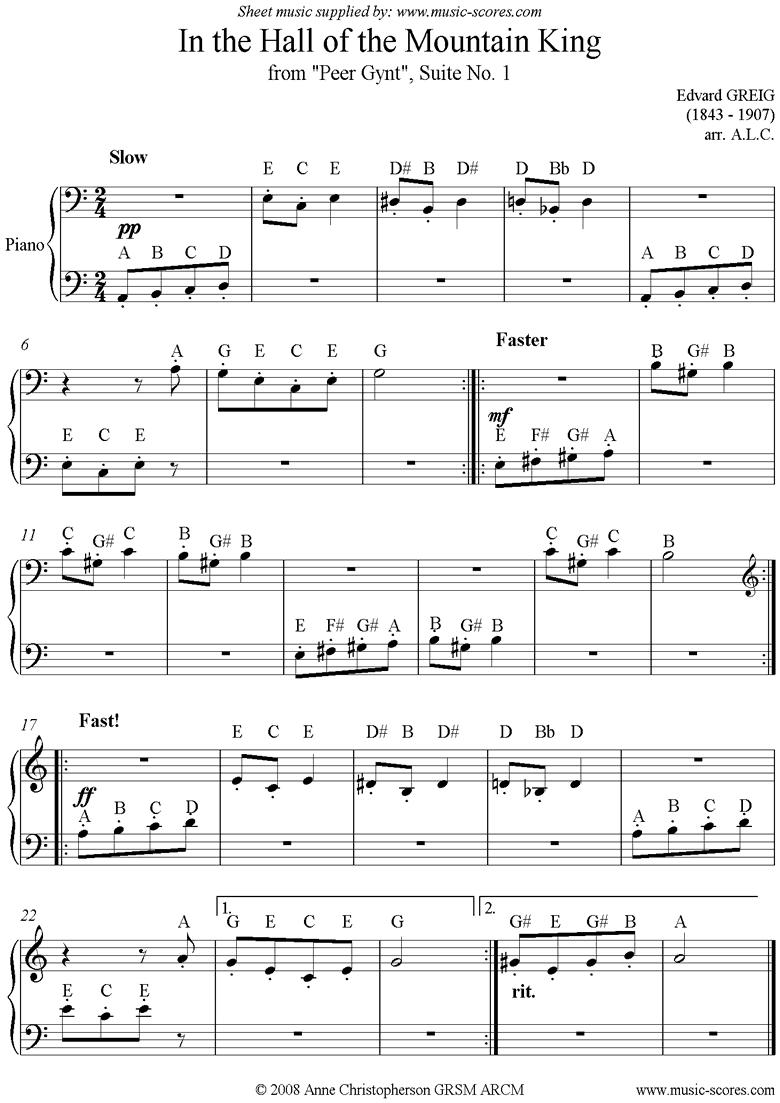
“In the Hall of the Mountain King” is a piece of orchestral music composed for the sixth scene of act 2 in Henrik Ibsen’s 1867 play Peer Gynt. It was originally part of Opus 23 but was later extracted as the final piece of Peer Gynt, Suite No. 1, Op. 46. Its easily recognizable theme has helped it attain iconic status in popular culture, where it has been arranged by many artists, including for the piano.

Borrow a copy of the sheet music from the O’Connor Music Studio.  I have this arranged for piano, duet, 2-piano, simplified…


8 part vocal orchestra (plus a tiny pair of cymbals)


Pianist Paul Barton


Solo piano sheet music – Video Score


Orchestral version