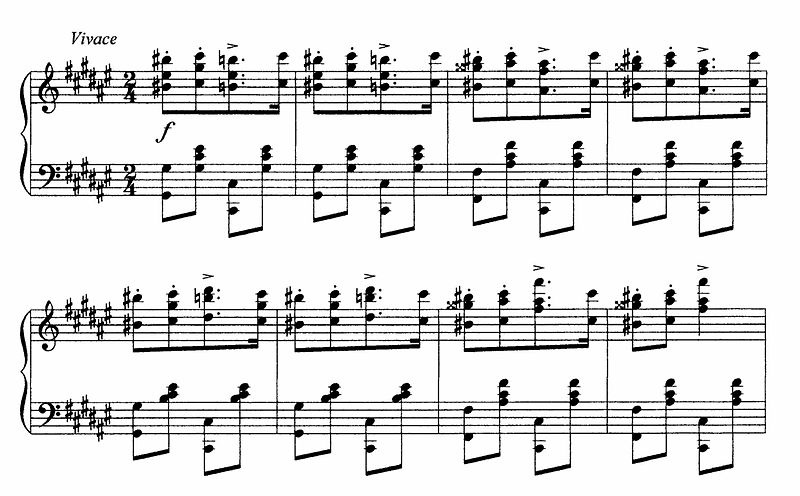
Hungarian Rhapsody No. 2, S.244/2, is the second in a set of 19 Hungarian Rhapsodies by composer Franz Liszt, and is by far the most famous of the set. Few other piano solos have achieved such widespread popularity, offering the pianist the opportunity to reveal exceptional skill as a virtuoso, while providing the listener with an immediate and irresistible musical appeal.
In both the original piano solo form and in the orchestrated version this composition has enjoyed widespread use in animated cartoons. Its themes have also served as the basis of several popular songs.
It is probable that you have heard this piece of music somewhere at one time or another because it is perhaps the most prominent piece of classical (romantic, actually) music featured in animated cartoons across the years.
Now, let the anvils fall and dynamite explode!
And, in real life, Valentina Lisitsa plays Liszt’s Hungarian Rhapsody No. 2
Hungarian Rhapsody No. 2, S.244/2, is the second in a set of 19 Hungarian Rhapsodies by composer Franz Liszt, and is by far the most famous of the set. Few other piano solos have achieved such widespread popularity, offering the pianist the opportunity to reveal exceptional skill as a virtuoso, while providing the listener with an immediate and irresistible musical appeal.
In both the original piano solo form and in the orchestrated version this composition has enjoyed widespread use in animated cartoons. Its themes have also served as the basis of several popular songs.
It is probable that you have heard this piece of music somewhere at one time or another because it is perhaps the most prominent piece of classical (romantic, actually) music featured in animated cartoons across the years.
Now, let the anvils fall and dynamite explode!
And, in real life, Valentina Lisitsa plays Liszt’s Hungarian Rhapsody No. 2
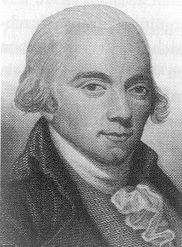
Today, in 1752, Muzio Clementi Italian pianist and composer was born.
More information about Clementi
Clementi was an Italian-born English composer, pianist, pedagogue, conductor, music publisher, editor, and piano manufacturer. Born in Rome, he spent most of his life in England.
Encouraged to study music by his father, he was sponsored as a young composer by Sir Peter Beckford who took him to England to advance his studies. Later, he toured Europe numerous times from his long-time base in London. It was on one of these occasions in 1781 that he engaged in a piano competition with Wolfgang Amadeus Mozart.
His student John Field would become a major influence on Frédéric Chopin
In 1802, Clementi and Field embarked on a European tour together. They went to Paris, Vienna and St. Petersburg.
John Field adopted the French word nocturne, meaning “of the night” and became the first composer to use this term in music. He wrote a series of short studies for solo piano which had a gently romantic late-night feeling about them.
Chopin soon took up this idea and wrote 21 nocturnes.
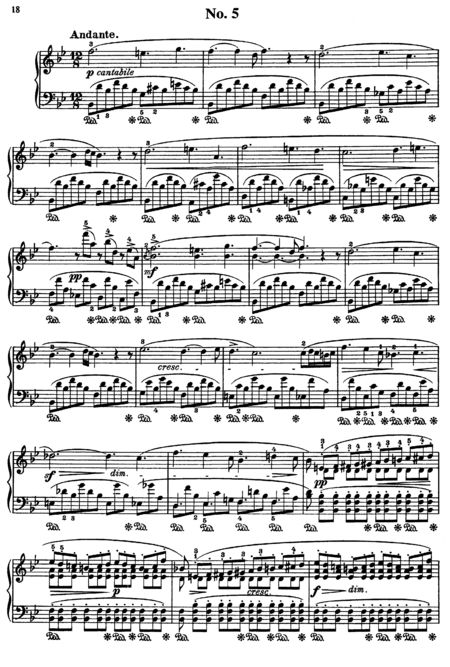
Compare: Field’s Nocturne No. 5 in B flat major
Chopin’s Nocturne E Flat Major Op.9 No.2 played by Valentina Lisitsa
Today, in 1837, Clementi’s student John Field died. Field was an Irish pianist, composer, and teacher. He was very highly regarded by his contemporaries and his playing and compositions influenced many major composers, including Frédéric Chopin, Johannes Brahms, Robert Schumann, and Franz Liszt.
Hungarian Rhapsody No. 2, S.244/2, is the second in a set of 19 Hungarian Rhapsodies by composer Franz Liszt, and is by far the most famous of the set. Few other piano solos have achieved such widespread popularity, offering the pianist the opportunity to reveal exceptional skill as a virtuoso, while providing the listener with an immediate and irresistible musical appeal.
In both the original piano solo form and in the orchestrated version this composition has enjoyed widespread use in animated cartoons. Its themes have also served as the basis of several popular songs.
It is probable that you have heard this piece of music somewhere at one time or another because it is perhaps the most prominent piece of classical (romantic, actually) music featured in animated cartoons across the years.
Now, let the anvils fall and dynamite explode!
And, in real life, Valentina Lisitsa plays Liszt’s Hungarian Rhapsody No. 2
Hungarian Rhapsody No. 2, S.244/2, is the second in a set of 19 Hungarian Rhapsodies by composer Franz Liszt, and is by far the most famous of the set. Few other piano solos have achieved such widespread popularity, offering the pianist the opportunity to reveal exceptional skill as a virtuoso, while providing the listener with an immediate and irresistible musical appeal.
In both the original piano solo form and in the orchestrated version this composition has enjoyed widespread use in animated cartoons. Its themes have also served as the basis of several popular songs.
It is probable that you have heard this piece of music somewhere at one time or another because it is perhaps the most prominent piece of classical (romantic, actually) music featured in animated cartoons across the years.
Now, let the anvils fall and dynamite explode!
And, in real life, Valentina Lisitsa plays Liszt’s Hungarian Rhapsody No. 2


 MaryO'Studio