November 1 ~ in Music History

today


OCMS 1830 ~ Frederic Chopin left Warsaw for Paris, never to return. He was presented a cup of Polish soil on this day.
More about Chopin

.1902 ~ Eugen Jochum, German conductor

.1921 ~ Jan Tausinger, Rumanian-born Czech violist, conductor and composer

.1923 ~ Victoria de Los Angeles, Spanish soprano

.1926 ~ Lou Donaldson, Alto saxophone, singer

.1937 ~ ‘Whispering’ Bill (James) Anderson, Songwriter, singer

.1940 ~ Barry Sadler, Songwriter, singer

.1944 ~ Keith Emerson, Keyboards with Emerson, Lake & Powell as well as Emerson, Lake & Palmer

.1944 ~ Chris Morris, Guitarist with Paper Lace

.1945 ~ Rick Grech, Bassist, violinist

.1950 ~ Dan Peek, Guitarist, singer with America

.1951 ~ Ronald Bell, Saxophone with Kool & The Gang

.1957 ~ Lyle Lovett, Grammy Award-winning singer, Best Male Country Vocal in 1989

.1959 ~ Eddie MacDonald, Bass with The Alarm

.1962 ~ Rick Allen, Drummer with Def Leppard

.1962 ~ Mags Furuholmen, Keyboards, singer with a-ha

.1968 ~ George Harrison’s soundtrack LP, “Wonderwall”, was released. It was the first solo album by one of The Beatles. The album was also the first on the new Apple label.

.1969 ~ Warner Brothers Records added Faces, to its roster. They fared OK, but even better when lead singer Rod Stewart stepped out to become a superstar on his own. The group’s former label, Mercury, capitalized on the fact by releasing Maggie Mae and three other Faces tunes before Stewart went solo for Warner exclusively.

.1969 ~ The last album of The Beatles reached #1 on the album chart. “Abbey Road” was the top LP for eleven nonconsecutive weeks.  The final studio recordings from the group featured two songs; ‘Something’ & ‘Here Comes The Sun’. The cover supposedly contained clues adding to the ‘Paul Is Dead’ phenomenon: Paul is barefoot and the car number plate ‘LMW 281F’ supposedly referred to the fact that McCartney would be 28 if he was still alive. ‘LMW’ was said to stand for ‘Linda McCartney Weeps.’

OCMS 1975 ~ Elton John’s Island Girl hit number one on the Billboard Hot 100 chart. The song parked itself at the top of the hit heap for 3 weeks.

.1979 ~ Andrew Lloyd Webber & Tim Rice’s musical “Joseph and the Amazing Technicolor Dreamcoat” premiered

October 31 ~ in Music History

Happy Halloween

Halloween (All Hallow’s Eve) is an ancient celebration dating back to the sixth or seventh centuries. This holiday combines the Druid autumn festival and the Christian celebration of Hallowtide, long associated with witches, ghosts, devils, spirits, magic … and all scary things that go bump in the night.

• 1896 ~ Ethel Waters, American blues and jazz singer

• 1906 ~ Louise Talma, American composer

• 1912 ~ Dale Evans (Frances Butts), Singer, songwriter of Happy Trails to You, actress, wife of ‘King of the Cowboys’ Roy Rogers

• 1922 ~ Illinois (Battiste) Jacquet, Tenor saxophone, played with Lionel Hampton, Cab Calloway, Count Basie

• 1927 ~ Anita Kerr, Pianist, singer, record producer, The Anita Kerr Singers, composer

• 1930 ~ In a rare recording, William ‘Count’ Basie sang with Bennie Moten’s orchestra, Somebody Stole My Gal, on Victor.

• 1934 ~ Tom Paxton, American folk singer, guitarist and songwriter

• 1947 ~ Russ Ballard, Singer, songwriter, guitar with Argent

• 1952 ~ Bernard Edwards, Bass with Chic

• 1953 ~ NBC televised “Carmen” on Opera Theatre in living color. It was the first major opera televised in anything other than black and white.

• 1956 ~ Tony Bowers, Bass with Simply Red

• 1961 ~ Larry Mullen, Grammy Award-winning drummer, with U2

• 1963 ~ Johnny Marr, Guitarist with The Smiths

• 1972 ~ Curtis Mayfield received a gold record for Freddie’s Dead from the movie, Superfly.

• 1984 ~ Caribbean Queen became a gold record for Billy Ocean. It was Ocean’s second hit song and the only one of his 11 hits to become a million-seller. He would have two other #1 songs and a pair of #2 hits, but none as big as Caribbean Queen (No More Love on the Run). Billy’s from Trinidad, and his real name is Leslie Sebastian Charles.


maryorednpurplewitch

Just in Time for Halloween: Toccata and Fugue in d minor by J.S Bach

toccata-d-minor


Johann Sebastian Bach’s towering monument of organ music, with its deep sense of foreboding, will forever be associated with Halloween.

Get a free copy of the sheet music at IMSLP or borrow a copy from the O’Connor Music Studio.  I have this arranged for organ, piano, duet, 2-piano, simplified…

If you want this in a book with other Bach transcriptions, amazon has this: Toccata and Fugue in D Minor and the Other Bach Transcriptions for Solo Piano, arranged by Ferruccio Busoni.

Here, Virgil Fox performs it on his Allen Digital Touring Organ.


Diane Bish plays the Massey Memorial Organ at the Chautauqua Institution and talks about this instrument.


And, the most fun…

October 27 ~ in Music History

today

OCMS 1782 ~ Niccolò Paganini, Italian violin virtuoso and composer
Read quotes by and about Paganini
More information about Paganini

• 1796 ~ Anton Thadäus Johann Nepomuk Stamitz, German composer

• 1908 ~ George Feyer, Pianist and entertainer, born in Budapest

• 1917 ~ Jascha Heifetz made his debut at Carnegie Hall in New York City. Heifetz was a 16-year-old sensation who had played the violin since age 5.

• 1927 ~ Dominick Argento, American composer

• 1933 ~ Floyd Cramer, Pianist

• 1941 ~ Edda Moser, German soprano

• 1941 ~ Everything I Love, by Buddy Clark, was recorded this day, number 6469 on the Okeh label.

• 1943 ~ Lee (Melvin) Greenwood, CMA Male Vocalist of the Year, 1983 and 1984, sax, piano, bandleader

• 1957 ~ The Crickets started a three-week run at No.1 on the UK singles chart with ‘That’ll Be The Day’. It was also a No.3 hit in the US where it went on to sell over a million. The song was inspired by a trip to the movies by Holly, Jerry Allison and Sonny Curtis in June 1956. The John Wayne film The Searchers was playing and Wayne’s frequently-used, world-weary catchphrase, “that’ll be the day” inspired the young musicians.

• 1958 ~ Simon LeBon, Singer with Duran Duran

• 1960 ~ Singer Ben E. King recorded “Spanish Harlem” & “Stand By Me”

• 1975 ~ Rocker Bruce Springsteen appeared on the cover of both TIME and Newsweek. Things were certainly going well for ‘The Boss’ that week.

• 2000 ~ Walter Berry, a bass-baritone who won acclaim for his interpretations of Mozart and Strauss and was beloved by Austrians for his renditions of Schubert, died of a heart attack at the age of 71. Known for the powerful timbre of his voice, Berry was a prolific performer who sang 100 different roles in more than 1,280 appearances at the Vienna State Opera. His U.S. debut was a 1963 performance with the Metropolitan Opera in New York. His interpretations of classical lieder by fellow Austrian Franz Schubert won him his most loyal following. Austrians who rarely went to the opera loved Berry for his renditions of popular Viennese songs performed as they believed only a native- born son could. In 1989, he became a professor at the Vienna University for Music and Performing Arts.

• 2001 ~ John Roberts, a promoter of the Woodstock Music and Art Fair in 1969, died of cancer. He was 56. Roberts produced the festival concert with three others, almost by accident. The idea originally was a pitch for a television comedy show about two young venture capitalists with money but no business plans. Roberts and his partners funded the festival with Roberts’ inheritance and ticket sales. They lost $2.3 million but recovered their loss with royalties from film and album spinoffs, and held on to the profitable name and trademark symbol of a dove on the neck of a guitar. A graduate of the University of Pennsylvania, Roberts later invested in other companies, avoiding the music business. Roberts also was a championship bridge player.

• 2006 ~ Amy Winehouse released her second and final studio album Back to Black. The album spawned five singles: ‘Rehab’, ‘You Know I’m No Good’, ‘Back to Black’, ‘Tears Dry on Their Own’ and ‘Love Is a Losing Game’ and won Best Pop Vocal Album at the 50th Annual Grammy Awards. Back to Black sold 3.58 million copies in the UK alone, becoming the UK’s second best-selling album of the 21st century. Worldwide, the album has sold over 20 million copies.

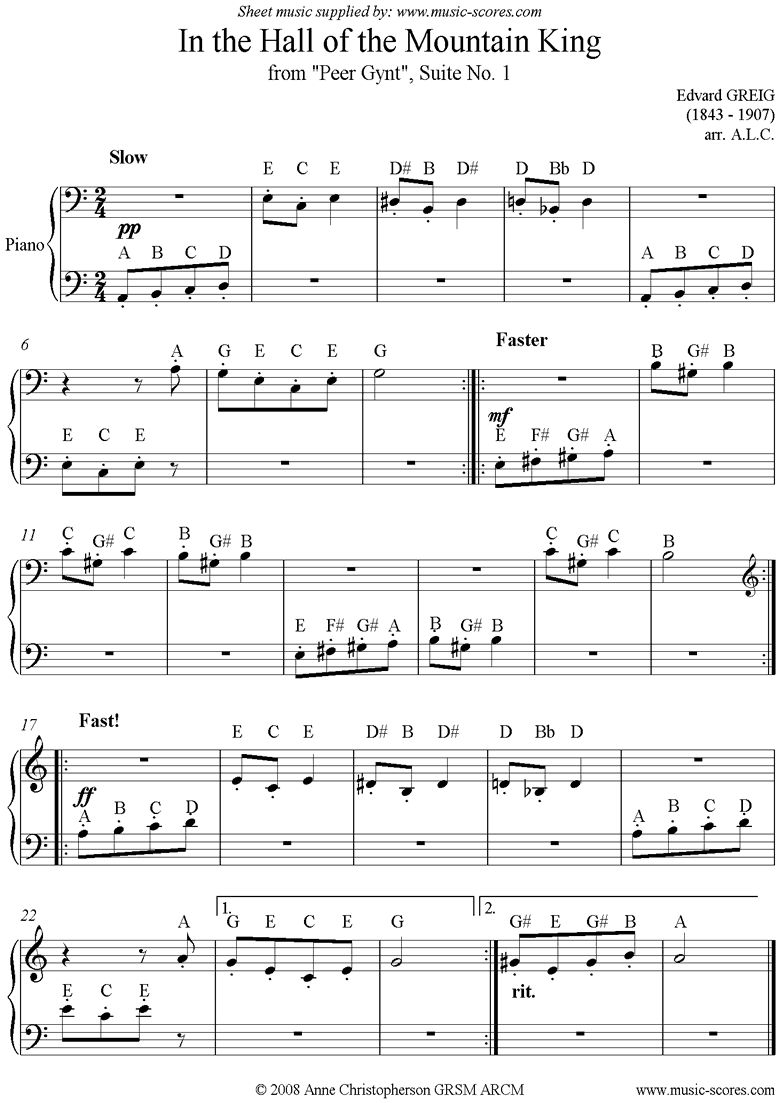
Just in Time for Halloween: In the Hall of the Mountain King by Edvard Grieg

hall-mountain


“In the Hall of the Mountain King” is a piece of orchestral music composed for the sixth scene of act 2 in Henrik Ibsen’s 1867 play Peer Gynt. It was originally part of Opus 23 but was later extracted as the final piece of Peer Gynt, Suite No. 1, Op. 46. Its easily recognizable theme has helped it attain iconic status in popular culture, where it has been arranged by many artists, including for the piano.

Borrow a copy of the sheet music from the O’Connor Music Studio.  I have this arranged for piano, duet, 2-piano, simplified…


8 part vocal orchestra (plus a tiny pair of cymbals)


Pianist Paul Barton


Solo piano sheet music – Video Score


Orchestral version

A Special Chamber Music Recital

Community Concert Event

featuring
Nikita Fitenko (piano)
Katerina Zaitseva (piano)
Lucia Margherita Marino (clarinet)
& Tamara Bairo (viola)
The Jordan Kitt’s Music Community Concert Series presents another exceptional event featuring internationally acclaimed local pianists Nikita Fitenko and Katerina Zaitseva along with Italian instrumentalists and recording artists Lucia Margherita Marino (clarinet) and Tamara Bairo (viola) in a chamber music recital.
The program includes the beloved Mozart “Kegelstatt” K.488 Trio for Clarinet, Viola, and Piano as well as other chamber music works by Teleman and Poulenc.
Nikita Fitenko, D.M.A., is a Yamaha Artist and Chair of the Music Performance Department at the Rome School of Music, Drama, and Art (Catholic University of America).
Katerina Zaitseva, D.M.A., is on the piano faculty at Levine Music. Lucia Margherita Marino and Tamara Bairo are members of the Turin Philharmonic Orchestra and are currently on tour in the United States.


For more information, call (703) 573-6070
Jordan Kitt’s Music, 8500 Lee Highway, Fairfax, VA 22031

October 22 ~ in Music History

today

OCMS 1811 ~ Franz Liszt, Hungarian composer and pianist
Read quotes by and about Franz Liszt
More information about Liszt

• 1885 ~ Giovanni Martinelli, Opera singer, tenor with Metropolitan Opera for 30 seasons

• 1904 ~ Paul Arma, Hungarian composer and theorist

• 1917 ~ Leopold Stokowski led the Philadelphia Orchestra in its first recording session, for Victor Records.

• 1930 ~ Dory Previn, Songwriter with André Previn

• 1939 ~ Ray Jones, Bass with Billy J. Kramer & The Dakotas

• 1943 ~ Paul Zukofsky, American violinist

• 1943 ~ Bobby Fuller, Singer, guitarist with Bobby Fuller Four

• 1945 ~ Leslie West (Weinstein), Singer, musician, guitarist with Mountain

• 1945 ~ Eddie Brigati, Singer, a musician with The (Young) Rascals

• 1959 ~ “Take Me Along” opened on Broadway and quickly became an American classic. Walter Pidgeon starred along with Jackie Gleason.

• 1966 ~ The Supremes rocketed to the top of the pop album charts with “Supremes A’ Go-Go”. They were the first all-female vocal group to hit the top of the LP chart.

• 1969 ~ Giovanni Martinelli passed away on his birthday

• 1969 ~ Michael Tilson Thomas, the 25-year-old assistant conductor of the Boston Symphony Orchestra, took over for ailing conductor William Steinberg in the symphony’s appearance in New York City.

• 1971 ~ Folk singer Joan Baez received a gold record for her hit, The Night They Drove Old Dixie Down. It turned out to be her biggest hit, peaking at #3 on the charts on October 2, 1971.

• 1979 ~ Nadia Boulanger, French composer and conductor (1st woman to conduct Boston Symphony), died at the age of 92

• 1983 ~ Celebrating its 100th anniversary, New York’s Metropolitan Opera featured a daylong concert with some of the world’s greatest opera stars. On stage at the Met were Dame Joan Sutherland, Placido Domingo and Luciano Pavarotti.

• 2001 ~ Tom Baker, one of Australia’s most respected jazz musicians, died of a heart attack while touring in the Netherlands. He was 49. Baker, a native of California, took up residence in Australia 30 years ago. He was a regular at Sydney’s famous jazz club, The Basement. Willie Qua, drummer and co-founder of one of Australia’s best-known jazz bands, Galapagos Duck, said Baker had often played as “a part-time member” of the band and was an icon of the Sydney jazz scene. Baker formed his first band, Tom Baker’s San Francisco Jazz Band, in 1975, earning himself a reputation as one of Australia’s very best jazz musicians. Recently he toured extensively through Europe and America.

Franz Liszt’s Birthday!

liszt-quote

Franz Liszt was born in Raiding, near Ödenburg, October 22, 1811 and died in Bayreuth, July 31, 1886. He was a Hungarian composer and pianist who was a major influence during the romantic period. Liszt was an outstanding pianist at seven, composed at eight and made concert appearances at nine. In addition to being a piano virtuoso, he was also a critic, conductor, city music director, literary writer and transcriber of the works of other composers. He transcribed Beethoven’s Symphonies for the piano.

Franz Liszt began his career as the outstanding concert pianist of the century, who, along with the prodigious violinist Niccoló Paganini (1782-1840), created the cult of the modern instrumental virtuoso. To show off his phenomenal and unprecedented technique, Liszt composed a great deal of music designed specifically for this purpose, resulting in a vast amount of piano literature laden with dazzling, and other technical marvels. In this vein, Liszt composed a series of virtuosic rhapsodies on Hungarian gypsy melodies, the best-known being the all too familiar Hungarian Rhapsody no. 2. Liszt developed the rhapsody as a form of serious music. This kind of music is worlds apart from the generally more introspective, poetic music of pianist-composer Frédéric Chopin.

Liszt was wildly handsome and hugely talented. He was extremely popular in Paris during the 1830’s. It is said that women actually fainted at his piano recitals. He was the first to position the piano so that its lid reflected the sound and the audience could see his profile as he performed.

Liszt was the first to write a tone poem, which is an extended, single-movement work for orchestra, inspired by paintings, plays, poems or other literary or visual works, and attempting to convey the ideas expressed in those media through music. Such a work is Les Préludes, based on a poem in which life is expressed as a series of struggles, passions, and mysteries, all serving as a mere prelude to . . .what? The Romantic genre of the symphonic poem, as well as its cousin the concert overture, became very attractive to many later composers, including Saint-Saëns, TchaikovskyDvorák, Sibelius, and Richard Strauss.


     Liszt’s birthday

     anniversary of Liszt’s death

    Listen to Liszt’s transcription of Meyerbeer’s Hellish Waltz from Robert du Diable, which probably caused more public commotion than any other piano piece in history.


     Read quotes by and about Liszt

     Liszt was the first recitalist

     In Praise of Pianos and the Artists Who Play Them

     History of the Piano

     Franz Liszt

October 21 ~ in Music History

today

• 1885 ~ Egon Wellesz, Austrian composer and musicologist

• 1907 ~ The “Merry Widow” opened in New York. The play starred Ethel Jackson and Donald Brian. The operetta had been introduced in Europe two years before.

• 1908 ~ A Saturday Evening Post advertisement offered a chance to buy, for the first time, a two-sided record. It was on Columbia.

• 1912 ~ Sir Georg Solti, Hungarian-born British conductor, Chicago Symphony Orchestra. He conducted the first complete recording of Wagner’s “Der Ring des Nibelungen”.

OCMS 1917 ~ Dizzy (John Birks) Gillespie, American jazz trumpeter and bandleader Read quotes by and about “Dizzy” Gillespie
More information about Gillespie

• 1921 ~ Sir Malcolm Arnold, Composer of screen scores: “David Copperfield”, “The Chalk “Garden”, “Suddenly, Last Summer”, “Solomon and Sheba”, “Island in the Sun”, “The Bridge on the River Kwai”, “Trapeze”, “I Am a Camera”, “The Belles of St. Trinian’s” “the Eye Witness series”

• 1924 ~ It was a big night for a big band in New York’s Cinderella Ballroom. The crowd loved the Wolverine Orchestra from Chicago and the guy on the cornet, Bix Beiderbecke, the ‘young man with a horn’.

• 1938 ~ Quaker City Jazz was recorded on the Bluebird label by Jan Savitt’s orchestra. The tune would become the theme of the band. It was not, however, recorded in the Quaker City of Philadelphia. The song was waxed in New York City.

• 1940 ~ Manfred Mann (Michael Lubowitz), Singer with Mann-Hugg Blues Brothers

• 1941 ~ Steve Cropper, Guitarist with the groups: Blues Brothers as well as Booker T and The MG’s

• 1942 ~ Elvin Bishop, Guitarist, singer with Paul Butterfield Blues Band

• 1943 ~ Ron Elliott, Guitarist with Beau Brummels

• 1946 ~ Lee Loughnane, Brass with Chicago

• 1953 ~ Charlotte Caffey, Guitar, singer with The Go-Gos

• 1955 ~ Eric Faulkner, Guitarist with Bay City Rollers

• 1957 ~ Julian Cope, Bass, guitar, singer

• 1957 ~ Steve Lukather, Guitarist with Toto

• 1958 ~ Orchestral strings were used for the first time in a rock and roll tune. Buddy Holly recorded It Doesn’t Matter Anymore, written by Paul Anka. Sadly, it would be Holly’s last studio session. The song wasn’t released until after his death in February of 1959.

• 2001 ~ George Feyer, a pianist and entertainer who played at some of New York’s top hotels, died at the age of 92. Feyer, who was known for setting pop lyrics to classical music, entertained the sophisticated Manhattan cafe society for three decades. He played for decades at the Carlyle, the Stanhope and the Waldorf-Astoria. He made many recordings, including his Echoes album series, which featured Echoes of Paris and Echoes of Broadway. Born in Budapest on Oct. 27, 1908, Feyer attended the Franz Liszt Academy of Music, where he studied with composer Sir Georg Solti. One of his first jobs was playing for silent movies. During World War II, the Nazis put Feyer on forced labor details, then imprisoned him in the Bergen-Belsen concentration camp for the final year of the war. Feyer and his family moved to New York in 1951. He stopped working full time in 1982.

Jelly Roll Morton’s Birthday

jelly-grandpa


Jelly Roll Morton, born Ferdinand Joseph La Menthe in 1885, was one of the most influential composers of the jazz era, bridging an important gap between ragtime, blues, and jazz. In a sense, he was the first great jazz composer.

His career began in New Orleans, where he began to experiment with a unique blend of blues, ragtime, Creole, and Spanish music in bordellos as a piano player. Along with being a musician, he also worked as a gambler, pool shark, vaudeville comedian, and was known for his flamboyant personality and diamond front tooth.

Morton became successful when he started making what would be some of the first jazz recordings in 1923 with “the New Orleans Rhythm Kings”. Whether he played on the West Coast, New Orleans, or in Chicago, his recordings were always very popular. He joined the group “the Red Hot Peppers” in 1924 and made several classic albums with the Victor label.

Nothing but success came to him until 1930, when “Hot Jazz” began to die out, and big bands began to take over. Morton died in 1941, claiming that a voodoo spell was the cause of his demise.


   anniversary of Morton’s death

  Read quotes by and about Morton