March 1 ~ Today in Music History

today


. 1810 ~ Frédéric Chopin, Polish composer and pianist
Read quotes by and about Chopin
More information about Chopin
Grammy winner

. 1826 ~ John Thomas, Welsh composer and harpist

. 1904 ~ Glenn Miller, American trombonist and bandleader
More information about Miller

. 1922 ~ Michael Flanders, Songwriter, comedian with the duo: Flanders and [Donald] Swann, made humorous mockery of English and American failings, died in 1975

. 1927 ~ Harry Belafonte, American calypso and folk singer, UNICEF goodwill ambassador, father of Shari Belafonte

. 1928 ~ Paul Whiteman and his orchestra recorded Ol´ Man River for Victor Records. The featured vocalist on the track was 29-year-old Paul Robeson. The song became an American classic.

. 1930 ~ Benny Powell, Jazz musician, trombone with the Ernie Fields band, Lionel Hampton, Count Basie veteran

. 1941 ~ FM Radio began in the U.S. when station W47NV in Nashville, TN started operations on this day. W47NV was the first commercial FM radio station to receive a license, some 20 years after its AM radio counterpart, KDKA in Pittsburgh. FM stands for ‘frequency modulation´ as opposed to ‘amplitude modulation´.

. 1941 ~ Downbeat magazine scooped the entertainment world with news that Glenn Miller’s renewed contract with Chesterfield Cigarettes was worth $4,850 a week (for three 15-minute programs).

. 1944 ~ Roger Daltrey, Singer with The Who

. 1968 ~ Country music stars Johnny Cash and June Carter got married on this day. Johnny walked down the aisle knowing that his 1956 hit, Folsom Prison Blues, was about to be redone for a June release. Cash has a daughter, Rosanne, (previous marriage) who became a country star in her own right in the 1980s.

. 1968 ~ Elton John’s first record, I’ve Been Loving You, was released by Philips Records in England. Philips, not realizing the potential of the soon-to-be superstar, released him in 1969, just prior to his teaming with lyricist Bernie Taupin. Elton then signed a contract with Uni Records and began to turn out what would become a string of more than 50 hits over the next 25 years.

. 1973 ~ The Robert Joffrey Dance Company opened with a unique presentation in New York City. The show featured music of the Beach Boys in “Deuce Coupe Ballet”. A clever show, even if it didn’t do much to bring the masses to ballet.

. 1985 ~ A Beatles song was used for the first time in a U.S. TV commercial. The rights for Lincoln-Mercury to use the song, HELP!, cost $100,000, helping boost the fortunes of the Ford Motor Company. March has been designated as the “Music In Our Schools” month. Visit the National Association for Music Education website for exciting programmatic information.

. 2003 ~ Nadine Conner, a soprano who performed for nearly two decades at the Metropolitan Opera after singing on national radio, died. She was 96. Conner debuted at the Met in 1941 as Pamina in Mozart’s “The Magic Flute,” conducted by Bruno Walter. She performed there 249 times over 18 seasons. She won acclaim not only for her Mozart roles, including Zerlina in “Don Giovanni” and Susanna in “The Marriage of Figaro,” but also for her portrayals of Violetta in Verdi’s “La Traviata,” Mimi inPuccini’s “La Boheme,” Gilda in Verdi’s “Rigoletto,” and Rosina in Rossini’s “The Barber of Seville.” Conner began her career singing on national radio from Los Angeles, and appeared with such stars as Bing Crosby and Gordon MacRae and toured with film star Nelson Eddy. She joined a fledgling opera troupe in Los Angeles, making her debut as Marguerite in Gounod’s “Faust.” Her Met farewell, in 1960, also was in “Faust.”
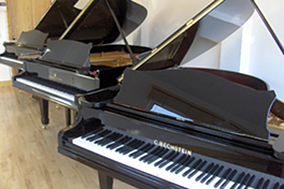
The Pitfalls And Perks Of Playing A Concert Hall Piano | Music | The Guardian

showroom284

Piano lore can be summarised thus: there are good and bad pianos. This is the basic fact in a pianist’s life. Both kinds are to be found in all sizes, from all manufacturers, at any price point. A concert grand costing more than £100,000 can be bad. Smaller can be better than larger, but between two good pianos, the sound of the larger will be richer and more present.

One can get used to any piano, even when the instrument is terrible, but the better the piano, the less time is required, and vice versa. Spending time with a good piano is rewarding: there is always something more to discover in its tone. A bad piano functions in what-you-see-is-what-you-get mode, producing the same sound even after hours of practice. And each piano is unique. Manufacturing involves hundreds of processes and adjustments, most done by hand, all affecting the final tone. As a result two pianos of the same model, made in the same year, will sound different to the untrained ear, despite their outward sameness. The contrast in sound between different models, or between pianos made in different years or from different companies will be even more apparent.

Read more at The pitfalls and perks of playing a concert hall piano | Music | The Guardian.

February 26 ~ Today in Music History

today

. 1770 ~ Anton Reicha, Czech-born, later naturalized French composer of music very much in the German style

. 1802 ~ Victor Hugo, author of Les Miserables and many other works

. 1879 ~ Frank Bridge, English composer, violist and conductor

. 1922 ~ Dancing to jazz music and tango bands was criticized in Paris. It seems that dancing was detracting the French from their postwar reconstruction, according to “La Revue Mondiale”.

. 1928 ~ “Fats” (Antoine) Domino, American rock-and-roll pianist and singer. His works include: Ain’t That a Shame, Goin’ Home, I’m in Love Again, Blue Monday, I’m Walkin’ and Blueberry Hill

. 1930 ~ Lazar Berman, Soviet pianist

. 1932 ~ Johnny Cash, American country-music singer guitarist and songwriter. He is married to June Carter. Some of his songs are: Folsom Prison Blues, I Walk the Line,Don’t Take Your Guns to Town, A Boy Named Sue and Ring of Fire. More information about Cash

. 1945 ~ Mitch Ryder (William Levise), Singer with Mitch Ryder & the Detroit Wheels

. 1947 ~ Sandie Shaw (Goodrich), Singer

. 1950 ~ Jonathan Cain, Keyboard with Babys

. 1954 ~ Michael Bolton, Grammy Award-winning singer. Some of his songs are: When a Man Loves a Woman and How Am I Supposed to Live Without You

. 1961 ~ John-Jon (John Andrew Foster), Musician with Bronski Beat

. 1972 ~ Harry Nilsson started his second week at number one with that toe- tapping ditty, Without You. The whiny love song stayed at the top for a total of four weeks.

. 1977 ~ The Eagles’ New Kid in Town landed in the top spot on the pop music charts for one week beginning this day.

. 1981 ~ Howard Hanson died.  He was an American composer, conductor, educator, music theorist, and champion of American classical music.

. 1983 ~ Charley Pride’s Why Baby Why topped the country charts. The song was written by George Jones (who found national fame with his own version in 1955) and Darrell Edwards. Legend has it that inspiration for the song came when Edwards overheard a couple squabbling in their car in Orange, TX.

. 2003 ~ Otha Turner, 94, who created his own niche in blues music with an ethereal mix of early American colonial drums and West African flute, died in Como, Miss. His recording Everybody Hollerin’ Goat was rated among the Top 10 blues releases in 1997 by Rolling Stone magazine. Members of a Senegalese drum troupe performed with Mr. Turner on the album. Mr. Turner was presented with a National Endowment for the Arts Heritage Award, the Smithsonian Lifetime Achievement Award and the Charlie Patton Lifetime Achievement Award from the Mississippi Delta Blues and Heritage Festival.

February 25 ~ Today in Music History

today

. 1727 ~ Armand-Louis Couperin,  French composer, organist, and harpsichordist of the late Baroque and early Classical periods.


. 1890 ~ Dame Myra Hess, British pianist

. 1929 ~ Tommy Newsom, Musician: tenor sax, arranger, composer, back-up conductor for NBC’s Tonight Show Band

. 1943 ~  George Harrison, British rock singer, guitarist and songwriter and former member of  The Beatles group

. 1952 ~ The complete choreographic score of Cole Porter’s “Kiss Me Kate” became the first musical choreography score given a copyright. The work was the effort of Hanya Holm.

. 1953 ~ The musical, “Wonderful Town”, opened at the Winter Garden Theatre in New York City. The show was based on the book, “My Sister Eileen”, and the ran for 559 performances.

. 1957 ~ Buddy Holly and The Crickets traveled to Clovis, NM, to record That’ll Be the Day (one of the classics of rock ‘n’ roll) and I’m Looking for Someone to Love. Both songs were released on Brunswick Records in May of that year.

. 1963 ~ Please Please Me was the second record released in the U.S. by The Beatles. Some labels carried a famous misprint, making it an instant, and valuable, collector’s item. The label listed the group as The Beattles.

. 1966 ~ Nancy Sinatra was high-stepping with a gold record award for the hit, These Boots are Made for Walkin’.

. 1986 ~ We are the World captured four Grammy Awards. The song, featuring  more than 40 superstar artists gathered at one time, was awarded the Top Song, Record of the Year, Best Pop Performance and Best Short Video Awards.

. 2001 ~ Ann Colbert, a manager of classical musicians, died at the age of 95. Colbert founded Colbert Artists Management Inc. Her clientele included the Juilliard String Quartet; conductors Sir Georg Solti, Christoph von Dohnanyi and Richard Bonynge; singers Dame Joan Sutherland, Elizabeth Schwarzkopf, Christa Ludwig and Dietrich Fischer-Dieskau; and musicians Alfred Brendel and the late Jean-Pierre Rampal. Colbert moved to the United States from Berlin in 1936 and started the management company with her husband, Henry Colbert, in 1948. She retired in 1991, leaving the company to her longtime associate, Agnes Eisenberger. The company has retained Colbert’s name.

. 2003 ~ Walter Scharf, 92, a composer who earned 10 Academy Award nominations and worked on more than 200 movies and television programs, including “Funny Girl,” “Mission: Impossible” and “White Christmas,” died in Los Angeles. He received Oscar nominations for the scores for such films as “Mercy Island” (1941), “Hans Christian Andersen” (1952), “Funny Girl” (1968), “Willy Wonka and the Chocolate Factory” (1971) and “Ben” (1972). He won an Emmy for his work on a National Geographic television special and a Golden Globe for “Ben,” whose theme song helped launch singer Michael Jackson’s solo career.

February 24 ~ Today in Music History

today

. 1766 ~ Samuel Wesley, English organist and composer in the late Georgian period. Wesley was a contemporary of Mozart (1756–1791) and was called by some “the English Mozart.”

. 1771 ~ Johann Baptist Cramer,  English musician of German origin. He was the son of Wilhelm Cramer, a famous London violinist and musical conductor, one of a numerous family who were identified with the progress of music during the 18th and 19th centuries.

. 1832 ~ Frederic Chopin’s first Paris concert. The musicologist Arthur Hedley has observed that “As a pianist Chopin was unique in acquiring a reputation of the highest order on the basis of a minimum of public appearances—few more than thirty in the course of his lifetime.

. 1842 ~ Arrigo Boito, Italian composer, librettist and poet

. 1858 ~ Arnold Dolmetsch, British music antiquarian and musician

. 1932 ~ Michel Legrand, Academy Award-Winning composer for Best Original Score: Yentl in 1983, Brian’s Song, Ice Station Zebra

. 1934 ~ Renata Scotto, Italian soprano. She made her operatic debut at age 18 and is best known for performances as Violetta in La Traviata, Cio-Cio- San in Madama Butterfly, Mimi (and the occasional Musetta) in La Bohème, Lucia in Lucia di Lammermoor, Lady Macbeth in Macbeth and Francesca in Francesca da Rimini. She is also an opera director.

. 1940 ~ Frances Langford recorded one of the classic songs of all time — and one that would become a Walt Disney trademark. When You Wish Upon a Star was recorded on Decca Records during a session in Los Angeles. Many artists have recorded the song, including pop diva Linda Ronstadt (with the Nelson Riddle Orchestra in the early 1980s). One can hear the song not only on record, but as the theme in the opening credits of any Disney movie, video and TV program and those “I’m going to Disneyland/World!” commercials, too.

. 1942 ~ Paul Jones, Harmonica, singer with Manfred Mann

. 1947 ~ Rupert Holmes, Songwriter: over 300 songs & jingles, singer, producer

. 1947 ~ Lonnie Turner, Bass, singer with The Steve Miller Band

. 1964 ~ The musical, “What Makes Sammy Run”, opened in New York at the 54th Street Theatre. Making his Broadway debut in the show was Steve Lawrence. The production ran for 540 performances.

. 1985 ~ Yul Brynner reprised his role in “The King and I” setting a box office record for weekly receipts. The show took in $520,920.

. 1990 ~ Johnnie Ray died.  He was an American singer, songwriter, and pianist.

. 1991 ~ Webb Pierce passed away.  He was one of the most popular American honky tonk, rockabilly vocalists, guitarists of the 1950s

Piano versus violin: the eternal battle to be the dominant player

Piano_Violin


The thought-provoking talk on February 10th was given by Keith Pascoe, second violinist of the Vanbrugh Quartet, in connection with tomorrow night’s violin and piano recital by Ray Chen and Julien Quentin. Pascoe came up with a great title, David and Goliath, The Ballet of Unequals: A Stradivari and Model D Steinway Recital. Using videos from YouTube as illustrations (which unfortunately allowed in snippets of a couple of unwanted advertisements), Pascoe began at the beginning, with the emergence of the piano and violin as instruments in their own right, and traced some of the changes they have both undergone in the centuries since.

The piano has become bigger, stronger and louder. Not only were extra notes added to the keyboard, but the early wooden frames were replaced with cast iron. The violin may not have grown externally, but the shape of the body was remoulded, the neck and fingerboard realigned, and internal buttressing extended, all with the intention of producing greater sound.

What composers did with the combination of violin and piano – and before that, violin and harpsichord – changed too. In the typical baroque violin sonata, the violin was to the fore. In the classical era, the roles were reversed, although this reversal has long been dishonoured by performers. And in the 19th century, the balance as we know it today began to take hold. That balance usually presents the two performers in a master-servant relationship, the violinist usually the boss whose bidding is carried out by the pianist.

Read the entire article at Piano versus violin: the eternal battle to be the dominant player.

February 20 ~ Today in Music History

today


1791 ~ Carl Czerny, Austrian pianist and compose whose vast musical production amounted to over a thousand works. His books of studies for the piano are still widely used in piano teaching.
More information on Czerny

Czerny is in the center top of this image.  He influenced many!

Czerny is in the center top of this image. He influenced many!

. 1937 ~ Nancy Wilson, American jazz singer

. 1941 ~ Buffy (Beverly) Sainte-Marie, Singer, songwriter, married to Jack Nitzsche

. 1940 ~ Christoph Eschenbach, German pianist and conductor

. 1940 ~ Larry Clinton and his orchestra recorded Limehouse Blues on Victor Records.

. 1946 ~ Sandy Duncan, Dancer, actress

. 1946 ~ J. (Jerome) Geils, Guitarist with The J. Geils Band

. 1950 ~ Walter Becker, Bass, guitarist with Steely Dan

. 1951 ~ Randy California (Wolfe), Singer, guitarist with Spirit

. 1963 ~ Ian Brown, Singer with Stone Roses

. 1974 ~ After a decade of marriage, Cher filed for separation from husband Sonny Bono. Not long afterwards, she filed for divorce and the accompanying alimony. This time she sang, I Got You Babe, for real … before becoming a successful solo singer and movie actress in films such as “Moonstruck” (Best Actress Oscar in 1987).

. 1975 ~ Brian (Thomas) Littrell, Singer with Backstreet Boys

. 1982 ~ Singer Pat Benatar married musician-producer Neil Geraldo in Hawaii.

It’s Never Too Late to… Take Up Piano – Telegraph

Schubert took piano lessons aged six, but don't let that put you off

Lionel Kelly, 78, may have come late to the piano – he took it up at the age of 73 – but it’s changed his life. “I first heard Mahler performed in London in the mid-50s, when he became very popular over here,” he says. “I’m currently working on a piano transcription of the Adagietta from his Symphony No. 5. It’s a beautiful piece of music, slow and passionate, and was used in Luchino Visconti’s 1971 film of Thomas Mann’s novella, Death in Venice. To be able to play Mahler now, all these years later, is a real treat.”

Kelly, formerly director of American Studies at Reading University, practises up to four hours a day. He has lessons in Reading with Janet Sherbourne, whom he describes as “an excellent, if strict, teacher”, and is not taking grades. “Janet reckons I’m somewhere between grade four and five level, but I’m just doing it for pleasure, because I want to learn and play,” he says.

Bach, Beethoven and Mozart are among other composers tackled by Kelly…

Read the entire article at It’s Never Too Late to… Take Up Piano – Telegraph.

February 19 ~ Today in Music History

today


. Luigi Boccherini, Italian composer
More information on Boccherini

boccherini-minuet


. 1878 ~ Thomas Alva Edison, famed inventor, patented a music player at his laboratory in Menlo Park, NJ. This music device is the one we know as the phonograph. Edison paid his assistant $18 to make the device from a sketch Edison had drawn. Originally, Edison had set out to invent a telegraph repeater, but came up with the phonograph or, as he called it, the speaking machine.

. 1902 ~ John Bubbles (John William Sublett), An actor: Porgy and Bess (1935 Broadway version), films: Cabin in the Sky, Variety Show, A Song Is Born, No Maps on My Taps; dancer: credited with creating ‘rhythm tap’

. 1912 ~ Stan Kenton, American jazz pianist, composer and Grammy Award-winning bandleader

. 1927 ~ Robert Fuchs, Austrian composer and music teacher. As Professor of music theory at the Vienna Conservatory, Fuchs taught many notable composers, while he was himself a highly regarded composer in his lifetime.

. 1940 ~ “Smokey” Robinson, American rhythm-and-blues singer and songwriter

. 1942 ~ If there was ever such a thing as a jam session, surely, this one was it: Tommy Dorsey and his orchestra recorded I’ll Take Tallulah (Victor Records). Some other musical heavyweights were in the studio too, including Frank Sinatra, Jo Stafford and the Pied Pipers, Ziggy Elman and drummer extraordinaire, Buddy Rich.

. 1981 ~ George Harrison was ordered to pay ABKCO Music the sum of $587,000 for “subconscious plagiarism” between his song, My Sweet Lord and the Chiffons early 1960s hit, He’s So Fine.

Pianist uses music to help those suffering from brain conditions | abc7.com

Legendary Pianist Mike Garson took his talents from the stage to the studio to compose songs for people suffering from Parkinson’s and Alzheimer’s disease.

Anaheim Hills resident Nancy Dufault needs a walker to get around because her body is stiff and she often suffers from tremors. It has gotten worse over the last 20 years since she was first diagnosed with Parkinson’s disease.

The disease causes nerve cells in the brain to die, which affects a person’s movement.

“Balance is always an issue and I tend to have a lot of falls,” she said.

Parkinson’s has been especially tough on Nancy because she and her husband Bob own a dance studio. She said she has tried different medications, and she’s even had brain surgery.

But the Dufaults said there is only one therapy that actually works.

http://abc7.com/video/embed/?pid=520782

Read more at Pianist uses music to help those suffering from brain conditions | abc7.com.