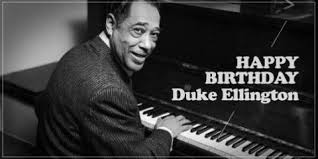
Duke Ellington’s Birthday

ellington-bd
Duke Ellington (1899 to 1974) was a composer, bandleader, and pianist. He was born Edward Kennedy Ellington in Washington, D.C.

From an early age, the handsome, sharply dressed teenager (that’s where he got the nickname, Duke) was headed for success. At first it was art. He won a poster-design contest and an art scholarship, left school and started a sign-painting business. But it was his natural piano-playing ability that attracted the young women, so Duke Ellington headed in that direction. He developed his keyboard skills by listening to local black ragtime pianists; he composed his first piece, Soda Fountain Rag, around 1915. A successful professional musician by the early 1920s, he left Washington in the spring of 1923 for New York, which was his home base for the rest of his life. Between December 1927 and 1931 his orchestra held forth at Harlem’s Cotton Club, where regular radio broadcasts, together with an active recording schedule, helped him establish a nationwide reputation. Take the “A” Train was his “signature song”.

In such compositions as Black and Tan Fantasy (1927), Mood Indigo (1930),Solitude (1934), and Echoes of Harlem (1935), Ellington emerged as a distinctive composer for his ensemble, employing the rhythms, harmonies, and tone colors of jazz to create pieces that vividly captured aspects of the African-American experience. At the same time, he sought to broaden jazz’s expressive range and formal boundaries in such extended works asReminiscing in Tempo (1935), Black, Brown, and Beige (1943), and Harlem(1951).

An essential feature of Ellington’s composing method was to write with specific instrumentalists in mind, often drawing them into the creative process by building entire pieces out of their musical ideas.

He wrote scores for big band pieces, film scores, operas, ballets, Broadway shows, gospel music, musicals, films, television, and ballet and in the 1960s produced a series of sacred concerts combining his orchestra, choirs, vocalists, and dancers. He would work with each section of his orchestra as an entity unto its own and then bring them together to create the unique sounds such as, Mood Indigo. Over 1,000 musical pieces are credited to the great Duke Ellington. James Lincoln Collier studied the Duke and his Orchestra, comparing Duke Ellington to a “master chef who plans the menus, trains the assistants, supervises them, tastes everything, adjusts the spices … and in the end we credit him with the result.”

Ellington was successful, as few others have been, in reconciling the practical function of a popular entertainer with the artistic aspirations of a serious composer. His rich legacy consists of hundreds of recordings, his many pieces that have entered the standard repertory, and his musical materials now preserved in the Duke Ellington Collection at the Smithsonian Institution. There is a statue of Duke Ellington in New York.

 Ellington’s birthday

 anniversary of Ellington’s death

Ellington’s works were played in an Grammy Winning performance, Forty-Second Annual Awards

Read quotes by and about Ellington

 News Item about Ellington

April 29 in Music History

today


OCMS 1879 ~ Sir Thomas Beecham, English conductor. Founded the Royal Philharmonic Orchestra in 1947 and did much to promote the works of Delius, Sibelius and Richard Strauss.
Read quotes by and about Beecham

. 1895 ~ Sir Malcolm Sargent, English conductor, born. He was in charge of the Liverpool Philharmonic Orchestra from 1942 until 1948 and of the BBC Symphony Orchestra from 1950 until 1957.

OCMS 1899 ~ Duke Ellington, American jazz pianist, bandleader and composer
Read quotes by and about Ellington
More information about Ellington
Grammy winner

. 1913 ~ Donald Mills, Singer with The Mills Brothers.

. 1925 ~ Danny Davis (George Nowland), Grammy Award-winning bandleader with Danny Davis and the Nashville Brass. Best Country Instrumental Performance in 1969, Country Music Awards Instrumental Group of the Year 1969 to 1974

. 1927 ~ Carl Gardner, Singer with The Coasters

. 1931 ~ (Anthony James) Lonnie Donegan, Folk singer, musician: guitar, banjo

. 1933 ~ Rod McKuen, Singer, poet-song writer

. 1936 ~ Zubin Mehta, Indian conductor, Los Angeles Philharmonic Orchestra, and violinist

. 1936 ~ April Stevens (Carol Lo Tempio), Singer

. 1943 ~ Duane Allen, Singer with the Oak Ridge Boys

. 1947 ~ Tommy James (Jackson), Singer with Tommy James and The Shondells

. 1949 ~ Francis Rossi, Musician, guitar and singer with Status Quo

. 1968 ~ Hair made its way from Greenwich Village to Broadway. The show certainly opened eyes. It was the first time that actors appeared nude in a Broadway musical. Hair ran for 1,844 shows on and off Broadway. It was even more successful in its London run later. Big songs from the show: Hair (The Cowsills) and Aquarius/Let the Sunshine In (The 5th Dimension).

. 1969 ~ Sir Duke, Duke Ellington, celebrated his 70th birthday. He was honored with the presentation of the Medal of Freedom, the U.S. government’s highest civilian honor.

. 2001 ~ Opera diva Rita Nellie Hunter, a powerful soprano celebrated for her fine Wagnerian performances, died at the age of 67. Hunter, originally from Wallasey, England, was best remembered as the quintessential Brunnhilde of Wagner’s “Ring” cycle, which she performed in London, New York, Germany and Sydney. Hunter’s agile voice led her through performances of Verdi’s “Aida,” and “Macbeth,” Puccini’s “Turandot” and Strauss’ challenging “Elektra.” Despite her remarkable voice, Hunter did not reach international stardom. Her physical size, at a time when the opera was seeking slimmer performers, and the fact that she sang roles primarily in English, kept her from achieving global fame. Hunter married tenor John Darnley Thomas in 1960, and after his death in 1994, took over management of his Singing Academy in Sydney.

April 27 in Music History

today

. 1867 ~ Charles Gounod’s opera “Romeo et Juliette” was first performed, in Paris.

. 1894 ~ Nicholas Slonimsky, Russian-born American musicologist, musical lexicographer and composer

. 1871 ~ Sigismond Thalberg died.  He was a composer and one of the most famous virtuoso pianists of the 19th century.

. 1931 ~ Igor Oistrakh, Violinist

. 1932 ~ Maxine (Ella) Brown, Singer

. 1933 ~ Calvin Newborn, Jazz/blues guitarist, brother of piano wizard Phineas Newborn Jr.

. 1938 ~ Tommy Dorsey and his orchestra recorded I Hadn’t Anyone ’til You for Victor Records. Jack Leonard was featured as vocalist.

. 1941 ~ Judith Blegan, American soprano

. 1944 ~ Cuba Gooding, Singer

. 1947 ~ Pete Ham, Musician, guitar, piano, singer

. 1948 ~ Kate Pierson, Musician, organ, singer with the B-52s

. 1959 ~ Sheena Easton, Singer

. 1959 ~ Lloyd Price’s song, Personality, was released. Price had 10 songs that made it on the nation’s pop music charts in the 1950s through early 1960s.

. 1970 ~ Mariah Carey, Singer

. 1976 ~ Maxine Nightingale received a gold record for the single, Right Back Where We Started From. Nightingale was in the productions of Hair, Jesus Christ Superstar, Godspell and Savages in the early ’70s. Right Back Where We Started From was a number two hit for two weeks in 1976.

. 1981 ~ Former Beatle Ringo Starr married Barbara Bach at the Marylebone Registry Office in London. Paul McCartney and wife Linda, George Harrison and Harry Nilsson were in attendance.

. 1999 ~ Jazz trumpet great Al Hirt died

. 2002 ~ Classical violinist Guila Bustabo died at the age of 86. Bustabo, born in Manitowoc, Wis., in 1916, toured Europe and Asia, performing under such conductors as Herbert von Karajan and Wilhelm Furtwangler. Bustabo studied at the Juilliard School in New York before moving to Paris. During her career, she recorded concertos by Beethoven and Bruch with the Concertgebouw Orchestra in Amsterdam. Bustabo was arrested in Paris after World War II, accused of being a Nazi sympathizer because she played under conductor Willem Mengelberg. Mengelberg had been affiliated with musical associations sanctioned by the Nazi Party. The accusation against Bustabo was eventually dropped.

April 26 in Music History

today

. 1813 ~ Fredrich von Flotow, German composer
More information about von Flotow

. 1886 ~ Gertrude “Ma” Rainey (Gertrude Malissa Nix Pridgett), American blues, jazz and vaudeville singer

. 1900 ~ Joseph Fuchs, American violinist

. 1924 ~ Teddy Edwards (Theodore Marcus), Jazz musician, tenor sax

. 1936 ~ Carol Burnett, Entertainer

. 1938 ~ Duane Eddy, Singer

. 1938 ~ Maurice Williams, Singer, songwriter

. 1941 ~ Claudine Clark, Singer

. 1942 ~ Bobby Rydell, American rock-and-roll singer and drummer

. 1970 ~ The musical, Company, opened on Broadway. It ran for 705 performances at the Alvin Theatre in New York City. Company starred Elaine Stritch.

. 1975 ~ On top of the Billboard popular music chart was B.J. Thomas, with the longest title ever for a number one song. (Hey Won’t You Play) Another Somebody Done Somebody Wrong Song was number one for one week, though it took that long just to say the title.

. 1978 ~ An updated version of Mark Twain’s The Prince and the Pauper appeared on television. In the lead role (his first TV special), was former Beatle, Ringo Starr. He sang new versions of Act Naturally, Yellow Submarine and With a Little Help from My Friends.

. 1984 ~ Count Basie (William Basie), U.S. jazz pianist and big band leader who led his orchestra from 1937, died.

April 24 in Music History

today

. 1706 ~ Giovanni Battista Martini, Italian music scholar and composer

. 1792 ~ La Marseillaise composed by French army officer Claude Joseph Rouget de Lisle

. 1913 ~ Violet Archer, Canadian pianist and composer

. 1916 ~ Stanley Kauffmann, Theatre critic for the New York Times

. 1922 ~ (Samuel) Aaron Bell, Jazz musician, bass, composer

. 1923 ~ Freddy Scott, Singer

. 1928 ~ Johnny Griffin, Jazz musician, tenor sax

. 1934 ~ Shirley Boone (Foley), Singer, married to singer Pat Boone since 1953

. 1934 ~ Shirley MacLaine, Entertainer, Academy Award-winning actress, sister of actor Warren Beatty

. 1934 ~ Laurens Hammond, in Chicago, IL, announced news that would be favored by many churches across the United States. The news was the development of the pipeless organ — and a granting of a U.S. patent for same.
Read more about the Hammond Organ

. 1936 ~ Benny Goodman and his trio recorded China Boy for Victor Records. GeneKrupa, Teddy Wilson and Goodman recorded the session in Chicago.

. 1937 ~ Joe Henderson, Musician, composer. He played live in sextet at San Francisco’s Keystone Korner and also played with Blood Sweat and Tears

. 1942 ~ John Williams, Guitarist

. 1942 ~ Barbra Streisand, American actress and singer of popular music, GrammyAward-winning Best Female Pop Vocalist (1963-1965, 1977, 1986), Best Songwriter in 1977, Academy Award-winning Best Actress, Oscar for Best Song (Evergreen in 1976)
Read a news item about Barbra Streisand

. 1943 ~ Richard Sterban, Musician: bass, singer with The Oak Ridge Boys

. 1945 ~ Doug Clifford, Drummer with Creedence Clearwater Revival

. 1954 ~ Billboard magazine, the music industry trade publication, headlined a change to come about in the music biz. The headline read, “Teenagers Demand Music with a Beat — Spur Rhythm and Blues” … a sign of times to come. Within a year, R&B music by both black and white artists became popular.

. 1959 ~ Your Hit Parade ended after a nine-year run on television and many more years on radio. The show debuted in 1935. On the final show, these were the top five songs on Your Hit Parade:
1 Come Softly to Me
2 Pink Shoelaces
3 Never Be Anyone Else but You
4 It’s Just a Matter of Time
5 I Need Your Love Tonight

. 1965 ~ Game of Love, by Wayne Fontana and The Mindbenders, made it to the top spot on the Billboard music chart. Game of Love stayed for a short visit of one week, before Peter Noone and Herman’s Hermits took over the top spot with Mrs. Brown You’ve Got a Lovely Daughter.

. 1968 ~ Climaxing his birthday celebration, the Who’s drummer, Keith Moon, accidentally drove a Lincoln Continental into a hotel swimming pool in Flint, Mich.

. 1969 ~ The singing family, The Cowsills, received a gold record for their hit single, Hair, from the Broadway show of the same name.

. 2000 ~ Singer and pianist George Paoa, whose smooth voice and mellow style introduced generations of tourists to Hawaiian music, died. He was 65. For more than 40 years, Paoa entertained vacationers at isle hotels with a repertoire of old Hawaiian standards, light jazz and hapa-haole music, a tourist favorite with its blend of English lyrics and Hawaiian melodies. Paoa played with the jazz recording star Martin Denny in the 1960s and two of his children sang on his 1994 album, “Walking in the Sand.”

. 2001 ~ Jazz singer Al Hibbler, who was known for his rich baritone and exaggerated phrasing, died at the age of 85. Hibbler is best remembered as one of Duke Ellington’s most colorful vocalists. Hibbler went solo in the 1950s, and enjoyed his biggest hit,Unchained Melody. Another of his hit songs was After the Lights Go Down Low. The Mississippi native, who was blind from birth, joined Ellington’s band in 1943 and became popular for singing tunes with the band that included Do Nothing Till You Hear From Meand I’m Just a Lucky So and So. Hibbler’s penchant for distorted vocal effects were described by Ellington as “tonal pantomime.” Hibbler started his professional singing career in the 1930s, after vocal studies at the Conservatory for the Blind in Little Rock, Ark. After winning amateur concerts in Memphis, Tenn., he led a group in Texas and toured with Kansas City bandleader Jay McShann in 1942. Hibbler went on to record with Ellington’s son, Mercer Ellington, Billy Taylor, Count Basie, Gerald Wilson and Rahsaan Roland Kirk. He sang When the Saints Go Marching In at Louis Armstrong’s funeral.

April 23 in Music History

today

. 1882 ~ Albert Coates, British conductor and composer

OCMS 1891 ~ Sergei Prokofiev, Russian composer and pianist
More information about Prokofiev
Grammy winner

. 1928 ~ Shirley Temple, Entertainer

. 1936 ~ Roy Orbison, American rock-and-roll singer, songwriter and guitarist

. 1939 ~ Ray Peterson, Singer

. 1947 ~ Keith Moon, Drummer for the rock band The Who

. 1952 ~ Narada Michael Walden, Musician: drums with the group Mahavishnu Orchestra, record producer, singer, songwriter

. 1952 ~ Elisabeth Schumann, German soprano, died. Best known for her roles in Mozart’s “Don Giovanni” and “Cosi Fan Tutte,” she was also a popular recitalist

. 1985 ~ This was a big day for the flamboyant Liberace. Lee, as he was called by those close to him, first appeared on the TV soap opera, Another World. The sequined and well-furred pianist appeared as a fan of Felicia Gallant, a romance novelist. Later in the day, Liberace was a guest video jockey on MTV!

and

. 1985 ~ The first musical to win a Pulitzer Prize in over a decade was Sunday in the Park with George.

. 2001 ~ Genji Ito, the resident composer for the experimental theater club La MaMa E.T.C. and a music collaborator with many other groups, died of cancer at the age of 54. Ito composed scores for more than 25 theatrical productions at La MaMa. He received an Obie Award in 1986 for sustained excellence. Working closely with Ellen Stewart, La MaMa’s founder, Ito produced scores notable for their stylistic variation and diversity. For 1986’s “Orfei,” a retelling of the Orpheus myth, Ito composed a score that mixed traditional folk instruments with modern electronic ones. For 1993’s “Ghosts: Live form Galilee,” the story of a group of black men accused of raping a white woman in 1931, Ito composed a score that combined blues with country and vaudeville. Ito also wrote 15 compositions for the Ubu Repertory.

April 22 in Music History

today

. 1858 ~ Dame Ethel Smyth, British composer

. 1912 ~ Kathleen Ferrier, British contralto singer, born. Best known for her emotional performances of Gustav Mahler’s “Das Lied von der Erde” (“Song of the Earth”).

OCMS 1916 ~ Yehudi Menuhin, American violinist
Read quotes by and about Menuhin
More information about Menuhin

. 1921 ~ Candido (Camero), Musician: bongos, congas, tres, bass: over 100 recording credits with famous jazz, Latin and R&B artists

. 1922 ~ Charles Mingus, American jazz double-bass player, pianist, composer and bandleader

. 1936 ~ Glen Campbell, Grammy Award-winning singer

. 1940 ~ The first all-Chinese commercial radio program was broadcast over KSAN radio in San Francisco, CA. Later, KSAN would become a pioneer in playing ‘underground rock’ music.

. 1943 ~ Mel Carter, Singer

. 1950 ~ Peter Frampton, Singer, guitarist

. 1956 ~ Elvis Presley made his Las Vegas debut on this night at the Frontier Hotel. With Heartbreak Hotel at the top of the pop charts, one can imagine the excitement generated by the new ‘King of rock and roll’. Even with a number one hit, Elvis was not yet well-received by the middle-aged audience. Management of the Frontier was so unimpressed, they gave Elvis his walking papers after one week of a two-week engagement.

. 2001 ~ Jazz pianist-composer Isaac Cole, brother of the late singer Nat King Cole who worked on his niece Natalie’s multiple Grammy-winning 1991 album, died of cancer. He was 73. Ike Cole said he may have benefited from being compared with his more famous brother, who died in 1965 of lung cancer at 45, but that he disliked being accused of “trying to live off the name.” Ike Cole said he decided against changing his name because, shortly before dying, Nat asked him not to. He and brother Freddy toured in 1990 with a show saluting their famous brother. Ike Cole had played a bass drum in an Army band but in 1957, he formed the Ike Cole Trio in Chicago, where he was born, and went on the road. Winning major TV exposure, he soon was booked steadily for Las Vegas shows. His trio also regularly toured Japan, Australia and Europe as well as the United States. Though he often sang a medley of his older brother’s hits, Ike primarily was a jazzman. He played keyboard when Natalie Cole recorded her late father’s songs for a 1991 album that won three Grammys.

April 21 in Music History

today

. 1880 ~ Estelle Liebling, American soprano

. 1899 ~ Randall Thompson, American composer

. 1920 ~ Bruno Maderna, Italian-born German conductor and composer

. 1924 ~ Don Cornell (Louis Varlaro), Singer

. 1924 ~ Clara Ward, Gospel singer, Clara Ward Gospel Troupe

. 1931 ~ Carl Belew, Country singer

. 1947 ~ Iggy Pop (James Newell Osterburg), Singer, songwriter, with the Psychedelic Stooges

. 1963 ~ The Beatles and The Rolling Stones met for the first time together, at the Crawdaddy Club in Richmond, England. The Stones opened show.

. 1977 ~ Annie opened on Broadway at the Alvin Theatre. Andrea McArdle was a shining star in the title role. Annie continued on the Great White Way until January 2, 1983.

. 2016 ~ Prince Rogers Nelson died.  He was known by the mononym Prince, was an American singer, songwriter, multi-instrumentalist, record producer, and actor. Prince was renowned as an innovator, and was widely known for his eclectic work, flamboyant stage presence, and wide vocal range.

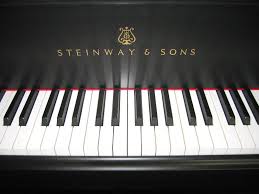
Steinway just released an iPad-controlled piano

steinway-new


Steinway was so adamant about getting the technology right that in 2014 it bought Live Performance, a company founded by music engineer Wayne Stahnke. Lauded as the creator of the first mass market computer-controlled player piano able to simulate the nuances of a human performer (the Bosendorfer 290 SE), the former NASA engineer opened Live Performance in 1992 to commercialize his four decade’s worth of experimentations in “high resolution” electronic reproducing pianos.
At its new Manhattan showroom, Steinway president Ron Losby showed Quartz how the Spirio can be played manually like a regular piano, but can also “accompany” a singer in the absence of a pianist. In theory, a sophisticated self-playing piano can work well in any number of live events such as a ballet recital, a church choir performance, a party—or perhaps just to give the pianist a break.

Read the entire article at http://qz.com/658430/steinway-just-released-an-ipad-controlled-piano/