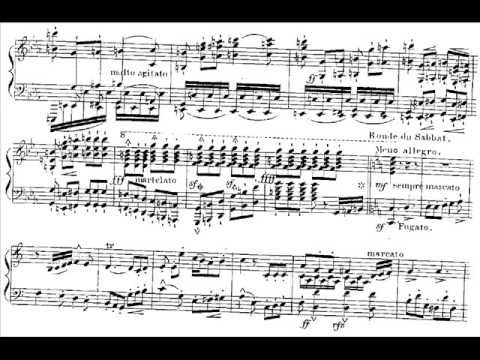
The final movement is the best known part of the symphony, thanks to its use in the Julia Roberts movie, Sleeping With The Enemy. It features a four-part structure, which Hector Berlioz described in his own program notes from 1845 as follows:
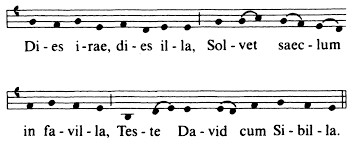
“He sees himself at a witches’ Sabbath, in the midst of a hideous gathering of shades, sorcerers and monsters of every kind who have come together for his funeral. Strange sounds, groans, outbursts of laughter; distant shouts which seem to be answered by more shouts. The beloved melody appears once more, but has now lost its noble and shy character; it is now no more than a vulgar dance tune, trivial and grotesque: it is she who is coming to the Sabbath… Roar of delight at her arrival… She joins the diabolical orgy… The funeral knell tolls, burlesque parody of the Dies irae, the dance of the witches. The dance of the witches combined with the Dies irae.”
The Dies irae melody is one of the most-quoted in musical literature, appearing in the works of many diverse composers.
The traditional Gregorian melody has also been used as a theme or musical quotation in a number of classical compositions, notable among them:
• 1952 ~ Doug Fieger, Musician, guitar, singer with The Knack
• 1952 ~ Rudy Gatlin, Singer with The Gatlin Brothers
• 1969 ~ Andy Williams received a gold record for the album Happy Heart on Columbia Records.
• 1977 ~ Best of My Love, by the Emotions, topped the pop charts. It had a number one run of four weeks.
• 2001 ~ Frank C. “Papa” Mangione, father of jazz musicians Chuck and Gap Mangione, died at age 91.
Mangione worked at Eastman Kodak Co., ran a grocery store for about two decades and returned to the photography company until his retirement in 1975. For the next 15 years, he sold music and merchandise on worldwide tours with his more famous son, Chuck, a flugelhorn ace.
A son of Italian immigrants, Mangione’s childhood was chronicled by his brother, Jerry, in a best-selling 1942 memoir called “Mount Allegro: A Memoir of Italian American Life.”
Three of Chuck Mangione’s songs, 60 Miles Young, 70 Miles Young and Papa Mangione, were dedicated to his father.
• 2013 ~ Marian McPartland, British jazz pianist (Marian McPartland’s Piano Jazz), died at the age of 95
• 2016 ~ Irving Fields, American composer and pianist (Miami Beach Rhumba), died at the age of 101
• 1874 ~ Reynaldo Hahn, Venezuelan-born French composer, conductor and music critic
• 1902 ~ Solomon Cutner, Classical pianist. A virtuoso performer, he played Tchaikovsky’s First Concerto at the age of 10. His career was stopped after a stroke in 1965.
• 1902 ~ Zino (Rene) Francescatti, French concert violinist; passed away in 1991
• 1910 ~ A.J. Fisher of Chicago, IL received a patent for an invention that moms, grandmas and single guys certainly came to appreciate: the electric washing machine. Previous to Mr. Fisher’s invention, washing machines were cranked by hand (not easily done) – or you used a washboard (also sometimes used as a musical instrument).
• 1919 ~ Ruggiero Leoncavallo, Italian composer and librettist, died. He is famous for the single opera “Pagliacci” but never repeated the success with his other works.
• 1932 ~ Helen Morgan joined the Victor Young orchestra to record Bill, a popular tune from Broadway’s Showboat.
• 1934 ~ Merle Kilgore, Songwriter Hall of Famer
• 1939 ~ Billy Henderson, Singer with Spinners
• 1955 ~ Benjamin Orr (Orzechowski), Musician, bass guitar, singer with The Cars
• 1963 ~ The TV program Ready, Set, Go! premiered on the BBC in London, England. The show gave exposure to such music luminaries as Bob Dylan and The Rolling Stones.
• 1964 ~ Joan Baez and Bob Dylan shared the stage for the first time when the singers performed in a concert in Forest Hills, NY.
• 1969 ~ Hot Fun in The Summertime, by Sly and the Family Stone, and Easy to Be Hard, from the Broadway production Hair, were released on this day. Hot Fun made it to number two on the music charts and Easy to Be Hard climbed to number four.
• 1975 ~ Dmitri Shostakovich, Russian composer, died. He wrote 15 symphonies as well as operas, ballets and film and theater scores.
• 1995 ~ Jerry Garcia of the Grateful Dead passed away
• 2003 ~ Chester Ludgin, a baritone in the New York City Opera for more than 30 years, died at the age of 78.
Ludgin sang a host of lead baritone parts, but was most recognizable in operas including “The Ballad of Baby Doe,” “The Devil and Daniel Webster” and “Susannah.” He debuted at the City Opera in 1957 in Johann Strauss II’s “Fledermaus.”
He also portrayed the part of Sam for Leonard Bernstein’s “A Quiet Place” at the Houston Grand Opera in 1983. He also sang for the San Francisco Opera and other North American companies.
His last appearance at City Opera was in 1991, but he remained on the stage, singing in musical comedies. His most recent lead was in “The Most Happy Fella.”
• 2003 ~ Gregory Hines, American actor and dancer, died of liver cancer at the age of 57
• 1919 ~ Eva (Evita) Peron, Argentina’s spiritual leader and wife of Argentina’s President, Juan Peron; actress on stage, film and radio; the subject of the Broadway musical and film Evita
• 1927 ~ Elisabeth Söderström, Swedish soprano
• 1931 ~ Teresa Brewer (Breuer), Singer
• 1941 ~ Glenn Miller and his Orchestra recorded one of the great American music standards, Chattanooga Choo Choo
More information about Chattanooga Choo Choo
• 1942 ~ Felix Weingartner, Austrian conductor and composer, died; best known for his interpretations of Wagner and Beethoven.
• 1958 ~ Pianist Van Cliburn signed an artist’s contract with RCA Victor Records.
• 1966 ~ The Mamas & The Papas made the climb to the top of the Billboard pop music chart with Monday, Monday.
• 1977 ~ The Eagles went to No.1 on the US singles chart with ‘Hotel California’, the group’s fourth US No.1, a No.8 hit in the UK. The Eagles also won the 1977 Grammy Award for Record of the Year for ‘Hotel California’ at the 20th Annual Grammy Awards in 1978. The song’s guitar solo is ranked 8th on Guitar Magazine’s Top 100 Guitar Solos and was voted the best solo of all time by readers of Guitarist magazine.
• 1995 ~ Ray McKinley passed away. He was an American jazz drummer, singer, and bandleader.
• 2002 ~ Buster Brown, a tap star and choreographer who danced on stage, in films and on television, died. He was 88. Brown was one of the last surviving members of the Copasetics, a legendary group of veteran dancers who performed together. Known for his quick rhythms and charm, Brown was a mentor and teacher for a younger generation of dancers. Brown, who was born James Brown in Baltimore, began his dancing career with a trio called the Three Aces and Speed Kings. He eventually began a solo career, appearing in the Hollywood musical “Something to Shout About” in 1943. Brown toured with the bands of Count Basie, Dizzy Gillespie and Duke Ellington, and was a featured dancer in Ellington’s concerts in the 1960s. He danced in the films “The Cotton Club” and “Tap” and on two public television specials. He also performed with the original casts of the Broadway musicals “Bubbling Brown Sugar” and “Black and Blue.” Brown toured South America with the Cab Calloway Orchestra and was commissioned by the State Department to perform in several African countries. He also taught master classes throughout Europe. Beginning in 1997, Brown was master of ceremonies at a weekly Sunday tap jam at the Manhattan club Swing 46, where young and old dancers stopped by to perform. He recently received an honorary doctorate from Oklahoma City University.
• 1891 ~ New York City was the site of the dedication of a building called the Music Hall. It was quite a celebration. A festival was held for five days, featuring guest conductor Peter Ilych Tchaikovsky. The structure is not called the Music Hall anymore. It’s called Carnegie Hall, named in honor of Andrew Carnegie.
• 1900 ~ The Billboard, a magazine for the music and entertainment industries, began weekly publication after six years as a monthly. The name was later shortened to Billboard.
• 1910 ~ Giulietta Simionato, Italian contralto
• 1927 ~ Charles Rosen, American pianist, musicologist, and writer
• 1934 ~ Ace Cannon, Saxophonist
• 1935 ~ The radio program, Rhythm at Eight, made its debut. The star of the show was 24-year-old Ethel Merman. Though Merman would become a legend years later, she didn’t fare so well on radio. Her show was taken off the air after 13 weeks and Miss Merman returned to her first love, Broadway. Tammy Wynette (1942) (Pugh) Grammy Award-winning country singer and songwriter
• 1948 ~ Bill Ward, Musician, drummer
• 1955 ~ The musical, Damn Yankees, opened in New York City for a successful run of 1,019 performances. The show at the 42nd Street Theatre mixed both baseball and ballet. It is an adaptation of the book, The Year the Yankees Lost the Pennant. Gwen Verdon starred in the role of Lola. Whatever Lola wants Lola gets including the Tony for Best Actress in a musical for her performance.
• 1973 ~ 56,800 fans paid $309,000 to see Led Zeppelin at Tampa Stadium. This was the largest, paid crowd ever assembled in the U.S. to see a single musical act. The concert topped The Beatles 55,000-person audience at Shea Stadium in New York ($301,000) on August 15, 1965.
. 1988 ~ Adele (Adele Laurie Blue Adkins, English singer-songwriter, With sales of over 120 million records, Adele is one of the world’s best-selling music artists
• 2000 ~ Hugh N. Pruett, the wardrobe director for the Lyric Opera of Chicago, died at 68. Pruett worked with countless international opera singers, directors and designers on 329 productions in his more than 40 years with the Lyric Opera.
• 2002 ~ Veteran movie director George Sidney, famed for such musicals as “Anchors Aweigh,” “Kiss Me Kate” and “Annie Get Your Gun,” died at his Las Vegas home. Born into a show business family, the Long Island, New York, native shot 28 features in 27 years, and worked with such stars as Frank Sinatra, Gene Kelly, Tony Curtis, Lana Turner, Dick Van Dyke, Elvis Presley and Ann-Margret. He once defined a star as “someone who attracts your attention even when he or she isn’t doing anything.” After making his mark in short films, Sidney moved to features in 1941 with “Thousands Cheer,” a hit musical starring Kathryn Grayson and Gene Kelly. “Anchors Aweigh” (1945), which starred Sinatra and Gene Kelly as sailors on liberty, received five Oscar nominations including best picture. In 1950, Sidney took over the troubled production of “Annie Get Your Gun,” which was a major success — as was his 1951 remake of “Show Boat” and his 1953 film version of Cole Porter’s musical “Kiss Me Kate.” In 1963, he directed Presley and Ann-Margret in “Viva Las Vegas,” considered one of the better entries in the rock legend’s woeful Hollywood career. Sidney’s last film was the 1968 British musical “Half a Sixpence,” starring Tommy Steele. Sidney served two stints as president of the Directors Guild of America, and helped animators William Hanna and Joseph Barbera set up what would become a cartoon powerhouse.
. 1788 ~ Charles Wesley, writer of over 5,500 hymns and, with his brother John, the founder of Methodism, died.
. 1871 ~ The Royal Albert Hall in London opened
. 1878 ~ Albert Von Tilzer, Composer. He was the composer of “Take Me out to the Ball Game” among other old favorites.
More information about Von Tilzer
. 1879 ~ “Eugene Onegin”, best-known opera by Russian composer Tchaikovsky, was first performed at the Maliy Theatre in Moscow
. 1947 ~ Bobby Kimball (Toteaux), Singer with Toto
. 1949 ~ Michael Brecker, Jazz musician, reeds with The Brecker Brothers
. 1951 ~ The King and I, the wonderful Rodgers and Hammerstein musical based on Margaret Langdon’s novel, Anna and the King of Siam, opened this night in 1951 on Broadway. The King and I starred Yul Brynner in the role of the King of Siam. The king who, along with his subjects, valued tradition above all else. From this day forward, the role of the King of Siam belonged to Yul Brynner and no other. Brynner appeared in this part in more than 4,000 performances on both stage and screen (the Broadway show was adapted for Hollywood in 1956). Anna, the English governess hired to teach the King’s dozens of children, was portrayed by Gertrude Lawrence. Ms. Lawrence and Mr. Brynner acted, danced and sang their way into our hearts with such memorable tunes as Getting to Know You, Shall We Dance, Hello, Young Lovers, I Whistle a HappyTune, We Kiss in a Shadow, I Have Dreamed, Something Wonderful, A Puzzlement and March of the Siamese Children. The King and I ran for a total of 1,246 outstanding performances at New York’s St. James Theatre.
. 1952 ~ Roy Henderson’s last singing performance was on this date in the role of Christus in Bach’s “St. Matthew Passion” at Southwark Cathedral, the Anglican cathedral on the south bank of the Thames in London.
. 1973 ~ Hommy, the Puerto Rican version of the rock opera Tommy, opened in New York City. The production was staged at Carnegie Hall.
. 1973 ~ After recording On the Cover of ‘Rolling Stone’, Dr. Hook finally got a group shot on the cover of Jann Wenner’s popular rock magazine. Inside, a Rolling Stone writer confirmed that members of the group (Dr. Hook and the Medicine Show) bought five copies of the magazine for their moms – just like in the song’s lyrics!
. 1980 ~ Annunzio Paolo Mantovani, Anglo-Italian conductor and arranger, died. Created the “Mantovani sound” that made him a highly successful recording artist and concert attraction.
. 1982 ~ Carl Orff, German composer of “Carmina Burana,” died.
. 1982 ~ Ray Bloch passed away
. 1999 ~ Legendary U.S. jazz and blues singer Joe Williams died aged 80.
. 2001 ~ John Lewis, a pianist who masterminded one of the most famous ensembles in jazz, the Modern Jazz Quartet, died at the age of 80. The M.J.Q., as the quartet was known, remained mostly unchanged from the mid-1950’s to the 90’s. It began recording in 1952 with Lewis, vibraphonist Milt Jackson, bassist Percy Heath and drummer Kenny Clarke. When Clarke moved to Paris in 1955, Connie Kay replaced him and the quartet continued until Kay’s death in 1994. Lewis contributed the bulk of the group’s compositions and arrangements, including Django and Two Degrees East, Three Degrees West, and he insisted members wear tuxedos to dignify jazz as an art. He was born in LaGrange, Ill., in 1920, and grew up in Albuquerque, N.M. His entree to the jazz world came during World War II, when he met Kenny Clarke, an established drummer in the nascent bebop movement. At Clarke’s urging, Lewis moved to New York after his discharge and eventually replaced Thelonious Monk as Dizzy Gillespie’s pianist. He also performed or recorded with Charlie Parker, Lester Young and Ella Fitzgerald. In 1952 he formed the M.J.Q. with Clarke, Jackson and Heath. The quartet was a steady seller of records and concert tickets well into the 1970’s. Lewis also taught music at Harvard and the City College of New York, and in the late 1950’s helped found the Lenox School of Jazz in Massachusetts.
. 2009 ~ Maurice Jarre, French composer (Doctor Zhivago-Acadamy Award winner in 1966), died at the age of 84
. 1678 ~ Antonio Lucio Vivaldi, Italian Baroque composer. The creator of hundreds of spirited, extroverted instrumental works, Vivaldi is widely recognized as the master of the Baroque instrumental concerto, which he perfected and popularized perhaps more than any of his contemporaries. A group of four violin concerti from Vivaldi’s Op. 8, better known as “The Four Seasons”, may well be the most universally recognizable musical work from the Baroque period. Perhaps the most prolific of all the great European composers, he once boasted that he could compose a concerto faster than a copyist could ready the individual parts for the players in the orchestra.
More information about Vivaldi
(MaryO’Note: Spring from The Four Seasons is available in the Piano Maestro App for piano students)
. 1801 ~ The U.S. Marine Band performed for the first time at a presidential nomination. That president was Thomas Jefferson.
. 1839 ~ Ignace Antoine Ladurner, pianist/composer, died at the age of 72
. 1877 ~ The ballet of Swan Lake, composed by Peter Ilyich Tchaikovsky, was performed for the first time in the famous Bolshoi Theatre in Moscow, Russia
and
. 1915 ~ Carlos Surinac, Catalan Spanish-born composer and conductor
. 1918 ~ Frank Wigglesworth, American composer
. 1925 ~ Enzo Stuarti, Opera singer
. 1928 ~ Samuel Adler, German-born American composer
. 1929 ~ Bernard Haitink, Dutch conductor
. 1932 ~ Miriam (Zensile) Makeba, South African born singer who was the first black South African to attain international stardom.
. 1934 ~ Barbara McNair, Singer, TV hostess of The Barbara McNair Show, actress
. 1942 ~ Dick Jurgen’s orchestra recorded One Dozen Roses on Okeh Records in Chicago.
. 1942 ~ The Stage Door Canteen opened on West 44th Street in New York City. The canteen became widely known as a service club for men in the armed forces and a much-welcomed place to spend what would otherwise have been lonely hours. The USO, the United Service Organization, grew out of the ‘canteen’ operation, to provide entertainment for American troops around the world.
. 1943 ~ Irving Berlin picked up the Best Song Oscar for a little ditty he had written for the film, Holiday Inn: White Christmas at the 15th Academy Awards.
. 1944 ~ Bobby Womack, Songwriter, singer
. 1948 ~ Chris Squire, Bass with Yes
. 1948 ~ Shakin’ Stevens (Michael Barratt), Singer, actor
. 1951 ~ Chris Rea, Guitarist with these groups Chris Rea Band and Ambrosia; singer, songwriter
. 1969 ~ Chastity Bono, Singer, daughter of Sonny & Cher
. 1978 ~ Andy Gibb reached the top of the music charts as (Love is) Thicker Than Water reached #1 for a two-week stay. The Bee Gees also set a record on this day as their single, How Deep Is Your Love, from the Saturday Night Fever soundtrack stayed in the top 10 for an unprecedented 17 weeks.
. 1981 ~ Lyricist E.Y. ‘Yip’ Harburg died in an auto accident in Hollywood, CA at the age of 82. Two of his most successful hits were Over the Rainbow from The Wizard of Oz and It’s Only a Paper Moon, popularized by Nat King Cole and many others.
. 2001 ~ Glenn Hughes, a singer who performed as the mustachioed, leather-clad biker in the disco band the Village People, died at the age of 50. The group, which was the brainchild of producer Jacques Morali, featured men dressed as an Indian, a soldier, a construction worker, a police officer, a cowboy and Hughes’ character, a biker. The band released its first single, San Francisco (You’ve Got Me), in 1977. It followed the next year with its first hit, Macho Man. The band then produced a string of hits, including Y.M.C.A., In theNavy and Go West. Collectively the Village People sold 65 million albums and singles. Although disco fell out of fashion in the 1980s, Hughes stayed with the band until 1996, when he left to sing in Manhattan cabarets.
. 2003 ~ Fedora Barbieri, a mezzo-soprano whose passionate singing sometimes stole the scene from opera diva Maria Callas, died. She was 82. Born in Trieste in 1920, Barbieri performed on stages ranging from Milan’s La Scala to New York’s Metropolitan Opera House to London’s Covent Garden. Barbieri’s career started in 1940 and for her 80th birthday, she sang the role of Mamma Lucia in Pietro Mascagni’s “Cavalleria Rusticana” in Florence. Her repertoire included roles in operas by Giuseppe Verdi and Giacomo Puccini. Barbieri died in Florence, which she had adopted as her home and where she gave many performances.
. 2003 ~ Emilio Estefan Sr., father of the Latin music mogul, died at the age of 83. Estefan Sr. played the plump and comical ambassador in a music video for the Miami Sound Machine’s hit song Conga, which featured singer Gloria Estefan, wife of Estefan Jr. The Miami Sound Machine’s office was once located in Estefan Sr.’s garage. His son later built a home for his parents on his Star Island compound. Estefan Sr. was born in Santiago de Cuba and moved to Spain with Estefan Jr. in 1966. His wife and another son stayed in Cuba because the boy was of military draft age and couldn’t leave until 1980. Estefan Sr. came to Miami in 1968, a year after Estefan Jr., and opened a clothing business in Hialeah.
. 2009 ~ Joseph Bloch died. He was an American concert pianist and professor of piano literature at the Juilliard School in New York City. During a career at Juilliard that spanned five decades, Bloch’s students included Emanuel Ax, Van Cliburn, Misha Dichter, Garrick Ohlsson, Jeffrey Siegel and Jeffrey Swann.
. 2011 ~ Johnny Preston, American pop singer (Running Bear), died at the age of 71
. 1881 ~ Jacques Offenbach’s opera “Les Contes d’Hoffman” premiered in Paris
. 1914 ~ Larry Adler, Composer of movie scores such as A Cry from the Streets, Genevieve, Great Chase
. 1927 ~ Leontyne Price, American soprano, Metropolitan Opera
More information about Price
. 1929 ~ Jerry Goldsmith, pianist and composer (Twilight Zone)
. 1933 ~ The singing telegram was introduced by the Postal Telegraph Company of New York City.
. 1937 ~ Roberta Flack, American pop-soul singer
. 1942 ~ Glenn Miller was awarded the first-ever gold record for selling 1 million copies of “Chattanooga Choo Choo”
. 1944 ~ Peter Allen, Australian pop singer, songwriter and pianist
. 1942 ~ Ted Fio Rito’s orchestra recorded Rio Rita for Decca Records in Los Angeles. Bob Carroll sang on the disc that became the group’s theme song.
. 1946 ~ Donovan (Leitch), Singer
. 1956 ~ Elvis Presley wiggled his way through Heartbreak Hotel this day for RCA Records in Nashville, TN. The record received two gold records, one for each side. The hit on the other side was I Was the One.
. 1958 ~ Elvis Presley’s ballad “Don’t” reached #1 on music charts. This was his ninth #1 hit single since he had produced “Heartbreak Hotel”. In all, Elvis had recorded a total of 17 #1 hits.
. 1960 ~ “Unsinkable Molly Brown” closed at the Winter Garden in New York City after 532 performances. Molly Brown was based on the true story of a Titanic survivor.
. 1964 ~ The Beatles, British super rock group, made their first American appearance on the Ed Sullivan TV show
. 1964 ~ Bob Dylan released “The Times They Are a-Changin” his 3rd album, by Columbia Records. The album was seen as a protest album featuring songs about issues such as racism, poverty, and social change. The title track was one of Dylan’s most famous capturing the spirit of social and political upheaval that characterized the 1960s.
. 1966 ~ Billy Rose passed away. Rose was an American impresario, theatrical showman and lyricist.
. 2002 ~ Dave Van Ronk, a New York-born guitarist and singer who was at the forefront of the Greenwich Village folk boom, died at the age of 65. A prolific musician who was nominated for a Grammy, Van Ronk offered his home as a hangout for fellow musicians in the 1960s. Among them was a young Bob Dylan. “People were always stopping by,” said Mitch Greenhill, his longtime manager. “He (Van Ronk) was one of the few guys who was working at a pretty high level who went out of his way to be friendly.” Born in Brooklyn, Van Ronk started living in Greenwich Village by the time he was a teenager. His first album, “Ballads, Blues and a Spiritual” was released in 1957. He opened his home to Dylan when the artist arrived in New York in the 1960s. Inspired by a haunting version of House of the Rising Sun, released by Van Ronk, Dylan performed it on his debut album. They also appeared together in 1974 with other singers at a benefit for Chilean political prisoners. Asked over the years about his relationship with Dylan, Van Ronk always played down his influence on Dylan by saying, “He was as big an influence on me as I was on him,” said Greenhill, who knew Van Ronk for more than 40 years. Van Ronk spent 40 years on tour, and made at least 26 albums. His most recent was last year’s “Sweet and Lowdown,” a return to his jazz roots. He received a Grammy nomination in 1996 for his record “From … Another Time and Place.” He was also honored with a Lifetime Achievement Award by the American Society for Composers, Authors and Publishers (ASCAP).
. 2006 ~ At the XX Winter Olympic Games open in Turin, Italy, Luciano Pavarotti sang “Nessun Dorma” in his last ever performance.
Giuseppe Tartini was born in Pirano, Italy and lived from 1692 until 1770. He was a violinist and composer, who also had studied law and divinity at Padua, and was an accomplished fencer. He secretly married a proteg?e of the Archbishop of Padua, for which he was arrested. He fled to Assisi but, after attracting the archbishop’s attention by his violin playing, he was invited back to his wife. Perhaps one of the greatest violinists of all time, he was also an eminent composer. His best-known work is the Trillo del Diavolo (c.1735, Devil’s Trill).
Tavener, John
John Taverner lived from about 1490 until 1545. He was employed as master of the choristers at Cardinal College (Christ Church), Oxford, in its early heyday, retiring, on Cardinal Wolsey’s fall from power, to Boston, where he was held in considerable regard until his death in 1545. The popular, if mistaken, account of his life is the subject of the opera by Peter Maxwell Davies, Taverner.
Taverner wrote Latin Mass settings, Magnificat settings and motets. Of the first of these the Western Wynde Mass, using the melody of a popular song of that name, is among the better known. From his Mass Gloria tibi Trinitas came the fragment of a theme that served later generations as the basis of an English genre of consort music, the In nomine.
Taverner himself began the tradition of the In nomine, an instrumental arrangement of part of the Benedictus of his Mass Gloria tibi Trinitas.
Taverner, John Keith
John Kenneth Tavener, born in 1944 in London, England is a composer. He studied at the Royal Academy of Music, London and has been professor of music at Trinity College of Music since 1969. He was still at college when he won the prestigious Prince Rainier of Monaco Prize in 1965 with his cantata, Cain and Abel. His music is predominantly religious, and includes the cantata The Whale (1966), Ultimos ritos (1972, Last Rites) for soloists, chorus, and orchestra, and a sacred opera Therese (1979). He was converted to the Russian Orthodox faith in 1976.
His work, Eternity’s Sunrise, won a Grammy Award. His sacred work, Song for Athene, was sung at the funeral ceremony of Princes Diana.
Tchaikovsky
Piotr Ilyich Tchaikovsky lived between 1840 and 1893. He is considered to be a romantic composer. He was a Russian composer who was a master of melancholy moods, emotional outbursts and dramatic climaxes in his music.
“Worthless, vulgar, derivative, unplayable” were a few of the adjectives that pianist and conductor Nicholas Rubinstein used to describe Tchaikovsky’s Piano Concerto in b-flat minor, when he first heard it on Christmas Eve, 1874. Ironically, Tchaikovsky had arranged the piece as a gift for Rubinstein, to whom he intended to dedicate it. Furious, Tchaikovsky re-dedicated the piece to pianist Hans von Bülow, who was the first to perform it.
Within a few yers, Rubinstein’s distaste for the concerto mellowed and he became one of its principal interpreters.
Tchaikovsky read Goethe’s novel Wilhelm Meisters Lehrjahre in the 1860’s and set its melancholy poem “None but the Lonely Heart” to music.
Tchaikovsky found one of his greatest successes with his lovely waltz from the “Serenade for Strings” which he composed in 1880. He was also composing the 1812 Overture at the same time. He conducted several early performances of the Serenade himself, but he had no formal conducting training and became so nervous that he sometimes lost the place in his own music.
Shakespeare’s Romeo and Juliet inspired the melancholy Tchaikovsky to write his own version, using musical themes to suggest various themes from the play.
On his way to New York in 1891 to participate in the opening of Carnegie Hall, Tchaikovsky stopped in Paris and discovered the celesta, The celesta is a small keyboard with tiny silver bars which sound like bells when struck. He ordered one to be sent to Moscow in strict secrecy so that he could be the first to use it. His ballet The Nutcracker included the “Dance of the Sugar Plum Fairy” which has several wonderfully shimmering phrases for the celesta.
Tchaikovsky’s Nutcracker was featured in the Walt Disney movie Fantasia.
The first performance of the Sixth Symphony was only a mild success. By the time of the next performance a few weeks later – which was a tremendous success – Tchaikovsky was dead of cholera. It’s title Pathétique – is characteristic of the composer, who always was afraid that his creativity would suddenly stop.
Teagarden
Weldon Leo ‘Jack’ Teagarden was a Jazz musician, born in Vernon, Texas and he lived from 1905 until 1964. He came from a musical family with his mother, Helen, playing piano and his father,Charles, trumpet. His two brothers, Charlie (trumpet) and Clois (drums) were also talented musicians as was his sister Norma (piano). Jack started on piano at the age of five and two years later learned to play the baritone horn, bought for him by his father. By the age of ten Jack was playing trombone.
The family moved from Vernon to Chappell, Nebraska in 1918 and Jack was soon playing in local theatres accompanied by his mother on piano. From here his travels become a little blurred but we know that he lived for a while in 1919 in Oklahoma City then with his uncle in San Angelo and started playing with local bands. He then played with a quartet at the Horn Palace Inn, San Antonio led by drummer Cotton Bailey,from late 1920 until September 1921 except for a summer season in Shreveport.
It was from Cotton Bailey that the young Weldon received his nickname, “Jack”. From then until the spring of 1923 he played with the legendary Peck Kelly’s Bad Boys. Dropped out of music in Wichita Falls in the summer of ’23 then joined Marin’s Southern Serenaders before rejoining Peck Kelly.
His recording debut came with Johnny Johnson and his Statler Pennsylvanians in early December 1927 when they cut two sides for Victor, “Thou Swell”/”My One and Only”. Jack was twenty-two years old. Two months with the Tommy Gott Orchestra then a major move to Ben Pollack where he remained from June 1928 until May 1933. This period with Pollack was extremely productive in recording terms as he led his own recording groups as well as playing as a sideman with Louis Armstrong, Benny Goodman, Red Nichols, Eddie Condon, and many other famous musicians of the day.
He took part in the first ‘mixed’ recording session with Louis which produced the majestic blues “Knockin’ a Jug”. In October 1928 Jack cut “Makin’ Friends” with Eddie Condon and made history by using a water glass as a substitute for a mute, removing the bell of the trombone and holding the glass over the open end of the tubing producing a unique sound.
In December 1933 he made his big move to join Paul Whiteman. He stayed with Whiteman’s star-studded aggregation until December 1938. His stay with Whiteman brought him financial security but we will never know if this residency was a good move or a bad one. Opinions differ strongly. It has been surmised that Benny Goodman would have offered Jack the trombone chair in his new orchestra as featured soloist.
After leaving Whiteman, Jack started up his own big band which he led until from February 1939 until November 1946. Musically the band was a success but financially a disaster. When the band was finally broken up, Jack gigged around, recorded as a freelance and played at the ‘Esquire’ jazz concert in January 1944 at the Metropolitan Opera House with Armstrong, Eldridge, Tatum, Hawkins. He led his own sextet until joining Louis Armstrong’s All Stars where he stayed from July 1947 until August 1951.
When he left Louis he formed his own All Stars and toured with them until he disbanded in 1956 when he played with Ben Pollack for a few months. He co-led another all-star group with Earl Hines which visited Britain and Europe in the fall of 1957 which was raptuorously received. Jack led another group on a State Department sponsored tour of Asia from September 1958 until January 1959.
Jack was a mainstay of late 1920s New York Jazz scene, a trombonist and singer whose relaxed, melodic instrumental style was highly influential. He was also one of the best White Jazz singers, particularly when he sang the Blues on songs like Makin’ Friends.
He continued playing and leading a group until his death on January 15, 1964. He played his last engagement at The Dream Room in New Orleans while suffering from bronchial pneumonia, returned to the Prince Conti Motor Hotel, just three blocks from Basin Street, after the gig and was found by the room-maid the next afternoon, dead on the floor clad in his dress shirt and shorts. He was 58 years old. The New Orleans “Times-Picayune” published his obituary on January 16, 1964. Jack was buried at Forest Lawn Memorial Park, Los Angeles, Plot # 7281. The headstone reads “Where there is Hatred, Let Me Sow Love”
Tebaldi
Renata Tebaldi is an Operatic soprano, born in Pesaro, Italy in 1922. She studied at Parma Conservatory, made her debut at Rovigo in 1944, and was invited by Toscanini to appear at the re~opening of La Scala, Milan, in 1946, where she sang until 1954. She then sang in many opera houses, including several seasons at the Metropolitan Opera, New York City, and made many recordings. Tebaldi had one of the most beautiful Italian voices of the century. Although her rivalry with Maria Callas attracted much attention, it was her singing that captivated her fans.
Her breakthrough came in 1946 when she auditioned in Milan for the great conductor Toscanini and from then until the late 1970s she performed across Europe and the United States.
When she made her debut at the city’s La Scala opera house in late 1946, the maestro dubbed her “The Voice of an Angel.”
Singing the soprano part in Giuseppe Verdi’s “Te Deum,” the concert marked the reopening of the theater after the end of World War II. It also branded Tebaldi in Italian minds as part of the country’s post-war renaissance.
She went on to perform at London’s Covent Garden, the San Francisco Opera and appeared regularly at the Metropolitan Opera (news – web sites) in New York taking the lead roles in “La Boheme,” “Madam Butterfly,” “Tosca” and “La Traviata.”
“I started my career at 22 and finished it at 54. 32 years of success, satisfaction and sacrifices. Singing was my life’s scope to the point that I could never have a family,” she wrote in a preface to her official Web site.
Tebaldi was born in the Italian seaside town of Pesaro on Feb. 1, 1922. Stricken with polio at the age of 3, she was unable to partake in strenuous activities and instead became interested in music.
In her early teens, she began studying music at the Conservatory of Parma.
“I started singing when I was a young girl but my family wanted me to study piano but my overwhelming need to express myself with my voice made me choose the art of singing,” she once told her fans.
Tebaldi has left a huge legacy of complete operas on disc with other famous singers including Mario del Monaco, Giulietta Simionato, and Carlo Bergonzi.
Her recordings include Verdi’s “Otello” and “Aida” and Puccini’s “La Boheme” and “Madama Butterfly.”
She last performed on the opera stage in 1973, and her last concert took place in 1976.
Tebaldi was a Knight Commander of the Order of Merit of the Italian Republic and had received a Commander, Order of Arts and Letters from France.
Te Kanawa
Dame Kiri Te Kanawa, born in 1944 in Gisborne, New Zealandin, is an Operatic soprano. After winning many awards in New Zealand and Australia she came to London, where she made her debut with the Royal Opera Company in 1970. She has since taken a wide range of leading roles, and in 1981 sang at the wedding of the Prince and Princess of Wales. She was made a dame in 1982 and has produced many non-classical recordings. In 1989 she published Land of the Long White Cloud: Maori Myths and Legends.
Teleman
Georg Philipp Telemann, born in 1681 in Magdeburg, Germany, was a very prolific late Baroque era composer, composing 600 overtures in the Italian style, 44 Passions, 40 operas, innumerable trio sonatas, suites and flute quartets. He was a self-taught composer and organist. When he died in 1767, his organist post in Leipzig went to Johann Sebastian Bach.
Tilson Thomas
Michael Tilson Thomas is the Music Director of the San Francisco Symphony, the Founder and Artistic Director of the New World Symphony, and the Principal Guest Conductor of the London Symphony Orchestra. He is currently Artistic Director of the Pacific Music Festival in Sapporo, Japan, which he and Leonard Bernstein inaugurated in 1990. Born in Los Angeles, he is the third generation of his family to follow an artistic career. At age nineteen he was named Music Director of the Young Musicians Foundation Debut Orchestra where he worked with Stravinsky, Boulez, Stockhausen and Copland on premieres of their compositions. He was also Assistant Conductor at the Bayreuth Festival. Noted for his commitment to music education, Michael Tilson Thomas founded the New World Symphony in 1988, to be a national orchestra for the most gifted graduates of America’s music conservatories. In addition to their regular season in Miami, they have toured France, Great Britain, South America, Japan, Israel and the United States, and in 1998 celebrated their 10th anniversary with concerts in New York, London, Paris, Amsterdam and Vienna.
Tilson Thomas has recently completed a very successful tour of Europe with the San Francisco Symphony and back at home in June 1999, they present a festival of Stravinsky’s music, some of which they have recently recorded together.
With the London Symphony Orchestra, Tilson Thomas has toured in Israel, Japan, the USA, as well as in Europe including an appearance at the Salzburg Festival. In London, he and the orchestra have mounted major festivals focusing on the music of Brahms, Mahler, Rimsky-Korsakov, Gershwin, Reich and Takemitsu.
Tilson Thomas’ recordings have received many awards and cover a wide range of repertoire including Bach, Beethoven, Mahler and Prokofiev as well as his pioneering work with the music of Ives, Ruggles, Reich, Cage and Gershwin. In 1994 Michael Tilson Thomas received the Ditson Award for contributions to American Music, was named Musical America’s Conductor of the Year and received five Grammy nominations and two Gramophone awards for his recordings. He has been an exclusive BMG Classics/RCA Victor Red Seal recording artist since 1995 and his most recent releases include the disc “New World Jazz” with the New World Symphony Orchestra.
Tilson Thomas has also worked extensively for television including educational broadcasts with the New York Philharmonic, a BBC series with the London Symphony Orchestra including programmes on Strauss, Sibelius and Beethoven, and other television productions celebrating works by Gershwin and Bernstein.
Von Tilzer, Albert
Albert Von Tilzer (Albert Gumm) (1878 – 1956) was born in Indianapolis, Indiana on Mar. 29, 1878. He was the younger brother of Harry Von Tilzer. He was a vaudeville performer and composer and wrote many hit tunes. Some of them were: Carrie (Carrie Marry Harry), Give Me the Moonlight, Give Me the Girl, I’ll Be with You in Apple Blossom Time, Put Your Arms Around Me Honey and Take Me Out to the Ball Game
Overview Composer Albert Von Tilzer was an important songwriter most active from the early 1900’s into the 1920’s. He was the younger brother of composer Harry Von Tilzer.
Albert went to work in his father’s Indianapolis shoe store after graduating from high school. He learned to play the piano by ear and did have some lessons in harmony before he joined a vaudeville troupe.
In 1899, he went to Chicago, and worked briefly for his older brother’s music publishing firm, Shapiro, Bernstein and Von Tilzer. Albert then traveled to New York City, and found work as a shoe salesman in a large Department store.
In 1900, he published his first song “The Absent Minded Beggar Waltz”, a piano instrumental. In 1903 he wrote “That’s What the Daisy Said”, with his own lyric. This was published by his brother’s firm.
In 1903, he formed York Music Company, his own publishing house, which would thereafter publish all of his own music.
All the while Albert was composing and publishing, he was also working as a vaudeville performer. He was a headliner on the Orpheum circuit. In 1930, he settled in Hollywood and worked in a few motion pictures. He was elected to the Songwriter’s Hall of Fame. Albert Von Tilzer died in L.A., in 1956, at age 78.
Von Tilzer, Harry
Harry Von Tilzer (Harry Gummbinsky -the family later shortened the name to “Gumm”.) lived from 1872 until 1946. He was born in Detroit, Michigan and was the older brother of Albert Von Tilzer. He was an entertainer and common laborer who turned to music composition and formed the Harry Von Tilzer Music Company in 1902. He wrote many hit tunes. Some of them are: (She was only a) Bird in a Gilded Cage; I Want a Girl (Just Like the Girl That Married Dear Old Dad); I’d Leave My Happy Home for You; Take Me Back to New York Town; Wait ‘Til the Sun Shines Nellie; When My Baby Smiles at Me and Why Do They Always Pick on Me?
Harry, one of six children, was to find a career in music as did his younger brother Albert. (Apparently, two of the children, a boy and an girl, perished in childhood.) When Harry was still a child, his family moved to Indianapolis, IN, where he father acquired a shoe store. A theatrical company gave performances in the loft above the store, and that’s where Harry learned to love show business.
His career really started in 1886 when, at age 14, he ran away from home and joined the Cole Brothers Circus. By 1887, he was playing piano, composing songs, and acting in a traveling repertory company. He changed his name at that time. His mother’s maiden name was Tilzer, and he ‘gussied’ it up by adding the ‘Von’. Thereafter he would be called Harry Von Tilzer, and later his younger brother would adopt the name also, Albert Von Tilzer.
Harry met Lottie Gilson when the burlesque troupe with which he was working reached Chicago. The popular vaudevillian took an interest, and induced him to go to New York. In 1892, Harry, working as a groom on a trainload of horses, arrived in New York, with just $1.65 in his pocket. He rented a room near the Brooklyn Bridge and became a $15.00 per week saloon pianist. He left New York briefly to work in a traveling medicine show, but returned to again work in saloons and later as a vaudevillian in a ‘Dutch’ act with George Sidney.
At this time, Harry was writing songs, literally hundreds of songs that were never published. He would sell them outright to other entertainers for $2.00 each. Even Tony Pastor sang a few of his songs in his theater. But the tide was about to turn for Harry.
One of his songs was published, “My Old New Hampshire Home”, lyric by Andrew B. Sterling. William C. Dunn, owner of a small print shop, purchased it outright for $15.00, and issued it in 1898. It was a hit that sold more than 2 million copies.
There is an interesting historical note connected with Harry Von Tilzer. In the Early 1900’s, Von Tilzer kept an upright piano in his publishing firm. Harry kept pieces of paper stuffed between the strings of the piano’s harp. It gave the piano a tinny sort of sound to which Von Tilzer was partial. One day, the lyricist and newspaper journalist Monroe Rosenfeld was in Harry’s office and heard him playing the tinny sounding piano. The sound suggested a title for a piece he was writing, – Tin Pan Alley.
Harry’s last years were spent in retirement, while living in the Hotel Woodward, in New York City. He died in 1946, at age 74.
Tippett
Sir Michael (Kemp) Tippett is a Composer, born in London, England, UK in 1905. He studied at the Royal College of Music, London, and became director of music at Morley College from 1940 until 1951. His oratorio, A Child of Our Time (1941), reflecting the problems of the 1930s and 1940s, won him wide recognition. A convinced pacifist, he was imprisoned for three months as a conscientious objector during World War 2. He scored a considerable success with his operas The Midsummer Marriage (1952) and King Priam (1961), and among his other works are four symphonies, a piano concerto, and string quartets. He was knighted in 1966, and received the Order of Merit in 1983.
Toscanini
Arturo Toscanini, 1867 to 1957, was a conductor who born in Parma, Italy. He was a cellist before the night in 1886 when he took over the baton from an indisposed conductor in Rio de Janeiro and stayed on the podium for the rest of his career. After years of journeyman work in Italian opera houses, he became conductor of Milan’s La Scala in 1898. In 1909 he came to the USA to lead the Metropolitan Opera orchestra; his subsequent career took him to positions in Europe, England, and the USA, including the podium of the New York Philharmonic from 1928 to 1936. In 1937 the NBC Symphony, primarily a broadcasting and recording orchestra, was created for Toscanini; he led it until 1954, cementing his reputation as one of the most revered conductors in the world. He helped pioneer a new performance tradition that proclaimed an end to Romantic interpretive excesses and substituted absolute fidelity to the score; in practice, that made for clean, sinewy performances, achieved partly by his legendary tantrums in rehearsals. He was equally admired for his performances of Beethoven and other 19th-century classics and of modern composers including Stravinsky, Debussy, and Richard Strauss.
Townshend
Born Peter Dennis Blandford Townshend on May 19, 1945, as a member of The Who, he wrote nearly all of the songs and sang “The Acid Queen” and “Sensation”. for the double album Tommy. Tommy is a deaf, dumb, and blind kid who becomes a Messiah and later is forsaken by his followers. Tommy is based, in part, on the spiritual teachings of Indian mystic Meher Baba, of whom Townshend had become a devotee. Read the rest of this biography at http://www.petetownshend.net
Tucker
There is a statue of Richard Tucker, an opera singer, in New York.
On January 18, 1958 Leonard Bernstein began presenting his television series What does music mean? The series ran for 53 programs. Some of the episodes can be found below:
Part 1 What is Classical Music?
Plot: Bernstein conducts Handel’s Water Music and cites it as an indisputable example of classical music. “Exact” is the word that best defines classical music, Bernstein says and he demonstrates with musical illustrations from Bach’s Fourth Brandenburg Concerto, Mozart’s Concerto No. 21 in C Major and The Marriage of Figaro, and Haydn’s Symphony No. 102.
The decline of classical music at the end of the eighteenth century is tied to Beethoven’s innovations and the Romantic movement, and Bernstein conducts Beethoven’s Egmont Overture.
Part 2 What is Melody?
Plot: Bernstein discusses the different forms melody can take, including tune, theme, motive, melodic line and musical phrase. He illustrates by conducting the orchestra in excerpts from Tchaikovsky, Wagner, Hindemith, and Brahms.
Part 3 What is a Mode?
Plot: Bernstein discusses scales, intervals, and tones, and analyzes several pieces, including Debussy’s Fêtes, Rimsky-Korsakov’s Scheherazade, and music from the Kinks and the Beatles, to illustrate different modes.
An excerpt from Bernstein’s ballet Fancy Free is also performed.