“Ode to Joy” was written in the summer of 1785 by German poet, playwright, and historian Friedrich Schiller and published the following year in Thalia. A slightly revised version appeared in 1808, changing two lines of the first and omitting the last stanza.
“Ode to Joy” is best known for its use by Ludwig van Beethoven in the final (fourth) movement of his Ninth Symphony, completed in 1824. This was Beethoven’s final symphony and lasts over an hour for the whole thing.
The entire final movement:
Beethoven’s text is not based entirely on Schiller’s poem, and introduces a few new sections. His melody (but not Schiller’s words) was adopted as the Anthem of Europe by the Council of Europe in 1972 and subsequently by the European Union.
If your student is in Wunderkeys, this is a classical pop piano solo based on Beethoven’s 9th Symphony. This Level 4 piano solo is from the book The Beethoven Sessions; a collection of 7 classical pop piano solos inspired by the music of Beethoven.
It is often called Joyful, Joyful We Adore Thee (You) in hymnbooks.
Find Ode to Joy in Piano Maestro, Prelude, Beethoven: Exploring His Life and Music and several hym books.
By now, you know I love flashmobs:
And Muppets (note the metronome going wild!):
And Barbershop:
An animated score:
Boomwhackers:
The Piano Guys combined Ode to Joy with Joy to the World for a new Christmas arrangement:
As the European Anthem:
And, finally Joyful, Joyful we Adore Thee by the Mormon Tabernacle Choir.
Do a search on youtube – lots and lots of people have played this famous Beethoven melody.
Happy Birthday is a song that I like to have each of my students learn at various levels appropriate to their level. When a friend or family member has a birthday, it’s great to be able to sit down and play.
It’s only been fairly recently that piano students could have this music in their books.
“Happy Birthday to You”, more commonly known as simply “Happy Birthday”, is a song that is traditionally sung to celebrate the anniversary of a person’s birth. According to the 1998 Guinness World Records, “Happy Birthday to You” is the most recognized song in the English language, followed by “For He’s a Jolly Good Fellow”.
The melody, or part you sing, of “Happy Birthday to You” comes from the song “Good Morning to All”, which has traditionally been attributed to American sisters Patty and Mildred J. Hill in 1893, although the claim that the sisters composed the tune is disputed.
Patty Hill was a kindergarten principal and her sister Mildred was a pianist and composer. The sisters used “Good Morning to All” as a song that young children would find easy to sing. The combination of melody and lyrics in “Happy Birthday to You” first appeared in print in 1912, and probably existed even earlier.
“Happy Birthday” in the style of Bach, Mozart, Beethoven, Mendelssohn, Chopin, Liszt, Dvorak, and Stravinsky. Find the melody!
Lots of legal stuff below which you can skip…
None of the early appearances of the “Happy Birthday to You” lyrics included credits or copyright notices. The Summy Company registered a copyright in 1935, crediting authors Preston Ware Orem and Mrs. R. R. Forman. In 1988, Warner/Chappell Music purchased the company owning the copyright for US$25 million, with the value of “Happy Birthday” estimated at US$5 million. Based on the 1935 copyright registration, Warner claimed that the United States copyright will not expire until 2030, and that unauthorized public performances of the song are illegal unless royalties are paid to Warner. In one specific instance in February 2010, these royalties were said to amount to US$700. By one estimate, the song is the highest-earning single song in history, with estimated earnings since its creation of US$50 million.In the European Union, the copyright for the song expired on January 1, 2017.
The American copyright status of “Happy Birthday to You” began to draw more attention with the passage of the Sonny Bono Copyright Term Extension Act in 1998. When the U.S. Supreme Court upheld the Act in Eldred v. Ashcroft in 2003, Associate Justice Stephen Breyer specifically mentioned “Happy Birthday to You” in his dissenting opinion. American law professor Robert Brauneis, who extensively researched the song, concluded in 2010 that “It is almost certainly no longer under copyright.”
In 2013, based in large part on Brauneis’s research, Good Morning to You Productions, a company producing a documentary about “Good Morning to All”, sued Warner/Chappell for falsely claiming copyright to the song. In September 2015, a federal judge declared that the Warner/Chappell copyright claim was invalid, ruling that the copyright registration applied only to a specific piano arrangement of the song, and not to its lyrics and melody.
In 2016, Warner/Chappell settled for US $14 million, and the court declared that “Happy Birthday to You” was in the public domain.
Legal stuff is finished and people can now sing and play “Happy Birthday to You” whenever and wherever they want.
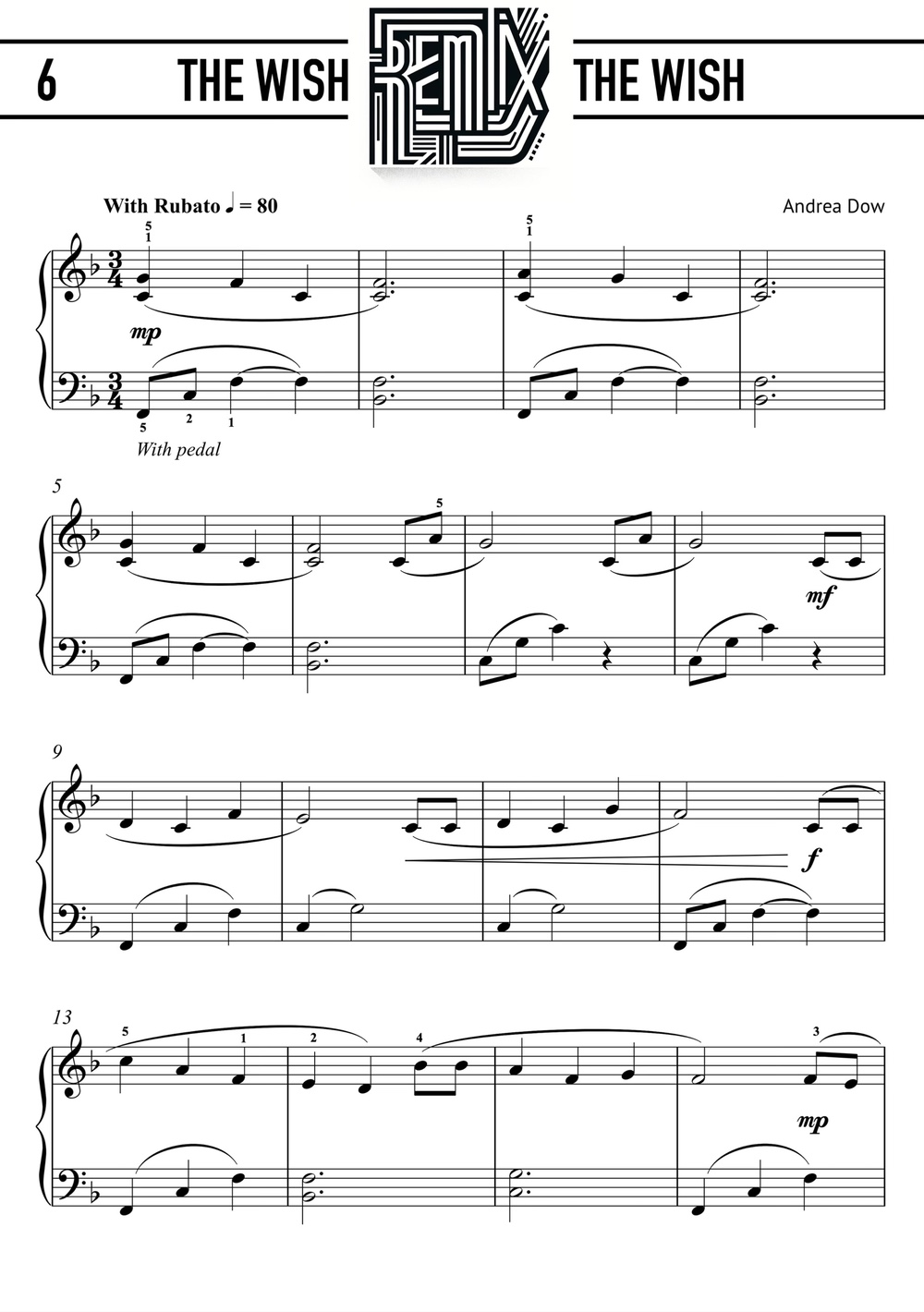
Students in Wunderkeys may play this version from Remix: Teen Hits from Kids Tunes
One of my all-time versions of Happy Birthday, in duet form – and I have the music if you want to tackle it.
• 1813 ~ (Wilhelm) Richard Wagner, German composer
Read quotes by and about Wagner
More information about Wagner
Happy Birthday Wagner-Style
• 1820 ~ Alexander Ernst Fesca, Composer
• 1850 ~ Johann Schrammel, Composer
• 1852 ~ Emile Sauret, Composer
• 1865 ~ Enrique Morera, Composer
• 1879 ~ Eastwood Lane, Composer
• 1879 ~ Jean Emile Paul Cras, Composer
• 1884 ~ Alceo Toni, Composer
• 1885 ~ Julio Fonseca, Composer
• 1900 ~ Edwin S. Votey of Detroit, MI patented his pianola, a pneumatic piano player. The device could be attached to any piano. Batteries not included.
• 1914 ~ Sun Ra (Herman Blount), American jazz composer and keyboard player who led a free jazz big band known for its innovative instrumentation and the theatricality of its performances. He passed away in 1993.
• 1916 ~ Gordon Binkerd, Composer
• 1924 ~ Charles Aznavour, French chanteur and composer
• 1924 ~ Claude Andre Francois Ballif, French composer
• 1926 ~ Elaine Leighton, Drummer, played with Billie Holiday
• 1966 ~ Iva Davies (1955) Guitarist, singer with Icehouse
• 1958 ~ Wedding vows were taken by rock ’n’ roll star, Jerry Lee Lewis and his thirteen-year-old cousin, Myra.
• 1965 ~ The Beatles got their eighth consecutive number one hit as Ticket to Ride rode to the top of the singles list. The song topped the charts for one week and became their eighth consecutive number one hit.
• 1966 ~ Bruce Springsteen recorded his very first song at the age of 16, along with his band, The Castilles. It was titled, That’s What You’ll Get. The song was never released.
• 2003 ~ The final manuscript of Beethoven’s Ninth Symphony, which was annotated by the composer, sold at auction for $3.47 million.
• 1919 ~ Eva (Evita) Peron, Argentina’s spiritual leader and wife of Argentina’s President, Juan Peron; actress on stage, film and radio; the subject of the Broadway musical and film Evita
• 1927 ~ Elisabeth Söderström, Swedish soprano
• 1931 ~ Teresa Brewer (Breuer), Singer
• 1941 ~ Glenn Miller and his Orchestra recorded one of the great American music standards, Chattanooga Choo Choo
More information about Chattanooga Choo Choo
• 1942 ~ Felix Weingartner, Austrian conductor and composer, died; best known for his interpretations of Wagner and Beethoven.
• 1958 ~ Pianist Van Cliburn signed an artist’s contract with RCA Victor Records.
• 1966 ~ The Mamas & The Papas made the climb to the top of the Billboard pop music chart with Monday, Monday.
• 1977 ~ The Eagles went to No.1 on the US singles chart with ‘Hotel California’, the group’s fourth US No.1, a No.8 hit in the UK. The Eagles also won the 1977 Grammy Award for Record of the Year for ‘Hotel California’ at the 20th Annual Grammy Awards in 1978. The song’s guitar solo is ranked 8th on Guitar Magazine’s Top 100 Guitar Solos and was voted the best solo of all time by readers of Guitarist magazine.
• 1995 ~ Ray McKinley passed away. He was an American jazz drummer, singer, and bandleader.
• 2002 ~ Buster Brown, a tap star and choreographer who danced on stage, in films and on television, died. He was 88. Brown was one of the last surviving members of the Copasetics, a legendary group of veteran dancers who performed together. Known for his quick rhythms and charm, Brown was a mentor and teacher for a younger generation of dancers. Brown, who was born James Brown in Baltimore, began his dancing career with a trio called the Three Aces and Speed Kings. He eventually began a solo career, appearing in the Hollywood musical “Something to Shout About” in 1943. Brown toured with the bands of Count Basie, Dizzy Gillespie and Duke Ellington, and was a featured dancer in Ellington’s concerts in the 1960s. He danced in the films “The Cotton Club” and “Tap” and on two public television specials. He also performed with the original casts of the Broadway musicals “Bubbling Brown Sugar” and “Black and Blue.” Brown toured South America with the Cab Calloway Orchestra and was commissioned by the State Department to perform in several African countries. He also taught master classes throughout Europe. Beginning in 1997, Brown was master of ceremonies at a weekly Sunday tap jam at the Manhattan club Swing 46, where young and old dancers stopped by to perform. He recently received an honorary doctorate from Oklahoma City University.
. 1867 ~ Charles Gounod’s opera “Romeo et Juliette” was first performed, in Paris.
. 1894 ~ Nicholas Slonimsky, Russian-born American musicologist, musical lexicographer and composer
. 1871 ~ Sigismond Thalberg died. He was a composer and one of the most famous virtuoso pianists of the 19th century.
. 1915 ~ Alexander Scriabin, Russian composer (Prometheus) and pianist, died at the age of 43
. 1931 ~ Igor Oistrakh, Violinist
. 1932 ~ Maxine (Ella) Brown, Singer
. 1933 ~ Calvin Newborn, Jazz/blues guitarist, brother of piano wizard Phineas Newborn Jr.
. 1938 ~ Tommy Dorsey and his orchestra recorded I Hadn’t Anyone ’til You for Victor Records. Jack Leonard was featured as vocalist.
. 1941 ~ Judith Blegan, American soprano
. 1944 ~ Cuba Gooding, Singer
. 1947 ~ Pete Ham, Musician, guitar, piano, singer
. 1948 ~ Kate Pierson, Musician, organ, singer with the B-52s
. 1954 ~ The Movie White Christmas featuring the songs of Irving Berlin, including the Title Song White Christmas, starring Bing Crosby and Danny Kaye, opens at Radio City Music Hall. The original song “White Christmas” was originally heard for the first time in the 1942 film Holiday Inn starring Bing Crosby and Fred Astaire.
. 1959 ~ Sheena Easton, Singer
. 1959 ~ Lloyd Price’s song, Personality, was released. Price had 10 songs that made it on the nation’s pop music charts in the 1950s through early 1960s.
. 1959 ~ Louis Lortie, French Canadian concert pianist
. 1970 ~ Mariah Carey, Singer
. 1976 ~ Maxine Nightingale received a gold record for the single, Right Back Where We Started From. Nightingale was in the productions of Hair, Jesus Christ Superstar, Godspell and Savages in the early ’70s. Right Back Where We Started From was a number two hit for two weeks in 1976.
. 1981 ~ Former Beatle Ringo Starr married Barbara Bach at the Marylebone Registry Office in London. Paul McCartney and wife Linda, George Harrison and Harry Nilsson were in attendance.
. 2002 ~ Classical violinist Guila Bustabo died at the age of 86. Bustabo, born in Manitowoc, Wis., in 1916, toured Europe and Asia, performing under such conductors as Herbert von Karajan and Wilhelm Furtwangler. Bustabo studied at the Juilliard School in New York before moving to Paris. During her career, she recorded concertos by Beethoven and Bruch with the Concertgebouw Orchestra in Amsterdam. Bustabo was arrested in Paris after World War II, accused of being a Nazi sympathizer because she played under conductor Willem Mengelberg. Mengelberg had been affiliated with musical associations sanctioned by the Nazi Party. The accusation against Bustabo was eventually dropped.
Joseph Lamb (1887 to 1960) was an extraordinarily gifted ragtime pianist and composer along with Scott Joplin and James Scott. He differed from them, though, because the art of improvisation completely baffled him. In response to this, Lamb viewed ragtime as an art form written on paper, instead of a spontaneous one. Though his style and approach were markedly different from his peers, he still left behind a rich legacy and remained one of the most influential ragtime composers.
Lehar
Franz Lehar, 1870 to 1948 was the son of a bandmaster serving principally in Hungary. He followed his father’s profession, before winning, in 1902, success in the theatre in Vienna, where he succeeded in the following years in reviving the operetta, providing music of greater distinction, with tenor arias written specifically for Richard Tauber.
The reputation of Franz Lehar as a composer of operetta is assured as he wrote nearly forty of them. Of these by the far the best known is Die lustige Witwe (The Merry Widow), first staged in Vienna in 1905, the favourite operetta of Adolf Hitler.
Lennon
John Lennon, 1940 to 1980,was a pop star, composer, songwriter, and recording artist. He was born in Liverpool, Merseyside, NW England, UK. and was The Beatles rhythm guitarist, keyboard player, and vocalist, and a partner in the Lennon–McCartney song-writing team. He married Japanese artist Yoko Ono in 1969. On the birth of his son, Sean (born in 1975), he retired from music to become a house-husband. Five years later he recorded (Just Like) Starting Over, but he was shot and killed by a deranged fan just before its release. His death affected millions of people, record sales soared, and he continues to be admired by new generations of fans.
Lerner and Lowe
Alan Jay Lerner,
Playwright, born August 31, 1918, New York, New York; died June 14, 1986
Frederick Loewe,
Composer, born June 10, 1904, Vienna, Austria; died February 14, 1988
Frederick Loewe, an unheralded Vienna-born composer, and Alan Jay Lerner, the lyricist-playwright son of the proprietors of an American chain of women’s clothing shops, with sketches and lyrics for two Harvard Hasty Pudding shows among his major credits, met by chance at New York’s Lambs Club in 1942. Had they not, Brigadoon would never have emerged from the mists of the Scottish Highlands to make the world feel “Almost Like Being in Love” . . . no one would have been there to “Paint Your Wagon” . . . My Fair Lady would still be a less than lyrical English girl from George Bernard Shaw’s Pygmalion who couldn’t sing a note. . . we might never have thought to “Thank Heaven for Little Girls” like “Gigi” . . . and Camelot would most likely have stayed within the pages of Arthurian legend.
When the two, who were destined to enrich the American musical theater with some of its most poignant, rousing, and memorable lyrics, engaging books and powerful musical scores, had that chance meeting more than 50 years ago, neither was widely known. Loewe’s Great Lady had had a brief run on Broadway in 1938. Lerner had added radio scripts to his Hasty Pudding Club show credits. But later collaborations after one brief failure, What’s Up? (1943), and the moderately successful The Day Before Spring (1945), which ran five months on Broadway, made musical history.
Alan Jay Lerner was one of three sons of Joseph J. Lerner, who founded Lerner Stores, Inc. He was educated in England and at the Choate School in Wallingford, Connecticut, before entering Harvard. He studied at the Juilliard School of Music during vacations from Harvard. After graduating in 1940 with a B.S. degree, he wrote advertising copy and radio scripts for such programs as the “Philco Hall of Fame.”
Frederick “Fritz” Loewe was the son of Edmund Loewe, an eminent operetta tenor. When he was two, Frederick accompanied his father on a tour of the United States. The youngster played piano at four and, at nine, composed the tunes for a music hall sketch in which his father toured Europe. At 15, he wrote “Katrina,” a popular song that sold 3,000,000 copies in Europe. He had begun his own concert career as soloist with some of Europe’s leading symphony orchestras at the age of 13 after having studied with the noted European musician Ferruccio Busoni and Eugene d’Albert. In 1923, young Loewe was awarded the Hollander Medal in Berlin and studied composition and orchestration with Nickolaus von Reznicek.
The following year, the younger Loewe accompanied his father to America. Since neither a concert he gave at New York’s Town Hall, nor a subsequent week’s engagement at the Rivoli Theater led to further concert engagements, he tried teaching music and playing at Greenwich Village night clubs. When music failed to earn him a living, he worked as a busboy in a cafeteria and as a riding instructor at a New Hampshire resort. He took up flyweight boxing and failed, then went West, cowpunching, gold mining, and carrying mail on horseback over the Montana mountains before returning to New York where he found work as a piano player. In 1935, Loewe’s song “Love tiptoes Through My Heart” was accepted for the musical Petticoat Fever. His own musical, Salute to Spring, was presented in St. Louis in 1937. The next year, his Great Lady reached Broadway, but ran for only 20 performances.
The first Lerner-Loewe collaboration was a musical adaptation of Barry Connor’s farce The Patsy for a Detroit stock company in 1942. They called it Life of the Party and it enjoyed a nine-week hit that encouraged them to continue with the musical comedy What’s Up? which opened on Broadway in 1943. Lerner wrote the book and lyrics with Arthur Pierson, and Loewe composed the music. It ran for 63 performances and was followed in 1945 by their The Day Before Spring.
It was when the curtain went up to the haunted strains of bagpipes on the night of March 13, 1947, and the mist-shrouded Scottish Highland village of Brigadoon first appeared, that the team of Lerner and Loewe also emerged as potentially legendary. The musical, which after its original 581 performances on Broadway, toured extensively and has been revived frequently, won the “best musical”award from the New York Drama Critics Circle the year it opened and was hailed as having “evoked magic on Broadway.”
Between Brigadoon and Paint Your Wagon, the next team effort by Lerner and Loewe, Lerner wrote Love Life, with music by Kurt Weill, which was selected as one of the best plays of the 1948-49 Broadway season, plus the story, screenplay and lyrics for the films Royal Wedding and Brigadoon and the story and screenplay for An American in Paris, for which he won an Oscar in 1951.
Paint Your Wagon rolled in in 1951, and then, five years later, on March 15, 1956, My Fair Lady opened and became one of the most spectacular successes–artistic and financial–in the history of the American theater. Playing a record 2,717 performances on Broadway alone, it went on to break all other existing world records. This musicalization of Shaw’s classic Pygmalion was named “outstanding musical of the year” by the New York Drama Critics Circle–and by millions of theater goers.
Lerner and Loewe’s next collaboration was on the film adaptation of the Colette novel Gigi, another success filled with songs destined to become standard.
There was more collaborating to come–the film version of the Antoine de Saint-Exupery fable The Little Prince in 1972, but the 1960 Broadway hit Camelot which brought Arthurian England to life for its most shining hour, rang the curtain down on the phenomenon of Lerner and Loewe. Loewe, who had suffered a heart attack in 1958, went into retirement.
In tribute to his long time former partner, Lerner wrote, “There will never be another Fritz. . . . Writing will never again be as much fun . A collaboration as intense as ours inescapably had to be complex. But I loved him more than I understood or misunderstood him, and I know he loved me more than he understood or misunderstood me.”
Lewis
Jerry Lee Lewis (September 29, 1935 – October 28, 2022) was an American pianist, singer and songwriter. Nicknamed “The Killer”, he was described as “rock ‘n’ roll’s first great wild man”.
Liadov
Anatol Konstantinovich Liadov lived from 1855 until 1914. He was the son of a conductor at the Mariinsky Theatre in St Petersburg, and was trained at the Conservatory, where he was briefly a pupil of Rimsky-Korsakov and later a member of the teaching staff. He was associated with Balakirev and subsequently became a member of Belyayev’s circle, helping, in particular, in the establishment of the publishing-house that Belyayev established for Russian composers.
He was a thoroughly competent musician, conductor and composer, but did not apply himself constantly to work. His failure to supply music for the Dyagilev ballet in Paris in 1910 allowed Stravinsky his first chance with the Ballets russes. His compositions are characteristic of the period in Russian nationalism, when nationalism was joined with technical competence inculcated at the Conservatories.
The best known orchestral compositions by Liadov are the descriptive Russian fairy-tale pieces Kikimora, Baba-Yaga and Volshebnoye ozero (The Enchanted Lake). His last orchestral work was the symphonic poem Skorbnaya pesn. All are very much in the nationalist tradition exemplified by Rimsky-Korsakov.
Liadov wrote a number of shorter piano pieces, including Fugues and a set of Canons, testimony to his contrapuntal ability. Other pieces have characteristic titles, examples of pleasing and well crafted compositions for which there was a ready market.
Liadov wrote a setting of the final scene of Schiller’s Die Braut von Messina (The Bride from Messina) for his Conservatory graduation. Of some 26 songs, eighteen are Children’s Songs.
Liberace
(Walter) (Wladziu Valentino) Liberace, American pianist and showman. Lee, as he was known, was the master of Las Vegas. Hundreds of thousands flock to his museum there (operated by his brother, George) to see Liberace’s garish suits, trademark candelabra, and learn of the myths behind this hugely successful star of television, stage and concerts the world over.
Ligeti
György Ligeti, a composer, was born in 1923 in Transylvania. He studied and later taught at the Budapest Academy of Music. After leaving Hungary in 1956, he worked at the electronics studio in Cologne, then settled in Vienna, where he developed an experimental approach to composition. His first large orchestral work, Apparitions (1958–9), made his name widely known. In Aventures (1962) he uses his own invented language of speech sounds. He has also written a choral requiem, a cello concerto, and music for harpsichord, organ, and wind and string ensembles.
Lipatti
Dinu Lipatti was born in Bucharest and lived from 1917 until 1950. He was a pianist and composer who studied in Paris with Cortot and Boulanger, and after World War 2 established an international reputation as a gifted pianist, especially in the works of Chopin. His compositions include a Symphonie concertante for two pianos and strings, and a concertino for piano and orchestra. His career was cut short when he died of a rare form of cancer.
Liszt
Franz Liszt was born in Raiding, near Doborján, October 22, 1811 and died in Bayreuth, July 31, 1886. He was a Hungarian composer and pianist who was a major influence during the romantic period. Liszt was an outstanding pianist at seven, composed at eight and made concert appearances at nine. In addition to being a piano virtuoso, he was also a critic, conductor, city music director, literary writer and transcriber of the works of other composers. He transcribed Beethoven’s Symphonies for the piano.
Franz Liszt began his career as the outstanding concert pianist of the century, who, along with the prodigious violinist Niccolò Paganini (1782-1840), created the cult of the modern instrumental virtuoso. To show off his phenomenal and unprecedented technique, Liszt composed a great deal of music designed specifically for this purpose, resulting in a vast amount of piano literature laden with dazzling scales, trills, arpeggios, leaps, and other technical marvels. In this vein, Liszt composed a series of virtuosic rhapsodies on Hungarian gypsy melodies, the best-known being the all too familiar Hungarian Rhapsody no. 2. Liszt developed the rhapsody as a form of serious music. This kind of music is worlds apart from the generally more introspective, poetic music of pianist-composer Frédéric Chopin.
Liszt was wildly handsome and hugely talented. He was extremely popular in Paris during the 1830’s. It is said that women actually fainted at his piano recitals. He was the first to position the piano so that its lid reflected the sound and the audience could see his profile as he performed.
Liszt was the first to write a tone poem, which is an extended, single-movement work for orchestra, inspired by paintings, plays, poems or other literary or visual works, and attempting to convey the ideas expressed in those media through music. Such a work is Les Pruludes, based on a poem in which life is expressed as a series of struggles, passions, and mysteries, all serving as a mere prelude to . . .what? The Romantic genre of the symphonic poem, as well as its cousin the concert overture, became very attractive to many later composers, including Saint-Saëns, Tchaikovsky, Dvořák, Sibelius, and Richard Strauss.
Lloyd Webber
British composer Andrew Lloyd Webber is one of the most successful composers of this era with hugely successful commercial hits such as Jesus Christ Superstar, Sunset Boulevard, Cats, Phantom of the Opera and Evita. Cats, the longest-running production in Broadway history, closed after 7,397 performances on June 25, 2000.
Locatelli
Pietro Antonio Locatelli lived from 1695 until 1764. He was born in Bergamo, later moving to Rome, where he might have studied with Corelli, but more probably was a pupil of Valentini. He was an Italian composer of sonatas and concerti, but he was best known as a virtuoso violinist playing mostly in Amsterdam where he settled in 1721. He won a reputation as a virtuoso, performing in Italy, in Bavaria and in Berlin. In 1729 he settled in Amsterdam, where he taught and conducted an amateur orchestra and was able to pursue his wider cultural interests.
Locatelli wrote a number of concerti grossi, following the example of Corelli. The first set, published in Amsterdam in 1720, include twelve fugues. L’arte del violino (The Art of the Violin), published in 1733, contains twelve violin concertos and 24 Caprices, precursors of Paganini’s famous set for unaccompanied violin. A further set of six concertos was published two years later and a set of six, published in 1744, is scored for four violins, two violas and basso continuo. Locatelli combines the Roman style of Corelli with, in his solo concertos, the virtuosity of Vivaldi in Venice.
In his Concerti grossi, works for string orchestra with a smaller group of soloists, Locatelli at first follows the pattern of Corelli, with one or two violas added to Corelli’s solo group of two violins, cello and harpsichord. There is also a Concerto grosso that includes a group of solo wind instruments, in addition to solo violin concertos. Some of these works have programmatic titles. His L’arte del violino (The Art of the Violin) includes 24 Caprices for unaccompanied violin, challenging works that have been regarded by some as foreshadowing the Caprices of Paganini in the following century. Locatelli also published sets of trio sonatas and solo sonatas, including a set of the latter for flute and basso continuo.
Loewe
Frederick “Fritz” Loewe lived from 1904 until 1988. He was a composer, born in Vienna, Austria and at age 13 he was the youngest pianist to solo with the Berlin Symphony. At age 15 he composed Katrina (1919), which sold two million copies of sheet music in Europe. Although he had studied with great European masters of the piano, when he came to the U.S.A. in 1924 he failed as a piano virtuoso. He took up a series of odd jobs–prospecting for gold, professional boxing–but by the mid-1930s he had launched his career as a composer for the musical theater. Not until he teamed up with lyricist Alan Jay Lerner in 1942, however, did he find his true talent; their first big success was Brigadoon (1947) and this was followed by such classic stage and film musical scores as My Fair Lady (1956), Gigi (1958), and Camelot (1960). This last led to their falling-out and they did not collaborate again until in 1973 when they made a stage version of their film musical, Gigi. Their last collaboration was The Little Prince (1974), after which Loewe retired.
If ever I would leave you from Camelot won him a Grammy Award.
Lully
Jean Baptiste Lully lived from about 1632 until 1687 and was considered to be a baroque composer. He was an Italian-born French court composer who molded Italian opera music to suit the French text. He was the first to compose French overtures, which served as model for subsequent composers, especially J. S. Bach. He changed his name from the Italian Giovanni Battista Lulli when he became a French citizen.
Lully was conducting a Te Deum to celebrate Louis XIV’s recovery from illness. He was banging loudly on the floor with a staff when he struck his foot with such force that it developed an abscess, from which the unfortunate Lully died shortly after.
Lunceford
James Melvin Lunceford was born. June 6, 1902, Fulton, Miss., U.S. and died on July 12, 1947, Seaside, Ore. He was an American jazz dance-band leader whose rhythmically appealing, well-disciplined orchestra performed arrangements by trumpeter Sy Oliver and others to popular acclaim from 1934 to 1945 and influenced both swing and post-World War II dance bands.
Lunceford, during his youth, acquired proficiency on all reed instruments, but he seldom played with his band because he preferred to conduct. He taught and organized a student orchestra in a Memphis, Tenn., high school before beginning his professional career as a bandleader in 1929. Practiced showmanship, precise ensembles, and a medium two-beat swing tempo rather than exciting soloists were the Lunceford band’s trademarks. The band’s most popular songs included Organ Grinder’s Swing (1936) and For Dancers Only (1937). The Lunceford band was considered to be on a par with bands led by Duke Ellington, Count Basie, and Benny Goodman during the 1930s, and in 1940 the ensemble won a celebrated “battle of the bands” from a field of 28 groups, among them Basie’s, Goodman’s, and Glenn Miller‘s. Arranger Oliver left Lunceford in 1939, and by 1942 the band’s popularity had declined. Following Lunceford’s death while on tour, pianist Edwin Wilcox and saxophonist Joe Thomas led the band for several years.
Lutoslawski
Witold Lutoslawski lived from 1913 until 1994. He was born and studied in Warsaw, winning a distinguished international reputation particularly from the 1950s onwards, a leading composer among a group of creative artists of outstanding ability, remarkable in his handling of forms and textures of great originality.
The genius of Lutoslawski was early evident in his 1938 Symphonic Variations. The years after the war brought a return to more conventional national modes of composition, heard in his Little Suite and Concerto for Orchestra. Later works have allowed a more experimental approach on a broader palette, to be heard in his Funeral Music of 1958, his Second Symphony and the Prelude and Fugue for thirteen string instruments.
Characteristic works for voice and orchestra include Paroles tissées for tenor and chamber orchestra, and Three Poems by Henri Michaux for twenty voices and orchestra.
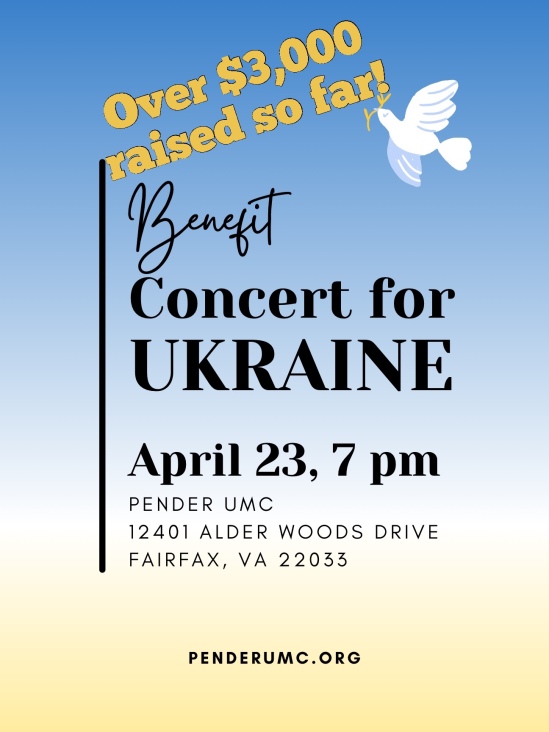
Liz Sellers, Pianist/Organist at Pender UMC in Fairfax, VA, and violinist Anthony Shieldsperformed Violin Sonata No. 5 in F major, Op. 24 by Ludwig van Beethoven during Pender’s new Concert Series which began on April 23, 2022.
The Violin Sonata No. 5 in F major, Op. 24, is a four movement work for violin and piano by Ludwig van Beethoven. It was first published in 1801. The work is commonly known as the Spring Sonata (Frühlingssonate), although the name “Spring” was apparently given to it after Beethoven’s death.
Liz and Anthony played the first movement.
The Pender Concert Supporting Ukraine on April 23 featured Liz Sellers on piano, Brian on harp, and local professional musicians, including woodwind quintet, drums, organ, guitar, flute, penny whistle, singing and violin.
Concert repertoire included: Harp arrangements by Debussy, Piano trio of Jazz/Baroque, Flute Concertino by Chaminade, Woodwind Quintet with music of Duke Ellington, The Widor Toccata Organ Symphony Movement V and an Irish session!
There was no charge for this concert but there was a free will offering taken to support Ukraine through Advance #982450, UMCOR International Disaster Response and Recovery. This fund provides direct assistance to those in Ukraine as well as assistance to Ukrainians fleeing to neighboring countries.
One hundred percent of all Advance contributions go to the designated cause. (The independent charity watchdog, “Charity Watch,” gives UMCOR an “A+” ranking, and includes the UM organization on a highly selective list of charities it recommends when considering how to support the Ukrainian people. Read more)
The United Methodist community in Ukraine, though quite small, is actively engaged in assisting neighbors in need. Global Ministries is in touch with the church’s leadership as well as with church leaders in countries welcoming those who are fleeing from violence in Ukraine.
Click this link and choose UMCOR to send direct aid. In the memo line, put Advance #982450, UMCOR International Disaster Response and Recovery.
The Piano Puzzlers book is available in the O’Connor Music Studio library if you’d like to give any a try. Piano Puzzlers as heard on American Public Media’s “Performance Today.” Includes 32 tunes with songs by Gershwin, Berlin, Arlen, Porter, Rodgers, Fats Waller, Lennon & McCartney, and others disguised in the styles of Bach, Handel, Haydn, Mozart, Beethoven, Brahms, Schubert, Schumann, Chopin, Janacek, Debussy, Ravel, Rachmaninoff, Stravinsky, Prokofiev, Bartok, and Copland.
Includes an introduction by Fred Child, host of “Performance Today” as well as background info by Bruce Adolphe. “Bruce Adolphe has taken a common musician’s party game and elevated it to high art and truly funny musical slapsticks. The Piano Puzzlers are a unique combination of extraordinary insight into the styles of many composers subtle, expert workmanship and great, great fun!”
If you’re a music geek (like me), I have a program for you. Now, let me be clear, to fully qualify as a music geek…you must have a fond appreciation for classical music (no, Poison, Quiet Riot, and Zepplin do not count as classical music). So, if you’re a “music geek” without an appreciation for classical music…well, I hate to burst your bubble…but, you’re not truly a music geek. Instead, you’re a music appreciator, but not a geek. So, if you just listen to indie music and scowl at anything on a label larger than Matador…don’t bother following the link I’ll provide…the fun will be lost on you…And, you probably won’t have a chance.
Every Wednesday night, on my way home from WNL, I turn on my local NPR station to listen to Piano Puzzlers on Performance Today. It’s absolutely incredible. A pianist/composer (Bruce Adolphe) takes a familiar folk or pop tune and sets it inside a classical masterpiece (or in the style of a particular composer). Sometimes it’s easy…sometimes it’s ridiculously difficult. There are days when I say, “got it” on the first pass. Then there are days when I say, “what the heck?” And, more often than not, I’m able to get either the popular/folk tune or the composer.
This is sad to admit, but there are nights when I’ll slow down on the drive home or sit in the car in the driveway to finish an episode. In fact, I get a little worked up if someone stops me after WNL…as I might miss the beginning of Piano Puzzlers (it usually hits around 8:20pm on our local station).
Take a listen to some of the archives and see if you can figure it out! It’s really cool…but probably only appreciated by music geeks (the kind of people that listen to NPR for their musical programs and not just the snipets of cool indie rock between segments on All Things Considered…which is a great show too).
• 1915 ~ Laverne Andrews, Pop Singer
More information about The Andrews Sisters
• 1915 ~ Dorothy Kirsten, Opera Singer
• 1925 ~ Merv Griffin, Entertainer
• 1925 ~ Bill Haley, American rock-and-roll singer, songwriter and guitarist with Bill Haley and His Comets
• 1932 ~ Della Reese (Delloreese Patricia Early), Pop Singer
• 1937 ~ Vladimir Ashkenazy, Russian-born Icelandic pianist and conductor
More information about Ashkenazy Grammy winner
• 1937 ~ Gene Chandler (Eugene Dixon), Singer
• 1937 ~ The big band classic, Sing, Sing, Sing was recorded by Benny Goodman and his band. Sitting in on this famous Victor Records session was Gene Krupa, Ziggy Elman and Harry James.
• 1945 ~ Rik Elswit, Musician, guitarist and singer with Dr. Hook and the Medicine Show
• 1954 ~ Nanci Griffith, Grammy Award-winning singer, songwriter
• 1957 ~ John Lennon and Paul McCartney met for the first time at The Woolton Church Parish Fete where The Quarry Men were appearing. As The Quarry Men were setting up for their evening performance, McCartney eager to impress Lennon picked up a guitar and played ‘Twenty Flight Rock’ (Eddie Cochran) and ‘Be-Bop-A-Lula’ (Gene Vincent). Lennon was impressed, and even more so when McCartney showed Lennon and Eric Griffiths how to tune their guitars, something they’d been paying someone else to do for them.
• 1959 ~ Jon Keeble, Musician, drummer with Spandau Balle
• 1971 ~ Louis Armstrong, Jazz musician, died. His groups, the Hot Five and Hot Seven, from 1925 to 1927, had a revolutionary impact on jazz.
• 1971 ~ Karen and Richard Carpenter hosted the summer series, Make Your Own Kind of Music, on NBC-TV.
• 1973 ~ Otto Klemperer, German conductor particularly known for his interpretations of Beethoven, died.
• 1984 ~ Michael Jackson and his brothers started their Victory Tour in Kansas City, Missouri’s Arrowhead Stadium. The tour turned out to be a victory for the Jacksons when the nationwide concert tour concluded months later.
• 1998 ~ Roy Rogers, U.S. film actor known as “the singing cowboy”, died.
• 2000 ~ Władysław Szpilman, Polish pianist and classical composer, died at the age of 88
• 2020 ~ Country Music legend Charlie Daniels, best known for his monster 1979 hit “The Devil Went Down to Georgia,” died at the age of 83.
• 2020 ~ Ennio Morricone wrote the scores for more than 500 movies and TV series, as well as over 100 works for the concert hall. He died following complications from a fall at the age of 91.







 MaryO'Studio