September 25: On This Day in Music

today

• 1683 ~ Jean-Philippe Rameau, French composer, theorist and organist
Read more about Rameau

• 1906 ~ Dmitri Shostakovich, Soviet composer
Read more about Shostakovich
Grammy winner
Shostakovich’s music was once condemned as being “un-Soviet” Shostakovich’s Piano Concerto number 2 is featured in Disney’s Fantasia 2000.

• 1932 ~ Glenn (Herbert) Gould, Canadian pianist, composer, wrote a piano essay about Petula Clark
Read quotes by and about Gould
Read news items about Gould

• 1933 ~ Erik Darling, Folk singer with The Weavers and also The Tarriers

• 1934 ~ Hot Lips was recorded by Henry Busse and his orchestra in Chicago, IL.

• 1943 ~ Gary Alexander, Guitar, singer with The Association

• 1945 ~ Onnie McIntyre, Guitar with Average White Band

• 1950 ~ NBC~TV introduced a new concept in daytime programming. Kate Smith debuted an hourlong show. Her theme song for the show was When the Moon Comes Over the Mountain. Kate’s daytime show ran for four years. God Bless America.

• 1953 ~ John Locke, Keyboards with Spirit

• 1953 ~ Following in the footlights of musical greats like Ignace Jan Paderewski and Victor Borge, a piano player named Liberace made his debut at Carnegie Hall. Liberace performed before a sellout audience. His candelabra and concert grand piano were instant trademarks that lasted throughout his career.

• 1955 ~ Steve Severin (Bailey), Bass with Siouxsie & The Banshees

• 1979 ~ The third musical resulting from the collaboration of Tim Rice and Andrew Lloyd Webber lit up the Great White Way. Evita opened on Broadway to rave reviews.

• 2002 ~ Bob Radonich, who for 47 years owned a local landmark cafe shaped like a coffee pot, died after suffering a series of strokes. He was 83. His cafe, Bob’s Java Jive, evokes a largely forgotten era of architecture. The street where it sits once featured toy factories shaped like castles, a gas station resembling a colossal neon gas pump and a yellow, lemon-shaped restaurant called the Lemon Lunch. Those other buildings vanished, but the Java Jive survived. Java Jive was originally known as the Coffee Pot Restaurant, built in 1927 by local veterinarian Otis G. Button and designed by an artist, inventor and promoter named Bert Smyser. Radonich bought the cafe in 1955. His wife Lylabell renamed the business for an Ink Spots’ song whose lyrics included I love coffee, I love tea, I love java jive, it loves me. The Java Jive, which was used for a scene in the 1990 movie “I Love You to Death,” was renowned for a pair of chimpanzees, Java and Jive, who played drums while Bobby Floyd, who was Bob and Lylabell’s son, entertained on the organ. Radonich’s daughter now owns and runs Bob’s Java Jive.

• 2009 ~ Alicia de Larrocha, Catalan pianist died. She was considered one of the great piano legends of the 20th century.

• 2012 ~ Andy Williams, American singer, died from bladder cancer at the age of 84

July 13: Today’s Music History

today

Be sure your student reads and listens to Today’s Daily Listening Assignment

• 1668 ~ Van Marco Cesti’s opera “Il Pomo d’Oro,” premiered in Vienna

• 1813 ~ Johann Friedrich Peter, Composer, died at the age of 67

• 1844 ~ Johann Gansbacher, Composer, died at the age of 66

• 1866 ~ C.C. Birchard, Music Publisher

• 1877 ~ Karl Erb, German tenor

• 1884 ~ John Francis Larchet, Composer

• 1889 ~ Carli Zoeller, Composer, died at the age of 49

• 1891 ~ Franco Casavola, Composer

• 1894 ~ Juventino Rosas, Composer, died at the age of 26

• 1898 ~ Guglielmo Marconi patented the radio

• 1903 ~ August Reissmann, Composer, died at the age of 77

• 1906 ~ Harry Sosnik, American orchestra leader of the Jack Carter Show and Your Hit Parade

• 1909 ~ David Branson, Composer

• 1909 ~ Paul Constantinescu, Composer

• 1909 ~ Washington Castro, Composer

• 1913 ~ Ladislav Holoubek, Composer

• 1915 ~ Paul Williams, Jazz saxophonist and bandleader Williams played with Clarence Dorsey in 1946, and then made his recording debut with King Porter in 1947 for Paradise before forming his own band later that year.

• 1921 ~ Ernest Gold, Composer

• 1921 ~ Charles Scribner Jr, Music publisher

• 1923 ~ Asger Hamerik (Hammerich) German composer, died at the age of 80

• 1924 ~ Carlo Bergonzi, Italian tenor

• 1926 ~ Meyer Kupferman, American composer

• 1928 ~ Donal Michalsky, Composer

• 1932 ~ Per Nørgård, Danish composer
More information about Nørgård

• 1934 ~ Roger Reynolds, Composer

• 1936 ~ Izydor Lotto, Composer, died at the age of 91

• 1939 ~ Frank Sinatra made his recording debut with the Harry James band. Frankie sang Melancholy Mood and From the Bottom of My Heart.

• 1942 ~ Roger McGuinn, Musician, guitarist and vocalist with the Byrds (1965 US & UK No.1 single ‘Mr Tambourine Man’). He was the only member of The Byrds to play on the hit, the others being session players. He toured with Bob Dylan in 1975 and 1976 as part of Dylan’s Rolling Thunder Revue, and later worked with fellow ex-Byrds Gene Clark and Chris Hillman to form “McGuinn, Clark and Hillman”.

• 1951 ~ Arnold Schoenberg, Austrian-born composer, died in Los Angeles; he was best known for his 12-note serial method and his composition Verklaerte Nacht and his opera “Moses und Aaron.”
More information about Schoenberg

• 1942 ~ Stephen Jo Bladd, American drummer with the J Geils Band

• 1954 ~ Louise Mandrell, American country singer with the Mandrell Sisters

• 1958 ~ Karl Erb, German tenor, died on 81st birthday

• 1959 ~ Dedicated to the One I Love, by The Shirelles, was released. The tune went to number 83 on the Top 100 chart of “Billboard” magazine. The song was re-released in 1961 and made it to number three on the charts.

• 1961 ~ Lawrence Donegan, Musician, bass with Lloyd Cole & The Commotions

• 1965 ~ Neil Thrasher, Country Singer

• 1973 ~ Martian Negrea, Composer, died at the age of 80

• 1973 ~ The Everly Brothers called it quits during a concert at the John Wayne Theatre in Buena Park, CA. Phil Everly walked off the stage in the middle of the show and brother Don said, “The Everly Brothers died ten years ago.” The duo reunited a decade later for a short time.

• 1976 ~ Max Butting, Composer, died at the age of 87

• 1978 ~ Antonio Veretti, Composer, died at the age of 78

• 1979 ~ George Harrison released Faster

• 1985 ~ Duran Duran took A View to a Kill, from the James Bond movie of the same name, to the top of the record charts this day. The song stayed on top for two weeks. Live and Let Die by Wings and Nobody Does It Better by Carly Simon — both James Bond themes — got only as high as number two on the record charts.

• 1985 ~ Live Aid, a rock concert masterminded by Bob Geldof, took place in London, Sydney, Moscow and Philadelphia and raised over 60 million dollars for famine in Africa.

• 1992 ~ Carla van Neste, Belgian violinist, died at the age of 78

• 1994 ~ Eddie Boyd, Blues vocalist and pianist, died at the age of 79

• 2023 ~ André Watts, pianist and Jacobs School professor, died at the age of 77. Watts made his national concert debut when he was 16 years old with Leonard Bernstein and the New York Philharmonic. Shortly after, he was asked to substitute in place of Glenn Gould with the Philharmonic. That performance is credited with launching Watts’ career.

September 25: On This Day in Music

today

OCMS 1683 ~ Jean-Philippe Rameau, French composer, theorist and organist
Read more about Rameau


OCMS 1906 ~ Dmitri Shostakovich, Soviet composer
Read more about Shostakovich
Grammy winner
Shostakovich’s music was once condemned as being “un-Soviet” Shostakovich’s Piano Concerto number 2 is featured in Disney’s Fantasia 2000. Read more about Shostakovich

• 1932 ~ Glenn (Herbert) Gould, Canadian pianist, composer, wrote a piano essay about Petula Clark
Read quotes by and about Gould
Read news items about Gould

• 1933 ~ Erik Darling, Folk singer with The Weavers and also The Tarriers

• 1934 ~ Hot Lips was recorded by Henry Busse and his orchestra in Chicago, IL.

• 1943 ~ Gary Alexander, Guitar, singer with The Association

• 1945 ~ Onnie McIntyre, Guitar with Average White Band

• 1950 ~ NBC~TV introduced a new concept in daytime programming. Kate Smith debuted an hourlong show. Her theme song for the show was When the Moon Comes Over the Mountain. Kate’s daytime show ran for four years. God Bless America.

• 1953 ~ John Locke, Keyboards with Spirit

• 1953 ~ Following in the footlights of musical greats like Ignace Jan Paderewski and Victor Borge, a piano player named Liberace made his debut at Carnegie Hall. Liberace performed before a sellout audience. His candelabra and concert grand piano were instant trademarks that lasted throughout his career.

• 1955 ~ Steve Severin (Bailey), Bass with Siouxsie & The Banshees

• 1979 ~ The third musical resulting from the collaboration of Tim Rice and Andrew Lloyd Webber lit up the Great White Way. Evita opened on Broadway to rave reviews.

• 2002 ~ Bob Radonich, who for 47 years owned a local landmark cafe shaped like a coffee pot, died after suffering a series of strokes. He was 83. His cafe, Bob’s Java Jive, evokes a largely forgotten era of architecture. The street where it sits once featured toy factories shaped like castles, a gas station resembling a colossal neon gas pump and a yellow, lemon-shaped restaurant called the Lemon Lunch. Those other buildings vanished, but the Java Jive survived. Java Jive was originally known as the Coffee Pot Restaurant, built in 1927 by local veterinarian Otis G. Button and designed by an artist, inventor and promoter named Bert Smyser. Radonich bought the cafe in 1955. His wife Lylabell renamed the business for an Ink Spots’ song whose lyrics included I love coffee, I love tea, I love java jive, it loves me. The Java Jive, which was used for a scene in the 1990 movie “I Love You to Death,” was renowned for a pair of chimpanzees, Java and Jive, who played drums while Bobby Floyd, who was Bob and Lylabell’s son, entertained on the organ. Radonich’s daughter now owns and runs Bob’s Java Jive.

• 2009 ~ Alicia de Larrocha, Catalan pianist died. She was considered one of the great piano legends of the 20th century.

• 2012 ~ Andy Williams, American singer, died from bladder cancer at the age of 84

On September 25 ~ in Music History

today

OCMS 1683 ~ Jean-Philippe Rameau, French composer, theorist and organist
Read more about Rameau


OCMS 1906 ~ Dmitri Shostakovich, Soviet composer
Read more about Shostakovich
Grammy winner
Shostakovich’s music was once condemned as being “un-Soviet” Shostakovich’s Piano Concerto number 2 is featured in Disney’s Fantasia 2000. Read more about Shostakovich

• 1932 ~ Glenn (Herbert) Gould, Canadian pianist, composer, wrote a piano essay about Petula Clark
Read quotes by and about Gould
Read news items about Gould

• 1933 ~ Erik Darling, Folk singer with The Weavers and also The Tarriers

• 1934 ~ Hot Lips was recorded by Henry Busse and his orchestra in Chicago, IL.

• 1943 ~ Gary Alexander, Guitar, singer with The Association

• 1945 ~ Onnie McIntyre, Guitar with Average White Band

• 1950 ~ NBC~TV introduced a new concept in daytime programming. Kate Smith debuted an hourlong show. Her theme song for the show was When the Moon Comes Over the Mountain. Kate’s daytime show ran for four years. God Bless America.

• 1953 ~ John Locke, Keyboards with Spirit

• 1953 ~ Following in the footlights of musical greats like Ignace Jan Paderewski and Victor Borge, a piano player named Liberace made his debut at Carnegie Hall. Liberace performed before a sellout audience. His candelabra and concert grand piano were instant trademarks that lasted throughout his career.

• 1955 ~ Steve Severin (Bailey), Bass with Siouxsie & The Banshees

• 1979 ~ The third musical resulting from the collaboration of Tim Rice and Andrew Lloyd Webber lit up the Great White Way. Evita opened on Broadway to rave reviews.

• 2002 ~ Bob Radonich, who for 47 years owned a local landmark cafe shaped like a coffee pot, died after suffering a series of strokes. He was 83. His cafe, Bob’s Java Jive, evokes a largely forgotten era of architecture. The street where it sits once featured toy factories shaped like castles, a gas station resembling a colossal neon gas pump and a yellow, lemon-shaped restaurant called the Lemon Lunch. Those other buildings vanished, but the Java Jive survived. Java Jive was originally known as the Coffee Pot Restaurant, built in 1927 by local veterinarian Otis G. Button and designed by an artist, inventor and promoter named Bert Smyser. Radonich bought the cafe in 1955. His wife Lylabell renamed the business for an Ink Spots’ song whose lyrics included I love coffee, I love tea, I love java jive, it loves me. The Java Jive, which was used for a scene in the 1990 movie “I Love You to Death,” was renowned for a pair of chimpanzees, Java and Jive, who played drums while Bobby Floyd, who was Bob and Lylabell’s son, entertained on the organ. Radonich’s daughter now owns and runs Bob’s Java Jive.

• 2009 ~ Alicia de Larrocha, Catalan pianist died. She was considered one of the great piano legends of the 20th century.

• 2012 ~ Andy Williams, American singer, died from bladder cancer at the age of 84

September 25 ~ in Music History

today

OCMS 1683 ~ Jean-Philippe Rameau, French composer, theorist and organist
Read more about Rameau


OCMS 1906 ~ Dmitri Shostakovich, Soviet composer
Read more about Shostakovich
Grammy winner
Shostakovich’s music was once condemned as being “un-Soviet” Shostakovich’s Piano Concerto number 2 is featured in Disney’s Fantasia 2000. Read more about Shostakovich

• 1932 ~ Glenn (Herbert) Gould, Canadian pianist, composer, wrote a piano essay about Petula Clark
Read quotes by and about Gould
Read news items about Gould

• 1933 ~ Erik Darling, Folk singer with The Weavers and also The Tarriers

• 1934 ~ Hot Lips was recorded by Henry Busse and his orchestra in Chicago, IL.

• 1943 ~ Gary Alexander, Guitar, singer with The Association

• 1945 ~ Onnie McIntyre, Guitar with Average White Band

• 1950 ~ NBC~TV introduced a new concept in daytime programming. Kate Smith debuted an hourlong show. Her theme song for the show was When the Moon Comes Over the Mountain. Kate’s daytime show ran for four years. God Bless America.

• 1953 ~ John Locke, Keyboards with Spirit

• 1953 ~ Following in the footlights of musical greats like Ignace Jan Paderewski and Victor Borge, a piano player named Liberace made his debut at Carnegie Hall. Liberace performed before a sellout audience. His candelabra and concert grand piano were instant trademarks that lasted throughout his career.

• 1955 ~ Steve Severin (Bailey), Bass with Siouxsie & The Banshees

• 1979 ~ The third musical resulting from the collaboration of Tim Rice and Andrew Lloyd Webber lit up the Great White Way. Evita opened on Broadway to rave reviews.

• 2002 ~ Bob Radonich, who for 47 years owned a local landmark cafe shaped like a coffee pot, died after suffering a series of strokes. He was 83. His cafe, Bob’s Java Jive, evokes a largely forgotten era of architecture. The street where it sits once featured toy factories shaped like castles, a gas station resembling a colossal neon gas pump and a yellow, lemon-shaped restaurant called the Lemon Lunch. Those other buildings vanished, but the Java Jive survived. Java Jive was originally known as the Coffee Pot Restaurant, built in 1927 by local veterinarian Otis G. Button and designed by an artist, inventor and promoter named Bert Smyser. Radonich bought the cafe in 1955. His wife Lylabell renamed the business for an Ink Spots’ song whose lyrics included I love coffee, I love tea, I love java jive, it loves me. The Java Jive, which was used for a scene in the 1990 movie “I Love You to Death,” was renowned for a pair of chimpanzees, Java and Jive, who played drums while Bobby Floyd, who was Bob and Lylabell’s son, entertained on the organ. Radonich’s daughter now owns and runs Bob’s Java Jive.

• 2009 ~ Alicia de Larrocha, Catalan pianist died. She was considered one of the great piano legends of the 20th century.

• 2012 ~ Andy Williams, American singer, died from bladder cancer at the age of 84

September 25 ~ This Day in Music History

today

OCMS 1683 ~ Jean-Philippe Rameau, French composer, theorist and organist
Read more about Rameau


OCMS 1906 ~ Dmitri Shostakovich, Soviet composer
Read more about Shostakovich
Grammy winner
Shostakovich’s music was once condemned as being “un-Soviet” Shostakovich’s Piano Concerto number 2 is featured in Disney’s Fantasia 2000. Read more about Shostakovich

• 1932 ~ Glenn (Herbert) Gould, Canadian pianist, composer, wrote piano essay about Petula Clark
Read quotes by and about Gould
Read news items about Gould

• 1933 ~ Erik Darling, Folk singer with The Weavers and also The Tarriers

• 1934 ~ Hot Lips was recorded by Henry Busse and his orchestra in Chicago, IL.

• 1943 ~ Gary Alexander, Guitar, singer with The Association

• 1945 ~ Onnie McIntyre, Guitar with Average White Band

• 1950 ~ NBC~TV introduced a new concept in daytime programming. Kate Smith debuted an hourlong show. Her theme song for the show was When the Moon Comes Over the Mountain. Kate’s daytime show ran for four years. God Bless America.

• 1953 ~ John Locke, Keyboards with Spirit

• 1953 ~ Following in the footlights of musical greats like Ignace Jan Paderewski and Victor Borge, a piano player named Liberace made his debut at Carnegie Hall. Liberace performed before a sellout audience. His candelabra and concert grand piano were instant trademarks that lasted throughout his career.

• 1955 ~ Steve Severin (Bailey), Bass with Siouxsie & The Banshees

• 1979 ~ The third musical resulting from the collaboration of Tim Rice and Andrew Lloyd Webber lit up the Great White Way. Evita opened on Broadway to rave reviews.

• 2002 ~ Bob Radonich, who for 47 years owned a local landmark cafe shaped like a coffee pot, died after suffering a series of strokes. He was 83. His cafe, Bob’s Java Jive, evokes a largely forgotten era of architecture. The street where it sits once featured toy factories shaped like castles, a gas station resembling a colossal neon gas pump and a yellow, lemon-shaped restaurant called the Lemon Lunch. Those other buildings vanished, but the Java Jive survived. Java Jive was originally known as the Coffee Pot Restaurant, built in 1927 by local veterinarian Otis G. Button and designed by an artist, inventor and promoter named Bert Smyser. Radonich bought the cafe in 1955. His wife Lylabell renamed the business for an Ink Spots’ song whose lyrics included I love coffee, I love tea, I love java jive, it loves me. The Java Jive, which was used for a scene in the 1990 movie “I Love You to Death,” was renowned for a pair of chimpanzees, Java and Jive, who played drums while Bobby Floyd, who was Bob and Lylabell’s son, entertained on the organ. Radonich’s daughter now owns and runs Bob’s Java Jive.

September 25, 2016 ~ Today in Music History

today

OCMS 1683 ~ Jean-Philippe Rameau, French composer, theorist and organist
Read more about Rameau


OCMS 1906 ~ Dmitri Shostakovich, Soviet composer
Read more about Shostakovich
Grammy winner
Shostakovich’s music was once condemned as being “un-Soviet” Shostakovich’s Piano Concerto number 2 is featured in Disney’s Fantasia 2000. Read more about Shostakovich

• 1932 ~ Glenn (Herbert) Gould, Canadian pianist, composer, wrote piano essay about Petula Clark
Read quotes by and about Gould
Read news items about Gould

https://youtu.be/c7zwcTYFgBw

• 1933 ~ Erik Darling, Folk singer with The Weavers and also The Tarriers

• 1934 ~ Hot Lips was recorded by Henry Busse and his orchestra in Chicago, IL.

• 1943 ~ Gary Alexander, Guitar, singer with The Association

• 1945 ~ Onnie McIntyre, Guitar with Average White Band

• 1950 ~ NBC~TV introduced a new concept in daytime programming. Kate Smith debuted an hourlong show. Her theme song for the show was When the Moon Comes Over the Mountain. Kate’s daytime show ran for four years. God Bless America.

• 1953 ~ John Locke, Keyboards with Spirit

• 1953 ~ Following in the footlights of musical greats like Ignace Jan Paderewski and Victor Borge, a piano player named Liberace made his debut at Carnegie Hall. Liberace performed before a sellout audience. His candelabra and concert grand piano were instant trademarks that lasted throughout his career.

• 1955 ~ Steve Severin (Bailey), Bass with Siouxsie & The Banshees

• 1979 ~ The third musical resulting from the collaboration of Tim Rice and Andrew Lloyd Webber lit up the Great White Way. Evita opened on Broadway to rave reviews.

• 2002 ~ Bob Radonich, who for 47 years owned a local landmark cafe shaped like a coffee pot, died after suffering a series of strokes. He was 83. His cafe, Bob’s Java Jive, evokes a largely forgotten era of architecture. The street where it sits once featured toy factories shaped like castles, a gas station resembling a colossal neon gas pump and a yellow, lemon-shaped restaurant called the Lemon Lunch. Those other buildings vanished, but the Java Jive survived. Java Jive was originally known as the Coffee Pot Restaurant, built in 1927 by local veterinarian Otis G. Button and designed by an artist, inventor and promoter named Bert Smyser. Radonich bought the cafe in 1955. His wife Lylabell renamed the business for an Ink Spots’ song whose lyrics included I love coffee, I love tea, I love java jive, it loves me. The Java Jive, which was used for a scene in the 1990 movie “I Love You to Death,” was renowned for a pair of chimpanzees, Java and Jive, who played drums while Bobby Floyd, who was Bob and Lylabell’s son, entertained on the organ. Radonich’s daughter now owns and runs Bob’s Java Jive.

September 25 ~ Today in Music

today


OCMS 1683 ~ Jean-Philippe Rameau, French composer, theorist and organist
Read more about Rameau

OCMS 1906 ~ Dmitri Shostakovich, Soviet composer
Read more about Shostakovich
Grammy winner
Shostakovich’s music was once condemned as being “un-Soviet” Shostakovich’s Piano Concerto number 2 is featured in Disney’s Fantasia 2000. Read more about Shostakovich

• 1932 ~ Glenn (Herbert) Gould, Canadian pianist, composer, wrote piano essay about Petula Clark
Read quotes by and about Gould
Read news items about Gould

• 1933 ~ Erik Darling, Folk singer with The Weavers and also The Tarriers

• 1934 ~ Hot Lips was recorded by Henry Busse and his orchestra in Chicago, IL.

• 1943 ~ Gary Alexander, Guitar, singer with The Association

• 1945 ~ Onnie McIntyre, Guitar with Average White Band

• 1950 ~ NBC~TV introduced a new concept in daytime programming. Kate Smith debuted an hourlong show. Her theme song for the show was When the Moon Comes Over the Mountain. Kate’s daytime show ran for four years. God Bless America.

• 1953 ~ John Locke, Keyboards with Spirit

• 1953 ~ Following in the footlights of musical greats like Ignace Jan Paderewski and Victor Borge, a piano player named Liberace made his debut at Carnegie Hall. Liberace performed before a sellout audience. His candelabra and concert grand piano were instant trademarks that lasted throughout his career.

• 1955 ~ Steve Severin (Bailey), Bass with Siouxsie & The Banshees

• 1979 ~ The third musical resulting from the collaboration of Tim Rice and Andrew Lloyd Webber lit up the Great White Way. Evita opened on Broadway to rave reviews.

• 2002 ~ Bob Radonich, who for 47 years owned a local landmark cafe shaped like a coffee pot, died after suffering a series of strokes. He was 83. His cafe, Bob’s Java Jive, evokes a largely forgotten era of architecture. The street where it sits once featured toy factories shaped like castles, a gas station resembling a colossal neon gas pump and a yellow, lemon-shaped restaurant called the Lemon Lunch. Those other buildings vanished, but the Java Jive survived. Java Jive was originally known as the Coffee Pot Restaurant, built in 1927 by local veterinarian Otis G. Button and designed by an artist, inventor and promoter named Bert Smyser. Radonich bought the cafe in 1955. His wife Lylabell renamed the business for an Ink Spots’ song whose lyrics included I love coffee, I love tea, I love java jive, it loves me. The Java Jive, which was used for a scene in the 1990 movie “I Love You to Death,” was renowned for a pair of chimpanzees, Java and Jive, who played drums while Bobby Floyd, who was Bob and Lylabell’s son, entertained on the organ. Radonich’s daughter now owns and runs Bob’s Java Jive.

Mozart’s Fantasia in d minor, K. 397

mozart-fantasia

I have always really enjoyed playing Mozart’s Fantasia in d minor and when I was asked to play for the new piano dedication service at my church a couple years ago I knew what I would “dust off” to perform.

The Grove’s Dictionary of Music and Musicians defines the genre of musical fantasia as “a piece of instrumental music owning no restriction of formal construction, but the direct product of the composer’s impulse.”

The Fantasia in d minor has somewhat unusual rhythm, constantly changing tempo (seven different tempi occur throughout the piece), three cadenzas and its apparent lack of any recognizable musical form (as indicated by the “Fantasy” title). Although it begins in d minor, the final section is in D Major.

Mozart composed this, his third and final, Fantasia in 1782 and it was unfinished at the time of his death in 1791.  Even Mozart’s sister, “Nannerl”, who came across the work in 1807, was astounded to have discovered a previously unknown composition of such quality.

In its original form this Fantasia was probability only a fragment of what was to be a larger work. The closing bars which are most frequently performed today originated from an unauthorized print believed to have been composed in 1806 by August Eberhard Müller, one of Mozart’s admirers.

Because it was unfinished, many of the dynamic and pedal markings are nonexistant and left for the performer to choose.

As you can see from these videos, there is a wide range of tempi and interpretation from Frederich Gulda’s 4 minute, 36 second rendition 

to Glenn Gould’s version which lasts for 8 minutes, 22 seconds

Both these composers have added their own ornamentation to Mozart’s original work.

I will be playing from a G. Henley Verlag urtext edition instead of one of the many edited versions available.  I prefer to make my own musical decisions wherever possible.

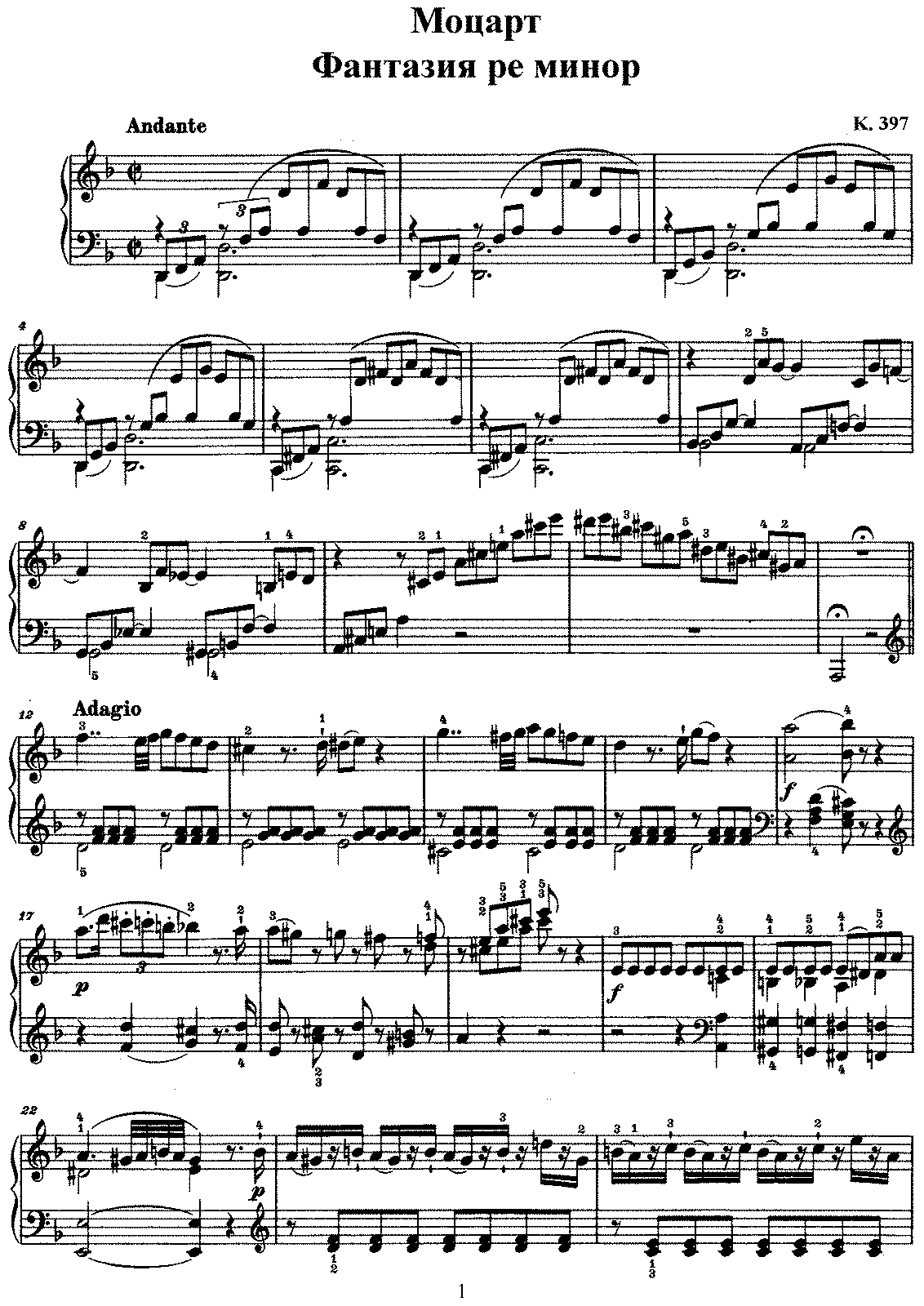
The version above is originally from http://imslp.org/wiki/Fantasia_in_D_minor,_K.397/385g_(Mozart,_Wolfgang_Amadeus)  I had printed it out as another source to compare with mine, since this one has different dynamic and other interpretive markings.  This version also has 3 notes which differ from the urtext edition.

I also used 3 other sources before I finally decided how I would shape my performance and choose my fingerings.

Some sites that I consulted as part of the learning process: 

I’ve played this for just about everyone I know and on 4 different pianos and it was ready on time!


Mozart’s Fantasia in d minor, K. 397

I have always really enjoyed playing Mozart’s Fantasia in d minor and when I was asked to play for the new piano dedication service at my church I knew what I would “dust off” to perform.

The Grove’s Dictionary of Music and Musicians defines the genre of musical fantasia as “a piece of instrumental music owning no restriction of formal construction, but the direct product of the composer’s impulse.”

The Fantasia in d minor has somewhat unusual rhythm, constantly changing tempo (seven different tempi occur throughout the piece), three cadenzas and its apparent lack of any recognizable musical form (as indicated by the “Fantasy” title). Although it begins in d minor, the final section is in D Major.

Mozart composed this, his third and final, Fantasia in 1782 and it was unfinished at the time of his death in 1791.  Even Mozart’s sister, “Nannerl”, who came across the work in 1807, was astounded to have discovered a previously unknown composition of such quality.

In its original form this Fantasia was probability only a fragment of what was to be a larger work. The closing bars which are most frequently performed today originated from an unauthorized print believed to have been composed in 1806 by August Eberhard Müller, one of Mozart’s admirers.

Because it was unfinished, many of the dynamic and pedal markings are nonexistant and left for the performer to choose.

As you can see from these videos, there is a wide range of tempi and interpretation from Frederich Gulda’s 4 minute, 36 second rendition 

to Glenn Gould’s version which lasts for 8 minutes, 22 seconds

Both these composers have added their own ornamentation to Mozart’s original work.

I will be playing from a G. Henley Verlag urtext edition instead of one of the many edited versions available.  I prefer to make my own musical decisions wherever possible.

The version below is originally from http://imslp.org/wiki/Fantasia_in_D_minor,_K.397/385g_(Mozart,_Wolfgang_Amadeus)  I had printed it out as another source to compare with mine, since this one has different dynamic and other interpretive markings.  This version also has 3 notes which differ from the urtext edition.

Mozart-fantasia-d-minor.pdf
Download this file

I also used 3 other sources before I finally decided how I would shape my performance and choose my fingerings.

Some sites that I consulted as part of the learning process: 

I’ve played this for just about everyone I know and on 4 different pianos and I think it’s ready for Sunday night!