Bargemusic

Another small break from Christmas music since we went to Bargemusic last week:

is a classical music venue and cultural icon founded in 1977,  housed on a converted coffee barge moored at Fulton Ferry Landing on the East River near the Brooklyn Bridge.  I took this picture of the NY skyline and Steinway piano from the second row seating.
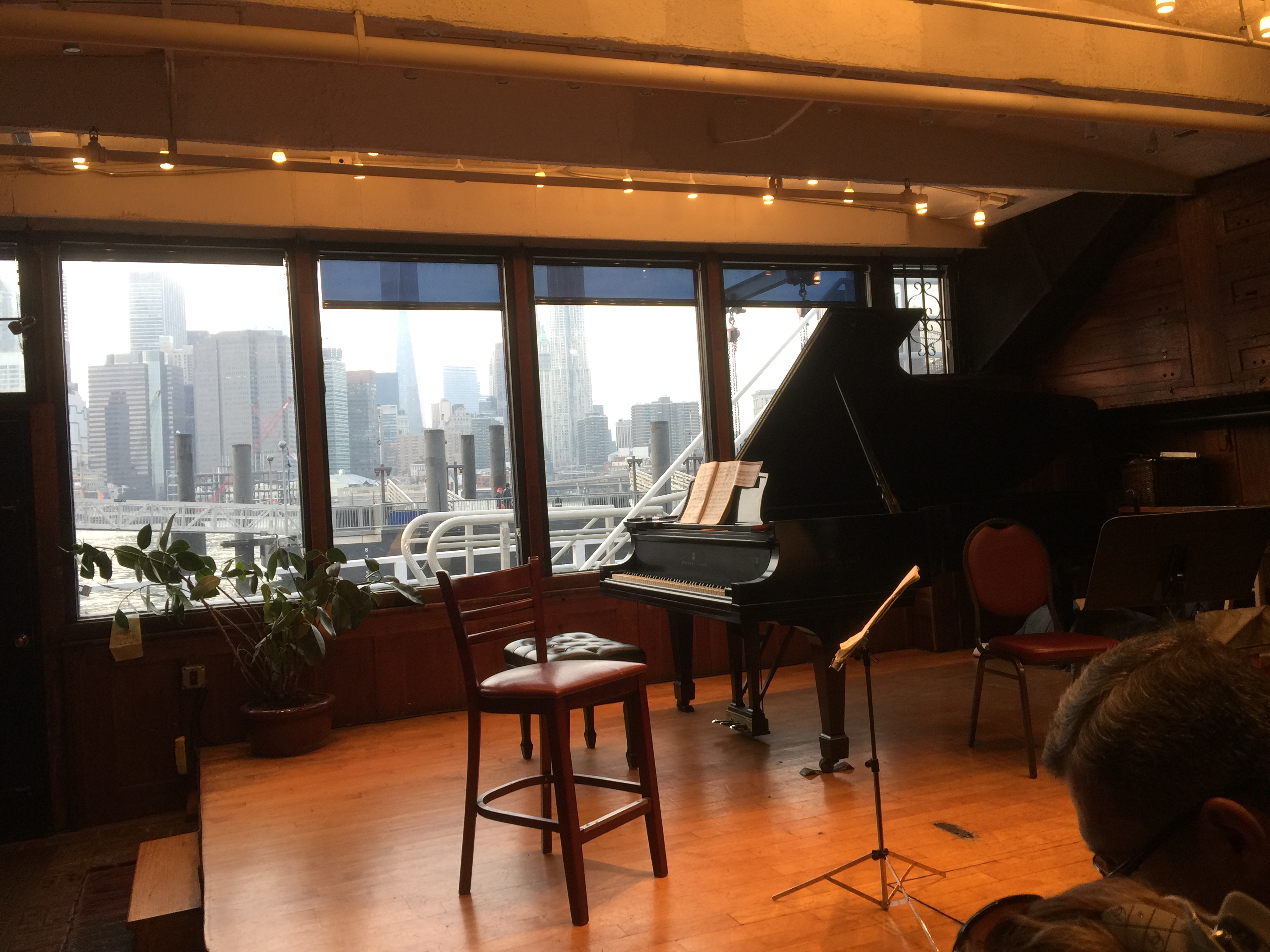
bargemusic

On Saturday afternoons at 4, Bargemusic is free!  Such a deal.  The nighttime performances cost a bit but still reasonable.

Founder and director, Olga Bloom was interviewed about the floating concert hall under the Brooklyn Bridge she converted from an old coffee barge. The video includes excerpts from one of the chamber music concerts typical of the Bargemusic programs, and features classical music artists, Ida Levin, violin, Anton Nel, piano, Thomas Hill, clarinet, Ronald Thomas, cello. A Greenpoint Video Project production. Supported through a grant from NYCEF, New York State Council on the Arts.

One of our performers was Mark Peskanov, Bargemusic President, Executive & Artistic Director.  He talked a little about the program, about Bargemusic in general, and introduced the pianist and cellist for today.  Each played a Bach solo and the 3 played  Piano Trio No.4, Op.90 by Antonín Dvořák.  Here, it’s played by another trio:


Ludwig Van Beethoven Piano Trios Opus 70 No. 2, Opus 97 “Archduke”

beethoven

Beethoven’s first published works—his Opus No.1—were three trios for piano, violin and cello and already they show a marked advance on Haydn’s trios in the comparative interdependence of the three parts. Their freedom from Haydn’s oppressive formality looks forward to the first mature trios, the pair that comprises Opus 70, displaying all sorts of harmonic twists, thematic innovations and structural idiosyncrasies, these trios make much of the piano part and contain plenty of dramatic outbursts that are typical of Beethoven’s middle period.

Even more arresting is the first of the Opus 70 trios (1808) nicknamed ”The Ghost” because of its mysterious and haunting Largo. Its sibling boasts a cheerful bombastic finale that is the most entertaining music that Beethoven composed for this combination of instruments.

The “Archduke” Trio Opus 97 (1811) was Beethoven’s last full – scale work for piano trio and is typically conclusive. The third movement is its centre of gravity, a highly moving set of variations with the cello dominating the thematic content. It opens with a hymn-like theme and progresses to a coda which magnificently sums up the movements ideas. The finale might be less powerful than that of Opus 70 No. 2, but it nevertheless has a sweeping rhythmic power. Again, it is beyond the shadow of a doubt that Beethoven defined the piano trio form that it retained throughout the 19th century by allowing the string instruments the status of genuinely equal partners in this superlative performance.

Read more at Ludwig Van Beethoven Piano Trios Opus 70 No. 2, Opus 97 “Archduke” | World Music Report.


The Piano Guys are coming to Wolf Trap August 6

The Piano Guys are an American musical group who gained popularity through YouTube, where they posted piano and cello renditions of popular songs and classical music.

They are also adding piano music books.  This one from amazon.com says:

piano-guysWith their clever and inspiring takes on popular music and creative videos, The Piano Guys serve up an eclectic mix of classical, film score, rock and pop favorites that resonates with a wide variety of audiences.

Play 12 of their most popular songs in these arrangements for easy piano with optional cello: All of Me * Arwen’s Vigil * Begin Again * Home * Kung Fu Piano: Cello Ascends * Moonlight * Over the Rainbow * Paradise * Rolling in the Deep * A Thousand Years * Titanium * Without You.

Includes separate pull-out cello part.


I am not sure about their idea of  “easy piano” but I have ordered a copy for the studio.

Wolf Trap tickets are available here: http://www.wolftrap.org/tickets/calendar/performance/15filene/0806show15.aspx

Ludwig Van Beethoven Piano Trios Opus 70 No. 2, Opus 97 “Archduke” | World Music Report

beethoven

Beethoven’s first published works—his Opus No.1—were three trios for piano, violin and cello and already they show a marked advance on Haydn’s trios in the comparative interdependence of the three parts. Their freedom from Haydn’s oppressive formality looks forward to the first mature trios, the pair that comprises Opus 70, displaying all sorts of harmonic twists, thematic innovations and structural idiosyncrasies, these trios make much of the piano part and contain plenty of dramatic outbursts that are typical of Beethoven’s middle period.

Even more arresting is the first of the Opus 70 trios (1808) nicknamed ”The Ghost” because of its mysterious and haunting Largo. Its sibling boasts a cheerful bombastic finale that is the most entertaining music that Beethoven composed for this combination of instruments.

The “Archduke” Trio Opus 97 (1811) was Beethoven’s last full – scale work for piano trio and is typically conclusive. The third movement is its centre of gravity, a highly moving set of variations with the cello dominating the thematic content. It opens with a hymn-like theme and progresses to a coda which magnificently sums up the movements ideas. The finale might be less powerful than that of Opus 70 No. 2, but it nevertheless has a sweeping rhythmic power. Again, it is beyond the shadow of a doubt that Beethoven defined the piano trio form that it retained throughout the 19th century by allowing the string instruments the status of genuinely equal partners in this superlative performance.


Read more at Ludwig Van Beethoven Piano Trios Opus 70 No. 2, Opus 97 “Archduke” | World Music Report.