
You only need to practice on the days that you eat 🙂

You only need to practice on the days that you eat 🙂
Picture a seven-foot grand piano in a studio. The lid’s missing, so you can see all the strings. Researchers suspend a rod embedded with 32 microphones over the piano’s body.
“We played this middle C at a very soft level, a medium level, and a very loud level,” says Agnieszka Roginska, a professor in NYU’s music technology program. She says using a pianist to play middle C over and over wouldn’t be scientific. So they’re using a disklavier, a fancy player piano triggered by electronics. “So we could hit the same note, with the same velocity, thousands of times,” she says.
They’d record the piano in one spot. Then move the microphones eight inches. Record the note. Move the mics again. Record the note. Over and over and over, until they reach the back of the piano. At the end, they get “what is basically a very dense acoustical scan of the radiation pattern of the grand piano,” Roginska says.
Read the entire article here: http://www.pri.org/stories/2014-08-10/science-tries-understand-what-gives-piano-its-voice
Lee Eckroth couldn’t hold back a smile as piano music filled the air Wednesday afternoon on the streets of downtown Corvallis.
The moment marked the culmination of months of work from by Eckroth, Corvallis Imagination Music & Art founder David Lundahl and dozens of volunteers who’d banded together to create the first Play Corvallis, Play.
The art installation features eight theme-decorated pianos, placed at outdoor locations around Corvallis. It is open to the public from 7 a.m. to 10 p.m. daily through Aug. 16 as a prelude event to the Imagination Music and Art festival at Bruce Starker Arts Park on Aug. 15 and 16.
Play Corvallis, Play is intended to inspire appreciation of the arts, and it is just what it sounds like: an invitation to residents to stop and play the piano to showcase local musical creativity and art as a way of drawing attention to the fundraising at Corvallis public schools.
Read the whole article at Pianos are popping up all over Corvallis.
When my students are first working with the Grand Staff, they are often confused about the placement of the various clefs.
In piano music, we generally use only the G-clef (Treble clef – not “trouble clef” as some think!) and the F-clef (Bass clef) I try to show students how the curvy part of the G-clef wraps around the G above middle C and the F-clef looks sort of like an F marking the F below middle C. I draw out G and F on the staff to show how these could have looked.
Originally, instead of a special clef symbol, the reference line of the staff was simply labeled with the name of the note it was intended to bear: F and C and, more rarely, G. These were the most often-used ‘clefs’ in Gregorian chant notation. Gregorian chant developed mainly in western and central Europe during the 9th and 10th centuries, with later additions and redactions.
Over time the shapes of these letters became stylized, leading to their current versions.

NOT Mrs. O’Connor!
See if a prospective teacher allows a trial lesson to test how the personalities mesh. And be sure to ask lots of questions. What’s the teacher’s background as a musician and as an instructor? What kinds of teaching materials and music does she use? How much practice time is expected for students, and does that vary by the student’s age? Does the teacher have access to student ensembles? What kinds of performance opportunities will he provide? Will the teacher allow the student to record the lesson? This can be a terrific practice aid, especially when it comes to remembering how something is supposed to sound. Does she teach any music theory or composition? What are the expectations for students and for their parents?
A good teacher can be a friendly, encouraging and inspiring presence — even when a student hits rough patches. He will point out the student’s weaknesses without being harsh or dismissive, suggest innovative ways to overcome challenges, and create engaging ways to tackle even rote activities like playing scales or honing fine motor skills. The instructor’s age and experience might or might not be a deciding factor; for example, I’m consistently impressed by the range of tricks my own child’s very youthful private teacher has up her sleeve to turn what could easily be drudgery into fun. Not to mention the huge helpings of good humor and patience she brings to her tiny charges!
Read more at Finding The Right Teacher For Your Music-Loving Kid : Deceptive Cadence : NPR.
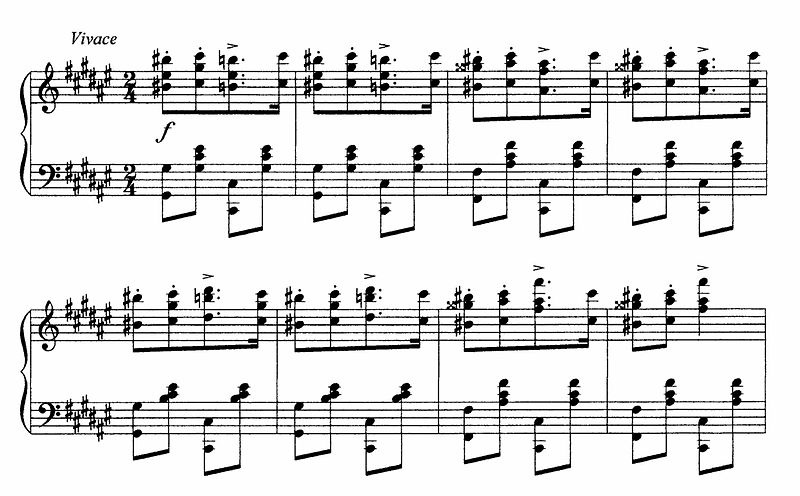
Hungarian Rhapsody No. 2, S.244/2, is the second in a set of 19 Hungarian Rhapsodies by composer Franz Liszt, and is by far the most famous of the set. Few other piano solos have achieved such widespread popularity, offering the pianist the opportunity to reveal exceptional skill as a virtuoso, while providing the listener with an immediate and irresistible musical appeal.
In both the original piano solo form and in the orchestrated version this composition has enjoyed widespread use in animated cartoons. Its themes have also served as the basis of several popular songs.
It is probable that you have heard this piece of music somewhere at one time or another because it is perhaps the most prominent piece of classical (romantic, actually) music featured in animated cartoons across the years.
Now, let the anvils fall and dynamite explode!
And, in real life, Valentina Lisitsa plays Liszt’s Hungarian Rhapsody No. 2
Many homeowners don’t realize that there are movers available to them who specialize in the transportation and storage of pianos. A piano is a delicate instrument and not something you want to take risks with. By trusting this major job to a piano mover, you can rest easy knowing that one of the most valuable items in your home is being transported with the care it deserves.
But It Weighs 1500 Pounds. How Delicate Can It Be?
 This is exactly where many homeowners go wrong. Sure, that piano in your living room is heavy enough to throw out the backs of four or five of your best buddies as you wrestle it out the door and up into the truck, but don’t let that fool you. Despite its bulky appearance, it is also a precision musical instrument with over 1000 moving parts and 200 finely-tuned strings, any number of which can be damaged and require repair if your piano isn’t handled properly in a move.
Your Piano Mover Understands Pianos
These intricate inner workings of a piano are exactly why hiring an expert in piano moving is so important. These professionals understand pianos and moving them, from the safest way to lift and twist a standard upright piano to get it out the door, to how to properly disassemble a grand piano and transport it without causing any damage. And even more importantly, a piano mover understands that when your piano is delivered to your new home, you expect to be able to sit down and play it right away. It’s why many piano movers keep tuners and repairmen on staff, and why the rest will have a trusted list of professionals available on request if you need it.

I have copies of the above sheet music in the music studio, if anyone wants to play this!
Having trouble counting various note values?
In music notation, a note value indicates the relative duration of a note, using the color or shape of the note head, the presence or absence of a stem, and the presence or absence of flags/beams/hooks/tails.
A rest indicates a silence of an equivalent duration.
Read the article at Note values.
The following ornament table is a transcription of the one appearing in the Clavier-Büchlein vor Wilhelm Friedemann Bach, written by Johann Sebastian Bach for the keyboard instruction of his eldest son.
A scan of the original manuscript appears at Dave’s J.S. Bach Page.
The German title translates as “Explanation of various signs, showing how to play certain ornaments correctly.”{1} Bach gives the sign for each ornament on the upper of the paired staves, while the lower shows its execution directly beneath.
(This blog has) simply modernized the clefs in my transcription, since Bach’s manuscript uses soprano clefs, as several composers continued to do throughout the 18th century in place of the treble clef now used in all keyboard music.
After the transcription graphic showing the table, there appear clickable buttons which are keyed to AU sound files; you can click on any of the ornaments and hear a sound file play its execution.

Read the original blog post with the ornament table and listening files at J.S. Bach’s Ornament Table.
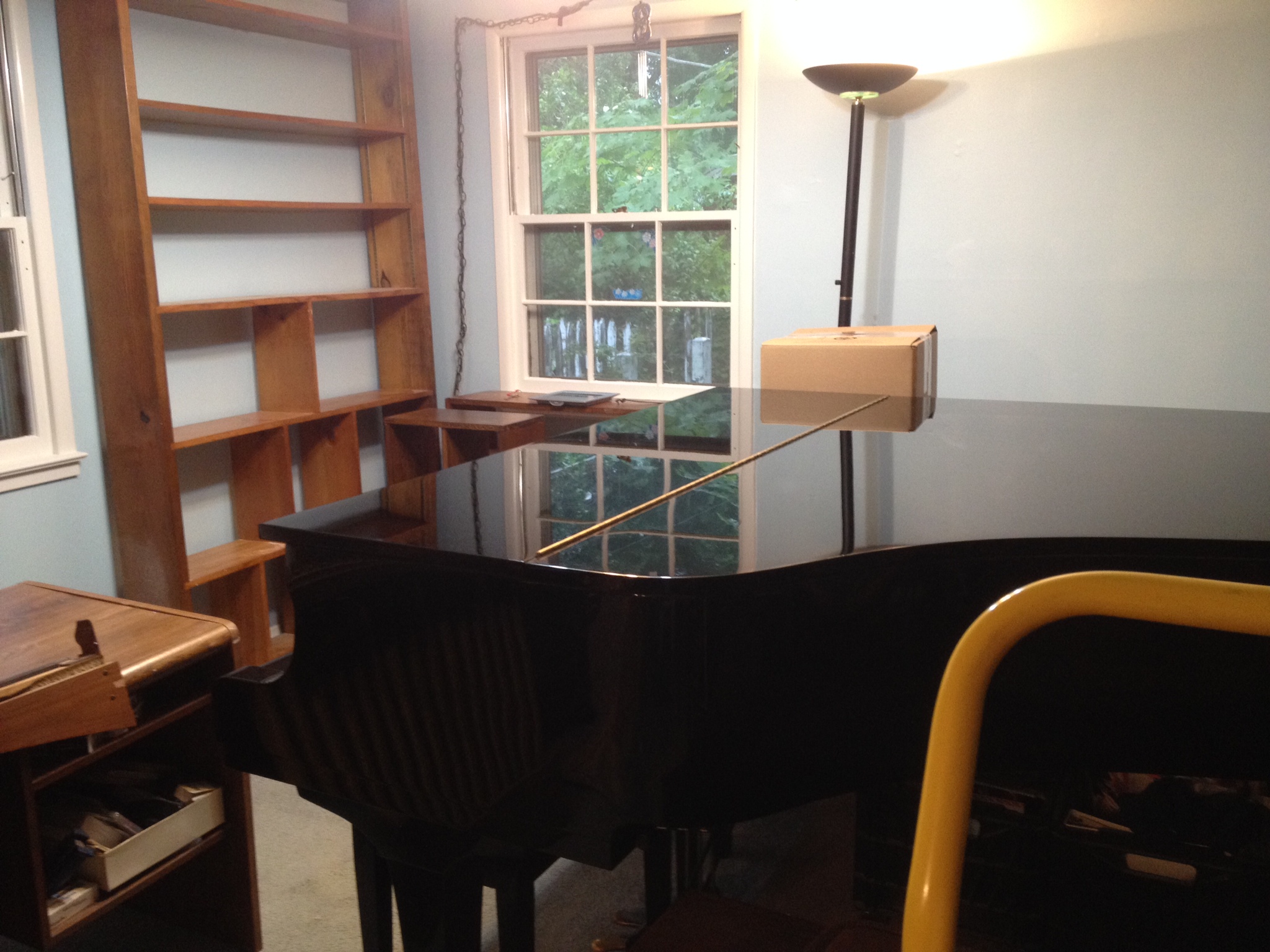
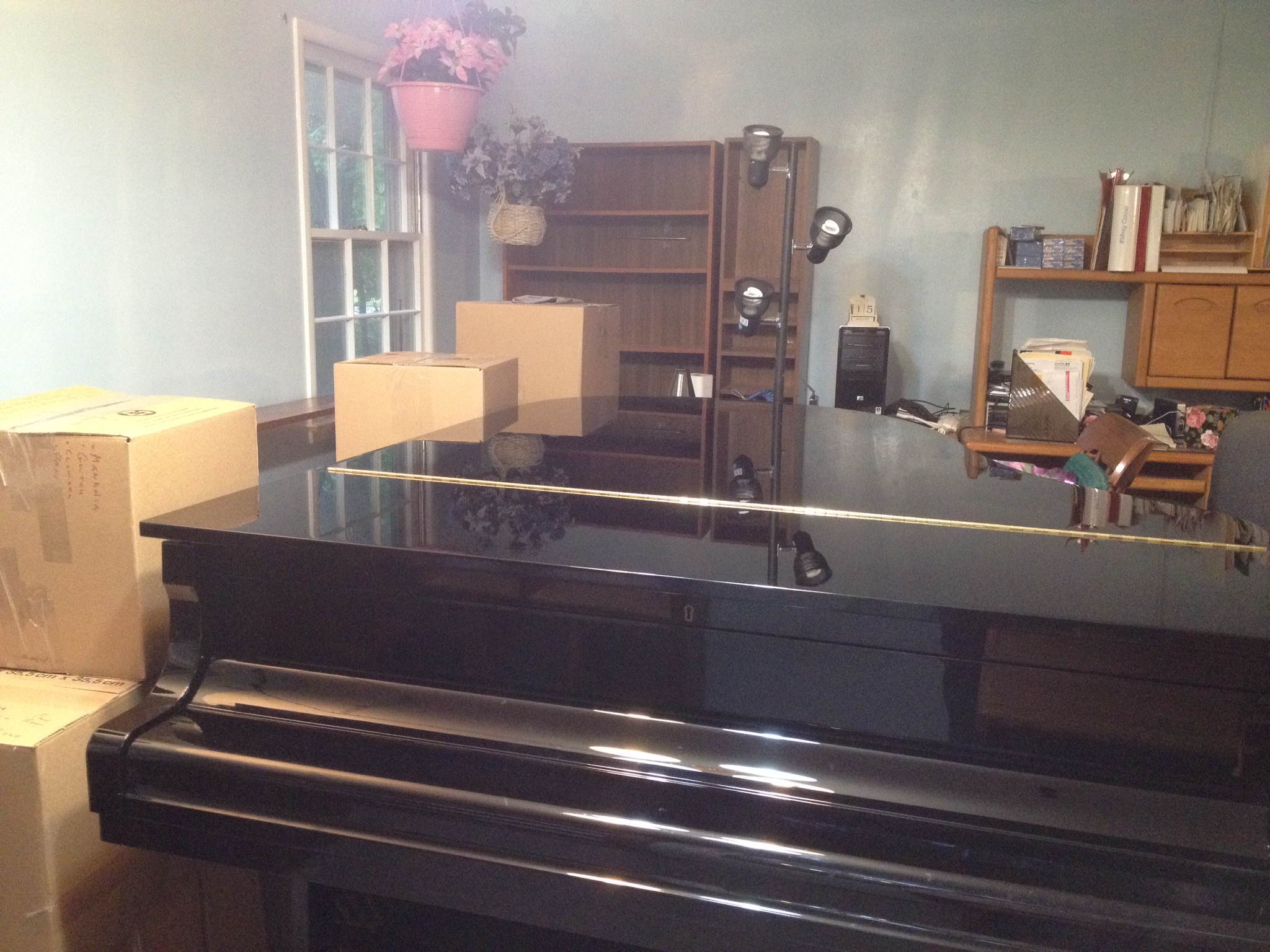
Now, it’s time to start putting the furniture back where it goes, although I think I’m leaving the piano more in the center of the room for now. It shows the piano off better and I’ll have a place to put the digital keyboard against the wall and closer to the piano.
After a lot of thought, the organs will stay in their respective places next to each other but the music for them will be moving nearer to them.
Then putting all the other books away. I have an iPad app which is a database that adds items by taking pictures of their barcodes. Hopefully, this will help organize some of my books.
It won’t be done by Monday but it will be done enough for teaching purposes!


