June 14 is set aside to observe National Pop Goes the Weasel Day. On this day people dig back into their memories to the nursery rhymes they learned as children and celebrate the day singing “Pop Goes the Weasel”.
The origins of this nursery rhyme are believed to date back to the 1700′s.
The following lyric was printed in Boston in 1858:
All around the cobbler’s house,
The monkey chased the people.
And after them in double haste,
Pop! goes the weasel.
In 1901 in New York the opening lines were:
All around the chicken coop,
The possum chased the weasel.
The most common recent version was not recorded until 1914. In addition to the three verses above, American versions often include some of the following:
All around the mulberry bush,
The monkey chased the weasel.
The monkey stopped to pull up his sock, (or The monkey stopped to scratch his nose)
Pop! goes the weasel.
Half a pound of tuppenny rice,
Half a pound of treacle.
Mix it up and make it nice,
Pop! goes the weasel.
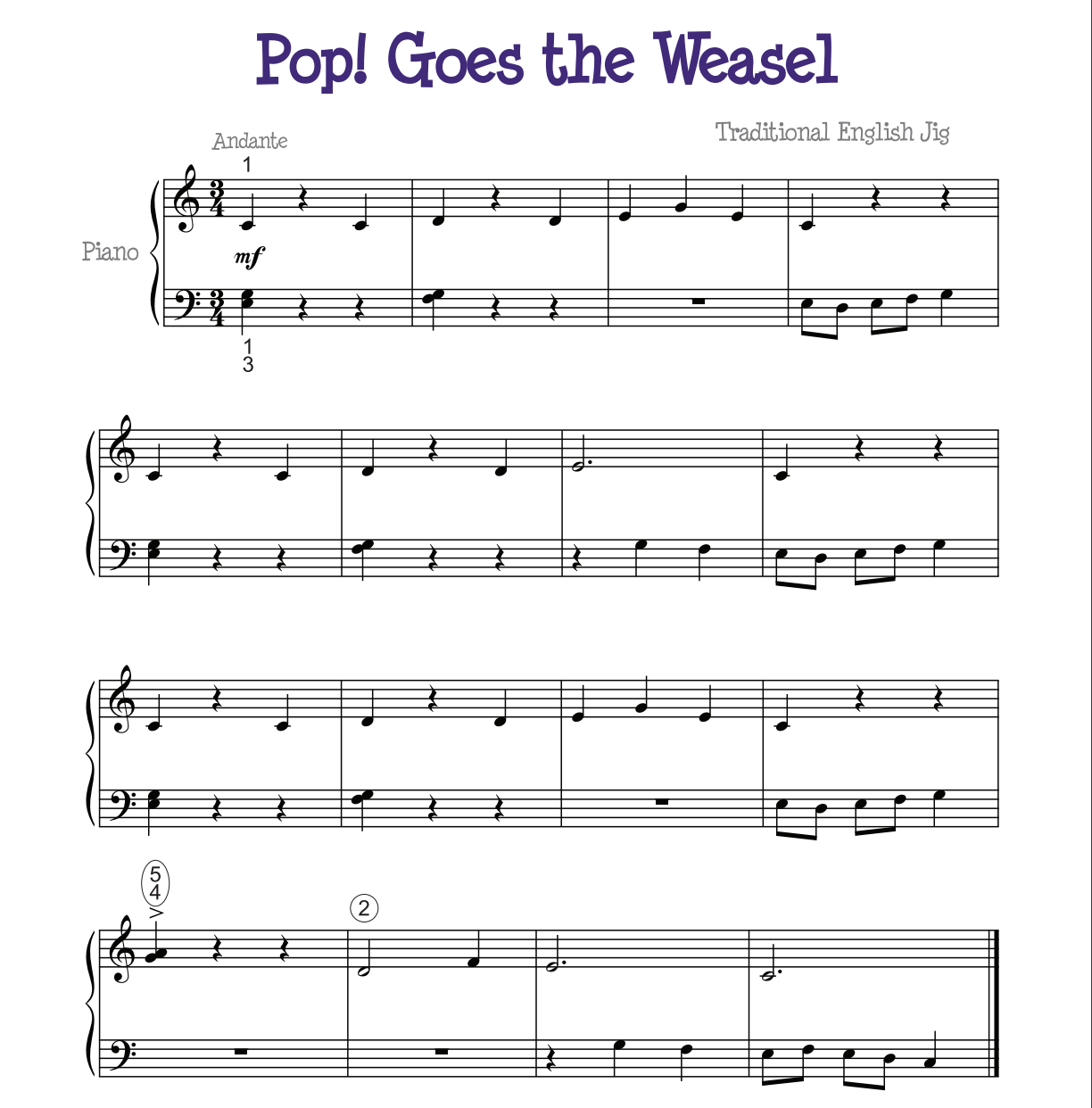
A Piano Version:
‘Pop Goes the Weasel’ is played by the oboe while Elgar’s ‘Enigma’ Theme is performed on piano. This test of Dennis Whitten’s alleged solution demonstrates it is not a credible counterpoint to the ‘Enigma’ Theme, finishing five measures too soon while producing an unacceptably high number of dissonant note intervals.
• 1884 ~ John McCormack, Irish/American singer of Irish folksongs
• 1891 ~ Nicolo Gabrielli, Composer, died at the age of 77
• 1895 ~ Cliff Edwards “Ukulele Ike”, Singer of When You Wish Upon a Star
• 1904 ~ Benno Ammann, Composer
• 1909 ~ Burl Ives, American folk singer, banjo player, guitarist and Oscar-winning actor. His gentle voice helped popularise American folk music. He played powerful dramatic roles in movies including “The Big Country,” for which he won an Acadamy Award for best supporting actor, and “Cat on a Hot Tin Roof.” anniversary of his death
• 1910 ~ Nappy (Hilton Napoleon) Lamare, Musician with Bob Cats
• 1911 ~ Johan Severin Svendsen, Composer, died at the age of 70
• 1916 ~ Karl-Rudi Griesbach, Composer
• 1916 ~ MIT and the American Telephone and Telegraph Company attempted the largest transcontinental telephone circuit of the time at Symphony Hall!
• 1918 ~ Carter Harman, Composer
• 1920 ~ Helmer-Rayner Sinisalo, Composer
• 1923 ~ Theodore Bloomfield, Composer
• 1923 ~ It was the beginning of the country music recording industry. Ralph Peer of Okeh Records recorded Fiddlin’ John Carson doing The Little Old Log Cabin in theLane— and the first country music recording was in the can.
• 1929 ~ Cy Coleman (Seymour Kaufman), American composer of popular music and pianist
More information about Cy Coleman
• 1932 ~ Coleridge-Taylor Perkinson, Composer
• 1933 ~ Albert Ross Parsons, Composer, died at the age of 85
• 1940 ~ John Mizelle, Composer
• 1943 ~ Muff (Mervyn) Winwood, Singer, songwriter, bass with The Spencer Davis Group
• 1945 ~ Rod Argent, Keyboard
• 1948 ~ Ernst Henrik Ellberg, Composer, died at the age of 79
• 1948 ~ John Blackwood McEwen, Composer, died at the age of 80
• 1953 ~ Elvis Presley graduated from L.C. Humes High School in Memphis, TN. Within three years, the truck driver-turned-singer had his first number-one record with Heartbreak Hotel.
• 1960 ~ Vladimir Nikolayevich Kryukov, Composer, died at the age of 57
• 1962 ~ Boy George, Singer
• 1965 ~ Guido Guerrini, Composer, died at the age of 74
• 1969 ~ John & Yoko appeared on David Frost’s British TV Show
• 1974 ~ Knud Christian Jeppesen, Composer, died at the age of 81
• 1975 ~ America reached the top spot on the Billboard pop music chart with SisterGolden Hair. The group had previously (March, 1972) taken A Horse With No Name to the number one spot. The trio of Dan Peek, Gerry Beckley and Dewey Bunnell had received the Best New Artist Grammy in 1972. America recorded a dozen hits that made it to the popular music charts in the 1970s and 1980s. Though number one, Sister Golden Hair did not qualify for gold record (million-seller) status.
• 1976 ~ The Beatles were awarded a gold record for the compilation album of past hits titled, Rock ’n’ Roll Music.
• 1978 ~ Theodore Karyotakis, Composer, died at the age of 74
• 1980 ~ Theme From New York, New York by Frank Sinatra hit #32
• 1986 ~ Alan Jay Lerner, Broadway librettist, died in NY at 67
More information about Lerner
• 1989 ~ Carole King got a star in Hollywood’s walk of fame
• 1994 ~ Henry Mancini passed away at the age of 70
More information about Mancini
• 1994 ~ Lionel Grigson, Professor of jazz, died at the age of 52
• 1994 ~ Harry “Little” Caesar, blues singer/actor (City Heat), died at the age of 66
• 1996 ~ Thomas Edward Montgomery, drummer, died at the age of 73
• 2002 ~ Marvin Paymer, Pianist, composer, musicologist and author, died of cancer. He was 81. His son, actor David Paymer, told the Los Angeles Times that Paymer died in San Diego. In 1977, he co-founded and, until his retirement in 1993, served as associate director of the Pergolesi Research Center at City University of New York Graduate Center. Pergolesi was 18th century Italian composer Giovanni Battista Pergolesi. Paymer authenticated 13 Pergolesi compositions among hundreds of fakes attributed to the posthumously famous composer, who died at 26.
For tapping out a beat may help children learn difficult fraction concepts, according to new findings due to be published in the journal Educational Studies in Mathematics.
An innovative curriculum uses rhythm to teach fractions at a California school where students in a music-based programme scored significantly higher on math tests than their peers who received regular instruction.”Academic Music” is a hands-on curriculum that uses music notation, clapping, drumming and chanting to introduce third-grade students to fractions.The programme, co-designed by San Francisco State University researchers, addresses one of the most difficult – and important – topics in the elementary mathematics curriculum.”If students don’t understand fractions early on, they often struggle with algebra and mathematical reasoning later in their schooling,” said Susan Courey, assistant professor of special education at San Francisco State University.
• 1962 ~ Eugene Goossens, British Composer (Perseus), died at the age of 69. A member of a famed musical family, he spent his later years conducting in Australia where he trained many musicians.
• 1970 ~ The Summertime by Mungo Jerry hit #1 in England
• 1970 ~ The Beatles’ “Let It Be,” album went #1 & stayed #1 for 4 weeks
• 1970 ~ The Beatles’Long & Winding Road, single went #1 & stayed #1 for 2 weeks
• 1970 ~ The song Make It with You, by David Gates and Bread, was released. It turned out to be a number-one hit on August 22, 1970. Though Bread had a dozen hits, including one other million-seller (Baby I’m-A Want You, 1971); Make It with Youwas the soft-pop group’s only number one tune.
• 1971 ~ Singer Francis Albert Sinatra made an attempt to retire from show business following a performance this night at the Music Center in Los Angeles, CA. ‘Ol’ Blue Eyes’ got a bit restless in retirement, however, and was back in Sinatra – The Main Event at Madison Square Garden in November, 1973.
• 1972 ~ Clyde L Mcphatter, American singer with the Drifters, died at the age of 39
• 1973 ~ Alvin Derold Etler, Composer, died at the age of 60
• 1973 ~ Frantisek Suchy, Composer, died at the age of 82
• 1989 ~ Jerry Lee Lewis got a star on the Hollywood Walk of Fame
• 1990 ~ “Les Miserables” opened at South Alberta Jubilee Centre, Calgary
• 1993 ~ “Someone Who’ll Watch Over Me” closed at Booth NYC after 232 performances
• 2001 ~ Makanda McIntyre, a jazz musician and educator, died at the age of 69. McIntyre’s best-known album was “Looking Ahead” (1960). He taught music in Manhattan schools and at Wesleyan University, Smith College, Fordham University and the New School. He was the founder and chairman of the American music, dance and theater program at the State University at Old Westbury, N.Y. McIntyre was born in Boston. After serving in the Army, he studied at the Boston Conservatory of Music and later earned a doctorate from the University of Massachusetts. Formerly Ken McIntyre, he changed his name to Makanda after a stranger in Zimbabwe handed him a piece of paper on which was written, “Makanda,” a word in the Ndebele and Shona languages meaning “many skins.”
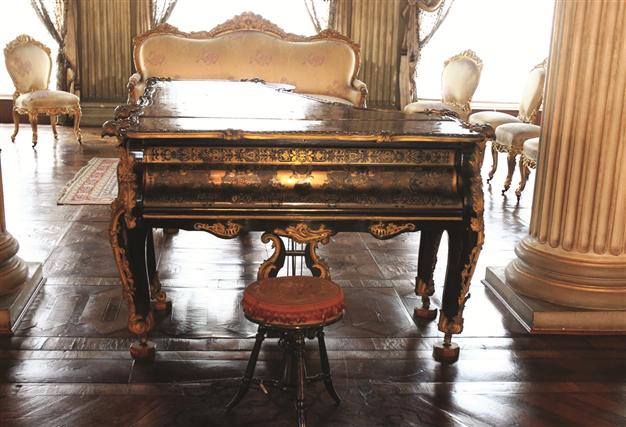
The pianos in Istanbul’s Dolmabahçe Palace, which hosted some 1 million people last year, draw great interest from local and foreign visitors for their magnificence and harmony with their surroundings.
National Palace guide Osman Nihat Bişgin said Dolmabahçe Palace was a Tanzimat (reform-era) palace, adding, “All features of the reform era are clearly seen in Dolmabahçe Palace. This process, which we call the Europeanization and westernization process, made western music enter Dolmabahçe Palace.”
He said the palace had a total of 12 pianos, and all of them had ornamentations suitable to the style and harmony of the palace.
Bişgin said the palace opened in 1856 and the pianos were brought there nearly at the same time. “The wives of sultans were taking piano education in the palace, particularly in the final years of the Ottomans. There are many pianos and none of them were inactive; all of them were being played,” he said.
He said most of the piano brands in the palace were Hertz, Pleyel, Gaveau and Erard, and that the number of grand pianos was less.
Speaking of a striking green piano in Zülvecheyn Hall on the upper floor of the palace, Bişgin said it was a classical Pleyel-brand palace piano.
“Since the magnificence and glory was dominant in the palace, the pianos draw our attention visually. Their sound is not very famous, but they are very important and famous visually,” he said.
Bişgin said Zülvecheyn Hall had gilded ornamentation on its white and beige ceiling, adding, “We see enormous harmony between the piano and the ceiling.”
He said the furniture in Dolmabahçe Palace was in its original place, and added, “We can say that the pianos belong to these halls. The pianos in the Zülvecheyn and Süfera halls were designed to add visual richness to halls like them. They are not generally played.”
Crystal piano and chair in the Glass Kiosk
As for the rare crystal piano in the Glass Kiosk, Bişgin said the following: “The Glass Kiosk is a big venue hidden behind the walls of the palace. Mustafa Kemal Atatürk greeted the public in this place. It is like a winter garden surrounded with glass. In harmony with this kiosk, there is a crystal piano. It is a Paris-made Gaveau piano. Its chair is crystal, too.”
Another piano in the palace is a plain black German-made Steinway. Bişgin said its sound was very strong and it was very valuable.
“It was produced as a Hamburg Steinway in 1912. Then the factory moved to the U.S. Accordingly, there were only five Steinway pianos made in Germany. This is one of them. Its estimated price is 200,000 euros. It also has the emblem of the sultan Abdulmecid,” Bişgin added.
Speaking of the piano, which was used during the acceptance of ambassadors in the Süfera Hall, Bişgin said, “Süfera is the plural of the word sefir [ambassador]. This hall was created to address foreigners. The furniture is gold-plated; the ceiling is the same. There is a boulle-work piano here to show the beauty of metal and gold. This piano is wonderful for decoration.”
• 1928 ~ Vic Damone (Vito Farinola), American singer of popular music
• 1930 ~ Jim Nabors, Singer
• 1935 ~ Ella Fitzgerald recorded her first sides for Brunswick Records. The tunes were Love and Kisses and I’ll Chase the Blues Away. She was featured with Chick Webb and his band. Ella was 17 at the time and conducted the Webb band for three years following his death in 1939.
• 1938 ~ Ian Partridge, British tenor
• 1941 ~ “Chick” Corea, American Grammy Award-winning (4) Jazz musician and composer
• 1942 ~ Walter Leigh, Composer, died at the age of 36
• 1942 ~ Paul Whiteman and his orchestra recorded Travelin’ Light on Capitol Records of Hollywood, California. On the track with Whiteman’s orchestra was the vocal talent of ‘Lady Day’, Billie Holiday.
• 1944 ~ Reg Presley, Singer with Troggs
• 1947 ~ Jazeps Medins, Composer, died at the age of 70
• 1948 ~ William Tell Overture by Spike Jones (originally an opera by Rossini) peaked at #6
Original:
• 1951 ~ Bun Carlos (Brad Carlson), Musician, drummer with Cheap Trick
• 1951 ~ Brad Delp, Musician, guitarist, singer with Boston
• 1962 ~ John N Ireland, English Composer/pianist, died at the age of 82
• 1965 ~ The Queen of England announced that The Beatles would receive the coveted MBE Award. The Order of the British Empire recognition had previously been bestowed only upon British military heroes, many of whom were so infuriated by the news, they returned their medals to the Queen. In fact, John Lennon wasn’t terribly impressed with receiving the honor. He returned it (for other reasons) four years later.
• 1965 ~ Rolling Stones released Satisfaction
• 1965 ~ Sonny and Cher made their first TV appearance, “American Bandstand”
• 1966 ~ Hermann Scherchen, German conductor and music publisher, died at the age of 74
• 1966 ~ The Dave Clark Five set record as they appear for twelfth time on Ed Sullivan
• 1968 ~ Fidelio Friedrich Finke, Composer, died at the age of 76
• 1968 ~ “What Makes Sammy Run?” closed at 84th St Theater NYC after 540 performances
• 1977 ~ “Pippin” closes at Imperial Theater NYC after 1944 performances
• 1989 ~ Peter Conrad Baden, Composer, died at the age of 80
• 1992 ~ “Batman Returns”, music by Danny Elfman, was released in America
• 1993 ~ Three Little Pigs by Green Jelly hit #17
• 1994 ~ Cab Calloway suffered massive stroke at his home White Plaines NY
• 1995 ~ Arturo Benedetti Michelangeli, Italian Pianist, died at the age of 75. He was hailed as one of the greatest pianists of the 20th century.
• 1996 ~ MacKenzie John, Pipe major, died at the age of 83
• 2000 ~ Robert J. Lurtsema, a classical music show host with a sonorous voice and unique delivery who became a fixture of the Boston radio scene over nearly three decades, died of lung disease. He was 68. Lurtsema, who worked at WGBH-FM for more than 28 years, is well-known to classical music buffs as the host of “Morning pro musica”, which could be heard throughout the Northeast.
There’s more to a song than meets the ear, as Neil deGrasse Tyson finds out when he interviews singer/songwriter/producer Josh Groban. Josh shares how he got started playing his family’s electronic Casio piano while he was still in diapers, and whether he was a science geek in school.
In studio, concert pianist and MIT Lecturer in Music, Elaine Kwon, and co-host Chuck Nice add their voices to the chorus to help us hear the science woven into the songs. You’ll learn how artists breathe life into their music, and about the qualitative difference between human generated and automated music.
Explore the importance of the acoustics of a performance space, the effect music has on people, the difference between melody and harmony, the ranges the human voice is capable of, and which was more important, Charlie Parker’s personal style or his sax.
Plus, Neil and Josh discuss “acoustic panty removers”, Chuck admits to singing first soprano in his church choir, and we find out whether Rachmaninoff really had “big hands” and what rubato means.
• 1864 ~ Richard Strauss, German composer and conductor. Strauss wrote in nearly every genre, but is best known for his tone poems and operas.
Read quotes by and about Strauss
More information about Richard Strauss
• 1874 ~ Richard Stohr, Composer
• 1896 ~ Friedrich Gottlieb Schwencke, Composer, died at the age of 72
• 1899 ~ George Frederick McKay, Composer
• 1900 ~ Charles Swinnerton Heap, Composer, died at the age of 53
• 1904 ~ Emil Frantisek Burian, Composer
• 1904 ~ Clarence “Pinetop” Smith, Jazz pianist and singer of Boogie Woogie Piano
• 1924 ~ Théodore Dubois, French organist and composer, died at the age of 86
• 1926 ~ Carlisle Floyd, American opera composer
• 1927 ~ Josef Anton Reidl, Composer
• 1928 ~ King Oliver and his band recorded Tin Roof Blues for Vocalion Records.
• 1939 ~ Wilma Burgess, Country singer
• 1940 ~ Joey Dee (Joseph DiNicola), Singer with Joey Dee and The Starliters
• 1940 ~ The Ink Spots recorded Maybe on Decca Records. By September, 1940, the song had climbed to the number two position on the nation’s pop music charts.
• 1946 ~ John Lawton, Singer
• 1949 ~ Hank Williams sang a show-stopper on the stage of the Grand Ole Opry at the Ryman Auditorium in Nashville. He sang the classic LovesickBlues, one of his most beloved songs. 1951 ~ Bonnie Pointer, Grammy Award-winning singer (with sister Anita) in the Pointer Sisters
• 1955 ~ Marcel Louis Auguste Samuel-Rousseau, Composer, died at the age of 72
• 1961 ~ Roy Orbison was wrapping up a week at number one on the Billboard record chart with Running Scared, his first number one hit. Orbison recorded 23 hits for the pop charts, but only one other song made it to number one: Oh Pretty Woman in 1964. He came close with a number two effort, Crying, number four with Dream Baby and number five with Mean Woman Blues. Orbison was inducted into the Rock and Roll Hall of Fame in 1987; but suffered a fatal heart attack just one year later.
• 1964 ~ The group, Manfred Mann, recorded Do Wah Diddy Diddy
• 1966 ~ Janis Joplin made her first onstage appearance — at the Avalon ballroom in San Francisco. She began her professional career at the age of 23 with Big Brother and The Holding Company. The group was a sensation at the Monterey Pop Festival in 1967. Piece of My Heart was the only hit to chart for the group in 1968. Big Brother and The Holding Company disbanded in 1972, though Joplin continued in a solo career with hits such as Down on Me and Me and Bobby McGee. Janis ‘Pearl’ Joplin died of a heroin overdose in Hollywood in October, 1970. The movie The Rose, starring Bette Midler, was inspired by the life of the rock star.
• 1966 ~ (I’m A) Road Runner by Jr Walker & The All-Stars peaked at #20
• 1990 ~ Clyde McCoy, Jazz trumpeter, died at the age of 86
• 1995 ~ Lovelace Watkins, Singer, died at the age of 58
• 2001 ~ Amalia Mendoza, one of Mexico’s most famous singers of mariachi and ranchera music, died at the age of 78. She was famous for songs such as Echame a mi la Culpa (Put the Blame onMe) and Amarga Navidad (Bitter Christmas). Born in the Michoacan town of San Juan Huetamo in 1923, she was part of a family of noted musicians. Ranchera music is a kind of Mexican country music that overlaps with Mariachi music.
• 2001 ~ Ponn Yinn, a flutist of traditional Cambodian music and dance who survived the Khmer Rouge purge and helped preserve his country’s culture, died of a stroke at the age of 82. Yinn was working under Prince Norodom Sihanouk, then Gen. Lon Nol, for the Classical Symphony of the Army for the Royal Ballet, when the Khmer Rouge overthrew Cambodia’s government in 1975. Khmer Rouge forces found Yinn during their campaign to uncover and eliminate Cambodia’s intellectuals and artists. He begged for his life and claimed to be a steel worker who enjoyed playing the flute. He was allowed to live, but was forced to play a makeshift flute nightly into loudspeakers to drown out the screams of people being slaughtered in fields nearby. In 1979, Yinn crossed through minefields and escaped to Thailand. In a border refugee camp, Yinn headed the Khmer Classical Dance Troupe. At a time when Cambodian culture was believed to have been almost eradicated – a result of the Khmer Rouge’s genocide of 1 million to 2 million people, the troupe was discovered by Western visitors. Yinn settled in Long Beach in 1984, where he taught music for more than 20 years and continued to perform.
• 2015 ~ Ornette Coleman died. He was an American jazz saxophonist, violinist, trumpeter and composer. He was one of the major innovators of the free jazz movement of the 1960s.


 Flag Day

 MaryO'Studio