• 1652 ~ Johann Krieger, German composer and organist
• 1701 ~ Johann Joachim Agrell, Composer
More information about Agrell
• 1735 ~ Paul Revere, American patriot and music engraver
• 1764 ~ In a stunning demonstration of prodigious talent, the Royal Family at Versailles in France was treated to a brilliant recital by an eight-year-old musician. His name was Wolfgang Amadeus Mozart.
1900 ~ Xavier Cugat (Francisco de Asís Javier Cugat Mingall de Brue y Deulofeo). Spanish violinist, composer and bandleader, married to Abbe Lane and Charo
More information about Cugat
• 1916 ~ Earl Wrightson, Actor, singer
• 1923 ~ Milt Jackson, Vibes with The Modern Jazz Quartet
• 1925 ~ Lucrezia Bori and John McCormack of the famous Metropolitan Opera in New York City made their singing debuts on radio this day. The broadcast over what was WEAF Radio (now WABC) encouraged others to sing on radio. Some of those were Hootie and the Blowfish, and Barry Manilow.
• 1928 ~ Frank Pourcel, Composer, violinist
• 1942 ~ Country Joe McDonald, Singer with Country Joe & the Fish
• 1953 ~ A sad day in country music, as the legendary Hank Williams died at the young age of 29. Undisputedly, the biggest star in the history of country music, Hank Williams’ legacy is being carried on by his son, Hank Williams, Jr.
• 1955 ~ Elvis Presley appeared at The Eagles Hall in Houston Texas. Presley went on to play over 250 shows in 1955.
• 1958 ~ Johnny Cash played his first-ever prison concert —a concert that helped set Merle Haggard, then a 20-year-old San Quentin inmate, on the path toward becoming a country music legend.
• 1962 ~ The Beatles went an audition with Decca Records and are turned down in favor of the Tremeloes.
• 1968 ~ A group known as The Blue Velvets decided to change its name this day and it’s a good thing they did. The new name soon became a national pop music favorite as Creedence Clearwater Revival climbed to stardom.
• 1972 ~ Maurice Chevalier passed away. Chevalier was a French actor, Cabaret singer and entertainer.
• 1981 ~ Hephzibah Menuhin, American-Australian concert pianist, writer, and human rights campaigner died at the age of 61. She was sister to the violinist Yehudi Menuhin and to the pianist, painter, and poet Yaltah Menuhin.
• 1984 ~ Alexis Korner passed away. Korner was a British blues musician and radio broadcaster, who has sometimes been referred to as “a founding father of British blues”.
• 2000 ~ Ray Walston, who found commercial success playing a comical devil in the play “Damn Yankees” and an extraterrestrial on the sitcom “My Favorite Martian,” of natural causes at the age of 86. Walston caught the biggest break of his career when he won a Tony in 1955 for his performance in Broadway’s “Damn Yankees.” The smash musical told the story of a frustrated baseball fan who sells his soul. His screen debut came in the 1957 movie “Kiss Them For Me” with Cary Grant, and the next year he played the devil again in the film version of “Damn Yankees.” Walston snagged the role that would stick with him for a lifetime – that of a lovable alien on the TV show “My Favorite Martian” in 1963. The show was immensely popular, but Walston felt so typecast that he tried to highlight his dramatic abilities by returning to the stage when the TV comedy went off the air in 1966. He stayed in theater for several years before re-emerging with a succession of solid supporting roles in movies and television. Nearly 30 years after the end of the lighthearted “My Favorite Martian,” Walston’s role on “Picket Fences” as acerbic Judge Henry Bone earned Walston successive Emmys in 1995-96.
• 2016 ~ Chart-topping R&B singer Natalie Cole, who followed her famous father in the music business with hits like “This Will Be (An Everlasting Love) and “Unforgettable,” died at age 65.
• 2018 ~ Robert Mann, American composer and violinist (the founding Violinist of the Juilliard String Quartet), died at the age of 97
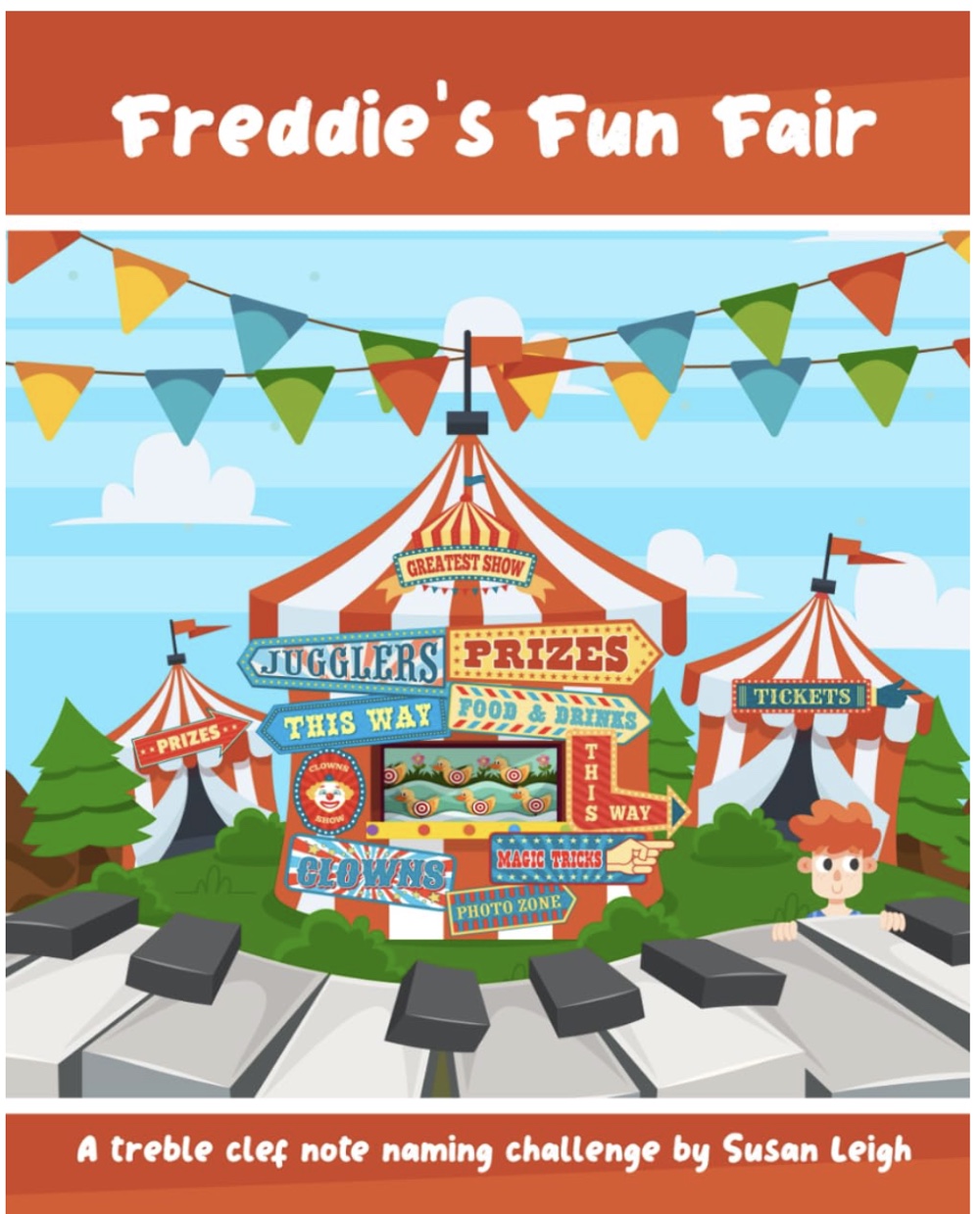
Susan Leigh’s other books have been a huge hit with students and I’m sure this one will be, too. It was just published and I’ve ordered it to arrive in time for students returning after winter break.
The note range includes all the lines and spaces of the treble clef stave, making it ideal for instrumentalists who play the piano, flute, saxophone and more.
Puzzles include traditional fairground games like the Coconut Shy, Bumper Cars, Hoopla, Toy Grabber, Skittles and Test Your Strength. There are match ups, scrambles, mazes, and also games against the clock like Tabletop Giraffe Racing, Splash the Shark and Whack-a-monster.
Students compete against Freddie in all events until the overall winner is crowned. There are two certificates to compete for; but who will win gold or silver and become the ultimate champion of both the treble clef and the fairground?!
New Year’s Day is observed on January 1, and is probably the most celebrated public holiday, often observed with fireworks at the stroke of midnight as the new year starts in each time zone.
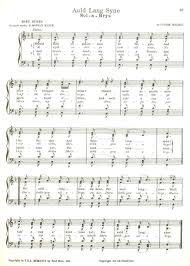
“Auld Lang Syne,” a poignant Scots poem penned by the legendary Robert Burns in 1788, is set to the melody of a timeless folk song. Renowned globally, particularly in English-speaking regions, it is traditionally sung to usher in the New Year at midnight. Additionally, the song finds a place in various other settings, including funerals, graduations, and farewells, symbolizing endings and transitions. The Boy Scout movement internationally has adopted it as a ceremonial conclusion to their gatherings and events.
The title, “Auld Lang Syne,” translates from Scots to English as “old long since,” but more colloquially, it means “long long ago,” “days gone by,” or “times of old.” Hence, the phrase “For auld lang syne” in the chorus loosely means “for the sake of old times.”
This song is a treasured Scottish offering to the world, evoking nostalgia and warmth of days past. It not only reminisces about times gone by but also fosters a sense of unity and togetherness for the future.
“Auld Lang Syne” is a gem from the rich Lowland Scots folk tradition, skillfully refined by one of the world’s premier songwriters, Burns. In his final years, Burns dedicated himself to preserving and enhancing the song tradition, often transforming fragments of old ballads into profound love songs or Scots poems. In “Auld Lang Syne,” he found a piece already gleaming with brilliance, as he expressed in an 1788 letter to Mrs. Dunlop.
An intriguing aspect of “Auld Lang Syne” is that the globally sung melody differs from the one Burns originally set the lyrics to. The original tune, still performed by traditionalists, carries a softer, more reflective quality, as showcased in Mairi Campbell’s rendition in the film “Sex and the City.” Regardless of the tune or its global reach, “Auld Lang Syne” maintains the deep emotional impact of the original Scottish folk song. As Burns himself once reflected, the phrase ‘Auld Lang Syne’ powerfully resonates, capturing the soul-stirring essence of an old song and tune.
Fancy singing along yourself? Here are the verses of the words to Auld Lang Syne:
Should auld acquaintance be forgot,
And never brought to mind?
Should auld acquaintance be forgot,
And auld lang syne.
Chorus:
For auld lang syne, my jo,
For auld lang syne,
We’ll tak a cup o’ kindness yet,
For auld lang syne,
And surely ye’ll be your pint-stowp!
And surely I’ll be mine!
And we’ll tak a cup o’ kindness yet,
For auld lang syne.
Chorus
We twa hae run about the braes
And pu’d the gowans fine;
But we’ve wander’d mony a weary foot
Sin auld lang syne.
Chorus
We twa hae paidl’d i’ the burn,
Frae mornin’ sun till dine;
But seas between us braid hae roar’d
Sin auld lang syne.
Chorus
And there’s a hand, my trusty fiere!
And gie’s a hand o’ thine!
And we’ll tak a right guid willy waught,
For auld lang syne.
Chorus
Should old acquaintance be forgot,
And never brought to mind?
Should old acquaintance be forgot,
And long, long ago.
Chorus
And for long, long ago, my dear
For long, long ago,
We’ll take a cup of kindness yet,
For long, long ago
And surely youll buy your pint-jug!
And surely I’ll buy mine!
And we’ll take a cup of kindness yet,
For long, long ago.
Chorus
We two have run about the hills
And pulled the daisies fine;
But we’ve wandered manys the weary foot
Since long, long ago.
Chorus
We two have paddled in the stream,
From morning sun till dine;
But seas between us broad have roared
Since long, long ago.
Chorus
And there’s a hand, my trusty friend!
And give us a hand of yours!
And we’ll take a deep draught of good-will
For long, long ago.
Chorus
Check out this vintage kinescope, a blast from over half a century ago! For a century now, the iconic descent of a glowing glass ball from One Times Square in New York City on New Year’s Eve has been a beloved American ritual. Year after year, throngs of people gather to ring in the New Year with jubilation.
Starting in 1956, Guy Lombardo and His Royal Canadians became synonymous with the US’s New Year’s Eve celebrations. They combined melodious tunes with the live spectacle of the Midnight ball drop. Guy spearheaded this tradition until his passing in 1977, and his band continued to grace CBS Television with their New Year’s performances for two more years. Meanwhile, Dick Clark’s Rockin’ New Years Eve kicked off in 1972 on ABC and remains a yearly broadcast. Guy’s show would start right after a 15-minute news segment and would run for an hour. While Guy orchestrated the music, news anchor Robert Trout would herald the onset of the New Year.
If you pay attention, you might spot the sharp-tongued TV figure Henry Morgan amidst the crowd. Television back then, fifty years ago, was a far cry from today’s standards, marked by stark lighting and basic technology, like a simple office clock and a World War II-era searchlight sweeping over the gathered crowd.
I hope you’ll enjoy ringing in the New Year – 1958! Recorded: December 31, 1957
Auld Lang Syne played on bagpipes (as it should be)
• 1894 ~ Ernest John Moeran, English composer who had strong associations with Ireland.
• 1904 ~ Nathan Milstein, Russian-born American violinist and composer
• 1908 ~ Jonah Jones (Robert Elliott Jones), Trumpeter, singer, played with Cab Calloway and threw spitball that got Dizzy Gillespie fired from a band
• 1922 ~ Rex Allen, ‘The Arizona Cowboy’, entertainer, rodeo star, singer, songwriter who published over 300 songs
• 1923 ~ Singer Eddie Cantor opened in the lead role of Kid Boots. Broadway critics called the production, “A smash musical hit!” Eddie made several of the songs from that show into smash hits also, like Alabamy Bound and If You Knew Susie. Three years later, If You Knew Susie became the title song for a movie starring Cantor.
• 1928 ~ Ross Barbour, Singer with The Four Freshmen
• 1929 ~ Guy Lombardo and his Royal Canadians played Auld Lang Syne as a New Year’s Eve song for the first time. Auld Lang Syne had been the band’s theme song long before 1929. However, this night was the start of a New Year’s Eve tradition as Lombardo’s famed orchestra played at the Hotel Roosevelt Grill in New York City to usher in the new year. Where did it Auld begin? Scottish poet Robert Burns said he heard an old man singing the words, and wrote them down, but Burns is considered the original author. The literal translation means “old long since”; less literal means “days gone by”. Auld Lang Syne and Happy New Year!
• 1930 ~ Odetta (Holmes Felious Gordon), American folk-blues singer, guitarist, songwriter and actress
• 1940 ~ As a result of a dispute between the radio networks and ASCAP (the American Society of Composers and Publishers), the radio industry was prevented from playing any ASCAP-licensed music. The ban lasted for ten months. An ASCAP competitor, BMI (Broadcast Music Incorporated) made giant strides, expanding to include 36,000 copyrights. Many radio stations had to resort to playing public domain songs, such as marches and operas, to keep their stations on the air. Even kids songs were played over and over again until the ban was lifted. One of the most popular songs to be played was Happy Birthday to You, which was performed in many different languages just to get past the ban.
The American copyright status of “Happy Birthday to You” began to draw more attention with the passage of the Sonny Bono Copyright Term Extension Act in 1998. When the U.S. Supreme Court upheld the Act in Eldred v. Ashcroft in 2003, Associate Justice Stephen Breyer specifically mentioned “Happy Birthday to You” in his dissenting opinion. American law professor Robert Brauneis, who extensively researched the song, concluded in 2010 that “It is almost certainly no longer under copyright.” In 2013, based in large part on Brauneis’s research, Good Morning to You Productions, a company producing a documentary about “Good Morning to All”, sued Warner/Chappell for falsely claiming copyright to the song. In September 2015, a federal judge declared that the Warner/Chappell copyright claim was invalid, ruling that the copyright registration applied only to a specific piano arrangement of the song, and not to its lyrics and melody.
In 2016, Warner/Chappell settled for US $14 million, and the court declared that “Happy Birthday to You” was in the public domain.
• 1942 ~ Andy Summers (Somers), Guitarist, singer with The Police
• 1943 ~ John Denver (Deutschendorf), American singer and songwriter of popular music
• 1947 ~ Burton Cummings, Jr., Singer with The Guess Who
• 1947 ~ Roy Rogers, ‘the King of the Cowboys’, and Dale Evans were hitched in marriage. They rode off into that sunset together for over fifty years. (Roy died July 6, 1998.)
• 1948 ~ Donna Summer (LaDonna Gaines), Grammy Award-winning singer
• 1951 ~ Tom Hamilton, Bass with Aerosmith
• 1960 ~ After playing California nightclubs as The Pendletones, Kenny and the Cadets, and Carl and the Passions, a new group emerged this day: The Beach Boys. The group’s first national hit, Surfin’ Safari, was soon to be. They recorded for local (Los Angeles) Colpix Records and at the height of their popularity, Capitol Records. The Beach Boys also recorded under the Reprise Records banner. The revitalized group still tours and Capitol continues to reissue various greatest hits packages. The Beach Boys were inducted into The Rock and Roll Hall of Fame in 1988.
• 1972 ~ Joe McIntyre, Singer with New Kids on the Block
• 1975 ~ Elvis Presley performed before 60,000 fans at the Silverdome in Pontiac, MI. He earned $800,000 for the concert, a world record for a single concert by a single artist.
• 1985 ~ Over 54,500 people played kazoos in downtown Rochester, New York. The assembled multitude played A Bicycle Built for Two. Any idea why? Well, they felt it was appropriate for the last day of the year and it got the crowd listed in the Guinness Book of World Records for ‘Most Kazoo-ers’.
• 1985 ~ Ricky Nelson killed in a plane crash.
• 1993 ~ Barbra Streisand performed her first paid concert in 22 years, singing to a sellout crowd at the MGM Grand Garden in Las Vegas.
• 1997 ~ Floyd Cramer, American Hall of Fame pianist (Nashville Sound), died of cancer at the age of 64
• 2000 ~ Tanaquil Le Clercq, the ballerina who dazzled the world in the 1940s and ’50s before her career was cut short by paralytic polio, died of pneumonia at the age of 71. Le Clercq contracted the disease, which left her paralyzed below the waist, in 1956. At the time, she was the fourth wife of George Balanchine and had attracted an adoring public because of her long-legged elegance. She later became a teacher at Dance Theater of Harlem, wrote two books and regularly attended dance performances. The New York City Ballet, of which Le Clercq was a charter member, paid tribute to her in 1988, when it opened its 50th-anniversary season. She acknowledged a thunderous New York State Theater ovation from her wheelchair. Le Clercq was blessed with an elongated physique that she used with refinement or humor. She epitomized the modernized look in classical dancing, which enthralled Balanchine, who once cast her as a dragonfly. As the first City Ballet ballerina trained since childhood by Balanchine, she was naturally identified with the roles he created for her in his major works, such as the ballets “Symphonie Concertante,” “Symphony in C” and “La Valse,” in which her doomed heroine danced herself to death. She was equally unforgettable in the ballets of Jerome Robbins and as the white-faced allegorical figure of Sacred Love in “Illuminations” in 1950.
• 2000 ~ José Greco, the famed flamenco dancer and choreographer who founded the José Greco Spanish Dance Company, of heart failure at the age of 82. Born in Montorio nei Frentani, Italy, of Spanish-Italian parents, he moved to Seville, Spain, at the age of 3, then was raised in Brooklyn from the age of 10. He began his career in 1937 and became known as the greatest Spanish dancer in the world. In 1941, the already famous Argentine-born dancer La Argentinita (known off the stage as Encarnacion Lopez) was preparing for an American tour when she saw Greco dance and asked him to perform as her partner and the featured male performer in her company until she died in 1945. After that, Greco danced with her sister Pilar Lopez. In 1951, Greco shared with Carol Channing the title of “New Broadway Personality of the Year.” The José Greco Dance Company, which helped integrate flamenco with mainstream ballet, toured extensively in North America, and six times worldwide, over the following two decades. In 1962, he Greco was knighted by the Spanish government. In 1971, Greco formed the Foundation for Hispanic Dance. His autobiography, “Gypsy in My Soul: The Autobiography of Jose Greco,” was published in 1977.
• 2000 ~ Eddy Shaver, a guitarist who performed with his father Billy Joe Shaver and Dwight Yoakam, died at the age of 38. Eddy Shaver grew up around music because of his father, a celebrated songwriter whose songs include I’m Just an Old Chuck of Coal (But I’m GonnaBe a Diamond Someday) and Georgia on a Fast Train. Dickie Betts of The Allman Brothers Band helped teach Eddy Shaver to play and gave him his two favorite guitars, one formerly owned by the late guitarist Duane Allman. Eddy Shaver began playing guitar with his father at 13, and gradually became Billy Joe Shaver’s musical partner and sometime co-writer. Billy Joe Shaver merged from country to a more rock-influenced sound because of his son. Albums by the band Shaver include “Tramp on Your Street,” the live “Shaver: Unshaven,” and “Electric Shaver.” A new album, “The Earth Rolls On,” was released on March 20, 2001.
• 2001 ~ Marie Hartford, a well-known businesswoman on Music Row and widow of the late songwriter and performer John Hartford, died of lung cancer. She was 67. Marie Hartford worked at Glaser Publishing, booking the studios at the Glaser Brothers’ Music Row operation, where country music’s Outlaw movement was bred. John Hartford, who wrote the standard Gentle on My Mind, died June 4 after a decade-long battle with cancer. The song was recorded more than 300 times, most prominently by Glen Campbell in 1967 but also by Dean Martin, Elvis Presley and Aretha Franklin.
• 2003 ~ Renata Babak, an internationally known mezzo-soprano with the Bolshoi Opera who defected from the Soviet Union in 1973, died of pancreatic cancer. She was 69. Babak gave recitals until last year, singing in a sweet but powerful and well-controlled voice described by critics as among the best in the world. Her last opera was in 1997, when she performed in Tchaikovsky’sIolanta with Opera Camerata of Washington. Babak was an international star with 10 years’ experience at the Bolshoi when she defected while the opera company was playing at La Scala in Milan, slipping out of a hotel lobby wearing a wig and dark glasses. She immigrated to Canada and went into hiding for two years. Babak’s U.S. debut at Carnegie Hall in 1975 was met with enthusiastic reviews. She moved to New York and then to Washington in the hopes of working with George London, then general director of the Washington Opera. Babak joined the faculty of the Washington Conservatory of Music when London was disabled by a stroke.
. 2021 ~ Betty White died at the age of 99. She would have turned 100 on January 17, 2022.
I have to admit that I’m kind of a piano bench hoarder. I save them from every piano and electric keyboard I’ve ever owned.
I was playing the grand piano the other day and noticed that the music rack was further away than it used to be. I don’t think that the piano grew any so I must have shrunk.
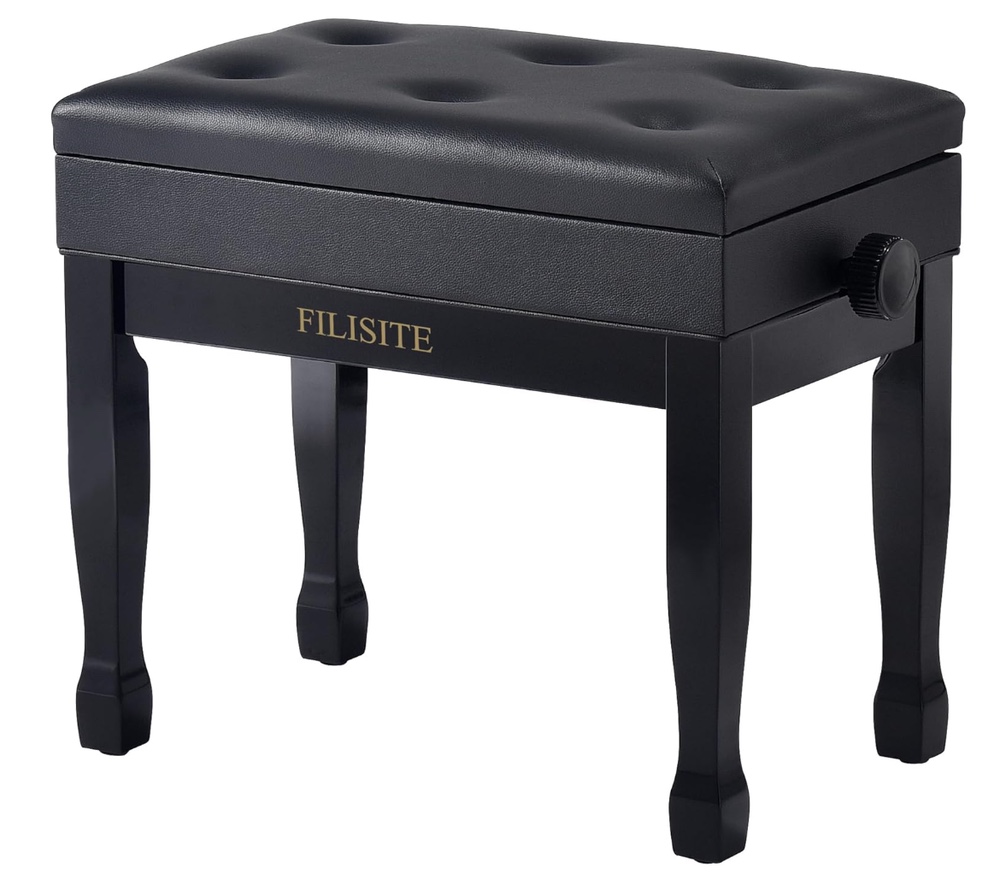
I have an adjustable piano bench but it’s brown from an old baby grand I once had. It’s also for only one person to play solo so I bought a new adjustable duet bench in black.
I was surprised to see that amazon has a lot of piano benches for sale. I don’t know why I was surprised since they seem to have everything else.
I chose this one since the reviews were good and the price seemed reasonable:
Comfortable Padded Cushion – Thickened cushion is made of scratch-resistant PU leather with 6 decorative buttons and filled with high-resilience sponge, which is soft, but not easy to deform. Even if you sit on it for a long time practicing the piano, you won’t feel tired. The surface is also water-resistant and easy to clean.
Height Adjustable – This piano seat comes with dual side knobs that adjust the bench height between 19.29″/49cm-23.23″/59cm to accommodate a wide range of heights for both adults and children.
Music Storage Compartment – Built-in storage compartment beneath the seat provides roomy space for your sheet music and accessories, folding lip support makes it convenient to open.
Sturdy Wooden Frame – The frame of this piano stool is made of solid wood, which is sturdy enough to hold up to 330lbs/150kg. Anti-slip rubber pads at bottom of legs protect your floor from being scratched and add extra stability. Classic black color suitable for various decorations.
Easy Assemble – No other drills are needed to install this piano bench with storage. All you need to install are the 4 legs. In addition to piano stool, it can also be used as keyboard stool, vanity stool, etc.
Hopefully, it is truly easy to assemble and we can get the legs installed before students return from winter break!
• 1756 ~ Pavel Vranicky, Moravian classical composer
• 1853 ~ Andre-Charles-Prosper Messager, French composer, organist, pianist, conductor and administrator.
• 1859 ~ Josef Bohuslav Foerster, Czech composer of classical music
• 1877 ~ Johannes Brahms’ 2nd Symphony in D, premiered in Vienna
• 1884 ~ Anton Bruckner’s 7th Symphony in E, premiered in Leipzig
• 1895 ~ Vincent Lopez, Bandleader, played at NYC’s Astor Hotel, some of the greats started with him: Artie Shaw, Buddy Morrow, Buddy Clark
• 1904 ~ Dmitri Kabalevsky, Russian composer, pianist and conductor
More information about Kabalevsky
• 1910 ~ Paul Frederic Bowles, American composer and novelist
• 1914 ~ Bert Parks (Jacobson), Radio/TV host of Miss America Pageant, Break the Bank, Stop the Music
• 1919 ~ Sir David Willcocks, British organist, conductor and educator
• 1928 ~ Bo Diddley (Otha Ellas Bates McDaniel), Singer
• 1931 ~ Skeeter Davis (Mary Frances Penick), Singer
• 1936 ~ The famous feud between Jack Benny and Fred Allen was ignited. After a 10- year-old performer finished a violin solo on The Fred Allen Show, Mr. Allen said, “A certain alleged violinist should hide his head in shame for his poor fiddle playing.” It didn’t take long for Mr. Benny to respond. The humorous feud lasted for years on both comedian’s radio shows.
• 1937 ~ John Hartford, Grammy Award-winning songwriter, banjo, fiddle, guitar on Glen Campbell’s Good Time Comedy Hour
• 1939 ~ Del Shannon (Charles Westover), Singer, songwriter, inducted into the Rock and Roll Hall of Fame
• 1942 ~ Michael Nesmith, Guitarist with The Monkees, formed The First National Band, movie producer of the first Grammy-winning video
• 1945 ~ Davy Jones (David Thomas Jones), Singer with The Monkees, actor
• 1947 ~ Jeff Lynne, Singer, guitar with The Electric Light Orchestra, songwriter
• 1948 ~ Alfred Drake and Patricia Morrison starred in Kiss Me Kate which opened at the New Century Theatre in New York City. Cole Porter composed the music for the classic play that was adapted from Shakespeare’s comedy, The Taming ofthe Shrew. The show ran for 1,077 performances on the Great White Way.
• 1942 ~ Frank Sinatra opened at New York’s Paramount Theatre for what was scheduled to be a 4-week engagement (his shows turned out to be so popular that he was booked for an additional 4 weeks). An estimated 400 policemen were called out to help curb the excitement. It is said that some of the teenage girls were hired to scream, but many more screamed for free. Sinatra was dubbed ‘The Sultan of Swoon’, ‘The Voice that Thrills Millions’, and just ‘The Voice’. Whatever he was, it was at this Paramount Theatre engagement that modern pop hysteria was born.
• 1954 ~ Pearl Bailey opened on Broadway in the play, House of Flowers, about two madams with rival bordellos. Diahann Carroll was also cast in the play, written by Truman Capote. Harold Arlen provided the musical score.
• 1969 ~ Peter, Paul and Mary received a gold record for the single, Leaving On aJet Plane. The song had hit #1 on December 20.
• 1970 ~ Paul McCartney sued the other three Beatles to dissolve the partnership and gain control of his interest. The suit touched off a bitter feud between McCartney and the others, especially his co-writer on many of the Beatles compositions, John Lennon. The partnership officially came to end in 1974.
• 1976 ~ The Smothers Brothers, Tom and Dick, played their last show at the Aladdin Hotel in Las Vegas and retired as a team from show business. Each continued as a solo artist. They reunited years later for another stab at TV (on NBC) plus concert appearances that proved very successful.
• 2000 ~ Bohdan Warchal, a violinist and conductor who was one of Slovakia’s most popular musicians, of an unspecified illness at the age of 70. A violinist in the Slovak Philharmonic, Warchal, who died on Saturday, won acclaim as the founder and conductor of the Slovak Chamber Orchestra, which has given concerts all over the world ever since it was established in 1960. Warchal was awarded a medal by President Rudolf Schuster for his lifetime work last year.
• 2003 ~ Hong Kong’s Canto-pop diva and actress Anita Mui died. She was 40 years old. Mui began her career after winning a singing contest in Hong Kong in 1982. She rose to stardom with her song Homecoming in 1984. Canto-pop refers to hits sung in Cantonese, the dialect of Chinese that is widely spoken in Hong Kong and in many overseas Chinese communities. Mui also turned to acting and won Taiwan’s Golden Horse film award for best actress in 1987 for her role as a tormented ghost in the movie “Rouge.”
2004 ~ Artie Shaw (Arthur Arschawsky), American jazz clarinetist, bandleader, composer and arranger died
More information about Shaw
• 1876 ~ Pablo Casals, Spanish cellist and conductor
More information about Casals
• 1912 ~ Peggy Glanville-Hicks, Australian composer and music critic
• 1922 ~ Rose Lee Maphis, Entertainer, half of the team: Mr. and Mrs. Country Music with husband Joe, Hee Haw regular
• 1942 ~ Ray Thomas, Flute, saxophone, harmonica, singer with The Moody Blues
• 1943 ~ San Fernando Valley was recorded by Bing Crosby. He chose the tune because he felt it would be a big hit. He was right. Within a week after its release, the song became a popular favorite everywhere, including the San Fernando Valley in California.
• 1945 ~ Sheb Wooley recorded the first commercial record made in Nashville, TN. The song was recorded on the Bullet label; but it was 13 years before Wooley would finally score with a big hit (The Purple People Eater was #1 for six weeks in June and July, 1958). Wooley (whose first name is Shelby) played the part of Pete Nolan on TV’s Rawhide, recorded novelty tunes under the name, Ben Colder, and acted in High Noon, Rocky Mountain, Giant and Hoosiers.The Country Music Association honored him with the title of Comedian of the Year in 1968. If you remember the TV show Hee Haw, with Buck Owens and Roy Clark, it was Sheb Wooley who wrote the theme song.
• 1951 ~ Yvonne Elliman, Actress, singer joined Eric Clapton in his 1974 comeback tour
• 1952 ~ Beryl Rubinstein, American pianist and composer, died at the age of 54
• 1957 ~ Steve Lawrence and Eydie Gorme were married. They became popular singers on the The Tonight Show with Steve Allen, and as Las Vegas showroom regulars and recording artists. They remained married until Eydie’s death in 2013. Lawrence issued a statement: “Eydie has been my partner on stage and in my life for more than 55 years. I fell in love with her the moment I saw her and even more the first time I heard her sing. While my personal loss is unimaginable, the world has lost one of the greatest pop vocalists of all time.”
• 1961 ~ Mark Day, Guitarist with Happy Mondays
• 1963 ~ Much to the chagrin of the disc jockeys at 50,000-watt WABC in New York, the 5,000-watt blowtorch known as WMCA and its famed ‘Good Guys’ became the first New York radio station to play The Beatles’I Want to Hold Your Hand. It didn’t take long for WABC to get revenge. It started calling itself the ‘official’ Beatles station (W-A-Beatle-C).
• 1967 ~ Orchestra leader Paul Whiteman passed away at the age of 76. Known as the King of Jazz, Whiteman had 28 #1 hits between 1920 and 1934 including Three O’Clock in the Morning, My Blue Heaven, All of Me and Smoke Gets in Your Eyes.
• 1980 ~ American singer, songwriter Tim Hardin died of a heroin overdose. Hardin wrote the songs ‘If I Were A Carpenter’ (covered by Bobby Darin, Johnny Cash and June Carter, The Four Tops, Leon Russell, Small Faces, Robert Plant and Bob Seger,) and ‘Reason To Believe’, (covered by Rod Stewart). Hardin appeared at the 1969 Woodstock Festival.
• 2001 ~ Cassia Eller, one of the most irreverent singers of Brazilian rock music, died at the age of 39. Eller’s fame peaked in 2001 with the sale of about 250,000 copies of her “MTV Unplugged” album and a performance in January’s Rock in Rio festival in front of hundreds of thousands of fans, singing along with one of her hits, I just ask God for a little indecency.
• 2001 ~ Jazz pianist Ralph Sutton, a leading practitioner of the stride piano, died at the age of 79. Born in St. Charles, Mo., in 1922, Sutton made his professional debut at age 11 with his father’s band. He later signed on with trombone great Jack Teagarden, and played at several clubs along New York’s famed 52nd Street. To create his eclectic style, Sutton drew from the jazz piano, from ragtime and the blues to stride, in the style made famous by James P. Johnson, Willie “The Lion” Smith, and Fats Waller. Critics hailed Sutton as one of the best contemporary jazz pianists with a mastery of his instrument. He was a founding member of the 1968 World’s Greatest Jazz Band, which performed at Elitch Gardens in Denver.
• 2003 ~ Manny Dworman, who owned a Greenwich Village nightspot where comedians including Jerry Seinfeld, Ray Romano and Jon Stewart performed, died. He was 73. Dworman, a musician who played the oud, guitar and mandolin, owned the Comedy Cellar and the Olive Tree Cafe upstairs. The club was previously the site of Cafe Feenjon, a Middle Eastern nightclub that originally opened as a coffeehouse in 1960. Dworman performed at Cafe Feenjon with his band, the Feenjon Group, which recorded five albums, performed at Carnegie Hall and inspired the radio show “Music From Around the World.” Comedy Cellar, which opened in 1980, also hosted performances by Chris Rock and Colin Quinn. Discussions at the club inspired the Comedy Central show “Tough Crowd with Colin Quinn.” Dworman was featured in the 2002 documentary “Comedian” by Jerry Seinfeld.
• 2004 ~ Jerry Orbach, American singer and actor for the musical theater and longtime star of the “Law & Order” television series, died at 69. Orbach, a lanky actor with a deep voice and a slicked mop of black hair, first made his name on Broadway, winning a Tony for “Promises, Promises.” He was also in the original cast of “Chicago” and “42nd Street.”






 MaryO'Studio