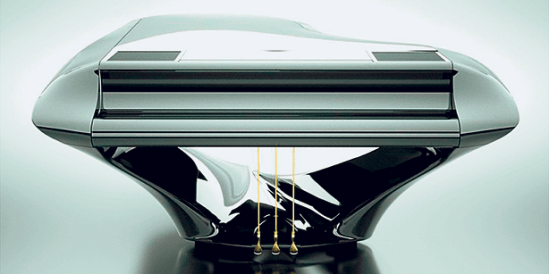
A revolutionary new piano created in Budapest by internationally acclaimed pianist Gergely Bogányi and his design team was unveiled at a press event on Jan. 20 at the Budapest Music Center and at a concert on Jan. 21 at Budapest’s historic Franz Liszt Academy.
At the press event, Bogányi performed classical selections by Bach and Debussy to show the piano’s power and lyrical capabilities; the renowned Grammy-nominated jazz pianist Gerald Clayton improvised limpid and soulful variations on Cole Porter’s “You’d Be So Nice to Come Home To,” which showed the new instrument’s vast kaleidoscope of colors and the satisfyingly muscular bass notes.
Does the world need a new piano?
Most emphatically yes, Bogányi says. “The piano was invented 300 years ago,” Bogányi told Today’s Zaman. “Although there have been modifications, there have been no major developments in piano construction in over 100 years. So I spoke to many of my colleagues about the kinds of [mechanical and physical] problems and limitations we all have to deal with, and all agreed that we needed solutions.”
. 1887 ~ Artur Rubinstein, Polish-born American pianist, played solo for the Berlin Symphony at the age of 12. Read quotes by and about Rubinstein
More information about Rubinstein
. 1904 ~ Enrico Caruso signed his first contract with Victor Records. He had debuted at the Metropolitan Opera just two months before.
. 1927 ~ Twenty years before the famous record by Art Mooney was recorded, Jean Goldkette and his dancing orchestra recorded, I’m Looking Over a Four-LeafClover. Though the name of the bandleader may not be so famous, two of his sidemen on this Victor recording session certainly were: Big band fans know Bix Beiderbecke and Joe Venuti.
. 1940 ~ “Beat the Band” made its debut on NBC radio. The band was that of TedWeems and his 14-piece orchestra, who were joined by Elmo ‘The Whistling Troubadour’ Tanner, Harry Soskind and Country Washington. One other star of the show was a barber from Pittsburgh, PA (nearby Canonsburg, actually), who would record many hits for RCA Victor from 1943 right through the dawn of the 1970s. His name was Perry Como. Beat the Band was a funky show where listeners’ questions were selected in the hopes of stumping the band. If a listener’s question was chosen, he or she received $10. The questions were posed as riddles: What song title tells you what Cinderella might have said if she awoke one morning and found that her foot had grown too large for her glass slipper? If the band played the correct musical answer,Where Oh Where Has My Little Dog Gone?, the listener lost.
. 1943 ~ Dick Taylor, Bass, guitar with The Pretty Things
. 1944 ~ John Tavener, British avant-garde composer
More information about Tavener
. 1944 ~ Brian Keenan, Drummer with groups Manfred Mann and The Chambers Brothers
. 1956 ~ Elvis Presley made his first appearance on national television. No, he didn’t appear on some teenage dance show; but rather, “The Dorsey BrothersShow”, starring Tommy and Jimmy. Elvis sang Blue Suede Shoes and Heartbreak Hotel. He was backed by the instruments of the Dorsey band.
. 1968 ~ Sarah McLauchlan, Singer
. 1985 ~ 45 of the world’s top recording artists were invited to an all-night recording session at the A&M studios in Los Angeles. As each of the artists walked through the studio door, they were greeted by a hand-lettered sign — put there by Lionel Richie. It simply said, “Check your ego at the door.” The session started at 10 p.m. with producer Quincy Jones conducting. At 8 o’clock the following morning, the project, “USA for Africa”, spearheaded by promoter, Ken Kragen, was recorded and mixed. The resulting song, We Arethe World, featuring Michael Jackson, Cyndi Lauper, Kenny Rogers, Dolly Parton, Sting, Harry Belafonte, Diana Ross, Paul Simon and many others became the top song in the U.S. on April 13, 1985.
. 2002 ~ Michael Hammond, who became chairman of the National Endowment for the Arts just a week earlier, died apparently of natural causes. He was 69. A native of Kenosha, Wis., the conductor and composer had been dean of the School of Music at Rice University in Houston when President Bush nominated him to lead the federal agency that decides grants for the arts. After being confirmed by the Senate on Dec. 20, 2001, Hammond had assumed the post Jan. 22, 2002, and was still in the process of moving to Washington. A student of music and medicine, Hammond’s interests included music from Southeast Asia, the Renaissance and medieval times and the intersection between music and neuroscience. He received a Rhodes scholarship to study philosophy, psychology and physiology at Oxford University. He also studied Indian philosophy and music at Dehli University in India. In 1968, he left his post as director of the Wisconsin Conservatory of Music in Milwaukee to become the founding dean of music at the State University of New York at Purchase. He later served as president of the school, until he left for Rice’s Shepherd School of Music in 1986. All the while, he retained his interest in medicine, teaching neuroanatomy and physiology at Marquette Medical School and at the University of Wisconsin. Hammond also served as the founding rector of the Prague Mozart Academy in the Czech Republic, now the European Mozart Academy, was on the board of the Houston Symphony, and was vice chairman of the board of Interlochen Center for the Arts in Michigan.
. 2002 ~ Steve Caldwell, who sang and played saxophone for the Swingin’ Medallions at the time of the band’s 1966 hit Double Shot (of My Baby’s Love), died of pancreatic cancer. He was 55. Caldwell was with the group from 1963 to 1969. After getting his master’s degree in chemistry at the University of South Carolina, he returned to his native Atlanta and ran the Norell temporary staffing agency until starting his own company in 1976. His wife, Lynn Caldwell, said he raised $1 million for charity through World Methodist Evangelism.
. 1885 ~ Jerome Kern, American songwriter and composer of musical comedies He was known as the father of the American musical, composing Show Boat, Ol’ Man River, Smoke Gets in Your Eyes, Lovely to Look At, The Way YouLook Tonight and The Last Time I Saw Paris
. 1895 ~ Harry Ruby (Rubinstein), Musician and composer
. 1918 ~ Skitch Henderson, Conductor of the Tulsa Symphony Orchestra, bandleader, musical director of NBC-TV’s The Tonight Show with Steve Allen and JohnnyCarson
. 1961 ~ Leontyne Price made her debut at the Metropolitan Opera House in New York City. She sang in the role of Leonora in “Il Trovatore”. Price was only the seventh black singer to make a debut at the Met. Marian Anderson was the first (1955).
. 1968 ~ The Bee Gees played their first American concert, as a group. They earned $50,000 to entertain at the Anaheim Convention Center in California. This is identical to what The Beatles were paid to perform at the Hollywood Bowl a few years earlier.
. 1968 ~ Otis Redding’s(Sittin’ On) The Dock of the Bay was released on this day, seven weeks after the singer’s death. It became #1 on March 16, 1968 and remained at the top spot for a month. Redding began his recording career in 1960 with Johnny Jenkins and The Pinetoppers (on Confederate Records). He sang duet with Carla Thomas and had 11 chart hits. Redding of Dawson, GA was killed in a plane crash at Lake Monona near Madison, WI. Four members of the Bar-Kays were also killed in the crash. The Dock of the Bay, his only number one song, was recorded just three days before his death.
. 1984 ~ Michael Jackson’s hair caught on fire during the filming of a Pepsi commercial in Los Angeles. Pyrotechnics did not operate on cue, injuring the singer. Jackson was hospitalized for a few days and fans from around the world sent messages of concern.
What better way to get things started than with a party?
At Wolfie, that means the first worldwide event in honor of Mozart’s birthday – taking place this Tuesday, January 27th! Every musician – concert pianist or 2nd-grader – playing a score on the Wolfie app on January 27th will automatically appear on an interactive world map at www.wolfiepiano.com.
Share this special event with colleagues and inspire your students by enabling them to take part in a worldwide event that will connect them to piano players around the world! It all starts by joining the event, here.
Finally, we’d love to hear from you. You, Mozart’s ambassadors, are keeping his legacy alive and instilling the gift of music appreciation into young peoples’ lives every day.
See you on Tuesday – on the map!
~~~~~~~~ Wolfgang Amadeus Theophilus Mozart lived between 1756 and 1791. He is considered to be a classical composer. Mozart, born in Salzburg, Austria, began composing before most children go to kindergarten. By the time he was six he had played the piano and violin in public.
A Wunderkind, a prodigy of the first rank before the age of five, Mozart astounded the musical world with compositions of unsurpassed brilliance. His father Leopold had recognized his talent at the age of three and immediately set out to teach him to play the harpsichord, violin, and organ. Mozart and his sister made their debut in Munich when he was just six and traveled about Europe together, performing at courts and before royalty, always with success. While still a little child Mozart was inventing symphonies, sonatas, and his first opera. Legends abound about how Mozart could hear an entire work in his head and write everything down without making even one change.
As a child performer he was often treated as a freak. People would cover his hands as he played the piano, make him compose tunes on the spot and perform all sorts of other musical tricks.
In 1787 Mozart became court composer to Joseph II. He played for royalty, received commissions from aristocrats and in his short lifetime composed nearly a thousand masterpieces, including symphonies, operas, serenades, sonatas, concertos, masses, vocal works, and church works.
Mozart was a prolific composer writing masterpieces using every form of music, including his operas “The Marriage of Figaro” (based on a play by Pierre Beaumarchais), “Don Giovanni”, “Cosi fan tutte” and “The Magic Flute”. His mastery of instrumental and vocal forms, from symphony to concerto and opera, was unrivalled in his own time and perhaps in any other.
Composing the Requiem Mass commissioned for Count Walsegg, he felt he was writing his own requiem and he died before it was finished.
Wolfgang Amadeus Mozart, composer, died in Vienna Austria at the age of 35, penniless, on December 5th, 1791, of malignant typhus. Mozart, the precocious child prodigy, composed several pieces that are deemed central to the classical era. Though he ranked as one of the greatest musical genius, he did not live a life of affluence as none of his compositions earned him a decent commission but the world is forever enriched by such works as Eine Kleine Nachtmusik, the Symphonies No. 38 through 41 and the Coronation Mass.
When you listen to music, multiple areas of your brain become engaged and active. But when you actually play an instrument, that activity becomes more like a full-body brain workout.
What’s going on? Anita Collins explains the fireworks that go off in musicians’ brains when they play, and examines some of the long-term positive effects of this mental workout.
. 1908 ~ Stéphane Grappelli, French jazz violinist
. 1913 ~ Jimmy Van Heusen (Edward Chester Babcock), American songwriter and Academy Award-winning composer. He wrote Swinging on a Star in 1944, All the Way in 1957, High Hopes in 1959 and Call Me Irresponsible in 1963. He also wrote the music to over 75 songs for Frank Sinatra with lyricists Johnny Burke and Sammy Cahn … My Kind of Town and Second Time Around
. 1928 ~ Eartha Kitt, American singer of popular music. See January 17 for Ms. Kitt’s real birthday.
. 1934 ~ The Apollo Theatre opened in New York City as a ‘Negro vaudeville theatre’. It became the showplace for many of the great black entertainers, singers, groups and instrumentalists in the country.
. 1945 ~ Jacqueline DuPré, British cellist
. 1956 ~ Buddy Holly had his first of three 1956 recording sessions for Decca Records and producer, Owen Bradley, in Nashville. Nothing much came out of those sessions. He formed the group, The Three Tunes (changed later to The Crickets), and went on to find fame and fortune when he hooked up with producer Norman Petty in New Mexico. Holly died in a plane crash near Mason City, IA, February 3, 1959 (“the day the music died”). He was 22. Holly was inducted into the Rock and Roll Hall of Fame in 1986.
. 1979 ~ The Gizmo guitar synthesizer was first demonstrated.
. 1992 ~ Jose Ferrer, Puerto Rican actor, theater, and film director, died.
. 1858 ~ Felix Mendelssohn’s overture to “A Midsummer Night’s Dream”was first used as a wedding march. The bride was Queen Victoria’s daughter, the groom was the Crown Prince of Prussia.
. 1886 ~ Wilhelm Furtwängler, German conductor and composer
1913 ~ Witold Lutoslawski, Polish composer
More information about Lutoslawski
. 1940 ~ Mary Martin recorded My Heart Belongs to Daddy — for Decca Records. The song was her signature song until she starred in “South Pacific” in 1949. Then, Larry Hagman’s mother had a new trademark: “I’m gonna wash that man right out of my hair…”
More about Mary Martin
. 1945 ~ Richard Tucker debuted at the Metropolitan OperaHouse in New York City in the production of “La Gioconda”.
. 1964 ~ The Beatles reached the #1 spot on the music charts, as their hit single, I Want to Hold Your Hand, grabbed the top position in “Cash Box” magazine, as well as on the list of hits on scores of radio stations. It was the first #1 hit for The Beatles. “Billboard” listed the song as #1 on February 1. The group’s second #1 hit song, She Loves You, was also released this day – but not on Capitol Records. It was on Swan Records. Other songs by The Beatles were released on Vee Jay (Please, Please Me), M-G-M (My Bonnie with Tony Sheridan), Tollie (Twist and Shout), Atco (Ain’t She Sweet) and the group’s own label, Apple Records, as well as Capitol.
. 1999 ~ Robert Shaw passed away. Shaw was an American conductor most famous for his work with his namesake Chorale, with the Cleveland Orchestra and Chorus, and the Atlanta Symphony Orchestra and Chorus. Shaw received 14 Grammy awards, four ASCAP awards for service to contemporary music, the first Guggenheim Fellowship ever awarded to a conductor, the Alice M. Ditson Conductor’s Award for Service to American Music; the George Peabody Medal for outstanding contributions to music in America, the Gold Baton Award of the American Symphony Orchestra League for “distinguished service to music and the arts,” the American National Medal of Arts, France’s Officier des Arts et des Lettres, England’s Gramophone Award, and was a 1991 recipient of the Kennedy Center Honors.
. 2004 ~ Ronald Fredianelli, a co-founder of the 1950s pop vocal group the Gaylords, died in Las Vegas. He was 73. Fredianelli, who performed as Ronnie Gaylord teamed with Bonaldo Bonaldi and Don Rea in the early 1950s. Bonaldi performed as Burt Holiday. Their debut song, Tell Me You’re Mine, was a Top 10 hit in 1953. Other hits included From the Vine Came the Grape and The Little Shoemaker.Although the Gaylords formed in Detroit, Fredianelli and Bonaldi became a staple in Nevada showrooms, where they performed for decades as Gaylord and Holiday. Bonaldi and Rea live in Reno. One of Fredianelli’s sons, Anthony, is guitarist for the rock group Third Eye Blind.
2014 ~ Artemios “Demis” Ventouris Roussos (June 15 1946-January 25, 2015) was a Greek singer and performer who had international hit records as a solo performer in the 1970s after having been a member of Aphrodite’s Child, a progressive rock group that also included Vangelis. He has sold over 60 million albums worldwide.
. 1913 ~ Norman Dello Joio, American composer
More information about Dello Joio
. 1919 ~ Leon Kirchner, American composer and pianist
. 1925 ~ Maria (Betty Marie) Tallchief, Prima ballerina: Ballet Russe de Monte Carlo, New York City Ballet; formed ballet troupe and school (1974) which became Chicago City Ballet in 1980, wife of choreographer George Balanchine
. 1936 ~ Jack Scott (Scafone), Singer
. 1936 ~ Benny Goodman and his orchestra recorded one of the all-time greats,Stompin’ at the Savoy, on Victor Records. The song became such a standard, that, literally, hundreds of artists have recorded it, including a vocal version by Barry Manilow. The ‘King of Swing’ recorded the song in a session at the Congress Hotel in Chicago.
. 1941 ~ Neil Diamond, American pop-rock singer and songwriter
. 1941 ~ Ray Stevens, Singer and entertainer
. 1942 ~ Abie’s Irish Rose was first heard on NBC radio this day as part of “Knickerbocker Playhouse”. The program was a takeoff on the smash play from Broadway that ran for nearly 2,000 performances. Sydney Smith played the part of Abie. Rosemary Murphy was played by Betty Winkler.
. 1973 ~ ‘Little’ Donny Osmond, of the famed Osmond Brothers/Family, received a gold record for his album, “Too Young”. When he played the gold-plated disc on his Mickey Mouse phonograph, all he heard was Ben by ‘little’ MichaelJackson, a competitor in the ‘Kids Who Sing Really High Awards’ battle.
. 1941 ~ Artie Shaw and his orchestra recorded Moonglow on Victor Records. In the band were such sidemen as Johnny Guarnieri, Jack Jenney, Billy Butterfield and Ray Conniff on trombone.
. 1943 ~ Duke Ellington and the band played for a black-tie crowd at Carnegie Hall in New York City. It was the first of what was to become an annual series of concerts featuring the the Duke.
. 1948 ~ Anita Pointer, Singer with The Pointer Sisters
. 1950 ~ Bill Cunningham, Bass, piano with The Box Tops
. 1950 ~ Patrick Simmons, Singer, guitarist with The Doobie Brothers
. 1974 ~ Mike Oldfield’sTubular Bells opened the credits of the movie, “The Exorcist”, based on the book by William Peter Blatty. The song received a gold record this day.
. 1977 ~ Carole King’s landmark album, “Tapestry”, became the longest-running album to hit the charts, as it reached its 302nd week on the album lists.
. 2002 ~ Alfred Glasser, a former director of education for the Lyric Opera of Chicago, died of cancer. He was 70. Glasser held the education post for 30 years before his retirement in 1996. Since 1997, Glasser served as chairman of the board and commentator for Chicago’s concert opera company, da Corneto Opera. For the past decade, he served on the board of Alliance Francaise of Chicago, a French cultural group. Glasser also founded the Lyric Opera Lecture Corps, a community service project.
. 2003 ~ Nell Carter, actress-singer, died at the age of 54. She was best known for her role as the housekeeper in the TV sitcom “Gimme a Break!”. Carter, who was born September 13, 1948, in Birmingham, Alabama, first rose to stardom on the New York stage. After a series of roles on- and off-Broadway — and a short-lived part in the soap opera “Ryan’s Hope” — in 1977 she starred in the show “Ain’t Misbehavin’!”, a revue of the works of composer Fats Waller. She was rewarded for her performance with an Obie Award, and later with a Tony Award when the show moved to Broadway. Several years later, she earned an Emmy for her performance on a television presentation of the musical. Despite her Broadway success, Carter would have preferred to sing opera. “When I was growing up, it was not something you aspired to,” she said in 1988. “I was a weirdo to want to be in show business. Most kids wanted to be teachers or nurses.” “Gimme a Break!” ran from 1981 to 1987. Carter was nominated for two Emmys for her role as housekeeper Nell Harper, who helped run the household of police chief Carl Kanisky, played by Dolph Sweet. She also garnered two Golden Globe nominations for the role.
. 2003 ~ For Sale: One of London’s most famous music venues, which in its heyday in the 1960s played host to The Who, David Bowie and the Rolling Stones, is for sale, its administrators said. The Marquee Club, which in the 1970s was the epicenter of the punk explosion, ran into financial difficulties after its high-profile relaunch last fall, said a spokeswoman for administrator BDO Stoy Hayward. “We’re looking for someone in the music business who can capitalize on the Marquee brand and keep running it as a live venue,” she said. The price tag is at least $200 million. The club opened in London’s Soho district in 1958 and was so cramped and sweaty that, according to legend, Bob Geldof of the Boomtown Rats blacked out on stage. In 1988, it moved to a new location in nearby Charing Cross, but within eight years it had closed down. A high-profile relaunch at a new venue in Islington, north London September 2002 was headlined by the controversial electro-rockers Primal Scream, but according to the club’s administrators, huge start-up costs quickly led to its downfall.
. 1907 ~ The Richard Strauss opera, “Salome”, was featured with the Dance of the Seven Veils. It was copied by vaudeville performers. Soon, performances of the opera were banned at the Metropolitan Opera House.
. 1931 ~ Clyde McCoy and his orchestra recorded Sugar Blues. The tune became McCoy’s theme song, thanks to its popularity on Columbia Records, and later on Decca, selling over a million copies.
. 1935 ~ Sam Cooke, American rhythm-and-blues singer
. 1949 ~ Steve Perry, Drummer with Radio Stars
. 2002 ~ Pete Bardens, a keyboardist who played alongside such pop stars as MickFleetwood, Ray Davies, Rod Stewart and Van Morrison, died of lung cancer. He was 57. He was known for his progressive and New Age rock style on synthesizer, electric piano and organ. In the 1960s, the London-born Bardens played in the Blues Messengers with Davies, who later went on to form The Kinks; Shotgun Express with Stewart; Them with Morrison; and the group Cheynes with Fleetwood and Peter Green, who went on to form Fleetwood Mac. In 1972, Bardens formed the progressive rock band Camel and stayed with it through the late 1970s. In 1978, he began a successful solo career, releasing several well-received records, including “Speed of Light”, and also played on Morrison’s album “Wavelength” and accompanied him on a world tour. Barden continued to compose, produce and perform music through the 1990s, appearing in Europe with his group Mirage.
. 2004 ~ Milt Bernhart, a big band trombonist known for his solo on FrankSinatra’sI’ve Got You Under My Skin, died. He was 77. During his three-decade career, Bernhart played in bands led by BennyGoodman, Henry Mancini and others. He was performing in Howard Rumsey’s Lighthouse All-Stars when Marlon Brando arranged for the band to play in the 1954 film The WildOne. Bernhart then became an in-studio musician for Columbia and other film and television studios, and in 1956 added a memorable solo to Sinatra’s I’ve Got You Under My Skin. Born in Valparaiso, Ind., Bernhart was drafted into the Army and was to be sent overseas during World War II before he was transferred to the service’s band. After his music career wound down in 1973, he bought Kelly Travel Service in Los Angeles. He created the Big Band Academy of America in 1986 and planned to retire as the organization’s founding president in March.
. 2004 ~ Ann Miller, a childhood dance prodigy who fast-tapped her way to movie stardom that peaked in 1940s musicals like “On the Town”, “EasterParade” and“Kiss Me Kate”, died of lung cancer. She was 81. Miller’s film career peaked at MGM in the late 1940s and early ’50s, but she honed her chops into her 60s, earning millions for “Sugar Babies”, a razzmatazz tribute to the era of burlesque featuring Mickey Rooney. Miller’s legs, pretty face and fast tapping (she claimed the record of 500 taps a minute) earned her jobs in vaudeville and night clubs when she first came to Hollywood. Her early film career included working as a child extra in films and as a chorus girl in a minor musical, “The Devil onHorseback”. An appearance at the popular Bal Tabarin in San Francisco won a contract at RKO studio, where her name was shortened to Ann. Her first film at RKO, “New Faces of 1937”, featured her dancing. She next played an acting hopeful in “Stage Door”, with Katharine Hepburn, GingerRogers, Lucille Ball and Eve Arden. When Cyd Charisse broke a leg before starting “Easter Parade” at MGM with Fred Astaire, Miller replaced her. That led to an MGM contract and her most enduring work. She was teamed with Gene Kelly and Frank Sinatra in “On the Town”, RedSkelton in “Watch the Birdie”, and Bob Fosse in “Kiss Me Kate“. Other MGM films included: “Texas Carnival”, “Lovely to Look At”, “Small Town Girl”, “Deep in My Heart”, “Hit the Deck” and “The Opposite Sex.” The popularity of musicals declined in the 1950s, and her film career ended in 1956. Miller remained active in television and the theater, dancing and belting songs on Broadway in “Hello, Dolly” and “Mame”. In later years, she astounded audiences in New York, Las Vegas and on the road with her dynamic tapping in “Sugar Babies.” The show opened on Broadway in 1979 and toured for years. In 1990, she commented that “Sugar Babies” had made her financially independent. While her career in Hollywood prospered, Miller became a regular figure in the town’s night life, and she caught the eye of Louis B. Mayer, all- powerful head of MGM. After dating, she declined to marry him because her mother would not allow it. She later married and divorced steel heir Reese Milner and oilmen William Moss and Arthur Cameron.
. 2004 ~ Dick Rodgers, an insurance salesman known as the “Polka King” when he hosted a regional television show from the 1950s to the 1970s, died. He was 76. Rodgers’ television show was on the air from 1955-78, starting on WMBV in Marinette, which later moved to Green Bay and became WLUK-TV. The program was shown on 17 Midwestern stations at its height. Rodgers’ accomplishments included membership in the International Polka MusicHall of Fame (1976) and in the World Concertina Congress Hall of Fame (1996). He also was named Orchestra Leader of the Year by the Wisconsin Orchestra Leaders Association in 1967.



 Wolfgang Amadeus Theophilus Mozart lived between 1756 and 1791. He is considered to be a classical composer. Mozart, born in Salzburg, Austria, began composing before most children go to kindergarten. By the time he was six he had played the piano and violin in public.