Musical Quotes – from Presidents

presidents-day

“The future of our nation depends on providing our children with a complete education that includes music.”

– Gerald Ford

“The future belongs to young people with an education and the imagination to create.”

Barack Obama

“The Arts and Sciences, essential to the prosperity of the State and to the ornament of human life, have a primary claim to the encouragement of every lover of his country and mankind.”

George Washington

“I must study politics and war, that my sons may study mathematics and philosophy…in order to give their children the right to study painting, poetry, music and architecture.”

John Q. Adams

“Aeschylus and Plato are remembered today long after the triumphs of Imperial Athens are gone. Dante outlived the ambitions of thirteenth century Florence. Goethe stands serenely above the politics of Germany, and I am certain that after the dust of centuries has passed over cities, we too will be remembered not for victories or defeats in battle or in politics, but for our contribution to the human spirit.”

John F. Kennedy

“Music education opens doors that help children pass from school into the world around them – a world of work, culture, intellectual activity, and human involvement. The future of our nation depends on providing our children with a complete education that includes music.”

– Gerald Ford

“Music is about communication, creativity, and cooperation, and by studying music in schools, students have the opportunity to build on these skills, enrich their lives, and experience the world from a new perspective.”

– Bill Clinton

“Education is not the means of showing people how to get what they want. Education is an exercise by means of which enough men, it is hoped, will learn to want what is worth having.”

Ronald Reagan

Music “brings us together, helping us reflect upon who we are, where we have come from, and what lies ahead.” The Arts and Music transcend “languages, cultures, and borders.” … “exchange ideas and styles and share in the artistic vibrancy born from diverse experiences and traditions.

– President Obama in a 2010 message to the World Choir Games in Shaoxing, China

Millions of Americans earn a living in the arts and humanities, and the non-profit and for-profit arts industries are important parts of both our cultural heritage and our economy…. We must recognize the contributions of the arts and humanities not only by supporting the artists of today, but also by giving opportunities to the creative thinkers of tomorrow. Educators across our country are opening young -minds, fostering innovation, and developing imaginations through arts education.

– White House Proclamation, National Arts and Humanities Month 2014

“In a lot of the poorest countries we’re trying to help, the level of violence is a continuous undercurrent…There’s an enormous amount of evidence that giving people an opportunity for creative expression improves their ability to learn in school and increases their ability and desire to navigate life in a positive rather than a negative way.” Music “taught me discipline and teamwork on the one hand and the importance of creativity.”

The THEA Foundation in Arkansas has proved the merits of including art instruction in the schools.

Clinton said:

“Every place they’ve done this program, you see a reduction in the dropout rate and an increase in the academic performance of the young people. Having strong arts instruction supports learning in a very substantial way.”

-Bill Clinton in an interview with Patrick Cole at the 2011 Clinton Global Initiative

Adapted from http://www.nafme.org/the-most-musical-united-states-presidents/

Don’t Give Up Because You Miss a Note!

FaeriesAireandDeathWaltz1

I have a copy of this music (Faerie’s Aire and Death Waltz) if anyone is interested in playing it!

The music above has been played:

http://youtu.be/sCgT94A7WgI

The drive you need to accomplish whatever you’re attempting—big or small—needs fuel. Instead of letting slip-ups set you back, psychologist and author John Norcross recommends you make them the fuel:

If you are learning to play the piano, you don’t give up because you miss a note. It’s not whether you slip, it’s how you respond to the slip.

Cut yourself some slack and remember that things take time and hard work. Listen to the sound of your “missed note” and let that push you forward. You missed that note yesterday, but that doesn’t mean you’ll miss it today.

via “If You’re Learning Piano, You Don’t Give Up Because You Miss a Note”.

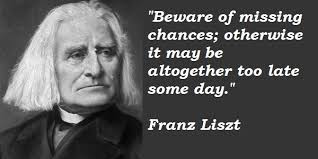
Happy Birthday to Franz Liszt!

liszt-quote

Franz Liszt was born in Raiding, near Ödenburg, October 22, 1811 and died in Bayreuth, July 31, 1886. He was a Hungarian composer and pianist who was a major influence during the romantic period. Liszt was an outstanding pianist at seven, composed at eight and made concert appearances at nine. In addition to being a piano virtuoso, he was also a critic, conductor, city music director, literary writer and transcriber of the works of other composers. He transcribed Beethoven’s Symphonies for the piano.

Franz Liszt began his career as the outstanding concert pianist of the century, who, along with the prodigious violinist Niccoló Paganini (1782-1840), created the cult of the modern instrumental virtuoso. To show off his phenomenal and unprecedented technique, Liszt composed a great deal of music designed specifically for this purpose, resulting in a vast amount of piano literature laden with dazzling, and other technical marvels. In this vein, Liszt composed a series of virtuosic rhapsodies on Hungarian gypsy melodies, the best-known being the all too familiar Hungarian Rhapsody no. 2. Liszt developed the rhapsody as a form of serious music. This kind of music is worlds apart from the generally more introspective, poetic music of pianist-composer Frédéric Chopin.

Liszt was wildly handsome and hugely talented. He was extremely popular in Paris during the 1830’s. It is said that women actually fainted at his piano recitals. He was the first to position the piano so that its lid reflected the sound and the audience could see his profile as he performed.

Liszt was the first to write a tone poem, which is an extended, single-movement work for orchestra, inspired by paintings, plays, poems or other literary or visual works, and attempting to convey the ideas expressed in those media through music. Such a work is Les Préludes, based on a poem in which life is expressed as a series of struggles, passions, and mysteries, all serving as a mere prelude to . . .what? The Romantic genre of the symphonic poem, as well as its cousin the concert overture, became very attractive to many later composers, including Saint-Saëns, TchaikovskyDvorák, Sibelius, and Richard Strauss.


     Liszt’s birthday

     anniversary of Liszt’s death

    Listen to Liszt’s transcription of Meyerbeer’s Hellish Waltz from Robert du Diable, which probably caused more public commotion than any other piano piece in history.


     Read quotes by and about Liszt

     Liszt was the first recitalist

     In Praise of Pianos and the Artists Who Play Them

     History of the Piano

     Franz Liszt

Presidential Musical Quotes

presidents-day


“The future of our nation depends on providing our children with a complete education that includes music.”

– Gerald Ford


“The future belongs to young people with an education and the imagination to create.”

Barack Obama


“The Arts and Sciences, essential to the prosperity of the State and to the ornament of human life, have a primary claim to the encouragement of every lover of his country and mankind.”

George Washington


“I must study politics and war, that my sons may study mathematics and philosophy…in order to give their children the right to study painting, poetry, music and architecture.”

John Q. Adams


“Aeschylus and Plato are remembered today long after the triumphs of Imperial Athens are gone. Dante outlived the ambitions of thirteenth century Florence. Goethe stands serenely above the politics of Germany, and I am certain that after the dust of centuries has passed over cities, we too will be remembered not for victories or defeats in battle or in politics, but for our contribution to the human spirit.”

John F. Kennedy


“Music education opens doors that help children pass from school into the world around them – a world of work, culture, intellectual activity, and human involvement. The future of our nation depends on providing our children with a complete education that includes music.”

– Gerald Ford


“Music is about communication, creativity, and cooperation, and by studying music in schools, students have the opportunity to build on these skills, enrich their lives, and experience the world from a new perspective.”

– Bill Clinton


“Education is not the means of showing people how to get what they want. Education is an exercise by means of which enough men, it is hoped, will learn to want what is worth having.”

Ronald Reagan


Music “brings us together, helping us reflect upon who we are, where we have come from, and what lies ahead.” The Arts and Music transcend “languages, cultures, and borders.” … “exchange ideas and styles and share in the artistic vibrancy born from diverse experiences and traditions.

– President Obama in a 2010 message to the World Choir Games in Shaoxing, China


Millions of Americans earn a living in the arts and humanities, and the non-profit and for-profit arts industries are important parts of both our cultural heritage and our economy…. We must recognize the contributions of the arts and humanities not only by supporting the artists of today, but also by giving opportunities to the creative thinkers of tomorrow. Educators across our country are opening young -minds, fostering innovation, and developing imaginations through arts education.

– White House Proclamation, National Arts and Humanities Month 2014


“In a lot of the poorest countries we’re trying to help, the level of violence is a continuous undercurrent…There’s an enormous amount of evidence that giving people an opportunity for creative expression improves their ability to learn in school and increases their ability and desire to navigate life in a positive rather than a negative way.” Music “taught me discipline and teamwork on the one hand and the importance of creativity.”

The THEA Foundation in Arkansas has proved the merits of including art instruction in the schools.

Clinton said:

“Every place they’ve done this program, you see a reduction in the dropout rate and an increase in the academic performance of the young people. Having strong arts instruction supports learning in a very substantial way.”

-Bill Clinton in an interview with Patrick Cole at the 2011 Clinton Global Initiative

Adapted from http://www.nafme.org/the-most-musical-united-states-presidents/

March 9 ~ Today in Music History

today


. 1745 ~ The first carillon was shipped from England to Boston, MA.

.1903 ~ “The Master of Charms“. ~ Claude Debussy on fellow composer Gabriel Fauré in the Paris periodical Gil Blas

. 1910 ~ Samuel Barber, Pulitzer Prize-winning American composer
Read quotes by and about Barber
More information about Barber

. 1925 ~ Billy Ford, Singer with Billy & Lillie

. 1927 ~ John Beckwith, Canadian composer and music critic

. 1930 ~ Thomas Schippers, American conductor

. 1932 ~ Keely Smith (Dorothy Keely), Singer, was married to Louis Prima

. 1942 ~ Tommy Dorsey and his orchestra recorded Well, Git It! for Victor Records. Ziggy Elman was featured on the session which was recorded in Hollywood. Sy Oliver arranged the Dorsey classic.

.1950 ~ Howard Gordon Shelley OBE, British pianist and conductor

. 1974 ~ Many new musical faces were on the scene, including Terry Jacks, who was starting week two of a three-week stay at the top of the pop charts with his uplifting ditty, Seasons in the Sun. Other newcomers: Jefferson Starship, Billy Joel, Kiss, Olivia Newton-John, Kool & the Gang and The Steve Miller Band.

. 1985 ~ The most requested movie in history, “Gone With The Wind”, went on sale in video stores across the U.S. for the first time. The tape cost buyers $89.95. The film, starring Clark Gable and Vivien Leigh, cost $4.5 million to produce and has earned over $400 million, making it one of the biggest money-makers in motion picture history. “GWTW” is now the cornerstone of the massive MGM film library owned by Ted Turner.

. 1986 ~ Bill Cosby broke Liberace’s long-standing record and earned the biggest box-office gross in the 54-year history of Radio City Music Hall in New York City.

. 1993 ~ Bob Crosby passed away

. 2001 ~ Richard Stone, whose musical compositions for such popular cartoon shows as “Animaniacs” and “Freakazoid” won him more than a half-dozen Emmys, died Friday at the age of 47. Stone grew up watching Warner Bros. “Looney Tunes” cartoons in the 1950s and ’60s before going on to study cello and music composition in college. He not only emulated the style of Carl Stalling, who composed hundreds of musical scores for classic Warner Bros. cartoons in the 1930s, ’40s and ’50s, but also incorporated elements of jazz, Broadway, country and rock music into his work. Stone also carved out his own style on modern-day shows, winning seven Emmys since 1994 for such cartoons as “Animaniacs,” “Freakazoid” and “Histeria!” He also worked on the cartoons “Pinky & the Brain,” “Taz-Mania,” “Road Rovers” and “The Sylvester & Tweety Mysteries” and scored several movies, including the cult classics “Sundown: The Vampire in Retreat” and “Pumpkinhead.”

March 8 ~ Today in Music History

today

. 1714 ~ Carl Phillip Emanuel (C.P.E.) Bach, German composer
More information on C. P. E. Bach

. 1857 ~ Ruggero Leoncavallo, Italian composer
More information about Leoncavallo

. 1866 ~ “It is possible to be as much of a musician as Saint-Saëns;  it is impossible to be more of one!” ~ Franz Liszt on meeting fellow composer Camille Saint-Saëns in Paris.

. 1869 ~ Hector Berlioz died in Paris

. 1889 ~ John Thompson, Piano educator

. 1911 ~ Alan Hovhaness, American composer
More information about Hovhaness

. 1923 ~ Cyd Charisse, Dancer

. 1927 ~ Dick Hyman, Pianist and music director for Arthur Godfrey

. 1961 ~ Conductor, Sir Thomas Beecham died at the age of 81.

. 1962 ~ The Beatles performed for the first time on the BBC in Great Britain. John,Paul, George and … Pete Best sang Dream Baby on the show, “Teenager’s Turn” on ‘Auntie Beeb’ (as the BBC was known).

. 1993 ~ Billy Eckstine passed away

. 2001 ~ Ballet Legend Dame Ninette De Valois died at the age of 102. She was the founder of Britain’s Royal Ballet who launched dancer Margot Fonteyn on the road to stardom. De Valois, a strict and demanding disciplinarian with her pupils, was a gifted and theatrical choreographer who almost single-handedly put British ballet on the international stage. The doyenne of dance helped to nurture the talents of unknowns like Fonteyn and courted controversy in the 1960’s at the height of the Cold War when she invited Russian dancer Rudolph Nureyev to appear with her company. De Valois always gave credit to Russian impresario Sergei Diaghilev for teaching her all she knew. “Everything,” she once said of the Ballet Russe legend. “Diaghilev just managed the whole company. He knew all about the different teachers. He knew the types of teachers he wanted, he knew the type of ballet he wanted. He was a musician.” Born Edris Stannus in 1898 in the Irish county of Wicklow, she graduated from Irish jig to the ballet, worked with the writer W.B. Yeats at Dublin’s Abbey Theater and then, almost single-handedly, brought ballet to the fore in Britain. The famed diva, who adopted her professional name from an ancestor who had married into a French family, was first inspired at the age of 11 when she watched Anna Pavlova dancing The Dying Swan. In 1923, she joined Diaghilev’s troupe in Monte Carlo and began to lay the foundations of her own ballet empire. She gave up dancing herself after discovering that she had been suffering for years from polio. “It was no tragedy. I wasn’t that great,” she once said. In 1926, she opened her own ballet school in London. From the tiniest beginnings, she built up the Sadlers Wells Ballet in less than a decade. At the end of World War II, the company moved triumphantly into the Royal Opera House. A ballet dynasty was born. De Valois retired in 1963 but remained intimately involved in the ballet school, forever the sharp-tongued martinet who could strike terror in tomorrow’s ballet hopefuls.

. 2001 ~ Maude Rutherford, a singer and dancer in the glory days of black theater during the 1920s, died. She was believed to have been 104. Rutherford was billed as the Slim Princess when she worked with entertainers such as Fats Waller, Josephine Baker and Pearl Bailey. She was a featured performer and favorite at Harlem’s Cotton Club. Rutherford’s theater credits include: “Dixie to Broadway,” (1924), “Chocolate Sandals,” (1927), and “Keep Shufflin”‘ (1928). She retired from show business in 1950 and worked as a switchboard operator at an Atlantic City hotel.

. 2003 ~ Adam Faith, a square-jawed British singer who was briefly a Cockney challenger to Elvis Presley’s rock ‘n’ roll crown, died of a heart attack. He was 62. Born Terry Nelhams in west London in 1940, Faith was a handsome teenager who was playing with a skiffle music group – a mixture of jug band, acoustic, folk, blues and country and western styles – when he was spotted by producers of a British Broadcasting Corp. music program. Adopting the stage name Adam Faith, he became – alongside Cliff Richard, Tommy Steele and Billy Fury – a pop star of the pre-Beatles era. Developing a hiccuping delivery reminiscent of Buddy Holly, Faith had more than 20 British hits, including the chart-topping What Do You Want? and Poor Me. Faith also was a versatile actor, appearing in films like Beat Girl, Mix Me A Person and 1975’sStardust opposite David Essex. In the 1970s he played a Cockney ex-con in the TV series Budgie.

March 7 ~ Today in Music History

today

. 1809 ~ Johann Georg Albrechtsberger passed away.  He was was an Austrian musician.

. 1824 ~ “I am convinced that the soul and spirit of Mozart have passed into the body of young Liszt” ~ Review of a concert given on this day by Franz List in Paris.

. 1875 ~ Maurice Ravel, French composer
More information on Ravel

. 1917 ~ In the United States, RCA released the first jazz record ever: The Dixie Jazz Band One Step by Nick LaRocca’s Original Dixieland Jazz Band.

. 1917 ~ Robert Erickson, American composer

. 1939 ~ Guy Lombardo and his Royal Canadians recorded one of the most popular songs of the century. The standard, “Auld Lang Syne”, was recorded for Decca Records.

. 1955 ~ “Peter Pan”, with Mary Martin as Peter and Cyril Richard as Captain Hook, was presented as a television special for the first time.
More about Mary Martin

http://youtu.be/It-LrRqqBiw

. 1969 ~ The Apollo astronauts began this day of their space voyage by singing Happy Birthday.

. 1985 ~ The song We Are the World, from the album of the same name, was played on the radio for the first time. Forty-five of pop music’s top stars gathered together to combine their talents to record the music of Lionel Richie and Michael Jackson. Richie and Jackson sang, too, while Quincy Jones did the producing of the USA for Africa record. The proceeds of the multimillion-selling recording went to aid African famine victims. The project, coordinated by Ken Kragen, was deemed a huge success.

. 2001 ~ Frankie Carle, a big-band leader best known for Sunrise Serenade, at the age of 97. Carle, who died in Mesa, Ariz., reached the high point of his popularity during World War II, when he was the focus of a bidding war among bands. His repertory was wide, ranging from classics like a revival of Stephen Foster’s Swanee River, to a World War II release that anticipated the Allied victory called I’m Going to See My Baby. Although Carle’s music did not rank high on record industry charts after the 1940s, he still toured and played concerts into the 1980s, some 70 years after he began his musical career.

. 2015 ~ Steve Zegree died.  He was a legendary jazz educator and former Western Michigan University Gold Company director.

https://youtu.be/PMQfwYvrz1c

March 3 ~ Today in Music History

today


Can it be that nothing happened in the world of music today?  I’ll be editing this post as I find items!

In the meantime, enjoy this video:


.1875 ~ The Georges Bizet opera Carmen premiered in Paris.

.1931 ~ The “Star Spangled Banner” was adopted as the American national anthem. The song was originally known as “Defense of Fort McHenry.”

.1931 ~ The first jazz album to sell a million copies was recorded. It was “Minnie The Moocher” by Cab Calloway.

.1940 ~ Artie Shaw and his orchestra recorded “Frenesi”.

.1945 ~ Bing Crosby recorded “Temptation” with John Scott Trotter’s Orchestra. He had recorded it before on October 22, 1933, with Lennie Hayton’s orchestra.

.1957 ~ Samuel Cardinal Stritch banned rock ‘n’ roll from Chicago archdiocese Roman Catholic schools.


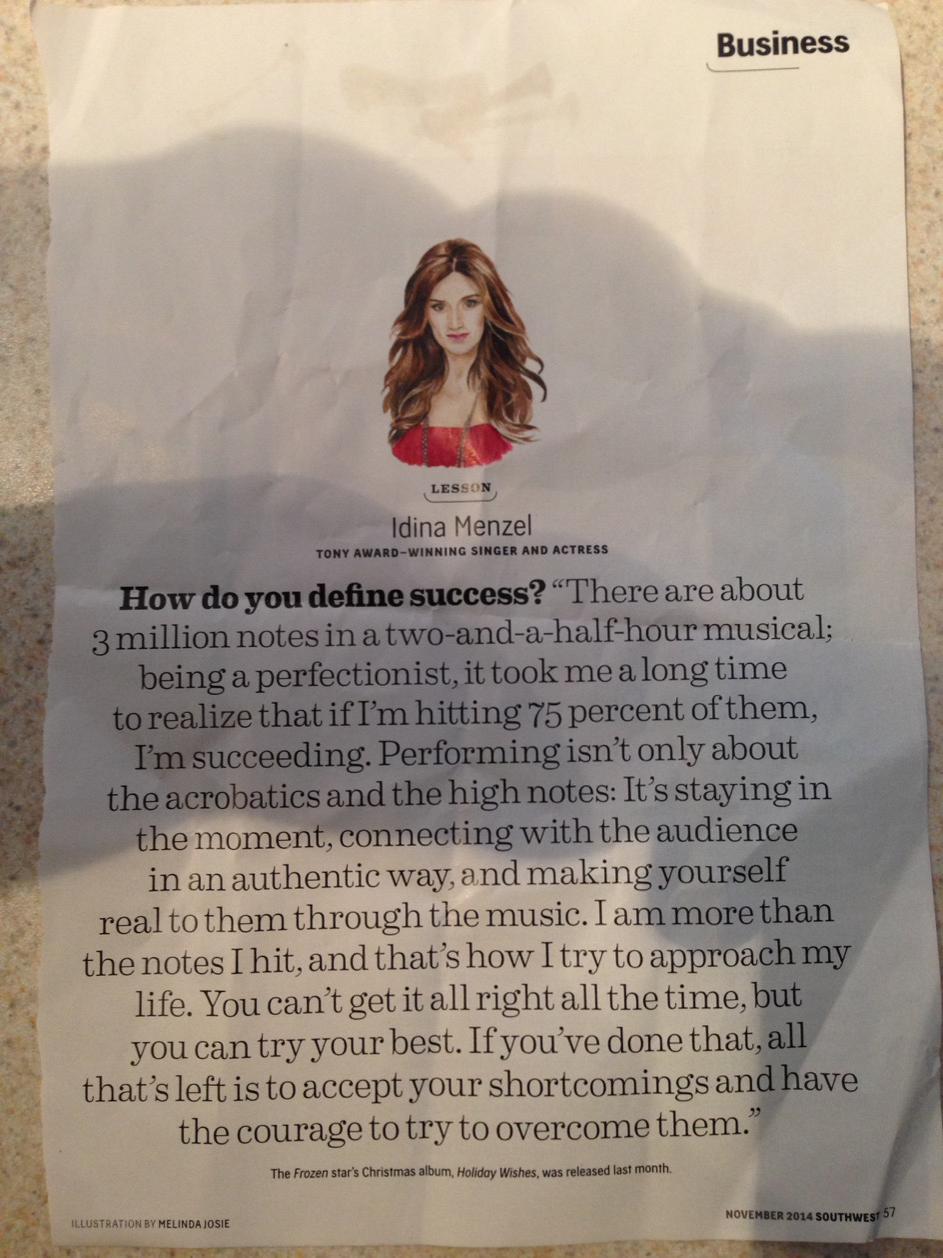
Idina Menzel pipes up after New Year’s Eve snark – NY Daily News

idina

Idina Menzel has seems to have a chilly response for the social media stooges who trashed her performance of “Frozen” hit “Let It Go” in Times Square on New Year’s Eve.

Menzelpiped up on Twitter late Thursday by posting an interview she gave to Southwest Airlines magazine recently in which she said,

“I am more than the notes I hit.”

“There are about 3 million notes in a two-and-a-half-hour musical; being a perfectionist, it took me a long time to realize that if I’m hitting 75 percent of them, I’m succeeding,” she told the magazine in the November issue.

“Performing isn’t only about the acrobatics and the high notes: It’s staying in the moment, connecting with the audience in an authentic way, and making yourself real to them through the music.”

“I am more than the notes I hit, and that’s how I try to approach my life.”

http://youtu.be/YAhzDDEsTzM

Read the entire article at Idina Menzel pipes up after New Year’s Eve snark – NY Daily News.

“If You’re Learning Piano, You Don’t Give Up Because You Miss a Note”

FaeriesAireandDeathWaltz1

I have a copy of this music (Faerie’s Aire and Death Waltz) if anyone is interested in playing it!


The music above has been played:

http://youtu.be/sCgT94A7WgI

The drive you need to accomplish whatever you’re attempting—big or small—needs fuel. Instead of letting slip-ups set you back, psychologist and author John Norcross recommends you make them the fuel:

If you are learning to play the piano, you don’t give up because you miss a note. It’s not whether you slip, it’s how you respond to the slip.

Cut yourself some slack and remember that things take time and hard work. Listen to the sound of your “missed note” and let that push you forward. You missed that note yesterday, but that doesn’t mean you’ll miss it today.

via “If You’re Learning Piano, You Don’t Give Up Because You Miss a Note”.