Felix Bartholdy Mendelssohn lived between 1809 and 1847. He is considered to be a romantic composer and pianist best known for his symphonies and concert overtures. Mendelssohn played the piano in public by the age of nine, so he was often compared to Mozart.
He composed works for solo instruments and orchestra, and German songs. Some of his better known works are the Wedding March, Elijah and Fingal’s Cave. Felix Mendelssohn, along with Hector Berlioz was one of the first conductors of a large orchestra.
Mendelssohn harmonized the works of other composers, including Johann Crüger. Listen to Mendelssohn’s harmonization of Now Thank We All our God:
One of my favorites, Mendelssohn’s Piano Concerto No. 1 in g minor, op. 25:
. 1789 ~ Armand-Louis Couperin, French composer, organist, and harpsichordist died at the age of 63
. 1875 ~ Fritz Kreisler, Austrian-born American violinist and virtuoso/composer Some of his best-known works are Caprice Viennois, Tambourin Chinois, Liebesfreud and La Gitana
. 1901 ~ Jascha Heifetz, Russian-born American violinist
Read quotes by and about Heifetz
More information about Heifetz
. 1911 ~ Jussi Björling, Swedish tenor
. 1912 ~ Burton Lane (Levy), Composer of How Are Things in Glocca Morra, That Old Devil Moon, Look to the Rainbow, How About You, I Hear Music, Come Back to Me, On a Clear Day You Can See Forever, How Could You Believe Me?; His Broadway musicals were Finian’s Rainbow (collaboration with Yip Harburg), On a Clear Day You Can See Forever (collaboration with Alan Jay Lerner). He contributed songs to over 30 films: Babes on Broadway, Royal Wedding, Ship Ahoy, St. Louis Blues and credited with discovering Judy Garland
. 1937 ~ Tom Smothers, Entertainer, The Smothers Brothers Comedy Hour, The Smothers Brothers Show, The Steve Allen Show, Dick’s Brother
. 1937 ~ Guy Lombardo and his orchestra recorded one of Guy’s most famous tunes. Boo Hoo was waxed on Victor Records and became one of the group’s all-time great hits.
. 1942 ~ Graham Nash, Singer with Crosby, Stills, Nash and Young
. 1947 ~ Peter Lucia, Drummer with Tommy James and The Shondells
. 1949 ~ Ross Valory, Bass with Journey
. 1959 ~ The Coasters tune, Charlie Brown, was released. The tune went to #2 and stayed there for three weeks, but didn’t make it to the top spot of the charts. A catchy song (“Fee fee fi fi fo fo fum. I smell smoke in the auditorium…”), it was on the charts for a total of 12 weeks. The song at number one, preventing Charlie Brown from reaching the top, was Venus, by Frankie Avalon.
. 1996 ~ Gene Kelly, American actor and dancer (Singin’ in the Rain), died at the age of 83
. 2001 ~ French pianist Nicole Henriot, who entered the Paris Conservatory at age 7 and went on to perform around the globe with conductor Charles Munch, died at the age of 75. Emerging on the world music scene after World War II, Henriot built her reputation on interpretations of works from Liszt to Prokofiev, and especially French composers such as Ravel, Fauré and Milhaud. She was most famous for her performances with Munch, music director of the Boston Symphony from 1949 to 1962. Munch, who died in 1968, was the uncle of Henriot’s husband. Born in 1925, Henriot won the Paris Conservatory’s first prize at age 13. During the war, Henriot gave aid to her brother, a member of the French Resistance. When Gestapo agents searched her home in 1944, she managed to destroy her brother’s secret documents but was badly beaten. After the war, Henriot became the first French pianist to appear in Britain and began an international tour that took her from Scandinavia to Egypt. She made her American debut in 1948 as a soloist with the New York Philharmonic under Munch’s direction. When Munch formed the Orchestra of Paris in 1967, Henriot was one of the fledgling orchestra’s first soloists. In the 1970s and 1980s, Henriot devoted herself to teaching, and worked at the Conservatory of Liege, Belgium, and at the Walloon Conservatory of Brussels.
. 2001 ~ Victor Norman, who founded the Eastern Connecticut Symphony Orchestra and conducted the group for three decades, died at the age of 95. Colleagues said Norman was a visionary who needed to be as skilled in politics as he was in music to keep the symphony together. “He had this idea that a symphony orchestra could be created around here, when really it had been tried several times before, never with any kind of significant success,” said Charles Frink, a New London composer who studied with Norman. Norman founded the New London Civic Orchestra in 1946. It merged with the Willimantic Orchestra in 1952 to become the Eastern Connecticut Symphony Orchestra. He stepped down from the podium in 1980. In his retirement, Norman composed music. Two of his orchestral pieces were performed by the New Britain Symphony Orchestra and the Westminster Community Orchestra in Princeton, N.J. His memoirs, “Victor Norman: A Life in Music, a Lifetime of Learning,” were published in 1999.
. 2015 ~ French piano virtuoso Aldo Ciccolini died at age 89. Born on August 15, 1925, into a musical family in Naples, Aldo Ciccolini was a child prodigy, beginning composition classes in the city’s conservatory at age nine.
. 2018 ~ Dennis Edwards, who joined the Temptations in 1968 and sang on a string of the group’s hits including “I Can’t Get Next to You,” “Ball of Confusion” and “Papa Was a Rollin’ Stone” in an initial tenure that stretched to 1977, died at the age of 74
Franz Peter Schubert lived between 1797 and 1828. He is considered to be a romantic composer. He was an Austrian composer who was one of the greatest creators of melody and foremost writer of ‘lieder’ (German songs).
Although he only lived for 31 years, Schubert composed more than 600 songs, 22 piano sonatas and many short piano pieces. This melodic output has never been equaled either in quantity of quality. He was one of the first musicians to earn a living from the sale of his music.
Schubert’s Ave Maria was featured in the Walt Disney movie Fantasia.
Schubert’s musical genius went well beyond his incomparable gift for melody
During Beethoven’s funeral in 1827, one of the torchbearers was a young composer who would himself die the following year. There’s a poignant irony in this image of Franz Schubert (1797-1828) paying homage to the master, for the extent of Schubert’s own accomplishment was to remain one of music’s best-kept secrets for decades after his death. He had indeed struck out on a uniquely personal creative path, however intense his hero worship of Beethoven was. As often happens in such periods of transition–in this case, the evolution in style and attitude from classical balance toward romantic experimentation–Schubert simply slipped through the cracks, not easily fitting into his contemporaries’ sense of the direction music was taking.
Yet the fact that the only recognition that came his way was mostly confined to a tight-knit circle of musical friends didn’t deter Schubert from pursuing his inspiration. Even though an astonishing number of compositions were never performed during his short lifetime, the prolific composer produced a wide body of material, all with a seemingly effortless swiftness reminiscent of Mozart (another of the composer’s idols). His style is most frequently associated with an uncanny gift for melody, but that’s a shortsighted view of the true nature of Schubert’s genius.
The selections on our featured disc represent two key but divergent aspects of his music: the gemlike miniaturism of his songwriting and his preoccupation with large-scale forms from the classical period. “Die Forelle” (“The Trout”)–sung here with a silvery, seductive grace by Barbara Bonney–is an example of how Schubert elevated the art of song to an opera in miniature, rich in evocative scene-painting. Pay attention not just to the beguiling melody but to how perfectly Schubert mirrors the text’s images in the details of the burbling piano accompaniment.
The cheerful quintet that takes its name from the song makes an excellent introduction to the composer’s longer works. Most of these belong to the realm of “chamber music”; that is, pieces written for small groups of musicians to be performed in people’s homes. From the high-spirited interplay of the ensemble gathered here–all virtuosos on their respective instruments but clearly merging their voices into a common goal–it’s easy to imagine a typical evening of Schubert making music with his friends. There’s a flowing sense of conversation in the music, and just as you think you’ve heard one untoppable melody, Schubert obliges with another, taking it down an unexpected course with a sudden harmonic surprise–another of the composer’s trademarks–and spinning it out as it suits his fancy. Schumann once characterized the composer’s tendency to make us want the music to last, following its multiple digressions, as Schubert’s “heavenly lengths.”
Much of the pleasure here can also be heard in the way Schubert plays sonorities off each other, above all in the fourth movement. It offers a set of variations on the melody from the “Trout” song, presaging how Mahler would later incorporate material from his own songs into vast symphonic structures. You can notice this both in the interwoven yet contrasting timbres from the keyboard against four strings and in the opposition between double bass and sparkling passages high in the register. And within the spontaneity of the moment, there’s something else: emerging within all the joie de vivre are ambivalent shadows hinting at Schubert’s darker side, particularly in the intensity of the slow movement’s middle core. This is also apparent in the opening of the “Arpeggione” Sonata (nicknamed after a short-lived invention that was a sort of cross between a guitar and a cello), which unfolds a kind of aching, spun-out lyricism that could belong to no one but Schubert.
In his final decade, when intense poverty and a debilitating case of syphilis began to take their toll, Schubert would mine this vein of profound self-expression. His last quartets and piano sonatas, the String Quintet, and his despairing song cycle Winterreise, he touches in his own way on the inwardness probed by Beethoven’s late-period creations. Thomas May, Classical Editor
. 1885 ~ Jerome Kern, American songwriter and composer of musical comedies He was known as the father of the American musical, composing Show Boat, Ol’ Man River, Smoke Gets in Your Eyes, Lovely to Look At, The Way You Look Tonight and The Last Time I Saw Paris
. 1895 ~ Harry Ruby (Rubinstein), Musician and composer
. 1901 ~ Giuseppe Verdi, Italian composer, died at the age of 77. He was an Italian operatic composer, the leading figure of Italian music in the nineteenth century and made important contributions to the development of opera.
More information about Verdi
. 1905 ~ John Schaum, Pianist, composer and music educator. Schaum began his career as a piano teacher in the late 1920s. In 1933 he founded the Schaum Piano School in Milwaukee. About the same time he began to compose piano music for teaching purposes. He also founded the first company to produce award stickers specifically for music students. Always on the lookout for better materials for his students, Schaum eventually decided to create his own books, beginning in 1941 with Piano Fun for Boys and Girls, which he later revised as the first in a series of nine piano method books that became the Schaum Piano Course, completed in 1945. These books are still widely used today.
. 1918 ~ Skitch Henderson, Conductor of the Tulsa Symphony Orchestra, bandleader, musical director of NBC-TV’s The Tonight Show with Steve Allen and Johnny Carson
. 1961 ~ Leontyne Price made her debut at the Metropolitan Opera House in New York City. She sang in the role of Leonora in “Il Trovatore”. Price was only the seventh black singer to make a debut at the Met. Marian Anderson was the first (1955).
. 1968 ~ The Bee Gees played their first American concert, as a group. They earned $50,000 to entertain at the Anaheim Convention Center in California. This is identical to what The Beatles were paid to perform at the Hollywood Bowl a few years earlier.
. 1968 ~ Otis Redding’s(Sittin’ On) The Dock of the Bay was released on this day, seven weeks after the singer’s death. It became #1 on March 16, 1968 and remained at the top spot for a month. Redding began his recording career in 1960 with Johnny Jenkins and The Pinetoppers (on Confederate Records). He sang duet with Carla Thomas and had 11 chart hits. Redding of Dawson, GA was killed in a plane crash at Lake Monona near Madison, WI. Four members of the Bar-Kays were also killed in the crash. The Dock of the Bay, his only number one song, was recorded just three days before his death.
. 1973 ~ Mr and Mrs O got married 🙂
Read more here.
. 1982 ~ “Joseph & the Amazing Dreamcoat” opened at the Royale NYC for 747 performances
. 1984 ~ Michael Jackson’s hair caught on fire during the filming of a Pepsi commercial in Los Angeles. Pyrotechnics did not operate on cue, injuring the singer. Jackson was hospitalized for a few days and fans from around the world sent messages of concern.
. 1626 ~ John Dowland, English composer (In Darkness We Dwell), died at the age of 62
. 1903 ~ First performance of “The Wizard of Oz” as a Broadway musical
. 1917 ~ Billy Maxted, Pianist, songwriter, arranger and bandleader
. 1927 ~ The first opera to be broadcast over a national radio network was presented in Chicago, IL. Listeners heard selections from “Faust” by Charles Gounod.
. 1932 ~ Annunzio Paolo Mantovani gave a memorable concert at Queen’s Hall in England to ‘glowing notices’. This was the beginning of the musician’s successful recording career that provided beautiful music to radio stations for nearly five decades. Better known as just Mantovani, his music still entertains us with hits like Red Sails in the Sunset, Serenade in the Night, Song from Moulin Rouge and Charmaine.
. 1939 ~ Wolfman Jack (Robert Smith), Disc jockey, icon of ’60s radio, broadcasting from XERF, then XERB in Mexico and heard throughout a major part of the U.S.; TV announcer: The Midnight Special; actor: American Graffiti; author: Have Mercy! Confessions of the Original Rock ‘n’ Roll Animal
. 1942 ~ Mac (Scott) Davis, Singer, actor, host of The Mac Davis Show, songwriter, ACM Entertainer of the Year in 1975
. 1942 ~ Nostalgia buffs will want to grab the greatest hits CD of Count Basie (on Verve) and crank up One O’Clock Jump. Just one of the many signature tunes by Bill Basie; the tune was originally recorded on Okeh Records this day.
. 1950 ~ Billy Ocean, Grammy Award-winning R&B Male Vocal in 1984
. 1957 ~ Singer Patsy Cline appeared on Arthur Godfrey’s nighttime TV show. She sang the classic, Walking After Midnight, which quickly launched her career.
. 1959 ~ The Kingston Trio (Bob Shane, Nick Reynolds and Dave Guard) received a gold record for Tom Dooley. The Kingston Trio recorded many hits, including: Greenback Dollar, M.T.A., Reverend Mr. Black, TijuanaJail, and the war protest song, Where Have All the Flowers Gone?.
. 1966 ~ George Harrison of The Beatles married Patricia (Patty) Anne Boyd in Surrey, England. The two met on the set of the movie, “A Hard Day’sNight”.
. 1970 ~ ABC-TV presented “The Johnny Cash Show” in prime time. Previously, the show had been a summer replacement. The regular season series was a big boost for country music. Johnny wore black in the all-color show, however, like he still does today.
. 1978 ~ The soundtrack of “Saturday Night Fever” reached #1 on the album charts — a position it held for the next six months.
. 1987 ~ Thirty years after its release, Jackie Wilson’s single, Reet Petite (written by Motown founder Berry Gordy), ended a month at the top of England’s music charts. Three years earlier, on this same date, Jackie Wilson died after being in a coma (following a heart attack) for eight and a half years.
. 2002 ~ Peggy Lee, the singer-composer whose smoky voice in such songs as Is That All There Is? and Fever made her a jazz and pop legend, died of a heart attack. She was 81. Lee battled injury and ill health, including heart trouble, throughout a spectacular career that brought her a Grammy, an Oscar nomination and sold- out houses worldwide. In more than 50 years in show business, which began during a troubled childhood and endured through four broken marriages, Lee recorded hit songs with the Benny Goodman band, wrote songs for a Disney movie and starred on Broadway in a short-lived autobiographical show, Peg. A string of hits, notably Why Don’t You Do Right?, made her a star. Then she fell in love with Goodman’s guitarist, Dave Barbour, and withdrew from the music world to be his wife and raise their daughter, Nicki. She returned to singing when the marriage fell apart. Lee’s other notable recordings included Why Don’t You Do Right?I’m a Woman,Lover,Pass Me By,Where or When,The Way You Look Tonight,I’m Gonna Go Fishin‘ and Big Spender. The hit Is That All There Is? won her a Grammy for best contemporary female vocal performance in 1969. She collaborated with Sonny Burke on the songs for Disney’s The Lady and the Tramp, and was the voice for the wayward canine who sang He’s a Tramp (But I Love Him).
. 1926 ~ David Tudor, American pianist and composer of experimental music
. 1935 ~ Buddy Blake (Buddy Cunningham), Recording artist: recorded for Sun Records as B.B. Cunningham and Buddy Blake; record executive: Cover Record Co.,Sam Phillips’ Holiday Inn label
. 1942 ~ Harry Babbitt sang as Kay Kyser and his orchestra recorded, Who Wouldn’tLove You, on Columbia Records. The record went on to be a big hit for Kyser.
. 1947 ~ George Grantham, Drummer with Poco
. 1958 ~ The rock ‘n’ roll classic, Get a Job, by The Silhouettes, was released.
. 1958 ~ Elvis Presley got a little U.S. mail this day with greetings from Uncle Sam. The draft board in Memphis, TN ordered the King to report for duty; but allowed a 60-day deferment for him to finish the film, “King Creole”.
. 1964, The Beatles, a British rock group, released its first LP album, “Meet The Beatles“, in the US record stores. The album turned out to be a super hit and reached #1 position on music charts by early February.
. 1965 ~ John Michael Montgomery, Country singer
. 1965 ~ Alan Freed, the ‘Father of Rock ‘n’ Roll’, died in Palm Springs, CA. Freed was one of the first radio disc jockeys to program black music, or race music, as it was termed, for white audiences. In the 1950s, Freed, at WJW Radio in Cleveland, coined the phrase, “rock ‘n’ roll,” before moving to WABC in New York. He was fired by WABC for allegedly accepting payola (being paid to play records by certain artists and record companies). The 1959-1960 congressional investigation into payola made Freed the scapegoat for what was a wide spread practice. Freed, not so incidentally, died nearly penniless after the scandal was exposed.
. 2002 ~ Actress, writer and musician Carrie Hamilton, daughter of actress Carol Burnett, died of cancer. She was 38. Hamilton, whose father was the late producer Joe Hamilton, appeared in the television series “Fame” and had guest roles on other shows, including “Murder She Wrote,” “Beverly Hills 90210” and “thirtysomething.” She also starred in television movies. She and her mother collaborated on a stage version of Burnett’s best-selling memoir “One More Time.” The resulting play, “Hollywood Arms,” will have its world premiere in Chicago in April, said Burnett’s publicist, Deborah Kelman. Hamilton spoke publicly in the ’80s about her struggles with addiction and her decision to go drug-free. She starred as Maureen in the first national touring version of the musical “Rent” and wrote and directed short films through the profit-sharing production company Namethkuf. She won “The Women in Film Award” at the 2001 Latino Film Festival for her short film “Lunchtime Thomas.”
. 2002 ~ John Jackson, who went from gravedigger to one of the pre-eminent blues musicians in the country, died from kidney failure. He was 77. During his long career, Jackson played for presidents and in 68 countries. Jackson earned a living as a cook, a butler, a chauffeur and a gravedigger before his music career took off. He was playing guitar for some friends at a gas station in Fairfax in 1964 when Charles L. Perdue, who teaches folklore at the University of Virginia, pulled in to get some gas. He listened as Jackson taught a song to a mailman he knew. He and Jackson became friends, and Perdue eventually helped launch Jackson’s career by introducing him to people in the music business. The seventh son of 14 children, Jackson had just three months’ education at the first-grade level. But he earned the admiration of fans from all walks of life around the world. B.B. King, Eric Clapton, Bob Dylan, Bonnie Raitt and Pete Seeger are among the performers he has played with and befriended. Among his numerous awards is the National Endowment for the Arts’ Heritage Fellowship Award, which he received in 1986.
. 1775 ~ Giovanni Battista Sammartini, composer, died
. 1890 ~ Premiere of The Sleeping Beauty, ballet by Pyotr Il’yich Tchaikovsky. After the less-than-promising 1877 debut of Swan Lake, marred by a largely amateur production, over a decade lapsed before the composer was commissioned by the Director of the Imperial Theatres in St. Petersburg to supply music for a ballet on the Perrault fairy tale, The Sleeping Beauty. Tchaikovsky threw himself arms-deep into the project. Not only was the composer again on happy turf, he was currently in a state of delight by the occasional presence of a three-year old little girl; children seemed to tap a joyful vein in Tchaikovsky. The little girl’s proximity fed a spirit of fantasy which transmitted to this most lighthearted of the composer’s scores. Most musicologists and historians concede that Sleeping Beauty is the most perfectly wrought of Tchaikovsky’s three ballet scores, classic in its restraint, yet possessing the right amount of color and panache to render it pure Tchaikovsky; its waltz remains a Pops favorite.
. 1896 ~ Alexander Scriabin made his European debut as a pianist at the Salle Erard in Paris
. 1964 ~ The soundtrack album of the musical, “The King and I”, starring Yul Brynner, earned a gold record.
. 1967 ~ Ed Sullivan told the Rolling Stones to change the lyrics and the title to the song, Let’s Spend the Night Together, so it became Let’s Spend Some Time Together.
. 1972 ~ Elvis Presley, who was also censored from the waist down by Ed Sullivan, reportedly drew the largest audience for a single TV show to that time. Elvis presented a live, worldwide concert from Honolulu on this day.
. 1987 ~ Ray Bolger died. He was an American entertainer of vaudeville, stage and actor, singer and dancer best known for his portrayal of the Scarecrow in The Wizard of Oz.
. 1993 ~ Sammy Cahn passed away. He was an was an American lyricist, songwriter and musician.
Alfred Brendel was born in 1931 in Wiesenberg, Czech Republic.
After World War II, Brendel composed music, as well as continuing to play the piano, to write and to paint. However, he never had more formal piano lessons and, although he attended master classes with Edwin Fischer and Eduard Steuermann, he was largely self-taught after the age of six.
He made his debut in Graz (1948), and has since performed widely throughout Austria, where he lives.
He is known for his interpretations of Mozart, Beethoven, Schubert, Liszt, and Schoenberg. He tours internationally, and has written many essays on music.
A short insight from Alfred Brendel on his recording career:
. 1809 ~ Louis Braille, Inventor of the Braille system which enables the blind to read words and music. When he was only 3, Louise Braille, was permanently blinded in an accident with a leatherworking awl in his father’s saddlemaking shop in Coupvray, France. Several years later, he was admitted to a school for the blind, the Institution Nationale des Jeunes Aveugles. Later, as a teacher at the school, he worked at adapting Charles Barbier’s system of writing with points. Ironically, his method centered around using an awl-like stylus to punch marks in paper that could be felt and interpreted by the blind, allowing them to “read” with their fingertips. Braille’s work went unnoticed until after his death, in poverty, in 1852.
. 1874 ~ Josef Suk, Czech violinist and composer
More information about Suk
. 1928 ~ NBC radio debuted one of radio’s first variety shows. “The Dodge Victory Hour” starred Will Rogers, Paul Whiteman and his Orchestra and singer Al Jolson. The cost to produce this one show was $67,600.
. 1932 ~ NBC Red presented “The Carnation Contented Hour”. The show continued on network radio for 19 years as a showcase for top singers and musicians.
. 1935 ~ Bert Ambrose and his orchestra recorded the song that became the group’s theme song. It was titled Hors d’oeuvres and was cut in London for Decca Records.
. 1935 ~ Bob Hope was first heard on network radio as part of “The Intimate Revue” with Jane Froman, James Melton and the Al Goodman Orchestra.
. 1936 ~ The first pop music chart based on national sales was published by “Billboard” magazine this day. Joe Venuti, jazz violinist, was at the top of the chart with a little ditty called Stop! Look! Listen!.
1937 ~ Grace Bumbry, American mezzo-soprano
More information about Bumbry
. 1950 ~ RCA Victor announced that it would manufacture long-playing (LP) records. This news came two years after Columbia Records debuted the ‘album’.
. 1954 ~ Elvis Presley strolled into the Memphis Recording Service and put $4 on the counter. He recorded Casual Love and I’ll Never Stand in Your Way, two songs that so impressed record executive Sam Phillips that he had Elvis record his first professional sides for Sun Records the following August.
. 1964 ~Bobby Vinton topped the pop charts with the last #1 single of the pre-Beatles era – “There! I’ve Said Again”
. 1965 ~ The Fender Guitar Company was sold to CBS for $13 million.
. 1979 ~ With a new interest in Beatles music on this day, the Star Club reopened in Hamburg, Germany. None of The Beatles returned to their beginnings to attend the gala opening.
. 2001 ~ Les Brown, whose Band of Renown scored a No. 1 hit with Sentimental Journey during America’s big band era of the 1930s and ’40s, died of lung cancer at the age of 88. A conductor-clarinetist whose smooth arrangements of swing melodies transcended changes in musical tastes, Brown was cited in 1996 by the Guinness Book of Records recognized him as the leader of the longest lasting musical organization in pop music history. He started his professional career in 1936, and his Band of Renown was still performing about 60 dates a year as recently as five months ago, often conducted by son Les Brown Jr. Brown formed his Band of Renown in 1936. In the 1940s heyday of swing, Brown never achieved the greatness of Tommy Dorsey, Glenn Miller or Benny Goodman. But the band scored two hit records – Sentimental Journey, with Doris Day as vocalist, and the instrumental I’ve Got My Love to Keep Me Warm. Sentimental Journey, co-written with Ben Homer and Bud Green, became a theme for soldiers returning home from World War II. “The happiest times in my life were the days when I was traveling with Les and his band,” Day said. “I loved Les very much, I am going to miss his phone calls.” Brown’s career included a close association with Bob Hope. In 1950, he joined Hope for the first of 18 Christmas tours to entertain American troops at military bases around the world. Day also participated. “The world has lost a great musician,” Hope said. “I have lost my music man, my sideman, my straight man and a special friend.” As the first president of the Los Angeles chapter of the Academy of Recording Arts and Sciences, Brown helped make the Grammy Awards a televised event. He convinced Hope, Frank Sinatra and Bing Crosby to participate in the first telecast.
. 2004 ~ Jake Hess, a four-time Grammy winner who sang with some of the premier quartets in gospel music and influenced the career of Elvis Presley, died. He was 76. Hess, whose career spanned more than 60 years, is best known to contemporary audiences as a regular member of Bill Gaither’s Homecoming Friends, on various Christian and country music cable channels, including TBN and TNN. Hess joined The John Daniel Quartet in 1943 and reached stardom with The Statesmen Quartet. He was founder of The Imperials and sang with The Masters V. Each of these groups is enshrined in the Southern Gospel Music Hall of Fame, as is Hess. He is also a member of the Alabama Music Hall of Fame. As a teen, Elvis Presley was a regular at Statesmen concerts. Later, Hess was a backup singer on several of Presley’s Grammy-winning albums. When Presley died in 1977, Hess sang at his funeral, as he had at the funeral of country legend Hank Williams in 1953. Peter Guralnick, author of a two-volume biography of Presley, said the rock star always wanted to emulate the voices of Hess and crooner Roy Hamilton.
Victor Borge was born in 1909 in Copenhagen, Denmark. He was an entertainer and pianist – a deliciously funny performer. He studied at the Royal Danish Academy of Music, Copenhagen, and in Vienna and Berlin.
He made his debut as a pianist in 1926, and as a revue actor in 1933. From 1940 until his death in 2000 he worked in the USA for radio, television, and theatre, and has performed with leading symphony orchestras on worldwide tours since 1956.
He was best known for his comedy sketches combining music and narrative. He used his classical training to skew serious music and performers.
From his obituary:
Pianist Victor Borge, died in his sleep Dec 23, 2000 at his Greenwich, Connecticut home, was known as the unmelancholy Dane of international show business. He would have turned 92 on Jan. 3, 2001.
“The cause of death was heart failure,” his daughter, Sanna Feirstein, told Reuters.
“He had just returned from a wonderfully successful trip to Copenhagen … and it was really heartwarming to see the love he experienced in his home country,” she said.
Borge was one of five performers selected for the Kennedy Center Honors in 1999.
“He went to sleep, and they went to wake him up this morning, and he was gone,” said his agent, Bernard Gurtman.
“He had so much on the table, and to the day he died he was creative, and practicing piano several hours a day,” Gurtman told Reuters. “He was just a great inspiration.”
Funeral services will be private, his daughter said.
Borge made a career of falling off piano stools, missing the keys with his hands and getting tangled up in the sheet music.
One of his inspirations was a pianist who played the first notes of the GriegA Minor Concerto and then fell on the keys dead.
He said that the only time he got nervous on stage was when he had to play seriously and adds that if it had not been for Adolf Hitler he probably would never have pursued a career as a concert-hall comedian.
Until he was forced to flee Denmark in 1940 he was a stage and screen idol in his native country.
Lampooned Hitler
But as a Jew who had lampooned Hitler, Borge — his real name was Boerge Rosenbaum — was in danger and fled first to Sweden and then to the United States, where he arrived penniless and unknown and by a fluke got booked on the Bing Crosby radio show. He was an instant success.
He became an American citizen in 1948, but thought of himself as Danish. It was obvious from the numerous affectionate tributes and standing ovations at his 80th birthday concert in Copenhagen in 1989 that Danes felt the same way.
In the concert at Copenhagen’s Tivoli gardens, Borge played variations on the theme of “Happy Birthday to You” in the styles of Mozart, Brahms, Wagner and Beethoven — all executed with such wit that the orchestra was convulsed with laughter that a woman performing a piccolo solo was unable to draw breath to play.
“Playing music and making jokes are as natural to me as breathing,” Borge told Reuters in an interview after that concert.
“That’s why I’ve never thought of retiring because I do it all the time whether on the stage or off. I found that in a precarious situation, a smile is the shortest distance between people. When one needs to reach out for sympathy or a link with people, what better way is there?
“If I have to play something straight, without deviation in any respect, I still get very nervous. It’s the fact that you want to do your best, but you are not at your best because you are nervous and knowing that makes you even more nervous.”
His varied career included acting, composing for films and plays and writing but he was best known for his comic sketches based on musical quirks and oddities.
Unpredictable Routine
His routines were unpredictable, often improvised on stage as his quick wit responded to an unplanned event — a noise, a latecomer in the audience — or fixed on an unlikely prop — a fly, a shaky piano stool.
Borge was born in Denmark on January 3, 1909, son of a violinist in the Danish Royal Orchestra.
His parents encouraged him to become a concert pianist, arranging his first public recital when he was 10. In 1927 he made his official debut at the Tivoli Gardens.
Borge’s mischievous sense of humor was manifest from an early age. Asked as a child to play for his parent’s friends he would announce “a piece by the 85-year-old Mozart” and improvise something himself.
When his mother was dying in Denmark during the occupation, Borge visited her, disguised as a sailor.
“Churchill and I were the only ones who saw what was happening,” he said in later years. “He saved Europe and I saved myself.”
From 1953 to 1956, he appeared in New York in his own production “Comedy in Music,” a prelude to world tours that often took him to his native Scandinavia.
On radio and television, Borge developed the comedy techniques of the bungling pianist that won him worldwide fame.
Many of his skits were based on real-life events. One of his classics evolved from seeing a pianist playing a Tchaikovsky concerto fall off his seat.
Borge’s dog joined the show after it wandered on stage while he was at the keyboard — an entrance nobody would believe had been unplanned.
One incident could not be repeated. A large fly flew on to Borge’s nose while he was playing. “How did you get that fly to come on at the right time?” people asked. “Well, we train them,” Borge explained.
Borge’s book, “My Favorite Intervals”, published in 1974, detailed little-known facts of the private lives of composers describing Wagner’s pink underwear and the time Borodin left home in full military regalia but forgot his trousers.
In 1975, Borge was honored in recognition of the 35th anniversary of his arrival in the United States and his work as unofficial goodwill ambassador from Denmark to the United States. He celebrated his 75th birthday in 1984 with a series of concerts at Carnegie Hall and in Copenhagen.
Borge received a host of honors from all four Scandinavian countries for his contributions to music, humor and worthy causes.
Borge, who had lived in Greenwich since 1964, is survived by five children, nine grandchildren, and one great grandchild. His wife of many years, Sanna, died earlier that year.

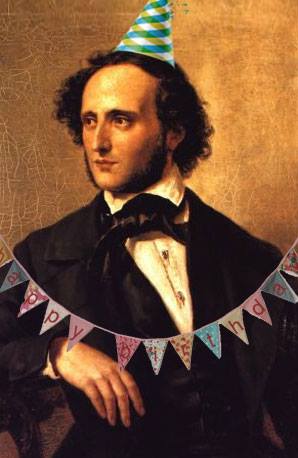
 Read more about Mendelssohn in the Baroque section
 Listen to Mendelssohn’s music.
 Read information about Mendelssohn’s “A Midsummer Night’s Dream”
 Franz Peter Schubert lived between 1797 and 1828. He is considered to be a romantic composer. He was an Austrian composer who was one of the greatest creators of melody and foremost writer of ‘lieder’ (German songs).


 Grammy winner


 1710 ~ Giovanni Battista Pergolesi, Italian Composer
 Victor Borge was born in 1909 in Copenhagen, Denmark. He was an entertainer and pianist – a deliciously funny performer. He studied at the Royal Danish Academy of Music, Copenhagen, and in Vienna and Berlin.
 MaryO'Studio