Daily Listening Assignments ~ August 1

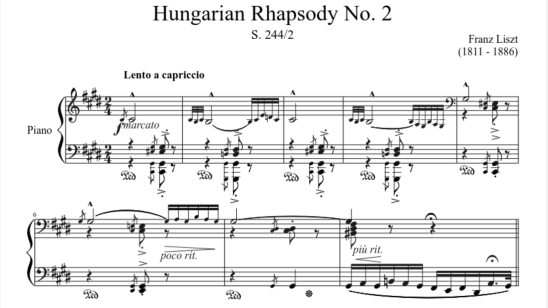
Today’s piece is a favorite in cartoons as you’ll see below.   Hungarian Rhapsody number 2 by Franz Liszt is the second in a set of 19 Hungarian Rhapsodies and is by far the most famous of the set. They are all based on Hungarian folk tunes, or what Liszt assumed were Hungarian folk tunes. Even though Liszt’s nationality was Hungarian, he wasn’t familiar with the language.

So he ended up making some assumptions. Some of these Hungarian Rhapsodies were not actually gypsy folk tunes at all, but tunes composed by middle-and-upper-class folk, which the gypsies integrated into their own music.

These Rhapsodies are very difficult for pianists since Liszt was a virtuoso musician and liked to compose pieces only he could play.
From the cartoons

For sort-of real

For real

Orchestra

Follow along

Daily Listening Assignments ~ July 31

And, we’re back with Clair de Lune by Claude Debussy. Clair de Lune is French for “light of the moon”, or “moonlight”. Debussy liked to create tonal “impressions” rather than conventional melodies. Clair de Lune” is a famous example of this as it creates the feeling of rippling water.

Follow the score:

Smalan

Borge

Liberace

For Orchestra

Guitar

Daily Listening Assignments ~ July 30

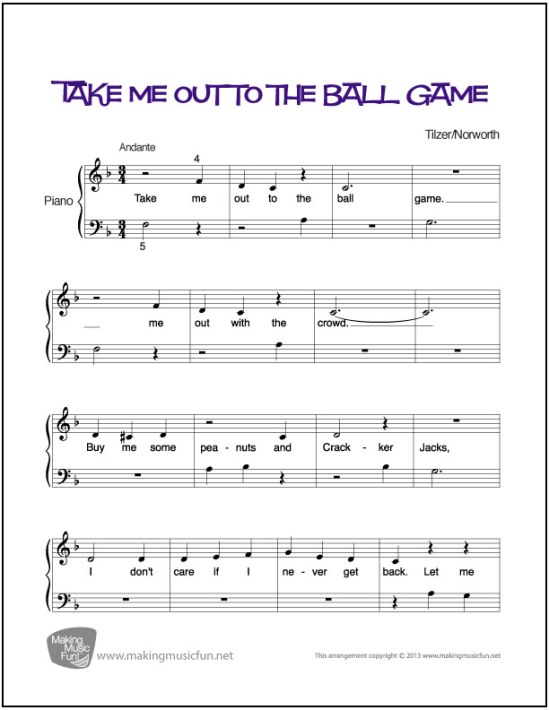
Today’s piece is a fine baseball standard “Take Me Out to the Ballgame” by Jack Norworth and Albert Von Tilzer.  The song’s chorus is traditionally sung during the middle of the seventh inning of a baseball game. Fans are generally encouraged to sing along, and at some ballparks, the words “home team” are replaced with the team name.

Find it in Piano Pronto Songs I love to Play 2 and Alfred Premier 2B among others.

Below are the lyrics to the chorus of the 1908 version, which is out of copyright.

Chorus

Take me out to the ball game,
Take me out with the crowd;
Buy me some peanuts and Cracker Jack,
I don’t care if I never get back.
Let me root, root, root for the home team,
If they don’t win, it’s a shame.
For it’s one, two, three strikes, you’re out,
At the old ball game.

From the movie Take Me Out to the Ballgame

Muppets

Organ

Ragtime Piano

Player piano

Orchestra

Daily Listening Assignments ~ July 25

Today’s piece is Also Sprach Zarathustra by Richard Strauss. It was made popular in the 1968 Stanley Kubrick science-fiction movie 2001: A Space Odyssey.

The organ part in this snippet looks pretty easy.

Just the main theme for piano

One-quarter speed

A piano reduction of the whole orchestral score

The orchestra playing the entire word

Just the opening of 2001: A Space Odyssey

The Blue Danube Waltz composed by Johann Strauss (no relation) was also used in this movie.

Daily Listening Assignments ~ July 23

Today we will listen to Minuet in G.  Several people composed a Minuet (a slow, stately ballroom dance for two in 3/4 time, popular especially in the 18th century) in the key of G including Beethoven, Mozart and Bach.

How are the same?  How are they different?

JS Bach’s version

The Bach version also was “acquired” for a popular song in the 1960s

Beethoven

Rowlf from the Muppets plays the Beethoven Minuet

Mozart

So – never say to your teacher that “I already played that” – you never know which version s/he has in mind!