All About Carnegie Hall

carnegie-hall

You’ve all heard it before.  How do you get to Carnegie Hall?  Practice, practice, practice.

We took the easier route with the tour December 1, 2014.  Unfortunately, I wasn’t posting much on my travel blog yet so I don’t remember everything that happened.  I do highly recommend the tour if you’re in New York City.

If you want to go, other than practicing, Carnegie Hall is a concert venue in Midtown Manhattan located at 881 Seventh Avenue, occupying the east stretch of Seventh Avenue between West 56th Street and West 57th Street, two blocks south of Central Park.

carnegie-hall-map

The tour was very inexpensive, maybe $10 each.  We were taken by elevator up to the Main Hall (Isaac Stern Auditorium/Ronald O. Perelman Stage) first.  The stories that were told were fascinating!  I don’t remember most but I remember the guide telling us that after renovations audience members complained of a buzzing sound.  The floor had to be removed…

From 1995:

SOURCE OF CARNEGIE HALL COMPLAINTS DISCOVERED: CONCRETE UNDER STAGE
MARY CAMPBELL , Associated Press
Sep. 13, 1995 11:53 PM ET

NEW YORK (AP) _ For nine years, the people who run Carnegie Hall insisted there was nothing wrong with the acoustics at the famed concert hall.

Wednesday, they sang a different tune

This summer, a layer of concrete, apparently left over from a major renovation job in 1986, was discovered under the stage. The concrete was ripped out and a new floor was installed that administrators say should improve acoustics.
Since the renovation, musicians and critics have complained about the acoustics, saying the sound the hall was world famous for wasn’t the same, that the bass had become washed out and the higher instruments harsh.

Executive Director Judith Arron said Wednesday she had been assured there was no concrete under the stage since arriving at the hall in 1986.

But the tongue-in-groove maple stage floor, which usually lasts 20 years, had warped so badly after just nine years, it was difficult to push a piano across it.

The hall closed for repairs after three Frank Sinatra tribute concerts the last week in July. “As we tore the whole floor up,” Arron said, “we learned we had a lot more hard substance than we had anticipated.”

She speculated the concrete was added to reinforce the stage while scaffolding was on it during the 1986 renovation and then simply left there in workers’ haste to finish.

The concrete had been placed under two layers of plywood, on which the maple stage floor rests.

“Concrete retains moisture,” Arron said. “As the moisture collected in the concrete, it went into the plywood, which expands with moisture and pushed up the floor.”

Jim Nomikos, the hall’s director of operations, compared the removal of hundreds of pounds of concrete to “an archeological dig.”

Nomikos said the floor is now constructed the way it was from Carnegie Hall’s opening in 1891 until 1986.

“In my opinion we’re not reconstructing the floor. We just restored it,” he said. “I think what we have now is a floor that will have some resonance, as opposed to a floor that was dead.”

The project cost $180,000.

Aaron said there are no plans to sue anybody for the way the floor was laid in 1986. “We’ve been focused on doing the job right,” she said. “We think this is going to be great.”

The new floor will meet its first test Sept. 26, when the Philadelphia Orchestra plays. The hall’s official gala opening for its 105th season will be Oct. 5 by the Boston Symphony.

I remember the guide not being happy with us because I knew the answers to some of the questions she asked such as Tchaikovsky conducting at the opening.  When she mentioned that Ignacy Jan Paderewski had made his debut there,  Tom piped up that he had lived near Steinway Hall (and that Michael and I had just played there in the final concert in the old building).  She gave us the evil eye and we stopped talking so much 🙂

padereski-me

Plaque on Steinwall Hall (old building). This was just after Michael and I played there.


Paderewski

Plaque on Steinwall Hall (old building).

There were many, many pictures on the walls of people who had performed there.  All in all, a fantastic tour.  Take it if you’re in NYC!

1891 Andrew Carnegie’s new Music Hall opened

Andrew Carnegie’s new Music Hall opened with a five-day music festival beginning on May 5.

Guest of honor Pyotr Ilyich Tchaikovsky conducted his Marche Solennelle on Opening Night and his Piano Concerto No. 1 several days later.

William Tuthill’s design reflects Gilded Age architectural tastes and engineering.  Since the Hall was built shortly before the advent of structural steel construction, its walls are made of fairly heavy brick and masonry, to carry the full load of the structure without the lighter support that a steel framework soon made possible. The Italian Renaissance design of the exterior reflects the eclectic architectural tastes of the period, which look to European models of earlier centuries for inspiration.  Tuthill deliberately chose to keep the styling and decorative elements simple, elegant, and functional, focusing his energies on designing an excellent acoustic environment.

I came across this interesting 1947 movie about Carnegie Hall for my Music Studio Blog and I’m posting it here, as well.

Jascha Heifetz (violinist) Tchaikovsky – “Violin Concerto in D, First Movement” – New York Philharmonic, Fritz Reiner, conductor
Harry James (trumpeter)
Vaughn Monroe (band leader)
Jan Peerce (vocalist)
Gregor Piatigorsky (cellist)
Ezio Pinza (vocalist)
Lily Pons (vocalist)
Fritz Reiner (conductor)
Artur Rodzinski (conductor)
Arthur Rubinstein (pianist)
Rise Stevens (vocalist)
Leopold Stokowski (conductor)
Bruno Walter (conductor)
Walter Damrosch (conductor)
Olin Downes (music critic)
New York Philharmonic Quintette (John Corigliano Sr., William Lincer, Nadia Reisenberg, Leonard Rose, Michael Rosenker)
New York Philharmonic

Storyline:
A mother (Marsha Hunt) wants her son (William Prince) to grow up to be a pianist good enough to play at Carnegie Hall but, when grown, the son prefers to play with Vaughan Monroe’s orchestra. But Mama’s wishes prevail and the son appears at Carnegie Hall as the composer-conductor-pianist of a modern horn concerto, with Harry James as the soloist. Frank McHugh is along as a Carnegie Hall porter and doorman, and Martha O’Driscoll is a singer who provides the love interest for Prince. Meanwhile and between while a brigade of classical music names from the 1940’s (and earlier and later) appear; the conductors Walter Damrosch, Bruno Walter, Artur Rodzinski, Fritz Reiner and Leopold Stokowski; singers Rise Stevens, Lily Pons, Jan Peerce and Ezio Pinza, plus pianist Arthur Rubinstein, cellist Gregor Piatigorsky and violinist Jascha Heifetz.


January 4 ~ On This Day in Music

National Spaghetti Day on January 4 recognizes that long, thin cylindrical pasta of Italian and Sicilian origin.

Who can forget

. 1710 ~ Giovanni Battista Pergolesi, Italian Composer
More information about Pergolesi

. 1720 ~ Johann Friedrich Agricola, German organist and composer

. 1809 ~ Louis Braille, Inventor of the Braille system which enables the blind to read words and music. When he was only 3, Louise Braille, was permanently blinded in an accident with a leatherworking awl in his father’s saddlemaking shop in Coupvray, France. Several years later, he was admitted to a school for the blind, the Institution Nationale des Jeunes Aveugles. Later, as a teacher at the school, he worked at adapting Charles Barbier’s system of writing with points. Ironically, his method centered around using an awl-like stylus to punch marks in paper that could be felt and interpreted by the blind, allowing them to “read” with their fingertips. Braille’s work went unnoticed until after his death, in poverty, in 1852.

. 1874 ~ Josef Suk, Czech violinist and composer
More information about Suk

. 1924 ~ Alfred Grünfeld, Austrian pianist and composer, died

. 1928 ~ NBC radio debuted one of radio’s first variety shows. “The Dodge Victory Hour” starred Will Rogers, Paul Whiteman and his Orchestra and singer Al Jolson. The cost to produce this one show was $67,600.

. 1932 ~ NBC Red presented “The Carnation Contented Hour”. The show continued on network radio for 19 years as a showcase for top singers and musicians.

. 1933 ~ Ray Starling, Arranger for Stan Kenton

. 1935 ~ Bert Ambrose and his orchestra recorded the song that became the group’s theme song. It was titled Hors-d’oeuvres and was cut in London for Decca Records.

. 1935 ~ Bob Hope was first heard on network radio as part of “The Intimate Revue” with Jane Froman, James Melton and the Al Goodman Orchestra.

. 1936 ~ The first pop music chart based on national sales was published by “Billboard” magazine this day. Joe Venuti, jazz violinist, was at the top of the chart with a little ditty called Stop! Look! Listen!.

. 1937 ~ Grace Bumbry, American mezzo-soprano
More information about Bumbry

. 1942 ~ John McLaughlin, Rock guitarist

. 1944 ~ Arthur Conley, Singer

. 1950 ~ RCA Victor announced that it would manufacture long-playing (LP) records. This news came two years after Columbia Records debuted the ‘album’.

. 1954 ~ Elvis Presley strolled into the Memphis Recording Service and put $4 on the counter. He recorded Casual Love and I’ll Never Stand in Your Way, two songs that so impressed record executive Sam Phillips that he had Elvis record his first professional sides for Sun Records the following August.

. 1956 ~ Barney Sumner (Bernie Albrecht) (Dicken), Guitarist, singer

. 1960 ~ Michael Stipe, Grammy Award-winning singer

. 1964 ~Bobby Vinton topped the pop charts with the last #1 single of the pre-Beatles era – “There! I’ve Said Again”

. 1965 ~ The Fender Guitar Company was sold to CBS for $13 million.

. 1979 ~ With a new interest in Beatles music on this day, the Star Club reopened in Hamburg, Germany. None of The Beatles returned to their beginnings to attend the gala opening.

. 2000 ~ Fantasia 2000 Hit Imax Record

. 2001 ~ Les Brown, whose Band of Renown scored a No. 1 hit with Sentimental Journey during America’s big band era of the 1930s and ’40s, died of lung cancer at the age of 88. A conductor-clarinetist whose smooth arrangements of swing melodies transcended changes in musical tastes, Brown was cited in 1996 by the Guinness Book of Records recognized him as the leader of the longest lasting musical organization in pop music history. He started his professional career in 1936, and his Band of Renown was still performing about 60 dates a year as recently as five months ago, often conducted by son Les Brown Jr. Brown formed his Band of Renown in 1936. In the 1940s heyday of swing, Brown never achieved the greatness of Tommy Dorsey, Glenn Miller or Benny Goodman. But the band scored two hit records – Sentimental Journey, with Doris Day as vocalist, and the instrumental I’ve Got My Love to Keep Me Warm. Sentimental Journey, co-written with Ben Homer and Bud Green, became a theme for soldiers returning home from World War II. “The happiest times in my life were the days when I was traveling with Les and his band,” Day said. “I loved Les very much, I am going to miss his phone calls.” Brown’s career included a close association with Bob Hope. In 1950, he joined Hope for the first of 18 Christmas tours to entertain American troops at military bases around the world. Day also participated. “The world has lost a great musician,” Hope said. “I have lost my music man, my sideman, my straight man and a special friend.” As the first president of the Los Angeles chapter of the Academy of Recording Arts and Sciences, Brown helped make the Grammy Awards a televised event. He convinced Hope, Frank Sinatra and Bing Crosby to participate in the first telecast.

. 2004 ~ Jake Hess, a four-time Grammy winner who sang with some of the premier quartets in gospel music and influenced the career of Elvis Presley, died. He was 76. Hess, whose career spanned more than 60 years, is best known to contemporary audiences as a regular member of Bill Gaither’s Homecoming Friends, on various Christian and country music cable channels, including TBN and TNN. Hess joined The John Daniel Quartet in 1943 and reached stardom with The Statesmen Quartet. He was founder of The Imperials and sang with The Masters V. Each of these groups is enshrined in the Southern Gospel Music Hall of Fame, as is Hess. He is also a member of the Alabama Music Hall of Fame. As a teen, Elvis Presley was a regular at Statesmen concerts. Later, Hess was a backup singer on several of Presley’s Grammy-winning albums. When Presley died in 1977, Hess sang at his funeral, as he had at the funeral of country legend Hank Williams in 1953. Peter Guralnick, author of a two-volume biography of Presley, said the rock star always wanted to emulate the voices of Hess and crooner Roy Hamilton.

. 2018 ~ Ray Thomas, English rock vocalist and flautist (Moody Blues-Legend Of A Mind), died at the age of 76
Born in 1941, Thomas founded The Moody Blues in 1964 with fellow musicians including Mike Pinder and Denny Laine.

January 3 ~ On This Day in Music

• 1710 (or January 4th?) ~ Giovanni Pergolesi, in Jesi, near Ancona, Italy

• 1898 ~ Zasu Pitts, Actress in Busby Berkeley’s 1933 musical, Dames

• 1900 ~ Giuseppe Verdi’s “Aida” was performed in New York.

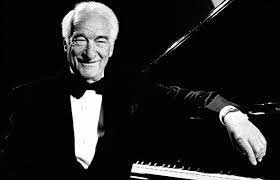
• 1909 ~ Victor Borge (Borge Rosenbaum), Danish pianist and comedic performer
More information about Borge

• 1918 ~ Maxine (Angelyn) Andrews, Singer with the Andrews Sisters
More information about the Andrews Sisters

• 1926 ~ George Martin born, Record producer, arranger, keyboard for The Beatles; AIR Studios; inducted into the Rock and Roll Hall of Fame on March 15, 1999

• 1940 ~ The Southland Shuffle was recorded on Bluebird Records by Charlie Barnet and his orchestra. A young trumpet player named Billy May was featured.

• 1945 ~ Stephen Stills born, American rock guitarist, singer and songwriter for Buffalo Springfield and also Crosby, Stills, Nash and Young

• 1946 ~ John Paul Jones (Baldwin), Bass with Led Zeppelin

• 1969 ~ 30,000 copies of the John Lennon, Yoko Ono album, “Two Virgins”, were confiscated by police in Newark, NJ. John and Yoko were nude on the cover.

• 1970 ~ “Mame” closed at Winter Garden Theater New York City after 1508 performances

• 1972 ~ Don McLean received a gold record for his 8-minute-plus hit, American Pie.

• 1974 ~ Following eight years of inactivity, Bob Dylan toured for 39 dates in 25 cities. His first stop was in Chicago, IL. The tour was recorded and later released as a double-LP set titled, “Before the Flood”.

• 1975 ~ Milton J Cross, TV announcer (Met Opera Auditions), died at the age of 87

• 1981 ~ John Lennon’s (Just Like) Starting Over and the album “Double Fantasy” topped the pop music charts just weeks after the death of the former Beatle.

• 1985 ~ Soprano Leontyne Price bid adieu to the Metropolitan Opera in New York. She sang the title role of “Aida”. Price had been part of the Met since 1961.

• 1987 ~ The first woman inducted into the Rock and Roll Hall of Fame was ‘Lady Soul’: Aretha Franklin. Bill Haley was among the 14 others inducted on this date.

“If You’re Learning Piano, You Don’t Give Up Because You Miss a Note”

FaeriesAireandDeathWaltz1

I have a copy of this music (Faerie’s Aire and Death Waltz) if anyone is interested in playing it!


The music above has been played:

The drive you need to accomplish whatever you’re attempting—big or small—needs fuel. Instead of letting slip-ups set you back, psychologist and author John Norcross recommends you make them the fuel:

If you are learning to play the piano, you don’t give up because you miss a note. It’s not whether you slip, it’s how you respond to the slip.

Cut yourself some slack and remember that things take time and hard work. Listen to the sound of your “missed note” and let that push you forward. You missed that note yesterday, but that doesn’t mean you’ll miss it today.

via “If You’re Learning Piano, You Don’t Give Up Because You Miss a Note”.


Happy Birthday, Victor Borge!

Victor Borge was born in 1909 in Copenhagen, Denmark. He was an entertainer and pianist – a deliciously funny performer. He studied at the Royal Danish Academy of Music, Copenhagen, and in Vienna and Berlin.

He made his debut as a pianist in 1926, and as a revue actor in 1933. From 1940 until his death in 2000 he worked in the USA for radio, television, and theatre, and has performed with leading symphony orchestras on worldwide tours since 1956.

He was best known for his comedy sketches combining music and narrative. He used his classical training to skew serious music and performers.

From his obituary:

Pianist Victor Borge, died in his sleep Dec 23, 2000 at his Greenwich, Connecticut home, was known as the unmelancholy Dane of international show business. He would have turned 92 on Jan. 3, 2001.

“The cause of death was heart failure,” his daughter, Sanna Feirstein, told Reuters.

“He had just returned from a wonderfully successful trip to Copenhagen … and it was really heartwarming to see the love he experienced in his home country,” she said.

Borge was one of five performers selected for the Kennedy Center Honors in 1999.

“He went to sleep, and they went to wake him up this morning, and he was gone,” said his agent, Bernard Gurtman.

“He had so much on the table, and to the day he died he was creative, and practicing piano several hours a day,” Gurtman told Reuters. “He was just a great inspiration.”

Funeral services will be private, his daughter said.

Borge made a career of falling off piano stools, missing the keys with his hands and getting tangled up in the sheet music.

One of his inspirations was a pianist who played the first notes of the Grieg A Minor Concerto and then fell on the keys dead.

He said that the only time he got nervous on stage was when he had to play seriously and adds that if it had not been for Adolf Hitler he probably would never have pursued a career as a concert-hall comedian.

Until he was forced to flee Denmark in 1940 he was a stage and screen idol in his native country.

Lampooned Hitler

But as a Jew who had lampooned Hitler, Borge — his real name was Boerge Rosenbaum — was in danger and fled first to Sweden and then to the United States, where he arrived penniless and unknown and by a fluke got booked on the Bing Crosby radio show. He was an instant success.

He became an American citizen in 1948, but thought of himself as Danish. It was obvious from the numerous affectionate tributes and standing ovations at his 80th birthday concert in Copenhagen in 1989 that Danes felt the same way.

In the concert at Copenhagen’s Tivoli gardens, Borge played variations on the theme of “Happy Birthday to You” in the styles of Mozart, BrahmsWagner and Beethoven — all executed with such wit that the orchestra was convulsed with laughter that a woman performing a piccolo solo was unable to draw breath to play.

“Playing music and making jokes are as natural to me as breathing,” Borge told Reuters in an interview after that concert.

“That’s why I’ve never thought of retiring because I do it all the time whether on the stage or off. I found that in a precarious situation, a smile is the shortest distance between people. When one needs to reach out for sympathy or a link with people, what better way is there?

“If I have to play something straight, without deviation in any respect, I still get very nervous. It’s the fact that you want to do your best, but you are not at your best because you are nervous and knowing that makes you even more nervous.”

His varied career included acting, composing for films and plays and writing but he was best known for his comic sketches based on musical quirks and oddities.

Unpredictable Routine

His routines were unpredictable, often improvised on stage as his quick wit responded to an unplanned event — a noise, a latecomer in the audience — or fixed on an unlikely prop — a fly, a shaky piano stool.

Borge was born in Denmark on January 3, 1909, son of a violinist in the Danish Royal Orchestra.

His parents encouraged him to become a concert pianist, arranging his first public recital when he was 10. In 1927 he made his official debut at the Tivoli Gardens.

Borge’s mischievous sense of humor was manifest from an early age. Asked as a child to play for his parent’s friends he would announce “a piece by the 85-year-old Mozart” and improvise something himself.

When his mother was dying in Denmark during the occupation, Borge visited her, disguised as a sailor.

“Churchill and I were the only ones who saw what was happening,” he said in later years. “He saved Europe and I saved myself.”

From 1953 to 1956, he appeared in New York in his own production “Comedy in Music,” a prelude to world tours that often took him to his native Scandinavia.

On radio and television, Borge developed the comedy techniques of the bungling pianist that won him worldwide fame.

Many of his skits were based on real-life events. One of his classics evolved from seeing a pianist playing a Tchaikovsky concerto fall off his seat.

Borge’s dog joined the show after it wandered on stage while he was at the keyboard — an entrance nobody would believe had been unplanned.

One incident could not be repeated. A large fly flew on to Borge’s nose while he was playing. “How did you get that fly to come on at the right time?” people asked. “Well, we train them,” Borge explained.

Borge’s book, “My Favorite Intervals”, published in 1974, detailed little-known facts of the private lives of composers describing Wagner’s pink underwear and the time Borodin left home in full military regalia but forgot his trousers.

In 1975, Borge was honored in recognition of the 35th anniversary of his arrival in the United States and his work as unofficial goodwill ambassador from Denmark to the United States. He celebrated his 75th birthday in 1984 with a series of concerts at Carnegie Hall and in Copenhagen.

Borge received a host of honors from all four Scandinavian countries for his contributions to music, humor and worthy causes.

Borge, who had lived in Greenwich since 1964, is survived by five children, nine grandchildren, and one great grandchild. His wife of many years, Sanna, died earlier that year.

Borge’s birthday

Anniversary of Borge’s death

January 2 ~ On This Day in Music

• 1732 ~ Franz Xaver Brixi, Czech classical composer of the 18th century

• 1837 ~ Mily Balakirev, Russian Composer and collector of Russian Music
More information about Balakirev

• 1899 ~ Alexander Tcherepnin, composer

• 1904 ~ James Melton, Singer in La Traviata

1905 ~ Sir Michael Tippett, British Composer and librettist
More information about Tippett

• 1917 ~ Vera Zorina (Eva Hartwig), Dancer, actress

• 1922 ~ Renata (Ersilia Clotilde) Tebaldi, Opera diva, lyric soprano. She debuted as Elena in Boito’s Mefistofele in 1944 and at the Metropolitan Opera in Verdi’s Otello in 1955
More information about Tebaldi

• 1930 ~ Julius LaRosa, American singer (fired by Arthur Godfrey on the air)

• 1932 ~ Freddy Martin formed a new band and was hired to play the Roosevelt Grill in New York City. Martin became one of the big names in the music business. Merv Griffin later became Martin’s lead vocalist.

• 1936 ~ Roger Miller. American country music singer, guitarist and songwriter, 11 Grammys in 1964-65

• 1941 ~ The Andrews Sisters recorded Boogie Woogie Bugle Boy on Decca Records. LaVerne, Maxine and Patti Andrews recorded in Los Angeles and the song was heard in the movie, “Buck Privates”, starring Bud Abbott and Lou Costello.

• 1949 ~ Chick Churchill, Keyboards with Ten Years After

• 1958 ~ Leonard Bernstein conducted his first concert as Joint Principal Conductor of the New York Philharmonic, a title he shared with Dimitri Mitropoulos during the 1957-58 season.  At this concert, Bernstein conducted a program similar to that of his November 1943 New York Philharmonic debut: Schumann’s “Manfred” Overture and ‪‎Strauss‬’ “Don Quixote.” Additionally, Bernstein led the New York Philharmonic from the piano in the U.S. premiere of Shostakovich’s Piano Concerto No. 2.

• 1971 ~The George Harrison album ‘All Things Must Pass’ started a seven-week run at No.1 on the US album chart, making Harrison the first solo Beatle to score a US No.1 album. The triple album included the hit singles ‘My Sweet Lord’ and ‘What Is Life’, as well as songs such as ‘Isn’t It a Pity’ and the title track that were turned down by The Beatles.

• 1974 ~ Singing cowboy Tex Ritter died of a heart attack at the age of 67. His son, John, became a significant television star in “Three’s Company”, and in movies, including “Problem Child”.

• 1977 ~ Erroll Garner passed away.  He was an American jazz pianist and composer known for his swing playing and ballads.

• 1980 ~ Officials of the Miss America Pageant announced that Bert Parks would not return as host of the annual beauty contest in Atlantic City, New Jersey. Parks sang There she is, Miss America for 25 years. He was replaced by Gary Collins.

• 1983 ~ The smash musical, “Annie”, closed on Broadway at the Uris Theatre after 2,377 performances: the sixth longest-running show on the Great White Way. The five longest-running shows at the time were: “Fiddler on the Roof”, “Life With Father”, “Tobacco Road”, “Hello Dolly” and “Music Man”.

• 2003 ~ Bluegrass music veteran James McReynolds, who with his mandolin-playing brother Jesse formed the legendary “Jim & Jesse” duo honored in the Country Music Hall of Fame, has died. Backed by their band, “The Virginia Boys,” their first single The Flame of Love, backed byGosh I Miss You All the Time, spent weeks on the national charts. Other songs regarded as Jim & Jesse classics are Cotton Mill Man, Diesel on My Tail, Are You Missing Me and Paradise. Jim’s enhanced high tenor and guitar playing combined with Jesse’s deep-voiced singing and unique mandolin style to produce their distinctive sound. Jesse developed a cross-picking technique and “split-string” style few could duplicate. The brothers’ performing career was interrupted by service in both World War II and the Korean War. They joined the Grand Ole Opry in Nashville in 1964, and their numerous honors included induction into the Country Music Hall of Fame’s “Walkway of Stars” and the International Bluegrass Music Association’s Hall of Honor.

• 2004 ~ Pioneering black actress and singer Etta Moten Barnett, who sang at the White House and appeared with Fred Astaire and Ginger Rogers in Flying Down to Rio, died. She was 102. Barnett was unique because of the romantic, sexy figures she portrayed – as opposed to the motherly nannies and maids that most black actresses were cast as in early Hollywood films. Barnett moved to New York City in her 30s and quickly landed a spot singing with the Eva Jessye Choir. The lead in the Broadway show Zombie followed. She later dubbed songs for actresses and was cast in the Busby Berkeley film Gold Diggers of 1933. In the 1933 film Flying Down to Rio, Barnett was cast as a Brazilian entertainer who sang The Carioca while Astaire and Rogers danced. The song was nominated for an Academy Award as best song. Her voice caught the attention of President Franklin D. Roosevelt, who invited her to sing at his White House birthday party. In 1942, she appeared as Bess in Porgy and Bess on Broadway and then toured with the show until 1945. Suffering from a strained voice, she gave her last formal concert in 1952

• 2019 ~ Daryl Frank Dragon was an American musician and songwriter, known as Captain from the pop musical duo Captain & Tennille, with his former wife, Toni Tennille. He died at the age of 76.

Piano Stores Closing as Fewer Children Taking up Instrument

pianomoving

Well-maintained pianos can make music for 50 to 70 years, said Peter Stumpf, a piano technician for the Pittsburgh Symphony Orchestra and Carnegie Mellon University, also in Pittsburgh.

Stumpf acknowledged new piano retailers are challenged by technicians like him who restore well-made used pianos and sell them at a fraction of the cost.

The piano’s design, durability and new flexibility brought by technology helps keep the instrument created by Italian Bartolomeo Cristofori more than 300 years ago relevant today, said Joe Lamond, president and CEO of the National Association of Music Merchants, a music products industry trade association.”Having all the notes laid out in front of you spatially is really an important way to learn music,” he said. “It’s why it’s one of the most important instruments for people to begin on. That’s not going to change.”

Read the entire article here: Piano Stores Closing as Fewer Children Taking up Instrument – ABC News.


January 1 ~ On This Day in Music

new-year-ani

Happy New Year!

• 1652 ~ Johann Krieger, German composer and organist

• 1701 ~ Johann Joachim Agrell, Composer
More information about Agrell

• 1735 ~ Paul Revere, American patriot and music engraver

• 1764 ~ In a stunning demonstration of prodigious talent, the Royal Family at Versailles in France was treated to a brilliant recital by an eight-year-old musician. His name was Wolfgang Amadeus Mozart.

• 1782 ~ Johann Christian Bach (“English Bach”), German composer, 11th son of Johann Sebastian Bach, died at the age of 46.

• 1878 ~ Edwin Franko Goldman, Composer

1900 ~ Xavier Cugat (Francisco de Asís Javier Cugat Mingall de Brue y Deulofeo). Spanish violinist, composer and bandleader, married to Abbe Lane and Charo
More information about Cugat

• 1916 ~ Earl Wrightson, Actor, singer

• 1923 ~ Milt Jackson, Vibes with The Modern Jazz Quartet

• 1925 ~ Lucrezia Bori and John McCormack of the famous Metropolitan Opera in New York City made their singing debuts on radio this day. The broadcast over what was WEAF Radio (now WABC) encouraged others to sing on radio. Some of those were Hootie and the Blowfish, and Barry Manilow.

• 1928 ~ Frank Pourcel, Composer, violinist

• 1942 ~ Country Joe McDonald, Singer with Country Joe & the Fish

• 1953 ~ A sad day in country music, as the legendary Hank Williams died at the young age of 29. Undisputedly, the biggest star in the history of country music, Hank Williams’ legacy is being carried on by his son, Hank Williams, Jr.

• 1955 ~ Elvis Presley appeared at The Eagles Hall in Houston Texas. Presley went on to play over 250 shows in 1955.

• 1958 ~ Johnny Cash played his first-ever prison concert —a concert that helped set Merle Haggard, then a 20-year-old San Quentin inmate, on the path toward becoming a country music legend.

• 1962 ~ The Beatles went an audition with Decca Records and are turned down in favor of the Tremeloes.

• 1968 ~ A group known as The Blue Velvets decided to change its name this day and it’s a good thing they did. The new name soon became a national pop music favorite as Creedence Clearwater Revival climbed to stardom.

• 1972 ~ Maurice Chevalier passed away. Chevalier was a French actor, Cabaret singer and entertainer.

• 1981 ~ Hephzibah Menuhin, American-Australian concert pianist, writer, and human rights campaigner died at the age of 61. She was sister to the violinist Yehudi Menuhin and to the pianist, painter, and poet Yaltah Menuhin.

• 1984 ~ Alexis Korner passed away. Korner was a British blues musician and radio broadcaster, who has sometimes been referred to as “a founding father of British blues”.

• 2000 ~ Ray Walston, who found commercial success playing a comical devil in the play “Damn Yankees” and an extraterrestrial on the sitcom “My Favorite Martian,” of natural causes at the age of 86. Walston caught the biggest break of his career when he won a Tony in 1955 for his performance in Broadway’s “Damn Yankees.” The smash musical told the story of a frustrated baseball fan who sells his soul. His screen debut came in the 1957 movie “Kiss Them For Me” with Cary Grant, and the next year he played the devil again in the film version of “Damn Yankees.” Walston snagged the role that would stick with him for a lifetime – that of a lovable alien on the TV show “My Favorite Martian” in 1963. The show was immensely popular, but Walston felt so typecast that he tried to highlight his dramatic abilities by returning to the stage when the TV comedy went off the air in 1966. He stayed in theater for several years before re-emerging with a succession of solid supporting roles in movies and television. Nearly 30 years after the end of the lighthearted “My Favorite Martian,” Walston’s role on “Picket Fences” as acerbic Judge Henry Bone earned Walston successive Emmys in 1995-96.

• 2016 ~ Chart-topping R&B singer Natalie Cole, who followed her famous father in the music business with hits like “This Will Be (An Everlasting Love) and “Unforgettable,” died at age 65.

• 2018 ~ Robert Mann, American composer and violinist (the founding Violinist of the Juilliard String Quartet), died at the age of 97

maryorhhappynewyear

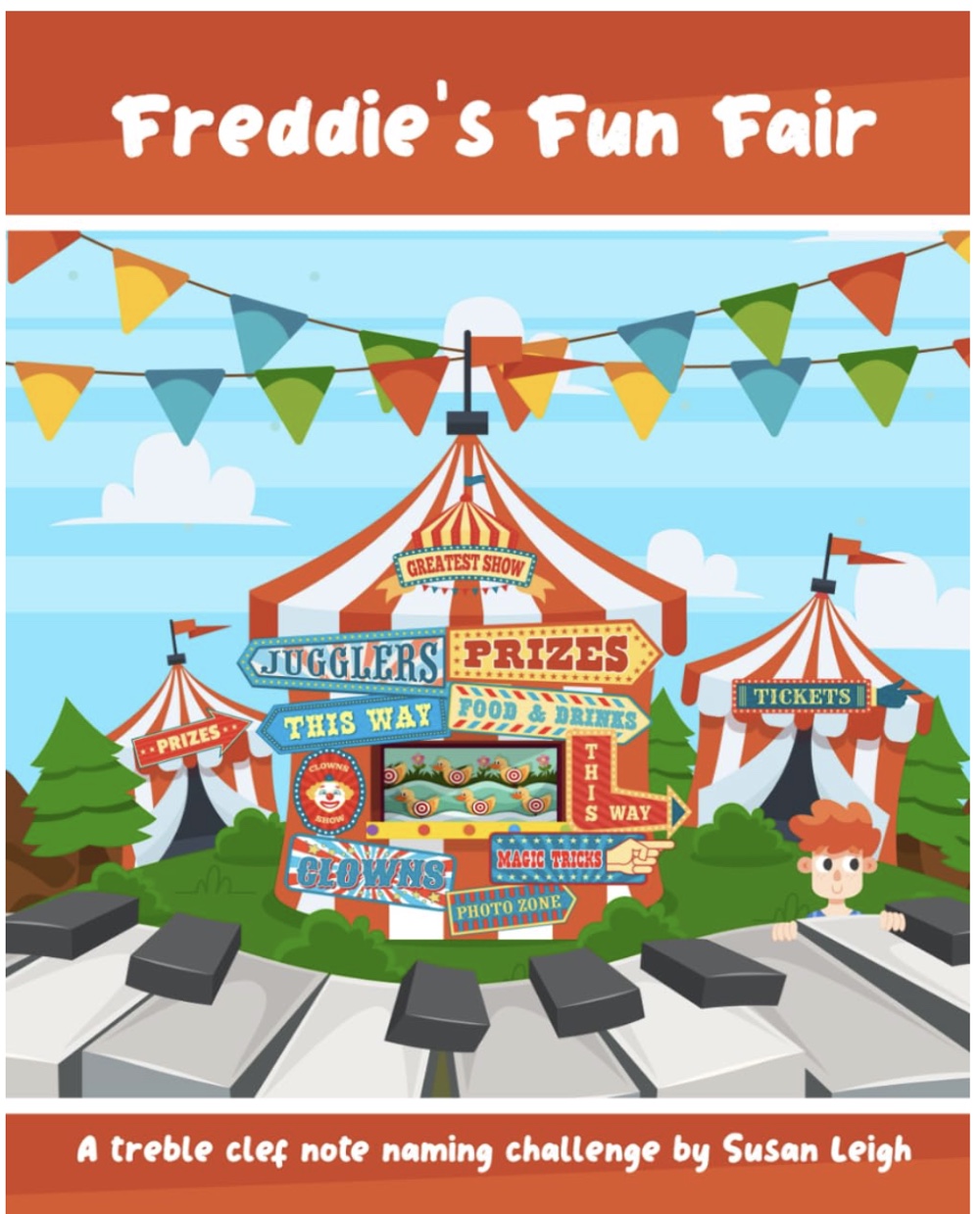
NEW! Freddie’s Fun Fair

Susan Leigh’s other books have been a huge hit with students and I’m sure this one will be, too.  It was just published and I’ve ordered it to arrive in time for students returning after winter break.

Freddie invites you to a treble clef challenge at the fun fair! Can you beat him in events like ‘Tin Can Alley’, ‘Hook a Duck’, ‘Balloon Darts’ and more? Improve your note reading and aim for the gold medal!

The note range includes all the lines and spaces of the treble clef stave, making it ideal for instrumentalists who play the piano, flute, saxophone and more.

Puzzles include traditional fairground games like the Coconut Shy, Bumper Cars, Hoopla, Toy Grabber, Skittles and Test Your Strength. There are match ups, scrambles, mazes, and also games against the clock like Tabletop Giraffe Racing, Splash the Shark and Whack-a-monster.

Students compete against Freddie in all events until the overall winner is crowned. There are two certificates to compete for; but who will win gold or silver and become the ultimate champion of both the treble clef and the fairground?!