Piano Pedaling

piano-pedal-diagram

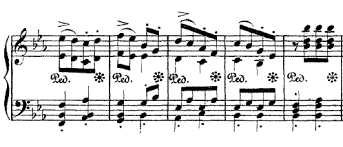
These are some examples of pedal marks in piano music:
piano-pedal-music

An older style of pedalling. The symbols can be between or below the staves.


piano-pedal-music2

This type of pedalling is more commonly used today.


piano-pedal-music3

Another type of pedalling

Pedals on a grand piano:

piano-pedal

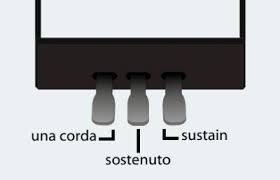
There are two standard foot pedals on the piano: on the left side is the una corda pedal and on the right side is the sustain (damper) pedal.

The middle sostenuto pedal is only standard on the American grand piano, and is very rarely used.

With pedals, the pianist can add resonance and color to the music and thereby bring out its inherent emotion. At the same time, over-pedaling or improper pedaling can drown the listener and the performer in a miasma of overlapping sounds.

Anton Rubinstein, renowned pianist of the late nineteenth century, said that the rightmost pedal is the very soul of the instrument.  His book, The Art of Piano Pedaling: Two Classic Guides, is still in print.

This pedal has various names. It is sometimes called the damper pedal (because it lifts all the dampers inside the piano), or the forte pedal (because the result of lifting all the dampers is a fuller sound), or the tre corde pedal (because it allows the three strings of each key to vibrate), or the sustaining pedal (because when you depress it the note will continue to sound even if you take your fingers off the keys).

Damper Pedaling Guidelines

Here are some guidelines pedaling. As with everything in art, they can be ignored under certain circumstances.

  1. Avoid pedaling notes that move in a stepwise or scalar pattern. Adjacent notes are dissonant, and when pedaled, they sound smudged.
  2. Do pedal notes that skip and form a nice harmony.
  3. Change your pedal (i.e., lift it up and put it down again) at each change of harmony.
  4. Avoid pedaling through rests (i.e., silence), at ends of phrases (at which point we would need to breathe and that split second of silence takes care of that), or staccato notes—although this is commonly ignored, because we actually can hear the disconnection through the pedal. This is why we do not depend on the pedal to achieve a beautiful legato.
  5. Keep your heel planted firmly on the floor, and pedal with either toes or the ball of foot, depending on your shoe size.

There are several manipulations possible with the damper pedal, each affecting the sound slightly differently.

Syncopated Pedaling

For the cleanest sound, the syncopated (or legato) pedal will give you the most control.  This is an action where the foot is put down immediately after the note is played. This may take some getting used to, but you can practice it by playing a C scale.

  1. Play C, and then lower the damper pedal.
  2. Hold the pedal down until you are just about ready to play the D.
  3. As the D’s finger goes down, the foot goes up, and then down again immediately after the D is struck.

The sound is clean. Continue up the scale the same way.

As an experiment, try putting the pedal down as you play a note, and notice the difference in the sound. Since the damper pedal lifts all the dampers, when you strike the D, not only are the three strings of that note free to vibrate but so do all the other strings vibrate sympathetically. You have a sound that is full of overtones.

There are times when you will want that effect and so will keep your foot down until the accumulated sound needs to breathe.

You can practice the syncopated pedal away from the piano by sitting on the bench or a chair and lifting your right knee at exactly the same time as your right hand goes down to tap the rising knee. This is the same action at the keyboard. The foot goes up when the hand goes down and then returns to the pedal.

Partial Pedals

There are half and quarter pedals too, which are used when you don’t want full vibrato. Rather than depressing the pedal all the way down, you lower your foot halfway so that the dampers are lifted only slightly off the strings, without allowing them to vibrate fully.

The quarter pedal gives even just a hint of pedal. It will take a while to feel these various distances on your piano. Also, you will find that each piano has its own pedal feel, which you must get used to before attempting to perform on that instrument.

Flutter Pedal

Then there are times, usually in scale passages, where touches of pedal can be very appealing and then the foot goes up and down rapidly and shallowly, and that is called the “flutter” pedal.

Choosing the Pedaling

The different types of damper pedaling techniques are for you, the pianist, to decide. But what determines which choice you will make?

Two things will control that: your very important ear, and your understanding of the music—the composer and the era in which the music was composed.

Your pedaling approach following the composer’s style depends on your knowledge of what instruments were available during the composer’s lifetime and how the pedal or lack of pedals would have made the music sound. This way, your interpretation will have authenticity.


Position of the Sustain Pedal:

Right pedal

The Sustain Pedal is Played With:

Right foot

Also Called:

Damper pedal, forte pedal, loud pedal

Effects of the Sustain Pedal:

The sustain pedal allows all of the notes on the piano to resonate after the keys have been lifted, for as long as the pedal is depressed. It creates a legato effect, forcing all of the notes to echo and overlap.

History of the Sustain Pedal:

The sustain pedal was originally operated by hand, and an assistant was required to operate it until the knee lever was created. The creators of the sustain foot pedal are unknown, but it is believed to have been invented around the mid-1700s.

Use of the sustain was uncommon until the Romantic Period, but is now the most commonly used piano pedal.

How the Sustain Pedal Works:

The sustain pedal lifts the dampers off of the strings, allowing them to vibrate until the pedal is released.

Sustain Pedal Marks:

In piano notation, use of the sustain pedal begins with Ped., and ends with a large asterisk.

Variable pedal marks, seen as __/\_/\__, are placed under notes, and define the precise pattern in which the sustain pedal is depressed and released.

    • Horizontal lines show when the sustain pedal is depressed.
  • Diagonal lines indicate a quick, temporary release of the sustain pedal.


Position of the Una Corda Pedal:

Left pedal

The Una Corda is Played With:

Left foot

Also Called:

Soft pedal, “piano” pedal

Effects of the Una Corda Pedal:

The una corda pedal is used to enhance the timbre of softly played notes, and exaggerate a low volume. The soft pedal should be used with notes that are already played softly, and will not produce the desired effect on louder notes.

History of the Una Corda Pedal:

The una corda was the first mechanism to modify the piano’s sound, and was originally operated by hand. It was invented in 1722 by Bartolomeo Cristofori, and quickly became a standard addition to the piano.

How the Una Corda Pedal Works:

Most treble keys are attached to two or three strings. The una corda shifts the strings so that the hammers only strike one or two of them, creating a softened sound.

Some bass keys are only attached to one string. In this case, the pedal creates a shift so that the hammer strikes on a lesser-used portion of the string.

Una Corda Pedal Marks:

In piano notation, use of the soft pedal begins with the words una corda (meaning “one string”), and is released by the words tre corde (meaning “three strings”).

Interesting Facts About the Una Corda Pedal:

  • Most upright pianos use a “piano” pedal instead of a true una corda pedal. The piano pedal moves the hammers closer to the strings, preventing them from striking with full force


Position of the Sostenuto Pedal:

Usually the middle pedal, but is often omitted.

The Sostenuto is Played With:

Right foot

Originally Called:

Tone-sustaining pedal

Effects of the Sostenuto Pedal:

The sostenuto pedal allows certain notes to be sustained while other notes on the keyboard are unaffected. It is used by hitting the desired notes, then depressing the pedal. The selected notes will resonate until the pedal is released. This way, sustained notes can be heard alongside notes played with a staccato effect.

History of the Sostenuto Pedal:

The sostenuto pedal was the last addition to the modern piano. Boisselot & Sons first showcased it in 1844, but the pedal didn’t gain popularity until Steinway patented it in 1874. Today, it’s primarily found on American grand pianos, but is not considered a standard addition since it is very rarely used.

How the Sostenuto Pedal Works:

When the sostenuto pedal is depressed, it keeps the dampers off the selected strings, allowing them to resonate while the rest of the keys’ dampers remain down.

Sostenuto Pedal Marks:

In piano music, use of the sostenuto pedal begins with Sost. Ped., and ends with a large asterisk. Notes meant to be sustained are sometimes marked by hollow, diamond-shaped notes, but there are no strict rules for this pedal since it is hardly ever used.

Interesting Facts About the Sostenuto Pedal:

    • Sostenuto is Italian for “sustaining,” although this incorrectly describes the pedal’s function.
    • On some pianos, the sostenuto pedal only affects the bass notes.
    • The middle pedal is sometimes built as a “practice rail” pedal instead of a sostenuto. A practice rail muffles notes with felt dampers, allowing for quiet play.
  • Sostenuto pedal markings are rarely seen in sheet music, but can be found in the works of Claude Debussy.


January 6 in Music History

today

. 1695 ~ Giuseppe Sammartini

. 1838 ~ Max Bruch, German Composer
More information about Bruch

. 1850 ~ Franz Xaver Scharwenka, Polish composer
More information about Scharwenka

. 1852 ~ Louis Braille passed away

. 1856 ~ Giuseppe Martucci.  He was an Italian composer, conductor, pianist and teacher influential in reviving Italian interest in non-operatic music.

. 1863 ~ First performance of Johannes Brahms‘ Piano Sonata No. 3 in f, in Vienna.

. 1872 ~ Alexander Scriabin, Russian composer
Recommended Books and CD’s by Scriabin

. 1878 ~ Carl Sandburg, Author, poet, folk balladeer

. 1924 ~ Earl Scruggs, American country music singer, banjo player and songwriter, born. He was with the Grand Ole Opry.

. 1929 ~ Wilbert Harrison, Singer

. 1934 ~ Bobby Lord, Country singer

. 1937 ~ Nino Tempo, Sax musician, singer with April Stevens

. 1937 ~ Doris Troy, Singer

. 1938 ~ Trummy Young played trombone and sang with the Jimmy Lunceford Orchestra in New York City as Margie became Decca record number 1617.

. 1946 ~ Roger Keith, Lead guitarist, Pink Floyd

. 1946 ~ Syd (Roger) Barrett, Guitarist, singer with Pink Floyd

. 1959 ~ Kathy Sledge, Singer with Sister Sledge

. 1964 ~ Premier of “Hello Dolly”

. 1966 ~ Duke Ellington’s concert of sacred music, recorded at 5th Avenue Presbyterian Church in New York City, was broadcast on CBS-TV.

. 1975 ~ The Broadway premiere of “The Wiz” opened, receiving enthusiastic reviews. The show, a black version of “The Wizard of Oz”, ran for 1,672 shows at the Majestic Theatre. Moviegoers, however, gave a thumbs down to the later cinema version of the musical that starred Diana Ross and Michael Jackson. One memorable song from the show is Ease on Down the Road.

. 1993 ~ The great jazz trumpeter, Dizzy Gillespie died of cancer at age 75. He has been credited with being a co-founder (with Charlie Parker) of ‘bebop’ music and wrote many jazz numbers (Salt Peanuts, Night in Tunisia). Gillespie also created the ‘afro-cuban’ sound in jazz music. A few of the disciples who preached Dizzy’s gospel of bebop were Thelonious Monk, Earl ‘Bud‘ Powell, Charlie Parker and Miles Davis.

. 2000 ~ Ancient note: music as bridge between species

Happy Birthday, Alfred Brendel

brendel
Alfred Brendel was born in 1931 in Wiesenberg, Czech Republic.

After World War II, Brendel composed music, as well as continuing to play the piano, to write and to paint. However, he never had more formal piano lessons and, although he attended master classes with Edwin Fischer and Eduard Steuermann, he was largely self-taught after the age of six.

He made his debut in Graz (1948), and has since performed widely throughout Austria, where he lives.

He is known for his interpretations of Mozart, Beethoven, Schubert, Liszt, and Schoenberg. He tours internationally, and has written many essays on music.

A short insight from Alfred Brendel on his recording career:

January 5 in Music History

today

. 1875 ~ Opening of the Paris Opera building.

. 1880 ~ Nicolai Karlovich Medtner,  Russian composer and pianist

. 1919 ~ Erica Morini, Concert violinist

. 1923 ~ Sam Phillips, Record executive with Sun Records: The [Memphis] Million Dollar Quartet: Elvis Presley, Johnny Cash, Carl Perkins, Charlie Rich

. 1931 ~ Alfred Brendel, American Pianist
More information about Brendel

. 1931 ~ Alvin Ailey, was an African-American choreographer and activist who founded the Alvin Ailey American Dance Theater in New York City

. 1935 ~ Phil Spitalny’s All-Girl Orchestra was featured on CBS radio this day on the program “The Hour of Charm”.

. 1938 ~ Lindsay Crosby, Actor, son of crooner Bing Crosby

. 1941 ~ Decca record #23210 was recorded. The title was Chica Chica Boom Chic by the lovely Carmen Miranda. She sang the song in the film, “That Night in Rio”.

. 1942 ~ Maurizio Pollini, Italian pianist

. 1949 ~ George ‘Funky’ Brown, Drummer with Kool and The Gang

. 1950 ~ Chris Stein, Guitarist with Blondie

. 1955 ~ A tune used in a “Studio One” production became the #1 song on the pop music charts this day. Joan Weber’s song, Let Me Go, Lover, rode the hit parade as the most popular record in the U.S. for four weeks straight. Before being aired on television, the song had only been heard on a limited basis. In fact, the title was even different. It used to be known as Let Me Go, Devil.

. 1972 ~ John Denver received a gold record for the album, “Aerie”, this day.

. 1979 ~ Charles Mingus passed away.  He was an American jazz double bassist, composer and bandleader.

. 1979 ~ John Travolta probably remembers that the soundtrack LP of “Saturday Night Fever” reached $25 million in sales.

. 1984 ~ The group, The Police, planned a farewell concert for March 2 in Australia. After nine years together, band members decided to go their separate ways.

. 1997 ~ Burton Lane passed away.  He was an American composer and lyricist. His most popular and successful works include Finian’s Rainbow and On a Clear Day You Can See Forever.

. 2000 ~ Mejla Hlavsa, a Czech rock performer and friend of President Vaclav Havel, died of cancer at the age of 49. He was a bass player and singer with the band Plastic People of the Universe. Hlavsa, whose group was banned in the 1970s, was imprisoned in 1976 for unauthorized performances, deemed political protests under the former communist regime. At the time, the band had been performing at private gatherings, including parties at Havel’s summer house in Hradecek, northern Bohemia. Now the country’s president, Havel was Czechoslovakia’s best known anti-communist dissident at the time. After the collapse of the communist regime in 1989, the band resumed public performances. Hlavsa also performed at the White House in September 1998, at a dinner organized by President Clinton during an official visit by the Czech president. One of Hlavsa’s influences, Lou Reed, also performed during Havel’s visit. Reed was a founding member of the rock group Velvet Underground, which helped inspire Havel’s leadership of the “Velvet Revolution” that brought democracy to the Czech Republic. Havel had called the musicians “two legends from our two nations who both, in one way or another, are bound with the ideal of freedom.”

. 2016 ~ Pierre Boulez, classical music’s maverick, died aged 90.  As well as composing, Boulez was a prolific writer and pianist and an inspiration for generations of young musicians.

January 4 in Music History

today

OCMS 1710 ~ Giovanni Battista Pergolesi, Italian Composer
More information about Pergolesi

. 1720 ~ Johann Friedrich Agricola, German organist and composer

. 1809 ~ Louis Braille, Inventor of the Braille system which enables the blind to read words and music. When he was only 3, Louise Braille, was permanently blinded in an accident with a leatherworking awl in his father’s saddlemaking shop in Coupvray, France. Several years later, he was admitted to a school for the blind, the Institution Nationale des Jeunes Aveugles. Later, as a teacher at the school, he worked at adapting Charles Barbier’s system of writing with points. Ironically, his method centered around using an awl-like stylus to punch marks in paper that could be felt and interpreted by the blind, allowing them to “read” with their fingertips. Braille’s work went unnoticed until after his death, in poverty, in 1852.

. 1874 ~ Josef Suk, Czech violinist and composer
More information about Suk

. 1928 ~ NBC radio debuted one of radio’s first variety shows. “The Dodge Victory Hour” starred Will Rogers, Paul Whiteman and his Orchestra and singer Al Jolson. The cost to produce this one show was $67,600.

. 1932 ~ NBC Red presented “The Carnation Contented Hour”. The show continued on network radio for 19 years as a showcase for top singers and musicians.

. 1933 ~ Ray Starling, Arranger for Stan Kenton

. 1935 ~ Bert Ambrose and his orchestra recorded the song that became the group’s theme song. It was titled Hors d’oeuvres and was cut in London for Decca Records.

. 1935 ~ Bob Hope was first heard on network radio as part of “The Intimate Revue” with Jane Froman, James Melton and the Al Goodman Orchestra.

. 1936 ~ The first pop music chart based on national sales was published by “Billboard” magazine this day. Joe Venuti, jazz violinist, was at the top of the chart with a little ditty called Stop! Look! Listen!.

1937 ~ Grace Bumbry, American mezzo-soprano
More information about Bumbry

. 1942 ~ John McLaughlin, Rock guitarist

. 1944 ~ Arthur Conley, Singer
More information about Conley

. 1950 ~ RCA Victor announced that it would manufacture long-playing (LP) records. This news came two years after Columbia Records debuted the ‘album’.

. 1954 ~ Elvis Presley strolled into the Memphis Recording Service and put $4 on the counter. He recorded Casual Love and I’ll Never Stand in Your Way, two songs that so impressed record executive Sam Phillips that he had Elvis record his first professional sides for Sun Records the following August.

. 1956 ~ Barney Sumner (Bernie Albrecht) (Dicken), Guitarist, singer

. 1960 ~ Michael Stipe, Grammy Award-winning singer

. 1965 ~ The Fender Guitar Company was sold to CBS for $13 million.

. 1979 ~ With a new interest in Beatles music on this day, the Star Club reopened in Hamburg, Germany. None of The Beatles returned to their beginnings to attend the gala opening.

. 2000 ~ Fantasia 2000 Hit Imax Record

. 2001 ~ Les Brown, whose Band of Renown scored a No. 1 hit with Sentimental Journey during America’s big band era of the 1930s and ’40s, died of lung cancer at the age of 88. A conductor-clarinetist whose smooth arrangements of swing melodies transcended changes in musical tastes, Brown was cited in 1996 by the Guinness Book of Records recognized him as the leader of the longest lasting musical organization in pop music history. He started his professional career in 1936, and his Band of Renown was still performing about 60 dates a year as recently as five months ago, often conducted by son Les Brown Jr. Brown formed his Band of Renown in 1936. In the 1940s heyday of swing, Brown never achieved the greatness of Tommy Dorsey, Glenn Miller or Benny Goodman. But the band scored two hit records – Sentimental Journey, with Doris Day as vocalist, and the instrumental I’ve Got My Love to Keep Me Warm. Sentimental Journey, co-written with Ben Homer and Bud Green, became a theme for soldiers returning home from World War II. “The happiest times in my life were the days when I was traveling with Les and his band,” Day said. “I loved Les very much, I am going to miss his phone calls.” Brown’s career included a close association with Bob Hope. In 1950, he joined Hope for the first of 18 Christmas tours to entertain American troops at military bases around the world. Day also participated. “The world has lost a great musician,” Hope said. “I have lost my music man, my sideman, my straight man and a special friend.” As the first president of the Los Angeles chapter of the Academy of Recording Arts and Sciences, Brown helped make the Grammy Awards a televised event. He convinced Hope, Frank Sinatra and Bing Crosby to participate in the first telecast.

. 2004 ~ Jake Hess, a four-time Grammy winner who sang with some of the premier quartets in gospel music and influenced the career of Elvis Presley, died. He was 76. Hess, whose career spanned more than 60 years, is best known to contemporary audiences as a regular member of Bill Gaither’s Homecoming Friends, on various Christian and country music cable channels, including TBN and TNN. Hess joined The John Daniel Quartet in 1943 and reached stardom with The Statesmen Quartet. He was founder of The Imperials and sang with The Masters V. Each of these groups is enshrined in the Southern Gospel Music Hall of Fame, as is Hess. He is also a member of the Alabama Music Hall of Fame. As a teen, Elvis Presley was a regular at Statesmen concerts. Later, Hess was a backup singer on several of Presley’s Grammy-winning albums. When Presley died in 1977, Hess sang at his funeral, as he had at the funeral of country legend Hank Williams in 1953. Peter Guralnick, author of a two-volume biography of Presley, said the rock star always wanted to emulate the voices of Hess and crooner Roy Hamilton.

Happy Birthday, Victor Borge!

Victor BorgeVictor Borge was born in 1909 in Copenhagen, Denmark. He wass an entertainer and pianist – a deliciously funny performer. He studied at the Royal Danish Academy of Music, Copenhagen, and in Vienna and Berlin.

He made his debut as a pianist in 1926, and as a revue actor in 1933. From 1940 until his death in 2000 he worked in the USA for radio, television, and theatre, and has performed with leading symphony orchestras on worldwide tours since 1956. He was best known for his comedy sketches combining music and narrative. He used his classical training to skew serious music and performers.

From his obituitary:

Pianist Victor Borge, died in his sleep Dec 23, 2000 at his Greenwich, Connecticut home, was known as the unmelancholy Dane of international show business. He would have turned 92 on Jan. 3, 2001.

“The cause of death was heart failure,” his daughter, Sanna Feirstein, told Reuters.

“He had just returned from a wonderfully successful trip to Copenhagen … and it was really heartwarming to see the love he experienced in his home country,” she said.

Borge was one of five performers selected for the Kennedy Center Honors in 1999.

“He went to sleep, and they went to wake him up this morning, and he was gone,” said his agent, Bernard Gurtman.

“He had so much on the table, and to the day he died he was creative, and practicing piano several hours a day,” Gurtman told Reuters. “He was just a great inspiration.”

Funeral services will be private, his daughter said.

Borge made a career of falling off piano stools, missing the keys with his hands and getting tangled up in the sheet music.

One of his inspirations was a pianist who played the first notes of the Grieg A Minor Concerto and then fell on the keys dead.

He said that the only time he got nervous on stage was when he had to play seriously and adds that if it had not been for Adolf Hitler he probably would never have pursued a career as a concert-hall comedian.

Until he was forced to flee Denmark in 1940 he was a stage and screen idol in his native country.

Lampooned Hitler

But as a Jew who had lampooned Hitler, Borge — his real name was Boerge Rosenbaum — was in danger and fled first to Sweden and then to the United States, where he arrived penniless and unknown and by a fluke got booked on the Bing Crosby radio show. He was an instant success.

He became an American citizen in 1948, but thought of himself as Danish. It was obvious from the numerous affectionate tributes and standing ovations at his 80th birthday concert in Copenhagen in 1989 that Danes felt the same way.

In the concert at Copenhagen’s Tivoli gardens, Borge played variations on the theme of “Happy Birthday to You in the styles of Mozart, BrahmsWagner and Beethoven — all executed with such wit that the orchestra was convulsed with laughter that a woman performing a piccolo solo was unable to draw breath to play.

“Playing music and making jokes are as natural to me as breathing,” Borge told Reuters in an interview after that concert.

“That’s why I’ve never thought of retiring because I do it all the time whether on the stage or off. I found that in a precarious situation, a smile is the shortest distance between people. When one needs to reach out for sympathy or a link with people, what better way is there?

“If I have to play something straight, without deviation in any respect, I still get very nervous. It’s the fact that you want to do your best, but you are not at your best because you are nervous and knowing that makes you even more nervous.”

His varied career included acting, composing for films and plays and writing but he was best known for his comic sketches based on musical quirks and oddities.

Unpredictable Routine

His routines were unpredictable, often improvised on stage as his quick wit responded to an unplanned event — a noise, a latecomer in the audience — or fixed on an unlikely prop — a fly, a shaky piano stool.

Borge was born in Denmark on January 3, 1909, son of a violinist in the Danish Royal Orchestra.

His parents encouraged him to become a concert pianist, arranging his first public recital when he was 10. In 1927 he made his official debut at the Tivoli Gardens.

Borge’s mischievous sense of humor was manifest from an early age. Asked as a child to play for his parent’s friends he would announce “a piece by the 85-year-old Mozart” and improvise something himself.

When his mother was dying in Denmark during the occupation, Borge visited her, disguised as a sailor.

“Churchill and I were the only ones who saw what was happening,” he said in later years. “He saved Europe and I saved myself.”

From 1953 to 1956, he appeared in New York in his own production “Comedy in Music,” a prelude to world tours that often took him to his native Scandinavia.

On radio and television, Borge developed the comedy techniques of the bungling pianist that won him worldwide fame.

Many of his skits were based on real-life events. One of his classics evolved from seeing a pianist playing a Tchaikovsky concerto fall off his seat.

Borge’s dog joined the show after it wandered on stage while he was at the keyboard — an entrance nobody would believe had been unplanned.

One incident could not be repeated. A large fly flew on to Borge’s nose while he was playing. “How did you get that fly to come on at the right time?” people asked. “Well, we train them,” Borge explained.

Borge’s book, “My Favorite Intervals”, published in 1974, detailed little-known facts of the private lives of composers describing Wagner’s pink underwear and the time Borodin left home in full military regalia but forgot his trousers.

In 1975, Borge was honored in recognition of the 35th anniversary of his arrival in the United States and his work as unofficial goodwill ambassador from Denmark to the United States. He celebrated his 75th birthday in 1984 with a series of concerts at Carnegie Hall and in Copenhagen.

Borge received a host of honors from all four Scandinavian countries for his contributions to music, humor and worthy causes.

Borge, who had lived in Greenwich since 1964, is survived by five children, nine grandchildren, and one great grandchild. His wife of many years, Sanna, died earlier this year.
Borge’s birthday

Anniversary of Borge’s death


January 3 in Music History

today

• 1710 (or January 4th?) ~ Giovanni Pergolesi, in Jesi, near Ancona, Italy

• 1898 ~ Zasu Pitts, Actress in Busby Berkeley’s 1933 musical, Dames

• 1900 ~ Giuseppe Verdi’s “Aida” was performed in New York.

• 1909 ~ Victor Borge (Borge Rosenbaum), Danish pianist and comedic performer
More information about Borge

• 1918 ~ Maxine (Angelyn) Andrews, Singer with the Andrews Sisters
More information about the Andrews Sisters

• 1926 ~ George Martin born, Record producer, arranger, keyboard for The Beatles; AIR Studios; inducted into the Rock and Roll Hall of Fame on March 15, 1999

• 1940 ~ The Southland Shuffle was recorded on Bluebird Records by Charlie Barnet and his orchestra. A young trumpet player named Billy May was featured.

• 1945 ~ Stephen Stills born, American rock guitarist, singer and songwriter for Buffalo Springfield and also Crosby, Stills, Nash and Young

• 1946 ~ John Paul Jones (Baldwin), Bass with Led Zeppelin

• 1969 ~ 30,000 copies of the John Lennon, Yoko Ono album, “Two Virgins”, were confiscated by police in Newark, NJ. John and Yoko were nude on the cover.

• 1972 ~ Don McLean received a gold record for his 8-minute-plus hit, American Pie.

• 1974 ~ Following eight years of inactivity, Bob Dylan toured for 39 dates in 25 cities. His first stop was in Chicago, IL. The tour was recorded and later released as a double-LP set titled, “Before the Flood”.

• 1981 ~ John Lennon’s (Just Like) Starting Over and the album “Double Fantasy” topped the pop music charts just weeks after the death of the former Beatle.

• 1985 ~ Soprano Leontyne Price bid adieu to the Metropolitan Opera in New York. She sang the title role of “Aida”. Price had been part of the Met since 1961.

• 1987 ~ The first woman inducted into the Rock and Roll Hall of Fame was ‘Lady Soul’: Aretha Franklin. Bill Haley was among the 14 others inducted on this date.

January 2 in Music History

today

• 1732 ~ Franz Xaver Brixi, Czech classical composer of the 18th century

• 1837 ~ Mily Balakirev, Russian Composer and collector of Russian Music
More information about Balakirev

• 1904 ~ James Melton, Singer in La Traviata

1905 ~ Sir Michael Tippett, British Composer and librettist
More information about Tippett

• 1917 ~ Vera Zorina (Eva Hartwig), Dancer, actress

• 1922 ~ Renata (Ersilia Clotilde) Tebaldi, Opera diva, lyric soprano. She debuted as Elena in Boito’s Mefistofele in 1944 and at the Metropolitan Opera in Verdi’s Otello in 1955
More information about Tebaldi
Anniversary of Tebaldi’s death

• 1930 ~ Julius LaRosa, Singer

• 1932 ~ Freddy Martin formed a new band and was hired to play the Roosevelt Grill in New York City. Martin became one of the big names in the music business. Merv Griffin later became Martin’s lead vocalist.

• 1936 ~ Roger Miller. American country-music singer, guitarist and songwriter, 11 Grammys in 1964-65

• 1941 ~ The Andrews Sisters recorded Boogie Woogie Bugle Boy on Decca Records. LaVerne, Maxine and Patti Andrews recorded in Los Angeles and the song was heard in the movie, “Buck Privates”, starring Bud Abbott and Lou Costello.

• 1949 ~ Chick Churchill, Keyboards with Ten Years After

• 1958 ~ Leonard Bernstein conducted his first concert as Joint Principal Conductor of the New York Philharmonic, a title he shared with Dimitri Mitropoulos during the 1957-58 season.  At this concert, Bernstein conducted a program similar to that of his November 1943 New York Philharmonic debut: Schumann’s “Manfred” Overture and ‪‎Strauss‬’ “Don Quixote.” Additionally, Bernstein led the New York Philharmonic from the piano in the U.S. premiere of Shostakovich’s Piano Concerto No. 2.

• 1971 ~The George Harrison album ‘All Things Must Pass’ started a seven week run at No.1 on the US album chart, making Harrison the first solo Beatle to score a US No.1 album. The triple album included the hit singles ‘My Sweet Lord’ and ‘What Is Life’, as well as songs such as ‘Isn’t It a Pity’ and the title track that were turned down by The Beatles.

• 1974 ~ Singing cowboy Tex Ritter died of a heart attack at the age of 67. His son, John, became a significant television star in “Three’s Company”, and in movies, including “Problem Child”.

• 1977 ~ Erroll Garner passed away.  He was an American jazz pianist and composer known for his swing playing and ballads.

• 1980 ~ Officials of the Miss America Pageant announced that Bert Parks would not return as host of the annual beauty contest in Atlantic City, New Jersey. Parks sang There she is, Miss America for 25 years. He was replaced by Gary Collins.

• 1983 ~ The smash musical, “Annie”, closed on Broadway at the Uris Theatre after 2,377 performances: the sixth longest-running show on the Great White Way. The five longest-running shows at the time were: “Fiddler on the Roof”, “Life With Father”, “Tobacco Road”, “Hello Dolly”and “Music Man”.

• 2003 ~ Bluegrass music veteran James McReynolds, who with his mandolin-playing brother Jesse formed the legendary “Jim & Jesse” duo honored in the Country Music Hall of Fame, has died. Backed by their band, “The Virginia Boys,” their first single The Flame of Love, backed byGosh I Miss You All the Time, spent weeks on the national charts. Other songs regarded as Jim & Jesse classics are Cotton Mill Man, Diesel on My Tail, Are You Missing Me and Paradise. Jim’s enhanced high tenor and guitar playing combined with Jesse’s deep-voiced singing and unique mandolin style to produce their distinctive sound. Jesse developed a cross-picking technique and “split-string” style few could duplicate. The brothers’ performing career was interrupted by service in both World War II and the Korean War. They joined the Grand Ole Opry in Nashville in 1964, and their numerous honors included induction into the Country Music Hall of Fame’s “Walkway of Stars” and the International Bluegrass Music Association’s Hall of Honor.

• 2004 ~ Pioneering black actress and singer Etta Moten Barnett, who sang at the White House and appeared with Fred Astaire and Ginger Rogers in Flying Down to Rio, died. She was 102. Barnett was unique because of the romantic, sexy figures she portrayed – as opposed to the motherly nannies and maids that most black actresses were cast as in early Hollywood films. Barnett moved to New York City in her 30s and quickly landed a spot singing with the Eva Jessye Choir. The lead in the Broadway show Zombie followed. She later dubbed songs for actresses and was cast in the Busby Berkeley film Gold Diggers of 1933. In the 1933 film Flying Down to Rio, Barnett was cast as a Brazilian entertainer who sang The Carioca while Astaire and Rogers danced. The song was nominated for an Academy Award as best song. Her voice caught the attention of President Franklin D. Roosevelt, who invited her to sing at his White House birthday party. In 1942, she appeared as Bess in Porgy and Bess on Broadway and then toured with the show until 1945. Suffering from a strained voice, she gave her last formal concert in 1952

January 1 in Music History

Happy-New-Year2016


Happy New Year!

• 1701 ~ Johann Joachim Agrell, Composer
More information about Agrell

• 1735 ~ Paul Revere, American patriot and music engraver

• 1764 ~ In a stunning demonstration of prodigious talent, the Royal Family at Versailles in France was treated to a brilliant recital by an eight year old musician. His name was Wolfgang Amadeus Mozart.

• 1878 ~ Edwin Franko Goldman, Composer

1900 ~ Xavier Cugat (Francisco de Asís Javier Cugat Mingall de Brue y Deulofeo). Spanish violinist, composer and band leader, married to Abbe Lane and Charo
More information about Cugat

• 1916 ~ Earl Wrightson, Actor, singer

• 1923 ~ Milt Jackson, Vibes with The Modern Jazz Quartet

• 1925 ~ Lucrezia Bori and John McCormack of the famous Metropolitan Opera in New York City made their singing debuts on radio this day. The broadcast over what was WEAF Radio (now WABC) encouraged others to sing on radio. Some of those were Hootie and the Blowfish, and Barry Manilow.

• 1928 ~ Frank Pourcel, Composer, violinist

• 1942 ~ Country Joe McDonald, Singer with Country Joe & the Fish

• 1953 ~ A sad day in country music, as the legendary Hank Williams died at the young age of 29. Undisputedly, the biggest star in the history of country music, Hank Williams’ legacy is being carried on by his son, Hank Williams, Jr.

• 1955 ~ Elvis Presley appeared at The Eagles Hall in Houston Texas. Presley went on to play over 250 shows in 1955.

• 1968 ~ A group known as The Blue Velvets decided to change its name this day and it’s a good thing they did. The new name soon became a national pop music favorite as Creedence Clearwater Revival climbed to stardom.

• 1972 ~ Maurice Chevalier passed away. Chevalier was a French actor, Cabaret singer and entertainer.

• 1984 ~ Alexis Korner passed away. Korner was a British blues musician and radio broadcaster, who has sometimes been referred to as “a founding father of British blues”.

• 2000 ~ Ray Walston, who found commercial success playing a comical devil in the play “Damn Yankees” and an extraterrestrial on the sitcom “My Favorite Martian,” of natural causes at the age of 86. Walston caught the biggest break of his career when he won a Tony in 1955 for his performance in Broadway’s “Damn Yankees.” The smash musical told the story of a frustrated baseball fan who sells his soul. His screen debut came in the 1957 movie “Kiss Them For Me” with Cary Grant, and the next year he played the devil again in the film version of “Damn Yankees.” Walston snagged the role that would stick with him for a lifetime – that of a lovable alien on the TV show “My Favorite Martian” in 1963. The show was immensely popular, but Walston felt so typecast that he tried to highlight his dramatic abilities by returning to the stage when the TV comedy went off the air in 1966. He stayed in theater for several years before re-emerging with a succession of solid supporting roles in movies and television. Nearly 30 years after the end of the lighthearted “My Favorite Martian,” Walston’s role on “Picket Fences” as acerbic Judge Henry Bone earned Walston successive Emmys in 1995-96.

• 2016 ~ Chart-topping R&B singer Natalie Cole, who followed her famous father in the music business with hits like “This Will Be (An Everlasting Love) and “Unforgettable,” died at age 65.

maryorhhappynewyear