“This collection represents a cross-section of Confrey’s works and encompasses the broad range of his styles. Besides his famous 1920s novelty works (including Kitten on the Keys), there are many wonderful, lesser-known gems of remarkable quality included here from later in his career. Appearing for the first time in print are transcriptions of one of his disc recordings (Poor Buttermilk) and two of his player piano roll arrangements (My Pet and Humorestless). Many of Confrey’s later works have long been out of print and are included here for the first time in decades.”
• 1870 ~ Josef Strauss, Austrian composer, died at the age of 42
• 1896 ~ Jean Rivier-Villemomble France, Composer
• 1898 ~ Ernest Willem Mulder, Composer
• 1898 ~ Sara Carter, Vocalist/guitarist with the Carter Family
• 1903 ~ Theodore Karyotakis, Composer
• 1906 ~ Daniel Ayala Perez, Composer
• 1915 ~ Floyd McDaniel ~ blues singer/guitarist
• 1920 ~ Isaac Stern, American concert violinist
Read quotes by and about Stern
More information about Stern
• 1920 ~ Manuel Valls Gorina, Composer
• 1921 ~ Billy Taylor, Orchestra leader on the David Frost Show
• 1922 ~ Kay Starr (Katherine Starks), Pop Singer
• 1925 ~ Lovro Zupanovic, Composer
• 1926 ~ Albert Fuller, American harpsichordist
• 1926 ~ Norman Jewison, Director of Jesus Christ, Superstar, Fiddler on the Roof
• 1927 ~ Stefan Niculescu, Composer
• 1931 ~ Leon Schidlowsky, Composer
• 1931 ~ Ted Husing was master of ceremonies for the very first CBS-TV program. The gala show featured singer Kate Smith, composer George Gershwin and New York City Mayor Jimmy Walker.
• 1935 ~ Kaye Stevens, Singer and comedienne on the Jerry Lewis Show
• 1938 ~ Anton Emil Kuerti, Composer
• 1938 ~ Paul Hindemith and Leonide Massines ballet premiered in London
• 1947 ~ Cat Stevens (Steven Demitri Georgiou) (Muslim name: Yusuf Islam), British folk-rock singer and songwriter
• 1948 ~ Donald Nichols Tweedy, Composer, died at the age of 58
• 1950 ~ Albert Riemenschneider, Composer, died at the age of 71
• 1958 ~ The last of Arthur Godfrey’s Talent Scouts programs aired on CBS-TV. Many artists got their start on Talent Scouts, including Tony Bennett, Pat Boone, The McGuire Sisters and a singer named Connie Francis, who not only sang, but played the accordion, as well.
• 1969 ~ Just one day after Neil Armstrong set foot on the moon, Duke Ellington and a portion of his band performed a 10-minute composition on ABC-TV titled Moon Maiden. The work featured piano, drums, bass and vocals.
• 1973 ~ Bad, Bad Leroy Brown reached the top spot on the Billboard pop-singles chart, becoming Jim Croce’s first big hit. Croce died in a plane crash two months later (September 20, 1973).
• 1976 ~ “Guys & Dolls” opened at Broadway Theater New York City for 239 performances
• 1994 ~ Dorothy Collins, Singer on Your Hit Parade, died at the age of 67
• 1995 ~ Edwin “Russell” House, Saxophonist, died at the age of 65
• 2000 ~ Iain Hamilton, the Scottish composer who turned Tolstoy’s “Anna Karenina” into an opera at the age of 78. Hamilton wrote four symphonies and dozens of orchestral and chamber works but is known best for his vocal music, which includes a cantata based on the poems of Robert Burns. “Anna Karenina” premiered at the English National Opera in 1981 to critical acclaim. His other operas include “Agamemnon”, “The Catiline Conspiracy”, based on a Ben Jonson play, and an adaptation of Peter Shaffer’s play “The Royal Hunt of the Sun”. From 1961 to 1978 he was a professor of music at Duke University in North Carolina.
• 2001 ~ Norman Hall Wright, the last surviving writer who worked on the Disney film Fantasia 2000, died at the age of 91. Wright studied at the University of Southern California before being hired by Walt Disney Productions. He started as an animator but later became a writer, producer and director. Wright developed the story of The Nutcracker Suite sequence for Fantasia 2000. He also was responsible for a sequence in Bambi. He wrote several cartoon shorts for Mickey Mouse, Donald Duck, and Goofy and also produced several Wonderful World of Disney television programs.
• 2002 ~ Gus Dudgeon, a respected music producer who worked on many of Elton John’s hit recordings, died in a car crash in western England. He was 59. Dudgeon produced Rocket Man,Goodbye Yellow Brick Road,Your Song,Daniel and Don’t Let The Sun Go Down On Me. Dudgeon also produced David Bowie’sSpace Oddity and worked with other stars, including Chris Rea and Joan Armatrading. But it was his partnership with Sir Elton in the 1970s for which he will be best remembered. Dudgeon began his career in the early 1960s as a tea boy, running errands at Olympic Studios in London before joining Decca Records. He engineered the Zombies’ classic She’s Not There and the groundbreaking Blues Breakers album by John Mayall with Eric Clapton, before moving into producing.
• 2015 ~ Theodore Meir Bikel, Austrian-American actor, folk singer, musician, composer, and activist, died at the age of 91.
• 1932 ~ Nam June Paik, Korean-born American avant-guarde composer
• 1938 ~ Jo Ann Campbell, Singer
• 1940 ~ Billboard magazine published its first listing of best-selling singles. 10 tunes were listed.
• 1943 ~ John Lodge, Guitar with Justin Hayward, singer with the Moody Blues
• 1944 ~ T.G. Shepherd (William Bowder), Country Singer
• 1946 ~ Kim Carnes, Grammy Award-winning singer, co-wrote score to Flashdance
• 1946 ~ John Almond, Reeds, keyboards, vibes with Johnny Almond and the Music Machine
• 1947 ~ Carlos Santana, Mexican-born American rock guitarist
• 1958 ~ Mick McNeil, Keyboards with Simple Minds
• 1961 ~ Stop the World, I Want to Get Off opened in London. The show went to Broadway in 1962.
• 1963 ~ Dino Esposito, Singer
• 1963 ~ Ray Conniff received two gold-record awards – for the albums, Concert in Rhythm and Memories are Made of This – on Columbia Records. Conniff recorded dozens of albums of easy listening music for the label. He had been a trombonist and arranger with Bunny Berigan, Bob Crosby, Harry James, Vaughn Monroe andArtie Shaw.
• 1964 ~ Chris Cornell, Grammy Award-winning musician: drums, singer, songwriter with Soundgarden
Let’s face it. Most kids don’t want to practice the piano. And if they do find the time to practice, it’s usually because their parent kept nagging them. How frustrating!
Piano teachers are frustrated too. It’s nearly impossible to teach students new concepts when they don’t understand the old ones–all because of a lack of practice.
If you’re a parent in this situation, I have just the solution you’re looking for.
In this upbeat book, I share all the tips I’ve discovered in my 14 years of teaching piano. You’ll learn fun, practical ways to get your kids to the keyboard.
But this book goes one step further. I’ll show you easy ways to encourage better quality practice. Even if you’ve never had a music lesson in your life!
I wrote this book for kids of all ages. There are creative ideas for elementary students and also a section for teens.
There’s even a section for what to do if your child wants to stop taking piano lessons. That’s right, there is hope and my book will show you exactly how to get them interested in piano again.
Don’t be the kind of parent who sits on the sidelines waiting until their child wants to practice. Piano lessons are too expensive for you to let another “no-practice” day go by.
This book is your answer to get your child to the keyboard, have good quality practice and develop a life-long love of music.
• 1811 ~ Vincenz Lachner, German organist, conductor and composer
• 1906 ~ Klauss Egge, Norwegian composer
• 1913 ~ Charles Teagarden, trumpeter, bandleader, brother of Jack
• 1926 ~ Sue Thompson (Eva McKee), singer of Norman and Sad Movies (Make Me Cry)
• 1937 ~ George Hamilton IV, Singer
• 1939 ~ Jack Teagarden and his orchestra recorded Aunt Hagar’s Blues for Columbia Records. Teagarden provided the vocal on the session recorded in Chicago, IL.
• 1941 ~ Natalya Besamertnova, Ballet Dancer with the Bolshoi ballet
• 1942 ~ The Seventh Symphony, by Dmitri Shostakovitch, was performed for the first time in the United States by Arturo Toscanini and the NBC Symphony Orchestra.
• 1946 ~ Alan Gorrie, Rock Singer with the Average White Band
• 1947 ~ Bernie Leadon, Musician, guitar with The Eagles
• 1947 ~ Brian Harold May, Musician, guitarist, singer and songwriter with Queen, who had the 1975 UK No.1 single Bohemian Rhapsody, which returned to No.1 in 1991. Queen scored over 40 other UK Top 40 singles, and also scored the 1980 US No.1 single Crazy Little Thing Called Love. May had the solo 1992 UK No.5 single Too Much Love Will Kill You. May was made Commander of the Order of the British Empire in 2005 for ‘services to the music industry and his charity work’. May earned a PhD in astrophysics from Imperial College, London, in 2007.
• 1949 ~ Singer Harry Belafonte began recording for Capitol Records on this day. The first sessions included They Didn’t Believe Me and Close Your Eyes. A short time later, Capitol said Belafonte wasn’t “commercial enough,” so he signed with RCA Victor (for a very productive and commercial career).
• 1952 ~ Allen Collins, Musician, guitar with Lynyrd Skynyrd
• 1952 ~ “Paint Your Wagon” closed at Shubert Theater New York City after 289 performances
• 1966 ~ Frank Sinatra married actress Mia Farrow this day.
• 1963 ~ Kelly Shiver, Country Singer
• 1980 ~ Billy Joel, pianist, singer-songwriter, and composer, earned his first gold record with It’s Still Rock and Roll to Me, which reached the top of the Billboard pop music chart. He would score additional million-sellers with Just the Way You Are, My Life, Uptown Girl (for girlfriend and later, wife and supermodel Christie Brinkley) and We Didn’t Start the Fire. Joel reached the top only one other time, with Tell Her About It in 1983.
• 2000 ~ H. LeBaron Taylor, a Sony executive who pioneered the mass marketing of music rooted in black culture and fostered minority development in the corporate world, died at the age of 65 of a heart attack. He was recognized by Ebony magazine as one of the top 50 black executives in corporate America. In the 1970s, Taylor was at CBS Records, leading its Black Music Marketing department, which sold music originating in black culture and styles that sprang from it, such as blues, soul, rap and hip-hop.
Roadtrip! is a primer level method book for very early beginners ages 4 and up. Students master basic music fundamentals while creating a musical memory book that becomes a keepsake item to commemorate their maiden voyage into piano lessons.
18 songs: Non-position based; black key pieces; R.H. & L.H. only pieces; on-staff reading only
Also features: improvisation activities; ear training; composition; teacher duets
What this means for the O’Connor Music Studio – younger beginners will be able to get a great start to their musical lives. Previously, I’ve only accepted students starting at age 6.
Starting with the new school year, interested parents can enroll their students from the age of 4.
• 1889 ~ Carli Zoeller, Composer, died at the age of 49
• 1891 ~ Franco Casavola, Composer
• 1894 ~ Juventino Rosas, Composer, died at the age of 26
• 1898 ~ Guglielmo Marconi patented the radio
• 1903 ~ August Reissmann, Composer, died at the age of 77
• 1906 ~ Harry Sosnik, American orchestra leader of the Jack Carter Show and Your Hit Parade
• 1909 ~ David Branson, Composer
• 1909 ~ Paul Constantinescu, Composer
• 1909 ~ Washington Castro, Composer
• 1913 ~ Ladislav Holoubek, Composer
• 1915 ~ Paul Williams, Jazz saxophonist and band leader Williams played with Clarence Dorsey in 1946, and then made his recording debut with King Porter in 1947 for Paradise before forming his own band later that year.
More information about Williams
• 1921 ~ Ernest Gold, Composer
• 1921 ~ Charles Scribner Jr, Music publisher
• 1923 ~ Asger Hamerik (Hammerich) German composer, died at the age of 80
• 1924 ~ Carlo Bergonzi, Italian tenor
• 1926 ~ Meyer Kupferman, American composer
• 1928 ~ Donal Michalsky, Composer
• 1932 ~ Per Nørgård, Danish composer
More information about Nørgård
• 1934 ~ Roger Reynolds, Composer
• 1936 ~ Izydor Lotto, Composer, died at the age of 91
• 1939 ~ Frank Sinatra made his recording debut with the Harry James band. Frankie sang Melancholy Mood and From the Bottom of My Heart.
• 1942 ~ Roger McGuinn, Musician, guitarist and vocalist with the Byrds (1965 US & UK No.1 single ‘Mr Tambourine Man’). He was the only member of The Byrds to play on the hit, the others being session players. He toured with Bob Dylan in 1975 and 1976 as part of Dylan’s Rolling Thunder Revue, and later worked with fellow ex-Byrds Gene Clark and Chris Hillman to form “McGuinn, Clark and Hillman”.
• 1951 ~ Arnold Schoenberg, Austrian-born composer, died in Los Angeles; he was best known for his 12-note serial method and his composition Verklaerte Nacht and his opera “Moses und Aaron.”
More information about Schoenberg
• 1942 ~ Stephen Jo Bladd , American drummer with the J Geils Band
• 1954 ~ Louise Mandrell, American country singer with the Mandrell Sisters
• 1958 ~ Karl Erb, German tenor, died on 81st birthday
• 1959 ~ Dedicated to the One I Love, by The Shirelles, was released. The tune went to number 83 on the Top 100 chart of “Billboard” magazine. The song was re-released in 1961 and made it to number three on the charts.
• 1961 ~ Lawrence Donegan, Musician, bass with Lloyd Cole & The Commotions
• 1965 ~ Neil Thrasher, Country Singer
• 1973 ~ Martian Negrea, Composer, died at the age of 80
• 1973 ~ The Everly Brothers called it quits during a concert at the John Wayne Theatre in Buena Park, CA. Phil Everly walked off the stage in the middle of the show and brother Don said, “The Everly Brothers died ten years ago.” The duo reunited a decade later for a short time.
• 1976 ~ Max Butting, Composer, died at the age of 87
• 1978 ~ Antonio Veretti, Composer, died at the age of 78
• 1985 ~ Duran Duran took A View to a Kill, from the James Bond movie of the same name, to the top of the record charts this day. The song stayed on top for two weeks.Live and Let Die by Wings and Nobody Does It Better by Carly Simon — both James Bond themes — got only as high as number two on the record charts.
• 1985 ~ Live Aid, a rock concert masterminded by Bob Geldof, took place in London and Philadelphia and raised over 60 million dollars for famine in Africa.
• 1992 ~ Carla van Neste, Belgian violinist, died at the age of 78
• 1994 ~ Eddie Boyd, Blues vocalist and pianist, died at the age of 79
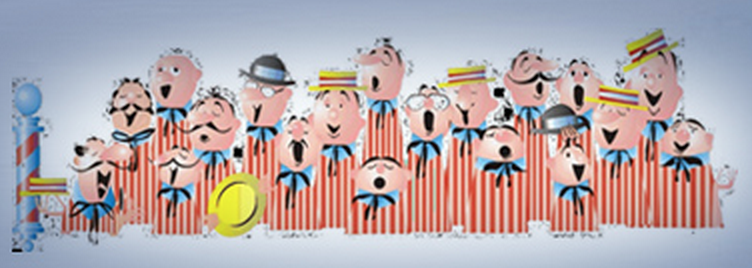
The Harmony Heritage Singers will present a Barbershop Harmony Concert on Saturday, August 1 at 7:00 pm at the Greenbriar Commons Park (next to the pool).
Free sodas and pretzels
Bring your chair or blanket
Rain Date: Sunday, August 2 at 7:00 pm
Barbershop harmony is music in a very pure form created with nothing but human voices coming together to create a rich and satisfying texture that is pleasing to the ears and invigorating to the soul. The barbershop style is unaccompanied vocal music characterized by four-part chords. The melody is sung by the lead, with the tenor harmonizing above the melody, the bass singing the lowest notes, and the baritone completing the chord.
For more about the barbershop style, please click here.
About the Harmony Heritage Singers:
We are the Harmony Heritage Singers, a group of retired gentlemen who enjoy singing together in the distinctive barbershop style. Under our director, Bob Wachter, we rehearse twice a month during the day at Sherwood Regional Library in the Mount Vernon neighborhood. We also present about 25 performances a year, mostly at retirement communities and seniors groups in Northern Virginia, Maryland, and the District of Columbia.
• 1943 ~ Christine (Perfect) McVie, Singer with Fleetwood Mac
• 1946 ~ Benjamin Britten’s “Rape of Lucretia,” premiered at Glyndebourne
• 1947 ~ James Melvin Lunceford, American jazz dance-band leader, passed away
More information about Lunceford
• 1949 ~ John Wetton, Bassist, singer with Asia
• 1952 ~ Liz Mitchell, Singer
• 1953 ~ Marie-Alphonse-Nicolas-Joseph Jongen, Belgian composer, died at the age of 79
• 1956 ~ Sandi Patti, Gospel Singer
• 1958 ~ “Li’l Abner” closed at St James Theater New York City after 693 performances
• 1958 ~ Yakety Yak, by The Coasters, became the number one song in America according to Billboard magazine. It was the first stereo record to reach the top of the chart.
• 1962 ~ The Rolling Stones first performance, at the Marquee Club, London. The lineup featured Mick Jagger, Keith Richards, Brian Jones, bass player Dick Taylor and drummer Mick Avory. Taylor and Avory were soon replaced.
• 1970 ~ Blues-Rock singer Janis Joplin’s debut, in Kentucky
• 1979 ~ Kalervo Tuukkanen, Composer, died at the age of 69
• 1979 ~ Minnie Ripperton (Andrea Davis) Singer, died at the age of 30
• 1985 ~ “Singin’ in the Rain” opened at Gershwin Theater New York City for 367 performances
• 1990 ~ Les Miserables opened at National Theatre, Washington
• 1995 ~ Alan David Marks, Pianist and composer, died at the age of 49
• 1995 ~ Earl Coleman, Singer, died at the age of 69
• 1995 ~ Ernie Furtado, Bassist, died at the age of 72
• 1996 ~ Gottfried von Einem, Composer, died at the age of 78
• 1996 ~ Jonathan Melvoin, Keyboardist with Smashing Pumpkins, died
• 2000 ~ Ras Shorty I, who fused calypso with an up-tempo beat that he said represented the true soul of calypso, died of bone cancer. He was 59. He was born Garfield Blackman and started singing calypso as Lord Shorty. Dozens of musicians later adopted his up-tempo “soca” beat, which he called the “Indianization of calypso,” bringing together the music of his Caribbean nation’s two major ethnic groups, descendants of African slaves and of indentured laborers from India.
• 2001 ~ James Bernard, who composed the eerie musical scores for some of Britain’s most famous horror films, died at the age of 75. The British composer was best known for his work with Hammer Film studios, which made low-budget gothic horror films featuring actors Peter Cushing and Christopher Lee. During his nearly 40-year career, Bernard composed scores for “The Curse of Frankenstein” (1957), “Dracula” (1958) and “The Devil Rides Out” (1968). He won an Academy Award, but not for his music. Bernard shared an Oscar in 1951 with Paul Dehn for best motion picture story for “Seven Days to Noon.” His last work was the score for “Universal Horror” in 1998, a documentary of Universal Studios’ horror films of the 1930s and 1940s.
• 1862 ~ Liza Nina Mary Frederica Lehmann, Composer
• 1892 ~ Giorgio Federico Ghedini, Composer
• 1897 ~ Blind Lemon Jefferson, Singer
• 1914 ~ Ahti Sonninen, Composer
• 1916 ~ Howard Brubeck, Composer
• 1918 ~ Enrico Caruso bypassed opera for a short time to join the war (WWI) effort. Caruso recorded Over There, the patriotic song written by George M. Cohan.
• 1927 ~ Herbert Blomstedt, American-born Swedish conductor of the Oslo Philharmonic from 1954 until 1961
• 1928 ~ Robert Washburn, Composer
• 1929 ~ Hermann Prey, German baritone
• 1931 ~ Thurston Harris, American vocalist
• 1931 ~ Tab Hunter (Arthur Gelien), Singer
• 1932 ~ Alex Hassilev, American vocalist with the Limeliters
• 1937 ~ George Gershwin, Composer of An American Paris, died at the age of 38
More information about Gershwin
• 1938 ~ Terry Garthwaite, American guitarist and singer
• 1944 ~ Bobby Rice, Singer
• 1945 ~ Debbie Harry, Singer
• 1947 ~ Jeff Hanna, Singer, guitarist with Nitty Gritty Dirt Band
• 1950 ~ Patty Pointer, Singer with Pointer Sisters
• 1950 ~ Timotei Popovici, Composer, died at the age of 79
• 1951 ~ Bonnie Pointer, Singer with Pointer Sisters
• 1957 ~ Peter Murphy, Singer with Bauhaus
• 1959 ~ Richie Sambora, Guitarist
• 1964 ~ 18-year-old Millie Small was riding high on the pop music charts with My BoyLollipop. Rod Stewart played harmonica. Millie Small was known as the ’Blue Beat Girl’ in Jamaica, her homeland.
• 1967 ~ Kenny Rogers formed The First Edition just one day after he and members Thelma Camacho, Mike Settle and Terry Williams left The New Christy Minstrels. The First Edition hosted a syndicated TV variety show in 1972.
• 1969 ~ David Bowie released Space Oddity in the UK for the first time. It was timed to coincide with the Apollo moon landing but had to be re-released before it became a hit, later in the year in the UK (but not until 1973 in the US).
• 1969 ~ Rolling Stones released Honky Tonk Woman
• 1973 ~ Alexander Vasilyevich Mosolov, Russian Composer, died at the age of 72
• 1980 ~ Boleslaw Woytowicz, Composer, died at the age of 80
• 1984 ~ Karel Mengelberg, Composer, died at the age of 81
• 1993 ~ Mario Bauza, Cuban/American jazz musician ~ died at the age of 82
• 1994 ~ Charles “Lefty” Edwards, Saxophonist, died at the age of 67
• 1994 ~ Lex P Humphries, Drummer, died at the age of 57
• 1996 ~ Louis Gottlieb, Musician, died at the age of 72
• 2001 ~ Herman Brood, an artist and musician in the Dutch rock scene for 30 years, died at the age of 55. Brood became a sensation with his 1978 hit single Saturday Night, which he wrote as leader of the band Wild Romance. Over 25 years, he recorded nearly 20 albums. He also appeared in Dutch movies.
• 2002 ~ Blues singer Rosco Gordon died of a heart attack. He was 74. Rosco was known for 1950s hits including Booted, No More Doggin’, Do theChicken and Just aLittle Bit, which sold more than 4 million copies in covers by Etta James, Elvis Presley, the Beatles and Jerry Butler. His offbeat, rhythmic style influenced the early sounds of ska and reggae after he toured the Caribbean in the late ’50s. Gordon quit the music business in the 1960s and invested his winnings from a poker game in a dry cleaning business. He started his own record label in 1969 and returned to concert performances in 1981.

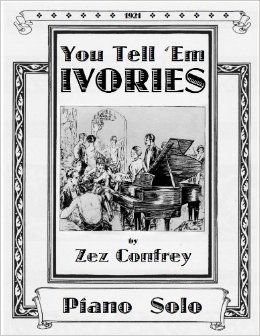
“This collection represents a cross-section of Confrey’s works and encompasses the broad range of his styles. Besides his famous 1920s novelty works (including Kitten on the Keys), there are many wonderful, lesser-known gems of remarkable quality included here from later in his career. Appearing for the first time in print are transcriptions of one of his disc recordings (Poor Buttermilk) and two of his player piano roll arrangements (My Pet and Humorestless). Many of Confrey’s later works have long been out of print and are included here for the first time in decades.”


 MaryO'Studio