. 1864 ~ Anton Schindler, German violinist and Beethoven’s biographer, died at the age of 68
. 1875 ~ First American performance of Johannes Brahms’“Hungarian Dances”
.
1886 ~ Death of Italian opera composer Amilcare Ponchielli, in Milan. He was 51.
. 1891 ~ French Composer Leo Delibes died at the age of 54
. 1905 ~ Ernesto Halffter, Spanish composer and conductor
. 1908 ~ Ethel Merman (Zimmerman), American singer of popular music, Tony Award-winning actress (musical), Musical Theater Hall of Fame. She is most famous for Call Me Madam in 1951, It’s a Mad, Mad, Mad, Mad World, There’s No Business Like Show Business and Alexander’s Ragtime Band
. 1929 ~ Marilyn Horne, American mezzo-soprano
. 1929 ~ G.T. (Granville) Hogan, Jazz drummer who played with Elmo Hope, Earl Bostic
. 1934 ~ Bob Bogle (Robert Lenard Bogle), Guitarist, bass with The Ventures
. 1938 ~ Béla Bartók and his wife, Ditta performed their first public concert featuring his Sonata for Two Pianos and Percussion
. 1938 ~ Benny Goodman and his band, plus a quartet, brought the sound of jazz to Carnegie Hall in New York City. When asked how long an intermission he wanted, he quipped, “I don’t know. How much does Toscanini get?”
. 1942 ~ Bill Francis, Keyboard, singer with Dr. Hook and the Medicine Show
. 1942 ~ Kay Kyser and the band recorded A Zoot Suit for Columbia Records. The tune is about the problems associated with wearing this garish, exaggerated ‘hep’ fashion.
. 1946 ~ Katia Ricciarelli, Italian soprano
. 1946 ~ Ronnie Milsap, Grammy Award-winning singer in 1976, CMA Male Vocalist of the Year (1974, 1976, 1977), CMA Entertainer of the Year (1977), blind since birth, he learned to play several instruments by age 12
. 1957 ~ Conductor Arturo Toscanini died in New York at the age of 89.
. 1957 ~ The Cavern Club opened for business in Liverpool, England. The rock club was just a hangout for commoners. Then, things changed — big time. It all started in the early 1960s when four kids from the neighborhood popped in to jam. They, of course, turned out to be The Beatles.
. 1962 ~ Paul Webb, Bass with Talk Talk
. 1964 ~ “Hello Dolly!” opened at the St. James Theatre in New York City. Carol Channing starred in the role of Mrs. Dolly Levi. The musical was an adaptation of Thornton Wilder’s play, “The Matchmaker”. The show, with an unforgettable title song, was hailed by critics as the “…possible hit of the season.” It was possible, all right. “Hello Dolly!” played for 2,844 performances. And, it returned to Broadway in the 1990s, again starring Carol Channing.
. 1972 ~ David Seville died on this day in Beverly Hills, CA. Born Ross Bagdasarian, the musician was the force, and artist, behind the Alvin and the Chipmunks novelty songs of the 1950s, ’60s and ’70s.
. 1973 ~ Clara Ward passed away. Ward was an American gospel artist who achieved great artistic and commercial success in the 1940s and 1950s.
. 1975 ~ “Mandy” is Barry Manilow’s first #1 pop hit
. 1976 ~ The album, “Frampton Comes Alive”, was released by Herb Alpert’s A&M Records. The double LP soon reached the top spot of the album charts and stayed perched there for 17 weeks. It sold 19 million copies in its first year.
. 1980 ~ Lin Manuel Miranda, American actor, composer, lyricist (Hamilton)
. 1984 ~ Michael Jackson received eight awards at the 11th annual American Music Awards this night.
. 2001 ~ Eleanor Lawrence, a flutist who played often in chamber music performances and with several orchestras in New York City, died of brain cancer at the age of 64. She is credited with transforming a simple newsletter into an important source for flutists. Lawrence studied the flute at the New England Conservatory with the principal flutist of the Boston Symphony Orchestra, James Pappoutsakis. She later studied with flutists from the Philadelphia Orchestra and the Metropolitan Opera orchestra. She joined the American Symphony Orchestra and the Brooklyn Philharmonic after moving to New York in the 1960s. She played periodically with the New York Philharmonic and the Metropolitan Opera. Besides performing, Lawrence taught at the Manhattan School of Music. She served three times as the president of the New York Flute Club. She edited The National Flute Association Newsletter, now The Flutist Quarterly, from the mid-1970s to the early 1980s, expanding it from a brief information sheet to a publication with regular interviews.
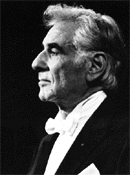
On January 18, 1958 Leonard Bernstein began presenting his television series What does music mean? The series ran for 53 programs. Some of the episodes can be found below:
Part 1 What is Classical Music?
Plot: Bernstein conducts Handel’s Water Music and cites it as an indisputable example of classical music. “Exact” is the word that best defines classical music, Bernstein says and he demonstrates with musical illustrations from Bach’s Fourth Brandenburg Concerto, Mozart’s Concerto No. 21 in C Major and The Marriage of Figaro, and Haydn’s Symphony No. 102.
The decline of classical music at the end of the eighteenth century is tied to Beethoven’s innovations and the Romantic movement, and Bernstein conducts Beethoven’s Egmont Overture.
Part 2 What is Melody?
Plot: Bernstein discusses the different forms melody can take, including tune, theme, motive, melodic line and musical phrase. He illustrates by conducting the orchestra in excerpts from Tchaikovsky, Wagner, Hindemith, and Brahms.
Part 3 What is a Mode?
Plot: Bernstein discusses scales, intervals, and tones, and analyzes several pieces, including Debussy’s Fêtes, Rimsky-Korsakov’s Scheherazade, and music from the Kinks and the Beatles, to illustrate different modes.
An excerpt from Bernstein’s ballet Fancy Free is also performed.
. 1775 ~ Giovanni Battista Sammartini, composer, died
. 1890 ~ Premiere of The Sleeping Beauty, ballet by Pyotr Il’yich Tchaikovsky. After the less-than-promising 1877 debut of Swan Lake, marred by a largely amateur production, over a decade elapsed before the composer was commissioned by the Director of the Imperial Theatres in St. Petersburg to supply music for a ballet on the Perrault fairy tale, The Sleeping Beauty. Tchaikovsky threw himself arms-deep into the project. Not only was the composer again on happy turf, but he was also currently in a state of delight by the occasional presence of a three-year-old little girl; children seemed to tap a joyful vein in Tchaikovsky. The little girl’s proximity fed a spirit of fantasy that transmitted to this most lighthearted of the composer’s scores. Most musicologists and historians concede that Sleeping Beauty is the most perfectly wrought of Tchaikovsky’s three ballet scores, classic in its restraint, yet possessing the right amount of color and panache to render it pure Tchaikovsky; its waltz remains a Pops favorite.
. 1896 ~ Alexander Scriabin made his European debut as a pianist at the Salle Erard in Paris
. 1909 ~ Gene Krupa, American Jazz bandleader and drummer
. 1919 ~ Pianist and statesman Ignace Paderewski became the first premier of Poland
. 1925 ~ Ruth Slenczynska, pianist, born in Sacramento, California
. 1941 ~ Captain Beefheart (Don Van Vliet), Singer with Captain Beefheart & His Magic Band, artist
. 1942 ~ Kenny Sargent vocalized with the Glen Gray Orchestra on Decca Records’ It’s the Talk of the Town.
. 1944 ~ Duke Ellington and His Famous Orchestra took the song “Do Nothin’ Till You Hear From Me” to the top of the charts. It was there for eight weeks before being knocked out off the top.
. 1948 ~ Ronnie Van Zandt, Singer, songwriter with Lynyrd Skynyrd
. 1964 ~ The soundtrack album of the musical, “The King and I”, starring Yul Brynner, earned a gold record.
. 1967 ~ Ed Sullivan told the Rolling Stones to change the lyrics and the title to the song, Let’s Spend the Night Together, so it became Let’s Spend Some Time Together.
. 1972 ~ Elvis Presley, who was also censored from the waist down by Ed Sullivan, reportedly drew the largest audience for a single TV show to that time. Elvis presented a live, worldwide concert from Honolulu on this day.
. 1972 ~ “American Pie” by Don McLean hit #1 on the pop charts
. 1987 ~ Ray Bolger died. He was an American entertainer of vaudeville, stage and actor, singer and dancer best known for his portrayal of the Scarecrow in The Wizard of Oz.
. 1993 ~ Sammy Cahn passed away. He was an American lyricist, songwriter and musician.
. 2018 ~ Edwin Hawkins, American gospel musician, choirmaster and composer (Oh Happy Day), died of pancreatic cancer at the age of 74
. 2019 ~ Carol Elaine Channing died at the age of 98. She was an American actress, singer, dancer and comedian. Notable for starring in Broadway and film musicals, her characters typically radiate a fervent expressiveness and an easily identifiable voice, whether singing or for comedic effect.
. 1929 ~ Billy Walker, Singer, known as the ‘masked singer’
. 1931 ~ Caterina Valente, Singer
. 1936 ~ Harriet Hilliard, vocalist and wife of bandleader Ozzie Nelson, sang Get Thee Behind Me Satan, for the movie “Follow the Fleet.” The song was originally written by Irving Berlin and was previously intended for Ginger Rogers to sing in the movie “Top Hat.”
. 1938 ~ Jack Jones (John Allan Jones), Singer, son of Allan Jones and wife, actress, Irene Hervey.
. 1939 ~ The program, “Honolulu Bound”, was heard on CBS radio. Phil Baker and The Andrews Sisters were featured on the program.
. 1949 ~ Joaquín Turina, Spanish pianist/conductor/composer (Rima), died at the age of 66
. 1956 ~ Rock ‘n’ roller, Little Richard, was singing the newly released Tutti-Frutti. The Pat Boone version became even more popular as a cover record.
. 1964 ~ A hootenanny was held for the first time at the White House, as the NewChristy Minstrels entertained President and Lady Bird Johnson, as well as Italy’s President.
. 1965 ~ Jeanette (Anna) MacDonald passed away. She was an American singer and actress best remembered for her musical films of the 1930s with Maurice Chevalier and Nelson Eddy
. 1968 ~ LL Cool J (James Todd Smith), Rap singer
. 1970 ~ Diana Ross and the Supremes perform their final concert
. 1995 ~ Alexander Gibson, British conductor and founder of the Scottish Opera, died at the age of 68
.2024 – Peter Schickele died at the age of 88. He was best known as P.D.Q. Bach and wrote a biography under that name titled Definitive Biography of P.D.Q. Bach. There’s a copy in the music studio if anyone wants to borrow it.
Peter Schickele, a virtuoso of versatility and a maestro of musical mirth, embarked on his final cadence in his home in Bearsville, N.Y. His daughter, Karla Schickele, confirmed his passing, marking the end of a vibrant era. Schickele’s health had waned following a series of infections last fall, but his legacy resonates with a crescendo of creativity and humor.
A composer of serious concert music, Schickele’s symphonic, choral, solo instrumental, and chamber works numbered over 100, enchanting audiences since the 1950s. His compositions, which graced the repertoires of the New York Philharmonic, the Cleveland Orchestra, the Lark Quartet, the Minnesota Opera, and other prestigious ensembles, reflected his deep musical prowess. His talents also shone in the realms of film scores and Broadway musicals, showcasing his versatility and profound understanding of diverse musical genres.
Yet, it was under the guise of his riotously comedic alter ego, P.D.Q. Bach, that Schickele achieved iconic status. In this whimsical persona, he masterfully blended the gravitas of classical music with the lightheartedness of parody. For over fifty years, he delighted and surprised audiences with performances that were a fantastical fusion of Mozart, the Marx Brothers, and Rube Goldberg. His prizewinning recordings and even a book-length biography of P.D.Q. Bach playfully punctured the oftentimes solemn bubble of classical-music culture, bringing a refreshing irreverence to the concert hall.
Peter Schickele’s life was a symphony of serious music and satirical comedy, leaving behind a legacy that dances between the profound and the playful, reminding us that at the heart of great art lies the joy of creation.
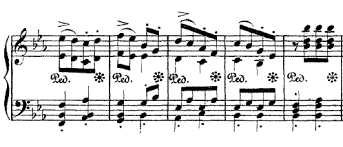
These are some examples of pedal marks in piano music:
An older style of pedaling. The symbols can be between or below the staves.
This type of pedaling is more commonly used today.
Another type of pedaling
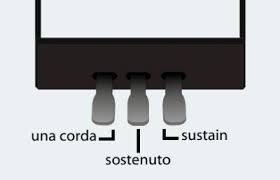
Pedals on a grand piano:
There are two standard foot pedals on the piano: on the left side is the una corda pedal and on the right side is the sustain (damper) pedal.
The middle sostenuto pedal is only standard on the American grand piano, and is very rarely used.
With pedals, the pianist can add resonance and color to the music and thereby bring out its inherent emotion. At the same time, over-pedaling or improper pedaling can drown the listener and the performer in a miasma of overlapping sounds.
This pedal has various names. It is sometimes called the damper pedal (because it lifts all the dampers inside the piano), or the forte pedal (because the result of lifting all the dampers is a fuller sound), or the tre corde pedal (because it allows the three strings of each key to vibrate), or the sustaining pedal (because when you depress it the note will continue to sound even if you take your fingers off the keys).
Damper Pedaling Guidelines
Here are some guidelines pedaling. As with everything in art, they can be ignored under certain circumstances.
Avoid pedaling notes that move in a stepwise or scalar pattern. Adjacent notes are dissonant, and when pedaled, they sound smudged.
Do pedal notes that skip and form a nice harmony.
Change your pedal (i.e., lift it up and put it down again) at each change of harmony.
Avoid pedaling through rests (i.e., silence), at ends of phrases (at which point we would need to breathe and that split second of silence takes care of that), or staccato notes—although this is commonly ignored, because we actually can hear the disconnection through the pedal. This is why we do not depend on the pedal to achieve a beautiful legato.
Keep your heel planted firmly on the floor, and pedal with either toes or the ball of foot, depending on your shoe size.
There are several manipulations possible with the damper pedal, each affecting the sound slightly differently.
Syncopated Pedaling
For the cleanest sound, the syncopated (or legato) pedal will give you the most control. This is an action where the foot is put down immediately after the note is played. This may take some getting used to, but you can practice it by playing a C scale.
Play C, and then lower the damper pedal.
Hold the pedal down until you are just about ready to play the D.
As the D’s finger goes down, the foot goes up, and then down again immediately after the D is struck.
The sound is clean. Continue up the scale the same way.
As an experiment, try putting the pedal down as you play a note, and notice the difference in the sound. Since the damper pedal lifts all the dampers, when you strike the D, not only are the three strings of that note free to vibrate but so do all the other strings vibrate sympathetically. You have a sound that is full of overtones.
There are times when you will want that effect and so will keep your foot down until the accumulated sound needs to breathe.
You can practice the syncopated pedal away from the piano by sitting on the bench or a chair and lifting your right knee at exactly the same time as your right hand goes down to tap the rising knee. This is the same action at the keyboard. The foot goes up when the hand goes down and then returns to the pedal.
Partial Pedals
There are half and quarter pedals too, which are used when you don’t want full vibrato. Rather than depressing the pedal all the way down, you lower your foot halfway so that the dampers are lifted only slightly off the strings, without allowing them to vibrate fully.
The quarter pedal gives even just a hint of pedal. It will take a while to feel these various distances on your piano. Also, you will find that each piano has its own pedal feel, which you must get used to before attempting to perform on that instrument.
Flutter Pedal
Then there are times, usually in scale passages, where touches of pedal can be very appealing and then the foot goes up and down rapidly and shallowly, and that is called the “flutter” pedal.
Choosing the Pedaling
The different types of damper pedaling techniques are for you, the pianist, to decide. But what determines which choice you will make?
Two things will control that: your very important ear, and your understanding of the music—the composer and the era in which the music was composed.
Your pedaling approach following the composer’s style depends on your knowledge of what instruments were available during the composer’s lifetime and how the pedal or lack of pedals would have made the music sound. This way, your interpretation will have authenticity.
Position of the Sustain Pedal:
Right pedal
The Sustain Pedal is Played With:
Right foot
Also Called:
Damper pedal, forte pedal, loud pedal
Effects of the Sustain Pedal:
The sustain pedal allows all of the notes on the piano to resonate after the keys have been lifted, for as long as the pedal is depressed. It creates a legato effect, forcing all of the notes to echo and overlap.
History of the Sustain Pedal:
The sustain pedal was originally operated by hand, and an assistant was required to operate it until the knee lever was created. The creators of the sustain foot pedal are unknown, but it is believed to have been invented around the mid-1700s.
Use of the sustain was uncommon until the Romantic Period, but is now the most commonly used piano pedal.
How the Sustain Pedal Works:
The sustain pedal lifts the dampers off of the strings, allowing them to vibrate until the pedal is released.
Sustain Pedal Marks:
In piano notation, use of the sustain pedal begins with Ped., and ends with a large asterisk.
Variable pedal marks, seen as /_/, are placed under notes, and define the precise pattern in which the sustain pedal is depressed and released.
Horizontal lines show when the sustain pedal is depressed.
Diagonal lines indicate a quick, temporary release of the sustain pedal.
Position of the Una Corda Pedal:
Left pedal
The Una Corda is Played With:
Left foot
Also Called:
Soft pedal, “piano” pedal
Effects of the Una Corda Pedal:
The una corda pedal is used to enhance the timbre of softly played notes, and exaggerate a low volume. The soft pedal should be used with notes that are already played softly, and will not produce the desired effect on louder notes.
History of the Una Corda Pedal:
The una corda was the first mechanism to modify the piano’s sound, and was originally operated by hand. It was invented in 1722 by Bartolomeo Cristofori, and quickly became a standard addition to the piano.
How the Una Corda Pedal Works:
Most treble keys are attached to two or three strings. The una corda shifts the strings so that the hammers only strike one or two of them, creating a softened sound.
Some bass keys are only attached to one string. In this case, the pedal creates a shift so that the hammer strikes on a lesser-used portion of the string.
Una Corda Pedal Marks:
In piano notation, use of the soft pedal begins with the words una corda (meaning “one string”), and is released by the words tre corde (meaning “three strings”).
Interesting Facts About the Una Corda Pedal:
Most upright pianos use a “piano” pedal instead of a true una corda pedal. The piano pedal moves the hammers closer to the strings, preventing them from striking with full force
Position of the Sostenuto Pedal:
Usually the middle pedal, but is often omitted.
The Sostenuto is Played With:
Right foot
Originally Called:
Tone-sustaining pedal
Effects of the Sostenuto Pedal:
The sostenuto pedal allows certain notes to be sustained while other notes on the keyboard are unaffected. It is used by hitting the desired notes, then depressing the pedal. The selected notes will resonate until the pedal is released. This way, sustained notes can be heard alongside notes played with a staccato effect.
History of the Sostenuto Pedal:
The sostenuto pedal was the last addition to the modern piano. Boisselot & Sons first showcased it in 1844, but the pedal didn’t gain popularity until Steinway patented it in 1874. Today, it’s primarily found on American grand pianos, but is not considered a standard addition since it is very rarely used.
How the Sostenuto Pedal Works:
When the sostenuto pedal is depressed, it keeps the dampers off the selected strings, allowing them to resonate while the rest of the keys’ dampers remain down.
Sostenuto Pedal Marks:
In piano music, use of the sostenuto pedal begins with Sost. Ped., and ends with a large asterisk. Notes meant to be sustained are sometimes marked by hollow, diamond-shaped notes, but there are no strict rules for this pedal since it is hardly ever used.
Interesting Facts About the Sostenuto Pedal:
Sostenuto is Italian for “sustaining,” although this incorrectly describes the pedal’s function.
On some pianos, the sostenuto pedal only affects the bass notes.
The middle pedal is sometimes built as a “practice rail” pedal instead of a sostenuto. A practice rail muffles notes with felt dampers, allowing for quiet play.
Sostenuto pedal markings are rarely seen in sheet music, but can be found in the works of Claude Debussy.
. 1884 ~ Sophie Tucker (Abuza), Russian-born American burlesque and vaudeville singer
. 1904 ~ Richard Addinsell was born
More information about Addinsell
. 1909 ~ Quentin ‘Butter’ Jackson, Trombonist, played with Duke Ellington
. 1910 ~ Enrico Caruso and Emmy Destinn were heard via a telephone transmitter; rigged by DeForest Radio-Telephone Company to broadcast from the Metropolitan Opera House in New York City.
. 1930 ~ Robert ‘Squirrel’ Lester, Singer with The Chi-Lites
. 1938 ~ Singer Allan Jones recorded The Donkey Serenade for Victor Records. The song became the one most often associated with the singer. Allan sang and acted in several Marx Brothers films: “A Night at the Opera”, “A Day at the Races”, but the film that catapulted him to stardom was the operetta, “Firefly”, with Jeanette MacDonald. Singer Jack Jones is the son of Allan and wife, actress Irene Hervey.
. 1941 ~ The four Modernaires joined to sing with the Glenn Miller Band on a permanent basis beginning this day. They had a ‘solo’ hit in 1946 with To Each His Own.
. 1957 ~ Elvis Presley recorded All Shook Up and That’s When Your Heartaches Begin for Victor Records in Hollywood. The former tune became Elvis’ ninth consecutive gold record.
. 1961 ~ Wayne Marshall, English pianist, organist and conductor
. 1962 ~ Singer Chubby Checker set a record, literally, with the hit, The Twist. The song reached the #1 position for an unprecedented second time – in two years. The Twist was also number one on September 26, 1960.
. 1968 ~ Johnny Cash performed live for the second time at Folsom Prison in the prison cafeteria which was recorded as the album “Johnny Cash at At Folsom Prison”.
. 2001 ~ Kenneth Haas, the former general manager of the Boston Symphony Orchestra and the Cleveland Orchestra, died after a long illness at the age of 57. Haas was general manager of the Boston orchestra from 1987 to 1996 and was instrumental in appointing Keith Lockhart conductor of the Boston Pops Orchestra. Haas was general manager of the Cleveland Orchestra from 1976 to 1987 after performing the same job for the Cincinnati Symphony Orchestra in 1975. In Cleveland he established the orchestra’s chamber music and recital series.
. 2001 ~ Michael Cuccione, youngest of the five-member spoof boy band 2gether, died at age 16 from complications from Hodgkin’s disease. The teen played Jason “Q.T.” McKnight on the MTV show “2gether,” which poked fun at the boy band craze. His character had a fictional illness, “biliary thrombosis,” but Cuccione really had suffered from Hodgkin’s disease as a child and underwent five months of chemotherapy. The singer-actor set up a cancer research foundation co-wrote a book with his grandmother and appeared on “Baywatch” as a cancer victim.
Get ready to celebrate a splashing fun day – January 13 is National Rubber Ducky Day! 🎉 This quirky holiday honors none other than Rubber Duckie, the beloved bath-time buddy of Sesame Street’s Ernie and Big Bird. First waddling onto the scene in a 1970 episode, this cheerful yellow companion has been making waves ever since.
But did you know? The humble rubber ducky has a history that floats back to the late 1800s. Originally envisioned as a chew toy, it paddled through the tides of time, evolving from rubber to plastic, especially during the World Wars when rubber was as precious as gold!
The first patent for this buoyant buddy was hatched in 1928 by Landon Smart Lawrence. His ingenious design? A ducky that always bobs back to an upright position, no matter how wavy the bathwater gets! And let’s not forget the artistic touch of Russian Sculptor Peter Ganine, who sculpted a duck that’s pretty much the doppelganger of our modern rubber duckies.
Fast forward to 2001, and the rubber ducky makes a royal splash in Britain. Why? The Sun revealed that even Queen Elizabeth II had a rubber duck in her bathroom – and it wore an inflatable crown! 👑
The crowning moment for these cheerful chirpers came in 2013 when the rubber ducky was inducted into the Toy Hall of Fame, joining an exclusive club of only 52 other toys.
So, on January 13, grab your rubber ducky and let’s quack open the celebrations for this iconic, floaty friend! 🦆💦🎈
The now world-famous giant rubber duck, by Dutch artist Florentijn Hofman, has sailed into the Port of Los Angeles. The six-story-tall bath toy has made its west coast debut to take part in their Tall Ships Festival parade. The duck has also appeared in Australia, Belgium, Japan, New Zealand and Brazil. Earlier this year, versions of the massive inflatable duck were in Asia, including Beijing’s harbor and Taiwan, where the duck actually exploded and fell apart while on display. Report by Sarah Kerr.
Did you know that the City of Fairfax Regional Library has a Rubber Ducky collection?
Go on a scavenger hunt to discover more than 200 ducks hiding throughout the building and are on display. The Rubber Ducky is the library’s mascot.
. 1715 ~ Jacques Duphly, French harpsichordist and composer.
.1782 ~ On this day Mozart wrote a letter to his father about Muzio Clementi. He said: “Clementi plays well, as far as execution with the right-hand goes. His greatest strength lies in his passages in 3rds. Apart from that, he has not a kreuzer’s worth of taste or feeling – in short he is a mere mechanicus.”
. 1876 ~ Ermanno Wolf-Ferrari, Italian Opera Composer
. 1905 ~ Tex (Woodward Maurice) Ritter, Country singer, actor, John Ritter’s father
. 1921 ~ The opening of Town Hall in New York City, an important new concert hall
. 1926 ~ Ray Price, Singer
. 1926 ~ Morton Feldman, American composer, born in NYC, New York
. 1928 ~ Vladimir Horowitz debuted as a soloist with the New York Philharmonic at Carnegie Hall in New York City. It was the very same night that Sir Thomas Beecham gave his first public performance in the United States.
. 1930 ~ Glenn Yarbrough, Singer with The Limeliters
. 1933 ~ Václav Suk, Czech-born Russian composer and violinist, died at the age of 71
. 1939 ~ William Lee Golden, Singer with The Oak Ridge Boys
. 1939 ~ The Ink Spots gained national attention after five years together, as they recorded If I Didn’t Care. Many other standards by the group soon followed.
. 1940 ~The Shep Fields Orchestra went to the top of Billboard’s Pop Chart with their song “South of the Border (Down Mexico Way).”
. 1946 ~ Cynthia Robinson, Singer, trumpeter with Sly and the Family Stone
. 1949 – Arthur Godfrey and His Friends was first seen on CBS-TV this day. The program stayed on the network for seven years.
. 1959 ~ Per Gessle, Guitarist, singer with Roxette
. 1963 ~ Songwriter Bob Dylan sang Blowin’ In the Wind on the BBC radio presentation of “The Madhouse on Castle Street”. The song soon became one of the classics of the 1960s protest movement.
. 1985 ~ After a record 24 weeks as the #1 album in the nation, Prince (now known as The Artist Previously Known as Prince) slipped to the #2 spot with Purple Rain. Replacing Prince at the top spot: ‘The Boss’ Bruce Springsteen’s Born In the USA, which spent 24 weeks waiting for Purple Rain to fall.
. 1995 ~ Laurel McGoff, American singer
. 2001 ~ Luis Floriano Bonfa, the master guitarist and composer who helped found Bossa Nova music, died of cancer at the age of 78. Bonfa, who was born in Rio de Janeiro in Oct. 17, 1922, began composing in the 1940s and launched his career as a solo artist in 1952. Better known abroad than at home, Bonfa became internationally famous for his contributions to the soundtrack of Marcel Camus’ 1959 classic film “Black Orpheus.” The film introduced an international audience to Bossa Nova – a more sophisticated and less percussive samba style – and made Bonfa and fellow composer Antonio Carlos Jobim stars. “Bonfa plays the guitar like no other, in a very personal, charismatic style. His guitar is a little orchestra,” the late composer Jobim once said. His reputation grew further when he was a featured performer at the Bossa Nova festival at Carnegie Hall in New York City in 1962. He was even more famous for his more than 500 compositions especially Manha de Carnaval andSamba de Orpheu. Placido Domingo, Julio Iglesias, Frank Sinatra and Elvis Presley recorded songs written by Bonfa. In recent years, his productivity slowed. His last major label release “The Bonfa Magic,” was recorded in 1991.
. 2001 ~ Opera singer Kyra Vayne, a star of the 1940s and 1950s whose talents were rediscovered in the 1990s, died at age 84. The Russian-born soprano was born in St. Petersburg. Vayne fled the 1917 Bolshevik Revolution with her family and was eight years old when her family settled in London. She began a successful opera career in the 1940s, and sang for allied troops during World War II. She later joined the Russian Opera Company, then based at London’s Savoy Theater. Her career collapsed in 1957 when her agent, Eugene Iskoldoff, committed suicide, and for the next 35 years she worked as a secretary for the British Broadcasting Corp.
In the early 1990s, a music company released four recordings of her voice, leading the U.S. music magazine “Fanfare” to ask, “How is it possible that such a singer has not come down to us as one of the century’s most celebrated sopranos?” Soon afterward, Arcadia Books published her autobiography, “A Voice Reborn,” which tenor Placido Domingo described as having “all the elements of an opera.” At the end of 1999, nearly 80 years after she fled Russia, Vayne was invited to perform at Moscow’s Bolshoi Theater to mark the new millennium – her first public performance in 40 years. “For me to sing at the Bolshoi is beyond any fairy tale,” she said at the time. “I am not worried about singing in public again after so long, but I am fearful of the emotional impact.” Vayne never married and had no children.
. 2003 ~ Maurice Gibb, a member of the famed disco band the Bee Gees, died at a Miami Beach hospital. He was 53. Gibb, joined with his older brother and his twin to harmonize their way to becoming one of the best selling musical groups ever. Gibb played bass and keyboard for the group, whose name is short for the Brothers Gibb. In a 1978 interview with TG Magazine, Gibb lamented the perception that the Bee Gees were only a disco band. “People accuse us of being nothing more than a disco band now,” Gibb said. “But they don’t know what they’re talking about. If you listen to our records, you’ll find that there’s dance music. But there are also ballads like More Than A Woman. And there are some very beautiful, undanceable songs, too.” The Bee Gees – twins Maurice and Robin, and their older brother Barry – have lived in South Florida since the late 1970s. Their younger brother, Andy, who had a successful solo career, died in 1988 at age 30 from a heart ailment. Chris Hutchins, a writer and former press agent for the Bee Gees, said Maurice was “very much a tormented soul.” “He was not the star (of the Bee Gees), and he knew it, he felt it,” Hutchins told British Broadcasting Corp. radio. Known for their close harmonies and original sound, the Bee Gees are members of the Rock and Roll Hall of Fame, and their 1977 contributions to the “Saturday Night Fever” album made it the best selling movie soundtrack ever with more than 40 million copies sold. Among their disco hits on that album are Stayin’ Alive, More Than a Woman and How Deep Is Your Love and Night Fever. The group won seven Grammy Awards. The Bee Gees last album was in 2001, entitled “This Is Where I Came In.” The family emigrated from England to Australia in 1958, and the brothers soon gained fame as a teen pop group. They returned to England in the 1960s, and their first four albums contained hits such as 1941 New York Mining Disaster, To Love Somebody and their first U.S. number one song, 1971’s How Can You Mend A Broken Heart.
The Bee Gees followed “Saturday Night Fever” with the 1978 album “Spirits Having Flown” which sold 20 million copies. The brothers wrote and produced songs for Barbra Streisand, Diana Ross and Dionne Warwick in the 1980s. They also wrote the Kenny Rogers and Dolly Parton hit Islands in the Stream. The Bee Gees released three studio albums and went on a world tour in the 1990s. The live album from the tour “One Night Only,” sold more than 1 million albums in the United States. The Bee Gees run a music production company in Miami called Middle Ear Studios. Gibb’s first wife was British singer Lulu. He and his second wife, Yvonne, were married for more than 20 years and had two children.
During the Offering at Pender UMC’s Traditional Service on January 9, 2022, we were treated to Ludwig van Beethoven’s Piano Sonata No. 8 in C minor, Op. 13, commonly known as Sonata Pathétique played by Liz Eunji Sellers .
View the entire service
Ludwig van Beethoven’s Piano Sonata No. 8 in C minor, Op. 13, commonly known as Sonata Pathétique, was written in 1798 when the composer was 27 years old, and was published in 1799. It has remained one of his most celebrated compositions.Beethoven dedicated the work to his friend Prince Karl von Lichnowsky. Although commonly thought to be one of the few works to be named by the composer himself, it was actually named Grande sonate pathétique (to Beethoven’s liking) by the publisher, who was impressed by the sonata’s tragic sonorities.
Liz played the second movement – Adagio cantabile (above)
This movement exemplifies the expressive Adagio style of many slow movements in the classical period. The famous cantabile melody is played three times, always in A♭ major, separated by two modulating episodes; the movement is thus a simple rondo rather than the sonata form more common for movements of this seriousness. The first episode is set in F minor (the relative minor of A♭ major), further modulating to E♭ major before returning to the main theme. The second episode begins in A♭ minor and modulates to E major. With the final return of the main theme, the accompaniment becomes richer and takes on the triplet rhythm of the second episode. There is a brief coda.
. 1895 ~ Laurens Hammond, inventor of the Hammond organ. The sound of the Hammond was used by many rock artists including; Procol Harum, Keith Emerson, Led Zeppelin, The Allman Brothers and The Faces. Hammond died on July 3, 1973. There is a Hammond organ in the O’Connor Music Studio.
. 1901 ~ Vasily Sergeyevich Kalinnikov died. Kalinnikov was a Russian composer of two symphonies, several additional orchestral works and numerous songs, all of them imbued with characteristics of folksong.
. 1902 ~ Maurice Duruflé, French organist and composer
. 1924 ~ Don Cherry, Singer with Band of Gold
. 1928 ~ Ol’ Man River was recorded on Victor Records by Paul Whiteman and his orchestra. Bing Crosby crooned as the song’s featured vocalist. The tune came from the Broadway musical, “Showboat”.
. 1930 ~ Jack Nimitz, Jazz ‘reed’ musician, toured with Supersax
. 1933 ~ Goldie Hill, Country entertainer, married to country singer, Carl Smith
. 1946 ~ Naomi (Diane) Judd, Grammy Award-winning singer in the duo, The Judds, mother of singers Wynonna and Ashley
. 1949 ~ Dennis (Frederick) Greene, Singer with Sha-Na-Na
. 1958 ~ Vicki Peterson, Guitarist, singer with The Bangles
. 1980 ~ Rupert Holmes was at the top of the pop music charts, with Escape (The Pina Colada Song).
. 1981 ~ Leonard Bernstein began conducting the BR – Bayerischer Rundfunk Symphony Orchestra in Richard Wagner’s “Tristan und Isolde” in Munich’s Hercules Hall. Performed one act at a time, in January, April, and November of 1981, respectively, Bernstein’s “Tristan und Isolde” was telecast live and later released as an audio recording by Philips–to some controversy.
Karl Böhm remarked, with regards to Bernstein’s exaggeratedly slow tempi, “For the first time, someone dares to perform this music as Wagner wrote it.” Böhm’s own recording of the Prelude was four minutes faster.
Upon completion of the project, Bernstein declared, “My life is complete… I don’t care what happens after this. It is the finest thing I’ve ever done.”
. 2003 ~ Mickey Finn, bongo player with 1970s band T.Rex, died at the age of 55. Formed by flamboyant lead singer Marc Bolan in 1967, T.Rex shot to fame with hits such as Get it On, Hot Love and Children of the Revolution in the early 1970s. The band was originally called Tyrannosaurus Rex but the name was shortened to T.Rex in 1970 after Finn joined, replacing original member Steve Took. The band achieved a huge following in Britain — sparking a period of “T.Rextacy” among devoted fans — but achieved more limited popularity in the United States and elsewhere. Credited with introducing the phenomenon of “glam rock” to pop music and influencing artists such as David Bowie, the band played to crowds of up to 100,000 and sold 39 million albums, according to Rolling Stone music magazine.
. 2004 ~ Randy VanWarmer, who recorded the pop hit Just When I Needed You Most and then had a successful career as a songwriter, died. He was 48. Just When I Needed You Most reached No. 4 on Billboard’s pop chart in 1979. VanWarmer, also a guitarist, had written it when he was 18. More recently, VanWarmer wrote I’m in a Hurry (And Don’t Know Why), a No. 1 hit by the country group Alabama in 1992, and I Guess It Never Hurts to Hurt Sometimes, No. 1 by the Oak Ridge Boys in 1984. VanWarmer was born March 30, 1955, in Indian Hills, Colo., and spent much of his childhood in Cornwall, England, after his father died. As a young man he lived in New York City and then Los Angeles before moving to Nashville in 1985. VanWarmer had recently recorded a duet with country singer Razzy Bailey, Sandcastles.
. 2005 ~ Spencer Dryden, drummer for the San Francisco rock band the Jefferson Airplane, died. He was 66.
. 2005 ~ Jimmy Griffin, an Academy Award-winning songwriter and former guitarist for the 1970s pop group Bread, died. He was 61.
. 2016 ~ Gilberto Mendes, Brazilian composer, died at the age of 93








 MaryO'Studio