November 17 ~ Today in Music

today


• 1726 ~ The first performance of J. S. Bach‘s Sacred Cantata No. 55 Ich armer Mensch, ich Sündenknecht on the 22nd Sunday following Trinity. Was part of Bach’s third annual Sacred Cantata cycle in Leipzig 1725-27


• 1848 ~ Frederic Chopin played his final piano concert at a Polish benefit ball at Guildhall in London.

• 1850 ~ Giuseppe Verdi‘s opera Stifellio was first performed at the Teatro Grande in Trieste despite difficulties with the censors which resulted in cuts and changes.


• 1861 ~ First Performance of Johannes Brahms‘ Piano Quintet No. 1 in g, Op. 25, at a rehearsal in Hamburg, with pianist Clara Schumann.

• 1862 ~ The work noted above received its official premiere with members of the Hellmesberger Quartet; Brahms at the piano, in Vienna.

• 1870 ~ Birth of Australian composer Alfred Hill in Melbourne. d-Sydney, 30 OCT 1960.

• 1876~ The first performance of Peter Ilyich Tchaikovsky‘s March Slav in Moscow.

• 1877 ~ The first production of Gilbert and Sullivan’s opera, The Sorcerer, was presented, in London.

• 1888~ The first production of Tchaikovsky‘s Fifth Symphony in St. Petersburg.

• 1891 ~ Poland’s premier and premier ivory tickler, Ignace Jan Paderewski, made his American debut at Carnegie Hall in New York City. In later years, Paderewski, who suffered from arthritis, settled in Paso Robles, CA. The hot mineral baths located there eased his pain. He played only Steinway grand pianos custom-built to his specifications. In fact, five were made just for his use.

• 1925 ~ Sir Charles Mackerras, Australian conductor

• 1930 ~ David Amram, American composer and French-horn player

• 1938 ~ Gordon Lightfoot, Canadian folk singer, songwriter and guitarist

• 1938 ~ Orchestra leader Kay Kyser, speaking to an audience at the College of the City of New York (CCNY) told of the “inner workings and artistic features of swing music.” It marked the first of a series of lectures on swing music presented by Kyser, who went on to presentThe Kollege of Musical Knowledge on radio.

• 1941 ~ Gene Clark, Singer, guitar with The Byrds

• 1942 ~ Bob Gaudio, Singer with The Royal Teens; The Four Seasons

• 1946 ~ Martin Barre, Guitarist with Jethro Tull

• 1950 ~ Roberta Peters filled in for the lead in Mozart’s Don Giovanni, making her debut at the Metropolitan Opera in New York City. She would become one of the Met’s most famous stars.

• 1962 ~ The 4 Seasons, with Frankie Valli as lead singer, began a five-week run at the top of the tunedex with Big Girls Don’t Cry.

• 1967 ~ Ronald DeVoe, Singer with New Edition

• 1970 ~ Elton John recorded an album live, on what was WABC-FM in New York City. It marked the first time that a concert was aired live and recorded for release as aired. The LP was titled, 11/17/70.

• 1981 ~ Bob Eberly died

• 2001 ~ Jerry Jerome, a tenor sax player who was a featured soloist with the bands of Glenn Miller and Benny Goodman, died of leukemia. He was 89. One of the big names in the Big Band era, Jerome was a featured soloist with the Glenn Miller, Benny Goodman, Red Norvo and Artie Shaw orchestras. He then became a successful musical director and conductor on radio and television. Jerome also established a music business, scoring and arranging commercial jingles. Three years ago, Arbors Records released Jerome’s “Something Old, Something New.” The sequel recording, “Something Borrowed, Something Blue,” will be released in December. Born in Brooklyn, N.Y., Jerome started playing the sax while in high school. He attended the University of Alabama and went on the medical school, playing gigs at jazz clubs to earn tuition money. He joined Goodman’s orchestra at the height of its popularity in 1938. When Goodman broke up his band in 1940, Jerome joined Shaw. While with Shaw, he appeared in the film “Second Chorus,” with Fred Astaire and Burgess Meredith.

• 2003 ~ Arthur Conley, a 1960s soul singer and protege of Otis Redding’s, died at his home in the town of Ruurlo, in the eastern Netherlands. He was 57. Conley was born in Atlanta and started his recording career in 1959 as leader of the group Arthur and the Corvets. He was best known for his 1967 hit, Sweet Soul Music, which he co-wrote with Redding based on a number by Sam Cooke. Conley had several minor hits in the following two years. He moved to Europe in the early 1970s after several tours of the continent, deciding that he was “fed up with the pressure” in the United States, said Giesen. In the Netherlands, Conley appeared on television and radio, and ran an independent record label. In the last five years he was an adviser to The Original Sixties R&B and Soul Show, which sought to reproduce the sound and look of the heyday of soul.

Adapted from http://www.oconnormusic.org/month-nov.htm
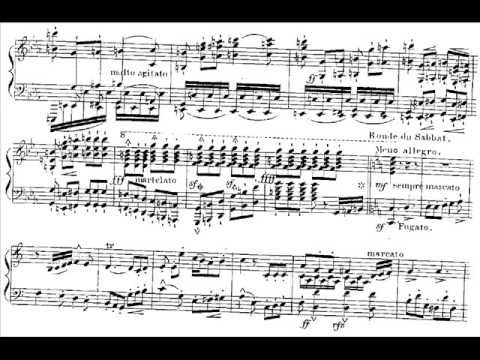
Halloween Music: Dreams of a Witches’ Sabbath from Symphonie fantastique by Hector Berlioz

berlioz-symphony-fantastique
The final movement is the best known part of the symphony, thanks to its use in the Julia Roberts movie, Sleeping With The Enemy. It features a four-part structure, which Berlioz described in his own program notes from 1845 as follows:

“He sees himself at a witches’ Sabbath, in the midst of a hideous gathering of shades, sorcerers and monsters of every kind who have come together for his funeral. Strange sounds, groans, outbursts of laughter; distant shouts which seem to be answered by more shouts. The beloved melody appears once more, but has now lost its noble and shy character; it is now no more than a vulgar dance tune, trivial and grotesque: it is she who is coming to the Sabbath… Roar of delight at her arrival… She joins the diabolical orgy… The funeral knell tolls, burlesque parody of the Dies irae, the dance of the witches. The dance of the witches combined with the Dies irae.”

The Dies irae melody is one of the most-quoted in musical literature, appearing in the works of many diverse composers.

The traditional Gregorian melody has also been used as a theme or musical quotation in a number of  classical compositions, notable among them:

Free sheet music from IMSLP for the basic Dies irae

Free sheet music from IMSLP for the basic Symphonie fantastique (look under Arrangements and Transcriptions)

The basic Gregorian Chant

An animated version of the  Dreams of a Witches’ Sabbath from Symphonie fantastique.  Can you hear the Dies irae in this?  It starts around 3:18.

Leonard Bernstein conducts the “Orchestre National de France” in Berlioz’s Symphonie Fantastique
5th Movement

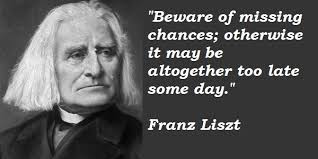
Happy Birthday, Franz Liszt

liszt-quote


Franz Liszt was born in Raiding, near Ödenburg, October 22, 1811 and died in Bayreuth, July 31, 1886. He was a Hungarian composer and pianist who was a major influence during the romantic period. Liszt was an outstanding pianist at seven, composed at eight and made concert appearances at nine. In addition to being a piano virtuoso, he was also a critic, conductor, city music director, literary writer and transcriber of the works of other composers. He transcribed Beethoven’s Symphonies for the piano.

Franz Liszt began his career as the outstanding concert pianist of the century, who, along with the prodigious violinist Niccoló Paganini (1782-1840), created the cult of the modern instrumental virtuoso. To show off his phenomenal and unprecedented technique, Liszt composed a great deal of music designed specifically for this purpose, resulting in a vast amount of piano literature laden with dazzling, and other technical marvels. In this vein, Liszt composed a series of virtuosic rhapsodies on Hungarian gypsy melodies, the best-known being the all too familiar Hungarian Rhapsody no. 2. Liszt developed the rhapsody as a form of serious music. This kind of music is worlds apart from the generally more introspective, poetic music of pianist-composer Frédéric Chopin.

Liszt was wildly handsome and hugely talented. He was extremely popular in Paris during the 1830’s. It is said that women actually fainted at his piano recitals. He was the first to position the piano so that its lid reflected the sound and the audience could see his profile as he performed.

Liszt was the first to write a tone poem, which is an extended, single-movement work for orchestra, inspired by paintings, plays, poems or other literary or visual works, and attempting to convey the ideas expressed in those media through music. Such a work is Les Préludes, based on a poem in which life is expressed as a series of struggles, passions, and mysteries, all serving as a mere prelude to . . .what? The Romantic genre of the symphonic poem, as well as its cousin the concert overture, became very attractive to many later composers, including Saint-Saëns, TchaikovskyDvorák, Sibelius, and Richard Strauss.


     Liszt’s birthday

     anniversary of Liszt’s death

    Listen to Liszt’s transcription of Meyerbeer’s Hellish Waltz from Robert du Diable, which probably caused more public commotion than any other piano piece in history.


     Read quotes by and about Liszt

     Liszt was the first recitalist

     In Praise of Pianos and the Artists Who Play Them

     History of the Piano

     Franz Liszt


August 20 ~ Today in Music History

today


• 1561 ~ Jacopo Peri, Italian composer
More information about Peri

• 1882 ~ Tchaikovsky’s “1812 Overture” first performed in Moscow.

• 1885 ~ The Mikado, by Gilbert and Sullivan, opened at the Fifth Avenue Theatre in New York City.

• 1905 ~ Weldon Leo ‘Jack’ Teagarden, Jazz musician, trombonist and singer whose relaxed, melodic instrumental style was highly influential
More information about Teagarden

• 1923 ~ Jim (James Travis) Reeves

• 1926 ~ Frank Rosolino, Musician: trombone, played with Stan Kenton, Harold Land, Bob Cooper, Clarke-Boland Big Band

• 1927 ~ Joya Sherrill, Singer

• 1931 ~ Frank Capp, Musician, drummer with the big jazz band, Capp-Pierce Juggernaut

• 1935 ~ Justin Tubb, Singer, Ernest Tubb’s son

• 1939 ~ Orrin Tucker’s orchestra recorded Oh, Johnny, Oh, Johnny, Oh!, on Columbia Records.

• 1942 ~ Issac Hayes, Grammy and Academy Award-winning American rhythm-and-blues singer, songwriter and arranger

• 1947 ~ Jim Pankow, Trombonist, song writer with Chicago

• 1948 ~ Robert Plant, British rock singer with Honeydrippers and composer

• 1951 ~ Phyl Lynott, Musician: bass, singer with Thin Lizzy

• 1952 ~ Doug Fieger, Musician, guitar, singer with The Knack

• 1952 ~ Rudy Gatlin, Singer with The Gatlin Brothers

• 1969 ~ Andy Williams received a gold record for the album Happy Heart on Columbia   Records.

• 1977 ~ Best of My Love, by the Emotions, topped the pop charts. It had a number one run of four weeks.

• 2001 ~ Frank C. “Papa” Mangione, father of jazz musicians Chuck and Gap Mangione, died  at age 91.
Mangione worked at Eastman Kodak Co., ran a grocery store for about two decades and returned to the photography company until his retirement in 1975. For the next 15 years, he sold music and merchandise on worldwide tours with his more famous son, Chuck, a flugelhorn ace.
A son of Italian immigrants, Mangione’s childhood was chronicled by his brother, Jerry, in a best-selling 1942 memoir called “Mount Allegro: A Memoir of Italian American Life.”
Three of Chuck Mangione’s songs, 60 Miles Young, 70 Miles Young and Papa Mangione, were dedicated to his father.

August 9 ~ Today in Music History

today


• 1874 ~ Reynaldo Hahn, Venezuelan-born French composer, conductor and music critic

• 1902 ~ Solomon Cutner, Classical pianist. A virtuoso performer, he played Tchaikovsky’s First Concerto at the age of 10. His career was stopped after a stroke in 1965.

https://youtu.be/4Vi0DwX6MEg

• 1902 ~ Zino (Rene) Francescatti, French concert violinist; passed away in 1991

• 1910 ~ A.J. Fisher of Chicago, IL received a patent for an invention that moms, grandmas and single guys certainly came to appreciate: the electric washing machine. Previous to Mr. Fisher’s invention, washing machines were cranked by hand (not easily done) – or you used a washboard (also sometimes used as a musical instrument).

• 1919 ~ Ruggiero Leoncavallo, Italian composer and librettist, died. He is famous for the single opera “Pagliacci” but never repeated the success with his other works.
More information about Leoncavallo

• 1932 ~ Helen Morgan joined the Victor Young orchestra to record Bill, a popular tune from Broadway’s Showboat.

• 1934 ~ Merle Kilgore, Songwriter Hall of Famer

• 1939 ~ Billy Henderson, Singer with Spinners

• 1955 ~ Benjamin Orr (Orzechowski), Musician, bass guitar, singer with The Cars

• 1963 ~ Whitney Houston, Grammy Award-winning singer

https://youtu.be/N_lCmBvYMRs

• 1963 ~ The TV program Ready, Set, Go! premiered on the BBC in London, England. The show gave exposure to such music luminaries as Bob Dylan and The Rolling Stones.

• 1964 ~ Joan Baez and Bob Dylan shared the stage for the first time when the singers performed in a concert in Forest Hills, NY.

• 1969 ~ Hot Fun in The Summertime, by Sly and the Family Stone, and Easy to Be Hard, from the Broadway production Hair, were released on this day. Hot Fun made it to number two on the music charts and Easy to Be Hard climbed to number four.

• 1975 ~ Dmitri Shostakovitch, Russian composer, died. He wrote 15 symphonies as well as operas, ballets and film and theater scores.
More information about Shostakovitch

https://youtu.be/tAL50lkWI8g

• 1995 ~ Jerry Garcia passed away

• 2003 ~ Chester Ludgin, a baritone in the New York City Opera for more than 30 years, died at the age of 78.
Ludgin sang a host of lead baritone parts, but was most recognizable in operas including “The Ballad of Baby Doe,” “The Devil and Daniel Webster” and “Susannah.” He debuted at the City Opera in 1957 in Johann Strauss II’s “Fledermaus.”
He also portrayed the part of Sam for Leonard Bernstein’s “A Quiet Place” at the Houston Grand Opera in 1983. He also sang for the San Francisco Opera and other North American companies.
His last appearance at City Opera was in 1991, but he remained on the stage, singing in musical comedies. His most recent lead was in “The Most Happy Fella.”

• 2005 ~ News Item:  New Vivaldi work heard for first time in 250 years.

May 7 ~ Today in Music History

today


•  1833 ~ Johannes Brahms, German composer
More information about Brahms

• 1840 ~ Piotr Ilyich Tchaikovsky, Russian composer
Listen to Tchaikovsky’s music
Read about Tchaikovsky
Read quotes by and about Tchaikovsky
More information about Tchaikovsky

• 1919 ~ Eva (Evita) Peron, Argentina’s spiritual leader and wife of Argentina’s President, Juan Peron; actress on stage, film and radio; subject of the Broadway musical and film Evita

• 1927 ~ Elisabeth Söderström, Swedish soprano

• 1931 ~ Teresa Brewer (Breuer), Singer

• 1941 ~ Glenn Miller and his Orchestra recorded one of the great American music standards, Chattanooga Choo Choo
More information about Chattanooga Choo Choo

• 1942 ~ Felix Weingartner, Austrian conductor and composer, died; best known for his interpretations of Wagner and Beethoven.

• 1958 ~ Pianist Van Cliburn signed an artist’s contract with RCA Victor Records.

• 1966 ~ The Mamas & The Papas made the climb to the top of the Billboard pop music chart with Monday, Monday.

• 1995 ~ Ray McKinley passed away.  He was an American jazz drummer, singer, and bandleader.

• 2002 ~ Buster Brown, a tap star and choreographer who danced on stage, in films and on television, died. He was 88. Brown was one of the last surviving members of the Copasetics, a legendary group of veteran dancers who performed together. Known for his quick rhythms and charm, Brown was a mentor and teacher for a younger generation of dancers. Brown, who was born James Brown in Baltimore, began his dancing career with a trio called the Three Aces and Speed Kings. He eventually began a solo career, appearing in the Hollywood musical “Something to Shout About” in 1943. Brown toured with the bands of Count Basie, Dizzy Gillespie and Duke Ellington, and was a featured dancer in Ellington’s concerts in the 1960s. He danced in the films “The Cotton Club” and “Tap” and on two public television specials. He also performed with the original casts of the Broadway musicals “Bubbling Brown Sugar” and “Black and Blue.” Brown toured South America with the Cab Calloway Orchestra and was commissioned by the State Department to perform in several African counties. He also taught master classes throughout Europe. Beginning in 1997, Brown was master of ceremonies at a weekly Sunday tap jam at the Manhattan club Swing 46, where young and old dancers stopped by to perform. He recently received an honorary doctorate from Oklahoma City University.

March 29 ~ Today in Music History

today


. 1788 ~ Charles Wesley, writer of over 5,500 hymns and, with his brother John, the founder of Methodism, died.

. 1871 ~ The Royal Albert Hall in London opened

. 1878 ~ Albert Von Tilzer, Composer.  He was the composer of “Take Me out to the Ball Game” among other old favorites.
More information about Von Tilzer

. 1879 ~ “Eugene Onegin”, best-known opera by Russian composer Tchaikovsky, was first performed at the Maliy Theatre in Moscow

. 1888 ~ Charles-Valentin Alkan died.  He was a French composer and pianist.

. 1902 ~ Sir William Walton, British composer
More information about Walton

. 1906 ~ E. Power Biggs, English Organist

. 1918 ~ Pearl Mae Bailey, American jazz singer, lead in black cast of Hello Dolly

. 1936 ~ Richard Rodney Bennett, British composer

. 1947 ~ Bobby Kimball (Toteaux), Singer with Toto

. 1949 ~ Michael Brecker, Jazz musician, reeds with The Brecker Brothers

. 1951 ~ The King and I, the wonderful Rodgers and Hammerstein musical based on Margaret Langdon’s novel, Anna and the King of Siam, opened this night in 1951 on Broadway. The King and I starred Yul Brynner in the role of the King of Siam. The king who, along with his subjects, valued tradition above all else. From this day forward, the role of the King of Siam belonged to Yul Brynner and no other. Brynner appeared in this part in more than 4,000 performances on both stage and screen (the Broadway show was adapted for Hollywood in 1956). Anna, the English governess hired to teach the King’s dozens of children, was portrayed by Gertrude Lawrence. Ms. Lawrence and Mr. Brynner acted, danced and sang their way into our hearts with such memorable tunes as Getting to Know You, Shall We Dance, Hello, Young Lovers, I Whistle a Happy Tune, We Kiss in a Shadow, I Have Dreamed, Something WonderfulA Puzzlement and March of the Siamese Children. The King and I ran for a total of 1,246 outstanding performances at New York’s St. James Theatre.

. 1952 ~ Roy Henderson’s last singing performance was on this date in the role of Christus in Bach’s “St. Matthew Passion” at Southwark Cathedral, the Anglican cathedral on the south bank of the Thames in London.

. 1958 ~ W.C. (William Christopher) Handy, Composer passed away
More information about Handy

. 1963 ~ M.C. Hammer (Stanley Kirk Burrell), Grammy Award-winning singer

. 1973 ~ Hommy, the Puerto Rican version of the rock opera Tommy, opened in New York City. The production was staged at Carnegie Hall.

. 1973 ~ After recording On the Cover of ‘Rolling Stone’, Dr. Hook finally got a group shot on the cover of Jann Wenner’s popular rock magazine. Inside, a Rolling Stone writer confirmed that members of the group (Dr. Hook and the Medicine Show) bought five copies of the magazine for their moms – just like in the song’s lyrics!

. 1980 ~ Annunzio Paolo Mantovani, Anglo-Italian conductor and arranger, died. Created the “Mantovani sound” that made him a highly successful recording artist and concert attraction.

. 1982 ~ Carl Orff, German composer of “Carmina Burana,” died.

. 1982 ~ Ray Bloch passed away

. 1999 ~ Legendary U.S. jazz and blues singer Joe Williams died aged 80.

. 2001 ~ John Lewis, a pianist who masterminded one of the most famous ensembles in jazz, the Modern Jazz Quartet, died at the age of 80. The M.J.Q., as the quartet was known, remained mostly unchanged from the mid-1950’s to the 90’s. It began recording in 1952 with Lewis, vibraphonist Milt Jackson, bassist Percy Heath and drummer Kenny Clarke. When Clarke moved to Paris in 1955, Connie Kay replaced him and the quartet continued until Kay’s death in 1994. Lewis contributed the bulk of the group’s compositions and arrangements, including Django and Two Degrees East, Three Degrees West, and he insisted members wear tuxedos to dignify jazz as an art. He was born in LaGrange, Ill., in 1920, and grew up in Albuquerque, N.M. His entree to the jazz world came during World War II, when he met Kenny Clarke, an established drummer in the nascent bebop movement. At Clarke’s urging, Lewis moved to New York after his discharge and eventually replaced Thelonious Monk as Dizzy Gillespie’s pianist. He also performed or recorded with Charlie ParkerLester Young and Ella Fitzgerald. In 1952 he formed the M.J.Q. with Clarke, Jackson and Heath. The quartet was a steady seller of records and concert tickets well into the 1970’s. Lewis also taught music at Harvard and the City College of New York, and in the late 1950’s helped found the Lenox School of Jazz in Massachusetts.

March 4 ~ Today in Music History

today


. 1678 ~ Antonio Lucio Vivaldi, Italian baroque composer. The creator of hundreds of spirited, extroverted instrumental works, Vivaldi is widely recognized as the master of the Baroque instrumental concerto, which he perfected and popularized perhaps more than any of his contemporaries. A group of four violin concerti from Vivaldi’s Op. 8, better known as “The Four Seasons”, may well be the most universally recognizable musical work from the Baroque period. Perhaps the most prolific of all the great European composers, he once boasted that he could compose a concerto faster than a copyist could ready the individual parts for the players in the orchestra.
More information about Vivaldi

(MaryO’Note:  Spring from The Four Seasons is available in the Piano Maestro App for piano students)

. 1801 ~ The U.S. Marine Band performed for the first time at a presidential nomination. That president was Thomas Jefferson.

. 1875 ~ Bizet’s Carmen premier, Paris

. 1877 ~ The ballet of Swan Lake, composed by Peter Ilyich Tchaikovsky, was performed for the first time in the famous Bolshoi Theatre in Moscow, Russia

and

. 1915 ~ Carlos Surinac, Catalan Spanish-born composer and conductor

. 1918 ~ Frank Wigglesworth, American composer

. 1925 ~ Enzo Stuarti, Opera singer

. 1928 ~ Samuel Adler, German-born American composer

. 1929 ~ Bernard Haitink, Dutch conductor

. 1932 ~ Miriam (Zensile) Makeba, South African born singer who was the first black South African to attain international stardom.

. 1934 ~ Barbara McNair, Singer, TV hostess of The Barbara McNair Show, actress

. 1942 ~ Dick Jurgen’s orchestra recorded One Dozen Roses on Okeh Records in Chicago.

. 1942 ~ The Stage Door Canteen opened on West 44th Street in New York City. The canteen became widely known as a service club for men in the armed forces and a much welcomed place to spend what would otherwise have been lonely hours. The USO, the United Service Organization, grew out of the ‘canteen’ operation, to provide entertainment for American troops around the world.

. 1943 ~ Irving Berlin picked up the Best Song Oscar for a little ditty he had written for the film, Holiday Inn: White Christmas at the 15th Academy Awards.

. 1944 ~ Bobby Womack, Songwriter, singer

. 1948 ~ Chris Squire, Bass with Yes

. 1948 ~ Shakin’ Stevens (Michael Barratt), Singer, actor

. 1951 ~ Chris Rea, Guitarist with these groups Chris Rea Band and Ambrosia; singer, songwriter

. 1969 ~ Chastity Bono, Singer, daughter of Sonny & Cher

. 1978 ~ Andy Gibb reached the top of the music charts as (Love is) Thicker ThanWater reached #1 for a two-week stay. The Bee Gees also set a record on this day as their single, How Deep Is Your Love, from the Saturday Night Fever soundtrack stayed in the top 10 for an unprecedented 17 weeks.

. 1981 ~ Lyricist E.Y. ‘Yip’ Harburg died in an auto accident in Hollywood, CA at the age of 82. Two of his most successful hits were Over the Rainbow from The Wizard of Oz and It’s Only a Paper Moon, popularized by Nat King Cole and many others.

. 2001 ~ Glenn Hughes, a singer who performed as the mustachioed, leather-clad biker in the disco band the Village People, died at the age of 50. The group, which was the brainchild of producer Jacques Morali, featured men dressed as an Indian, a soldier, a construction worker, a police officer, a cowboy and Hughes’ character, a biker. The band released its first single, San Francisco (You’ve Got Me), in 1977. It followed the next year with its first hit, Macho Man. The band then produced a string of hits, including Y.M.C.A., In the Navy and Go West. Collectively the Village People sold 65 million albums and singles. Although disco fell out of fashion in the 1980s, Hughes stayed with the band until 1996, when he left to sing in Manhattan cabarets.

. 2003 ~ Fedora Barbieri, a mezzo-soprano whose passionate singing sometimes stole the scene from opera diva Maria Callas, died. She was 82. Born in Trieste in 1920, Barbieri performed on stages ranging from Milan’s La Scala to New York’s Metropolitan Opera House to London’s Covent Garden. Barbieri’s career started in 1940 and for her 80th birthday, she sang the role of Mamma Lucia in Pietro Mascagni’s “Cavalleria Rusticana” in Florence. Her repertoire included roles in operas by Giuseppe Verdi and Giacomo Puccini. Barbieri died in Florence, which she had adopted as her home and where she gave many performances.

. 2003 ~ Emilio Estefan Sr., father of the Latin music mogul, died at the age of 83. Estefan Sr. played the plump and comical ambassador in a music video for the Miami Sound Machine’s hit song Conga, which featured singer Gloria Estefan, wife of Estefan Jr. The Miami Sound Machine’s office was once located in Estefan Sr.’s garage. His son later built a home for his parents on his Star Island compound. Estefan Sr. was born in Santiago de Cuba and moved to Spain with Estefan Jr. in 1966. His wife and another son stayed in Cuba because the boy was of military draft age and couldn’t leave until 1980. Estefan Sr. came to Miami in 1968, a year after Estefan Jr., and opened a clothing business in Hialeah.

January 15 ~ Today in Music History

today


1890 ~ Premiere of The Sleeping Beauty, ballet by Pyotr Il’yich Tchaikovsky. After the less-than-promising 1877 debut of Swan Lake, marred by a largely amateur production, over a decade lapsed before the composer was commissioned by the Director of the Imperial Theatres in St. Petersburg to supply music for a ballet on the Perrault fairy tale, The Sleeping Beauty. Tchaikovsky threw himself arms-deep into the project. Not only was the composer again on happy turf, he was currently in a state of delight by the occasional presence of a three-year old little girl; children seemed to tap a joyful vein in Tchaikovsky. The little girl’s proximity fed a spirit of fantasy which transmitted to this most lighthearted of the composer’s scores. Most musicologists and historians concede that Sleeping Beauty is the most perfectly wrought of Tchaikovsky’s three ballet scores, classic in its restraint, yet possessing the right amount of color and panache to render it pure Tchaikovsky; its waltz remains a Pops favorite.

. 1904 ~ Ellie Sigmeister, Classical composer

. 1905 ~ Weldon Leo ‘Jack’ Teagarden, died of pneumonia
More information about Teagarden

. 1909 ~ Gene Krupa, American Jazz bandleader and drummer

. 1941 ~ Captain Beefheart (Don Van Vliet), Singer with Captain Beefheart & His Magic Band, artist

. 1942 ~ Kenny Sargent vocalized with the Glen Gray Orchestra on Decca Records’ It’s the Talk of the Town.

. 1948 ~ Ronnie Van Zandt, Singer, songwriter with Lynyrd Skynyrd

. 1951 ~ Charo (Maria Rosario Pilar Martinez Molina Baeza), ‘The Hootchy Cootchy Girl’, actress, singer, wife of Xavier Cugat

. 1951 ~ Martha Davis, Singer with The Motels

. 1959 ~ Peter Trewavas, Bass with Marillion

. 1964 ~ The soundtrack album of the musical, “The King and I”, starring Yul Brynner, earned a gold record.

. 1967 ~ Ed Sullivan told the Rolling Stones to change the lyrics and the title to the song, Let’s Spend the Night Together, so it became Let’s Spend Some Time Together.

. 1972 ~ Elvis Presley, who was also censored from the waist down byEd Sullivan, reportedly drew the largest audience for a single TV show to that time. Elvis presented a live, worldwide concert from Honolulu on this day.

. 1987 ~ Ray Bolger died

. 1993 ~ Sammy Cahn passed away