. Luigi Boccherini, Italian composer
More information on Boccherini
. 1878 ~ Thomas Alva Edison, famed inventor, patented a music player at his laboratory in Menlo Park, NJ. This music device is the one we know as the phonograph. Edison paid his assistant $18 to make the device from a sketch Edison had drawn. Originally, Edison had set out to invent a telegraph repeater, but came up with the phonograph or, as he called it, the speaking machine.
. 1902 ~ John Bubbles (John William Sublett), An actor: Porgy and Bess (1935 Broadway version), films: Cabin in the Sky, Variety Show, A Song Is Born, No Maps on My Taps; dancer: credited with creating ‘rhythm tap’.
. 1927 ~ Robert Fuchs, Austrian composer and music teacher. As Professor of music theory at the Vienna Conservatory, Fuchs taught many notable composers, while he was himself a highly regarded composer in his lifetime.
. 1940 ~ “Smokey” Robinson, American rhythm-and-blues singer and songwriter
. 1942 ~ If there was ever such a thing as a jam session, surely, this one was it: Tommy Dorsey and his orchestra recorded I’ll Take Tallulah (Victor Records). Some other musical heavyweights were in the studio too, including Frank Sinatra, Jo Stafford and the Pied Pipers, Ziggy Elman and drummer extraordinaire, Buddy Rich.
. 1971 ~ Gil Shaham, Israeli-American violinist
. 1975 ~ Luigi Dallapiccola, composer, died at the age of 71
More about Dallapiccola
. 1981 ~ George Harrison was ordered to pay ABKCO Music the sum of $587,000 for “subconscious plagiarism” between his song, My Sweet Lord and the Chiffons early 1960s hit, He’s So Fine.
. 1736 ~ Johann Georg Albrechtsberger, Austrian musician
. 1809 ~ (Jacob Ludwig) Felix Bartholdy Mendelssohn, German composer
More information about Mendelssohn
. 1900 ~ Mabel Mercer, British-born American cabaret singer
. 1904 ~ Luigi Dallapiccola, Italian composer
More information about Dallapiccola
. 1911 ~ Jehan Alain, French organist and composer
. 1928 ~ Frankie Vaughn (Abelson), Singer
. 1929 ~ Russell Arms, Singer
. 1940 ~ Angelo D’Aleo, Singer with Dion and The Belmonts
. 1941 ~ Jimmy Dorsey and his orchestra recorded the classic, Amapola, on Decca Records. Helen O’Connell and Bob Eberly joined in a vocal duet on this very famous and popular song of the Big Band era.
. 1943 ~ Eric Haydock, Bass with The Hollies
. 1943 ~ Dennis Edwards, singer with the Temptations since 1968. He sang on a string of the group’s hits including “I Can’t Get Next to You,” “Ball of Confusion” and “Papa Was a Rollin’ Stone” in an initial tenure that stretched to 1977.
. 1947 ~ Melanie (Safka), Singer
. 1947 ~ Dave Davies, Singer, guitarist with The Kinks
. 1950 ~ Ed, Gene, Joe and Vic, The Ames Brothers, reached the #1 spot on the pop music charts for the first time, as Rag Mop became the most favorite song in the U.S. The brothers enjoyed many successes with their recording efforts.
.
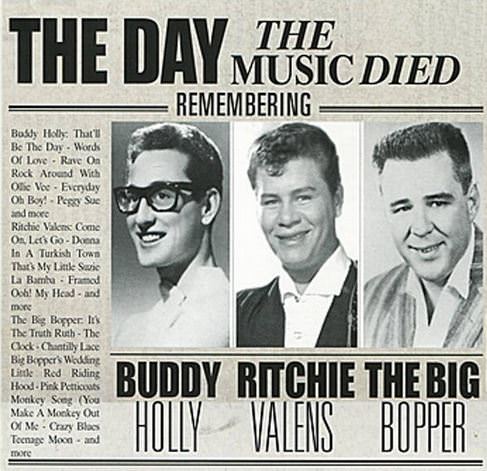
1959 ~ 22-year-old Buddy Holly, 28-year-old J.P. Richardson (The Big Bopper) and 17-year-old Ritchie Valens died in an airplane crash near Mason City, Iowa. February 3rd has been remembered as ‘The Day the Music Died’ since Don McLean made the line popular in his 1972 hit, “American Pie”. Buddy Holly, born Charles Hardin Holly in Lubbock, Texas, recorded That’ll Be the Day, Peggy Sue, Oh, Boy, Maybe Baby, and others, including It Doesn’tMatter Anymore (recorded just before his death, a smash in the U.K., non-top-10 in the U.S.). Buddy was inducted into the Rock and Roll Hall of Fame in 1986. A convincing portrait of the singer was portrayed by Gary Busey in The Buddy Holly Story, a made for TV movie. J.P. (Jiles Perry) Richardson was from Sabine Pass, TX. He held the record for longest, continuous broadcasting as a DJ at KTRM Radio in Beaumont, TX in 1956. He was on the air for 122 hours and eight minutes. In addition to his smash hit, Chantilly Lace, Richardson also penned Running Bear (a hit for Johnny Preston) plus White Lightning (a hit for country star, George Jones). Richard Valenzuela lived in Pacoima, CA (near LA) and had a role in the 1959 film, Go Johnny Go. Ritchie Valens’ two big hits were Donna and La Bamba … the last, the title of a 1987 film depiction of his life. La Bamba also represented the first fusion of Latin music and American rock. Of the three young stars who died in that plane crash, the loss of Buddy Holly reverberated the loudest over the years. But, fans of 1950s rock ‘n’ roll will agree, all three have been sorely missed.
. 1959 ~ Lol (Laurence) Tolhurst, Drummer, keyboard with The Cure
. 1964 ~ The British group, The Beatles, received its first gold record award for the single, I Want To Hold Your Hand. The group also won a gold LP award for “Meet The Beatles”. The album had been released in the United States only 14 days earlier.
. 1971 ~ Lynn Anderson received a gold record for the single, Rose Garden. The Grand Forks, ND country singer was raised in Sacramento, CA. In addition to being a singer, she was an accomplished equestrian and California Horse Show Queen in 1966.
. 1974 ~ “Pajama Game” closed at Lunt Fontanne Theater NYC after 65 performances
. 1979 ~ “YMCA“ by Village People peaked at #2 on the pop singles chart. It was fun to dance to!
. 2002 ~ Remo Palmier, a self-trained guitarist who was a fixture in the New York jazz scene in the 1940s, died at the age of 78, and had been suffering from leukemia and lymphoma, his wife said. Over the course of his career, Palmier played with jazz legends Charlie Parker, Billie Holiday and Dizzy Gillespie, among others. Born Remo Palmieri in the Bronx, Palmier achieved his greatest fame performing with broadcaster Arthur Godfrey on CBS, and taught Godfrey how to play the ukulele. After Godfrey retired, Palmier released his own albums, “Windflower and “Remo Palmier”.
. 1912 ~ Erich Leinsdorf, Austrian-born American conductor
. 1937 ~ Glen Gray and his Casa Loma Orchestra recorded A Study in Brown, on Decca Records.
. 1941 ~ John Steel, Singer, drummer with The Animals
. 1944 ~ Florence LaRue (Gordon), Singer with The Fifth Dimension
. 1962 ~ Clint Black, Singer, actor
. 2002 ~ Blues and jazz pianist Abie “Boogaloo” Ames died at the age of 83. Ames was born on Big Egypt Plantation in Cruger, Miss., on May 23, 1918. He began playing piano at the age of 5 and his style earned him the nickname “Boogaloo” in the 1940’s. Ames moved to Detroit as a teenager and started a band, touring Europe with Louis Armstrong in 1936. Ames worked at Motown Studio and befriended other great musicians like Nat King Cole and Erroll Garner. In 1980, Ames moved to Greenville, where he became a regular performer at local clubs and festivals. Cassandra Wilson’s forthcoming Blue Note CD tentatively titled “Belly of the Sun” is set to include Darkness in the Delta, a song written by Ames for the CD. Ames was named the 2001 winner of the Artist’s Achievement Award of the Governor’s Awards for Excellence in the Arts in the state of Mississippi. With his protege and 1990s musical partner Eden Brent, Ames performed at the Kennedy Center for Performing Arts in Washington, D.C., in 2000. Ames’ last public performance was in October 2001 at the E.E. Bass Cultural Center in Greenville with another former student, Mulgrew Miller.
. 2002 ~ David Stetler, a big band swing drummer who played with Benny Goodman and Spike Jones, died of pneumonia. He was 79. A Seattle native, Stetler was discovered in high school by Lunceford. With a style close to that of Gene Krupa and Jo Jones, Stetler toured the country in the 1940s but returned to Seattle after his first son was born. He backed up national acts in local performances, including many during the world’s fair in 1962.
. 2003 ~ Charlie Biddle, a leader of Montreal’s jazz scene in the 1950s and ’60s who played bass with Thelonious Monk and Charlie Parker, died after a battle with cancer. He was 76. Biddle was a native of Philadelphia who moved to Canada in 1948. Over the next five decades, the World War II veteran and former car salesman became synonymous with jazz in Montreal. Biddle opened his own club, Uncle Charlie’s Jazz Joint, in suburban Ste- Therese in 1958. He later performed in such legendary Montreal nightspots as The Black Bottom and the Penthouse, where he worked with the likes of Oscar Peterson, Art Tatum, Charlie Parker and Lionel Hampton. When there were no jobs in Montreal, Biddle played smaller Quebec cities with a group called Three Jacks and a Jill. Until recently, Biddle played four nights a week at Biddle’s Jazz and Ribs, a Montreal landmark for nearly 25 years. Coincidentally, the club closed Tuesday for planned renovations, which included erecting a wall of fame to honor Biddle and others who have played at the club. In 1979, he organized the three-day festival that some say paved the way for the renowned Montreal International Jazz Festival. News Item about Charlie Biddle
. 2003 ~ Jerome Hines, a bass vocalist who performed regularly at the Metropolitan Opera during a career that spanned more than six decades, died. He was 81. Hines spent 41 years performing at the Met, more than any other principal singer in its history. He was known for his timbral richness, as well as the research he conducted into the historical and psychological background of the roles he portrayed. During his career at the Met, he portrayed 45 characters in 39 works, including title roles in Mussorgsky’s “Boris Godunov” and Mozart’s “Don Giovanni,” and Colline in Puccini’s “La Boheme.” He gave a total of 868 performances at the Met, retiring in 1987. He went on to perform with regional opera companies and at benefits. Hines, who became a born-again Christian in the 1950s, composed his own opera, “I Am the Way,” about the life of Jesus. He sang the title role at the Met in 1968 and 93 times around the world.
. 2003 ~ Saxophonist Cornelius Bumpus, a former member of the Doobie Brothers who had performed with Steely Dan since 1993, died en route to a series of performances in California. He was 58. Bumpus began his career at age 10, playing alto saxophone in the school band in Santa Cruz, Calif. In 1966, he spent six months performing with Bobby Freeman, and joined Moby Grape in 1977, writing one tune for the “Live Grape” album. Bumpus also recorded two solo albums and toured with his own band. Since performing with The Doobie Brothers in the early 1980s, Bumpus played with a number of bands, most recently with Steely Dan, which won the “Album of the Year” Grammy for its 2000 “Two Against Nature” release. His relations with his former Doobies bandmates turned contentious in the late 1990s, when they sued him and several other musicians over their use of the Doobies name. A federal judge in 1999 ruled against Bumpus and the other musicians, ordering them not to use the name.
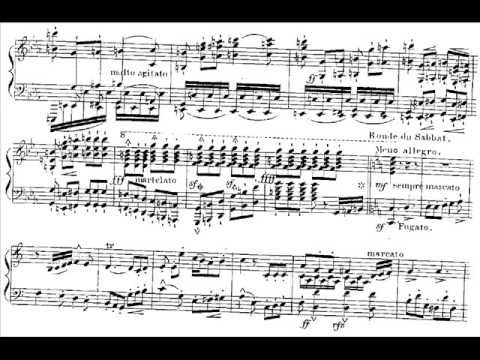
The final movement is the best known part of the symphony, thanks to its use in the Julia Roberts movie, Sleeping With The Enemy. It features a four-part structure, which Hector Berlioz described in his own program notes from 1845 as follows:
“He sees himself at a witches’ Sabbath, in the midst of a hideous gathering of shades, sorcerers and monsters of every kind who have come together for his funeral. Strange sounds, groans, outbursts of laughter; distant shouts which seem to be answered by more shouts. The beloved melody appears once more, but has now lost its noble and shy character; it is now no more than a vulgar dance tune, trivial and grotesque: it is she who is coming to the Sabbath… Roar of delight at her arrival… She joins the diabolical orgy… The funeral knell tolls, burlesque parody of the Dies irae, the dance of the witches. The dance of the witches combined with the Dies irae.”
The Dies irae melody is one of the most-quoted in musical literature, appearing in the works of many diverse composers.
The traditional Gregorian melody has also been used as a theme or musical quotation in a number of classical compositions, notable among them:
Luigi Dallapiccola was an Italian composer known for his lyrical twelve-tone compositions.
Debussy
Claude Debussy lived between 1862 and 1918. He is considered to be a impressionistic composer, because he tried to capture the mood of the action instead of the action itself, and was known as the Father of Impressionistic Music. Debussy’s work influenced another Impressionistic composer, Maurice Ravel.
The French Impressionistic painters like Auguste Renoir were painting at the same time that Debussy was composing and that influenced his music. “Clair de Lune” is a famous example of this as it creates the feeling of rippling water.
Debussy liked to create tonal “impressions” rather than conventional melodies. “Rêverie” was one of his first successes, although the critics of the 1890’s said things like “strangeness”, “dissonance”, “ugliness” and “difficulties” about it, missing the fragile loveliness and vague shimmer which were stylistic innovations.
Debussy was playing piano and composing by the time he was 12.
DeForest
Lee DeForest was born in 1873 in Council Bluffs, Iowa. We’re sure his parents had big plans for him; but they could never have realized how their son, Lee, would change the world.
DeForest seemed to be a born inventor. He held patents for hundreds of different items including the photoelectric cell and the surgical radio knife. But none had as much impact on the world as his invention of the electron tube, specifically the triode, a three element vacuum tube, which later became the audion tube ~~ possibly the most significant invention that made radio possible.
Wireless radio broadcasting was unthinkable in the early 1900s and DeForest was considered a fraud. He was arrested for selling stock to underwrite the development of his invention, which no one believed would work. He was forced into selling the rights to his patent to American Telephone and Telegraph for $500,000; considered by most to be foolish of AT&T. The rest is history.
Lee DeForest’s 1950 autobiography is called “Father of Radio”.
Delius
Frederick Delius was born in Bradford, England. His father owned a wool company and hoped that his son would follow a career in business. Delius, however, wanted to study music. In 1884, he left England for Florida, where he worked on a plantation as an orange grower. Delius proved to be a failure as an orange grower, and began supporting himself as a musician. During 1886 – 1887, he composed Florida Suite.
Des Prez
Josquin Des Prez was born around 1440 and he died: August 27, 1521 in Cond?-sur-l-Escaut, France.
He was a French/Franco-Flemish composer and generally acknowledged as the greatest composer of the High Renaissance.
Martin Luther, who had a good knowledge of music, said of Josquin Desprez, “he alone is the master of the notes, they have to do as he bids them.” Indeed, Josquin was acknowledged by nearly all his contemporaries as the greatest composer of his time. If so, he stands as the first among many great musicians, for the composers of what we often term the Netherlands School created one of the richest periods in Western musical history. His contemporaries — including Antoine Brumel (c.1460-c.1515), Pierre de la Rue (c.1460-1518) and Loyset Comp?re (c.1445-1518) — and the previous generation — led by Johannes Ockeghem (c.1410-1497) — created a style of music that can rightly be compared to the art of Leonardo da Vinci and Michelangelo.
As for Josquin himself, we know surprisingly little of his early life. We know that in the 1470s he began service in the court of Cardinal Ascanio Sforza, and that by 1489 he was a member of the papal choir in Rome. But we know nothing of his early training, or even when he came to Italy (it was believed that he came in 1459 as a choirboy in the Milan cathedral, but it seems that this was a case of mistaken identity). Later in his life he served Duke Ercole d’Este in Ferrara, and possibly King Louis XII of France. The final years of his life were spent in the town of Cond?-sur-l’Escaut in northern France (possibly his birthplace). The rest of his biography is still subject to scholarly speculation.
What we do know is just what Josquin’s contemporaries knew: that he created wonderful music. What stands out most in this music is his care for the words. This is seen in part by the way he uses imitation to allow each voice to present the text before the texture becomes too dense to be clear. He also made use of homophonic textures to give the text an added clarity. Some of his works, especially his Masses, use the older cantus firmus technique. Here he uses the borrowed melody to create a huge scaffolding upon which he constructs the other melodies. Some of these pieces display a high level of technical complexity. At the same time, he could create pieces of marvelous simplicity and elegance, as he did so often in his motets and chansons.
Musical Examples:
Inviolata, integra et casta es Maria
Miserere mei, Deus
Missa “La sol fa re mi” (Agnus Dei II)
Tu solus, qui facis mirabilia
Works:
Sacred works, including 18 masses (Missa “La sol fa re mi”, 2 L’homme arm?
Masses, Missa “Pange lingua”), more than 100 motets
Secular works, including nearly 70 French chansons and settings of German,
Spanish and Italian texts
Diaghilev
Sergei Pavlovich Diaghilev lived from 1872 until 1929. He was a ballet impresario, born in Novgorod, Russia. Diaghilev obtained a law degree, but was preoccupied with the arts. In 1898 he became editor of Mir Iskousstva (World of Art), and during the next few years arranged exhibitions and concerts of Russian art and music. His permanent company was founded in 1911, and remained perilously in existence for 20 years, triumphantly touring Europe. Many of the great dancers, composers, and painters of his period contributed to the success of his Ballets Russes. He also encouraged several major choreographers (eg Fokine, Nijinsky, Balanchine), and gave them opportunities for artistic collaboration.
Dispeker
Thea Dispeker molded operatic talent from Lauritz Melchior to Richard Leech and lived to be 97 years old.
Dispeker owned a classical music artists agency for more than 50 years. In her career, she influenced musicians such as Richard Tucker, Judith Blegen, Roberta Peters and Pablo Casals, among others.
In 1947, she helped found the Little Orchestra Society for children’s concerts and went into business for herself.
Even in her 80s and 90s, Dispeker continued to seek out young singers and musicians to promote. Her portfolio also included the Swedish baritone Hakan Hagegard.
Her agency, Thea Dispeker Inc., received an International Society for the Performing Arts Foundation award of merit in 1997, its 50th anniversary year.
Dittersdorf
Carl Ditters von Dittersdorf lived from 1739 until 1799. He was a composer and violinist. He had composition lessons from Giuseppe Bonno in his native Vienna and served as a violinist in the orchestra of the Prince of Sachsen-Hildburghausen, followed by a position in the imperial theatre. There followed a period as Kapellmeister to the Bishop of Grosswardein, where, in 1762, he succeeded Michael Haydn. In 1769 he became Kapellmeister to the Prince-Bishop of Breslau, at this period acquiring the patent of nobility that added to the name of Ditters the honorific von Dittersdorf. Conditions in Johannisberg, the seat of the Prince-Bishop, deteriorated in the political circumstances of the time, and on the death of his employer in 1795, he moved with his family to join the household of a nobleman in Bohemia.
Dohnányi
Ernő Dohnányi lived from 1877 until 1960. He was born in Poszony (now Bratislava) in 1877 and opted for further musical study in Budapest rather than, more conventionally, in Vienna, setting an example that was followed by his younger contemporary Bartok. He played a leading part in forming the musical culture of Hungary, although there were difficulties with the regime that replaced the first republican government of the country. Due to his overt opposition to the association of Hungary with National Socialist Germany, he found it necessary to spend his final years in America, dying in New York in 1960.
As a composer Dohnányi was versatile, continuing existing traditions of music, while as a pianist he enjoyed international fame.
Domingo
Opera king Plácido Domingo
joins the Global Music Network and serves up an aria for online listeners. Live events and interviews, along with jazz and classical clips.
Donizetti
Gaetano Donizetti was born in in Bergamo, November 29, 1797 and died in Bergamo, April 8, 1848.
Inheriting the bel canto tradition from Rossini, Donizetti’s operas are today mostly admired for their many attractive melodies and fine ensembles. Although he composed over seventy operas, only a handful have remained in the general repertory, but those are generally regarded as outstanding examples of the Italian Bel Canto period. Donizetti’s most famous opera is surely Lucia di Lammermoor, based on a novel by Sir Walter Scott. The plot concerns a young girl who is tricked by her brother into thinking her lover has been unfaithful to her and forces her into a marriage of political convenience. During the wedding scene, Lucia’s lover makes an unexpected entrance, and all the protagonists give vent to their varied emotions in the celebrated Sextet from Lucia di Lammermoor. As was popular in Italian opera of the time, Lucia then goes mad, giving the prima donna an opportunity to display great acting and vocal skill in an extended scena.
The Italian operatic tradition was continued and taken to sublime heights later in the nineteenth century in the works of Giuseppe Verdi.
Dowland
John Dowland lived from 1562 until 1626. He was an English composer, singer and lutenist who wrote about 90 works for the Renaissance lute, several psalm harmonizations and many sacred songs.
Driggo
Riccardo Drigo was born and educated in Padua but he spent most of his life – from 1878 until 1915 – among Russian royalty as conductor ot the Marinsky Theater. He lived from 1846 until 1930.
Du Fay
Guillaume Du Fay was born on August 5, 1397(?) in Cambrai, France and died on November 27, 1474 in Cambrai, France. He was a French composer and was considered the leading composer of the early Renaissance.
The fifteenth century saw the rise of a new musical style, one in which harmonies began to center on full triads and the setting of the text became an important concern to composers. Guillaume Du Fay is one of the most important figures in the transition from the medieval to Renaissance style, which took place mainly among composers associated with the rich court of Burgundy. For this reason, Du Fay and his contemporaries are usually referred to as the “Burgundian School.”
Guillaume Du Fay probably received his early musical training in the cathedral choir at Cambrai, in northern France. But his career took a decidedly international turn early on. By the age of twenty-five he had gone to Italy. During his years there, he worked for courts in Pesaro, Ferrara and sang in the Papal choir in Rome. During that time he also earned a degree in canon law, probably at the University of Bologna. He spent the latter part of his life back at the cathedral in Cambrai. Du Fay wrote both sacred and secular music; he is perhaps best known for his cantus firmus Masses. Before he died, he composed a Requiem Mass (now lost) to be sung at his funeral, and asked that four of the best singers from the cathedral sing his motet Ave regina caelorum (Hail, Queen of Heaven) to him on his deathbed.
Du Fay’s music set the tone for the Renaissance (one scholar credits him with defining the “central style” of the period). His triad-based harmonies and arching melodies create a pleasant balance of melody and harmony. In his sacred music, he changed the overall sound by a more regular use of four-voice textures. At the same time, we can still find the medieval concern with structure and isorhythm in his sacred music, especially his cantus firmus Masses.
Sacred works including at least 7 complete Mass settings, numerous Mass movements and pairs, 30 motets and 60 other sacred works (hymns, etc.)
Secular works including more than 50 rondeaux, 10 ballades, 4 virelais, 15 other works.
Dukas
Paul Dukas’ The Sorcerer’s Apprentice was featured in the Walt Disney movie Fantasia and Fantasia 2000.
Dvorák
Antonín Dvorák’s piece, “Humoresque” became one of the most famous pieces ever written nearly overnight. It was later discovered that this could be played simultaneously with Steven Foster’s “Way Down Upon the Swanee River”.
Dvorák, a native of Bohemia, traveled in the United States in 1892 and found American music to be “magical” and “spacious”. When Dvorák visited the United States, he encouraged American composers to use their native music. He himself incorporated folk melodies into 19th century Romantic music. His compositions include Slavonic Dances, Fifth Symphony, The Water Nymph, Carnival, Gypsy Melodies.
. Luigi Boccherini, Italian composer
More information on Boccherini
. 1878 ~ Thomas Alva Edison, famed inventor, patented a music player at his laboratory in Menlo Park, NJ. This music device is the one we know as the phonograph. Edison paid his assistant $18 to make the device from a sketch Edison had drawn. Originally, Edison had set out to invent a telegraph repeater, but came up with the phonograph or, as he called it, the speaking machine.
. 1902 ~ John Bubbles (John William Sublett), An actor: Porgy and Bess (1935 Broadway version), films: Cabin in the Sky, Variety Show, A Song Is Born, No Maps on My Taps; dancer: credited with creating ‘rhythm tap’.
. 1927 ~ Robert Fuchs, Austrian composer and music teacher. As Professor of music theory at the Vienna Conservatory, Fuchs taught many notable composers, while he was himself a highly regarded composer in his lifetime.
. 1940 ~ “Smokey” Robinson, American rhythm-and-blues singer and songwriter
. 1942 ~ If there was ever such a thing as a jam session, surely, this one was it: Tommy Dorsey and his orchestra recorded I’ll Take Tallulah (Victor Records). Some other musical heavyweights were in the studio too, including Frank Sinatra, Jo Stafford and the Pied Pipers, Ziggy Elman and drummer extraordinaire, Buddy Rich.
. 1971 ~ Gil Shaham, Israeli-American violinist
. 1975 ~ Luigi Dallapiccola, composer, died at the age of 71
More about Dallapiccola
. 1981 ~ George Harrison was ordered to pay ABKCO Music the sum of $587,000 for “subconscious plagiarism” between his song, My Sweet Lord and the Chiffons early 1960s hit, He’s So Fine.
. 1736 ~ Johann Georg Albrechtsberger, Austrian musician
. 1809 ~ (Jacob Ludwig) Felix Bartholdy Mendelssohn, German composer
More information about Mendelssohn
. 1900 ~ Mabel Mercer, British-born American cabaret singer
. 1904 ~ Luigi Dallapiccola, Italian composer
More information about Dallapiccola
. 1911 ~ Jehan Alain, French organist and composer
. 1928 ~ Frankie Vaughn (Abelson), Singer
. 1929 ~ Russell Arms, Singer
. 1940 ~ Angelo D’Aleo, Singer with Dion and The Belmonts
. 1941 ~ Jimmy Dorsey and his orchestra recorded the classic, Amapola, on Decca Records. Helen O’Connell and Bob Eberly joined in a vocal duet on this very famous and popular song of the Big Band era.
. 1943 ~ Eric Haydock, Bass with The Hollies
. 1943 ~ Dennis Edwards, singer with the Temptations since 1968. He sang on a string of the group’s hits including “I Can’t Get Next to You,” “Ball of Confusion” and “Papa Was a Rollin’ Stone” in an initial tenure that stretched to 1977.
. 1947 ~ Melanie (Safka), Singer
. 1947 ~ Dave Davies, Singer, guitarist with The Kinks
. 1950 ~ Ed, Gene, Joe and Vic, The Ames Brothers, reached the #1 spot on the pop music charts for the first time, as Rag Mop became the most favorite song in the U.S. The brothers enjoyed many successes with their recording efforts.
.
1959 ~ 22-year-old Buddy Holly, 28-year-old J.P. Richardson (The Big Bopper) and 17-year-old Ritchie Valens died in an airplane crash near Mason City, Iowa. February 3rd has been remembered as ‘The Day the Music Died’ since Don McLean made the line popular in his 1972 hit, “American Pie”. Buddy Holly, born Charles Hardin Holly in Lubbock, Texas, recorded That’ll Be the Day, Peggy Sue, Oh, Boy, Maybe Baby, and others, including It Doesn’tMatter Anymore (recorded just before his death, a smash in the U.K., non-top-10 in the U.S.). Buddy was inducted into the Rock and Roll Hall of Fame in 1986. A convincing portrait of the singer was portrayed by Gary Busey in The Buddy Holly Story, a made for TV movie. J.P. (Jiles Perry) Richardson was from Sabine Pass, TX. He held the record for longest, continuous broadcasting as a DJ at KTRM Radio in Beaumont, TX in 1956. He was on the air for 122 hours and eight minutes. In addition to his smash hit, Chantilly Lace, Richardson also penned Running Bear (a hit for Johnny Preston) plus White Lightning (a hit for country star, George Jones). Richard Valenzuela lived in Pacoima, CA (near LA) and had a role in the 1959 film, Go Johnny Go. Ritchie Valens’ two big hits were Donna and La Bamba … the last, the title of a 1987 film depiction of his life. La Bamba also represented the first fusion of Latin music and American rock. Of the three young stars who died in that plane crash, the loss of Buddy Holly reverberated the loudest over the years. But, fans of 1950s rock ‘n’ roll will agree, all three have been sorely missed.
. 1959 ~ Lol (Laurence) Tolhurst, Drummer, keyboard with The Cure
. 1964 ~ The British group, The Beatles, received its first gold record award for the single, I Want To Hold Your Hand. The group also won a gold LP award for “Meet The Beatles”. The album had been released in the United States only 14 days earlier.
. 1971 ~ Lynn Anderson received a gold record for the single, Rose Garden. The Grand Forks, ND country singer was raised in Sacramento, CA. In addition to being a singer, she was an accomplished equestrian and California Horse Show Queen in 1966.
. 1974 ~ “Pajama Game” closed at Lunt Fontanne Theater NYC after 65 performances
. 1979 ~ “YMCA“ by Village People peaked at #2 on the pop singles chart. It was fun to dance to!
. 2002 ~ Remo Palmier, a self-trained guitarist who was a fixture in the New York jazz scene in the 1940s, died at the age of 78, and had been suffering from leukemia and lymphoma, his wife said. Over the course of his career, Palmier played with jazz legends Charlie Parker, Billie Holiday and Dizzy Gillespie, among others. Born Remo Palmieri in the Bronx, Palmier achieved his greatest fame performing with broadcaster Arthur Godfrey on CBS, and taught Godfrey how to play the ukulele. After Godfrey retired, Palmier released his own albums, “Windflower and “Remo Palmier”.
. 1912 ~ Erich Leinsdorf, Austrian-born American conductor
. 1937 ~ Glen Gray and his Casa Loma Orchestra recorded A Study in Brown, on Decca Records.
. 1941 ~ John Steel, Singer, drummer with The Animals
. 1944 ~ Florence LaRue (Gordon), Singer with The Fifth Dimension
. 1962 ~ Clint Black, Singer, actor
. 2002 ~ Blues and jazz pianist Abie “Boogaloo” Ames died at the age of 83. Ames was born on Big Egypt Plantation in Cruger, Miss., on May 23, 1918. He began playing piano at the age of 5 and his style earned him the nickname “Boogaloo” in the 1940’s. Ames moved to Detroit as a teenager and started a band, touring Europe with Louis Armstrong in 1936. Ames worked at Motown Studio and befriended other great musicians like Nat King Cole and Erroll Garner. In 1980, Ames moved to Greenville, where he became a regular performer at local clubs and festivals. Cassandra Wilson’s forthcoming Blue Note CD tentatively titled “Belly of the Sun” is set to include Darkness in the Delta, a song written by Ames for the CD. Ames was named the 2001 winner of the Artist’s Achievement Award of the Governor’s Awards for Excellence in the Arts in the state of Mississippi. With his protege and 1990s musical partner Eden Brent, Ames performed at the Kennedy Center for Performing Arts in Washington, D.C., in 2000. Ames’ last public performance was in October 2001 at the E.E. Bass Cultural Center in Greenville with another former student, Mulgrew Miller.
. 2002 ~ David Stetler, a big band swing drummer who played with Benny Goodman and Spike Jones, died of pneumonia. He was 79. A Seattle native, Stetler was discovered in high school by Lunceford. With a style close to that of Gene Krupa and Jo Jones, Stetler toured the country in the 1940s but returned to Seattle after his first son was born. He backed up national acts in local performances, including many during the world’s fair in 1962.
. 2003 ~ Charlie Biddle, a leader of Montreal’s jazz scene in the 1950s and ’60s who played bass with Thelonious Monk and Charlie Parker, died after a battle with cancer. He was 76. Biddle was a native of Philadelphia who moved to Canada in 1948. Over the next five decades, the World War II veteran and former car salesman became synonymous with jazz in Montreal. Biddle opened his own club, Uncle Charlie’s Jazz Joint, in suburban Ste- Therese in 1958. He later performed in such legendary Montreal nightspots as The Black Bottom and the Penthouse, where he worked with the likes of Oscar Peterson, Art Tatum, Charlie Parker and Lionel Hampton. When there were no jobs in Montreal, Biddle played smaller Quebec cities with a group called Three Jacks and a Jill. Until recently, Biddle played four nights a week at Biddle’s Jazz and Ribs, a Montreal landmark for nearly 25 years. Coincidentally, the club closed Tuesday for planned renovations, which included erecting a wall of fame to honor Biddle and others who have played at the club. In 1979, he organized the three-day festival that some say paved the way for the renowned Montreal International Jazz Festival. News Item about Charlie Biddle
. 2003 ~ Jerome Hines, a bass vocalist who performed regularly at the Metropolitan Opera during a career that spanned more than six decades, died. He was 81. Hines spent 41 years performing at the Met, more than any other principal singer in its history. He was known for his timbral richness, as well as the research he conducted into the historical and psychological background of the roles he portrayed. During his career at the Met, he portrayed 45 characters in 39 works, including title roles in Mussorgsky’s “Boris Godunov” and Mozart’s “Don Giovanni,” and Colline in Puccini’s “La Boheme.” He gave a total of 868 performances at the Met, retiring in 1987. He went on to perform with regional opera companies and at benefits. Hines, who became a born-again Christian in the 1950s, composed his own opera, “I Am the Way,” about the life of Jesus. He sang the title role at the Met in 1968 and 93 times around the world.
. 2003 ~ Saxophonist Cornelius Bumpus, a former member of the Doobie Brothers who had performed with Steely Dan since 1993, died en route to a series of performances in California. He was 58. Bumpus began his career at age 10, playing alto saxophone in the school band in Santa Cruz, Calif. In 1966, he spent six months performing with Bobby Freeman, and joined Moby Grape in 1977, writing one tune for the “Live Grape” album. Bumpus also recorded two solo albums and toured with his own band. Since performing with The Doobie Brothers in the early 1980s, Bumpus played with a number of bands, most recently with Steely Dan, which won the “Album of the Year” Grammy for its 2000 “Two Against Nature” release. His relations with his former Doobies bandmates turned contentious in the late 1990s, when they sued him and several other musicians over their use of the Doobies name. A federal judge in 1999 ruled against Bumpus and the other musicians, ordering them not to use the name.
The final movement is the best known part of the symphony, thanks to its use in the Julia Roberts movie, Sleeping With The Enemy. It features a four-part structure, which Berlioz described in his own program notes from 1845 as follows:
“He sees himself at a witches’ Sabbath, in the midst of a hideous gathering of shades, sorcerers and monsters of every kind who have come together for his funeral. Strange sounds, groans, outbursts of laughter; distant shouts which seem to be answered by more shouts. The beloved melody appears once more, but has now lost its noble and shy character; it is now no more than a vulgar dance tune, trivial and grotesque: it is she who is coming to the Sabbath… Roar of delight at her arrival… She joins the diabolical orgy… The funeral knell tolls, burlesque parody of the Dies irae, the dance of the witches. The dance of the witches combined with the Dies irae.”
The Dies irae melody is one of the most-quoted in musical literature, appearing in the works of many diverse composers.
The traditional Gregorian melody has also been used as a theme or musical quotation in a number of classical compositions, notable among them:
. Luigi Boccherini, Italian composer
More information on Boccherini
. 1878 ~ Thomas Alva Edison, famed inventor, patented a music player at his laboratory in Menlo Park, NJ. This music device is the one we know as the phonograph. Edison paid his assistant $18 to make the device from a sketch Edison had drawn. Originally, Edison had set out to invent a telegraph repeater, but came up with the phonograph or, as he called it, the speaking machine.
. 1902 ~ John Bubbles (John William Sublett), An actor: Porgy and Bess (1935 Broadway version), films: Cabin in the Sky, Variety Show, A Song Is Born, No Maps on My Taps; dancer: credited with creating ‘rhythm tap’.
. 1927 ~ Robert Fuchs, Austrian composer and music teacher. As Professor of music theory at the Vienna Conservatory, Fuchs taught many notable composers, while he was himself a highly regarded composer in his lifetime.
. 1940 ~ “Smokey” Robinson, American rhythm-and-blues singer and songwriter
. 1942 ~ If there was ever such a thing as a jam session, surely, this one was it: Tommy Dorsey and his orchestra recorded I’ll Take Tallulah (Victor Records). Some other musical heavyweights were in the studio too, including Frank Sinatra, Jo Stafford and the Pied Pipers, Ziggy Elman and drummer extraordinaire, Buddy Rich.
. 1971 ~ Gil Shaham, Israeli-American violinist
. 1975 ~ Luigi Dallapiccola, composer, died at the age of 71
More about Dallapiccola
. 1981 ~ George Harrison was ordered to pay ABKCO Music the sum of $587,000 for “subconscious plagiarism” between his song, My Sweet Lord and the Chiffons early 1960s hit, He’s So Fine.
. 1736 ~ Johann Georg Albrechtsberger, Austrian musician
. 1809 ~ (Jacob Ludwig) Felix Bartholdy Mendelssohn, German composer
More information about Mendelssohn
. 1900 ~ Mabel Mercer, British-born American cabaret singer
. 1904 ~ Luigi Dallapiccola, Italian composer
More information about Dallapiccola
. 1911 ~ Jehan Alain, French organist and composer
. 1928 ~ Frankie Vaughn (Abelson), Singer
. 1929 ~ Russell Arms, Singer
. 1940 ~ Angelo D’Aleo, Singer with Dion and The Belmonts
. 1941 ~ Jimmy Dorsey and his orchestra recorded the classic, Amapola, on Decca Records. Helen O’Connell and Bob Eberly joined in a vocal duet on this very famous and popular song of the Big Band era.
. 1943 ~ Eric Haydock, Bass with The Hollies
. 1943 ~ Dennis Edwards, singer with the Temptations since 1968. He sang on a string of the group’s hits including “I Can’t Get Next to You,” “Ball of Confusion” and “Papa Was a Rollin’ Stone” in an initial tenure that stretched to 1977.
. 1947 ~ Melanie (Safka), Singer
. 1947 ~ Dave Davies, Singer, guitarist with The Kinks
. 1950 ~ Ed, Gene, Joe and Vic, The Ames Brothers, reached the #1 spot on the pop music charts for the first time, as Rag Mop became the most favorite song in the U.S. The brothers enjoyed many successes with their recording efforts.
.
1959 ~ 22-year-old Buddy Holly, 28-year-old J.P. Richardson (The Big Bopper) and 17-year-old Ritchie Valens died in an airplane crash near Mason City, Iowa. February 3rd has been remembered as ‘The Day the Music Died’ since Don McLean made the line popular in his 1972 hit, “American Pie”. Buddy Holly, born Charles Hardin Holly in Lubbock, Texas, recorded That’ll Be the Day, Peggy Sue, Oh, Boy, Maybe Baby, and others, including It Doesn’tMatter Anymore (recorded just before his death, a smash in the U.K., non-top-10 in the U.S.). Buddy was inducted into the Rock and Roll Hall of Fame in 1986. A convincing portrait of the singer was portrayed by Gary Busey in The Buddy Holly Story, a made for TV movie. J.P. (Jiles Perry) Richardson was from Sabine Pass, TX. He held the record for longest, continuous broadcasting as a DJ at KTRM Radio in Beaumont, TX in 1956. He was on the air for 122 hours and eight minutes. In addition to his smash hit, Chantilly Lace, Richardson also penned Running Bear (a hit for Johnny Preston) plus White Lightning (a hit for country star, George Jones). Richard Valenzuela lived in Pacoima, CA (near LA) and had a role in the 1959 film, Go Johnny Go. Ritchie Valens’ two big hits were Donna and La Bamba … the last, the title of a 1987 film depiction of his life. La Bamba also represented the first fusion of Latin music and American rock. Of the three young stars who died in that plane crash, the loss of Buddy Holly reverberated the loudest over the years. But, fans of 1950s rock ‘n’ roll will agree, all three have been sorely missed.
. 1959 ~ Lol (Laurence) Tolhurst, Drummer, keyboard with The Cure
. 1964 ~ The British group, The Beatles, received its first gold record award for the single, I Want To Hold Your Hand. The group also won a gold LP award for “Meet The Beatles”. The album had been released in the United States only 14 days earlier.
. 1971 ~ Lynn Anderson received a gold record for the single, Rose Garden. The Grand Forks, ND country singer was raised in Sacramento, CA. In addition to being a singer, she was an accomplished equestrian and California Horse Show Queen in 1966.
. 1974 ~ “Pajama Game” closed at Lunt Fontanne Theater NYC after 65 performances
. 1979 ~ “YMCA“ by Village People peaked at #2 on the pop singles chart. It was fun to dance to!
. 2002 ~ Remo Palmier, a self-trained guitarist who was a fixture in the New York jazz scene in the 1940s, died at the age of 78, and had been suffering from leukemia and lymphoma, his wife said. Over the course of his career, Palmier played with jazz legends Charlie Parker, Billie Holiday and Dizzy Gillespie, among others. Born Remo Palmieri in the Bronx, Palmier achieved his greatest fame performing with broadcaster Arthur Godfrey on CBS, and taught Godfrey how to play the ukulele. After Godfrey retired, Palmier released his own albums, “Windflower and “Remo Palmier”.
. 1912 ~ Erich Leinsdorf, Austrian-born American conductor
. 1937 ~ Glen Gray and his Casa Loma Orchestra recorded A Study in Brown, on Decca Records.
. 1941 ~ John Steel, Singer, drummer with The Animals
. 1944 ~ Florence LaRue (Gordon), Singer with The Fifth Dimension
. 1962 ~ Clint Black, Singer, actor
. 2002 ~ Blues and jazz pianist Abie “Boogaloo” Ames died at the age of 83. Ames was born on Big Egypt Plantation in Cruger, Miss., on May 23, 1918. He began playing piano at the age of 5 and his style earned him the nickname “Boogaloo” in the 1940’s. Ames moved to Detroit as a teenager and started a band, touring Europe with Louis Armstrong in 1936. Ames worked at Motown Studio and befriended other great musicians like Nat King Cole and Erroll Garner. In 1980, Ames moved to Greenville, where he became a regular performer at local clubs and festivals. Cassandra Wilson’s forthcoming Blue Note CD tentatively titled “Belly of the Sun” is set to include Darkness in the Delta, a song written by Ames for the CD. Ames was named the 2001 winner of the Artist’s Achievement Award of the Governor’s Awards for Excellence in the Arts in the state of Mississippi. With his protege and 1990s musical partner Eden Brent, Ames performed at the Kennedy Center for Performing Arts in Washington, D.C., in 2000. Ames’ last public performance was in October 2001 at the E.E. Bass Cultural Center in Greenville with another former student, Mulgrew Miller.
. 2002 ~ David Stetler, a big band swing drummer who played with Benny Goodman and Spike Jones, died of pneumonia. He was 79. A Seattle native, Stetler was discovered in high school by Lunceford. With a style close to that of Gene Krupa and Jo Jones, Stetler toured the country in the 1940s but returned to Seattle after his first son was born. He backed up national acts in local performances, including many during the world’s fair in 1962.
. 2003 ~ Charlie Biddle, a leader of Montreal’s jazz scene in the 1950s and ’60s who played bass with Thelonious Monk and Charlie Parker, died after a battle with cancer. He was 76. Biddle was a native of Philadelphia who moved to Canada in 1948. Over the next five decades, the World War II veteran and former car salesman became synonymous with jazz in Montreal. Biddle opened his own club, Uncle Charlie’s Jazz Joint, in suburban Ste- Therese in 1958. He later performed in such legendary Montreal nightspots as The Black Bottom and the Penthouse, where he worked with the likes of Oscar Peterson, Art Tatum, Charlie Parker and Lionel Hampton. When there were no jobs in Montreal, Biddle played smaller Quebec cities with a group called Three Jacks and a Jill. Until recently, Biddle played four nights a week at Biddle’s Jazz and Ribs, a Montreal landmark for nearly 25 years. Coincidentally, the club closed Tuesday for planned renovations, which included erecting a wall of fame to honor Biddle and others who have played at the club. In 1979, he organized the three-day festival that some say paved the way for the renowned Montreal International Jazz Festival. News Item about Charlie Biddle
. 2003 ~ Jerome Hines, a bass vocalist who performed regularly at the Metropolitan Opera during a career that spanned more than six decades, died. He was 81. Hines spent 41 years performing at the Met, more than any other principal singer in its history. He was known for his timbral richness, as well as the research he conducted into the historical and psychological background of the roles he portrayed. During his career at the Met, he portrayed 45 characters in 39 works, including title roles in Mussorgsky’s “Boris Godunov” and Mozart’s “Don Giovanni,” and Colline in Puccini’s “La Boheme.” He gave a total of 868 performances at the Met, retiring in 1987. He went on to perform with regional opera companies and at benefits. Hines, who became a born-again Christian in the 1950s, composed his own opera, “I Am the Way,” about the life of Jesus. He sang the title role at the Met in 1968 and 93 times around the world.
. 2003 ~ Saxophonist Cornelius Bumpus, a former member of the Doobie Brothers who had performed with Steely Dan since 1993, died en route to a series of performances in California. He was 58. Bumpus began his career at age 10, playing alto saxophone in the school band in Santa Cruz, Calif. In 1966, he spent six months performing with Bobby Freeman, and joined Moby Grape in 1977, writing one tune for the “Live Grape” album. Bumpus also recorded two solo albums and toured with his own band. Since performing with The Doobie Brothers in the early 1980s, Bumpus played with a number of bands, most recently with Steely Dan, which won the “Album of the Year” Grammy for its 2000 “Two Against Nature” release. His relations with his former Doobies bandmates turned contentious in the late 1990s, when they sued him and several other musicians over their use of the Doobies name. A federal judge in 1999 ruled against Bumpus and the other musicians, ordering them not to use the name.
The final movement is the best known part of the symphony, thanks to its use in the Julia Roberts movie, Sleeping With The Enemy. It features a four-part structure, which Berlioz described in his own program notes from 1845 as follows:
“He sees himself at a witches’ Sabbath, in the midst of a hideous gathering of shades, sorcerers and monsters of every kind who have come together for his funeral. Strange sounds, groans, outbursts of laughter; distant shouts which seem to be answered by more shouts. The beloved melody appears once more, but has now lost its noble and shy character; it is now no more than a vulgar dance tune, trivial and grotesque: it is she who is coming to the Sabbath… Roar of delight at her arrival… She joins the diabolical orgy… The funeral knell tolls, burlesque parody of the Dies irae, the dance of the witches. The dance of the witches combined with the Dies irae.”
The Dies irae melody is one of the most-quoted in musical literature, appearing in the works of many diverse composers.
The traditional Gregorian melody has also been used as a theme or musical quotation in a number of classical compositions, notable among them:



 MaryO'Studio