1685 ~ Johann Sebastian Bach, German composer birthday (Old Style)
Bach’s Toccata and Fugue in d minor was featured in the Walt Disney movie Fantasia and the new Fantasia 2000
Read quotes by and about Bach
More information about Bach Grammy winner
Adam de la Halle, also known as Adam le Bossu (“Adam the Hunchback’) lived from around 1237 to around 1286. He was a poet and composer, born in Arras, France. He was court poet and musician to Robert II of Artois, and followed him to Naples in 1283. He was the originator of French comic opera, with Le Jeu de Robin et de Marion, and the partly autobiographical composition Jeu de la fuelle (Play of the Greensward). He also wrote poems in mediaeval verse forms.
Hamlisch
Marvin Hamlisch, American pianist, composer and arranger of popular music. He helped revitalize Ragtime with his musical arrangements in the movie, The Sting.
Hammerstein
1895 – Oscar (Greeley Clendenning) Hammerstein II lived from 1895 until 1960. He was a lyricist and songwriter with Richard Rodgers. Some of their best known musicals are Oklahoma!, Carousel, South Pacific, The King and I, Flower Drum Song and Sound of Music.
Handel
George Frederick Handel lived between 1685 and 1759. He is considered to be an important baroque composer. Handel had a lot in common with Bach. They were both born in Germany, the same year and both were organists and composers. Handel moved to England and spent 40 years there. While he was there he began writing music for the British royal family and he directed and composed operas as director of the Academy of Music.
“Largo” is a musical term for “very slow” and it is also the title of Handel’s most famous single melody. Largo is from an opera called Xerxes about a Persian king with that name and had it’s premiere in London in 1738.
Handel’s nickname was “The Thunderbolt”, given to him by Mozart because he composed so much music.
One of Handel’s most popular works is The Sarabande from Suite Number 11 since it was made popular in the 1975 Stanley Kubrick movie Barry Lyndon, based on the novel by Thackery. This sarabande is part of a dance suite. Suites such as this were very popular with amateur players during Handel’s day.
He is most famous for the Messiah. This oratorio, composed in 1742, brought the entire baroque tradition to its climax. Handel’s enormous work included over 40 operas, about 20 oratorios, cantatas, sacred music, and orchestral, instrumental, and vocal works.
Handy
W. C. Handy was known as the Father of the Blues. His compositions “Memphis Blues” (1912) and “St. Louis Blues” (1914) made the blues popular in the United States.
Hanson, Howard
Howard Hanson lived from 1896 until 1981. He was a composer, conductor, educator; born in Wahoo, Nebraska. He studied and taught in the U.S.A. before winning the Rome Prize in 1921. He returned from Italy in 1924 to become director of the Eastman School of Music in Rochester, N.Y., remaining there until retirement in 1964. His compositions, including seven symphonies and the opera Merry Mount (1934), typically reflect both his Swedish family background and a conservative, Romantic spirit. He was also an important conductor and promoter of American composers, both conservative and innovative.
Hanson, Raymond
Raymond Hanson lived from 1913 until 1976. He was a composer and teacher, born in Sydney, New South Wales, Australia. He studied at the New South Wales Conservatory, to which he returned to lecture from 1948 until his death. His Trumpet Concerto is well known, and was one of the first Australian recordings to be released internationally. Other works include operas, a ballet, a symphony, four concertos, chamber music, and film scores.
Hanson-Dyer, Louise Berta Mosson
Louise Berta Mosson Hanson-Dyer lived from 1884 until 1962. She was a music publisher and patron, born in Melbourne, Victoria, Australia. She studied in Edinburgh and at the Royal College of Music, London, and became the centre of Melbourne’s musical life, helping establish the British Music Society there in 1921. She established Editions du Oiseau-Lyre, a music-publishing business in Paris in 1927, which set a new standard of music printing, and she became a leader in the revival of early music. Later resident in France, she maintained her links with Australia, and published the works of leading Australian composers. Her considerable Australian estate was left to Melbourne University for music research.
Hart
Lorenz Hart was born in New York City and lived from 1895 until 1943. He was a lyricist;. He studied journalism and wrote poetry at Columbia University and translated plays for the Shuberts before meeting composer Richard Rodgers in 1918. They collaborated on four songs for Poor Little Ritz Girl (1920) and did their first complete score for The Garrick Gaities (1925).
During the next 18 years they collaborated on a string of successful Broadway and Hollywood musicals–among them On Your Toes (1936), The Boys from Syracuse (1938), and Pal Joey (1940). Although they created many popular songs, including “With a Song in My Heart” (1929), “Blue Moon” (1934), and “My Funny Valentine” (1937), Hart’s show lyrics were distinguished by their clever wordplay, intricate internal rhymes, and often sardonic attitude.
Haydn
Joseph Haydn lived between 1732 and 1809 and was born in Austria. He is considered to be a classical composer. Haydn was born in Rohrau, Austria and is often called the father of the modern symphony. Most of his career was spent conducting an orchestra and composing music for a rich Hungarian family, the Esterházys, who not only maintained a magnificent palace in Eisenstadt, but kept a string quartet and an entire opera company in residence.
Haydn created the form of the classical symphony and string quartet as we know them today. He became one of the most important figures in the development of Classical music during the eighteenth century.
Haydn wrote 104 symphonies, more than 40 piano sonatas, over 20 operas, many string quartets, trios, masses and songs.
The Creation is one of his oratorios and has been compared to Handel’sMessiah.
Henderson
Roy Henderson was a baritone famed for his performances of Frederick Delius’ works and a teacher of Kathleen Ferrier. When he died Thursday March 11, 2000, he was 100.
Henderson learned to sing while serving with the Artists Rifles during World War I.
He studied at the Royal Academy of Music, and got his first major break in 1925 in a performance of Delius’ “Mass of Life,” which he sang at short notice at a Royal Philharmonic concert.
From then on, Henderson was regarded as the ideal Delius baritone. He sang on the first recording of Delius’ “Sea Drift” and in the premiere of “Idyll.”
He also performed all the Elgar oratorios and choral works, and sang Count Almaviva in “The Marriage of Figaro” at the 1934 opening night of the Glyndebourne summer opera festival.
Henderson’s last singing performance was on March 29, 1952 in the role of Christus in Bach’s “St. Matthew Passion” at Southwark Cathedral, the Anglican cathedral on the south bank of the Thames in London.
Henderson met Ferrier in 1942,and she later asked Henderson to teach her. She went on to become one of Britain’s renowned voices of the century.
Hill
Mildred Hill, born in 1859, American organist and pianist, composer of “Happy Birthday”. When it was granted a copywrite in 1893, it’s original title was “Goodmorning to All”.
Hindemith
Paul Hindemith lived from 1895 until 1963. He was a German composer who used many techniques of composition from the 1700’s therefore, bringing a neoclassical element to contemporary music.
Holst
Gustav Theodore Holst, English Composer, was born in Cheltenham, England in 1874 and died in London in 1934. He was of the same era as Elgar, but, like Pachelbel, is really only famous for one piece, his Planets’ Suite. This is a series of seven “movements”, one for each of the non~Earth planets known in Holst’s day (i.e., all of the planets but Earth and Pluto). The music reflects the character of the Greco-Roman divinity associated with each planet, with the opening Mars, Bringer of War, being a ferocious, menacing portrait indeed.
One of the themes to Jupiter was subsequently used as the basis for rather a patriotic hymn (I vow to thee my country), in much the same way as one of Elgar’s Pomp and Circumstance marches was turned into Land of Hope and Glory.
Horowitz
Destined to become one of the world’s greatest pianists, Vladimir Horowitz was born in 1903 in Kiev, Russia. While most young children were playing games, Vladimir was playing with the ivories. His time was well spent as he was fully capable of performing publicly by the time he was sixteen.
Within four years, the young piano virtuoso was entertaining audiences at recitals throughout Leningrad – 23 performances in one year, where he played over 200 different works of music, never repeating a composition. After Leningrad, Horowitz played in concerts in Berlin, Hamburg and Paris.
In 1928, the Russian pianist traveled to the United States to play with the New York Philharmonic Orchestra at Carnegie Hall. Arturo Toscanini chose Horowitz to perform his first solo with the New York Philharmonic. It was there that Horowitz met his bride-to-be, Toscanini?s daughter, Wanda. The two were wed in Milan in 1933. New York became Horowitz? permanent home in 1940. He became a U.S. citizen a few years later, devoting the rest of his career to benefit performances, and helping young, aspiring artists.
His return to the concert stage in May of 1965 was a triumphant success, as was his television recital, Vladimir Horowitz at Carnegie Hall.
Just three years before his death, Vladimir Horowitz returned to his homeland to perform once again for the Russian people on April 20, 1986. They felt he had been away far too long … close to sixty years.
Horn
Paul Horn was born in 1930. He is a composer, jazz musician, playing reeds. SOme of his most famous works are: Green Jelly Beans, Dancing Children, Inside [recorded in Taj Mahal]. His TV documentary was The Story of a Jazz Musician.
Hovhaness
Alan Hovhaness, (1911 until 2000) was a a prolific composer who melded Western and Asian musical styles.
Hovhaness wrote more than 400 pieces, including at least nine operas, two ballets, more than 60 symphonies, and more than 100 chamber pieces.
His works include “Lousadzak” (1944), for piano and orchestra; “Wind Drum” (1962), a music-dance drama; “And God Created the Great Whales” (1970); and “The Way of Jesus” (1974), a folk mass.
His early compositions were thoroughly Western. But the influences of Eastern musical styles became more evident after he attended Bohuslav Martinu’s master class in composition in 1942 at the Berkshire Music Center at Tanglewood.
Hovhaness was the first Western composer asked to write music for an orchestra comprised entirely of Indian instruments. He served for six months as composer-in-residence at the University of Hawaii and became a composer-in-residence with the Seattle Symphony in 1966.
Howe
Julia Ward Howe was a U.S. author and lecturer best known for her “Battle Hymn of the Republic.” In 1843 she married Samuel Gridley Howe of Boston, reformer and teacher of the blind. The “Battle Hymn”, composed to the rhythm of the folksong “John Brown’s Body”, was first published in The Atlantic Monthly in February 1862.
Huang
Dr. Hao Huang was a Leonard Bernstein Music scholarship recipient at Harvard University (AB cum laude), a piano scholarship Master’s student at the Juilliard School (MM in piano performance), and a Graduate Council Fellow at the State University of New York at Stony Brook (DMA). He has studied with Seymour Bernstein, Leon Fleisher, Claude Frank, Beveridge Webster and Gilbert Kalish. He is currently a piano professor at Scripps College and the Claremont Graduate School, and has taught at the Hochschule fur Musik “Franz Liszt” in Weimar and the School of Music at Converse College.
Victor Borge was born in 1909 in Copenhagen, Denmark. He was an entertainer and pianist – a deliciously funny performer. He studied at the Royal Danish Academy of Music, Copenhagen, and in Vienna and Berlin.
He made his debut as a pianist in 1926, and as a revue actor in 1933. From 1940 until his death in 2000 he worked in the USA for radio, television, and theatre, and has performed with leading symphony orchestras on worldwide tours since 1956.
He was best known for his comedy sketches combining music and narrative. He used his classical training to skew serious music and performers.
From his obituary:
Pianist Victor Borge, died in his sleep Dec 23, 2000 at his Greenwich, Connecticut home, was known as the unmelancholy Dane of international show business. He would have turned 92 on Jan. 3, 2001.
“The cause of death was heart failure,” his daughter, Sanna Feirstein, told Reuters.
“He had just returned from a wonderfully successful trip to Copenhagen … and it was really heartwarming to see the love he experienced in his home country,” she said.
Borge was one of five performers selected for the Kennedy Center Honors in 1999.
“He went to sleep, and they went to wake him up this morning, and he was gone,” said his agent, Bernard Gurtman.
“He had so much on the table, and to the day he died he was creative, and practicing piano several hours a day,” Gurtman told Reuters. “He was just a great inspiration.”
Funeral services will be private, his daughter said.
Borge made a career of falling off piano stools, missing the keys with his hands and getting tangled up in the sheet music.
One of his inspirations was a pianist who played the first notes of the GriegA Minor Concerto and then fell on the keys dead.
He said that the only time he got nervous on stage was when he had to play seriously and adds that if it had not been for Adolf Hitler he probably would never have pursued a career as a concert-hall comedian.
Until he was forced to flee Denmark in 1940 he was a stage and screen idol in his native country.
Lampooned Hitler
But as a Jew who had lampooned Hitler, Borge — his real name was Boerge Rosenbaum — was in danger and fled first to Sweden and then to the United States, where he arrived penniless and unknown and by a fluke got booked on the Bing Crosby radio show. He was an instant success.
He became an American citizen in 1948, but thought of himself as Danish. It was obvious from the numerous affectionate tributes and standing ovations at his 80th birthday concert in Copenhagen in 1989 that Danes felt the same way.
In the concert at Copenhagen’s Tivoli gardens, Borge played variations on the theme of “Happy Birthday to You” in the styles of Mozart, Brahms, Wagner and Beethoven — all executed with such wit that the orchestra was convulsed with laughter that a woman performing a piccolo solo was unable to draw breath to play.
“Playing music and making jokes are as natural to me as breathing,” Borge told Reuters in an interview after that concert.
“That’s why I’ve never thought of retiring because I do it all the time whether on the stage or off. I found that in a precarious situation, a smile is the shortest distance between people. When one needs to reach out for sympathy or a link with people, what better way is there?
“If I have to play something straight, without deviation in any respect, I still get very nervous. It’s the fact that you want to do your best, but you are not at your best because you are nervous and knowing that makes you even more nervous.”
His varied career included acting, composing for films and plays and writing but he was best known for his comic sketches based on musical quirks and oddities.
Unpredictable Routine
His routines were unpredictable, often improvised on stage as his quick wit responded to an unplanned event — a noise, a latecomer in the audience — or fixed on an unlikely prop — a fly, a shaky piano stool.
Borge was born in Denmark on January 3, 1909, son of a violinist in the Danish Royal Orchestra.
His parents encouraged him to become a concert pianist, arranging his first public recital when he was 10. In 1927 he made his official debut at the Tivoli Gardens.
Borge’s mischievous sense of humor was manifest from an early age. Asked as a child to play for his parent’s friends he would announce “a piece by the 85-year-old Mozart” and improvise something himself.
When his mother was dying in Denmark during the occupation, Borge visited her, disguised as a sailor.
“Churchill and I were the only ones who saw what was happening,” he said in later years. “He saved Europe and I saved myself.”
From 1953 to 1956, he appeared in New York in his own production “Comedy in Music,” a prelude to world tours that often took him to his native Scandinavia.
On radio and television, Borge developed the comedy techniques of the bungling pianist that won him worldwide fame.
Many of his skits were based on real-life events. One of his classics evolved from seeing a pianist playing a Tchaikovsky concerto fall off his seat.
Borge’s dog joined the show after it wandered on stage while he was at the keyboard — an entrance nobody would believe had been unplanned.
One incident could not be repeated. A large fly flew on to Borge’s nose while he was playing. “How did you get that fly to come on at the right time?” people asked. “Well, we train them,” Borge explained.
Borge’s book, “My Favorite Intervals”, published in 1974, detailed little-known facts of the private lives of composers describing Wagner’s pink underwear and the time Borodin left home in full military regalia but forgot his trousers.
In 1975, Borge was honored in recognition of the 35th anniversary of his arrival in the United States and his work as unofficial goodwill ambassador from Denmark to the United States. He celebrated his 75th birthday in 1984 with a series of concerts at Carnegie Hall and in Copenhagen.
Borge received a host of honors from all four Scandinavian countries for his contributions to music, humor and worthy causes.
Borge, who had lived in Greenwich since 1964, is survived by five children, nine grandchildren, and one great grandchild. His wife of many years, Sanna, died earlier that year.
• 1894 ~ Ernest John Moeran, English composer who had strong associations with Ireland.
• 1904 ~ Nathan Milstein, Russian-born American violinist and composer
• 1908 ~ Jonah Jones (Robert Elliott Jones), Trumpeter, singer, played with Cab Calloway and threw spitball that got Dizzy Gillespie fired from a band
• 1922 ~ Rex Allen, ‘The Arizona Cowboy’, entertainer, rodeo star, singer, songwriter who published over 300 songs
• 1923 ~ Singer Eddie Cantor opened in the lead role of Kid Boots. Broadway critics called the production, “A smash musical hit!” Eddie made several of the songs from that show into smash hits also, like Alabamy Bound and If You Knew Susie. Three years later, If You Knew Susie became the title song for a movie starring Cantor.
• 1928 ~ Ross Barbour, Singer with The Four Freshmen
• 1929 ~ Guy Lombardo and his Royal Canadians played Auld Lang Syne as a New Year’s Eve song for the first time. Auld Lang Syne had been the band’s theme song long before 1929. However, this night was the start of a New Year’s Eve tradition as Lombardo’s famed orchestra played at the Hotel Roosevelt Grill in New York City to usher in the new year. Where did it Auld begin? Scottish poet Robert Burns said he heard an old man singing the words, and wrote them down, but Burns is considered the original author. The literal translation means “old long since”; less literal means “days gone by”. Auld Lang Syne and Happy New Year!
• 1930 ~ Odetta (Holmes Felious Gordon), American folk-blues singer, guitarist, songwriter and actress
• 1940 ~ As a result of a dispute between the radio networks and ASCAP (the American Society of Composers and Publishers), the radio industry was prevented from playing any ASCAP-licensed music. The ban lasted for ten months. An ASCAP competitor, BMI (Broadcast Music Incorporated) made giant strides, expanding to include 36,000 copyrights. Many radio stations had to resort to playing public domain songs, such as marches and operas, to keep their stations on the air. Even kids songs were played over and over again until the ban was lifted. One of the most popular songs to be played was Happy Birthday to You, which was performed in many different languages just to get past the ban.
The American copyright status of “Happy Birthday to You” began to draw more attention with the passage of the Sonny Bono Copyright Term Extension Act in 1998. When the U.S. Supreme Court upheld the Act in Eldred v. Ashcroft in 2003, Associate Justice Stephen Breyer specifically mentioned “Happy Birthday to You” in his dissenting opinion. American law professor Robert Brauneis, who extensively researched the song, concluded in 2010 that “It is almost certainly no longer under copyright.” In 2013, based in large part on Brauneis’s research, Good Morning to You Productions, a company producing a documentary about “Good Morning to All”, sued Warner/Chappell for falsely claiming copyright to the song. In September 2015, a federal judge declared that the Warner/Chappell copyright claim was invalid, ruling that the copyright registration applied only to a specific piano arrangement of the song, and not to its lyrics and melody.
In 2016, Warner/Chappell settled for US $14 million, and the court declared that “Happy Birthday to You” was in the public domain.
• 1942 ~ Andy Summers (Somers), Guitarist, singer with The Police
• 1943 ~ John Denver (Deutschendorf), American singer and songwriter of popular music
• 1947 ~ Burton Cummings, Jr., Singer with The Guess Who
• 1947 ~ Roy Rogers, ‘the King of the Cowboys’, and Dale Evans were hitched in marriage. They rode off into that sunset together for over fifty years. (Roy died July 6, 1998.)
• 1948 ~ Donna Summer (LaDonna Gaines), Grammy Award-winning singer
• 1951 ~ Tom Hamilton, Bass with Aerosmith
• 1960 ~ After playing California nightclubs as The Pendletones, Kenny and the Cadets, and Carl and the Passions, a new group emerged this day: The Beach Boys. The group’s first national hit, Surfin’ Safari, was soon to be. They recorded for local (Los Angeles) Colpix Records and at the height of their popularity, Capitol Records. The Beach Boys also recorded under the Reprise Records banner. The revitalized group still tours and Capitol continues to reissue various greatest hits packages. The Beach Boys were inducted into The Rock and Roll Hall of Fame in 1988.
• 1972 ~ Joe McIntyre, Singer with New Kids on the Block
• 1975 ~ Elvis Presley performed before 60,000 fans at the Silverdome in Pontiac, MI. He earned $800,000 for the concert, a world record for a single concert by a single artist.
• 1985 ~ Over 54,500 people played kazoos in downtown Rochester, New York. The assembled multitude played A Bicycle Built for Two. Any idea why? Well, they felt it was appropriate for the last day of the year and it got the crowd listed in the Guinness Book of World Records for ‘Most Kazoo-ers’.
• 1985 ~ Ricky Nelson killed in a plane crash.
• 1993 ~ Barbra Streisand performed her first paid concert in 22 years, singing to a sellout crowd at the MGM Grand Garden in Las Vegas.
• 1997 ~ Floyd Cramer, American Hall of Fame pianist (Nashville Sound), died of cancer at the age of 64
• 2000 ~ Tanaquil Le Clercq, the ballerina who dazzled the world in the 1940s and ’50s before her career was cut short by paralytic polio, died of pneumonia at the age of 71. Le Clercq contracted the disease, which left her paralyzed below the waist, in 1956. At the time, she was the fourth wife of George Balanchine and had attracted an adoring public because of her long-legged elegance. She later became a teacher at Dance Theater of Harlem, wrote two books and regularly attended dance performances. The New York City Ballet, of which Le Clercq was a charter member, paid tribute to her in 1988, when it opened its 50th-anniversary season. She acknowledged a thunderous New York State Theater ovation from her wheelchair. Le Clercq was blessed with an elongated physique that she used with refinement or humor. She epitomized the modernized look in classical dancing, which enthralled Balanchine, who once cast her as a dragonfly. As the first City Ballet ballerina trained since childhood by Balanchine, she was naturally identified with the roles he created for her in his major works, such as the ballets “Symphonie Concertante,” “Symphony in C” and “La Valse,” in which her doomed heroine danced herself to death. She was equally unforgettable in the ballets of Jerome Robbins and as the white-faced allegorical figure of Sacred Love in “Illuminations” in 1950.
• 2000 ~ José Greco, the famed flamenco dancer and choreographer who founded the José Greco Spanish Dance Company, of heart failure at the age of 82. Born in Montorio nei Frentani, Italy, of Spanish-Italian parents, he moved to Seville, Spain, at the age of 3, then was raised in Brooklyn from the age of 10. He began his career in 1937 and became known as the greatest Spanish dancer in the world. In 1941, the already famous Argentine-born dancer La Argentinita (known off the stage as Encarnacion Lopez) was preparing for an American tour when she saw Greco dance and asked him to perform as her partner and the featured male performer in her company until she died in 1945. After that, Greco danced with her sister Pilar Lopez. In 1951, Greco shared with Carol Channing the title of “New Broadway Personality of the Year.” The José Greco Dance Company, which helped integrate flamenco with mainstream ballet, toured extensively in North America, and six times worldwide, over the following two decades. In 1962, he Greco was knighted by the Spanish government. In 1971, Greco formed the Foundation for Hispanic Dance. His autobiography, “Gypsy in My Soul: The Autobiography of Jose Greco,” was published in 1977.
• 2000 ~ Eddy Shaver, a guitarist who performed with his father Billy Joe Shaver and Dwight Yoakam, died at the age of 38. Eddy Shaver grew up around music because of his father, a celebrated songwriter whose songs include I’m Just an Old Chuck of Coal (But I’m GonnaBe a Diamond Someday) and Georgia on a Fast Train. Dickie Betts of The Allman Brothers Band helped teach Eddy Shaver to play and gave him his two favorite guitars, one formerly owned by the late guitarist Duane Allman. Eddy Shaver began playing guitar with his father at 13, and gradually became Billy Joe Shaver’s musical partner and sometime co-writer. Billy Joe Shaver merged from country to a more rock-influenced sound because of his son. Albums by the band Shaver include “Tramp on Your Street,” the live “Shaver: Unshaven,” and “Electric Shaver.” A new album, “The Earth Rolls On,” was released on March 20, 2001.
• 2001 ~ Marie Hartford, a well-known businesswoman on Music Row and widow of the late songwriter and performer John Hartford, died of lung cancer. She was 67. Marie Hartford worked at Glaser Publishing, booking the studios at the Glaser Brothers’ Music Row operation, where country music’s Outlaw movement was bred. John Hartford, who wrote the standard Gentle on My Mind, died June 4 after a decade-long battle with cancer. The song was recorded more than 300 times, most prominently by Glen Campbell in 1967 but also by Dean Martin, Elvis Presley and Aretha Franklin.
• 2003 ~ Renata Babak, an internationally known mezzo-soprano with the Bolshoi Opera who defected from the Soviet Union in 1973, died of pancreatic cancer. She was 69. Babak gave recitals until last year, singing in a sweet but powerful and well-controlled voice described by critics as among the best in the world. Her last opera was in 1997, when she performed in Tchaikovsky’sIolanta with Opera Camerata of Washington. Babak was an international star with 10 years’ experience at the Bolshoi when she defected while the opera company was playing at La Scala in Milan, slipping out of a hotel lobby wearing a wig and dark glasses. She immigrated to Canada and went into hiding for two years. Babak’s U.S. debut at Carnegie Hall in 1975 was met with enthusiastic reviews. She moved to New York and then to Washington in the hopes of working with George London, then general director of the Washington Opera. Babak joined the faculty of the Washington Conservatory of Music when London was disabled by a stroke.
. 2021 ~ Betty White died at the age of 99. She would have turned 100 on January 17, 2022.
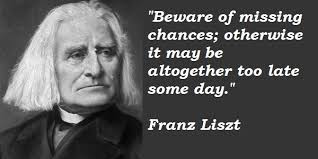
Franz Liszt was born in Raiding, near Ödenburg, October 22, 1811 and died in Bayreuth, July 31, 1886. He was a Hungarian composer and pianist who was a major influence during the romantic period. Liszt was an outstanding pianist at seven, composed at eight and made concert appearances at nine. In addition to being a piano virtuoso, he was also a critic, conductor, city music director, literary writer and transcriber of the works of other composers. He transcribed Beethoven’s Symphonies for the piano.
Franz Liszt began his career as the outstanding concert pianist of the century, who, along with the prodigious violinist Niccoló Paganini (1782-1840), created the cult of the modern instrumental virtuoso. To show off his phenomenal and unprecedented technique, Liszt composed a great deal of music designed specifically for this purpose, resulting in a vast amount of piano literature laden with dazzling, and other technical marvels. In this vein, Liszt composed a series of virtuosic rhapsodies on Hungarian gypsy melodies, the best-known being the all too familiar Hungarian Rhapsody no. 2. Liszt developed the rhapsody as a form of serious music. This kind of music is worlds apart from the generally more introspective, poetic music of pianist-composer Frédéric Chopin.
Liszt was wildly handsome and hugely talented. He was extremely popular in Paris during the 1830’s. It is said that women actually fainted at his piano recitals. He was the first to position the piano so that its lid reflected the sound and the audience could see his profile as he performed.
Liszt was the first to write a tone poem, which is an extended, single-movement work for orchestra, inspired by paintings, plays, poems or other literary or visual works, and attempting to convey the ideas expressed in those media through music. Such a work is Les Préludes, based on a poem in which life is expressed as a series of struggles, passions, and mysteries, all serving as a mere prelude to . . .what? The Romantic genre of the symphonic poem, as well as its cousin the concert overture, became very attractive to many later composers, including Saint-Saëns, Tchaikovsky, Dvorák, Sibelius, and Richard Strauss.
Listen to Liszt’s transcription of Meyerbeer’s Hellish Waltz from Robert du Diable, which probably caused more public commotion than any other piano piece in history.
• 1855 ~ William Barclay Squire, British musicologist
• 1893 ~ On this day a song called “Goodmorning to All” was copyrighted by two teachers who wrote it for their kindergarten pupils. The title was later changed to “Happy Birthday to You”. The copyright was claimed illegal in September, 2015.
• 1941 ~ Fry Me Cookie, with a Can of Lard was recorded by the Will Bradley Orchestra on Columbia. Ray McKinley was featured.
• 1942 ~ Dave Lovelady, Drummer with The Fourmost
• 1943 ~ C.F. (Fred) Turner, Musician with Bachman~Turner Overdrive
• 1947 ~ Bob Weir (Hall), American rock guitarist and singer with The Grateful Dead
• 1953 ~ Tony Carey, Keyboards with Rainbow
• 1959 ~ Gary Kemp, Guitarist with Spandau Ballet, brother of musician Martin Kemp
• 1969 ~ Wendy Wilson, Singer with Wilson Phillips, daughter of Beach Boys singer, Brian Wilson
• 1972 ~ John C. Fogerty and Creedence Clearwater Revival called it a career … and the group disbanded. Fogerty continued in a solo career with big hits including, Centerfield and The Old Man Down the Road.
• 1976 ~ Memphis, TN disc jockey Rick Dees and his ‘Cast of Idiots’ made it all the way to number one on the Billboard Hot 100 with the immortal Disco Duck(Part 1). Dees is still around, but not as a recording artist. He’s a DJ in Los Angeles and is hosting several varieties of the Weekly Top 40 show, syndicated around the world.
• 1983 ~ George Liberace passed away. He was an American musician and television performer. Born in Menasha, Wisconsin, he was the elder brother and business partner of famed U.S. pianist Liberace.
• 1990 ~ Art Blakey passed away. He was an American jazz drummer and bandleader.
• 2000 ~ David Golub, American pianist and chamber music conductor, passed away at the age of 50. Born in Chicago, Golub grew up in Dallas, where he began learning the piano. In 1969 he moved to New York and spent his student years honing his technique at New York’s Juilliard School of Music. He also began conducting during summer breaks at Vermont’s Marlboro festival. In 1979, he accompanied violinist Isaac Stern on a tour of China. A film about the tour, “From Mao to Mozart,” won the 1980 Academy Award for Best Documentary. As a performer, Golub was perhaps best known for his work with violinist MarkKaplan and cellist Colin Carr in the trio they formed in 1982. In the late 1990s, Golub began cultivating his interest in opera. Under his leadership, the Padua Chamber Orchestra recorded some of Haydn’s least-known work for opera. An acclaimed chamber ensemble performer – most notably with the Golub-Kaplan-Carr Trio – Golub led the Padua Chamber Orchestra during the 1994-95 season and took it on tour in the United States in 1999. He is survived by his wife, Maria Majno.
• 2001 ~ Oscar-winning composer and lyricist Jay Livingston, whose collaboration with Ray Evans led to such hits as Silver Bells, Que Sera, Sera and Mona Lisa, died of pneumonia. He was 86. Livingston’s songwriting partnership with Evans spanned 64 years. Often called the last of the great songwriters, Livingston and Evans had seven Academy Award nominations and won three – in 1948 for Buttons and Bows in the film The Paleface, in 1950 for Mona Lisa in Captain Carey, USA, and in 1956 for Que Sera, Sera in The Man Who Knew Too Much. They wrote the television theme songs for Bonanza and Mr. Ed, and were honored by the American Society of Composers, Authors and Publishers for the most performed music for film and TV for 1996. Livingston was born on March 28, 1915, in the Pittsburgh suburb of McDonald. He met Evans in 1937 at the University of Pennsylvania, where they were both students. The team’s final project was the recording, Michael Feinstein Sings the Livingston and Evans Song Book, due for 2002 release.
Happy Birthday is a song that I like to have each of my students learn at various levels appropriate to their level. When a friend or family member has a birthday, it’s great to be able to sit down and play.
It’s only been fairly recently that piano students could have this music in their books.
“Happy Birthday to You”, more commonly known as simply “Happy Birthday”, is a song that is traditionally sung to celebrate the anniversary of a person’s birth. According to the 1998 Guinness World Records, “Happy Birthday to You” is the most recognized song in the English language, followed by “For He’s a Jolly Good Fellow”.
The melody, or part you sing, of “Happy Birthday to You” comes from the song “Good Morning to All”, which has traditionally been attributed to American sisters Patty and Mildred J. Hill in 1893, although the claim that the sisters composed the tune is disputed.
Patty Hill was a kindergarten principal and her sister Mildred was a pianist and composer. The sisters used “Good Morning to All” as a song that young children would find easy to sing. The combination of melody and lyrics in “Happy Birthday to You” first appeared in print in 1912, and probably existed even earlier.
“Happy Birthday” in the style of Bach, Mozart, Beethoven, Mendelssohn, Chopin, Liszt, Dvorak, and Stravinsky. Find the melody!
Lots of legal stuff below which you can skip…
None of the early appearances of the “Happy Birthday to You” lyrics included credits or copyright notices. The Summy Company registered a copyright in 1935, crediting authors Preston Ware Orem and Mrs. R. R. Forman. In 1988, Warner/Chappell Music purchased the company owning the copyright for US$25 million, with the value of “Happy Birthday” estimated at US$5 million. Based on the 1935 copyright registration, Warner claimed that the United States copyright will not expire until 2030, and that unauthorized public performances of the song are illegal unless royalties are paid to Warner. In one specific instance in February 2010, these royalties were said to amount to US$700. By one estimate, the song is the highest-earning single song in history, with estimated earnings since its creation of US$50 million.In the European Union, the copyright for the song expired on January 1, 2017.
The American copyright status of “Happy Birthday to You” began to draw more attention with the passage of the Sonny Bono Copyright Term Extension Act in 1998. When the U.S. Supreme Court upheld the Act in Eldred v. Ashcroft in 2003, Associate Justice Stephen Breyer specifically mentioned “Happy Birthday to You” in his dissenting opinion. American law professor Robert Brauneis, who extensively researched the song, concluded in 2010 that “It is almost certainly no longer under copyright.”
In 2013, based in large part on Brauneis’s research, Good Morning to You Productions, a company producing a documentary about “Good Morning to All”, sued Warner/Chappell for falsely claiming copyright to the song. In September 2015, a federal judge declared that the Warner/Chappell copyright claim was invalid, ruling that the copyright registration applied only to a specific piano arrangement of the song, and not to its lyrics and melody.
In 2016, Warner/Chappell settled for US $14 million, and the court declared that “Happy Birthday to You” was in the public domain.
Legal stuff is finished and people can now sing and play “Happy Birthday to You” whenever and wherever they want.
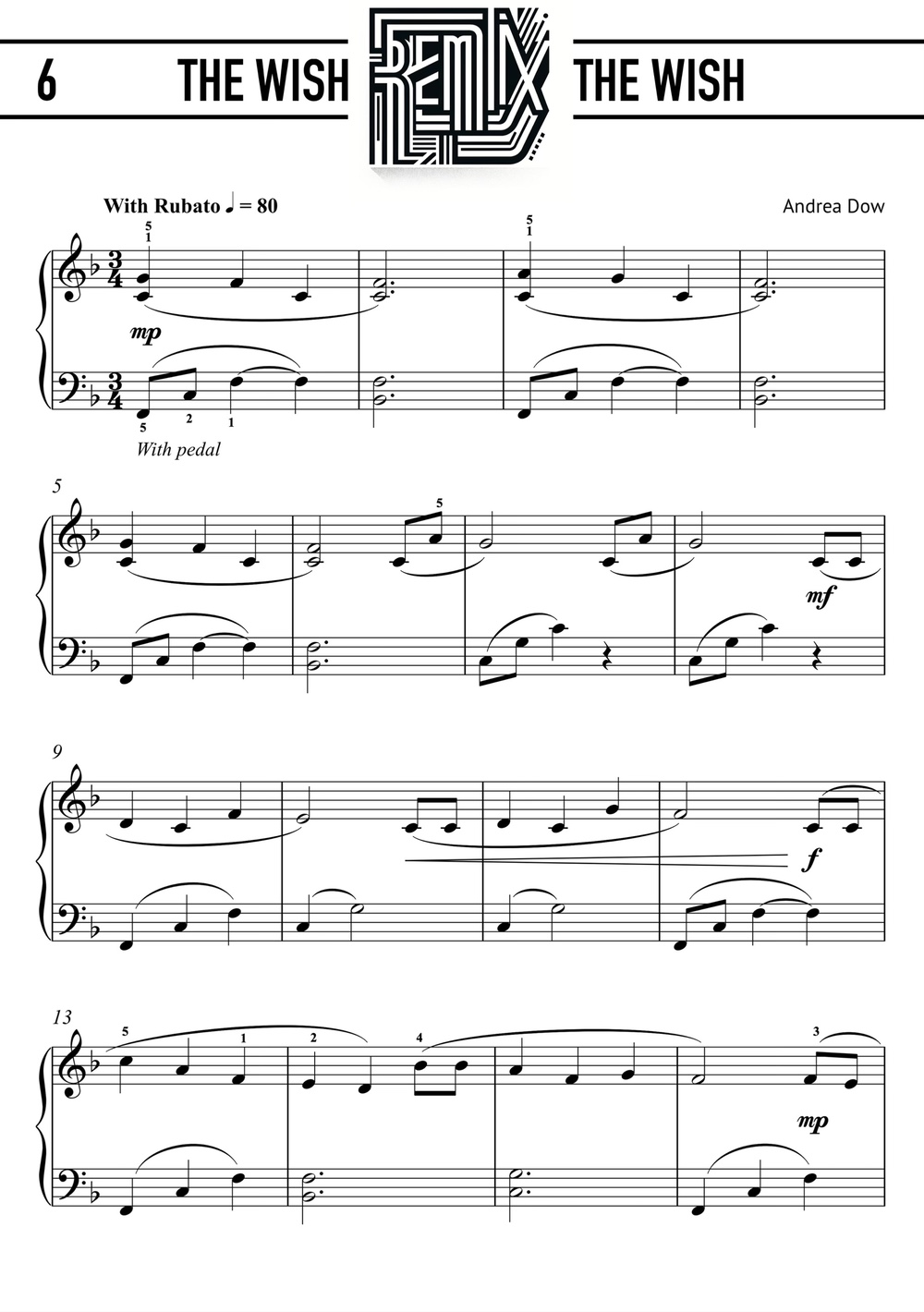
Students in Wunderkeys may play this version from Remix: Teen Hits from Kids Tunes
One of my all-time versions of Happy Birthday, in duet form – and I have the music if you want to tackle it.
Happy Birthday is a song that I like to have each of my students learn at various levels appropriate to their level. When a friend or family member has a birthday, it’s great to be able to sit down and play.
It’s only been fairly recently that piano students could have this music in their books.
“Happy Birthday to You”, more commonly known as simply “Happy Birthday”, is a song that is traditionally sung to celebrate the anniversary of a person’s birth. According to the 1998 Guinness World Records, “Happy Birthday to You” is the most recognized song in the English language, followed by “For He’s a Jolly Good Fellow”.
The melody, or part you sing, of “Happy Birthday to You” comes from the song “Good Morning to All”, which has traditionally been attributed to American sisters Patty and Mildred J. Hill in 1893, although the claim that the sisters composed the tune is disputed.
Patty Hill was a kindergarten principal and her sister Mildred was a pianist and composer. The sisters used “Good Morning to All” as a song that young children would find easy to sing. The combination of melody and lyrics in “Happy Birthday to You” first appeared in print in 1912, and probably existed even earlier.
“Happy Birthday” in the style of Bach, Mozart, Beethoven, Mendelssohn, Chopin, Liszt, Dvorak, and Stravinsky. Find the melody!
Lots of legal stuff below which you can skip…
None of the early appearances of the “Happy Birthday to You” lyrics included credits or copyright notices. The Summy Company registered a copyright in 1935, crediting authors Preston Ware Orem and Mrs. R. R. Forman. In 1988, Warner/Chappell Music purchased the company owning the copyright for US$25 million, with the value of “Happy Birthday” estimated at US$5 million. Based on the 1935 copyright registration, Warner claimed that the United States copyright will not expire until 2030, and that unauthorized public performances of the song are illegal unless royalties are paid to Warner. In one specific instance in February 2010, these royalties were said to amount to US$700. By one estimate, the song is the highest-earning single song in history, with estimated earnings since its creation of US$50 million.In the European Union, the copyright for the song expired on January 1, 2017.
The American copyright status of “Happy Birthday to You” began to draw more attention with the passage of the Sonny Bono Copyright Term Extension Act in 1998. When the U.S. Supreme Court upheld the Act in Eldred v. Ashcroft in 2003, Associate Justice Stephen Breyer specifically mentioned “Happy Birthday to You” in his dissenting opinion. American law professor Robert Brauneis, who extensively researched the song, concluded in 2010 that “It is almost certainly no longer under copyright.”
In 2013, based in large part on Brauneis’s research, Good Morning to You Productions, a company producing a documentary about “Good Morning to All”, sued Warner/Chappell for falsely claiming copyright to the song. In September 2015, a federal judge declared that the Warner/Chappell copyright claim was invalid, ruling that the copyright registration applied only to a specific piano arrangement of the song, and not to its lyrics and melody.
In 2016, Warner/Chappell settled for US $14 million, and the court declared that “Happy Birthday to You” was in the public domain.
Legal stuff is finished and people can now sing and play “Happy Birthday to You” whenever and wherever they want.
One of my all-time versions of Happy Birthday, in duet form – and I have the music if you want to tackle it.
1685 ~ Johann Sebastian Bach, German composer birthday (Old Style)
Bach’s Toccata and Fugue in d minor was featured in the Walt Disney movie Fantasia and the new Fantasia 2000
Read quotes by and about Bach
More information about Bach Grammy winner
Victor Borge was born in 1909 in Copenhagen, Denmark. He was an entertainer and pianist – a deliciously funny performer. He studied at the Royal Danish Academy of Music, Copenhagen, and in Vienna and Berlin.
He made his debut as a pianist in 1926, and as a revue actor in 1933. From 1940 until his death in 2000 he worked in the USA for radio, television, and theatre, and has performed with leading symphony orchestras on worldwide tours since 1956.
He was best known for his comedy sketches combining music and narrative. He used his classical training to skew serious music and performers.
From his obituary:
Pianist Victor Borge, died in his sleep Dec 23, 2000 at his Greenwich, Connecticut home, was known as the unmelancholy Dane of international show business. He would have turned 92 on Jan. 3, 2001.
“The cause of death was heart failure,” his daughter, Sanna Feirstein, told Reuters.
“He had just returned from a wonderfully successful trip to Copenhagen … and it was really heartwarming to see the love he experienced in his home country,” she said.
Borge was one of five performers selected for the Kennedy Center Honors in 1999.
“He went to sleep, and they went to wake him up this morning, and he was gone,” said his agent, Bernard Gurtman.
“He had so much on the table, and to the day he died he was creative, and practicing piano several hours a day,” Gurtman told Reuters. “He was just a great inspiration.”
Funeral services will be private, his daughter said.
Borge made a career of falling off piano stools, missing the keys with his hands and getting tangled up in the sheet music.
One of his inspirations was a pianist who played the first notes of the GriegA Minor Concerto and then fell on the keys dead.
He said that the only time he got nervous on stage was when he had to play seriously and adds that if it had not been for Adolf Hitler he probably would never have pursued a career as a concert-hall comedian.
Until he was forced to flee Denmark in 1940 he was a stage and screen idol in his native country.
Lampooned Hitler
But as a Jew who had lampooned Hitler, Borge — his real name was Boerge Rosenbaum — was in danger and fled first to Sweden and then to the United States, where he arrived penniless and unknown and by a fluke got booked on the Bing Crosby radio show. He was an instant success.
He became an American citizen in 1948, but thought of himself as Danish. It was obvious from the numerous affectionate tributes and standing ovations at his 80th birthday concert in Copenhagen in 1989 that Danes felt the same way.
In the concert at Copenhagen’s Tivoli gardens, Borge played variations on the theme of “Happy Birthday to You” in the styles of Mozart, Brahms, Wagner and Beethoven — all executed with such wit that the orchestra was convulsed with laughter that a woman performing a piccolo solo was unable to draw breath to play.
“Playing music and making jokes are as natural to me as breathing,” Borge told Reuters in an interview after that concert.
“That’s why I’ve never thought of retiring because I do it all the time whether on the stage or off. I found that in a precarious situation, a smile is the shortest distance between people. When one needs to reach out for sympathy or a link with people, what better way is there?
“If I have to play something straight, without deviation in any respect, I still get very nervous. It’s the fact that you want to do your best, but you are not at your best because you are nervous and knowing that makes you even more nervous.”
His varied career included acting, composing for films and plays and writing but he was best known for his comic sketches based on musical quirks and oddities.
Unpredictable Routine
His routines were unpredictable, often improvised on stage as his quick wit responded to an unplanned event — a noise, a latecomer in the audience — or fixed on an unlikely prop — a fly, a shaky piano stool.
Borge was born in Denmark on January 3, 1909, son of a violinist in the Danish Royal Orchestra.
His parents encouraged him to become a concert pianist, arranging his first public recital when he was 10. In 1927 he made his official debut at the Tivoli Gardens.
Borge’s mischievous sense of humor was manifest from an early age. Asked as a child to play for his parent’s friends he would announce “a piece by the 85-year-old Mozart” and improvise something himself.
When his mother was dying in Denmark during the occupation, Borge visited her, disguised as a sailor.
“Churchill and I were the only ones who saw what was happening,” he said in later years. “He saved Europe and I saved myself.”
From 1953 to 1956, he appeared in New York in his own production “Comedy in Music,” a prelude to world tours that often took him to his native Scandinavia.
On radio and television, Borge developed the comedy techniques of the bungling pianist that won him worldwide fame.
Many of his skits were based on real-life events. One of his classics evolved from seeing a pianist playing a Tchaikovsky concerto fall off his seat.
Borge’s dog joined the show after it wandered on stage while he was at the keyboard — an entrance nobody would believe had been unplanned.
One incident could not be repeated. A large fly flew on to Borge’s nose while he was playing. “How did you get that fly to come on at the right time?” people asked. “Well, we train them,” Borge explained.
Borge’s book, “My Favorite Intervals”, published in 1974, detailed little-known facts of the private lives of composers describing Wagner’s pink underwear and the time Borodin left home in full military regalia but forgot his trousers.
In 1975, Borge was honored in recognition of the 35th anniversary of his arrival in the United States and his work as unofficial goodwill ambassador from Denmark to the United States. He celebrated his 75th birthday in 1984 with a series of concerts at Carnegie Hall and in Copenhagen.
Borge received a host of honors from all four Scandinavian countries for his contributions to music, humor and worthy causes.
Borge, who had lived in Greenwich since 1964, is survived by five children, nine grandchildren, and one great grandchild. His wife of many years, Sanna, died earlier that year.


 Grammy winner
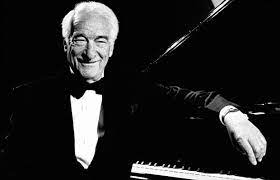





 Victor Borge was born in 1909 in Copenhagen, Denmark. He was an entertainer and pianist – a deliciously funny performer. He studied at the Royal Danish Academy of Music, Copenhagen, and in Vienna and Berlin.
 MaryO'Studio