. 1710 ~ Thomas Arne, English composer
More information about Arne
. 1890 ~ Vaslav Nijinsky, Ukrainian ballet dancer
. 1891 ~ Clara Schumann gave her final piano performance.
. 1921 ~ Gordon MacRae, Singer
. 1923 ~ Dr. Lee DeForest demonstrated his putting sound on motion picture film. One of the pioneers of radio in the early 1900s, DeForest came up with a snappy name for his invention; he called it phonofilm. Today, we call it a soundtrack.
. 1937 ~ Charles-Marie Widor died. He was a was a French organist, composer and teacher.
. 1939 ~ Artie Shaw and his band recorded the standard, Deep Purple, in New York for the Bluebird label. Listening carefully after the first minute or so, one can hear Helen Forrest sing the vocal refrain. Larry Clinton and his orchestra had a number one song with a similar arrangement of the same tune that same year. It later was a hit for saxophonist, Nino Tempo and his sister, April Stevens in 1963. Hundreds of versions of this song have been recorded through the years, making it one of the most popular standards of all time.
. 1940 ~ Al Jarreau, Singer
. 1946 ~ Liza Minnelli, American actress and singer of popular music
More information about Minnelli
. 1948 ~ James Taylor, American folk-rock singer, songwriter, and guitarist
. 1955 ~ One of the great groups of jazz appeared for the first time at Carnegie Hall in New York City. The Dave Brubeck Quartet presented a magnificent concert for jazz fans.
. 1969 ~ Wedding bells rang in London for singer, Paul McCartney and his new bride, photographer, Linda Eastman.
If you haven’t seen someone playing the piano backwards before, take a good look at this video.
A brother and sister are seen battling it out on the piano in this clever clip, first nudging each other out of the way then rotating around on their stool.
Jason and Sarah Black perform a mash-up of Frozen songs including Love is an Open Door, For the First Time in Forever, Do You Want to Build a Snowman and Let it Go.
. 1851 ~ The first performance of Giuseppe Verdi’s opera “Rigoletto” was given in Venice.
“Rigoletto lacks melody. This opera has hardly any chance of being kept in the repertoire.” ~ Gazette Musicale de Paris, reviewing Rigoletto shortly after its premiere.
. 1897 ~ Henry Dixon Cowell, American composer
More information about Cowell
. 1903 ~ Lawrence Welk, American accordionist and conductor of “champagne” music
More information about Welk
. 1914 ~ William Lloyd Webber, English composer
. 1919 ~ Mercer Ellington, Trumpeter, bandleader, songwriter, only son of Duke Ellington. He led the Duke’s band after he died.
. 1921 ~ Astor Piazzola, Argentine tango composer, bandoneon player and arranger
. 1942 ~ Vaughn Monroe and his orchestra recorded the classic, Sleepy Lagoon. It was the last song Monroe would record for Bluebird Records. Vaughn sang on the track while Ray Conniff played trombone. Both later moved to different record companies. Monroe went with RCA and Conniff to Columbia. The big- voiced baritone of Monroe was regularly heard on radio and he was featured in several movies in the 1950s. He died in May, 1973. Racing With the Moon and Ghost Riders in the Sky were two of his greatest contributions to popular music.
. 1950 ~ Bobby McFerrin, Singer, pianist, jazz musician, songwriter, improvisational solo, McFerrin can sing all vocal parts and imitate instruments.
. 1968 ~ Otis Redding posthumously received a gold record for the single, (Sittin’ on) The Dock of the Bay. Redding was killed in a plane crash in Lake Monona in Madison, WI on December 10, 1967. The song was recorded just three days before his untimely death. He recorded 11 charted hit songs between 1965 and 1969. Otis Redding was inducted into the Rock and Roll Hall of Fame in 1989.
. 1985 ~ DJs around the U.S. began questioning listeners to see which ones could name the 46 pop music stars who appeared on the hit, We Are the World. The song, airing first on this day as a single, contains a “Who’s Who” of contemporary pop music.
. 2000 ~ Roy Henderson, a baritone famed for his performances of Frederick Delius’ works and a teacher of Kathleen Ferrier, died. He was 100.
. 2003 ~ Sidney Lippman, a songwriter who helped compose hits for Nat King Cole and other artists, died. He was 89. Lippman, who studied musical composition at the Juilliard School in New York, wrote or co-wrote several well-known songs, including Too Young, a song Cole took to the top of the charts in 1951. That hit, co-written by longtime collaborator Sylvia Dee, came two years after he teamed up with Buddy Kaye and Fred Wise on ‘A’ You’re Adorable (TheAlphabet Song), a No. 1 hit performed by Perry Como and the Fontane Sisters.
. 2015 ~ Jimmy Greenspoon died. He was an American keyboard player and composer, best known as a member of the band, Three Dog Night.
Seymour Bernstein might have ranked alongside such classical pianists as Alfred Brendel and Van Cliburn. His recitals were glowingly reviewed and he had a highly supportive patron. Yet, at the significant age of 50, he voluntarily withdrew from the world of public performance to concentrate on teaching.
When it comes to piano technique and music theory, he clearly has much to offer. But he also has insight into how one best pursues an artistic career in general, or at least that is what one future Oscar nominee thought when he happened to meet Bernstein at a dinner party. The music teacher gets a low-key but satisfying ovation in Ethan Hawke’s documentary profile, “Seymour: An Introduction.”
Evidently, Hawke found in Bernstein an empathetic counselor-guru who could well understand his bouts of stage fright and the general career uncertainty that was plaguing him. Perhaps he was also frustrated about that film he had spent over 10 years on, but had yet to come out. Regardless, Bernstein had a knack for saying reassuring things.
In a variety of master classes and private lessons, we observe Bernstein at work. He is indeed a calm and constructive instructor, but also firm and specific. If you have the talent, he will refine it. Should you doubt it, several of his former students, including pianists Joseph Smith and Kimball Gallagher, offer their reminiscences and insights into Bernstein’s lasting influence on their careers.
For his documentary directorial debut, Hawke was not out to rake any muck. While not exactly hagiography, his “Introduction” is unflaggingly nice and polite. Fortunately, Bernstein is a New Yorker (albeit a really pleasant one), whose experienced, down-to-earth personality keeps it all real and grounded.
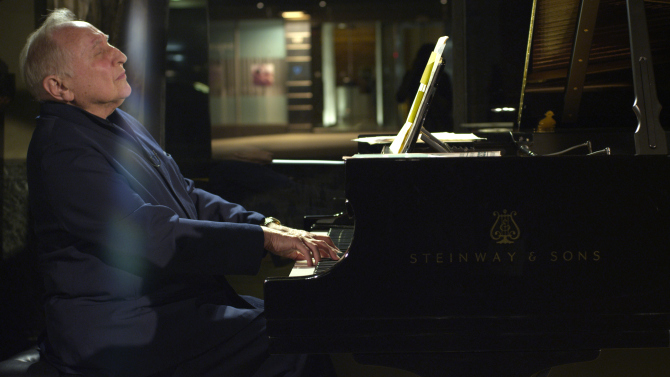
Anyone who knows pianos will not be surprised to see the prime placement for American Steinway in “Seymour.” As always, their concert models look and sound lovely. It is also cool to see that they still consider Bernstein a Steinway artist 30-some years after his last public performance. Fittingly, Hawke coaxes Bernstein into a return performance in the Steinway Rotunda on 57th Street, which naturally serves as the closing sequence for the film. Obviously, he still has his touch.
“Seymour: An Introduction” has surely received considerably more attention because of Hawke’s involvement than it otherwise would have, but that is a fine way for him to spend some of his accrued “Boyhood” and “Before Midnight” capital in a way that will generate further good will. It is a very refined and civilized film that will probably have a number of viewers checking out YouTube for Bernstein’s original compositions. (He has a number of them posted, including “The Hawke.”)
Respectfully recommended for classical connoisseurs, Hawke fans, and Steinway admirers, the Salingerishly titled “Seymour: An Introduction” opens this Friday, March 13, in New York at the IFC Center.
. 1832 ~ Muzio Clementi died. He was an Italian-born English composer, pianist, pedagogue, conductor, music publisher, editor, and piano manufacturer.
. 1844 ~ Pablo de Sarasate, Spanish violinist
. 1879 ~ Ignaz Moscheles died. He was a Bohemian composer and piano virtuoso
. 1892 ~ Arthur Honegger, French composer
Read quotes by and about Honegger
More information about Honegger
1903 ~ “Bix” Beiderbecke, American jazz cornetist
More information about Beiderbecke
. 1935 ~ Nelson Eddy recorded Ah! Sweet Mystery of Life for Victor Records. The song came from the film, “Naughty Marietta”. Later, Eddy recorded the classic tune with Jeanette MacDonald.
. 1937 ~ An audience of 21,000 jitterbuggers jammed the Paramount Theatre in New York City to see a young clarinetist whom they would crown, ‘King of Swing’ on this night. The popular musician was Benny Goodman.
. 1940 ~ W2XBS-TV in New York City originated the first televised opera as members of the Metropolitan Opera Company presented scenes from “I Pagliacci”.
. 1956 ~ Julie Andrews was 23 years old this night when she made her TV debut. She appeared with Bing Crosby and Nancy Olson in the musical adaptation of Maxwell Anderson’s play, “High Tor”.
. 2003 ~ Lionel Dakers, who directed the Royal School of Church Music for 16 years, died at age 79. Dakers was a stickler for high musical standards and opposed some of the modernizing trends in English church music. Dakers was organist at Ripon Cathedral from 1954 to 1957, then moved to Exeter Cathedral before his appointment as director of the Royal School of Church Music in 1972. In 1976, he was appointed a director of Hymns Ancient & Modern, publisher of some of the most widely used Anglican hymnals.
When you listen to music, multiple areas of your brain become engaged and active. But when you actually play an instrument, that activity becomes more like a full-body brain workout.
What’s going on? Anita Collins explains the fireworks that go off in musicians’ brains when they play, and examines some of the long-term positive effects of this mental workout.
. 1910 ~ Samuel Barber, Pulitzer Prize-winning American composer
Read quotes by and about Barber
More information about Barber
. 1925 ~ Billy Ford, Singer with Billy & Lillie
. 1927 ~ John Beckwith, Canadian composer and music critic
. 1930 ~ Thomas Schippers, American conductor
. 1932 ~ Keely Smith (Dorothy Keely), Singer, was married to Louis Prima
. 1942 ~ Tommy Dorsey and his orchestra recorded Well, Git It! for Victor Records. Ziggy Elman was featured on the session which was recorded in Hollywood. Sy Oliver arranged the Dorsey classic.
.1950 ~ Howard Gordon Shelley OBE, British pianist and conductor
. 1974 ~ Many new musical faces were on the scene, including Terry Jacks, who was starting week two of a three-week stay at the top of the pop charts with his uplifting ditty, Seasons in the Sun. Other newcomers: Jefferson Starship, Billy Joel, Kiss, Olivia Newton-John, Kool & the Gang and The Steve Miller Band.
. 1985 ~ The most requested movie in history, “Gone With The Wind”, went on sale in video stores across the U.S. for the first time. The tape cost buyers $89.95. The film, starring Clark Gable and Vivien Leigh, cost $4.5 million to produce and has earned over $400 million, making it one of the biggest money-makers in motion picture history. “GWTW” is now the cornerstone of the massive MGM film library owned by Ted Turner.
. 1986 ~ Bill Cosby broke Liberace’s long-standing record and earned the biggest box-office gross in the 54-year history of Radio City Music Hall in New York City.
. 2001 ~ Richard Stone, whose musical compositions for such popular cartoon shows as “Animaniacs” and “Freakazoid” won him more than a half-dozen Emmys, died Friday at the age of 47. Stone grew up watching Warner Bros. “Looney Tunes” cartoons in the 1950s and ’60s before going on to study cello and music composition in college. He not only emulated the style of Carl Stalling, who composed hundreds of musical scores for classic Warner Bros. cartoons in the 1930s, ’40s and ’50s, but also incorporated elements of jazz, Broadway, country and rock music into his work. Stone also carved out his own style on modern-day shows, winning seven Emmys since 1994 for such cartoons as “Animaniacs,” “Freakazoid” and “Histeria!” He also worked on the cartoons “Pinky & the Brain,” “Taz-Mania,” “Road Rovers” and “The Sylvester & Tweety Mysteries” and scored several movies, including the cult classics “Sundown: The Vampire in Retreat” and “Pumpkinhead.”
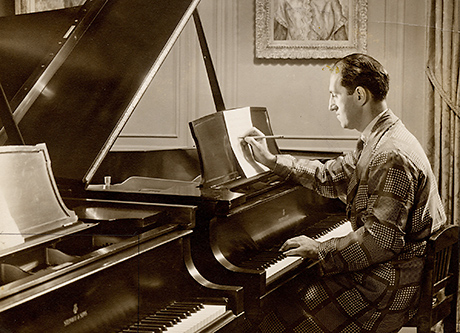
The Gershwin family donated the Steinway to the University as part of the George and Ira Gershwin initiative that is focused on research and study of the brothers’ music.
According to Marc Gershwin, George and Ira’s nephew, “I wanted the instrument to be accessible to the students and faculty who would be preserving the legacy of George and Ira Gershwin’s music… I’m delighted that the piano will once again be in regular use [by students and faculty], and am thrilled that it has been restored to performance condition.” [Two other Gershwin Steinways are in museums.]
From what I know of George he would have wanted it this way. Unlike some composers George was a gifted pianist. He had a rich social life and enjoyed playing his music for anyone who would listen.
There’s a lesson in that thought. If you have something valuable, sometimes it becomes more valuable – or at least more appreciated – when people can see it and use it. If you look at the piano as an instrument of technology that is it, then it makes sense that organizations give people access to technology – as well as resources – to do their work.
. 1714 ~ Carl Phillip Emanuel (C.P.E.) Bach, German composer
More information on C. P. E. Bach
. 1857 ~ Ruggero Leoncavallo, Italian composer
More information about Leoncavallo
. 1866 ~ “It is possible to be as much of a musician as Saint-Saëns; it is impossible to be more of one!” ~ Franz Liszt on meeting fellow composer Camille Saint-Saëns in Paris.
. 1911 ~ Alan Hovhaness, American composer
More information about Hovhaness
. 1923 ~ Cyd Charisse, Dancer
. 1927 ~ Dick Hyman, Pianist and music director for Arthur Godfrey
. 1961 ~ Conductor, Sir Thomas Beecham died at the age of 81.
. 1962 ~ The Beatles performed for the first time on the BBC in Great Britain. John,Paul, George and … Pete Best sang Dream Baby on the show, “Teenager’s Turn” on ‘Auntie Beeb’ (as the BBC was known).
. 2001 ~ Ballet Legend Dame Ninette De Valois died at the age of 102. She was the founder of Britain’s Royal Ballet who launched dancer Margot Fonteyn on the road to stardom. De Valois, a strict and demanding disciplinarian with her pupils, was a gifted and theatrical choreographer who almost single-handedly put British ballet on the international stage. The doyenne of dance helped to nurture the talents of unknowns like Fonteyn and courted controversy in the 1960’s at the height of the Cold War when she invited Russian dancer Rudolph Nureyev to appear with her company. De Valois always gave credit to Russian impresario Sergei Diaghilev for teaching her all she knew. “Everything,” she once said of the Ballet Russe legend. “Diaghilev just managed the whole company. He knew all about the different teachers. He knew the types of teachers he wanted, he knew the type of ballet he wanted. He was a musician.” Born Edris Stannus in 1898 in the Irish county of Wicklow, she graduated from Irish jig to the ballet, worked with the writer W.B. Yeats at Dublin’s Abbey Theater and then, almost single-handedly, brought ballet to the fore in Britain. The famed diva, who adopted her professional name from an ancestor who had married into a French family, was first inspired at the age of 11 when she watched Anna Pavlova dancing The Dying Swan. In 1923, she joined Diaghilev’s troupe in Monte Carlo and began to lay the foundations of her own ballet empire. She gave up dancing herself after discovering that she had been suffering for years from polio. “It was no tragedy. I wasn’t that great,” she once said. In 1926, she opened her own ballet school in London. From the tiniest beginnings, she built up the Sadlers Wells Ballet in less than a decade. At the end of World War II, the company moved triumphantly into the Royal Opera House. A ballet dynasty was born. De Valois retired in 1963 but remained intimately involved in the ballet school, forever the sharp-tongued martinet who could strike terror in tomorrow’s ballet hopefuls.
. 2001 ~ Maude Rutherford, a singer and dancer in the glory days of black theater during the 1920s, died. She was believed to have been 104. Rutherford was billed as the Slim Princess when she worked with entertainers such as Fats Waller, Josephine Baker and Pearl Bailey. She was a featured performer and favorite at Harlem’s Cotton Club. Rutherford’s theater credits include: “Dixie to Broadway,” (1924), “Chocolate Sandals,” (1927), and “Keep Shufflin”‘ (1928). She retired from show business in 1950 and worked as a switchboard operator at an Atlantic City hotel.
. 2003 ~ Adam Faith, a square-jawed British singer who was briefly a Cockney challenger to Elvis Presley’s rock ‘n’ roll crown, died of a heart attack. He was 62. Born Terry Nelhams in west London in 1940, Faith was a handsome teenager who was playing with a skiffle music group – a mixture of jug band, acoustic, folk, blues and country and western styles – when he was spotted by producers of a British Broadcasting Corp. music program. Adopting the stage name Adam Faith, he became – alongside Cliff Richard, Tommy Steele and Billy Fury – a pop star of the pre-Beatles era. Developing a hiccuping delivery reminiscent of Buddy Holly, Faith had more than 20 British hits, including the chart-topping What Do You Want? and Poor Me. Faith also was a versatile actor, appearing in films like Beat Girl,Mix Me A Person and 1975’sStardust opposite David Essex. In the 1970s he played a Cockney ex-con in the TV series Budgie.
In this new campaign by Folksam, one of the largest insurance companies in Sweden, 15 children, aged 2 to 5, were invited to participate in a challenging musical experiment lead by Sweden’s famous conductor, oboist and composer, Jan Risberg.
For a duration of five weeks, these lively and boisterous children would take piano classes in order to learn a 19th-century musical piece by French composer and pianist Erik Satie. The entire experience was intended to be playful and fun for the kids.
Risberg used creative techniques to teach the chords and the melody, like colored keys, sound boxes and simple word associations like “pancake”.
And the result is possibly the most endearing thing we’ve ever seen!


 MaryO'Studio