Will You Be Going to the Circus This Spring?

A small break from Christmas music since we been to the Big Apple Circus several times both here and in New York.  The Big Apple is bringing its one-ring circus show to National Harbor March 8 through April 1, 2018.
 

big-apple

In New York:  Back on the subway to the Lincoln Center for the Big Apple Circus.  We’d seen them a couple times here but Michael had never seen them.  On the grounds of the Lincoln Center, everything is under the tents where here, much is outside.

We found that Michael had bought tickets in the VIP Seating & Lounge.  This included:

  • The best seats in the tent! First row, center ringside
  • Private Concierge
  • Complimentary Circus Meal – includes hot dog, soda and choice of popcorn or cotton candy
  • Cheese, vegetable and fruit crudite
  • Juice, water, wine, and beer
  • Dessert
  • Souvenir Book (We didn’t get this!)
  • Private restrooms (They called this the Golden Restroom)
  • Coat rack
  • Photo ops as you try on our circus costumes and hats
  • Close-up magician who did card tricks with us

THE GRAND TOUR is a circus extravaganza set in the 1920s and featuring acts from the four corners of the globe. Ships, trains, automobiles, and airplanes will serve as the backdrop for breathtaking acts of wonder, accompanied by the seven-piece Big Apple Circus Band playing live at each of more than 100 performances. Acts will include clowns, jugglers, acrobats, and aerialists, from Africa, Asia, Australia, Europe, and North and South America, as well as domestic and rescue animals, all creating performances that will leave audiences smiling and cheering. The show runs 1 hour and 50 minutes including a 20-minute intermission.

I was glad to see the ringmaster, John Kennedy Kane, was back.  The last time we went here at home, there had been a female ringmaster.

There were so many neat acts and we were right there, front and center, to see them.  Some of the acts seemed like they would land in our laps.

This is one of the clown acts:

A sample of some of the other acts.  I loved the Wheel of Wonder, about 1:20:

And, a short TV interview:

This video is so cool – “Our performers give a bird’s eye view of what it’s like to perform under the Big Top! Get your tickets today and see the joy and wonder of this season’s show for yourself!

WINDJAMMERS

Circus marches are called “screamers” because they are traditionally so high, loud & fast!! Circus Band members are often called “windjammers” because they jam so much wind into their instruments in the process of playing these screamers. Playing the circus requires incredible endurance & skills on your instrument. The windjammers play almost none stop and much of the music is really difficult!

The greatest circus bands were about 100 years ago in the heyday of the circus. At that time the big top band could be 25 or so, plus there were often sideshow musicians as well. Cowboy bands, women’s bands and bands of Blacks were often part of the sideshows.

Contemporary circuses are much smaller all the way around, and some don’t use live musicians at all, just “canned” music (recordings). Others carry 3 musicians, a drummer, a trumpet player and a keyboard (synthesizer) player. A few, like the Big Apple Circus, still have bands. The Big Apple Circus has 8 musicians on its bandstand: a conductor/trumpet, a person who plays alto sax and clarinet, one who plays tenor sax and flute, a violin, a trombone, a bass player, a keyboard player and a drummer.

In the “old days,” being a circus musician was one of the most strenuous jobs a musician could have. In the days before musicians’ unions, the windjammer would be expected to play for the circus parade, play a pre-show free concert for the townspeople, ballyhoo around the grounds before the big top show, play the show itself (nonstop for two or three hours!), play post show concerts on the grounds or play sideshows. Then after everyone left, they helped take down the tents or do other chores around the grounds. It was a busy day and the pay was not very good, but it was an exciting life with lots of great music, and many musicians loved it!

THE MUSIC

Entry of the Gladiators (Thunder and Blazes) was written in 1897 by, the Czechoslovakian composer, Julius Fucik (1872-1916). This march is a classic circus march & one that just about everyone will think, “Ah, circus!” when they hear it. Thunder and Blazes (as it is most frequently called) and Fucik’s Florentiner March are probably his most well known marches.

Most circus marches follow the standard American military march form, but often abbreviated (no repeats in the second half):

  • Introduction (a bit longer than military marches)
  • First strain (repeated)
  • Second strain (repeated)
  • Trio (more mellow and the key changes)
  • Breakup strain (often called the dogfight in military marches)
  • Last strain

In a circus march, the last strain is often the same as the trio, but louder, and often the trio, breakup strain and last strain are not repeated like they are in a military march (in military marches, the trio and breakup strain are often reversed & the way they repeat may vary).

The music sets the scene for the performer’s act. Different music is needed for different kinds of acts: the bareback riders galloping around the hippodrome need a lively tune, the trapeze artists want something more peaceful, and of course the clowns need music that sounds humorous (like trombone smears!).

In the early days of the circus, the band masters would take some of the European classical music and arrange it for the circus band. “The most obvious example would be the beautiful, flowing waltz music that is essential to the trapeze artists (‘flyers’ and ‘catchers’). The bandmaster and musicians must be precise in coordinating the music and the timing of the artists, requiring rehearsal with the artists and the musicians.  Similarly, it may be interesting to note that the bareback riders perform in a smaller ring because of the gait of the horses. The centrifugal effect requires a ring of a certain diameter for timing. Thus, the conductor must follow the gait of the horses, whereas the aerialists depend on the tempo of the music for timing their act.”

Modern circuses also play a lot of popular tunes, jazz and other songs that people will recognize. You will likely hear fewer of the standard circus marches at a circus today.

The drummer has a particularly challenging and important role in the circus music. He/she must “play the tricks.” Usually the drummer is situated so that he can see the ring because it is his job to accent and intensify what is happening in the ring. This was true 100 years ago, and it is true today. If the act is getting tense, the drummer will get intense. If someone slides down a rope or vaults off the trampoline, there will be a cymbal crash or drum hit when the performer reaches the floor. Sometimes the cues come from the conductor or from the ringmaster, but sometimes it is the drummer who is really in charge!

Circus bands occasionally play a John Philip Sousa composition during the traditional Center Ring Concert, but his melodic marches are not the right structure for most circus acts.

Sousa’s Stars and Stripes Forever is never part of the regular program. It is reserved for emergency use – sometimes called the “Disaster March”. If a major problems happens — an animal gets loose, a high wind threatens the tent, or a fire breaks out — the band plays the march as warning signal to every worker on the circus lot that something is wrong.

(Click here for information on the Hartford fire of 1944)

For lesser problems, the 12th Street Rag was played to alert the clowns to come out and divert attention during the more common mishaps.

Edward F. Shevlin describes what goes on in the circus band as follows:

“Our music is usually by Karl King,  Alexander, Fred Jewell, C. E. Duble and other old time circus bandmasters and musicians.  Much of the music by these circus musician-composers is amenable to quick cut-offs and tempo changes as necessary to fit particular acts. Hence, Windjammers usually play two musicians to a stand so that when the conductor cuts to a new piece and tempo, one musician can quickly move the music to expose the next piece while the other continues without skipping a beat! We might quickly go from a march to a Samba or rhumba or galop; or from a waltz to an up-tempo march or galop for the “come down” when the aerialists quickly descend into the net or slide down a rope at the conclusion of their act . . .followed by that ubiquitous B-flat chord! The old circus bands would play anything from Ragtime to a Polonaise or a tone poem!”

*Information from an email from Edward F. Shevlin, a Windjammer who happened upon this page! Many thanks, Mr. Shevlin!

THE BANDWAGON

ParadeWagon

When the circus came to town, there was always a circus parade — the parade served to get the wagons filled with people, equipment, baggage, tents and animals to the location of the circus, but it also provided some free advertisement. The wagons were very elaborate & were intended to get people interested in the circus so they would come and see the acts. The band road on top of a bandwagon and inside the bandwagon was luggage, tents and other necessities.

Hey, have you ever heard the term, “jump on the bandwagon”? Here’s the story. In 1848, when Zachary Taylor won the Whig party nomination for president, Dan Rice, a famous clown whose attire inspired the image of Uncle Sam, invited Mr. Taylor to ride on the bandwagon that Dan Rice had. When the bandwagon arrived at the center of town, Dan Rice stopped his parade and made a very emotional speech supporting Zachary Taylor’s candidacy. Someone noted that Dan Rice was on Mr. Taylor’s bandwagon and the term stuck, so that to jump on the bandwagon means to get involved with whatever the issue is. “He jumped on the ecology bandwagon.” “She is definitely on the civil rights bandwagon.”

Below you will find some links to pictures of bandwagons.

PT Barnum’s Bandwagon http://www.vintageviews.org/vv-3/t_land/pages/trl02_002.html

Windjammers in a Bandwagon http://www.circusparade.com/album/albmusic.htm

Pawnee Bill Bandwagon No. 80 http://www.circusparade.com/wagons/w_pawnee.htm

The Columbia Bandwagon– purchased by James Bailey for the Barnum & Bailey Circus — and see this wagon hitched to FORTY horses!!! The picture including the wagon & the band is at the bottom of the page.

The Mirror Bandwagon http://www.circusmodelbuilders.org/twohemis.htm

A clown marching band (Baraboo, WI High School) http://www.circusparade.com/album/albpic22.htm

THE CALLIOPE

Most people pronounce this instrument “cal eye’ o pee”. Circus people pronounce it “cal’ ee ope” (last syllable like “rope”). What is a calliope?? It is a huge instrument made of whistles with a steam engine that blows steam through the whistles when you press the key. Most calliopes are played with a keyboard like a piano keyboard & each key controls one whistle. It is LOUD!!!! Some can be heard up to 3 – 5 miles! Don’t stand too close to one!

The calliope traditionally brought up the rear in a circus parade.

Here is a picture of an early calliope – this one is not on wheels like a circus instrument would be. http://mmd.foxtail.com/Calliope/index.html

Go to this site to see an instrument built recently and see how it works. http://mmd.foxtail.com/Calliope/davis.html


SUPERSTITIONS!

Most performing entities have some superstitions. One of the superstition in circus bands is that you can not play Franz von Suppe’s Light Cavalry March. Quoting from Mr. Beal’s book:

“To play it on the circus lot means disaster and sudden death.”You may not believe this but most circus folks do, at least those who know the facts. Played once in Oklahoma, a train wreck followed and sixteen were killed. Played again, this time while [Merle] Evans was on tour with Miller Bros. 101 Ranch Wild West, a blowdown followed and 38 fatalities resulted. [A blow down is a wind that destroys all or part of the tents.]

“And the last time Merle played it a cornet player died immediately after the performance. That was enough for Evans. He collected the parts, tied them up in a neat bundle, and dropped them over the nearest bridge…

“From that day to this the music of Suppe’s Light Cavalry march is taboo. Even its presence in the music trunk would be considered a serious menace to the life and safety of the circus musicians.”

A second superstition about the music played, is that the only time you can play Home Sweet Home is during the very last performance of the season, the very last song. Otherwise it could mean the immediate closing of the show.

Information from:
Beal, George Brinton. Through the Back Door of the Circus with George Brinton Beal. Springfield, Massachusetts: McLoughlin Bros., Inc., 1938. p. 1-20.

Some important Windjammers and composers of circus music

Links to other Circus Band Websites

Definitions & Explanations

Screamers – Circus marches are called screamers because they are so loud, fast & often very high!

Windjammers – Circus musicians are often called windjammers because they jam so much wind into their instruments in the process of playing these screamers.

Ballyhooing – The dictionary defines the verb “ballyhoo” as a vigorous attempt to win customers. When not playing, the musicians went around the grounds & the town shouting about the circus & trying to get people to come see it. Ex: “Come to the circus tonight! See flying trapeze artists and the ….”

Hippodrome – The hippodrome is the track around the inside of the ring where the horses were run.

Trombone Smears – Smear refers both to a trombone technique and to a type of music. The technique (officially called a glissando) where the trombonist pulls the slide in or out without tonguing and you get a smearing sound as the notes move up or down, rather than a distinct set of individual notes. Smear also refers a type of music that includes and features these smear techniques. These pieces are often used as clown music. Henry Fillmore wrote many trombone smears and they had an African-American minstrel sound to them.

Adapted from http://bandnotes.info/tidbits/circus.htm
December 17 ~ This Day in Music History

hanukkah

Hanukkah
Hanukkah Music
Hanukkah Music Lyrics


Hanukkah 2017 began at sunset (4:48 at the O’Connor Music Studio) on Tuesday, December 12 and ends on Wednesday, December 20.

• 1749 ~ Domenico Cimarosa, Italian composer

OCMS 1894 ~ Arthur Fiedler, American violinist and conductor
More information on Fiedler

• 1910 ~ Sy (Melvin James) Oliver, Trumpeter, singer, arranger, bandleader, composer

• 1926 ~ Benny Goodman played a clarinet solo. This was not unusual for Benny except that it was his first time playing solo within a group recording session. Goodman was featured with Ben Pollack and His Californians on He’s the Last Word.

• 1936 ~ Tommy Steele (Hicks), Singer, actor

• 1937 ~ Art Neville, Keyboards, percussion, singer with The Neville Brothers

• 1937 ~ Nat Stuckey, Country singer, songwriter

• 1939 ~ Eddie Kendricks, Singer with The Temptations

• 1942 ~ Paul Butterfield, American blues singer and harmonica player with Paul Butterfield Blues Band

• 1943 ~ Dave Dee (Harmon), Tambourine, singer, record promoter

• 1955 ~ Carl Perkins wrote Blue Suede Shoes. Less than 48 hours later, he recorded it at the Sun Studios in Memphis. The tune became one of the first records to be popular simultaneously on rock, country and rhythm & blues charts.

• 1958 ~ Mike Mills, Bass with R.E.M

• 1961 ~ Sarah Dallin, Singer with Bananarama

• 1969 ~ Tiny Tim (Herbert Buchingham Khaury) married Miss Vickie (Victoria Budinger) on The Tonight Show starring Johnny Carson. This is the Tiny Tim of the falsetto version of Tiptoe Through the Tulips fame. The NBC-TV program earned the second-highest, all-time audience rating; second only to Neil Armstrong’s walking on the the moon. Mr. Tiny Tim and Miss Vickie had a daughter, Tulip. Then in 1977 they stopped tiptoeing together.

• 1969 ~ Chicago Transit Authority became a gold record for the group of the same name (they later changed their name to Chicago). When the album was released by Columbia Records, it marked the first time an artist’s debut LP was a double record.

• 1970 ~ The Beach Boys played to royalty at Royal Albert Hall in London. Princess Margaret was in attendance and shook the royal jewelry to such classics as Good Vibrations, I Get Around and Help Me, Rhonda.

• 1977 ~ Elvis Costello, making a rare TV appearance, agreed to perform on NBC’s Saturday Night Live.

• 1978 ~ Don Ellis passed away

• 1999 ~ Rex Allen passed away

• 2004 ~ Johnnie Carl, Crystal Cathedral Orchestra conductor, took his life. Mr. Carl has been in the employment of the Crystal Cathedral for nearly 30 years and was internationally renowned as a conductor and as a composer and arranger of over 3,500 musical pieces. He was 57 years old.

Christmas Music: Good King Wenceslas

Good King Wenceslas

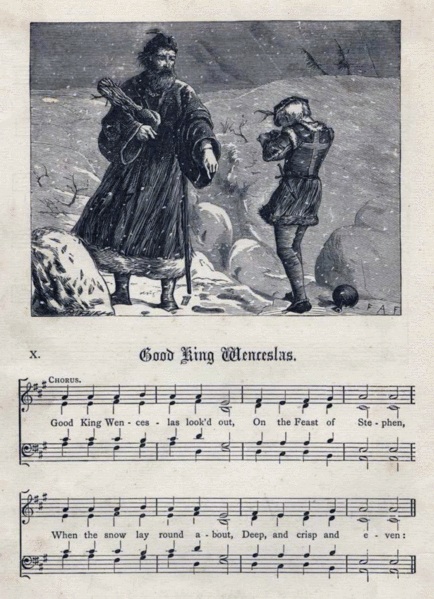
“Good King Wenceslas” is a popular Christmas carol that tells a story of Good King Wenceslas braving harsh winter weather to give alms to a poor peasant on the Feast of Stephen (the second day of Christmas, December 26). During the journey, his page is about to give up the struggle against the cold weather, but is enabled to continue by following the king’s footprints, step for step, through the deep snow. The legend is based on the life of the historical Saint Wenceslaus I, Duke of Bohemia or Svatý Václav in Czech (907–935).

In 1853, English hymn writer John Mason Neale wrote the “Wenceslas” lyrics, in collaboration with his music editor Thomas Helmore, and the carol first appeared in Carols for Christmas-Tide, 1853. Neales’ lyrics were set to a tune based on a 13th century spring carol “Tempus adest floridum” (“The time is near for flowering”) first published in the 1582 Finnish song collection Piae Cantiones.

Good King Wenceslas looked out
On the feast of Stephen
When the snow lay round about
Deep and crisp and even
Brightly shone the moon that night
Though the frost was cruel
When a poor man came in sight
Gath’ring winter fuel

“Hither, page, and stand by me
If thou know’st it, telling
Yonder peasant, who is he?
Where and what his dwelling?”
“Sire, he lives a good league hence
Underneath the mountain
Right against the forest fence
By Saint Agnes’ fountain.”

“Bring me flesh and bring me wine
Bring me pine logs hither
Thou and I will see him dine
When we bear him thither.”
Page and monarch forth they went
Forth they went together
Through the rude wind’s wild lament
And the bitter weather

“Sire, the night is darker now
And the wind blows stronger
Fails my heart, I know not how,
I can go no longer.”
“Mark my foteps, my good page
Tread thou in them boldly
Thou shalt find the winter’s rage
Freeze thy blood less coldly.”

In his master’s steps he trod
Where the snow lay dinted
Heat was in the very sod
Which the Saint had printed
Therefore, Christian men, be sure
Wealth or rank possessing
Ye who now will bless the poor
Shall yourselves find blessing

A traditional choir:

Jane Seymour and the Mormon Tabernacle Choir:

The Mannheim Steamroller version:

December 16 ~ This Day in Music History

hanukkah

Hanukkah
Hanukkah Music
Hanukkah Music Lyrics


Hanukkah 2017 began at sunset (4:48 at the O’Connor Music Studio) on Tuesday, December 12 and ends on Wednesday, December 20.

Christmas Music: We Three Kings

OCMS 1770 ~ Ludwig van Beethoven, Composer Beethoven’s Pastoral Symphony was featured in the Walt Disney movie Fantasia and his Symphony Number 5 in Fantasia 2000
Listen to Beethoven’s music
More information on Beethoven
Grammy winner
If composers had Facebook: Beethoven’s profile

OCMS 1882 ~ Zoltán Kodály, Hungarian composer and collector of folk songs
More information on Kodály

• 1893 ~ Antonin Dvorák attended the first performance of his New World Symphony at Carnegie Hall in New York City.

• 1899 ~ Sir Noel Coward, British composer of musical comedies, actor and producer

• 1905 ~ Sime Silverman published the first issue of Variety, the weekly showbiz magazine. The first issue was 16 pages in length and sold for a nickel. Variety and Daily Variety are still going strong.

• 1907 ~ Eugene H. Farrar became the first singer to broadcast on radio. He sang from the Brooklyn Navy Yard in New York. The song was Do You Really Want to Hurt Me?

• 1940 ~ Bob Crosby and his Bobcats backed up brother Bing as San Antonio Rose was recorded on Decca Records.

• 1960 ~ Lucille Ball took a respite from her weekly TV series to star in the Broadway production of Wildcat, which opened at the Alvin Theatre in New York City. The show ran for 171 performances.

• 1967 ~ The Lemon Pipers released Green Tambourine on an unsuspecting psychedelic world this day. The tune made #1 on February 3, 1968.

• 1971 ~ Melanie (Safka) received a gold record for the single, Brand New Key, about roller skates and love and stuff like that. This one made it to #1 on Christmas Day, 1971.

• 1971 ~ Don McLean’s eight-minute-plus (8:32) version of American Pie was released. It became one of the longest songs with some of the most confusing (pick your favorite interpretation) lyrics to ever hit the pop charts. American Pie hit #1 on January 15, 1972.

• 1972 ~ Paul McCartney’s single, Hi, Hi, Hi, was released. It peaked at #10 on the top tune tabulation (February 3, 1973).

• 2003 ~ Singer and guitarist Gary Stewart, who had a No. 1 country hit in 1975 with She’s Actin’ Single (I’m Drinkin’ Doubles), died of an apparently self-inflicted gunshot wound. He was 58. A native of Letcher County, Ky., Stewart was a compelling songwriter and performer of guitar-driven, honky-tonk country. His last album, Live at Billy Bob’s Texas, was released in 2003. Besides the 1975 chart-topper, his hits included Drinkin’ Thing and Out of Hand. He worked with Southern rock greats Dickie Betts and Gregg Allman of The Allman Brothers Band on the 1980 album Cactus and a Rose.

• 2017 ~ Z’ev, a percussionist, performer, composer, instrument builder, visual artist, poet and theorist who explored visceral and mystical dimensions of sound — becoming a pioneer of industrial music along the way — died in Chicago, where he lived. He was 66.

If composers had Facebook: Beethoven

beethoven-birthday

Happy Birthday, Beethoven!

He used the # in unusual places before Twitter… but how would Beethoven have used Facebook? And what would his profile look like? From his likes and dislikes to his friends and love interests, we’ve imagined what the composer might have posted online throughout his life.

beethovens-facebook

via If composers had Facebook: Beethoven’s profile.

Christmas Music: We Three Kings

we-three

“We Three Kings”, also known as “We Three Kings of Orient Are” or “The Quest of the Magi”, is a Christmas carol written by the Reverend John Henry Hopkins, Jr., who wrote both the lyrics and the music.

we-three-sheet-white


We three kings of Orient are
Bearing gifts we traverse afar
Field and fountain, moor and mountain
Following yonder star

O Star of wonder, star of night
Star with royal beauty bright
Westward leading, still proceeding
Guide us to thy Perfect Light

Born a King on Bethlehem’s plain
Gold I bring to crown Him again
King forever, ceasing never
Over us all to reign

O Star of wonder, star of night
Star with royal beauty bright
Westward leading, still proceeding
Guide us to Thy perfect light

Frankincense to offer have I
Incense owns a Deity nigh
Prayer and praising, all men raising
Worship Him, God most high

O Star of wonder, star of night
Star with royal beauty bright
Westward leading, still proceeding
Guide us to Thy perfect light

Myrrh is mine, its bitter perfume
Breathes of life of gathering gloom
Sorrowing, sighing, bleeding, dying
Sealed in the stone-cold tomb

O Star of wonder, star of night
Star with royal beauty bright
Westward leading, still proceeding
Guide us to Thy perfect light

Glorious now behold Him arise
King and God and Sacrifice
Alleluia, Alleluia
Earth to heav’n replies

O Star of wonder, star of night
Star with royal beauty bright
Westward leading, still proceeding
Guide us to Thy perfect light

From Mannheim Steamroller, Chip Davis gives this song an “Arabian Nights” feel. A classic song that tells the story of the Gentiles who were quicker to recognize the significance of Christ’s birth than were His own people. Enjoy, and Merry Christmas!

December 15 ~ This Day in Music History

hanukkah

Hanukkah
Hanukkah Music
Hanukkah Music Lyrics


Hanukkah 2017 began at sunset (4:48 at the O’Connor Music Studio) on Tuesday, December 12 and ends on Wednesday, December 20.

Christmas Music: The First Noel

• 1910 ~ John Hammond, American jazz critic

• 1922 ~ Alan Freed, American disc jockey

• 1939 ~ One of the most celebrated motion pictures of all time, Gone with the Wind, starring Vivien Leigh and Clark Gable was premiered in Atlanta to critical acclaim. The picture ran for close to four hours.


• 1941 ~ A musical standard was recorded this day on Victor Records. Lena Horne sang the torch classic that became her signature: Stormy Weather. “Don’t know why there’s no sun up in the sky. Stormy weather…”


• 1942 ~ Dave Clark, British rock drummer and singer

• 1943 ~ Fats (Thomas Wright) Waller died at the age of 39 from pneumonia.  He was an American jazz pianist, organist, composer, singer, and comedic entertainer, whose innovations to the Harlem stride style laid the groundwork for modern jazz piano

More information about Waller


• 1944 ~ Glenn Miller passed away when his plane disappeared over the English Channel. Major Glenn Miller was on his way to lead his Air Force Band in a Christmas concert.

• 1954 ~ Davy Crockett, Indian Fighter was featured on Walt Disney’s TV series for the first time. Crockett was played by Fess Parker. It wasn’t long before the Davy Crockett craze brought a new number one song to the pop music charts. “Davy, Davy Crockett, king of the wild frontier.”

• 1962 ~ The first record album to poke fun at a U.S. President became the #1 LP in the country. Vaughn Meader’s The First Family made the humorist a household word. The album stayed at #1 for three months.

• 1984 ~ Jan Peerce passed away

• 1986 ~ Violinist Isaac Stern arrived in a horse-drawn carriage to cut the ribbon for the renovated Carnegie Hall in New York City.

• 1986 ~ Kenny Rogers cut himself a deal with the Dole Food Company. The singer became the highest-paid celebrity pitchman, ‘doling’ out nice words about pineapple and other Dole products for 17 million dollars.

• 2000 ~ Revered conjunto musician Valerio Longoria, who taught accordion to children in San Antonio for many years, died at the age of 76. Musicians and friends remembered the master accordionist as an innovator and influential stylist of conjunto music, a Texas-based rhythm fueled by the accordion and the bajo sexto, a 12-string Spanish bass guitar. As a teenager, Longoria played weddings and parties in Harlingen. In 1942, he was drafted into the U.S. Army and at the end of World War II was stationed in Germany, where he managed to get an accordion and play in nightclubs. In 1945, he moved to San Antonio, where he began recording for Corona Records. Longoria was among the first inductees into the Tejano Conjunto Music Hall of Fame in 1982, and in 1986 he received the National Heritage Award, the nation’s highest honor for folk artists.

• 2001 ~ Rufus Thomas, a musician whose Bear Cat helped Sun Records get its start and whose Funky Chicken gave a boost to the Stax Label, died at the age of 84. Rufus Thomas was best known for novelty dance recordings like Walking the Dog, Do the Funky Chicken and Push and Pull. He began tap dancing on the streets of Memphis for tips and performed in amateur shows in high school. In the 1940s, Thomas ran his own Beale Street amateur show that attracted B.B. King, Bobby “Blue” Bland and many other performers who went on to become famous. In his declining years, Thomas took on the title of Beale Street ambassador and liked to refer to himself as the world’s oldest teen- ager. In 1953, Thomas recorded Bear Cat, an answer to Big Mama Thornton’s Hound Dog, and it became Sun Record’s first hit. That was before Elvis Presley arrived on the scene to become Sun’s undisputed star. Thomas complained in later years that Sun’s black artists were pushed aside after Presley’s success. In the 1960s, Thomas became one of the founding performers for Stax Records, which created what came to be known as “the Memphis sound,” with performers like Isaac Hayes, Otis Redding and Sam and Dave.

• 2002 ~ John Crosby, founder and longtime former general director of the Santa Fe Opera, died in Rancho Mirage, Calif., after a brief illness. He was 76. Crosby founded the Santa Fe Opera in 1957 and was its general director until his retirement at the end of the 2000 season. After his military service during World War II, Crosby majored in music theory at Yale and studied under composer Paul Hindemith, whom Crosby later brought to Santa Fe for the 1961 U.S. premiere of Hindemith’s opera News of the Day. Crosby also had worked as a Broadway arranger and studied at Columbia University in New York before making his move to found an opera company in Santa Fe. With $200,000 in financing from his father, Crosby purchased a ranch seven miles north of Santa Fe and oversaw construction of a 480-seat, open-air theater. The inaugural performance July 3, 1957, was Puccini’s Madama Butterfly. With the participation of Igor Stravinsky, early Santa Fe seasons gained world attention. Stravinsky brought music to the 1957 through 1963 seasons. His last night as both conductor and general director was Aug. 24, 2000, when he led Richard Strauss’ Elektra. Former President Bush presented Crosby a National Medal of Arts in 1991. He also received an Officer’s Cross of the Federal German Order of Merit in 1992 for his service to German music.

• 2002 ~ Rick Chase, a morning radio personality for KWIN-FM of Stockton, was found dead in his apartment. He was 45. Chase was best known for his work at KMEL-FM in San Francisco from 1986 to 1998. He also worked at KFRC-FM and KITS-FM in the Bay Area, KNVQ-FM in Reno and KZZO-FM in Sacramento. Chase, a 20-year radio veteran known to his listeners for his bombastic on-air personality, had worked at KWIN for two years.

• 2002 ~ Washington, DC Area: The storied history and sweeping skyline of US Airways Arena ended in a billowing cloud of dust Sunday morning as technicians reduced it to rubble with hundreds of pounds of dynamite. Almost 200 people, some of whom grew up watching sports and cultural events at the arena, gathered hundreds of yards away in the chill morning to say goodbye to the piece of 20th-century Washington’s history just outside the Capital Beltway. A shopping center will replace it. The arena began life in 1973 as the Capital Centre, a state-of-the-art architectural gem. In the ensuing decades, it housed the Washington Bullets basketball team and the Washington Capitals hockey team and held concerts by Elvis Presley, Michael Jackson, Frank Sinatra, the Rolling Stones, Luciano Pavarotti. “I remember seeing the Washington Bullets when they were really good and the Caps when they were really bad, as well as Prince and Tina Turner,” said Stewart Small, who grew up near the arena and now lives in Alexandria, Va. “I know it’s not Ebbets Field, but it had a lot of memories for me.” Crews used about 400 pounds of dynamite at 500 locations to do the job. In just over 15 seconds, the stadium that took 15 months to build caved into a cloud of light brown dust. Some in the crowd cheered, but most were silent. A few were teary-eyed as dust soared above where the 18,000-seat arena had stood. The arena opened Dec. 2, 1973, to a sellout crowd that watched the Bullets beat the Seattle SuperSonics 98-96. It has had no regular clients since the NBA Bullets, now Wizards, and the NHL Capitals moved to the MCI Center downtown.

Christmas Music: The First Noel

first-noel

The First Nowell (also written The First Noël) is a traditional classical English carol, most likely from the 18th century, although possibly earlier.

The word Noel comes from the French word Noël meaning “Christmas”, from the Latin word natalis “birthday”.

The melody is unusual among English folk melodies in that it consists of one musical phrase repeated twice, followed by a refrain which is a variation on that phrase. All three phrases end on the third of the scale.

The first Noel the angel did say
Was to certain poor shepherds in fields as they lay;
In fields where they lay tending their sheep,
On a cold winter’s night that was so deep.

Refrain

Noel, Noel, Noel, Noel,
Born is the King of Israel.

They lookèd up and saw a star
Shining in the east, beyond them far;
And to the earth it gave great light,
And so it continued both day and night.

Refrain

And by the light of that same star
Three Wise Men came from country far;
To seek for a King was their intent,
And to follow the star wherever it went.

Refrain

This star drew nigh to the northwest,
Over Bethlehem it took its rest;
And there it did both stop and stay,
Right over the place where Jesus lay.

Refrain

Then did they know assuredly
Within that house the King did lie;
One entered it them for to see,
And found the Babe in poverty.

Refrain

Then entered in those Wise Men three,
Full reverently upon the knee,
And offered there, in His presence,
Their gold and myrrh and frankincense.

Refrain

Between an ox stall and an ass,
This Child truly there He was;
For want of clothing they did Him lay
All in a manger, among the hay.

Refrain

Then let us all with one accord
Sing praises to our heavenly Lord;
That hath made Heaven and earth of naught,
And with His blood mankind hath bought.

Refrain

If we in our time shall do well,
We shall be free from death and hell;
For God hath prepared for us all
A resting place in general.

Refrain

first-noel-sheet-white


The University of Utah Singers performed “The First Noel” arr. by Dan Forrest live in concert, December 11th & 12th, 2009 in Libby Gardner concert hall under the direction of Dr. Brady Allred.

December 14 ~ This Day in Music History

hanukkah

Hanukkah
Hanukkah Music
Hanukkah Music Lyrics


Hanukkah 2017 began at sunset (4:48 at the O’Connor Music Studio) on Tuesday, December 12 and ends on Wednesday, December 20.


Christmas Music: O Little Town Of Bethlehem

• 1911 ~ “Spike” (Lindley Armstrong) Jones, American drummer, bandleader of satiric music

• 1913 ~ Dan Dailey, Singer, dancer, actor

• 1914 ~ Rosalyn Tureck, American pianist and harpsichordist

• 1920 ~ Clark Terry, Trumpet, flugelhorn with Lionel Hampton, Count Basie, Duke Ellington, Quincy Jones

• 1928 ~ America’s original Funny Girl, Fanny Brice, recorded If You Want the Rainbow, a song from the play, My Man, on Victor Records.

• 1932 ~ Abbe Lane (Lassman), Singer, glamour actress, photographed in a bathtub filled with coffee, bandleader Xavier Cugat’s ex-wife

• 1936 ~ You Can’t Take It with You opened at the Booth Theatre in New York City.

• 1946 ~ Patty Duke, US film actress

• 1947 ~ Christopher Parkening, American guitarist

• 1953 ~ Fred Allen returned from semi-retirement to narrate Prokofiev’s classic, Peter and the Wolf, on the Bell Telephone Hour on NBC radio.

• 1963 ~ Singer Dinah Washington died in Detroit.

• 1970 ~ George Harrison received a gold record for his single, My Sweet Lord.

• 1983 ~ The musical biography of Peggy Lee opened at the Lunt-Fontanne Theatre in New York City. The show was titled Peg.

• 1984 ~ The Cotton Club opened around the U.S. There were nine classic songs by Duke Ellington on the soundtrack of the movie.

• 1990 ~ Opera lovers were turned into couch potatoes. For four evenings, starting on this day, they watched and listened to an unabridged telecast of Richard Wagner’s marathon-length opera The Ring.

• 2001 ~ Conte Candoli, a Trumpet player and staple of The Tonight Show band during Johnny Carson’s era, died of cancer. He was 74. Candoli was recognized for developing a musical style based on Dizzy Gillespie’s bebop playing, with a touch of Miles Davis and Clifford Brown. The Indiana-born Candoli, grew up surrounded by musical instruments and influences. His father, a factory worker, played the trumpet and wanted Candoli and his brother Pete to become musicians. At 16, he worked in Woody Herman’s orchestra during summer vacations. While playing in California, Candoli began his association with the then New York-based Tonight Show. In 1972, when Carson moved the show to Burbank, Candoli joined the band. He left when Carson retired in 1992.

Christmas Music: O Little Town Of Bethlehem

O Little Town Of Bethlehem

“O Little Town of Bethlehem” is a popular Christmas carol. The text was written by Phillips Brooks (1835–1893), an Episcopal priest, Rector of the Church of the Holy Trinity, Philadelphia. He was inspired by visiting the Palestinian city of Bethlehem in 1865.

Three years later, he wrote the poem for his church and his organist, Lewis Redner, added the music. Redner’s tune, simply titled “St. Louis”, is the tune used most often for this carol in the United States.

The Mormon Tabernacle Choir sings O Little Town Of Bethlehem