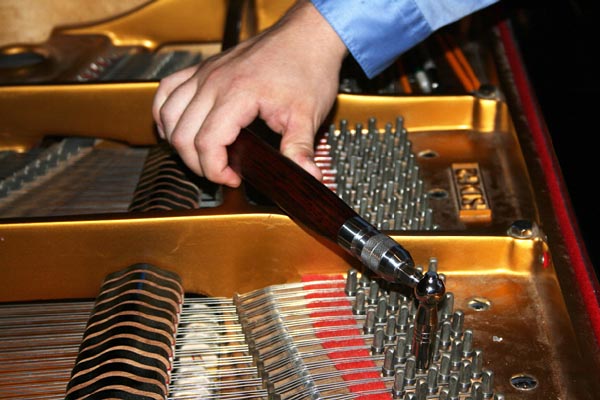
When it comes to tuning, every piano is different, even two pianos of the same style and make are different, and the humidity of the room makes a big difference, he said.
High humidity causes the sound board to swell, stretching the strings and causing the pitch to go sharp, while low humidity has the opposite effect.
In Minnesota, humidity can easily range from 80 percent in the summertime to 10-15 percent in the winter, if the home doesn’t have a humidifier. Wood-heated homes tend to be especially dry, he said.
“Pianos like it between 40 and 50 percent humidity in the house,” he said.
Even places that are supposedly “climate-controlled,” aren’t always. The heat might get turned down substantially evenings and weekends, for example.
A new piano needs a few weeks to settle into its new home before tuning, Fry said.
“If they get a new piano, generally they call us the day before it gets in the house,” he said. “It should sit in the house a couple weeks just to acclimatize it to its new surroundings … brand new pianos stretch for a while. They go out of tune quicker. The wire stretches and they settle into themselves.”
Some people think they have to let a new, or recently moved older piano, sit six months or a year before it gets tuned. That’s not true, Fry said, but it does need a few weeks.
He recommends that pianos be tuned at least once a year (he tunes his own piano once a year, even though he no longer gives lessons) and the busiest time for him is before the holidays — September through December.
“Piano-tuning is something people can put off,” he said. “We noticed a real drop in tuning when gas got over $3 a gallon. I didn’t think it would make that much of a difference, but it did.”
Fry said he is looking for some kind of work to do in the summertime when his other businesses are slow.
He doesn’t give piano or guitar lessons anymore, but does enjoy tuning all types of pianos.
“It takes me a couple of hours. I have time,” Fry said. “I’m going to do the job that I like to do, and do it right.”
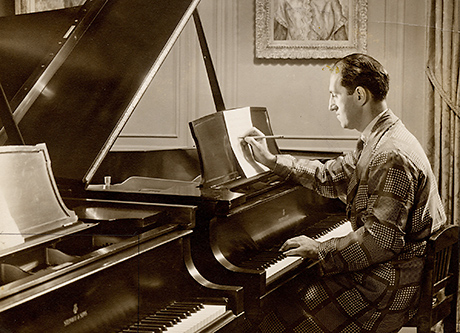
The Gershwin family donated the Steinway to the University as part of the George and Ira Gershwin initiative that is focused on research and study of the brothers’ music.
According to Marc Gershwin, George and Ira’s nephew, “I wanted the instrument to be accessible to the students and faculty who would be preserving the legacy of George and Ira Gershwin’s music… I’m delighted that the piano will once again be in regular use [by students and faculty], and am thrilled that it has been restored to performance condition.” [Two other Gershwin Steinways are in museums.]
From what I know of George he would have wanted it this way. Unlike some composers George was a gifted pianist. He had a rich social life and enjoyed playing his music for anyone who would listen.
There’s a lesson in that thought. If you have something valuable, sometimes it becomes more valuable – or at least more appreciated – when people can see it and use it. If you look at the piano as an instrument of technology that is it, then it makes sense that organizations give people access to technology – as well as resources – to do their work.
Founded in Manhattan in 1853, Steinway & Sons is widely considered to be one of the greatest piano makers in the world. Its grand pianos grace the world’s grandest stages and are played by the best pianists.
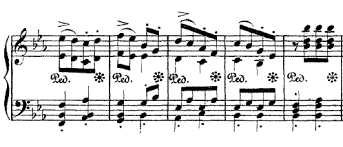
These are some examples of pedal marks in piano music:
An older style of pedaling. The symbols can be between or below the staves.
This type of pedaling is more commonly used today.
Another type of pedaling
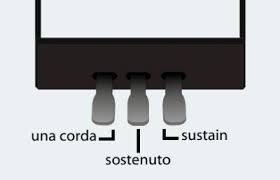
Pedals on a grand piano:
There are two standard foot pedals on the piano: on the left side is the una corda pedal and on the right side is the sustain (damper) pedal.
The middle sostenuto pedal is only standard on the American grand piano, and is very rarely used.
With pedals, the pianist can add resonance and color to the music and thereby bring out its inherent emotion. At the same time, over-pedaling or improper pedaling can drown the listener and the performer in a miasma of overlapping sounds.
This pedal has various names. It is sometimes called the damper pedal (because it lifts all the dampers inside the piano), or the forte pedal (because the result of lifting all the dampers is a fuller sound), or the tre corde pedal (because it allows the three strings of each key to vibrate), or the sustaining pedal (because when you depress it the note will continue to sound even if you take your fingers off the keys).
Damper Pedaling Guidelines
Here are some guidelines pedaling. As with everything in art, they can be ignored under certain circumstances.
Avoid pedaling notes that move in a stepwise or scalar pattern. Adjacent notes are dissonant, and when pedaled, they sound smudged.
Do pedal notes that skip and form a nice harmony.
Change your pedal (i.e., lift it up and put it down again) at each change of harmony.
Avoid pedaling through rests (i.e., silence), at ends of phrases (at which point we would need to breathe and that split second of silence takes care of that), or staccato notes—although this is commonly ignored, because we actually can hear the disconnection through the pedal. This is why we do not depend on the pedal to achieve a beautiful legato.
Keep your heel planted firmly on the floor, and pedal with either toes or the ball of foot, depending on your shoe size.
There are several manipulations possible with the damper pedal, each affecting the sound slightly differently.
Syncopated Pedaling
For the cleanest sound, the syncopated (or legato) pedal will give you the most control. This is an action where the foot is put down immediately after the note is played. This may take some getting used to, but you can practice it by playing a C scale.
Play C, and then lower the damper pedal.
Hold the pedal down until you are just about ready to play the D.
As the D’s finger goes down, the foot goes up, and then down again immediately after the D is struck.
The sound is clean. Continue up the scale the same way.
As an experiment, try putting the pedal down as you play a note, and notice the difference in the sound. Since the damper pedal lifts all the dampers, when you strike the D, not only are the three strings of that note free to vibrate but so do all the other strings vibrate sympathetically. You have a sound that is full of overtones.
There are times when you will want that effect and so will keep your foot down until the accumulated sound needs to breathe.
You can practice the syncopated pedal away from the piano by sitting on the bench or a chair and lifting your right knee at exactly the same time as your right hand goes down to tap the rising knee. This is the same action at the keyboard. The foot goes up when the hand goes down and then returns to the pedal.
Partial Pedals
There are half and quarter pedals too, which are used when you don’t want full vibrato. Rather than depressing the pedal all the way down, you lower your foot halfway so that the dampers are lifted only slightly off the strings, without allowing them to vibrate fully.
The quarter pedal gives even just a hint of pedal. It will take a while to feel these various distances on your piano. Also, you will find that each piano has its own pedal feel, which you must get used to before attempting to perform on that instrument.
Flutter Pedal
Then there are times, usually in scale passages, where touches of pedal can be very appealing and then the foot goes up and down rapidly and shallowly, and that is called the “flutter” pedal.
Choosing the Pedaling
The different types of damper pedaling techniques are for you, the pianist, to decide. But what determines which choice you will make?
Two things will control that: your very important ear, and your understanding of the music—the composer and the era in which the music was composed.
Your pedaling approach following the composer’s style depends on your knowledge of what instruments were available during the composer’s lifetime and how the pedal or lack of pedals would have made the music sound. This way, your interpretation will have authenticity.
Position of the Sustain Pedal:
Right pedal
The Sustain Pedal is Played With:
Right foot
Also Called:
Damper pedal, forte pedal, loud pedal
Effects of the Sustain Pedal:
The sustain pedal allows all of the notes on the piano to resonate after the keys have been lifted, for as long as the pedal is depressed. It creates a legato effect, forcing all of the notes to echo and overlap.
History of the Sustain Pedal:
The sustain pedal was originally operated by hand, and an assistant was required to operate it until the knee lever was created. The creators of the sustain foot pedal are unknown, but it is believed to have been invented around the mid-1700s.
Use of the sustain was uncommon until the Romantic Period, but is now the most commonly used piano pedal.
How the Sustain Pedal Works:
The sustain pedal lifts the dampers off of the strings, allowing them to vibrate until the pedal is released.
Sustain Pedal Marks:
In piano notation, use of the sustain pedal begins with Ped., and ends with a large asterisk.
Variable pedal marks, seen as /_/, are placed under notes, and define the precise pattern in which the sustain pedal is depressed and released.
Horizontal lines show when the sustain pedal is depressed.
Diagonal lines indicate a quick, temporary release of the sustain pedal.
Position of the Una Corda Pedal:
Left pedal
The Una Corda is Played With:
Left foot
Also Called:
Soft pedal, “piano” pedal
Effects of the Una Corda Pedal:
The una corda pedal is used to enhance the timbre of softly played notes, and exaggerate a low volume. The soft pedal should be used with notes that are already played softly, and will not produce the desired effect on louder notes.
History of the Una Corda Pedal:
The una corda was the first mechanism to modify the piano’s sound, and was originally operated by hand. It was invented in 1722 by Bartolomeo Cristofori, and quickly became a standard addition to the piano.
How the Una Corda Pedal Works:
Most treble keys are attached to two or three strings. The una corda shifts the strings so that the hammers only strike one or two of them, creating a softened sound.
Some bass keys are only attached to one string. In this case, the pedal creates a shift so that the hammer strikes on a lesser-used portion of the string.
Una Corda Pedal Marks:
In piano notation, use of the soft pedal begins with the words una corda (meaning “one string”), and is released by the words tre corde (meaning “three strings”).
Interesting Facts About the Una Corda Pedal:
Most upright pianos use a “piano” pedal instead of a true una corda pedal. The piano pedal moves the hammers closer to the strings, preventing them from striking with full force
Position of the Sostenuto Pedal:
Usually the middle pedal, but is often omitted.
The Sostenuto is Played With:
Right foot
Originally Called:
Tone-sustaining pedal
Effects of the Sostenuto Pedal:
The sostenuto pedal allows certain notes to be sustained while other notes on the keyboard are unaffected. It is used by hitting the desired notes, then depressing the pedal. The selected notes will resonate until the pedal is released. This way, sustained notes can be heard alongside notes played with a staccato effect.
History of the Sostenuto Pedal:
The sostenuto pedal was the last addition to the modern piano. Boisselot & Sons first showcased it in 1844, but the pedal didn’t gain popularity until Steinway patented it in 1874. Today, it’s primarily found on American grand pianos, but is not considered a standard addition since it is very rarely used.
How the Sostenuto Pedal Works:
When the sostenuto pedal is depressed, it keeps the dampers off the selected strings, allowing them to resonate while the rest of the keys’ dampers remain down.
Sostenuto Pedal Marks:
In piano music, use of the sostenuto pedal begins with Sost. Ped., and ends with a large asterisk. Notes meant to be sustained are sometimes marked by hollow, diamond-shaped notes, but there are no strict rules for this pedal since it is hardly ever used.
Interesting Facts About the Sostenuto Pedal:
Sostenuto is Italian for “sustaining,” although this incorrectly describes the pedal’s function.
On some pianos, the sostenuto pedal only affects the bass notes.
The middle pedal is sometimes built as a “practice rail” pedal instead of a sostenuto. A practice rail muffles notes with felt dampers, allowing for quiet play.
Sostenuto pedal markings are rarely seen in sheet music, but can be found in the works of Claude Debussy.
For a musical family on the Plains of South Dakota, it was a tragedy that left ashes in the soul – not just that a fire on Nov. 26, 1898, burned down the log house at Oahe Mission north of Pierre, but also that it destroyed the Steinway Grand Piano inside.
It was that same Steinway that had traveled up the Missouri River by steamboat for Nina, the first wife of missionary Thomas L. Riggs, in the early 1870s when the Missouri River country was still Dakota Territory. It supplied just the right tone, full and powerful, to fill that big empty space in the grassland. It helped carry the message of the ancient faith to Dakota and Lakota converts through music.
Very likely it was on the Steinway that Nina taught her first son, Theodore Foster Riggs, what a piano sounded like after he was born in 1874; probably it was a silent reminder of Thomas Riggs’ grief when Nina died in childbirth in August 1878. In spring 1885, when Louisa Irvine Riggs, also with a love for music, moved into the log home at Oahe Mission as the second Mrs. Riggs, the Steinway sat along one wall; and she started to play.
And now, in November 1898, it was burned to cinders…
Well-maintained pianos can make music for 50 to 70 years, said Peter Stumpf, a piano technician for the Pittsburgh Symphony Orchestra and Carnegie Mellon University, also in Pittsburgh.
Stumpf acknowledged new piano retailers are challenged by technicians like him who restore well-made used pianos and sell them at a fraction of the cost.
The piano’s design, durability and new flexibility brought by technology helps keep the instrument created by Italian Bartolomeo Cristofori more than 300 years ago relevant today, said Joe Lamond, president and CEO of the National Association of Music Merchants, a music products industry trade association.”Having all the notes laid out in front of you spatially is really an important way to learn music,” he said. “It’s why it’s one of the most important instruments for people to begin on. That’s not going to change.”
I have to admit that I’m kind of a piano bench hoarder. I save them from every piano and electric keyboard I’ve ever owned.
I was playing the grand piano the other day and noticed that the music rack was further away than it used to be. I don’t think that the piano grew any so I must have shrunk.
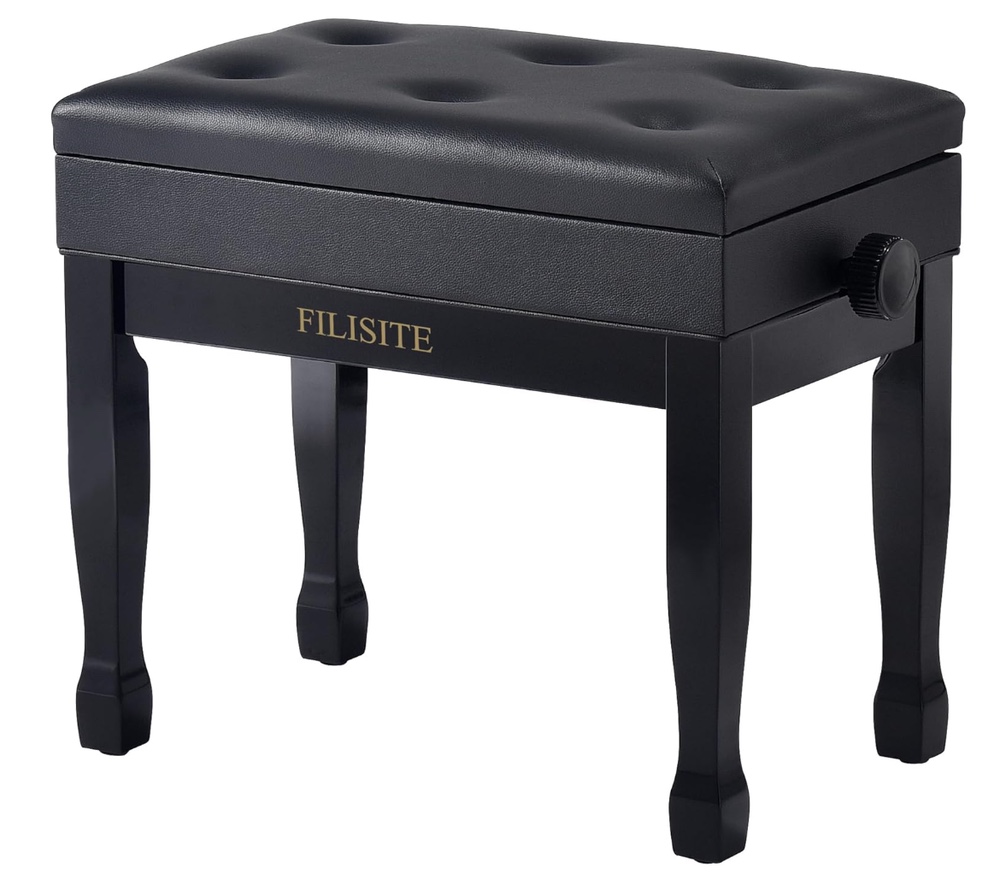
I have an adjustable piano bench but it’s brown from an old baby grand I once had. It’s also for only one person to play solo so I bought a new adjustable duet bench in black.
I was surprised to see that amazon has a lot of piano benches for sale. I don’t know why I was surprised since they seem to have everything else.
I chose this one since the reviews were good and the price seemed reasonable:
Comfortable Padded Cushion – Thickened cushion is made of scratch-resistant PU leather with 6 decorative buttons and filled with high-resilience sponge, which is soft, but not easy to deform. Even if you sit on it for a long time practicing the piano, you won’t feel tired. The surface is also water-resistant and easy to clean.
Height Adjustable – This piano seat comes with dual side knobs that adjust the bench height between 19.29″/49cm-23.23″/59cm to accommodate a wide range of heights for both adults and children.
Music Storage Compartment – Built-in storage compartment beneath the seat provides roomy space for your sheet music and accessories, folding lip support makes it convenient to open.
Sturdy Wooden Frame – The frame of this piano stool is made of solid wood, which is sturdy enough to hold up to 330lbs/150kg. Anti-slip rubber pads at bottom of legs protect your floor from being scratched and add extra stability. Classic black color suitable for various decorations.
Easy Assemble – No other drills are needed to install this piano bench with storage. All you need to install are the 4 legs. In addition to piano stool, it can also be used as keyboard stool, vanity stool, etc.
Hopefully, it is truly easy to assemble and we can get the legs installed before students return from winter break!
Today, since it’s a “teaching day”, I’m thankful for my piano studio, my students, and my piano 🙂
When I was growing up, my dad was a minister, meaning we lived in whatever parsonage the church chose to let us live in. The one we had in Pawcatuck, CT had an upright piano that someone had put out in the sunroom. Not the best place for a piano, but I digress.
Since we had the piano already, someone – probably my mom – decided that I would take lessons. We had the organist from the Baptist church just across the river in Westerly, RI
Apparently, Clara Pashley was fondly remembered at the church (now Central Baptist Church) since she was mentioned in an article from 2010.
Miss Pashley walked to our house each week and taught me (and my mom who was always listening in) piano for the grand sum of 25 cents.
I started with Ada Richter’s classic Teaching Little Fingers to Play, which has now been morphed into the John Thompson library.
From there, it was the Michael Aaron series, and some sheet music.
There was no music store in our town, so I have no idea where any of this music came from – but I still have it all.
My parents did very well for their quarter a week investment, especially since my mom paid good attention and was able to beef up lessons she’d had as a child. Later on, she played well enough that she was church organist for a local Roman Catholic Church.
But I digress…
In those days, kids couldn’t do a whole lot of activities, so in 6th grade, I decided I wanted to be a Girl Scout. Bye, bye Clara.
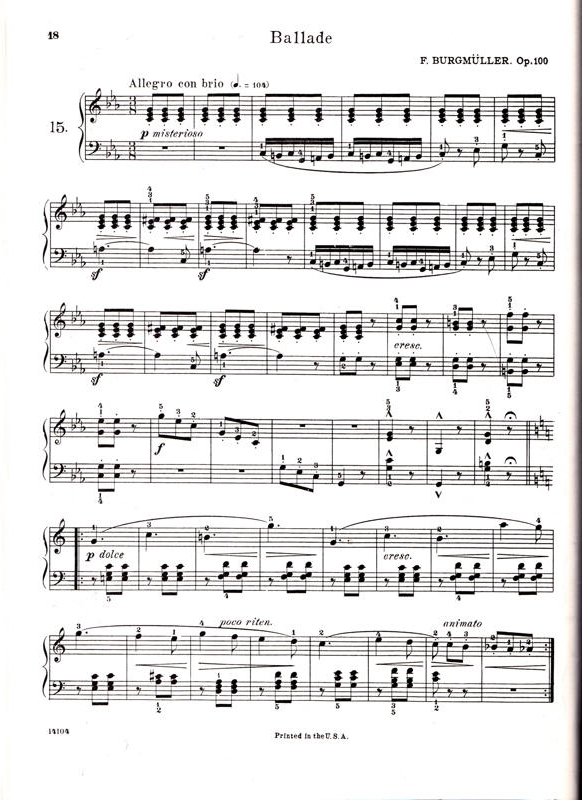
Girl Scouts didn’t last long but I did play piano in a talent show. I remember, I carefully cut Burgmüller’s Ballade out of my Michael Aaron book and made a nice construction paper cover. (I still have this, too)
I doubt that I played this well but here’s what it was supposed to sound like:
A few years intervened and we moved to Springfield, MA. The parsonage piano there was in terrible shape and in the dark, never-used basement. But I decided to make it mine and cleared up the area around it and started “practicing”.
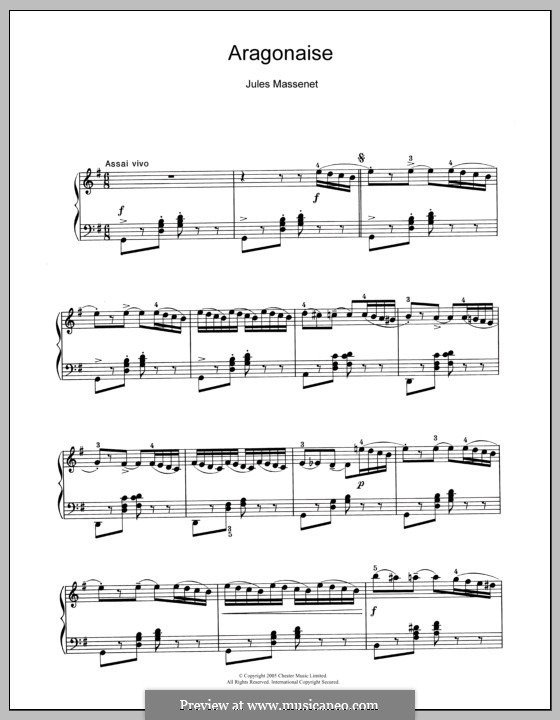
My Junior or Senior year of High School I decided I wanted to major in music in college. I decided to learn, on my own, a piano arrangement of Aragonnaise by Jules Massenet. I have no idea why or where that sheet music came from but I started working furiously on this piece.
Hopefully, at some point, it should have sounded like this:
I started pedaling (no pun intended!) my music to the Universities of Connecticut and Massachusetts and ended up at UMass Amherst since we were state residents.
Early morning gym classes (usually swimming), then wet hair traipsing across campus to music theory classes in a trailer aka”Parko” in winter 5 days a week. AARRGGH!
I took yet another break from piano lessons – but I kept playing.
After DH graduated, we moved to Milwaukee, WI for his graduate school. Besides working 2 jobs, I found time to commandeer the practice rooms at the University of Wisconsin. I also found a teacher at the Schaum School of Music. She was amazed that I had no piano at home to practice on.
When we later moved to Alexandria, VA my DH gave me a choice of new car or piano. So, I found a used piano. The owner had acquired it in a divorce and wanted it gone. Yesterday. She even paid to move it out of her apartment.
The new-to-me piano took up half our living room. When my parents came to visit, their feet were under my piano as they slept on cots.
I found yet another new piano teacher and she is still my best friend to this day.
That piano moved to several locations before I bought a brand new Yamaha grand piano. The movers accidentally brought in the wrong one and I made them return it. The people who lived in an apartment were probably unhappy when they had to return my piano and take their own new baby grand back.
I started teaching as a traveling piano teacher in Silver Spring, Maryland. I continued that in Wilmington, DE.
When we got to Fairfax, VA I decided no more traveling. Students would come to me. And so they have since 1973.
What is supposed to be our living room is filled with music books, electric keyboards, the grand piano, 2 organs, 2 violins, 2 clarinets, a hand-made (by me!) dulcimer, a balalaika, autoharp, electric violin, recorders, aerophone (digital saxophone/clarinet/trumpet/other instrument sounds) and other musical “stuff”.
Piano playing has gotten me through the worst times of my life. Teaching has been a lifeline for me, as well.
I am so thankful for the students who have stayed with me over the years.
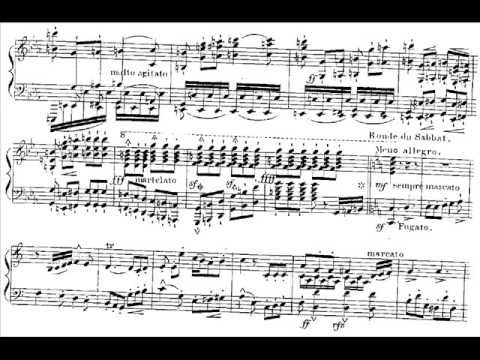
The final movement is the best known part of the symphony, thanks to its use in the Julia Roberts movie, Sleeping With The Enemy. It features a four-part structure, which Hector Berlioz described in his own program notes from 1845 as follows:
“He sees himself at a witches’ Sabbath, in the midst of a hideous gathering of shades, sorcerers and monsters of every kind who have come together for his funeral. Strange sounds, groans, outbursts of laughter; distant shouts which seem to be answered by more shouts. The beloved melody appears once more, but has now lost its noble and shy character; it is now no more than a vulgar dance tune, trivial and grotesque: it is she who is coming to the Sabbath… Roar of delight at her arrival… She joins the diabolical orgy… The funeral knell tolls, burlesque parody of the Dies irae, the dance of the witches. The dance of the witches combined with the Dies irae.”
The Dies irae melody is one of the most-quoted in musical literature, appearing in the works of many diverse composers.
The traditional Gregorian melody has also been used as a theme or musical quotation in a number of classical compositions, notable among them:









 MaryO'Studio