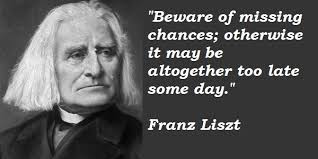
Franz Liszt was born in Raiding, near Ödenburg, October 22, 1811 and died in Bayreuth, July 31, 1886. He was a Hungarian composer and pianist who was a major influence during the romantic period. Liszt was an outstanding pianist at seven, composed at eight and made concert appearances at nine. In addition to being a piano virtuoso, he was also a critic, conductor, city music director, literary writer and transcriber of the works of other composers. He transcribed Beethoven’s Symphonies for the piano.
Franz Liszt began his career as the outstanding concert pianist of the century, who, along with the prodigious violinist Niccoló Paganini (1782-1840), created the cult of the modern instrumental virtuoso. To show off his phenomenal and unprecedented technique, Liszt composed a great deal of music designed specifically for this purpose, resulting in a vast amount of piano literature laden with dazzling, and other technical marvels. In this vein, Liszt composed a series of virtuosic rhapsodies on Hungarian gypsy melodies, the best-known being the all too familiar Hungarian Rhapsody no. 2. Liszt developed the rhapsody as a form of serious music. This kind of music is worlds apart from the generally more introspective, poetic music of pianist-composer Frédéric Chopin.
Liszt was wildly handsome and hugely talented. He was extremely popular in Paris during the 1830’s. It is said that women actually fainted at his piano recitals. He was the first to position the piano so that its lid reflected the sound and the audience could see his profile as he performed.
Liszt was the first to write a tone poem, which is an extended, single-movement work for orchestra, inspired by paintings, plays, poems or other literary or visual works, and attempting to convey the ideas expressed in those media through music. Such a work is Les Préludes, based on a poem in which life is expressed as a series of struggles, passions, and mysteries, all serving as a mere prelude to . . .what? The Romantic genre of the symphonic poem, as well as its cousin the concert overture, became very attractive to many later composers, including Saint-Saëns, Tchaikovsky, Dvorák, Sibelius, and Richard Strauss.
Listen to Liszt’s transcription of Meyerbeer’s Hellish Waltz from Robert du Diable, which probably caused more public commotion than any other piano piece in history.
• 1885 ~ Egon Wellesz, Austrian composer and musicologist
• 1907 ~ The “Merry Widow” opened in New York. The play starred Ethel Jackson and Donald Brian. The operetta had been introduced in Europe two years before.
• 1908 ~ A Saturday Evening Post advertisement offered a chance to buy, for the first time, a two-sided record. It was on Columbia.
1917 ~ Dizzy (John Birks) Gillespie, American jazz trumpeter and bandleader Read quotes by and about “Dizzy” Gillespie
More information about Gillespie
• 1921 ~ Sir Malcolm Arnold, Composer of screen scores: “David Copperfield”, “The Chalk “Garden”, “Suddenly, Last Summer”, “Solomon and Sheba”, “Island in the Sun”, “The Bridge on the River Kwai”, “Trapeze”, “I Am a Camera”, “The Belles of St. Trinian’s” “the Eye Witness series”
• 1924 ~ It was a big night for a big band in New York’s Cinderella Ballroom. The crowd loved the Wolverine Orchestra from Chicago and the guy on the cornet, Bix Beiderbecke, the ‘young man with a horn’.
• 1938 ~ Quaker City Jazz was recorded on the Bluebird label by Jan Savitt’s orchestra. The tune would become the theme of the band. It was not, however, recorded in the Quaker City of Philadelphia. The song was waxed in New York City.
• 1940 ~ Manfred Mann (Michael Lubowitz), Singer with Mann-Hugg Blues Brothers
• 1941 ~ Steve Cropper, Guitarist with the groups: Blues Brothers as well as Booker T and The MG’s
• 1942 ~ Elvin Bishop, Guitarist, singer with Paul Butterfield Blues Band
• 1943 ~ Ron Elliott, Guitarist with Beau Brummels
• 1946 ~ Lee Loughnane, Brass with Chicago
• 1953 ~ Charlotte Caffey, Guitar, singer with The Go-Gos
• 1955 ~ Eric Faulkner, Guitarist with Bay City Rollers
• 1957 ~ Julian Cope, Bass, guitar, singer
• 1957 ~ Steve Lukather, Guitarist with Toto
• 1958 ~ Orchestral strings were used for the first time in a rock and roll tune. Buddy Holly recorded It Doesn’t Matter Anymore, written by Paul Anka. Sadly, it would be Holly’s last studio session. The song wasn’t released until after his death in February of 1959.
• 2001 ~ George Feyer, a pianist and entertainer who played at some of New York’s top hotels, died at the age of 92. Feyer, who was known for setting pop lyrics to classical music, entertained the sophisticated Manhattan cafe society for three decades. He played for decades at the Carlyle, the Stanhope and the Waldorf-Astoria. He made many recordings, including his Echoes album series, which featured Echoes of Paris and Echoes of Broadway. Born in Budapest on Oct. 27, 1908, Feyer attended the Franz Liszt Academy of Music, where he studied with composer Sir Georg Solti. One of his first jobs was playing for silent movies. During World War II, the Nazis put Feyer on forced labor details, then imprisoned him in the Bergen-Belsen concentration camp for the final year of the war. Feyer and his family moved to New York in 1951. He stopped working full time in 1982.
• 1923 ~ Robert Craft, American conductor and writer
• 1935 ~ Jerry Orbach, American singer and actor for the musical theater
• 1937 ~ Wanda Jackson, Singer, songwriter
• 1939 ~ Jay Siegel, Singer with The Tokens
• 1939 ~ All the Things You Are was recorded by the Tommy Dorsey Orchestra on the Victor label. Jack Leonard was the featured vocalist.
• 1945 ~ Ric Lee, Drummer with Ten Years After
• 1950 ~ Tom Petty, Singer with The Traveling Wilburys
• 1951 ~ Al Greenwood, Keyboards with Foreigner
• 1955 ~ “Day-O. Day-ay-ay-ay-o!” One of the most popular of the Harry Belafonte hits was recorded for RCA Victor. Day-O didn’t make it to the pop charts for over a year, until January of 1957, after its name had been changed to The Banana Boat Song (Day-O).
• 1958 ~ Mark King, Bass, singer with Level 42
• 1962 ~ With Halloween just around the corner, we remember that Bobby “Boris” Picket and the Crypt Kickers reached the top of the charts this day (for two weeks) with The Monster Mash. And someone, somewhere, has resurrected it every Halloween since.
This piece is now in Piano Maestro in the Halloween section and there is sheet music, if you are interested.
• 1962 ~ The musical, Mr. President, written by Irving Berlin, opened on Broadway. Mr. President ran for 265 performances.
• 1965 ~ The Beatles received a gold record for the single, Yesterday. This song marked the first time a cello was used in a pop hit.
• 2000 ~ Li Yundi, an 18-year-old virtuoso from China, has won Poland’s Frederic Chopin piano competition, becoming one of the youngest players to capture the prestigious international prize. Read the whole story
1855 ~ William Barclay Squire, British musicologist
• 1893 ~ On this day a song called “Goodmorning to All” was copyrighted by two teachers who wrote it for their kindergarten pupils. The title was later changed to “Happy Birthday to You”. The copyright was claimed illegal in September, 2015.
• 1941 ~ Fry Me Cookie, with a Can of Lard was recorded by the Will Bradley Orchestra on Columbia. Ray McKinley was featured.
• 1942 ~ Dave Lovelady, Drummer with The Fourmost
• 1943 ~ C.F. (Fred) Turner, Musician with Bachman~Turner Overdrive
• 1947 ~ Bob Weir (Hall), American rock guitarist and singer with The Grateful Dead
• 1953 ~ Tony Carey, Keyboards with Rainbow
• 1959 ~ Gary Kemp, Guitarist with Spandau Ballet, brother of musician Martin Kemp
• 1969 ~ Wendy Wilson, Singer with Wilson Phillips, daughter of Beach Boys singer, Brian Wilson
• 1972 ~ John C. Fogerty and Creedence Clearwater Revival called it a career … and the group disbanded. Fogerty continued in a solo career with big hits including, Centerfield and The Old Man Down the Road.
• 1976 ~ Memphis, TN disc jockey Rick Dees and his ‘Cast of Idiots’ made it all the way to number one on the Billboard Hot 100 with the immortal Disco Duck (Part 1). Dees is still around, but not as a recording artist. He’s a DJ in Los Angeles and is hosting several varieties of the Weekly Top 40 show, syndicated around the world.
• 1983 ~ George Liberace passed away. He was an American musician and television performer. Born in Menasha, Wisconsin, he was the elder brother and business partner of famed U.S. pianist Liberace.
• 1990 ~ Art Blakey passed away. He was an American jazz drummer and bandleader.
• 2000 ~ David Golub, American pianist and chamber music conductor, passed away at the age of 50. Born in Chicago, Golub grew up in Dallas, where he began learning the piano. In 1969 he moved to New York and spent his student years honing his technique at New York’s Juilliard School of Music. He also began conducting during summer breaks at Vermont’s Marlboro festival. In 1979, he accompanied violinist Isaac Stern on a tour of China. A film about the tour, “From Mao to Mozart,” won the 1980 Academy Award for Best Documentary. As a performer, Golub was perhaps best known for his work with violinist MarkKaplan and cellist Colin Carr in the trio they formed in 1982. In the late 1990s, Golub began cultivating his interest in opera. Under his leadership, the Padua Chamber Orchestra recorded some of Haydn’s least-known work for opera. An acclaimed chamber ensemble performer – most notably with the Golub-Kaplan-Carr Trio – Golub led the Padua Chamber Orchestra during the 1994-95 season and took it on tour in the United States in 1999. He is survived by his wife, Maria Majno.
• 2001 ~ Oscar-winning composer and lyricist Jay Livingston, whose collaboration with Ray Evans led to such hits as Silver Bells, Que Sera, Sera and Mona Lisa, died of pneumonia. He was 86. Livingston’s songwriting partnership with Evans spanned 64 years. Often called the last of the great songwriters, Livingston and Evans had seven Academy Award nominations and won three – in 1948 for Buttons and Bows in the film The Paleface, in 1950 for Mona Lisa in Captain Carey, USA, and in 1956 for Que Sera, Sera in The Man Who Knew Too Much. They wrote the television theme songs for Bonanza and Mr. Ed, and were honored by the American Society of Composers, Authors and Publishers for the most performed music for film and TV for 1996. Livingston was born on March 28, 1915, in the Pittsburgh suburb of McDonald. He met Evans in 1937 at the University of Pennsylvania, where they were both students. The team’s final project was the recording, Michael Feinstein Sings the Livingston and Evans Song Book, due for 2002 release.
• 1906 ~ American premièr of Puccini’s opera, “Madama Butterfly”, Washington, D.C.
• 1913 ~ David Carroll, Conductor, arranger, record producer for The Diamonds and The Platters
• 1925 ~ Mickey (McHouston) Baker, Guitarist, singer in the duo, Mickey and Sylvia
• 1925 ~ Grand Ole Opry started on radio in Nashville, Tennessee (where it still originates). It was first heard on network radio in 1939. The show finally made it to TV on this day in 1955.
• 1926 ~ Karl Richter, German organist and conductor
• 1931 ~ The production of “Cat and the Fiddle” opened in New York. It played for 395 performances.
• 1932 ~ The first city-owned opera house, the War Memorial Opera House of San Francisco, opened this day. “Tosca” was the first opera presented.
• 1937 ~ Barry McGuire, Singer, songwriter with The New Christy Minstrels
• 1942 ~ Don Stevenson, Drummer, singer with Moby Grape
• 1946 ~ Richard Carpenter, Composer, singer, Grammy Award-winning group, the Carpenters
• 1948 ~ Chris De Burgh (Davidson), Singer, songwriter
• 1951 ~ I Love Lucy debuted on CBS-TV. For the next 20 years, Lucille Ball would be a TV regular. She did take 1956 off. Why? No, having little Ricky had nothing to do with it. She starred in “Damn Yankees” on Broadway that year.
• 1953 ~ Tito (Toriano) Jackson, Singer with The Jackson Five, brother of Michael, Janet, Jermaine, LaToya
• 1953 ~ “Teahouse of the August Moon” opened on Broadway to begin a long and successful run of 1,027 performances.
• 1964 ~ An American treasure passed away. Cole Porter, renowned lyricist and composer, died at age 73. I’ve Got You Under My Skin and hundreds of other classics crossed all musical style and format boundaries throughout his long and rich career. More information about Porter
• 2001 ~ Etta James, the prolific jazz vocalist whose soulful, blues-influenced recordings over more than a half century won her acclaim and two Grammy nominations, died of complications from a bout with cancer. She was 72. Jones’ style was described as a cross between Billie Holiday, her idol, and Dinah Washington. She died the same day her last recording, Etta Jones SingsLady Day, hit music stores. Born in Aiken, S.C., Jones was a teenager when she was discovered while competing in a contest at the famed Apollo Theater in Harlem. Jones collaborated with such greats as Oliver Nelson, Earl “Fatha” Hines, Kenny Burrell and Cedar Walton, both in concert and on recordings. She recorded prolifically for RCA, Prestige, Muse and more recently Highnote Records. Jones earned a gold record for her 1960 recording Don’t Go to Strangers, and received a Grammy nomination in 1981 for Save Your Love For Me. She got a second Grammy nomination in 1999 for a collection of songs: My Buddy – Etta Jones Sings the Songs of Buddy Johnson. Jones was the recipient of many awards, including the prestigious Eubie Blake Jazz Award and the Lifetime Achievement Award from the International Women in Jazz Foundation.
• 1930 ~ I Got Rhythm, by George Gershwin, sung by Ethel Merman, was a show-stopper in the production of “Girl Crazy” on Broadway. It was Merman’s debut on the Great White Way as she captivated audiences and launched her stellar career. “Girl Crazy” went on for 272 performances.
• 1931 ~ Rafael Puyana, Colombian harpsichordist
• 1938 ~ Melba Montgomery, Singer
• 1938 ~ One of the great songs of the big band era was recorded by Bob Crosby (Bing’s brother) and The Bob Cats. Big Noise from Winnetka on Decca Records featured Bob Haggart and Ray Bauduc. Haggart whistled and played bass, while Bauduc played the skins.
• 1939 ~ Broadcast Music, Inc. (BMI) was organized on this day to compete with ASCAP (American Society of Composers and Publishers). The two music licensing organizations’ goal is to ensure that composers, artists and publishers are properly paid for the use of their works.
• 1940 ~ Cliff Richard (Harry Webb), Singer
• 1946 ~ Justin Hayward, Guitarist, singer with The Moody Blues
• 1961 ~ The Broadway production “How to Succeed in Business without Really Trying” opened.
• 1971 ~ It was John and Yoko Day on The Dick Cavett Show on ABC. The couple promoted Lennon’s new LP (Imagine) and film (Imagine) and Yoko’s book, two films and a fine arts show.
• 1996 ~ Eighteen years after its creation, The Rolling Stones’ Rock & Roll Circus was finally released. The 1968 event put together by The Stones comprised two concerts on a circus stage and included performances by The Who, Taj Mahal, Marianne Faithfull and Jethro Tull. John Lennon and Yoko Ono performed as part of a supergroup called The Dirty Mac, along with Eric Clapton, Mitch Mitchell and Keith Richards. It was originally planned to be aired on BBC TV.
• 2001 ~ Willam Farr Christensen, a Utah dancer who started on the vaudeville stage and went on to become one of the most important figures in American ballet, died at the age of 99. Founder of the San Francisco Ballet and Utah’s Ballet West, Christensen was the first person in the United States to choreograph full-length versions of several ballet classics, including “The Nutcracker”, “Coppelia” and “Swan Lake”. With his brothers Lew and Harold, he toured the famous Orpheum vaudeville circuit in the 1920s, performing a ballet act at a time when few Americans were familiar with the art. By 1934, Christensen had quit the circuit to found the first ballet company in Portland, Ore., then left three years later to join the San Francisco Opera Ballet as a principal soloist. Within a year he was named ballet master of the company. In 1941 he founded the San Francisco Ballet, the first major ballet company in the West. Christensen choreographed the country’s first full-length production of “The Nutcracker” in 1944, and today it is a Christmas tradition for nearly every ballet company in the nation.
• 1902 ~ The Gibson Mandolin guitar company was formed. Gibson’s first electric guitar the ES-150 was produced in 1936, and in 1946 Gibson introduced the P-90 single coil pickup, which was eventually used on the first Les Paul model made in 1952.
• 1906 ~ Paul Creston, American composer and organist
• 1908 ~ Johnny Green, Songwriter of Coquette, Body and Soul, I’m Yours, (You Came Along From) Out of Nowhere, I Cover the Waterfront, Easy Come, Easy Go; won five Oscars for work on MGM films: “Easter Parade”, “West Side Story”, “Oliver”, “An American in Paris”, “Bye Bye Birdie”, “High Society”, “Raintree County”, “The Great Caruso”, “Summer Stock” and “Brigadoon”
• 1928 ~ You’re the Cream in My Coffee … comes from “Hold Everything”, which opened on Broadway this day and ran for 413 performances.
• 1937 ~ The Mutual Broadcasting System debuted Thirty Minutes in Hollywood. 48 sponsors shared the cost of the program that aired in 72 cities nationwide. It was the first Mutual co-op radio show. George Jessel and Norma Talmadge starred. Music was provided by the Tommy Tucker Orchestra.
• 1940 ~ Moonlight and Roses, by Lanny Ross, was recorded on the Victor label.
• 1942 ~ The anniversary of the first production of Verdi’s opera Aida by an all African-American cast
• 1946 ~ Ben Vereen, American dancer and singer of popular music, Tony Award-winning actor, TV host of You Write the Songs
• 1953 ~ Midge (James) Ure, Singer, songwriter
• 1955 ~ David Lee Roth, Singer with Van Halen
• 1958 ~ Tanya Tucker, Singer
• 1961 ~ Martin Kemp, Bass with Spandau Ballet, brother of musician Gary Kemp
• 1970 ~ Neil Diamond reached the #1 spot on the pop music charts for the first time with Cracklin’ Rosie. In 1972, Diamond would reach a similar pinnacle with Song Sung Blue.
• 1979 ~ Not just Rumours, but fact, that Fleetwood Mac got a star on the Hollywood Walk of Fame.
• 2001 ~ Patricia Anne McKinnon, whose singing career began on Canadian television’s “Singalong Jubilee”, died of lymphatic cancer. She was 53. McKinnon was born in Shilo, Manitoba. Beginning her singing career at the age of 13, McKinnon sang for the Halifax-produced “Singalong Jubilee,” a show on the Canadian Broadcasting Corporation. She also starred in television programs, including “Juliette,” “Show of the Week,” and “A Go Go ’66.” For more than 28 years McKinnon fought Hodgkins disease, which put her career on hold at times.
• 2003 ~ Eugene Istomin, one of the first great classical pianists born in America, died after battling liver cancer. He was 77. At 17, Istomin won both the prestigious Leventritt and Philadelphia Youth Orchestra awards. In 1943, he made sensational debuts in the same week with the Philadelphia Orchestra under Eugene Ormandy and the New York Philharmonic under Artur Rodzinski, playing Johannes Brahms’Second Piano Concerto. At 25, he began a long association with cellist Pablo Casals. A year and a half after Casals’ death in 1973, Istomin married his widow, Marta, now president of the Manhattan School of Music. In a career that carried him throughout the world, Istomin gave more than 4,000 concerts with leading conductors – including Bruno Walter, Fritz Reiner, George Szell, Leopold Stokowski and Leonard Bernstein.
• 1898 ~ Alfred Wallenstein, American cellist and conductor
• 1911 ~ Jo (Jonathan) Jones, Drummer, piano, reeds, trumpet. The first to minimize use of base drum, keeping time on top cymbal. He played with Count Basie, Benny Goodman sextet.
• 1942 ~ TIME magazine described Command Performance, which debuted this day, as “…the best wartime program in radio.” The show was originally produced by the U.S. War Department in cooperation with Armed Forces Radio Services specifically for those in the military overseas. It continued until 1949 and was reprised for more than three decades in syndication. Command Performance was hosted by Bob Hope,Bing Crosby, Don Wilson and Harry Von Zell and featured just about every major Hollywood and Broadway star.
• 1945 ~ Kevin Godley, Drummer, singer with 10cc
• 1949 ~ David Hope, Bass with Kansas
• 1950 ~ The Frank Sinatra Show debuted. It was the crooner’s first plunge into TV, the beginning of a $250,000 per year, five-year contract. Ben Blue, The Blue Family, the Whippoorwills and Axel Stordahl’s orchestra were regulars on the show.
• 1951 ~ John Cougar Mellencamp, Singer
• 1953 ~ Tico Torres, Drummer with Bon Jovi
• 1955 ~ Yo-Yo Ma, Chinese-born American cello virtuoso
• 1969 ~ Put on your headband, love beads, surfer’s cross and give the peace sign. It was on this day that The Youngbloods hit, Get Together, passed the million-selling mark to achieve gold record status.
• 1982 ~ “Cats”, another musical hit by Andrew Lloyd Webber, began a long Broadway run. It’s most memorable for its song, Memories. Cats ended on September 10, 2000.
• 1995 ~ Alanis Morissette went to No.1 on the US album chart with her third album Jagged Little Pill. The record produced six successful singles, including ‘You Oughta Know’, ‘Ironic’, ‘You Learn’, ‘Hand in My Pocket’, and ‘Head over Feet’ and went on to become the biggest selling album ever by a female artist with sales over 30m. Do you have a favorite track from the album?
• 2000 ~ Dennis Sandole, a jazz guitarist and mentor to John Coltrane, died at 87. Beginning in the early 1940s, Sandole played with some of the major swing-era bands of the time, including those led by Charlie Barnet, Boyd Raeburn, Tommy Dorsey and Ray McKinley. He also recorded film soundtracks and played at recording sessions for Frank Sinatra and Billie Holiday. Sandole was mentor to jazz giantJohn Coltrane from 1946 to the early 1950s, teaching him music theory and exposing him to music from other cultures. He recorded some of his own music, including “Modern Music From Philadelphia” in 1956. In 1999 Cadence Jazz released “The Dennis Sandole Project,” which contained parts of a jazz ballet/opera he wrote in the 1960s and 70s called “Evenin’ Is Cryin'”. Sandole published a book, “Guitar Lore,” in 1981.
• 2003 ~ Arthur Berger, a composer, critic and teacher who was an influential analyst of contemporary music, died of heart failure. He was 91. In 1943, Berger began a decade as a music critic for the New York Herald Tribune. Later, he was one of the founders of the periodical Perspectives of New Music. In 1953, he published the first book-length study of composer Aaron Copland. Berger’s “Ideas of Order” premiered with the New York Philharmonic in 1952. His primary interest as a composer, however, was in chamber music and in music for the piano. His neoclassicalQuartet for Winds is probably his most performed work. Igor Stravinsky admired Berger’s music, and Copland wrote of its distinction, craftsmanship, individuality and idiosyncrasy. Over his career, Berger taught at Mills College in California, Brandeis University and the New England Conservatory of Music. Berger celebrated his 90th birthday last year by publishing a collection of essays, “Reflections of an American Composer.”
• 2003 ~ William Bennett, whose Manhattan music studio gave hope to those with aspirations of escaping the corporate world to become rock stars, Oct. 7 from injuries he received in a car accident. He was 49. Bennett bought Off Wall Street Jam in 1997. The TriBeCa studio became a place where he mentored other musicians and helped to arrange music engagements at city clubs. Bennett grew up on the Upper East Side in a show business family. He majored in music in college and played guitar in bands like the Immortal Primitives, which had opened for the Ramones. But he eventually wound up working at a photography agency and did not play guitar for years. A friend advised him to purchase the studio, which grew to more than 400 dues-paying members.
• 2003 ~ John Pagaard “Johnnie” Jessen, a former vaudeville saxophone player and University of Washington instructor who inspired pop musician Kenny G, died at the age of 94. At Jessen’s retirement from the university in 1989, Kenny Gorelick, who shortened his name to Kenny G for performing and recording, said 12 years of working with Jessen were crucial to his success. “I made a breakthrough after I started studying with Johnnie,” he said. “One morning I woke up and I could play twice as fast. He had this great tone on flute, and got me to the point where I was doubling on clarinet and flute.” The son of Danish immigrants, Jessen was playing the violin at parties by age 9 and soon afterward formed his first band, the Rinky Dinks. He went on to play on cruise ships crisscrossing the Pacific Ocean in the 1920s and on the RKO vaudeville circuit behind stars such as Betty Grable, Judy Garland and Sammy Davis, Jr. in the 1930s.
• 1917 ~ A new word cropped up in the American lexicon: Jazz. The Literary Digest described jazz as music that caused people to, “shake, jump and writhe in ways to suggest a return to the medieval jumping mania.”
• 1927 ~ Paul Badura-Skoda, Austrian pianist and music editor
• 1927 ~ “Mammy, how I love you, how I love you, my dear old mammy!” It was Al Jolson in blackface, singing in the first full-length talking picture, The Jazz Singer, as it opened in New York City. In reality, The Jazz Singer was not a true talkie. There were only 291 spoken words in the landmark film; however, it was the first to integrate sound and this small amount of dialogue into a story through the Vitaphone disk process; and the first to entertain a large audience. The talking part was mostly singing, and it was Al Jolson who made the flick a success, proving to the critics that an all-talking film could work. (Because he didn’t think the pioneer of talkies would be all the rage, George Jessel actually turned down the starring role; as did Eddie Cantor.) A silent version of the film was released to movie theaters who had not yet popped for the $20,000 or so that it cost to rewire their venue. The audience was thrilled with Jolson’s sound performance as a cantor’s son, Jake Rabinowitz, rejecting the world he came from to become a singer of popular music, changing his name to Jack Robin in the process. Although not jazz as we know it, the songs Jolson sang became part of American music culture: Toot Toot Tootsie (Goodbye), Blue Skies, Waiting for the RobertE. Lee and, of course, My Mammy. For those truly with a need to know, Neil Diamond did not audition for Jolson’s part when finding out that Jessel had turned it down. Diamond performed in a remake of The Jazz Singer in 1980. As Jolson said, “Wait a minute, wait a minute, you ain’t heard nothin’ yet!” Maybe, through the wonders of modern technology, we could hear Jolson and Diamond together, in concert. That would be the Mammy of all jazz singin’.
• 1941 ~ Claude Thornhill and his orchestra recorded Autumn Serenade on Columbia Records.
• 1946 ~ Millie Small (Smith), Singer, known as ‘The Blue Beat Girl’ in her native Jamaica
• 1949 ~ Bobby Farrell, Singer
• 1950 ~ Thomas McClary, Guitarist with The Commodores
• 1962 ~ Robert Goulet stepped out of the role of Sir Lancelot after singing/acting the part since 1960. The fabulously successful Broadway musical, Camelot, also starred Richard Burton as King Arthur and Julie Andrews as Queen Guenevere.
• 1964 ~ Matthew Sweet, Guitarist, singer, songwriter
• 1969 ~ George Harrison‘s song ‘Something’ was released as the “A” side of a Beatles’ 45, a first for Harrison. Along with Lennon and McCartney’s ‘Come Together’, the single went on reach No.1 on the US chart the following month. Both tracks were lifted from the Abbey Road album.
• 2001 ~ Blues singer Mamie “Galore” Davis died of a stroke. She was 61. Davis was born Sept. 24, 1940, in Erwin, where she started singing the blues. She graduated from O’Bannon High School and joined a local band. She performed with such musicians as Little Johnny Burton, Buddy Hicks, Little Milton and the Ike and Tina Turner Revue. Her first solo recording, Special Agent 34-24-38, was recorded on the St. Lawrence label in 1965. Under her first producer, Monk Higgins, she recorded two more singles for St. Lawrence, including her biggest hit, It Ain’t Necessary, in 1966.
• 2003 ~ Victor Buelow, who made it into the record books as the longest-serving community band director, died os an apparent heart attack. He was 94. Buelow directed the Jefferson American Legion Band for 72 years, from 1931 through the 2002 band season. Guinness World Records declared him the longest-serving director anywhere after he retired. Buelow stayed with the band even in retirement, playing the alto horn this summer
• 2007 ~ Queen’s groundbreaking promo for their 1975 hit Bohemian Rhapsody was named the UK’s best music video in a survey of music fans. Out of 1,051 adults polled by O2, 30% named the six-minute video, (which took only three hours to shoot and cost a mere £3,500 to make), their favorite.
• 1930 ~ The New York Philharmonic Orchestra was first heard on the air over CBS radio from Carnegie Hall. The Sunday afternoon concerts set CBS back $15,000. Not per week, but for the entire season!
• 1935 ~ Margie Singleton, Singer, TV performer on Louisiana Hayride
• 1938 ~ Johnny Duncan, Singer
• 1938 ~ Carlo Mastangelo, Singer with Dion and The Belmonts
• 1939 ~ As long as Ted Weems’ orchestra recorded on Decca Records, so did the featured vocalist in his band, the barber from Canonsburg, PA, Perry Como. Before becoming a star in his own right, and making the move to RCA Records and NBC, ‘Mr. C.’ recorded I Wonder Who’s Kissing Her Now with Weems on Decca.
• 1943 ~ Steve Miller, Singer, songwriter with The Steve Miller Band
• 1947 ~ A small Northern California company got a major boost from Bing Crosby. The first show recorded on tape was broadcast on ABC radio. ‘Der Bingle’ was so popular, that his taped show promoted wide distribution of the new magnetic tape recorders that would become broadcast classics – the venerable Ampex 200.
• 1949 ~ Brian Connolly, Singer with The Sweet
• 1949 ~ B.W. Stevenson, Singer, songwriter
• 1950 ~ Eddie Clarke, Guitarist with Motorhead
• 1951 ~ Bob Geldof, Singer, songwriter with Boomtown Rats, organized fund-raising group: Band Aid
• 1955 ~ Leo Barnes, Musician with Hothouse Flowers
• 1962 ~ Ken Noda, American pianist and composer
• 1962 ~ The Beatles debut single ‘Love Me Do’ was released in the UK. It spent 26 weeks on the chart peaking at No.17. Beatles producer George Martin has said when ‘Love Me Do’ was released, it was the day the world changed.
• 1965 ~ Adding to his many credits, accolades and honors, Henry Mancini received a gold record for the soundtrack LP from the movie, The Pink Panther.
• 2000 ~ Singer, actor and composer Cuco Sanchez, whose six-decade career included the ranchera hits La cama de piedra and Anillo de compromiso, died of liver failure. He was 79. Sanchez, whose full name was Jose del Refugio Sanchez Saldana, recorded his first song at 13. In 1940, he was signed by Mexico’s largest media company, for which he acted in movies and television programs. Sanchez’s long career included about 200 songs, which were translated into 27 languages. Among his hits were Mi chata, Anoche estuve llorando, No soy monedita de oro, Buenas noches mi amor, Con la misma moneda, Que manera de perder, Fallaste corazon, and Oigame compadre. Sanchez also composed music for movies.
• 2003 ~ Clarence B. Cagle, a legendary pianist for the Texas Playboys, died at the age of 83. Cagle began playing violin and banjo at house parties at age 9. In 1938, Cagle moved to Coffeyville, Kan., where he played with Herb Goddard’s Oklahoma Wanderers. By then, he’d switched to playing the piano. Cagle auditioned for legendary Texas swing musician Bob Wills in 1943 in Tulsa. He got the job and performed with the Texas Playboys until Wills left for Hollywood to make Western films. Cagle stayed in Tulsa with Wills’ brother, Johnnie Lee Wills, developing his well-known “Boogie Woogie Highball.” Cagle played with him for the next 17 years. He was admitted to the Western Swing Hall of Fame in Sacramento, Calif., in 1988.


 Listen to Liszt’s transcription of Meyerbeer’s Hellish Waltz from Robert du Diable, which probably caused more public commotion than any other piano piece in history.
 Read quotes by and about Liszt
 Liszt was the first recitalist
 1917 ~ Dizzy (John Birks) Gillespie, American
