. 1732 ~ Franz Joseph Haydn, Austrian composer
Listen to Haydn’s music
More information about Haydn
. 1872 ~ Sergei Pavlovich Diaghilev. He was a Russian art critic, patron, ballet impresario and founder of the Ballets Russes.
. 1880 ~ Henryk Wieniawski, Polish violist/composer, died at the age of 44
. 1901 ~ John Stainer died. He was an English composer and organist whose music, though not generally much performed today, was very popular during his lifetime.
. 1922 ~ Richard Kiley, American actor and singer (Kismet, Man of La Mancha, Endless Love)
. 1928 ~ Lefty (William Orville) Frizzell, Country Music Hall of Famer
. 1934 ~ Shirley Jones, Singer, actress
. 1935 ~ Herb Alpert, American trumpeter, bandleader (Tijuana Brass), composer, record company executive: the “A” of A&M Records
. 1937 ~ Phil Harris recorded one of his best-known songs in Los Angeles, CA. That’s What I Like About the South was recorded on a 78 RPM disk. Harris would move to TV stardom and continue as a popular vocalist during the 1950s with such hit songs as The Thing.
. 1943 ~ The show, Away We Go, was renamed. The show opened at the St. James Theatre in New York City and, thanks to the talents of stars like Alfred Drake, Joan Roberts and Howard DeSilva, it became an instant hit. The show ran for 2,248 performances, until 1948. The musical, which has grossed millions of dollars on stage and as a blockbuster movie was initially produced for the sum of $75,000. It is still legendary among musical productions – especially after it was retitled Oklahoma!
. 1944 ~ Rod Allen (Rodney Bainbridge), Bass, singer with The Fortunes
. 1944 ~ Mick Ralphs, Guitarist
. 1945 ~ Al Nichol, Guitarist, keyboards with The Turtles
. 1953 ~ Sean Hopper, Keyboards with Clover and Huey Lewis and The News
. 1959 ~ Angus Young, Guitarist with AC/DC
. 1967 ~ Jimi Hendrix burned his guitar for the first time in a public performance at Finsbury Park in London.
. 1985 ~ Tootsie’s Orchid Lounge, long a favorite of country music stars, closed its doors in Nashville, TN.
Piano Day, an annual worldwide event founded by a group of like-minded people, takes place on the 88th day of the year – in 2019 it’s the 29th March – because of the number of keys on the instrument being celebrated.
. 1788 ~ Charles Wesley, writer of over 5,500 hymns and, with his brother John, the founder of Methodism, died.
. 1871 ~ The Royal Albert Hall in London opened
. 1878 ~ Albert Von Tilzer, Composer. He was the composer of “Take Me out to the Ball Game” among other old favorites.
More information about Von Tilzer
. 1879 ~ “Eugene Onegin”, best-known opera by Russian composer Tchaikovsky, was first performed at the Maliy Theatre in Moscow
. 1947 ~ Bobby Kimball (Toteaux), Singer with Toto
. 1949 ~ Michael Brecker, Jazz musician, reeds with The Brecker Brothers
. 1951 ~ The King and I, the wonderful Rodgers and Hammerstein musical based on Margaret Langdon’s novel, Anna and the King of Siam, opened this night in 1951 on Broadway. The King and I starred Yul Brynner in the role of the King of Siam. The king who, along with his subjects, valued tradition above all else. From this day forward, the role of the King of Siam belonged to Yul Brynner and no other. Brynner appeared in this part in more than 4,000 performances on both stage and screen (the Broadway show was adapted for Hollywood in 1956). Anna, the English governess hired to teach the King’s dozens of children, was portrayed by Gertrude Lawrence. Ms. Lawrence and Mr. Brynner acted, danced and sang their way into our hearts with such memorable tunes as Getting to Know You, Shall We Dance, Hello, Young Lovers, I Whistle a HappyTune, We Kiss in a Shadow, I Have Dreamed, Something Wonderful, A Puzzlement and March of the Siamese Children. The King and I ran for a total of 1,246 outstanding performances at New York’s St. James Theatre.
. 1952 ~ Roy Henderson’s last singing performance was on this date in the role of Christus in Bach’s “St. Matthew Passion” at Southwark Cathedral, the Anglican cathedral on the south bank of the Thames in London.
. 1973 ~ Hommy, the Puerto Rican version of the rock opera Tommy, opened in New York City. The production was staged at Carnegie Hall.
. 1973 ~ After recording On the Cover of ‘Rolling Stone’, Dr. Hook finally got a group shot on the cover of Jann Wenner’s popular rock magazine. Inside, a Rolling Stone writer confirmed that members of the group (Dr. Hook and the Medicine Show) bought five copies of the magazine for their moms – just like in the song’s lyrics!
. 1980 ~ Annunzio Paolo Mantovani, Anglo-Italian conductor and arranger, died. Created the “Mantovani sound” that made him a highly successful recording artist and concert attraction.
. 1982 ~ Carl Orff, German composer of “Carmina Burana,” died.
. 1982 ~ Ray Bloch passed away
. 1999 ~ Legendary U.S. jazz and blues singer Joe Williams died aged 80.
. 2001 ~ John Lewis, a pianist who masterminded one of the most famous ensembles in jazz, the Modern Jazz Quartet, died at the age of 80. The M.J.Q., as the quartet was known, remained mostly unchanged from the mid-1950’s to the 90’s. It began recording in 1952 with Lewis, vibraphonist Milt Jackson, bassist Percy Heath and drummer Kenny Clarke. When Clarke moved to Paris in 1955, Connie Kay replaced him and the quartet continued until Kay’s death in 1994. Lewis contributed the bulk of the group’s compositions and arrangements, including Django and Two Degrees East, Three Degrees West, and he insisted members wear tuxedos to dignify jazz as an art. He was born in LaGrange, Ill., in 1920, and grew up in Albuquerque, N.M. His entree to the jazz world came during World War II, when he met Kenny Clarke, an established drummer in the nascent bebop movement. At Clarke’s urging, Lewis moved to New York after his discharge and eventually replaced Thelonious Monk as Dizzy Gillespie’s pianist. He also performed or recorded with Charlie Parker, Lester Young and Ella Fitzgerald. In 1952 he formed the M.J.Q. with Clarke, Jackson and Heath. The quartet was a steady seller of records and concert tickets well into the 1970’s. Lewis also taught music at Harvard and the City College of New York, and in the late 1950’s helped found the Lenox School of Jazz in Massachusetts.
. 2009 ~ Maurice Jarre, French composer (Doctor Zhivago-Acadamy Award winner in 1966), died at the age of 84
. 1699 ~ Johann Adolph Hasse, German composer, singer and teacher of music. Immensely popular in his time, Hasse was best known for his prolific operatic output, though he also composed a considerable quantity of sacred music.
. 1784 ~ François-Joseph Fetis, Belgian musicologist, composer, teacher, and influential music critic.
. 1851 ~ The Playel piano factory in Paris was destroyed by fire. Playel was the favorite of Chopin in the 19th century, and it was identified with French composers known as the impressionist musicians of the early 20th century — like Ravel and Debussy.
Pleyel was founded in 1807 by Ignaz Pleyel, a composer and music publisher who studied with Franz Joseph Haydn.
. 1867 ~ Arturo Toscanini, Italian conductor and musical director. Famed for his temper in rehearsals, he was director of La Scala and the Metropolitan opera houses. He also conducted the NBC symphony orchestra. With a career spanned 68 years, he was a cellist at age 19
Read quotes by and about Toscanini
More information on Toscanini
. 1881 ~ Béla Bartók, Hungarian composer and pianist, born. His knowledge of western musical techniques allied to the inspiration he derived from Hungarian peasant songs enabled him to become a unique musical force.
More information about Bartók
. 1903 ~ Grammy winner Frankie Carle (Carlone), Pianist and bandleader
. 1913 ~ The Palace Theatre opened its doors in New York City. Ed Wynn was first on the vaudeville bill. Some 20 years later, Wynn would be named as radio’s top entertainer. He later became popular on television, as well.
. 1918 ~ Claude Debussy, French composer, died. His music, described as “musical Impressionism”, explored original avenues of expression.
. 1931 ~ Hal Kemp and his orchestra recorded Whistles, with Skinnay Ennis, for Brunswick Records. Both Kemp and Ennis sang in the Dorsey Brothers Concert Orchestra, under the direction of Dr. Eugene Ormandy (later, conductor of the Philadelphia Symphony Orchestra). The pair were part of the orchestra vocal quartet that also featured Nye Mayhew and Saxey Dowell in 1928.
. 1934 ~ Johnny Burnette, ‘The Master’, singer, brother of singer Dorsey Burnette
. 1938 ~ Hoyt Axton, Singer, musician and songwriter. Axton’s mother, Mae Boren Axton, wrote Elvis Presley’s Heartbreak Hotel
. 1940 ~ Anita Bryant, Singer
. 1942 ~ Aretha Franklin, American soul singer, known as the “Queen of Soul” and “Lady Soul”, she won 15 Grammy Awards and was the first woman inducted into Rock and Roll Hall of Fame (1987)
. 1947 ~ Elton John (Reginald Kenneth Dwight), Entertainer
More information about John
. 1948 ~ Kelly Garrett, Actress, singer
. 1949 ~ Neil Jones, Musician with Amen Corner
. 1951 ~ Maizie Williams, Singer with Boney M
. 1961 ~ “Gypsy” closed at the Broadway Theater in New York City after 702 performances
. 1966 ~ Jeff Healey, Guitarist, singer, songwriter with the Jeff Healey Band, CBC radio show: My Kind of Jazz
. 1971 ~ Tom Jones went gold with his single, She’s a Lady.
. 1972 ~ The group, America, rode to the top of the pop music charts with their LP, America, and the single (included on the LP), A Horse with No Name. A Horse With No Name would be the group’s only gold record.
. 1991 ~ Eileen Joyce, pianist, died at the age of 78
He’s the master of harmony and counterpoint, he could effortlessly compose an amazing concerto or cantata, but what if Johann Sebastian Bach was on social media?
To celebrate the 333rd anniversary of the great composer’s birth (it’s either today or March 31, depending on Old Style and New Style dates), we’ve imagined what his Facebook page might have looked like.
So sit back and enjoy the Baroque master’s status updates and life events in full Instagram, wall-post and emoticon glory.
1685 ~ Johann Sebastian Bach, German composer birthday (Old Style)
Bach’s Toccata and Fugue in d minor was featured in the Walt Disney movie Fantasia and the new Fantasia 2000
Read quotes by and about Bach
More information about Bach Grammy winner
. 1884 ~ Joseph Bonnet, French organist and composer. He founded the organ department at the Eastman School of Music during his time in the U.S.
. 1901 ~ Alfred Newman, Conductor
More information about Newman
. 1917 ~ Nat “King” Cole, American jazz singer and pianist
More information about Cole
. 1930 ~ Paul Horn, American jazz flutist, saxophonist, clarinetist and composer
More information about Horn
. 1938 ~ Rudolf Nureyev, Dancer
More information about Nureyev
. 1944 ~ John Lill CBE, English classical pianist
. 1944 ~ John Sebastian, American pop-rock singer-songwriter and guitarist, His group, The Lovin’ Spoonful performed Do You BelieveIn Magic, Summer In The City, Daydream, You Didn’t Have to be SoNice, Nashville Cats His solos include Darling Be Home Soon and Welcome Back
.1897 ~ First performance of Ludwig van Beethoven‘s Symphony No. 4 in B-flat major, Op. 60. It is a symphony in four movements.
. 1835 ~ Eduard Strauss, Austrian composer who, together with brothers Johann Strauss II and Josef Strauss made up the Strauss musical dynasty. He was the son of Johann Strauss I and Maria Anna Streim.
. 1873 ~ Lee Shubert, Broadway producer. Theaters in NY and LA named after him. He died in 1953
. 1907 ~ Jimmy McPartland, Jazz musician: cornetist; played for the Wolverine Orchestra, Embassy Four; bandleader; played at Newport Jazz Festival with wife, Marian
. 1916 ~ Harry James, American jazz trumpeter and bandleader, married to Betty Grable (second of four wives)
. 1918 ~ Lili Boulanger, composer, died at the age of 24
More about Boulanger
. 1933 ~ Cecil Taylor, American jazz pianist and composer
. 1944 ~ Sly Stone, American soul-rock singer and instrumentalist
. 1956 ~ “My Fair Lady” opened at the Mark Hellinger Theater in New York City for 2,715 performances
. 1959 ~ The musical, No Strings, opened on Broadway at the 54th Street Theatre. Richard Kiley and Diahann Carroll starred in the show. Also featured was the show’s composer in an acting role, singing his own lyrics. The composer was Richard Rodgers.
. 1968 ~ LIFE magazine called Jimi Hendrix, “the most spectacular guitarist in the world.”
. 1987 ~ Andrew Lloyd Webber’s “Starlight Express” opened on Broadway. This was the first ever roller-skating musical.
. 1964 ~ My Fair Lady, by Lerner and Loewe, opened on Broadway. It ran for 6-1/2 years before 2,717 audiences. It became, thanks to Rex Harrison and an outstanding cast, the longest-running musical to that time.
. 1970 ~ The musical, Purlie, opened a run of 680 continuous performances on Broadway.
. 2001 ~ Ann Sothern died at the age of 92. She was an actress who starred as the saucy, liberated showgirl in MGM’s “Masie” movies during the 1940s and played single working women on TV in “Private Secretary” and “The Ann Southern Show.”
There is also another work based on π called What pi sounds like
Today is pi day, and to celebrate, we bring you a musical representation of π, to 31 decimal places, at 157 beats per minute (which, incidentally, is 314 divided by two).
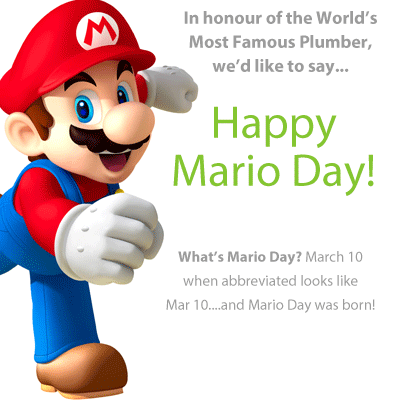
National Mario Day is observed each year on March 10th and honors Mario from the popular Nintendo game.
It is celebrated on March 10th because of the way the date appears, when abbreviated (Mar.10), it looks just like the name Mario.
. 1832 ~ Muzio Clementi died. He was an Italian-born English composer, pianist, pedagogue, conductor, music publisher, editor, and piano manufacturer. He is also the subject of this month’s Piano Explorer, which is enjoyed by my students.
. 1844 ~ Pablo de Sarasate, Spanish violinist
. 1879 ~ Ignaz Moscheles died. He was a Bohemian composer and piano virtuoso
. 1892 ~ Arthur Honegger, French composer
Read quotes by and about Honegger
More information about Honegger
1903 ~ “Bix” Beiderbecke, American jazz cornetist
More information about Beiderbecke
. 1910 ~ Carl Heinrich Carsten Reinecke, composer, died at the age of 85
. 1935 ~ Nelson Eddy recorded Ah! Sweet Mystery of Life for Victor Records. The song came from the film, “Naughty Marietta”. Later, Eddy recorded the classic tune with Jeanette MacDonald.
. 1937 ~ An audience of 21,000 jitterbuggers jammed the Paramount Theatre in New York City to see a young clarinetist whom they would crown, ‘King of Swing’ on this night. The popular musician was Benny Goodman.
. 1940 ~ W2XBS-TV in New York City originated the first televised opera as members of the Metropolitan Opera Company presented scenes from “I Pagliacci”.
. 1956 ~ Julie Andrews was 23 years old this night when she made her TV debut. She appeared with Bing Crosby and Nancy Olson in the musical adaptation of Maxwell Anderson’s play, “High Tor”.
. 1977 ~ E Power Biggs, English organist/composer (CBS), died at the age of 70
. 2003 ~ Lionel Dakers, who directed the Royal School of Church Music for 16 years, died at age 79. Dakers was a stickler for high musical standards and opposed some of the modernizing trends in English church music. Dakers was organist at Ripon Cathedral from 1954 to 1957, then moved to Exeter Cathedral before his appointment as director of the Royal School of Church Music in 1972. In 1976, he was appointed a director of Hymns Ancient & Modern, publisher of some of the most widely used Anglican hymnals.
. 2016 ~ Keith Emerson died. He was an English keyboardist and composer with English rock musician Emerson, Lake & Palmer.
. 2017 ~(Joan) Joni Sledge, vocalist (Sister Sledge “We are Family”), died at the age of 60


 Grammy winner