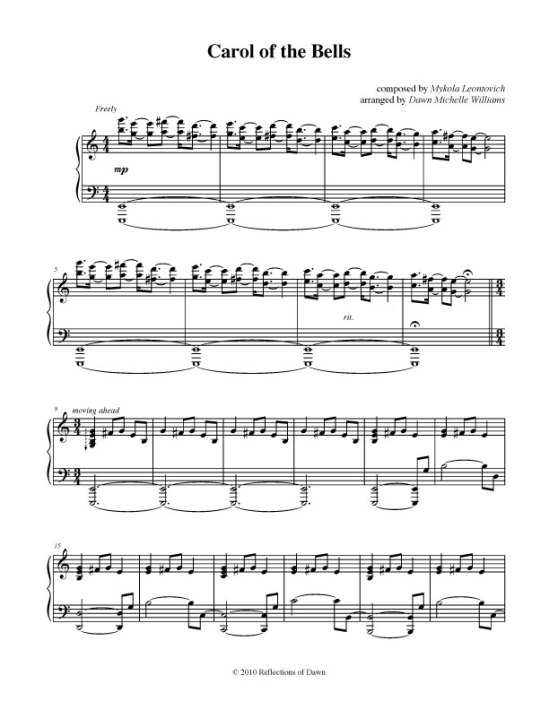
Carol of the Bells was composed by Mykola Dmytrovych Leontovych (1877-1921) in 1916. Originally titled Shchedryk, this Ukrainian folk song is sometimes called Ukrainian Bell Carol. “Shchedryk” which was associated with the coming New Year, originally celebrated in April.
Leontovych used this tune in 1904 along with lyrics by Peter J. Wilhousky to create the version that everyone knows today. It gained popularity during the 1920s and 1930s, and was introduced to an even wider audience when it was used in the movie “Home Alone”.
It was first performed in the Ukraine on the night of January 13, 1916, on the Julian calendar this is considered New Year’s Eve. In the United States the song was first performed on October 5, 1921 at Carnegie Hall.
This video is from the Christmas special of the Mormon Tabernacle Choir, presented at the BYU channel. The orchestra and choir produce a very beautiful sound.
Not the standard version –
The O’Connor Music Studio has several versions of this Christmas Carol available for loan, including this version from the Mannheim Steamroller:
• 1927 ~ Duke Ellington’s big band opened the famed Cotton Club in Harlem. It was the first appearance of the Duke’s new and larger group. He played the club until 1932.
For part 2:
• 1934 ~ Ethel Merman recorded I Get a Kick Out of You, from Cole Porter’s musical, Anything Goes. She was backed by the Johnny Green Orchestra. The tune was recorded for Brunswick Records.
• 1934 ~ Wink (Winston Conrad) Martindale, TV host, singer
• 1938 ~ Yvonne Minton, Australian mezzo-soprano
• 1940 ~ John Cale, Bass, keyboard, viola, singer with The Velvet Underground
• 1942 ~ Bob Mosley, Bass with Moby Grape
• 1942 ~ Chris Hillman, Guitar, bass, mandolin with The Byrds
• 1944 ~ Dennis Wilson, American rock-and-roll singer and drummer
• 1948 ~ Southside Johnny (Lyon), Singer with Southside Johnny and The Asbury Dukes
• 1965 ~ Composer, lyricist, and singer, Jacques Brel made his American debut in concert at Carnegie Hall in New York City. Brel composed Jackie, You’re Not Alone, If You Go Away and more.
• 1972 ~ Billy Paul from Philadelphia received a gold record for his smash hit, Meand Mrs. Jones.
• 2002 ~ Emmy-nominated pianist George Gaffney, who accompanied such musicians as Peggy Lee, Engelbert Humperdink and Sarah Vaughan, died. He was 62. Born in New York City, Gaffney began studying the piano at age 10 but switched to the trombone. After serving in the U.S. Marine Corps from 1958 to 1961, Gaffney returned to New York, where he played piano and began arranging and accompanying singers. Gaffney moved to the Chicago area in the mid-1960s and was musical director of the Playboy Club in Lake Geneva, Wis., where he first met Vaughan. Gaffney came to California in the early 1970s and found work as a studio musician and accompanist. He worked on a number of television programs, including the TV series “Moonlighting,” and was nominated for an Emmy. From 1980 to 1990, he was Vaughan’s accompanist and musical director. He moved to Las Vegas in 1994 and worked as Humperdink’s musical director. In recent years, he also orchestrated tunes for Rita Moreno.
• 2002 ~ Mary Hansen, guitarist and vocalist with the ’90s alternative band Stereolab died. She was 36. Hansen, from Maryborough in Queensland, Australia, died in a cycling accident in London, The Independent newspaper reported Friday. Details of the accident were not available. Band spokesman Mick Houghton was quoted by The Independent as saying a truck might have backed into her, “but I really don’t know much more than that.” Hansen joined the band in 1992, two years after it was formed by Tim Gane, formerly of the band McCarthy, and his girlfriend Laetitia Sadier. Among hundreds of messages posted on the band Web site, one from a fan who identified himself as Louis called Hansen “the soul” of the band. Hansen, who played several instruments, first appeared on 1992’s LoFi single and all subsequent releases, including 1994’s Mars Audiac Quintet and 1996’s Emperor Tomato Ketchup. Stereolab had been working on a new album, expected to be released next year.
• 2003 ~ Barry Morell, a tenor who played leading roles at the Metropolitan Opera and internationally for more than two decades, died of esophageal cancer. He was 75. Morell began his career as a baritone, until he sought the guidance of former Metropolitan Opera baritone Giuseppe Danise, who told him he should be a tenor. He was best known for performing the operas of Puccini. He made his debut as Pinkerton in “Madame Butterfly” in 1955 with the New York City Center Opera Company. In 1958, he made his Met debut in the same role. He appeared in Berlin, Barcelona, Vienna and other opera houses in Europe, South America and across the United States. Among his more than 20 roles during 257 performances at the Met were Rodolfo in “LaBoheme,” Enzo in “La Gioconda” and the title roles of “Don Carlo”and “Faust”.
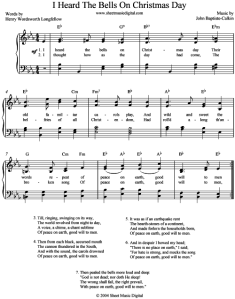
“I Heard the Bells on Christmas Day” is a Christmas carol based on the 1863 poem “Christmas Bells” by American poet Henry Wadsworth Longfellow. The song tells of the narrator’s despair, upon hearing Christmas bells, that “hate is strong and mocks the song of peace on earth, goodwill to men”. The carol concludes with the bells carrying renewed hope for peace among mankind.
This version is done by Casting Crowns. I chose it because the Pender choir sang this on Christmas Eve with past-Associate Pastor Dan Elmore singing the solo…and I fell in love with this version.
As seen on 2008 TBN Christmas special. “I Heard The Bells On Christmas Day” is available on Casting Crowns’ Christmas album, Peace On Earth.
More traditionally, the Mormon Tabernacle Choir’s version:
I heard the bells on Christmas Day
Their old, familiar carols play,
and wild and sweet
The words repeat
Of peace on earth, good-will to men!
And thought how, as the day had come,
The belfries of all Christendom
Had rolled along
The unbroken song
Of peace on earth, good-will to men!
Till ringing, singing on its way,
The world revolved from night to day,
A voice, a chime,
A chant sublime
Of peace on earth, good-will to men!
Then from each black, accursed mouth
The cannon thundered in the South,
And with the sound
The carols drowned
Of peace on earth, good-will to men!
It was as if an earthquake rent
The hearth-stones of a continent,
And made forlorn
The households born
Of peace on earth, good-will to men!
And in despair I bowed my head;
“There is no peace on earth,” I said;
“For hate is strong,
And mocks the song
Of peace on earth, good-will to men!”
Then pealed the bells more loud and deep:
“God is not dead, nor doth He sleep;
The Wrong shall fail,
The Right prevail,
With peace on earth, good-will to men.”
• 1596 ~ Nicola Amati, Italian violin maker, teacher of Guarneri and Stradivari
• 1729 ~ Padre Antonio Francisco Javier Jose Soler, Spanish composer whose works span the late Baroque and early Classical music eras. He is best known for his keyboard sonatas, an important contribution to the harpsichord, fortepiano and organ repertoire.
• 1876 ~ Hermann Goetz died. He was a German composer.
1883 ~ Anton Webern, Austrian composer and conductor
Read quotes by and about Webern
More information about Webern
• 1907 ~ Connie (Connee) Boswell, Singer Connie or Connee (a spelling she preferred later in life), who also played several musical instruments, arranged vocals for herself and her two sisters. Although she was stricken with polio and worked from her wheelchair, she never let this get in the way of being part of her jazz-singing trio. The Boswell Sisters’ talent was quickly recognized and by the time Connee was 24 years old, the sisters were doing vaudeville, radio, playing New York’s Paramount Theatre, recording with the Dorsey Brothers: You Oughta Be in Pictures; making films and appearing on the U.S.A.’s first public TV broadcast. One thing led to another and Connie went solo, entertaining World War II troops, making films, appearing on Broadway and recording with big names like Woody Herman’s; even a duet classic with Bing Crosby: Basin Street Blues. Her musical influence spanned many generations and music styles. If you’d have asked Ella Fitzgerald, she would have told you, “They just don’t make ’em like Connee Boswell anymore.”
1923 ~ Maria Callas (Calogeropoulous), American soprano
More information about Callas Read quotes by and about Callas
• 1925 ~ The first jazz concerto for piano and orchestra was presented at Carnegie Hall in NYC. Commissioned by Walter Damrosch, American composer George Gershwin presented Concerto In F, and was also the featured soloist playing a flugelhorn in a slow, bluesy style as one of his numbers.
• 1927 ~ Phyllis Curtin, Singer: soprano with the New York City Opera, MetropolitanOpera, Vienna Staatsoper, La Scala, Teatro Colon; coordinator of Voice Dept and Opera at Yale School of Music, Dean Emerita of Boston Univ School for the Arts
• 1927 ~ Ferlin Husky (aka: Simon Crum, Terry Preston), Singer
• 1930 ~ Andy (Howard Andrew) Williams, American Emmy Award-winning entertainer, singer
• 1931 ~ Jaye P. (Mary Margaret) Morgan, Singer, performer
• 1944 ~ Frank Sinatra was in the Columbia Records studio recording Old Man River.
• 1948 ~ Ozzy (John) Osbourne, Songwriter, singer
• 1949 ~ Mickey Thomas, Singer with Jefferson Starship
• 1953 ~ Kismet opened on Broadway in New York. The show ran for 583 performances.
• 1955 ~ Elvis Presley’s first release on RCA Victor Records was announced. No, it wasn’t Hound Dog or Heartbreak Hotel. The first two sides were actually purchased from Sam Phillips of Sun Records: Mystery Train and I Forgot to Remember to Forget. Elvis was described by his new record company as “The most talked about personality in recorded music in the last 10 years.”
• 1960 ~ Camelot opened at the Majestic Theatre in New York City. Richard Burton and Julie Andrews played the leading roles in the musical written by Lerner and Loewe. Robert Goulet got rave reviews for his songs, If Ever I Would Leave You,Then You May Take Me to the Fair and How to Handle a Woman, among others. Camelot had a run of 873 performances. Broadway went Hollywood in the 1967 film version of Camelot. Its run was not quite as successful.
• 1968 ~ The O’Kaysions received a gold record for Girl Watcher. The song had a promotional reprise in the 1990s as a theme for Merv Griffin’s Wheel of Fortune, with the revamped lyrics, I’m a Wheel Watcher…
• 1977 ~ After 29 weeks in the #1 position on the album charts (a record, literally…), Rumours, by Fleetwood Mac, was replaced at the top spot by the album Simple Dreams, sung by Linda Ronstadt.
• 2000 ~ Kevin Mills, a member of the Christian rock groups Newsboys and White Heart, died after a motorcycle accident in Hollywood. He was 32. Mills, of Louisville, Ky., was a singer and bass player, his family said. He also was a member of the Screen Actors Guild and appeared on TV in “An Inconvenient Woman” in 1991. White Heart started in 1982. Newsboys, an Australian band now based near Nashville, was formed four years later. Newsboys have sold nearly 3 million records and earned three Grammy nominations on the religious rock circuit.
• 2002 ~ Rich Dangel, credited with creating the opening guitar chords of garage band staple Louie Louie, died of an aneurysm at his home. He was 60. Dangel was a member of the seminal Northwest rock band the Wailers, who introduced the nation to the Northwest sound – raw, unpolished and catchy. He may be best known for coming up with the power chords that opened the Wailers’ 1961 regional hit, Louie, Louie, written by rhythm-and-blues singer Richard Berry and taken to the top of the national charts by another Northwest band, the Kingsmen from Portland, Ore. Dangel co-wrote his first chart hit, “Tall Cool One” with fellow Wailer John Greek when he was still in high school. The song resulted in the group’s first album, “The Fabulous Wailers,” a cross-country tour and a 1959 appearance on Dick Clark’s “American Bandstand.”
Angels we have heard on high
Sweetly singing o’er the plains
And the mountains in reply
Echoing their joyous strains
CHORUS:
Gloria, in excelsis Deo!
Gloria, in excelsis Deo!
Shepherds, why this jubilee?
Why your joyous strains prolong?
What the gladsome tidings be
Which inspire your heavenly song? ChorusCome to Bethlehem and see
Him Whose birth the angels sing;
Come, adore on bended knee,
Christ the Lord, the newborn King. ChorusSee Him in a manger laid
Jesus Lord of heaven and earth;
Mary, Joseph, lend your aid,
With us sing our Savior’s birth. Chorus
This is a traditional French carol (Les Anges dans nos Campagnes) that was translated into English by Bishop James Chadwick.
This carol commemorates the story of the birth of Jesus Christ found in the Gospel of Luke, in which shepherds outside Bethlehem encounter a multitude of angels singing and praising the newborn child.
In 2009, Andrea Bocelli and David Foster collaborated to produce a Christmas album with a number of other music legends. This is “Angels We Have Heard on High” with choir and orchestra.
The Piano Guys, Peter Hollens, David Archuleta, and The Mormon Tabernacle Choir get together to sing “Angels We Have Heard On High”
• 1918 ~ Milton DeLugg, Bandleader on The Tonight Show Starring Johnny Carson; Milton DeLugg and His Orchestra: Abe Burrows’ Almanac, The Chuck Barris Rah Rah Show, Dagmar’s Canteen, Doodles Weaver, The Gong Show, Judge for Yourself, Your Hit Parade; played accordion in The Milton DeLugg Quartet and songwriter
• 1928 ~ Jörg Demus, Austrian pianist
• 1934 ~ Billy Paul (Paul Williams), Singer
• 1941 ~ Tom McGuinness, Bass, guitar with Manfred Mann; McGuinness Flint; and Blues Band
• 1942 ~ Ted Bluechel, Jr., Singer, drummer with The Association
• 1944 ~ Eric Bloom, Singer, guitarist
• 1945 ~ John Densmore, Musician with The Doors
• 1952 ~ Michael McDonald, Singer, songwriter, keyboard with The Doobie Brothers
• 1960 ~ Rick Savage, Bass with Def Leppard
• 1972 ~ Motown’s Temptations reached the #1 spot on the top 40 charts with Papa Was a Rollin’ Stone. It was the fourth #1 hit for the Temptations, joining My Girl, I Can’t Get Next to You and Just My Imagination.
Isaac Watts wrote the words to “Joy to the World” in 1719, based on Psalm 98 in the Bible. The hymn originally glorified Christ’s triumphant return at the end of the age, rather than a song celebrating His first coming. Only the second half of Watts’ lyrics are still used today.
The music was adapted and arranged to Watts’ lyrics by Lowell Mason in 1839 from an older melody which was then believed to have originated from Handel. The name “Antioch” is generally used for the hymn tune.
As of the late 20th century, “Joy to the World” was the most-published Christmas hymn in North America.
There are versions of Joy to the World available at the O’Connor Music Studio for any level of playing, starting with Pre-Reading, all the way up through Advanced and duets.
Let’s get in the Christmas spirit together this Sunday, December 3rd, at our 8:15, 9:30 or 11:00 am Service.
Our amazing Sanctuary Choir (MrsO sings in it!) and Orchestra will present a Cantata by Joseph M. Martin entitled “The Mystery and the Majesty.”
From jubilant glorias to gentle manger lullabies, this inspirational cantata celebrates the wonder and splendor of Christmas. Traditional carols and newly composed seasonal anthems blend with thoughtful narration to help create a meaningful experience.
At PenderUMC, 5 minutes from the O’Connor Music Studio
• 1709 ~ Franz Xaver Richter, Austro-Moravian singer, violinist, composer, conductor and music theoretician
• 1879 ~ Gilbert and Sullivan’s operetta, H.M.S. Pinafore, opened. Arthur Sullivan conducted the orchestra while William Gilbert played the role of a sailor in the chorus and in the Queen’s Nay-vee.
• 1913 ~ Mary Martin, American singer and actress, primarily for the musical theater, Tony and Emmy Award-winning actress, mother of actor Larry Hagman
More about Mary Martin
• 1924 ~ Lady Be Good opened in New York City. George Gershwin wrote the music while Fred and Adele Astaire were well-received by the show’s audience for their dancing talents.
• 1936 ~ Lou Rawls (Louis Allen), American Grammy Award-winning singer of popular music, TV regular on Dean Martin Presents
• 1938 ~ Sandy Nelson, Drummer
• 1939 ~ Diane Lennon, Singer with The Lennon Sisters on Lawrence Welk Show, Jimmy Durante Presents the Lennon Sisters
• 1940 ~ Glenn Miller got a call from ASCAP (American Society of Composers and Publishers). He was informed that he couldn’t use his Moonlight Serenade as his band’s theme song. He had to use Slumber Song instead because of an ASCAP ban.
• 1945 ~ Bette Midler, American Grammy Award-winning pop-rock singer and actress
• 1945 ~ Burl Ives made his concert debut. He appeared at New York’s Town Hall. We lovingly listen every year for the voice of this old-time radio personality as the narrator and banjo-pickin’ snowman in TV’s Rudolph the Red-Nosed Reindeer.
• 1968 ~ Promises, Promises opened on Broadway. The play ran for 1,281 performances, earning $35,000 in profits each week of 1969. Dionne Warwick had a hit version of the title song.


 1883 ~ Anton Webern, Austrian composer and conductor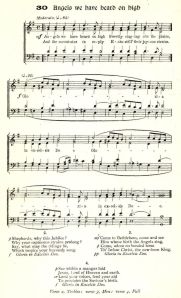


 MaryO'Studio