1685 ~ Johann Sebastian Bach, German composer birthday (Old Style)
Bach’s Toccata and Fugue in d minor was featured in the Walt Disney movie Fantasia and the new Fantasia 2000
Read quotes by and about Bach
More information about Bach Grammy winner
. 1890 ~ Lauritz Melchior, Danish-born American tenor
More information about Melchior
. 1890 ~ Beniamino Gigli, Italian operatic tenor, born; with a repertory of over 60 roles, he retired in 1955 after over 40 years singing.
. 1907 ~ Ozzie Nelson, Bandleader, actor in The Adventures of Ozzie and Harriet. He was married to actress, Harriet Nelson and they were the parents of David and Ricky Nelson.
. 1915 ~ Sviatoslav Richter, Russian pianist
More information about Richter
. 1917 ~ Dame Vera Lynn, English singer and sweetheart of British forces during World War Two, specifically the two songs “We’ll Meet Again ( 1939 )” and “The White Cliffs of Dover ( 1942 )”,
. 1920 ~ Marian McPartland, British jazz pianist
More information about McPartland
.1935 ~ The American radio show “Your Hit Parade” made its debut on the airwaves. In the following years, it became the jumping point for many of the most successful singers and artists in the music industry.
.1936 ~ Benny Goodman and his orchestra recorded Christopher Columbus on Victor Records in Chicago, IL.
. 1948 ~ Eugene Ormandy and the Philadelphia Symphony Orchestra were featured in the first televised symphonic concert. CBS-TV, with help from its then Philadelphia television station, WCAU-TV 10, carried the program from the Philadelphia Academy of Music, the home of the world-famous orchestra. The concert was televised live, at 5 p.m.
Ninety minutes later, NBC-TV carried TV’s second symphonic concert. This one was from Carnegie Hall in New York City. Arturo Toscanini and the NBC Symphony Orchestra was featured in a presentation of Wagner compositions.
. 1969 ~ BeatleJohn Lennon married Yoko Ono at the Rock of Gibraltar on this day. Lennon called the location, “quiet, friendly and British.” He was the second Beatle to marry in eight days. Paul McCartney and Linda Eastman were wed a week earlier.
. 1872 ~ Sergei Diaghilev, Russian impresario; founder of the Ballets Russes
More information about Diaghilev
. 1873 ~ Max Reger, German composer
Read quotes by and about Reger
More information about Reger
. 1900 ~ Charles-Louis Hanon, French piano pedagogue and composer, died
More about Hanon’s exercises
. 1917 ~ Dinu Lipatti, Rumanian pianist and composer
More information about Lipatti
. 1923 ~ Janine Dacosta, French pianist
. 1930 ~ Ornette Coleman, American jazz alto saxophonist and composer
More information about Coleman
. 1941 ~ Jimmy Dorsey and his orchestra recorded one of their biggest musical successes. It became one of Decca Records’ all-time greats. Green Eyes featured vocalists Helen O’Connell and Bob Eberly.
. 1946 ~ Ruth Pointer, Singer from The Pointer Sisters
. 2001 ~ Cuba-born entertainer Tony Alvarez of “El Show de Olga y Tony” died at age 85. Alvarez was best known for the television and radio programs he hosted with his wife, singer Olga Chorens. He began his career in Cuba in the 1940s as a singer and model, starring in a tango program on Channel Azul. In the 1960s, Alvarez and Chorens moved to Puerto Rico, where they began “El Show de Olga y Tony.” They later moved to New York, where they performed on WABC-TV, WPIX-TV and WNJU-TV from 1965 to 1972.
. 2001 ~ Elena Del Rubio, whose 60-year singing career with her sisters as the Del Rubio Triplets got a boost with campy covers of 1980s tunes, died of cancer. She was believed to be in her 70s. “It was a terrible blow to me,” said Milly, the only surviving sister. “Now I’m left alone.” Another triplet, Eadie, died in 1996. The sisters lived together in a mobile home overlooking the ocean. The trio that promoted itself as “3 Gals 3 Guitars 1 Birthday” performed for six decades in showcases ranging from television comedy to retirement homes. The three were in their 60s when they hit the Hollywood scene, dressed in identical miniskirts, go-go boots and big blonde hairdos. Calling themselves “song stylists,” the sisters’ diverse acts included mariachi strolling, country western music, Hawaiian-Calypso and holiday theme music.
. 2001 ~ Randall Hylton, a bluegrass performer who wrote Room at the Top of the Stairs, died in St. Thomas Hospital after suffering an aneurysm. He was 55. Hylton, who played guitar in the fingerpicking style of Chet Atkins and Merle Travis, was known for his ability to instantly write songs to fit any occasion. The 6-foot-6-inch performer also told jokes, did impersonations and could do guitar tricks, such as playing a song backward or two songs at once. Hylton’s songs were performed by more than 150 singers, including Ralph Stanley, Vern Gosdin, Mac Wiseman, Leo Kottke and Lester Flatt.
. 2001 ~ Herbie Jones, a jazz musician who worked with Duke Ellington and Billy Strayhorn, died of complications from diabetes. He was 74. Jones, a jazz trumpeter, composer, arranger and educator, toured five continents with the Ellington band. His recorded arrangements for the band were El Busto, Cootie’s Caravan, The Prowling Cat and The Opener, and he contributed to Ellington’s first and second Sacred Concerts. After leaving the Ellington band, Jones became the first director of Arts and Culture Inc., a New York City alternative school, and as a volunteer directed the Bugle Corps of the Police Athletic League in Harlem. In Ellington’s 1973 memoir, “Music Is My Mistress,” he called Jones “a great asset” to his orchestra in the 1960s. Jones often played first trumpet but rarely soloed.
. 2015 ~ Peter Katin died. He was a British classical pianist and pedagogue.
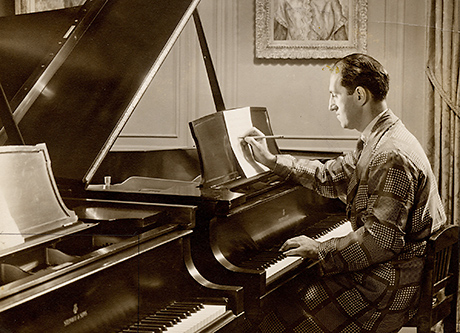
The Gershwin family donated the Steinway to the University as part of the George and Ira Gershwin initiative that is focused on research and study of the brothers’ music.
According to Marc Gershwin, George and Ira’s nephew, “I wanted the instrument to be accessible to the students and faculty who would be preserving the legacy of George and Ira Gershwin’s music… I’m delighted that the piano will once again be in regular use [by students and faculty], and am thrilled that it has been restored to performance condition.” [Two other Gershwin Steinways are in museums.]
From what I know of George he would have wanted it this way. Unlike some composers George was a gifted pianist. He had a rich social life and enjoyed playing his music for anyone who would listen.
There’s a lesson in that thought. If you have something valuable, sometimes it becomes more valuable – or at least more appreciated – when people can see it and use it. If you look at the piano as an instrument of technology that is it, then it makes sense that organizations give people access to technology – as well as resources – to do their work.
. 1842 ~ Stephane Mallarme, French Symbolist poet, born. His “L’Apres-midi d’un Faune” inspired composer Claude Debussy to write an orchestral prelude of the same name.
. 1844 ~ Nicolai Rimsky-Korsakov, Russian composer More information about Rimsky-Korsakov
. 1882 ~ Gian Francesco Malipiero, Italian composer and musicologist
. 1902 ~ Enrico Caruso recorded 10 arias for the Gramophone Company. The recording session took place in Milan, Italy and Caruso walked away with $500 for his effort.
. 1905 ~ John Kirkpatrick, American pianist (Concord Sonata)
. 1910 ~ Hold on to your hats! The opera, Pipe of Desire, was first performed this day at the Metropolitan Opera House in New York City. Frederick Sheperd Converse wrote the work that turned out to be the first opera by an American composer to be performed at the Met.
. 1911 ~ composer Irving Berlin got the copyright for “Alexander’s Ragtime Band,” the multimillion-selling smash hit that helped turn American popular music into a major international phenomenon, both culturally and economically.
. 1927 ~ John Kander, composer (Cabaret, Chicago, Funny Lady, Kramer vs Kramer)
. 1970 ~ Brook Benton received a gold record for the hit single, Rainy Night in Georgia. It was Benton’s first hit since 1963’s Hotel Happiness.
. 1970 ~ Queen Latifah (Dana Elaine Owens), American actress, rapper, singer-songwriter, record producer, TV Personality and author. Her music, TV and Movie Acting has bought her a large number of awards including Golden Globe and a Grammy Award plus numbers of nominations including Emmy and Academy Award. She began her career as a Rapper in the group Ladies Fresh and the Flavor Unit before embarking on a solo career gaining considerable success including headlining at the Hollywood Bowl in Los Angeles in a live jazz concert. Queen Latifah is one of the few rappers who has not only continued with a successful music career but has also enjoyed major success and critical acclaim in both the movie industry and on Television. Her roles have included starring role on the TV Sitcom “Living Single” and her own show “The Queen Latifah Show” and as Matron “Mama” Morton in the Oscar-winning musical Chicago plus a number of starring and supporting roles in Scary Movie 3, Last Holiday, Mad Money, Back in Business, Taxi and Hairspray.
. 1978 ~ The Bee Gees started an eight-week stay at the top of the pop music charts with Night Fever from the Saturday Night Fever soundtrack.
. 2001 ~ John Phillips died at the age of 65. He was the singer-songwriter who founded the 1960s pop act the Mamas the Papas.
. 2017 ~ Trisha Brown, American choreographer and dancer, died at the age of 80
. 1884 ~ Joseph Bonnet, French organist and composer. He founded the organ department at the Eastman School of Music during his time in the U.S.
. 1901 ~ Alfred Newman, Conductor
More information about Newman
. 1917 ~ Nat “King” Cole, American jazz singer and pianist
More information about Cole
. 1930 ~ Paul Horn, American jazz flutist, saxophonist, clarinetist and composer
More information about Horn
. 1938 ~ Rudolf Nureyev, Dancer
More information about Nureyev
. 1944 ~ John Lill CBE, English classical pianist
. 1944 ~ John Sebastian, American pop-rock singer-songwriter and guitarist, His group, The Lovin’ Spoonful performed Do You BelieveIn Magic, Summer In The City, Daydream, You Didn’t Have to be SoNice, Nashville Cats His solos include Darling Be Home Soon and Welcome Back
. 1905 ~ Nadia Boulanger made her public concert debut at the piano.
. 1924 ~ Christa Ludwig, German mezzo-soprano
. 1935 ~ Theresa Berganza, Spanish mezzo-soprano
. 1937 ~ David Del Tredici, American composer
. 1942 ~ Fats Waller recorded The Jitterbug Waltz in New York for Bluebird Records. The Jitterbug Waltz was inspired by some piano exercises that Waller’s son Maurice had been practicing on the piano.
. 1955 ~ The Ballad of Davy Crockett, by Bill Hayes, reached the number one spot on the pop music charts and stayed for five weeks beginning this day. The smash hit song sold more than 7,000,000 records on more than 20 different labels. Everyone seemed to be singing the song that saluted the frontier hero who was “Born on a mountain top in Tennessee…” Coonskin caps were seen everywhere as the Crockett craze spread like a frontier fire.
. 1963 ~ Peter, Paul and Mary released the single, Puff The Magic Dragon.
. 1970 ~ Motown star Tammi Terrell died of complications from the malignant brain tumor that caused her 1967 collapse.
. 1971 ~ Simon & Garfunkel’s Bridge Over Troubled Water LP and single won six Grammys including Record, Song and Album of the Year. Aretha Franklin won the Best Female R&B Performance Grammy for Don’t Play That Song. B.B. King won the Best Male R&B Vocal Performance Grammy for The Thrill Is Gone.
. 1983 ~ Arthur Godfrey passed away
. 1985 ~ A Chorus Line played performance number 4,000 this night at New York’s famed Shubert Theatre. The show originally opened in July, 1975, and became the longest-running show to light up the Great White Way in September, 1983.
. 1999 ~ Honoring a roster of music artists that range from The Beatles to the Backstreet Boys, the Recording Industry Association of America presented the first Diamond Awards, given in recognition of albums and singles that have sold a million copies or more.
. 1999 ~ Clarence “Gatemouth” Brown and the late Roosevelt Sykes were inducted into the Blues Foundation Hall of Fame.
. 2014 ~ Mitch Leigh, American musical composer (Man of La Mancha), died at the age of 86
. 2017 ~ James Cotton, American blues vocalist and harmonica player, died at the age of 81
.1897 ~ First performance of Ludwig van Beethoven‘s Symphony No. 4 in B-flat major, Op. 60. It is a symphony in four movements.
. 1835 ~ Eduard Strauss, Austrian composer who, together with brothers Johann Strauss II and Josef Strauss made up the Strauss musical dynasty. He was the son of Johann Strauss I and Maria Anna Streim.
. 1873 ~ Lee Shubert, Broadway producer. Theaters in NY and LA named after him. He died in 1953
. 1907 ~ Jimmy McPartland, Jazz musician: cornetist; played for the Wolverine Orchestra, Embassy Four; bandleader; played at Newport Jazz Festival with wife, Marian
. 1916 ~ Harry James, American jazz trumpeter and bandleader, married to Betty Grable (second of four wives)
. 1918 ~ Lili Boulanger, composer, died at the age of 24
More about Boulanger
. 1933 ~ Cecil Taylor, American jazz pianist and composer
. 1944 ~ Sly Stone, American soul-rock singer and instrumentalist
. 1956 ~ “My Fair Lady” opened at the Mark Hellinger Theater in New York City for 2,715 performances
. 1959 ~ The musical, No Strings, opened on Broadway at the 54th Street Theatre. Richard Kiley and Diahann Carroll starred in the show. Also featured was the show’s composer in an acting role, singing his own lyrics. The composer was Richard Rodgers.
. 1968 ~ LIFE magazine called Jimi Hendrix, “the most spectacular guitarist in the world.”
. 1987 ~ Andrew Lloyd Webber’s “Starlight Express” opened on Broadway. This was the first ever roller-skating musical.
. 1964 ~ My Fair Lady, by Lerner and Loewe, opened on Broadway. It ran for 6-1/2 years before 2,717 audiences. It became, thanks to Rex Harrison and an outstanding cast, the longest-running musical to that time.
. 1970 ~ The musical, Purlie, opened a run of 680 continuous performances on Broadway.
. 2001 ~ Ann Sothern died at the age of 92. She was an actress who starred as the saucy, liberated showgirl in MGM’s “Masie” movies during the 1940s and played single working women on TV in “Private Secretary” and “The Ann Southern Show.”
. 1681 ~ Georg Philipp Telemann, German composer. One of the leading composers of the German Baroque, Georg Philipp Telemann was immensely prolific and highly influential. He wrote an opera at age 12, produced it at school, and sang the lead. His mother put all his instruments away and forbade further music. However, he continued to study and write in secret. He led a remarkably busy life in Hamburg, teaching, composing two cantatas for each Sunday, leading a collegium, and writing immense amounts of additional music. For two centuries musical scholars tended to look down on him by comparison with Bach, but from the midpoint of the twentieth century his reputation soared as musicologists began cataloguing his immense output, uncovering masterpiece after masterpiece.
More information about Telemann
. 1727 ~ Johann Gottlieb Goldberg, German virtuoso harpsichordist, organist, and composer of the late Baroque and early Classical period
. 1804 ~ Johann Strauss, Sr., Austrian composer; “The Father of the Waltz”
Read quotes by and about Strauss
More information about Strauss
. 1864 ~ (John Luther) Casey Jones, railroad engineer, subject of The Ballad of Casey Jones, killed in train crash Apr 30, 1900
. 1879 ~ Albert Einstein, Mathematician and enthusiastic amateur violinist
Read quotes by and about Einstein
. 1885 ~ “The Mikado,’ the comic operetta by Gilbert and Sullivan, premiered at the Savoy Theater, London.
. 1912 ~ Les Brown, Bandleader, Les Brown and His Band of Renown
. 1922 ~ Les Baxter, Bandleader
. 1931 ~ Phil Phillips (Baptiste), Singer
. 1933 ~ Quincy Delight Jones, Jr., American jazz composer, trumpeter, bandleader and pianist. He composed film scores, TV show themes; record producer; arranger; 25 Grammys, Grammy’s Trustees Award in 1989, Grammy’s Legends Award in 1990; Musical Director for Mercury Records, then VP; established Qwest Records
. 1934 ~ Shirley Scott, Swinging, blues-oriented organist, recorded mostly with former husband Stanley Turrentine
. 1941 ~ Years before Desi Arnaz would make the song Babalu popular on the I Love Lucy TV show, Xavier Cugat and his orchestra recorded it with Miguelito Valdes doing the vocal. The song was on Columbia Records, as was the Arnaz version years later.
. 1945 ~ Walter Parazaider, Reeds with Chicago
. 1955 ~ Boon Gould, Guitarist with Level 42
. 1958 ~ The Recording Industry Association of America (RIAA) certified the first gold record. It was Perry Como’s Catch A Falling Star on RCA Victor Records. The tune became the first to win million-seller certification, though other songs dating as far back as the 1920s may have sold a million records or more. Due to lack of a certification organization like the RIAA, they weren’t awarded the golden platter. The next three gold records that were certified after Perry Como’s million seller were the 45 rpm recordings of He’s Got the Whole World in His Hands by Laurie London, Patricia, an instrumental by the ‘Mambo King’, Perez Prado and Hard Headed Woman by Elvis Presley. The first gold-album certification went to the soundtrack of the motion picture, Oklahoma!, featuring Gordon MacRae. Is there really a gold record inside the wooden frame presented to winners? Those who know say, “No.” Its a gold-leaf veneer of maybe 18 kt. gold and/or it is a record painted gold. Yes, the song earning the award is supposed to be the one making up the gold record, but this is not always the case, according to several artists who have tried to play theirs.
. 1959 ~ Elvis Presley made the album charts, but no one would have known by the title of the disk. For LP Fans Only was the first LP ever issued without the artist’s name to be found anywhere on the cover — front or back.
. 1976 ~ Busby Berkeley, U.S. director and choreographer, died. He was best known for his lavish mass choreography in the films “42nd Street,” “Gold Diggers of 1933” and “Roman Scandals.”
. 1985 ~ Bill Cosby captured four People’s Choice Awards for The Cosby Show. The awards were earned from results of a nationwide Gallup Poll. Barbara Mandrell stunned the audience by announcing that she was pregnant while accepting her second award on the show. Bob Hope won the award as All-Time Entertainer beating Clint Eastwood and Frank Sinatra for the honor.
. 2016 ~ Sir Peter Maxwell Davies died. He was an English composer and conductor.
There is also another work based on π called What pi sounds like
Today is pi day, and to celebrate, we bring you a musical representation of π, to 31 decimal places, at 157 beats per minute (which, incidentally, is 314 divided by two).


 Grammy winner






 MaryO'Studio