
The 6th annual International Sheet Music Day is set for August 17, 2024.

The 6th annual International Sheet Music Day is set for August 17, 2024.

• 1795 ~ Heinrich Marschner, German opera composer
• 1863 ~ Gabriel Pierné, French composer, conductor and organist
• 1929 ~ Bill Evans, American jazz pianist and composer
• 1932 ~ Eydie Gorme (Edith Gormezano), Grammy Award-winning singer, married since 1957 to Steve Lawrence.
• 1938 ~ Robert Johnson passed away
• 1939 ~ The famous vaudeville house, Hippodrome, in New York City, was used for the last time. There were several places called the Hippodrome around the country. They weren’t, generally, theatres, nor true nightclubs. Hippodromes were designed for the wide variety of vaudeville acts available at the time … dancing, music, comedy and skits.
• 1940 ~ Marching Along Together, by Frankie Masters and his orchestra, was recorded for Okeh Records.
• 1942 ~ Barbara George, Singer
• 1945 ~ Suzanne Farrell (Ficker), Ballerina
• 1953 ~ James ‘J.T.’ Taylor, Singer with Kool and The Gang
• 1958 ~ Madonna (Madonna Louise Veronica Ciccone), Singer
• 1962 ~ Brian Epstein, manager of The Beatles, handed drummer Pete Best his walking papers. Best had been with the group for 2-1/2 years. Ringo Starr (Richard Starkey) was picked to take his place. One month later, the group recorded, Love Me Do.
• 1977 ~ Elvis Presley was rushed from Graceland to Baptist Memorial Hospital in Memphis, Tennessee. Doctors’ efforts to revive him were fruitless and he was pronounced dead (coronary arrhythmia) at 3:30 p.m. He was 42 years old.
• 1984 ~ Prince was pictured on the cover of Rolling Stone magazine. He was shown with his left armpit exposed.
• 1984 ~ Though it didn’t make the pop music charts, a new single by Elvis Presley was released by RCA Victor Records. The song was originally recorded in 1956 at the Tupelo (MS) Fairgrounds. It was called, Baby, Let’s Play House.
• 2000 ~ Sally Amato, who founded the Amato Opera Theater with her husband, Anthony Amato, in 1948, died at the age of 82.
Amato, who performed under her maiden name, Serafina Bellantone, was born in Little Italy in 1917. As a child she appeared in vaudeville skits in local movie theaters.
She met her husband when they were both appearing in an operetta at New Jersey’s Paper Mill Playhouse, and they founded the Amato Opera Theater to provide young singers with a chance to perform.
• 2000 ~ Alan Caddy, English musician (The Tornados) died
• 2007 ~ Max Roach, American percussionist, drummer, and composer died
• 2018 ~ Aretha Franklin passed away at the age of 76. Franklin won 18 Grammy Awards and is one of the best-selling musical artists of all time, having sold over 75 million records worldwide. Franklin received numerous honors throughout her career including a 1987 induction into the Rock and Roll Hall of Fame, in which she became the first female performer to be inducted. She was inducted to the UK Music Hall of Fame in 2005. In August 2012, Franklin was inducted into the GMA Gospel Music Hall of Fame. Franklin is listed in at least two all-time lists on Rolling Stone magazine, including the 100 Greatest Artists of All Time, and the 100 Greatest Singers of All Time.

When my students are first working with the Grand Staff, they are often confused about the placement of the various clefs.
In piano music, we generally use only the G-clef (Treble clef – not “trouble clef” as some think!) and the F-clef (Bass clef) I try to show students how the curvy part of the G-clef wraps around the G above middle C and the F-clef looks sort of like an F marking the F below middle C. I draw out G and F on the staff to show how these could have looked.
Originally, instead of a special clef symbol, the reference line of the staff was simply labeled with the name of the note it was intended to bear: F and C and, more rarely, G. These were the most often-used ‘clefs’ in Gregorian chant notation. Gregorian chant developed mainly in western and central Europe during the 9th and 10th centuries, with later additions and redactions.
Over time the shapes of these letters became stylized, leading to their current versions.

• 1890 ~Jacques Ibert, French composer and educator
• 1909 ~ Hugo Winterhalter, Orchestra leader
• 1922 ~ Lukas Foss, German-born American pianist, conductor and composer
• 1925 ~ Oscar Peterson, Canadian Jazz pianist, jazz trios, solos, played with all jazz greats, composer. He achieved international fame with the touring “Jazz at the Philharmonic”. His biography is Oscar Peterson: The Will to Swing
• 1925 ~ Bill Pinkney, Musician, bass with The Drifters
• 1933 ~ Bobby Helms, Singer
• 1941 ~ Don Rich, Country musician, songwriter, one of Buck Owens’ Buckaroos
• 1941 ~ Au Revoir, Pleasant Dreams was recorded by Ben Bernie and his orchestra.
• 1942 ~ Peter York, Musician, drums with Spencer Davis Group
• 1946 ~ Jimmy Webb, Grammy Award-winning songwriter
• 1961 ~ Matt Johnson, Musician, guitar, singer
• 1965 ~ 55,600 people attended a Beatles concert at Shea Stadium, New York, creating world attendance and revenue records for a pop concert.
• 1969 ~ The first day of the most famous musical event of 1969, Woodstock. It was originally called The Woodstock Music and Arts Fair and it began in Bethel, New York.
• 1969 ~ Three Dog Night (Danny Hutton, Cory Wells and Chuck Negron) were awarded a gold record for the album, Three Dog Night. Where’d the name of the group come from? In Australia, the aborigine tribes of several regions slept outside all year. As the temperatures got colder, the tribesmen would sleep with a dog to keep warm. In colder weather, they would huddle with two dogs. It must have been an extremely cold night when the group was formed!
• 1980 ~ I, Me, Mine, an autobiography by former Beatle George Harrison, went on sale.
• 1981 ~ Lionel Richie and Diana Ross hit number one on the pop music charts with their beautiful duet, Endless Love. It was a huge success for the two singers. Endless Love was number one for 9 weeks.
• 1989 ~ Many groups who had been to Woodstock had a twentieth-anniversary celebration.
• 2015 ~ Licia Albanese, Italian-born American operatic soprano, died at the age of 105
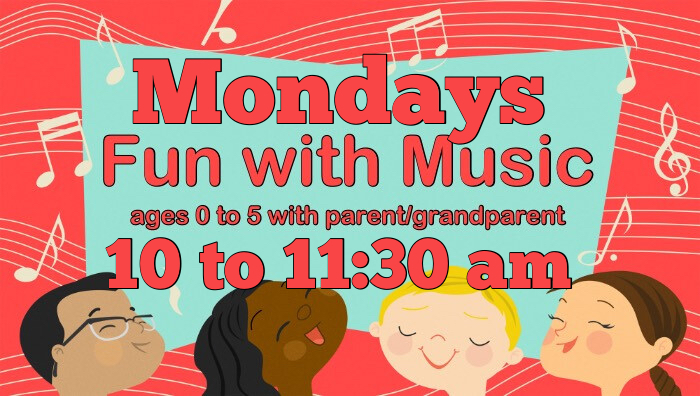
Step into a world of giggles and song with “Fun “with Music at Pender! This is not just any music class – it’s a journey through sound and imagination designed especially for preschoolers and their favorite grown-ups. Since 2013, Jim and Roberta Pont have been creating a space where tiny toes tap, and little voices echo with joy, crafting a magical musical experience for children from birth to five years old.
Wave ‘hello’ and join us every Monday morning for a delightful 30-minute musical escapade! Our littlest musicians and their families come together at 10 AM to sing, dance, and make friends with tunes. We dive into a treasure trove of stuffed animals and toys, transforming the room into an enchanting stage for our budding performers. With every stuffed lion’s roar or elephant’s trumpet, your child’s imagination will soar!
After the musical fiesta, it’s time for a yummy snack, followed by playtime where kids can explore and make-believe. Meanwhile, moms, dads, grandparents, and caregivers can relish a homemade brunch prepared with love – a perfect chance to mingle and share stories.
Our box of wonders is always brimming with surprises! One day it’s a car zooming around, another day it’s a train chugging along. Flip it over and voilà, it’s a drum or even a rumbling thunder to match the beat of our songs. From ‘The Wheels on the Bus’ to sparkling new Bible-based rhymes, we have tunes that will make your little one’s heart dance with every beat!
Last year, our pint-sized percussionists marched on bubble wrap to the rhythm of a march, popping and hopping with glee. And guess what’s next? A tunnel adventure awaits their curious little eyes and eager hands!
So, if you’re a parent with a playful tot between zero to five, and Monday mornings are open, come and make a splash in our sea of melodies at ‘Melody Mornings’. It’s not just fun; it’s a musical hug for the heart and soul. Can’t wait to sing and swing into a new day of joy with you and your little one!
This class meets every Monday starting September 8, 2025 at 10 am except for school holidays.
Pender UMC is at 12401 Alder Woods Drive, Fairfax, VA, 22033.
1778 ~ Augustus Toplady, English hymn-writer who wrote Rock of Ages, died.
• 1868 ~ Leone Sinigaglia, Italian composer
• 1888 ~ An audio recording of English composer Arthur Sullivan’s “The Lost Chord”, one of the first recordings of music ever made, is played during a press conference introducing Thomas Edison’s phonograph in London, England.
• 1926 ~ Buddy (Armando) Greco, Singer and pianist
• 1937 ~ Brian Fennelly, American composer, pianist and conductor
• 1940 ~ Dash Crofts, Drums, mandolin and keyboard with Champs; singer is a duo with Seals and Crofts
• 1941 ~ David Crosby (Van Cortland), American rock singer, guitarist and songwriter. Performed with The Byrds as well as Crosby, Stills, Nash and Young
• 1941 ~ Connie Smith (Meadows), Singer
• 1946 ~ Larry Graham, Bassist and singer with Sly and the Family Stone as well as Graham Central Station
• 1971 ~ Elton John put the finishing touches to his Madman Across the Water LP at Trident Studios, London. Since the album’s release on Feb 2, 1972, it has sold over two million copies in the U.S. alone.
• 1981 ~ The BBC recording of the Royal Wedding of Prince Charles and Lady Diana reached number one on the album charts in Britain.
• 1985 ~ Michael Jackson took control of the Beatles’ publishing rights. It was during their collaboration on 1983’s “Say Say Say” that former Beatle Paul McCartney is said to have advised King of Pop Michael Jackson to invest some of his enormous wealth in music publishing. It was sound financial advice that McCartney may have come to regret giving on August 14, 1985, when Michael Jackson purchased the publishing rights to the vast majority of the Beatles’ catalog for $47 million, outbidding McCartney himself.
• 2000 ~ Leonard Kwan, a master of slack key guitar whose composition Opihi Moemoe is considered a classic of the genre, died at the age of 69. Kwan began recording in 1957 and most recently recorded two albums for George Winston’s Dancing Cat Records. The second was released in September.
Kwan also was the first slack key guitarist to publicly share his instrument tunings in an instruction book.
Hawaiian slack key, or ki ho`alu, is a unique musical style dating to the 1830s, when Spanish and Mexican cowboys arrived in the islands. Some of the guitar strings are slacked from the standard tuning and songs are played in a finger-picking style, with the thumb playing bass. In 1960, he recorded, Slack Key, the world’s first all-instrumental slack key album.
• 2001 ~ Nicholas Orloff, a dancer and ballet teacher, died at the age of 86.
Orloff was known for his performance of the Drummer, a character he originated in David Lichine’s 1940 “Graduation Ball.”
He was a popular teacher with the Ballet Theater and other schools. He continued to teach in Manhattan schools even after suffering from a stroke three years ago.
Orloff appeared in the 1950 French film “Dream Ballerina” and on Broadway in the musical “Pipe Dream.”
He also was the ballet master of the Denver Civic Ballet in the mid- 1970s.
Born in Moscow, Orloff trained in Paris. He performed with the Ballet Russe de Monte Carlo, the Original Ballet Russe, Ballet Theater, as the American Ballet Theater was known, and the Grand Ballet du Marquis de Ceuvas.
• 2001 ~ Daniel Adrian Carlin, an Emmy-winning music editor who worked with soundtrack composers Lalo Schifrin and Ennio Morricone, died of complications from lung cancer and pulmonary fibrosis. He was 73.
Carlin edited the music for “Scorpio,” “The Outlaw Josey Wales,” “Ghost,” “Gorillas in the Mist,” “Dead Poets Society” and “Cliffhanger.” He won a music-editing Emmy in 1987 for his work on the miniseries “Unnatural Causes.”
He was founder in 1972 of La Da Music. Now known as Segue Music, it is considered the leading film and television editing company.
The following ornament table is a transcription of the one appearing in the Clavier-Büchlein vor Wilhelm Friedemann Bach, written by Johann Sebastian Bach for the keyboard instruction of his eldest son.
A scan of the original manuscript appears at Dave’s J.S. Bach Page.
The German title translates as “Explanation of various signs, showing how to play certain ornaments correctly.”{1} Bach gives the sign for each ornament on the upper of the paired staves, while the lower shows its execution directly beneath.
(This blog has) simply modernized the clefs in my transcription, since Bach’s manuscript uses soprano clefs, as several composers continued to do throughout the 18th century in place of the treble clef now used in all keyboard music.
After the transcription graphic showing the table, there appear clickable buttons which are keyed to AU sound files; you can click on any of the ornaments and hear a sound file play its execution.

Read the original blog post with the ornament table and listening files at J.S. Bach’s Ornament Table.
• 1820 ~ Sir George Grove, British musicographer and educator. Grove was editor of the Dictionary of Music and Musicians, the latest revised editions of which still carry his name
• 1860 ~ Annie Oakley born as Phoebe Anne Oakley Moses. She was a markswoman and member of Buffalo Bill Cody’s “Wild West Show” which toured America. The Irving Berlin musical, Annie Get Your Gun, was based on her life.
• 1912 ~ Jules Massenet, French composer of the operas Werther and Manon died.
• 1919 ~ George Shearing, British-born American jazz pianist and composer
• 1924 ~ The first country music record to sell one million copies reached that point on this day. It was The Prisoner’s Song, recorded by Vernon Dalhart. He became a Country Music Hall of Famer in 1981.
• 1930 ~ Don Ho, Singer
• 1930 ~ Guy Lombardo and his orchestra recorded Go Home and Tell Your Mother, on Columbia Records.
• 1948 ~ Kathleen Battle, American soprano, Metropolitan Opera diva, performed with the NY Philharmonic, Chicago Symphony, Boston Symphony, Berlin Philharmonic, Vienna Philharmonic, Orchestre de Paris
• 1949 ~ Cliff Fish, Musician, bassist with Paper Lace
• 1951 ~ Dan Fogelberg, Singer
• 1952 ~ “Hound Dog” was recorded for the first time by Big Mama Thornton
Elvis Presley’s “Hound Dog” (1956) is one of the biggest and most instantly recognizable pop songs in history. It’s a song so closely associated with the King of Rock and Roll, in fact, that many may mistakenly assume that it was a Presley original. In fact, the story of the song that gave Elvis his longest-running #1 hit (11 weeks) in the summer of 1956 began four years earlier, when “Hound Dog” was recorded for the very first time by the rhythm-and-blues singer Ellie Mae “Big Mama” Thornton in Los Angeles, California.
• 1958 ~ Feargal Sharkey, Singer with The Undertones
• 1987 ~ Vincent Persichetti, American composer died at the age of 72
• 2001 ~ Neil Cooper, the founder of the ROIR rock and reggae record label, died of cancer. He was 71.
Cooper started Reach Out International Records in 1979 and put out his first release – on cassette only – in 1981 by James Chance and the Contortions.
He then produced a catalog of cassettes by rock groups such as Bad Brains, Glenn Branca, Television, MC5, G.G. Allin, Johnny Thunders, and New York Dolls. ROIR’s reggae releases included Lee “Scratch” Perry, the Skatalites, Prince Far I, and Big Youth among others.
The cassette releases were a way to sidestep the artists’ exclusive contracts with other record labels. Vinyl album and compact disc versions were later issued.
Cooper also worked as an agent for MCA and Famous Artists before starting his label.
• 2003 ~ Ed Townsend, who wrote hit songs including 1958’s “For Your Love” and Marvin Gaye’s controversial “Let’s Get It On,” died at the age of 74. Townsend had written more than 200 songs. Nat King Cole and Etta James were among the stars who recorded Townsend’s songs. One of his first hits was “For Your Love” – which Townsend recorded himself.
Townsend also wrote and produced the Impressions’ 1974 No. 1 R&B hit “Finally Got Myself Together (I’m A Changed Man).”

The Piano Puzzlers book is available in the O’Connor Music Studio library if you’d like to give any a try. Piano Puzzlers as heard on American Public Media’s “Performance Today.” Includes 32 tunes with songs by Gershwin, Berlin, Arlen, Porter, Rodgers, Fats Waller, Lennon & McCartney, and others disguised in the styles of Bach, Handel, Haydn, Mozart, Beethoven, Brahms, Schubert, Schumann, Chopin, Janacek, Debussy, Ravel, Rachmaninoff, Stravinsky, Prokofiev, Bartok, and Copland.
Includes an introduction by Fred Child, host of “Performance Today” as well as background info by Bruce Adolphe. “Bruce Adolphe has taken a common musician’s party game and elevated it to high art and truly funny musical slapsticks. The Piano Puzzlers are a unique combination of extraordinary insight into the styles of many composers subtle, expert workmanship and great, great fun!”
From http://jasonmorris.blogsome.com/2008/08/08/piano-puzzlers/
If you’re a music geek (like me), I have a program for you. Now, let me be clear, to fully qualify as a music geek…you must have a fond appreciation for classical music (no, Poison, Quiet Riot, and Zepplin do not count as classical music). So, if you’re a “music geek” without an appreciation for classical music…well, I hate to burst your bubble…but, you’re not truly a music geek. Instead, you’re a music appreciator, but not a geek. So, if you just listen to indie music and scowl at anything on a label larger than Matador…don’t bother following the link I’ll provide…the fun will be lost on you…And, you probably won’t have a chance.
Every Wednesday night, on my way home from WNL, I turn on my local NPR station to listen to Piano Puzzlers on Performance Today. It’s absolutely incredible. A pianist/composer (Bruce Adolphe) takes a familiar folk or pop tune and sets it inside a classical masterpiece (or in the style of a particular composer). Sometimes it’s easy…sometimes it’s ridiculously difficult. There are days when I say, “got it” on the first pass. Then there are days when I say, “what the heck?” And, more often than not, I’m able to get either the popular/folk tune or the composer.
This is sad to admit, but there are nights when I’ll slow down on the drive home or sit in the car in the driveway to finish an episode. In fact, I get a little worked up if someone stops me after WNL…as I might miss the beginning of Piano Puzzlers (it usually hits around 8:20pm on our local station).
Take a listen to some of the archives and see if you can figure it out! It’s really cool…but probably only appreciated by music geeks (the kind of people that listen to NPR for their musical programs and not just the snipets of cool indie rock between segments on All Things Considered…which is a great show too).
• 1644 ~ Heinrich Biber, Bohemian violinist and composer
• 1859 ~ Katharine Lee Bates
Listen to Katharine Lee Bates’ music, America the Beautiful
More information about Bates
• 1919 ~ Michael Kidd (Milton Greenwald), Choreographer, dancer
• 1926 ~ Joe Jones, Singer, pianist for B.B. King
• 1927 ~ Porter Wagoner, Singer, songwriter
• 1929 ~ “Buck” (Alvis Edgar) Owens, American country-music guitarist, singer and songwriter
• 1941 ~ Jennifer Warnes, Singer
• 1944 ~ Peter Hofmann, German tenor and rock singer
• 1949 ~ Mark Knopfler, Musician, guitar, songwriter, singer with Dire Straits
• 1954 ~ Pat Metheny, Musician, jazz-guitar
• 1959 ~ Suzanne Vega, Musician, folk-guitar, singer, songwriter
• 1961 ~ Roy Hay, Musician, guitar with Culture Club
• 1966 ~ The last tour for The Beatles began at the International Amphitheater in Chicago, and John Lennon apologized for boasting that the Beatles were more popular than Jesus Christ. London’s Catholic Herald said Lennon’s comment was “arrogant … but probably true.”
• 1967 ~ Fleetwood Mac made their stage debut at the National Blues and Jazz Festival in Great Britain.
• 1992 ~ John Cage, American composer (Imaginary Landscape No 1/O’O), died of a stroke at the age of 79


