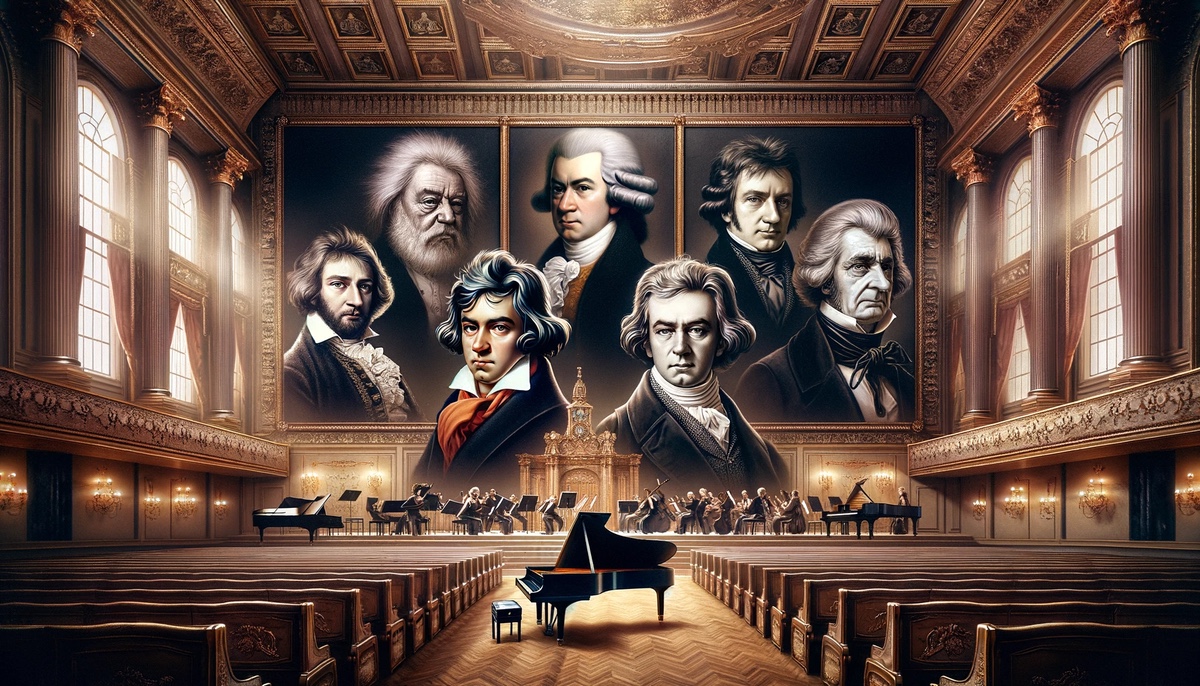
January 24: On This Day in Music

compliment


National Compliment Day.  Give an extra compliment on National Compliment Day which is observed annually on January 24. A compliment has a powerful effect. It can instill confidence in a child, or validate someone’s hard work.

The OCMS has sticker pages you can put in your student’s music or notebooks to remind him or her how well you think they’re doing.

Always find something to praise in your student’s practice and playing.  You’ll see that it makes a world of difference.

. 1776 ~ Ernst Theodor Amadeus Hoffmann, composer

. 1883 ~ Friedrich von Flotow, German baron/composer, died at the age of 70
More information about Flotow


. 1913 ~ Norman Dello Joio, American composer

. 1919 ~ Leon Kirchner, American composer and pianist

. 1925 ~ Maria (Betty Marie) Tallchief, Prima ballerina: Ballet Russe de Monte Carlo, New York City Ballet; formed ballet troupe and school (1974) which became Chicago City Ballet in 1980, wife of choreographer George Balanchine

. 1936 ~ Jack Scott (Scafone), Singer

. 1936 ~ Benny Goodman and his orchestra recorded one of the all-time greats, Stompin’ at the Savoy, on Victor Records. The song became such a standard, that, literally, hundreds of artists have recorded it, including a vocal version by Barry Manilow. The ‘King of Swing’ recorded the song in a session at the Congress Hotel in Chicago.

. 1937 ~ Bobby Scott, Singer, pianist, songwriter

. 1939 ~ Doug Kershaw, Cajun fiddle, songwriter, singer

. 1941 ~ Neil Diamond, American pop-rock singer and songwriter

. 1941 ~ Ray Stevens, Singer and entertainer

. 1942 ~ Abie’s Irish Rose was first heard on NBC radio this day as part of “Knickerbocker Playhouse”. The program was a takeoff on the smash play from Broadway that ran for nearly 2,000 performances. Sydney Smith played the part of Abie. Rosemary Murphy was played by Betty Winkler.

. 1973 ~ ‘Little’ Donny Osmond, of the famed Osmond Brothers/Family, received a gold record for his album, “Too Young”. When he played the gold-plated disc on his Mickey Mouse phonograph, all he heard was Ben by ‘little’ Michael Jackson, a competitor in the ‘Kids Who Sing Really High Awards’ battle.

. 2006 ~ Fayard Nicholas, American tap dancer, one-half of The Nicholas Brothers and actor (The Five Heartbeats), died of pneumonia and complications from a stroke at the age of 91.

Children: don’t try this at home – never, ever dance on a piano!


Compliment Day

compliment


National Compliment Day.  Give an extra compliment on National Compliment Day which is observed annually on January 24.

A compliment has a powerful effect. It can instill confidence in a child, or validate someone’s hard work.

The OCMS has sticker pages you can put in your student’s music or notebooks to remind him or her how well you think they’re doing.

Always find something to praise in your student’s practice and playing.  You’ll see that it makes a world of difference.


Composers – T


Tartini

Giuseppe Tartini was born in Pirano, Italy and lived from 1692 until 1770. He was a violinist and composer, who also had studied law and divinity at Padua, and was an accomplished fencer. He secretly married a proteg?e of the Archbishop of Padua, for which he was arrested. He fled to Assisi but, after attracting the archbishop’s attention by his violin playing, he was invited back to his wife. Perhaps one of the greatest violinists of all time, he was also an eminent composer. His best-known work is the Trillo del Diavolo (c.1735, Devil’s Trill).

Tavener, John

John Taverner lived from about 1490 until 1545. He was employed as master of the choristers at Cardinal College (Christ Church), Oxford, in its early heyday, retiring, on Cardinal Wolsey’s fall from power, to Boston, where he was held in considerable regard until his death in 1545. The popular, if mistaken, account of his life is the subject of the opera by Peter Maxwell Davies, Taverner.

Taverner wrote Latin Mass settings, Magnificat settings and motets. Of the first of these the Western Wynde Mass, using the melody of a popular song of that name, is among the better known. From his Mass Gloria tibi Trinitas came the fragment of a theme that served later generations as the basis of an English genre of consort music, the In nomine.

Taverner himself began the tradition of the In nomine, an instrumental arrangement of part of the Benedictus of his Mass Gloria tibi Trinitas.

Taverner, John Keith

John Kenneth Tavener, born in 1944 in London, England is a composer. He studied at the Royal Academy of Music, London and has been professor of music at Trinity College of Music since 1969. He was still at college when he won the prestigious Prince Rainier of Monaco Prize in 1965 with his cantata, Cain and Abel. His music is predominantly religious, and includes the cantata The Whale (1966), Ultimos ritos (1972, Last Rites) for soloists, chorus, and orchestra, and a sacred opera Therese (1979). He was converted to the Russian Orthodox faith in 1976.

His work, Eternity’s Sunrise, won a Grammy Award. His sacred work, Song for Athene, was sung at the funeral ceremony of Princes Diana.

Tchaikovsky

Piotr Ilyich Tchaikovsky lived between 1840 and 1893. He is considered to be a romantic composer. He was a Russian composer who was a master of melancholy moods, emotional outbursts and dramatic climaxes in his music.

“Worthless, vulgar, derivative, unplayable” were a few of the adjectives that pianist and conductor Nicholas Rubinstein used to describe Tchaikovsky’s Piano Concerto in b-flat minor, when he first heard it on Christmas Eve, 1874. Ironically, Tchaikovsky had arranged the piece as a gift for Rubinstein, to whom he intended to dedicate it. Furious, Tchaikovsky re-dedicated the piece to pianist Hans von Bülow, who was the first to perform it.

Within a few yers, Rubinstein’s distaste for the concerto mellowed and he became one of its principal interpreters.

Tchaikovsky read Goethe’s novel Wilhelm Meisters Lehrjahre in the 1860’s and set its melancholy poem “None but the Lonely Heart” to music.

Tchaikovsky found one of his greatest successes with his lovely waltz from the “Serenade for Strings” which he composed in 1880. He was also composing the 1812 Overture at the same time. He conducted several early performances of the Serenade himself, but he had no formal conducting training and became so nervous that he sometimes lost the place in his own music.

Shakespeare’s Romeo and Juliet inspired the melancholy Tchaikovsky to write his own version, using musical themes to suggest various themes from the play.

On his way to New York in 1891 to participate in the opening of Carnegie Hall, Tchaikovsky stopped in Paris and discovered the celesta, The celesta is a small keyboard with tiny silver bars which sound like bells when struck. He ordered one to be sent to Moscow in strict secrecy so that he could be the first to use it. His ballet The Nutcracker included the “Dance of the Sugar Plum Fairy” which has several wonderfully shimmering phrases for the celesta.

Tchaikovsky’s Nutcracker was featured in the Walt Disney movie Fantasia.

The first performance of the Sixth Symphony was only a mild success. By the time of the next performance a few weeks later – which was a tremendous success – Tchaikovsky was dead of cholera. It’s title Pathétique – is characteristic of the composer, who always was afraid that his creativity would suddenly stop.

Teagarden

Weldon Leo ‘Jack’ Teagarden was a Jazz musician, born in Vernon, Texas and he lived from 1905 until 1964. He came from a musical family with his mother, Helen, playing piano and his father,Charles, trumpet. His two brothers, Charlie (trumpet) and Clois (drums) were also talented musicians as was his sister Norma (piano). Jack started on piano at the age of five and two years later learned to play the baritone horn, bought for him by his father. By the age of ten Jack was playing trombone.

The family moved from Vernon to Chappell, Nebraska in 1918 and Jack was soon playing in local theatres accompanied by his mother on piano. From here his travels become a little blurred but we know that he lived for a while in 1919 in Oklahoma City then with his uncle in San Angelo and started playing with local bands. He then played with a quartet at the Horn Palace Inn, San Antonio led by drummer Cotton Bailey,from late 1920 until September 1921 except for a summer season in Shreveport.

It was from Cotton Bailey that the young Weldon received his nickname, “Jack”. From then until the spring of 1923 he played with the legendary Peck Kelly’s Bad Boys. Dropped out of music in Wichita Falls in the summer of ’23 then joined Marin’s Southern Serenaders before rejoining Peck Kelly.

His recording debut came with Johnny Johnson and his Statler Pennsylvanians in early December 1927 when they cut two sides for Victor, “Thou Swell”/”My One and Only”. Jack was twenty-two years old. Two months with the Tommy Gott Orchestra then a major move to Ben Pollack where he remained from June 1928 until May 1933. This period with Pollack was extremely productive in recording terms as he led his own recording groups as well as playing as a sideman with Louis Armstrong, Benny Goodman, Red Nichols, Eddie Condon, and many other famous musicians of the day.

He took part in the first ‘mixed’ recording session with Louis which produced the majestic blues “Knockin’ a Jug”. In October 1928 Jack cut “Makin’ Friends” with Eddie Condon and made history by using a water glass as a substitute for a mute, removing the bell of the trombone and holding the glass over the open end of the tubing producing a unique sound.

In December 1933 he made his big move to join Paul Whiteman. He stayed with Whiteman’s star-studded aggregation until December 1938. His stay with Whiteman brought him financial security but we will never know if this residency was a good move or a bad one. Opinions differ strongly. It has been surmised that Benny Goodman would have offered Jack the trombone chair in his new orchestra as featured soloist.

After leaving Whiteman, Jack started up his own big band which he led until from February 1939 until November 1946. Musically the band was a success but financially a disaster. When the band was finally broken up, Jack gigged around, recorded as a freelance and played at the ‘Esquire’ jazz concert in January 1944 at the Metropolitan Opera House with Armstrong, Eldridge, Tatum, Hawkins. He led his own sextet until joining Louis Armstrong’s All Stars where he stayed from July 1947 until August 1951.

When he left Louis he formed his own All Stars and toured with them until he disbanded in 1956 when he played with Ben Pollack for a few months. He co-led another all-star group with Earl Hines which visited Britain and Europe in the fall of 1957 which was raptuorously received. Jack led another group on a State Department sponsored tour of Asia from September 1958 until January 1959.

Jack was a mainstay of late 1920s New York Jazz scene, a trombonist and singer whose relaxed, melodic instrumental style was highly influential. He was also one of the best White Jazz singers, particularly when he sang the Blues on songs like Makin’ Friends.

He continued playing and leading a group until his death on January 15, 1964. He played his last engagement at The Dream Room in New Orleans while suffering from bronchial pneumonia, returned to the Prince Conti Motor Hotel, just three blocks from Basin Street, after the gig and was found by the room-maid the next afternoon, dead on the floor clad in his dress shirt and shorts. He was 58 years old. The New Orleans “Times-Picayune” published his obituary on January 16, 1964. Jack was buried at Forest Lawn Memorial Park, Los Angeles, Plot # 7281. The headstone reads “Where there is Hatred, Let Me Sow Love”

Tebaldi

Renata Tebaldi is an Operatic soprano, born in Pesaro, Italy in 1922. She studied at Parma Conservatory, made her debut at Rovigo in 1944, and was invited by Toscanini to appear at the re~opening of La Scala, Milan, in 1946, where she sang until 1954. She then sang in many opera houses, including several seasons at the Metropolitan Opera, New York City, and made many recordings.
Tebaldi had one of the most beautiful Italian voices of the century. Although her rivalry with Maria Callas attracted much attention, it was her singing that captivated her fans.

Her breakthrough came in 1946 when she auditioned in Milan for the great conductor Toscanini and from then until the late 1970s she performed across Europe and the United States.

When she made her debut at the city’s La Scala opera house in late 1946, the maestro dubbed her “The Voice of an Angel.”

Singing the soprano part in Giuseppe Verdi’s “Te Deum,” the concert marked the reopening of the theater after the end of World War II. It also branded Tebaldi in Italian minds as part of the country’s post-war renaissance.

She went on to perform at London’s Covent Garden, the San Francisco Opera and appeared regularly at the Metropolitan Opera (news – web sites) in New York taking the lead roles in “La Boheme,” “Madam Butterfly,” “Tosca” and “La Traviata.”

“I started my career at 22 and finished it at 54. 32 years of success, satisfaction and sacrifices. Singing was my life’s scope to the point that I could never have a family,” she wrote in a preface to her official Web site.

Tebaldi was born in the Italian seaside town of Pesaro on Feb. 1, 1922. Stricken with polio at the age of 3, she was unable to partake in strenuous activities and instead became interested in music.

In her early teens, she began studying music at the Conservatory of Parma.

“I started singing when I was a young girl but my family wanted me to study piano but my overwhelming need to express myself with my voice made me choose the art of singing,” she once told her fans.

Tebaldi has left a huge legacy of complete operas on disc with other famous singers including Mario del Monaco, Giulietta Simionato, and Carlo Bergonzi.

Her recordings include Verdi’s “Otello” and “Aida” and Puccini’s “La Boheme” and “Madama Butterfly.”

She last performed on the opera stage in 1973, and her last concert took place in 1976.

Tebaldi was a Knight Commander of the Order of Merit of the Italian Republic and had received a Commander, Order of Arts and Letters from France.

Te Kanawa

Dame Kiri Te Kanawa, born in 1944 in Gisborne, New Zealandin, is an Operatic soprano. After winning many awards in New Zealand and Australia she came to London, where she made her debut with the Royal Opera Company in 1970. She has since taken a wide range of leading roles, and in 1981 sang at the wedding of the Prince and Princess of Wales. She was made a dame in 1982 and has produced many non-classical recordings. In 1989 she published Land of the Long White Cloud: Maori Myths and Legends.

Teleman

Georg Philipp Telemann, born in 1681 in Magdeburg, Germany, was a very prolific late Baroque era composer, composing 600 overtures in the Italian style, 44 Passions, 40 operas, innumerable trio sonatas, suites and flute quartets. He was a self-taught composer and organist. When he died in 1767, his organist post in Leipzig went to Johann Sebastian Bach.

Tilson Thomas

Michael Tilson Thomas is the Music Director of the San Francisco Symphony, the Founder and Artistic Director of the New World Symphony, and the Principal Guest Conductor of the London Symphony Orchestra. He is currently Artistic Director of the Pacific Music Festival in Sapporo, Japan, which he and Leonard Bernstein inaugurated in 1990. Born in Los Angeles, he is the third generation of his family to follow an artistic career. At age nineteen he was named Music Director of the Young Musicians Foundation Debut Orchestra where he worked with Stravinsky, Boulez, Stockhausen and Copland on premieres of their compositions. He was also Assistant Conductor at the Bayreuth Festival. Noted for his commitment to music education, Michael Tilson Thomas founded the New World Symphony in 1988, to be a national orchestra for the most gifted graduates of America’s music conservatories. In addition to their regular season in Miami, they have toured France, Great Britain, South America, Japan, Israel and the United States, and in 1998 celebrated their 10th anniversary with concerts in New York, London, Paris, Amsterdam and Vienna.

Tilson Thomas has recently completed a very successful tour of Europe with the San Francisco Symphony and back at home in June 1999, they present a festival of Stravinsky’s music, some of which they have recently recorded together.

With the London Symphony Orchestra, Tilson Thomas has toured in Israel, Japan, the USA, as well as in Europe including an appearance at the Salzburg Festival. In London, he and the orchestra have mounted major festivals focusing on the music of Brahms, Mahler, Rimsky-Korsakov, Gershwin, Reich and Takemitsu.

Tilson Thomas’ recordings have received many awards and cover a wide range of repertoire including Bach, Beethoven, Mahler and Prokofiev as well as his pioneering work with the music of Ives, Ruggles, Reich, Cage and Gershwin. In 1994 Michael Tilson Thomas received the Ditson Award for contributions to American Music, was named Musical America’s Conductor of the Year and received five Grammy nominations and two Gramophone awards for his recordings. He has been an exclusive BMG Classics/RCA Victor Red Seal recording artist since 1995 and his most recent releases include the disc “New World Jazz” with the New World Symphony Orchestra.

Tilson Thomas has also worked extensively for television including educational broadcasts with the New York Philharmonic, a BBC series with the London Symphony Orchestra including programmes on Strauss, Sibelius and Beethoven, and other television productions celebrating works by Gershwin and Bernstein.

Von Tilzer, Albert

Albert Von Tilzer (Albert Gumm) (1878 – 1956) was born in Indianapolis, Indiana on Mar. 29, 1878. He was the younger brother of Harry Von Tilzer. He was a vaudeville performer and composer and wrote many hit tunes. Some of them were: Carrie (Carrie Marry Harry), Give Me the Moonlight, Give Me the Girl, I’ll Be with You in Apple Blossom Time, Put Your Arms Around Me Honey and Take Me Out to the Ball Game

Overview Composer Albert Von Tilzer was an important songwriter most active from the early 1900’s into the 1920’s. He was the younger brother of composer Harry Von Tilzer.

Albert went to work in his father’s Indianapolis shoe store after graduating from high school. He learned to play the piano by ear and did have some lessons in harmony before he joined a vaudeville troupe.

In 1899, he went to Chicago, and worked briefly for his older brother’s music publishing firm, Shapiro, Bernstein and Von Tilzer. Albert then traveled to New York City, and found work as a shoe salesman in a large Department store.

In 1900, he published his first song “The Absent Minded Beggar Waltz”, a piano instrumental. In 1903 he wrote “That’s What the Daisy Said”, with his own lyric. This was published by his brother’s firm.

In 1903, he formed York Music Company, his own publishing house, which would thereafter publish all of his own music.

All the while Albert was composing and publishing, he was also working as a vaudeville performer. He was a headliner on the Orpheum circuit. In 1930, he settled in Hollywood and worked in a few motion pictures. He was elected to the Songwriter’s Hall of Fame. Albert Von Tilzer died in L.A., in 1956, at age 78.

Von Tilzer, Harry

Harry Von Tilzer (Harry Gummbinsky -the family later shortened the name to “Gumm”.) lived from 1872 until 1946. He was born in Detroit, Michigan and was the older brother of Albert Von Tilzer. He was an entertainer and common laborer who turned to music composition and formed the Harry Von Tilzer Music Company in 1902. He wrote many hit tunes. Some of them are: (She was only a) Bird in a Gilded Cage; I Want a Girl (Just Like the Girl That Married Dear Old Dad); I’d Leave My Happy Home for You; Take Me Back to New York Town; Wait ‘Til the Sun Shines Nellie; When My Baby Smiles at Me and Why Do They Always Pick on Me?

Harry, one of six children, was to find a career in music as did his younger brother Albert. (Apparently, two of the children, a boy and an girl, perished in childhood.) When Harry was still a child, his family moved to Indianapolis, IN, where he father acquired a shoe store. A theatrical company gave performances in the loft above the store, and that’s where Harry learned to love show business.

His career really started in 1886 when, at age 14, he ran away from home and joined the Cole Brothers Circus. By 1887, he was playing piano, composing songs, and acting in a traveling repertory company. He changed his name at that time. His mother’s maiden name was Tilzer, and he ‘gussied’ it up by adding the ‘Von’. Thereafter he would be called Harry Von Tilzer, and later his younger brother would adopt the name also, Albert Von Tilzer.

Harry met Lottie Gilson when the burlesque troupe with which he was working reached Chicago. The popular vaudevillian took an interest, and induced him to go to New York. In 1892, Harry, working as a groom on a trainload of horses, arrived in New York, with just $1.65 in his pocket. He rented a room near the Brooklyn Bridge and became a $15.00 per week saloon pianist. He left New York briefly to work in a traveling medicine show, but returned to again work in saloons and later as a vaudevillian in a ‘Dutch’ act with George Sidney.

At this time, Harry was writing songs, literally hundreds of songs that were never published. He would sell them outright to other entertainers for $2.00 each. Even Tony Pastor sang a few of his songs in his theater. But the tide was about to turn for Harry.

One of his songs was published, “My Old New Hampshire Home”, lyric by Andrew B. Sterling. William C. Dunn, owner of a small print shop, purchased it outright for $15.00, and issued it in 1898. It was a hit that sold more than 2 million copies.

There is an interesting historical note connected with Harry Von Tilzer. In the Early 1900’s, Von Tilzer kept an upright piano in his publishing firm. Harry kept pieces of paper stuffed between the strings of the piano’s harp. It gave the piano a tinny sort of sound to which Von Tilzer was partial. One day, the lyricist and newspaper journalist Monroe Rosenfeld was in Harry’s office and heard him playing the tinny sounding piano. The sound suggested a title for a piece he was writing, – Tin Pan Alley.

Harry’s last years were spent in retirement, while living in the Hotel Woodward, in New York City. He died in 1946, at age 74.

Tippett

Sir Michael (Kemp) Tippett is a Composer, born in London, England, UK in 1905. He studied at the Royal College of Music, London, and became director of music at Morley College from 1940 until 1951. His oratorio, A Child of Our Time (1941), reflecting the problems of the 1930s and 1940s, won him wide recognition. A convinced pacifist, he was imprisoned for three months as a conscientious objector during World War 2. He scored a considerable success with his operas The Midsummer Marriage (1952) and King Priam (1961), and among his other works are four symphonies, a piano concerto, and string quartets. He was knighted in 1966, and received the Order of Merit in 1983.

Toscanini

Arturo Toscanini, 1867 to 1957, was a conductor who born in Parma, Italy. He was a cellist before the night in 1886 when he took over the baton from an indisposed conductor in Rio de Janeiro and stayed on the podium for the rest of his career. After years of journeyman work in Italian opera houses, he became conductor of Milan’s La Scala in 1898. In 1909 he came to the USA to lead the Metropolitan Opera orchestra; his subsequent career took him to positions in Europe, England, and the USA, including the podium of the New York Philharmonic from 1928 to 1936. In 1937 the NBC Symphony, primarily a broadcasting and recording orchestra, was created for Toscanini; he led it until 1954, cementing his reputation as one of the most revered conductors in the world. He helped pioneer a new performance tradition that proclaimed an end to Romantic interpretive excesses and substituted absolute fidelity to the score; in practice, that made for clean, sinewy performances, achieved partly by his legendary tantrums in rehearsals. He was equally admired for his performances of Beethoven and other 19th-century classics and of modern composers including Stravinsky, Debussy, and Richard Strauss.

Townshend

Born Peter Dennis Blandford Townshend on May 19, 1945, as a member of The Who, he wrote nearly all of the songs and sang “The Acid Queen” and “Sensation”. for the double album Tommy. Tommy is a deaf, dumb, and blind kid who becomes a Messiah and later is forsaken by his followers. Tommy is based, in part, on the spiritual teachings of Indian mystic Meher Baba, of whom Townshend had become a devotee. Read the rest of this biography at http://www.petetownshend.net

Tucker

There is a statue of Richard Tucker, an opera singer, in New York.

January 23: On This Day in Music

today

. 1752 ~ Muzio Clementi, Italian pianist and composer
More information about Clementi

. 1837 ~ John Field died.  Field was an Irish pianist, composer, and teacher.

. 1878 ~ Rutland Boughton, English composer

. 1888 ~ Richard Strauss made his conducting debut with the Berliner Philharmoniker.

. 1893 ~ Phillips Brooks passed away.  Brooks was the lyricist of the Christmas hymn, “O Little Town of Bethlehem”

. 1908 ~ Edward Alexander MacDowell, US composer (Indian Suite), died at the age of 47

. 1920 ~ Ray Abrams, Jazz/be-bop tenor saxophonist

. 1925 ~ Marty Paich, Pianist, composer, arranger with/for: Peggy Lee, Shorty Rogers’ Giants, Dorothy Dandridge, Shelley Manne, Art Pepper, Shorty Rogers, Dave Pell, Mel Torme, Ray Brown, Anita O’Day, Stan Kenton, Terry Gibbs, Ella Fitzgerald, and Buddy Rich

. 1928 ~ Ken Errair, Singer with The Four Freshmen

. 1933 ~ Chita Rivera (Conchita del Rivero), Singer, dancer, actress

. 1938 ~ Eugene Church, Singer

. 1941 ~ Artie Shaw and his orchestra recorded Moonglow on Victor Records. In the band were such sidemen as Johnny Guarnieri, Jack Jenney, Billy Butterfield and Ray Conniff on trombone.

. 1943 ~ Duke Ellington and the band played for a black-tie crowd at Carnegie Hall in New York City. It was the first of what was to become an annual series of concerts featuring the Duke.

. 1943 ~ Louis Jordan and His Tympany Five took the song “What’s the Use of Getting Sober” to the top chart spot. It only stayed there for one week.

https://youtu.be/2ANOkUVe92k

. 1948 ~ Anita Pointer, Singer with The Pointer Sisters

. 1950 ~ Bill Cunningham, Bass, piano with The Box Tops

. 1950 ~ Patrick Simmons, Singer, guitarist with The Doobie Brothers

. 1974 ~ Mike Oldfield’s Tubular Bells opened the credits of the movie, “The Exorcist”, based on the book by William Peter Blatty. The song received a gold record this day.

. 1977 ~ Carole King’s landmark album, “Tapestry”, became the longest-running album to hit the charts, as it reached its 302nd week on the album lists.

. 1978 ~ Vic Ames killed in car crash

. 1981 ~ Samuel Barber, American composer (School for Scandal), died of cancer at the age of 70

. 1986 ~The first ten musicians were inducted into Rock ‘n’ Roll Hall of Fame including James Brown, Elvis Presley, Ray Charles, Buddy Holly, Chuck Berry, Sam Cooke, Fats Domino, the Everly Brothers, Jerry Lee Lewis and Little Richard.

When Chuck Berry was inducted into the Rock and Roll Hall of Fame in 1986, an all-star band, including John Fogerty, Billy Joel, Jerry Lee Lewis, Keith Richards, Neil Young and Steve Winwood, charged through a raucous “Roll Over Beethoven” with de facto bandleader Chuck Berry guiding the show.


. 1993 ~Thomas Gorsey passed away on this day. He was considered to be the “Father of Gospel Music” and had written over a thousand gospel songs in his lifetime.

. 2002 ~ Alfred Glasser, a former director of education for the Lyric Opera of Chicago, died of cancer. He was 70. Glasser held the education post for 30 years before his retirement in 1996. Since 1997, Glasser served as chairman of the board and commentator for Chicago’s concert opera company, da Corneto Opera. For the past decade, he served on the board of Alliance Francaise of Chicago, a French cultural group. Glasser also founded the Lyric Opera Lecture Corps, a community service project.

. 2003 ~ Nell Carter, actress-singer, died at the age of 54. She was best known for her role as the housekeeper in the TV sitcom “Gimme a Break!”. Carter, who was born September 13, 1948, in Birmingham, Alabama, first rose to stardom on the New York stage. After a series of roles on- and off-Broadway — and a short-lived part in the soap opera “Ryan’s Hope” — in 1977 she starred in the show “Ain’t Misbehavin’!”, a revue of the works of composer Fats Waller. She was rewarded for her performance with an Obie Award, and later with a Tony Award when the show moved to Broadway. Several years later, she earned an Emmy for her performance on a television presentation of the musical. Despite her Broadway success, Carter would have preferred to sing opera. “When I was growing up, it was not something you aspired to,” she said in 1988. “I was a weirdo to want to be in show business. Most kids wanted to be teachers or nurses.” “Gimme a Break!” ran from 1981 to 1987. Carter was nominated for two Emmys for her role as housekeeper Nell Harper, who helped run the household of police chief Carl Kanisky, played by Dolph Sweet. She also garnered two Golden Globe nominations for the role.

. 2003 ~ For Sale: One of London’s most famous music venues, which in its heyday in the 1960s played host to The Who, David Bowie and the Rolling Stones, is for sale, its administrators said. The Marquee Club, which in the 1970s was the epicenter of the punk explosion, ran into financial difficulties after its high-profile relaunch last fall, said a spokeswoman for administrator BDO Stoy Hayward. “We’re looking for someone in the music business who can capitalize on the Marquee brand and keep running it as a live venue,” she said. The price tag is at least $200 million. The club opened in London’s Soho district in 1958 and was so cramped and sweaty that, according to legend, Bob Geldof of the Boomtown Rats blacked out on stage. In 1988, it moved to a new location in nearby Charing Cross, but within eight years it had closed down. A high-profile relaunch at a new venue in Islington, north London September 2002 was headlined by the controversial electro-rockers Primal Scream, but according to the club’s administrators, huge start-up costs quickly led to its downfall.

. 2017 ~ Bobby Freeman, American singer (Do You Want to Dance), died at the age of 76

. 2018 ~ Hugh Masekela, South African trumpeter, anti-apartheid activist (I Am Not Afraid), described as the “father of South African jazz,” died at the age of 78

Happy Birthday, Muzio Clementi!

Muzio Clementi lived from January 23, 1752 until  March 10, 1832. He was a composer and pianist who born in Rome. In 1766 he was brought to England, where he conducted the Italian Opera in London (1777–80), toured as a virtuoso pianist (1781), and went into the piano-manufacturing business.

He wrote the Gradus ad Parnassum from 1817 to 1826, a piano method on which subsequent piano methods have been based. He composed mainly piano and chamber music.


Composers – J


Jackson

Michael Joe Jackson
A star was born on August 29, 1958 in Gary, Indiana. Singer, songwriter, dancer, actor Michael Joe Jackson started on the road to stardom while at Garnett Elementary School in Gary. Michael performed for his class by singing Climb Every Mountain. Within just a few years, he took his act to the stage joining his brothers as The Jackson Five. They were entertaining at Mr. Lucky’s, also in Gary, Indiana. Michael was only 8. By the time he was 11, Michael, the youngest of the five brothers, was the lead singer of the group.

And their hits were hitting the top of the charts: I Want You Back, ABC, The Love You Save, I’ll Be There. Then young Michael started recording solo hits like Ben, also #1.

And the hits just kept on coming … and the awards came with them: A Grammy for Best Male R&B Vocal in 1979 for Don’t Stop ’Til You Get Enough, 5 Grammy Awards in 1983 — Best Male Pop Vocal and Album of the Year (Thriller), Best Male R & B vocal and Best R & B song (Billie Jean), and Best Recording for Children: E.T., the Extraterrestrial; 2 in 1984 — Record of the Year and Best Male Pop Vocal (Beat It); another in 1985 with Lionel Richie for Song of the Year (We are the World); a Best Music Video/Short Form Grammy in 1989 for Leave Me Alone; and finally, The Legend Award Grammy — for the living legend in the music industry, Michael Jackson.

Whether Michael sings with his brothers, his sisters, alone or in duets with fellow performers, the results are hit, after hit, after hit … The Girl is Mine and Stay, Stay, Stay with Paul McCartney; I Just Can’t Stop Loving You with Siedah Garrett; Rock with You, Bad, Smooth Criminal … Ease on Down the Road with Diana Ross (from Broadway’s The Wiz in which Michael played the scarecrow). Michael, the actor, was also seen as a hologram, Captain Eo in Epcot Center’s multimedia show.

A celebrity for most of his life, he is both magic and tragic … the gloved one’s fame and infamy well-known throughout the world: he made $70 million from Thriller; he paid $50 million for the rights to the Beatles’ 251 songs; his Bad album was number one in 23 countries; he has an amusement park and zoo at his California estate; he married and divorced Lisa Marie Presley, the daughter of the King of Rock.

He remarried, became a father … and the rest of the story is still being written …. To date, Michael Jackson remains the King of Pop.

Janácek

Leos Janácek lived from 1854 until 1928. It was relatively late in life that the Moravian composer Janácek won more than local recognition. He made his early career in the capital of his native province, Brno, coupling an interest in regional folk music with a study of speech intonations, echoed in his instrumental as well as vocal writing. His opera Jenufa was first staged in Brno in 1904, but it was the performance in Prague in 1915 that brought the work of the composer a much wider public. The seven operas that followed have formed a very idiosyncratic part of current operatic repertoire, culminating in From the House of the Dead, completed in 1928, the year of Janácek’s death, and based on the novel by Dostoyevsky.

The best known of Janácek’s music for orchestra is the Sinfonietta, derived from an original festival piece of 1926. To this may be added the rhapsody based on the work of Gogol, Taras Bulba, and the Lachian Dances, based on folk-dances.

Joachim

Joseph Joachim lived from 1831 until 1907. He was a Hungarian violinist, conductor and composer whose exceptional talent was recognized by Mendelssohn. He was also a close friend of Brahms. His music had much in common with the music of Schumann.

John

Elton Dwight John was born in 1947 and is a rock singer and pianist. He was born in Pinner, NW Greater London, England. He played the piano by ear from age four, and studied at the Royal Academy of Music at 11. From 1967, he and Bernie Taupin began writing songs such as “Rocket Man’ (1972), “Honky Cat’ (1972), and “Goodbye Yellow Brick Road’ (1973). Their publisher pressed John to perform them, for which he obscured his short, plump, myopic physique in a clownish garb that included huge glasses, sequined and fringed jump suits, and ermine boots. The top pop star of the 1970s, he later became chairman (1976 to 1990) and then honorary life president in 1990 of the Watford Football Club and a stock-market speculator. Despite health problems in 1993 brought about by his stressful lifestyle he continues to perform live across the world.

Johnson

James Price Johnson, Ragtime composer

Jolivet

André Jolivet lived from 1905 until 1974. Versatile in the arts, André Jolivet was a pupil of Le Flem and later of Varèse and was, with Olivier Messiaen, Daniel Lesur and Yves Baudrier, a member of the composers grouped together as Jeune France. As director of music for the Comédie française he wrote a quantity of incidental music and elsewhere based his work on principles that stemmed from his interest in the magical and incantatory element fundamental to human music.

Jolivet wrote a number of concertos, all demanding considerable virtuosity from the soloist. These include a concerto for the ondes Martenot, an electronic instrument developed in France in the 1920s, and concertos for trumpet and piano, for flute, for piano, for harp, for bassoon and harp, for percussion, for cello and for violin.

In addition to his varied incidental music, whether for Molière, Claudel, Corneille or Plautus, Jolivet wrote music for the ballet and for marionette plays.

Jolivet made an early impression on Messiaen with the six piano pieces that constitute Mana. Chamber music includes music involving the flute, an instrument he particularly favoured for its primitive human associations.

Joplin

Scott Joplin (1868-1919) was the most influential and famous composer of the ragtime era, and one of the most daring pioneers in the history of American music. He was known as the Father of Ragtime. At first, the musical establishment absolutely refused to acknowledge ragtime as a worthy means of musical expression, dismissing it as catastrophic noise that had little musical meaning at all. Only within the last few decades has his work finally been truly appreciated and accepted as a truly great form of art, and as a unique and substantial contribution to music.

Ragtime, which first emerged in the 1890’s, is a style of piano playing with an up-and-down “ragged time” rhythm. Joplin made ragtime an international dance craze with “Maple Leaf Rag”. “The Maple Leaf Rag”, became the first song to sell over one million copies of sheet music.

The remarkable part of his success as a musician was the fact that he was African American. His success paved the way for all black musicians who would come after him, breaking a long-standing race barrier: acceptance as a performer.

Joplin’s music enjoyed renewed popularity with the use of “Solace” in the 1973 movie The Sting. Solace was not a typical rag, although it does have similar rhythmic elements.

Treemonisha was an opera composed by Joplin, although it was not produced until 1975, 58 years after his death.

Some other ragtime composers were Joseph Lamb and James Scott. Eventually, ragtime was replaced by jazz.

Composers – G

Goodman

Benny Goodman was essentially the pioneer of swing. The jazz clarinetist and bandleader re-wrote the book on jazz music by speeding up the tempo and placing accents and emphasis on notes between the beats, earning him the nickname “the King of Swing”. Not only was he a world-class clarinetist, responsible for reviving the popularity of the instrument, but also an excellent arranger and composer. He was one of the first bandleaders to break the color barrier by hiring black musicians.

Benny was born Benny David Goodman in 1909. He was raised in the poverty of a Jewish ghetto in Chicago, growing up with the sounds of New Orleans jazz greats like King Oliver, Freddie Keppard, and Louis Armstrong in his home. Benny began playing the clarinet at the age of twelve, and formed his first band at the age of sixteen, “The Benny Goodman Trio”, which became one of the very first interracial jazz ensembles. He went on to play with many groups, including “Doc Cook and His Dreamland Orchestra”.

However, by 1934, it was time for a change. That year, he put together his own big band. Using the compositions and arrangements of fellow swing pioneer Fletcher Henderson, he almost single-handedly gave birth to the “swing era” of the thirties and forties. He would go on to spread his music to all corners of the globe, travelling to places such as the Soviet Union, Europe, and the Far East, playing both jazz and classical music along the way.

Aside from his success in music, Goodman was also a superstar personality, if not to his co-workers, to the American public, receiving roles in films, and radio and television programs. He also made the clarinet one of the most popular instruments to play after it had been nearly absent in music since ragtime. Goodman died in 1986.

January 22: On This Day in Music

polka-dots

National Polka Dot Day celebrates polka dots, and since 2016 has also been used to celebrate Minnie Mouse, who is known for often wearing the dots. She usually is seen wearing a red dress with white polka dots, and often has a matching bow. Celebrants of the holiday don polka dots to celebrate the dot and Minnie Mouse.

In the nineteenth century, garments with dots began becoming popular. Dotted-Swiss was one such type of garment. In Germany, dots on garments were called Thalertupfen. Dotted clothing could be seen in some famous paintings of the time, such as Monet’s Luncheon on the Grass and Bazille’s Family Reunion.

In the middle of that century, polka dancing became popular in Europe. The name for the dot comes from the dance, although there doesn’t seem to be any real connection between the two. “Polka” is a Polish word for “Polish woman,” and the term polka dot was first printed in 1857, in an American women’s magazine called Godey’s Lady’s Book.

The popularity of polka dots increased in the 1920s and ’30s. Miss America wore a polka dot swimsuit in 1926 and Minnie appeared with polka dots in 1928. Polka dot dresses were common during the 1930s. Following World War II, Dior began putting out dresses with polka dots, and polka dot clothing was worn by stars such as Elizabeth Taylor and Marilyn Monroe. In the 1960s, Yayoi Kusama began using polka dots in her paintings. Some men have worn polka dots, such as Bob Dylan, and Marvel Comics even created Polka-Dot Man. Today, polka dots are often worn nostalgically and have gained in popularity with the revival of vintage wear from the 1950s and ’60s.

Because Minnie Mouse is often seen wearing polka dots, the day has been closely tied to her. Although she appeared with Mickey in Plane Crazy on May 15, 1928, this did not have a wide release, and it is Steamboat Willie, which was released on November 18, 1928, which is widely known as Minnie Mouse’s debut. Independent, feminine, and cheerful, she is known for bringing happiness to others and helping them with troubles they may be having. Walt Disney was the first voice of Minnie, just for a short while, and many people have voiced her since. Russi Taylor began voicing her in 1986 and did so for decades afterward.

After Minnie’s debut in 1928, she appeared in many more short films throughout the 1930s. Mickey and Minnie were redesigned in the late 1930s, but Minnie was used less starting in the 1940s. It was not until the 1980s when she once again began being used more prominently in cartoons. She was in Mickey’s Christmas Carol in 1983 and had her first starring role in a television special with Totally Minnie in 1988. She has since appeared in films such as Mickey’s Once Upon a ChristmasMickey’s Twice Upon a Christmas, and Mickey, Donald, Goofy: The Three Musketeers, and in television shows such as Mickey Mouse WorksHouse of MouseMickey Mouse ClubhouseMickey Mouse, and Mickey and the Roadster Racers.

Minnie has been featured in comics, video games, and has been a staple at Disney parks such as Disneyland Resort and Walt Disney World, where events have been held on the day. In 2016, an art and fashion show called “Rock the Dots” was held on Polka Dot Day in Los Angeles; it was followed by an exhibit that was open to the public. Disney began encouraging people to wear polka dots and use the hashtag #RocktheDots. Minnie received her star on the Hollywood Walk of Fame on National Polka Dot Day in 2018, during her 90th anniversary year.

How to Observe National Polka Dot Day

Celebrate the day by wearing polka dots. D23: The Official Disney Fan Club and Shop Disney have polka dotted Minnie Mouse clothes and accessories available. Let people know you are wearing polka dots by using the hashtag #RocktheDots. The day could be spent watching films starring Minnie Mouse, such as Plane Crazy and Steamboat Willie. Minnie was not wearing polka dots in those first films, but she was wearing a polka dot dress in their opening title sequences. You could also do some Minnie Mouse crafts, or plan a trip to Disneyland Resort or Walt Disney World.

. 1886 ~ John J. Becker, American composer

. 1889 ~ The Columbia Phonograph Company was formed in Washington, DC.

. 1901 ~ Hans Erich Apostel, German-born Austrian composer

. 1904 ~ George Balanchine (Georgi Balanchivadze), Choreographer of Apollo, Orpheus, Firebird, Swan Lake, The Nutcracker. He founded School of American Ballet and New York City Ballet. He was married to Tanaquil Le Clercq.

. 1907 ~ The Richard Strauss opera, “Salome”, was featured with the Dance of the Seven Veils. It was copied by vaudeville performers. Soon, performances of the opera were banned at the Metropolitan Opera House.

. 1916 ~ Henri Dutilleux, French composer

. 1920 ~ William Warfield, singer (Show Boat)

. 1924 ~ James Louis “J.J.” Johnson, Trombonist, composer and bandleader. He was one of first to use the trombone in modern jazz

. 1931 ~ Clyde McCoy and his orchestra recorded Sugar Blues. The tune became McCoy’s theme song, thanks to its popularity on Columbia Records, and later on Decca, selling over a million copies.

. 1935 ~ Sam Cooke, American rhythm-and-blues singer

. 1949 ~ Steve Perry, Drummer with Radio Stars

. 1953 ~ Myung-Whun Chung, Seoul South Korea, pianist/conductor (Chung Trio)

. 2002 ~ Pete Bardens, a keyboardist who played alongside such pop stars as Mick Fleetwood, Ray Davies, Rod Stewart and Van Morrison, died of lung cancer. He was 57. He was known for his progressive and New Age rock style on synthesizer, electric piano and organ. In the 1960s, the London-born Bardens played in the Blues Messengers with Davies, who later went on to form The Kinks; Shotgun Express with Stewart; Them with Morrison; and the group Cheynes with Fleetwood and Peter Green, who went on to form Fleetwood Mac. In 1972, Bardens formed the progressive rock band Camel and stayed with it through the late 1970s. In 1978, he began a successful solo career, releasing several well-received records, including “Speed of Light”, and also played on Morrison’s album “Wavelength” and accompanied him on a world tour. Barden continued to compose, produce and perform music through the 1990s, appearing in Europe with his group Mirage.

. 2004 ~ Milt Bernhart, a big band trombonist known for his solo on Frank Sinatra’s I’ve Got You Under My Skin, died. He was 77. During his three-decade career, Bernhart played in bands led by Benny Goodman, Henry Mancini and others. He was performing in Howard Rumsey’s Lighthouse All-Stars when Marlon Brando arranged for the band to play in the 1954 film The Wild One. Bernhart then became an in-studio musician for Columbia and other film and television studios, and in 1956 added a memorable solo to Sinatra’s I’ve Got You Under My Skin. Born in Valparaiso, Ind., Bernhart was drafted into the Army and was to be sent overseas during World War II before he was transferred to the service’s band. After his music career wound down in 1973, he bought Kelly Travel Service in Los Angeles. He created the Big Band Academy of America in 1986 and planned to retire as the organization’s founding president in March.

. 2004 ~ Ann Miller, a childhood dance prodigy who fast-tapped her way to movie stardom that peaked in 1940s musicals like “On the Town”, “Easter Parade” and“Kiss Me Kate”, died of lung cancer. She was 81. Miller’s film career peaked at MGM in the late 1940s and early ’50s, but she honed her chops into her 60s, earning millions for “Sugar Babies”, a razzmatazz tribute to the era of burlesque featuring Mickey Rooney. Miller’s legs, pretty face and fast tapping (she claimed the record of 500 taps a minute) earned her jobs in vaudeville and nightclubs when she first came to Hollywood. Her early film career included working as a child extra in films and as a chorus girl in a minor musical, “The Devil on Horseback”. An appearance at the popular Bal Tabarin in San Francisco won a contract at RKO studio, where her name was shortened to Ann. Her first film at RKO, “New Faces of 1937”, featured her dancing. She next played an acting hopeful in “Stage Door”, with Katharine Hepburn, Ginger Rogers, Lucille Ball and Eve Arden.

When Cyd Charisse broke a leg before starting “Easter Parade” at MGM with Fred Astaire, Miller replaced her. That led to an MGM contract and her most enduring work. She was teamed with Gene Kelly and Frank Sinatra in “On the Town”, Red Skelton in “Watch the Birdie”, and Bob Fosse in “Kiss Me Kate“. Other MGM films included: “Texas Carnival”, “Lovely to Look At”, “Small Town Girl”, “Deep in My Heart”, “Hit the Deck” and “The Opposite Sex.” The popularity of musicals declined in the 1950s, and her film career ended in 1956. Miller remained active in television and the theater, dancing and belting songs on Broadway in “Hello, Dolly” and “Mame”. In later years, she astounded audiences in New York, Las Vegas and on the road with her dynamic tapping in “Sugar Babies.” The show opened on Broadway in 1979 and toured for years. In 1990, she commented that “Sugar Babies” had made her financially independent. While her career in Hollywood prospered, Miller became a regular figure in the town’s nightlife, and she caught the eye of Louis B. Mayer, all-powerful head of MGM. After dating, she declined to marry him because her mother would not allow it. She later married and divorced steel heir Reese Milner and oilmen William Moss and Arthur Cameron.

. 2004 ~ Dick Rodgers, an insurance salesman known as the “Polka King” when he hosted a regional television show from the 1950s to the 1970s, died. He was 76. Rodgers’ television show was on the air from 1955-78, starting on WMBV in Marinette, which later moved to Green Bay and became WLUK-TV. The program was shown on 17 Midwestern stations at its height. Rodgers’ accomplishments included membership in the International Polka Music Hall of Fame (1976) and in the World Concertina Congress Hall of Fame (1996). He also was named Orchestra Leader of the Year by the Wisconsin Orchestra Leaders Association in 1967.

Composers – E


Eisler

Hanns Eisler lived from 1898 until 1962. He was a composer, born in Leipzig, Germany. He studied under Schoenberg at the Vienna Conservatory (1919–23). A committed Marxist, he wrote political songs, choruses, and theatre music, often in collaboration with Brecht. From 1933 he worked in Paris, London, and Copenhagen, and moved to Hollywood in 1938, teaching and writing film music. Denounced in the McCarthy anti-Communist trials, he returned to Europe in 1948. He settled in East Germany in 1952, composing popular songs and organizing workers’ choirs. He wrote about 600 songs and choruses, and music for over 40 films and for nearly 40 plays.

Elgar

Edward Elgar lived from 1857 until 1934. He was a British composer whose works in the late 19th century orchestral style brought a Renaissance of English music.

His Pomp and Circumstance, usually heard at graduations, was featured in Fantasia 2000.

Ellington

Duke Ellington (1899 to 1974) was a composer, bandleader, and pianist. He was born Edward Kennedy Ellington in Washington, D.C.

From an early age, the handsome, sharply dressed teenager (that’s where he got the nickname, Duke) was headed for success. At first it was art. He won a poster-design contest and an art scholarship, left school and started a sign-painting business. But it was his natural piano-playing ability that attracted the young women, so Duke Ellington headed in that direction. He developed his keyboard skills by listening to local black ragtime pianists; he composed his first piece, Soda Fountain Rag, around 1915. A successful professional musician by the early 1920s, he left Washington in the spring of 1923 for New York, which was his home base for the rest of his life. Between December 1927 and 1931 his orchestra held forth at Harlem’s Cotton Club, where regular radio broadcasts, together with an active recording schedule, helped him establish a nationwide reputation. Take the “A” Train was his “signature song”.

In such compositions as Black and Tan Fantasy (1927), Mood Indigo (1930), Solitude (1934), and Echoes of Harlem (1935), Ellington emerged as a distinctive composer for his ensemble, employing the rhythms, harmonies, and tone colors of jazz to create pieces that vividly captured aspects of the African-American experience. At the same time, he sought to broaden jazz’s expressive range and formal boundaries in such extended works as Reminiscing in Tempo (1935), Black, Brown, and Beige (1943), and Harlem (1951).

An essential feature of Ellington’s composing method was to write with specific instrumentalists in mind, often drawing them into the creative process by building entire pieces out of their musical ideas.

He wrote scores for big band pieces, film scores, operas, ballets, Broadway shows, gospel music, musicals, films, television, and ballet and in the 1960s produced a series of sacred concerts combining his orchestra, choirs, vocalists, and dancers. He would work with each section of his orchestra as an entity unto its own and then bring them together to create the unique sounds such as, Mood Indigo. Over 1,000 musical pieces are credited to the great Duke Ellington. James Lincoln Collier studied the Duke and his Orchestra, comparing Duke Ellington to a “master chef who plans the menus, trains the assistants, supervises them, tastes everything, adjusts the spices … and in the end we credit him with the result.”

Ellington was successful, as few others have been, in reconciling the practical function of a popular entertainer with the artistic aspirations of a serious composer. His rich legacy consists of hundreds of recordings, his many pieces that have entered the standard repertory, and his musical materials now preserved in the Duke Ellington Collection at the Smithsonian Institution. There is a statue of Duke Ellington in New York.

Entwistle

John Entwistle, the bass player for veteran British rock band The Who, died in Las Vegas on Thursday, June 27, 2002, at age 57, just one day before the group was set to begin a North American tour in the city, officials said.

Entwistle, a bearded, taciturn musician affectionately known as “Ox” or “Thunderfingers,” died in his room at the Hard Rock Hotel and Casino, officials said, of an apparent heart attack.

The Who, known for such raw percussive hits as “My Generation,” “Pinball Wizard” and “Won’t Get Fooled Again,” were scheduled to begin their three-month tour at the Joint, a small club at the hotel. An MCA official said the show had been canceled, as well as two weekend concerts in Los Angeles. She referred questions about the rest of the tour to promoter Clear Channel, where a spokesman was not available for comment.

With Entwistle’s death, The Who are down to just two original members — singer Roger Daltrey and guitarist-songwriter Pete Townshend. Original drummer Keith Moon died of an accidental pill overdose in 1978.

A source close to the band told Reuters that a devastated Daltrey and Townshend spent several hours together in Los Angeles after hearing of Entwistle’s death. Entwistle had arrived in Las Vegas ahead of his bandmates to open a traveling exhibition of his artwork, said a statement from MCA Records.

In addition to his lightning finger work on the bass, Entwistle helped out on backing vocals, supplying an alto-tenor on “A Quick One While He’s Away” and “Summertime Blues.” His unique playing style mixed bass melodies with a more rhythmic role, producing a trebly sound that essentially became the band’s lead instrument.

On stage he rarely moved from his spot, allowing his colorful bandmates to vie for the spotlight.

His songwriting contributions were mostly limited to a few album tracks and B-sides. The first song he wrote for The Who, 1966’s creepy-crawly gem “Boris the Spider,” was resurrected on their 1989 reunion tour. Other songs he wrote for The Who included “My Wife” and “Whiskey Man.”

Entwistle released a half-dozen eclectic solo albums that revealed his wry sense of humor, and he also dabbled in art. He had spent the last dozen years writing a novel, although he noted in a recent interview that “at the current rate of writing they’re gonna have to engrave the end on my tombstone.”

ROOTS OF THE WHO

Born John Alec Entwistle in the London suburb of Chiswick on Oct. 9, 1944, he studied piano, trumpet and French horn as a youngster before moving on to a homemade bass. The formal music education proved helpful later on as he performed and arranged all the brass parts on The Who’s records.

At the age of 14, he formed a traditional jazz band at his grammar school, the Confederates, and invited schoolmate Townshend to join the short-lived combo. He then joined the Detours, a band formed by an older boy at their school, Roger Daltrey. At Entwistle’s suggestion, Daltrey brought in Townshend, and the early The Who started to take shape.

After leaving school, Entwistle worked as a tax clerk by day and played with the band by night. The group changed its name to The Who in 1964, and Moon joined later that year, replacing drummer Doug Sandom, who did not play aggressively enough for the other members of the band.

Influenced by the likes of bluesman Jimmy Reed, rocker Eddie Cochran and soul giants James Brown and Jackie Wilson, The Who made an immediate impression on the London “Mod” scene with its seemingly undisciplined garage rock, which it dubbed “Maximum R&B.”

The band trashed its equipment at the end of each show, and it was years before it made enough money to pay off its bills for new instruments.

After briefly flirting with a new name, the High Numbers, The Who released its first single in early 1965, “I Can’t Explain.” It followed up with “Anyway Anyhow Anywhere” and its signature anthem, “My Generation,” famed for Townshend’s nihilistic lyric “Hope I die before I get old.”

GOING SOLO

With Townshend and Daltrey often at loggerheads with each other, and Moon busy pioneering the lifestyle of a destructive rock star, Entwistle became the first member to release a solo album, 1971’s “Smash Your Head Against the Wall.”

“I never really wanted The Who to do more of my songs because I thought at the time they would mess them up,” Entwistle once said.

He released a succession of follow-up albums, and launched a money-losing tour of Britain and the United States with his own band, the Ox, in the mid-1970s.

The Who, meanwhile, became one of the biggest bands in the world, even earning a mention in the 1976 Guinness Book of Records for playing the loudest concert — 120 decibels, the same intensity as a jet engine.

Albums such as the 1969 rock opera “Tommy,” “Who’s Next” (1971) and “Quadrophenia” (1973) cemented its position as the third band in the great triumvirate of British rock, just below the Beatles and the Rolling Stones.

After Moon’s death in 1978, shortly following the release of “Who Are You,” the band recruited former Faces drummer Kenney Jones. But the group had lost its momentum and released its last studio album in 1982, “It’s Hard,” accompanied by a farewell tour. It regrouped in 1989 and toured sporadically.

Entwistle was married twice and has one son from his first marriage, Christopher.

Composers – B

Babbitt

Milton Babbitt was both a musical genius and a math whiz kid. He could identify classical music recordings and add up grocery bills when he was only 2 years old. When he was 5, he made his violin debut and composed his first concerto. Babbitt is now an electrical music pioneer and the founder of the Electronic Music Center.

Bach, Carl Phillip Emanuel

Carl Phillip Emanuel Bach was the second surviving son of Johann Sebastian Bach’s. He was born in Weimar, Germany. He lived from 1714 until 1788 and was the leading composer of the pre-Classical period.

He studied at the Thomasschule, Leipzig, where his father was cantor, and at Frankfurt University. In 1740 he became cembalist to the future Frederick II, and later became Kapellmeister at Hamburg in 1767. He was famous for his playing of the organ and clavier, for which his best pieces were composed. He published The True Art of Clavier Playing in 1753, the first methodical treatment of the subject, introduced the sonata form, and wrote numerous concertos, keyboard sonatas, church music, and chamber music. C.P.E. Bach wrote an influential “Essay on Keyboard Instruments”.

He is sometimes known as the “Berlin Bach” or the “Hamburg Bach”.

Bach, Johann Christian

Johann Christian Bach, the youngest son (the 11th!) of Johann Sebastian and Anna Magdalena Bach, lived from 1735 until 1782. He was born in Leipzig, Germany. He was taught music by his father and by one of his brothers Carl Phillip Emanuel.

After becoming a Catholic, he was appointed organist at Milan in 1760, and for a time composed only ecclesiastical music, including two Masses, a requiem, and a “Te Deum’, but later he began to compose opera.

In 1762 he went to London to spend the rest of his life and so became known as the “English Bach” or the “London Bach”. He was appointed composer to the London Italian opera in 1762, and became musician to Queen Charlotte. His influence can be seen in the early orchestral works of Mozart.

Bach, Johann Christoph Friedrich

Johann Christoph Friedrich Bach lived from 1732 until 1795. He was the ninth son of J S Bach, also a composer and was born in Leipzig, Germany. He studied there at the Thomasschule and at Leipzig University, and became in 1750 Kapellmeister at Bückeburg. He was an industrious but undistinguished church composer. Johann Christoph Friedrich Bach is known as the “Bückeburg Bach”

Bach, Johann Sebastian

Since 1580 there have been close to 100 musical Bachs in seven generations of distinguished musicians and composers.

Johann Sebastian Bach, the most famous of these, lived between 1685 and 1750. He is considered to be a baroque composer.

Bach was born in Eisenach, Germany in 1685. He was orphaned by the age of 10, and brought up by his elder brother, Johann Christoph Bach (1671 to 1721), organist at Ohrdruf, who taught him the organ and clavier.

Bach sought and got important posts through the years. He attended school in L?neburg, before becoming organist at Arnstadt. He found his duties as choirmaster irksome, and angered the authorities by his innovative chorale accompaniments. In 1707 he married a cousin, Maria Barbara Bach (1684 to 1720), and left to become organist at M?hlhausen.

By 1708 he has secured himself a position as court organist and chamber musician to the reigning Duke at Weimar, with plenty of opportunity to compose music for the organ and in 1711 became Kapellmeister to Prince Leopold of Anhalt-Köthen, where he wrote mainly instrumental music, including the “Brandenburg’ Concertos (1721) and The Well-tempered Clavier (1722).

In 1721, about a year and a half after the death of his beloved wife, Bach married again. His new bride, the 20-year old Anna Magdalena Wilcken (1701 to 1760), sang but could not play keyboard instruments, so Bach wrote The Anna Magdalena Notebook with pieces whe could learn. These pieces were charming minuets, marches and polonaises. They had 13 children, of whom six survived.

In 1723 he was appointed cantor of the Thomasschule in Leipzig, where his works included perhaps about 300 church cantatas, the St Matthew Passion (1727), and the Mass in B Minor. He later became “Kapellmeister” for the court of Prince Leopold. At age 38 he became “Cantor” of the St. Thomas School in Leipzig and stayed there until his death, almost totally blind, in 1750.

One of his main achievements was his remarkable development of polyphony. Known to his contemporaries mainly as an organist, his genius as a composer was not fully recognized until the following century. Today he is considered one of the greatest Baroque masters along with Handel, but the people of Bach’s time considered his compositions too elaborate. It was not until 100 years later that the world recognized Bach as one of its greatest composers. The very thought of a majestic old church and the music of Johann Sebastian Bach leaps gloriously to mind. Bach was one of the finest organists and ablest contrapuntists of his time and the noblest writer of fugues who ever lived. Little of his music was published during his lifetime and it was not until 1829 when Mendelssohn performed the St. Matthew Passion that the general public realized his genius and the music of Bach was “reborn”.

His home was filled with music and children: he had 20 children and five early pianos called claviers and many stringed instruments. Bach gave lessons to everyone in the family and wrote many keyboard pieces for family members. All four of Bach’s sons became successful musicians.

The period in which he lived came to be known as the baroque period not just in music, but in art and architecture, as well.

Bach’s Toccata and Fugue in d minor was featured in the Walt Disney movie Fantasia and the new Fantasia 2000.

Bach’s most famous works are the Brandenburg Concerti,the Well-Tempered Clavier (a collection of 48 preludes and fugues. A fugue is a composition in which different instruments repeat the same melodies with slight variations), The Art of Fugue, Mass in b minor, St. John Passion,and the St. Matthew Passion.

J.S. Bach also composed organ music; chamber music; orchestral concertos; and nearly 300 religious choral works called cantatas.

His timeless religious orchestral compositions are of unique purity.

Perhaps the finest exemplar of the baroque era, Bach composed major, complex works in every genre of music except opera. Both his sacred and secular compositions are among the finest ever penned and brilliantly synthesize the various national styles practiced by Bach’s contemporaries. Here are his essential recordings: Goldberg Variations; The 6 Cello Suites; Mass in B minor; The Art of Fugue, Musical Offering; Brandenburg Concertos 1-6, all of which were chosen as Best 100 Classical Pieces of the Millenium.

Barber

Samuel Barber lived from 1910 until 1981. He is most famous for his Adagio for Strings, used in the movie “Platoon”

Bartók

Béla Bartók lived from 1881 until 1945 and was one of the leading Hungarian and European composers of his time. He was also proficient as a pianist.

He collected folk-music in Hungary as did his friend, Zoltán Kodály. His compositions include Mikrokosmos, Concerto for Orchestra, Music for Strings, Percussion and Celeste, Solo Sonata for Violin, and Concerto No. 2 for Violin and Orchestra.

Basie

Count (William) Basie lived from 1904 until 1984. He was a jazz musician who was born in Red Bank, New Jersey, USA. He received his first piano lessons at age six from his mother and worked as an accompanist to silent films while still in high school. He studied organ informally with Fats Waller, whom he replaced in a New York vaudeville act called Katie Crippin and Her Kids. Between 1924 and 1927, he toured on the Keith Circuit with the Gonzelle White vaudeville show until it got stranded in Kansas City, then a bustling center of jazz and blues activity. He played piano at a silent movie theater there, then spent a year (1928 to 1929) with Walter Page’s Blue Devils. When this band broke up, he began a five~year association with Benny Moten’s orchestra, whose sidemen included blues singer Jimmy Rushing, trumpeter Hot Lips Page, and Lester Young, the highly innovative tenor saxophonist. Upon Moten’s death in 1935, these musicians formed the nucleus of Basie’s first band. Under his leadership they broadcast from the Reno Club in Kansas City, where a radio announcer dubbed him “Count”. Through these broadcasts, he attracted the attention of the well~connected talent scout John Hammond, who set up his first tour. The band played a residency at the Grand Terrace in Chicago, then opened at the Roseland in New York in December 1936. Basie began a prolific series of recordings the following year, and in 1938 he played a long residency at the Savoy Ballroom in Harlem, where his reputation as leader of one of the premier swing bands was firmly established. He led his band on a continual series of US tours throughout the 1940s, but in 1950 economic conditions compelled him to disband and front a sextet for two years. He formed a new 16~piece band in 1952 and began a long association with producer Norman Granz of Verve Records; this outfit established a new and enduring prototype for big bands and radio and television studio orchestras.

In 1954, the band undertook the first of its many European tours. During the 1960s, the Basie orchestra accompanied various singers, including Frank Sinatra, Sarah Vaughan, Tony Bennett, and Sammy Davis Jr, on recordings and concert tours. He made numerous appearances with all~star groups in the 1970s, but maintained a regular touring schedule with his band until his death. His autobiography, Good Morning Blues, written with Albert Murray, was published posthumously in 1985.

Bax

Arnold Bax, who lived from 1883 until 1853, was English by birth. He occupied an important place in English music in his own time and was knighted in 1937. At its best his music has a compelling charm and power.

Bax wrote scores for the films Oliver Twist, the war-time Malta GC and Journey into History. Orchestral Music In addition to his seven symphonies Bax wrote a series of evocative tone poems of Celtic implication, including The Garden of Fand, November Woods and Tintagel. There are concertos for cello, for viola and for violin and Symphonic Variations for piano and orchestra in addition to a Concertante for piano left hand and orchestra, written for Harriet Cohen, with whom he had a long relationship.

Bax wrote string quartets and quintets, an interesting Viola Sonata, three Violin Sonatas and works for larger instrumental groups, including a Nonet for wind and string instruments and an Octet for horn, piano and string sextet.

Bax’s choral works include settings of traditional carols, while his solo songs allow him to explore more Celtic ground in a variety of settings, ranging from A Celtic Song Cycle to settings of poems by James Joyce, J.M. Synge, and by the English writers A.E. Housman and his brother, the writer Clifford Bax.

Bax wrote seven piano sonatas, some unpublished, and a number of pieces for piano solo or duo, many with evocative titles.

Beach

Amy Marcy Cheney Beach (Mrs. H.H.A. Beach) was born on September 5, 1867 in Henniker, NH and died on December 27, 1944 in New York, NY. She was an American composer and pianist and the first significant female composer in America and one of the leading composers of the “New England School”.

By all measures, young Amy Marcy Cheney was a true prodigy. At one year she knew forty songs, always singing them at the same pitch. By age two she could improvise a countermelody to any melody her mother sang, and at age four, she could not only read four-part hymns at sight, but wrote her first pieces in her head and then sat down and played them on the piano. She began piano study at age six with her mother, and then studied with the finest pianists in Boston. She made her debut at sixteen, and in 1885 played with the Boston Symphony Orchestra.

From this point on, her career was influenced greatly by society’s views of women. It was suggested that her desire to study composition would best be served by independent study, in part in the belief that women composed based on feeling rather than intellect. When she married the physician and amateur musician Henry Harris Aubrey Beach in 1885, he asked that she limit her concertizing to a few performances a year. Because of this, she focused on composition. After his death in 1910, she resumed her concert career in Europe and in this country.

These all had an effect on her musical development, and the results can be seen as both positive and negative. Her natural abilities made self-study a viable avenue (she learned orchestration, for example, by translating the famous treatise by Hector Berlioz). At the same time, this probably accounts for the fact that much of her music borrows stylistic elements from contemporary composers. Her husband’s desire that she not make a career as a performer may have curtailed that aspect of her professional life, but it allowed her the rare luxury (rare for both men and women) of full-time compositional activity.

The body of work that Beach produced stands out for its size as well as its quality. She also stands out as the first woman to master larger forms. Her Symphony in E (the “Gaelic”) demonstrates this, and is one of the first works by an American to answer Antonin Dvor?k’s challenge to use national themes in their compositions. Beach believed that since a large percentage of Boston’s citizens were of Irish extraction, this would be the most representative source to draw upon. Many of her works have remained popular in this century, and her music is receiving a fairer re-evaluation as a result of the general interest in the music of women and the special circumstances of its creation.

Works:
Orchestral music, including Gaelic Symphony (1896) and Piano Concerto (1899)
1 opera, Cabildo (1932)

Chamber music, including a violin sonata (1896), piano quintet (1907), string quartet (1929), and piano trio (1938)

Choral music, including the Mass in E-flat (1890), Festival Jubilate (1891),
and many sacred works (anthems and hymns); secular choral works, including “The Song of Welcome” (1898) and “The Chambered Nautilus” (1907)

More than 120 songs for voice and piano, including Five Songs to Words by Robert Burns (1899) and Three Browning Songs (1900); concert aria “Eilende Wolken” (“Racing Clouds”) for voice and orchestra (1892)

Keyboard music, including character pieces (The Hermit Thrush at Morn and The Hermit Thrush at Eve, 1921); Suite for Two Pianos on Old Irish Melodies (1924); sets of variations

Numerous articles on composition and pedagogical topics

Beethoven

Ludwig van Beethoven lived between 1770 and 1824. He bridged the gap between the Classical period and the Romantic period Beethoven was born in Bonn, Germany, but lived most of his life in Vienna, Austria.

He studied in Vienna under Mozart and Haydn.

Beethoven was born and brought up in Bonn and first studied harpsichord and violin under the direction of his father, who had dreams of fame and fortune for his young prodigy. Alas, Beethoven was a talent “in waiting” – waiting for the right teacher and the right opportunity. This happened in 1783 with the appointment of Christian Gottlob Neefe to the music staff of the ruling prince, where both Beethoven’s father and grandfather were employed.

In nine years, Beethoven was ready to pursue his studies in Vienna, with Joseph Haydn. He never returned to Bonn. Beethoven had many influential patrons in Vienna and it was clear he was on the verge of becoming a major force in music. In Vienna he first made his reputation as a pianist and teacher, and he became famous quickly.

Four years later, about 1800, after arriving in Vienna, Beethoven started to become deaf. By 1820, when he was almost totally deaf, Beethoven composed his greatest works. These include the last five piano sonatas, the Missa solemnis, and the last five string quartets. He experienced the greatest of despair but accepted his fate with a sense of profound greatness: he would show the world! From this point on, he focused all his energy on his compositions. The first work was his Third Symphony, known as the “Eroica,” a work of infinite levels of expression. Some of Beethoven’s most popular works include the Violin Concerto in D Major, Mass in D Major (“Missa Solemnis”), The Nine Symphonies, including the “Eroica”, “Pastorale” and “Choral”), Egmont Overture, Fidelio, Piano Sonata in C-Sharp Minor (“Moonlight”), Sonata in F Minor “Appassionata”), Piano Concerto No. 5 in E Flat (“Emperor”). Major chamber works include 16 string quartets, 16 piano trios, 10 violin sonatas, and 35 piano sonatas. And what beginning piano student will ever forget “Fër Elise” or many sets of variations, including a set on a theme by Paisiello?

Beethoven waged a constant war with the world he lived in – with his landlords, his debtors, his students, his friends and, of course, his deafness. By the time he wrote his celebrated Fifth Symphony in 1805, he could hear virtually nothing. This symphony has become a musical symbol of victory all over the world.

Beethoven’s Pastoral Symphony was featured in the Walt Disney movie Fantasia and his Symphony number 5 in the newly released Fantasia 2000.

Beethoven surpassed himself with his Ninth Symphony, finally finished in 1823. He based his main theme of the choral movement on Friedrich von Schiller’s “Ode to Joy”. This theme also became an hymn with the words “Joyful, Joyful, We Adore Thee. When this symphony was performed in 1824, Beethoven was already deaf and was unaware of the audience applause until he turned around from the conductor’s podium to see the audience.

Beethoven composed 32 piano sonatas, 16 string quartets, 10 overtures, 10 sonatas for violin and piano, 9 symphonies, 5 piano concerti, 5 sonatas for cello and piano, 2 masses, 1 violin concerto, 1 opera and several miscellaneous works.

Beethoven developed a completely original style of music, reflecting his sufferings and joys. His work forms a peak in the development of tonal music and is one of the crucial evolutionary developments in the history of music. Before his time, composers wrote works for religious services, and to entertain people. But people listened to Beethoven’s music for its own sake. As a result, he made music more independent of social, or relgious purposes.

The story is often repeated that when Beethoven died, his last defiant act was to shake his fist at a raging thunderstorm outside. Many have seen this as symbolic of his triumph over deafness, which was a major turning point in his life.

Beiderbecke

“Bix” Beiderbecke. From the Smithsonian magazine article: Bix: The story of a young man and his horn:

Bix Beiderbecke taught himself to play the cornet when he was in his teens and died in 1931 at the age of 28. During his brief career, says author Fred Turner, he became one of the true sensations of the Jazz Age, unforgettable to anyone who ever heard him. So unforgettable, in fact, that the Bix Beiderbecke Memorial Jazz Festival held each July draws some 15,000 jazz aficionados to Davenport, Iowa, where the jazz legend was born. And the well-known composer Lalo Schifrin recently premiered a symphonic jazz work, “Rhapsody for Bix,” based on songs written or popularized by the cornetist. Bix was also the inspiration for a popular novel of the late ’30s, Young Man With a Horn, and the 1950 movie by the same title starring Kirk Douglas. He has been the subject of a steady stream of critical assessments, a full-scale biography, a 1990 feature film and a 1994 film documentary.

But what made this young musician so memorable? The qualities that strike the modern listener, says Turner, are the ones that awed his contemporaries: the round, shimmering tone; the deliberateness of the attack that still manages to flow. “The best of his solos,” said critic Chip Deffaa, “seem absolutely perfect: one cannot conceive of them being improved upon.” Guitarist Eddie Condon said Bix’s horn sounded like a girl saying yes.

Another part of Bix’s appeal, says Turner, derives from the way he lived. Here was a handsome young man who never grew old, whose frenetic pace matched that of the new music he helped create. When fans took him partying, they found he liked the things they liked, especially Prohibition alcohol, which he could consume in enormous quantities. With the aid of booze, said Eddie Condon, “he drove away all other things like food, sleep, women, ambition, vanity, desire. He played the piano and the cornet, that was all.”

But in the end, says Turner, despite his brief fame, despite the ghastly death, there remains the beautiful sound he made and left behind.

Berg

Alban Berg Lived from 1885 until 1935. He was the Viennese pupil of Arnold Schoenberg who brought to maturity the atonal style of twentieth-century music.

Berio

Luciano Berio was born in Oneglia, Italy in 1925. He is a composer and teacher of music who studied at the Music Academy in Milan, and founded an electronic studio. He moved to the USA in 1962, taught composition at the Juilliard School, New York City, and returned to Italy in 1972. In 1950 he married the US soprano Cathy Berberian (1925 to 1983), for whom he wrote several works. He is particularly interested in the combining of live and pre-recorded sound, and the use of tapes and electronic music, as in his compositions Mutazioni (Mutations) in 1955, and Omaggio a James Joyce (Homage to James Joyce) in 1958. His Sequenza series for solo instruments (1958 onwards) are striking virtuoso pieces. Other works include Passaggio (1963), Laborintus II (1965), and Opera (1969 to 1970).

Berlin

Irving Berlin lived from 1888 until 1989. He was born Israel Baline in Tyumen, Russia. Little Israel came to the United States with his family at the age of four. His father passed away several years later, so Israel took to the streets of New York, singing on street corners and in saloons, and as a singing waiter, all to earn money to help support his family. It was the beginning of a wonderful career in song, stage and movies. A printer’s error on the music sheet for his composition, Marie from Sunny Italy, accidentally changed his name. The change became permanent.

Mr. American Music, better known to us as Irving Berlin, wrote more songs than we care to count including Alexander’s Ragtime Band, Always, Doin’ What Comes Naturally, Puttin’ on the Ritz, Blue Skies, Oh! How I Hate to Get Up in the Morning and Play a Simple Melody. This man, who could neither read nor write music, also composed a song titled, Smile and Show Your Dimple. You probably never heard of that one; but seventeen years later, when produced, it became a hit as Easter Parade.

Kate Smith was the voice he chose to sing God Bless America, which he wrote in 1917. It became her signature and a major contender to replace The Star-Spangled Banner as the U.S. national anthem.

Berlin wrote the scores for many Broadway shows (Annie Get Your Gun) and films (Top Hat). Winning an Oscar for his composition, White Christmas, Irving Berlin had the unique experience of opening the envelope that contained his name. He was the presenter at this segment of the Academy Awards for 1942 and upon opening the envelope, said, “This goes to a nice guy; I’ve known him all my life. The winner is … me.”

Berlioz

Hector Berlioz (1803 until 1869), along with Felix Mendelssohn was one of the first conductors of a large orchestra. Berlioz was generally regarded as the most important French Romantic composer. He was also known as a critic and conductor. People either really loved him, or really hated him. His music could be so powerful and original, or trite and vulgar. His music is emotional and full of the drama of the Romantic life, but it also contained the Classicism of Gluck.

Louis Hector Berlioz’s father, a property owner and a doctor, wanted him to study medicine, but it was clear that the boy was destined for music. He had an aptitude for music, composing little bits as a child. But, with his father set against a career as a musician, young Hector had to piece together a musical education. He never even learned how to play the piano, the building block for almost every composer. But Berlioz gave a positive spin to his deficiency, saying that it allowed him to create music anywhere, piano or not. This freedom gave Berlioz a voice unlike any other.

But Hector’s father still insisted that the boy study medicine, so at 16, Berlioz began his medical studies. In 1821, he went to the Medical School in Paris, but the city of Paris was the wrong place for a frustrated musician stuck in medical school. Berlioz attended the opera and heard Gluck’s work, Iphigenie en Tauride. He fell in love with the music, and soon became obsessed with it. He went to the library at the Paris Conservatoire, studying all of Gluck’s opera scores. A year later, he was writing his first opera, and in 1823, he wrote an oratorio. He still managed to receive his Bachelor of Science in 1824, but this would be as far as he would go in his medical career.

He enrolled in the Paris Conservatoire, and lived the life of the starving artist. To earn extra money, he worked at the theatre, where he met Harriet Smithson. She was an Irish lass, an actress, and the 26-year-old Berlioz fell in love with her, but she rejected him. For the next three months, he poured all of his heartbreak into his Symphonie Fantastique, subtitled An Episode in the Life of an Artist. The symphony became his first success. Eventually, though, true love would conquer all and Berlioz and his beloved Harriet would marry, and then separate.

But, Berlioz wasn’t satisfied with success as a composer of orchestral works. He wanted to conquer the stage. Paris at the time of Berlioz was a difficult place for anyone who did not compose operas. Regular concert orchestras were such a rarity that an audience didn’t exist, and composers wanting to give concerts usually ended up losing money. The old patronage system that supported the likes of Mozart and Haydn was drying up, and making a living as a composer was almost impossible, unless you composed operas. But another reason for Berlioz’s enthusiasm for the stage was his own dramatic personality. One listen to his Requiem, and you get the feeling that his aim was more theatrical than religious. His Symphonie Fantastique also contains operatic elements. After writing his first opera in 1823, Berlioz tried again in 1826, and again in 1838 with Benvenuto Cellini. It failed after only 4 performances. His next opera, The Damnation of Faust (1846), premiered in Paris, did not do any better. According to Berlioz, it had only two performances, and both were before a half-empty house.

Frustrated, Berlioz left Paris and went travelling to Russia, Berlin, and London. The British and the Germans loved his music, and Berlioz regularly visited them for the next 15 years. His once beloved Paris was changing, embracing the new music of Liszt and Wagner. Liszt tried to help Berlioz’s cause, reviving Berlioz’s opera Benvenuto Cellini in 1852 and later that year having a Berlioz Week featuring performances of Berlioz works. Berlioz reciprocated by dedicating the published version of his Damnation of Faust to Liszt in 1854.

Bernstein

January 11, 1981 Leonard Bernstein began conducting the BR – Bayerischer Rundfunk Symphony Orchestra in Richard Wagner’s “Tristan und Isolde” in Munich’s Hercules Hall. Performed one act at a time, in January, April, and November of 1981, respectively, Bernstein’s “Tristan und Isolde” was telecast live and later released as an audio recording by Philips–to some controversy.

Karl Böhm remarked, with regards to Bernstein’s exaggeratedly slow tempi, “For the first time, someone dares to perform this music as Wagner wrote it.” Böhm’s own recording of the Prelude was four minutes faster.

Upon completion of the project, Bernstein declared, “My life is complete… I don’t care what happens after this. It is the finest thing I’ve ever done.”

Bizet

Georges Bizet, 1838 to 1875, was a French composer who wrote piano music, orchestral works and eight operas. Best known for his opera Carmen. He was asked to compose music for Daudet’s play L’Arlésienne when he was only 33. This play needed 27 musical pieces, which Bizet amazingly produced, even though he had little time and his health was poor. He died 3 years later.

Black

Arnold Black was a composer and violinist who started a beloved classical music program in the rural Berkshires. He died in 2000 at the age of 77, two days after the Mohawk Trails Concert series opened its 31st year.

Black moved to the Berkshires in 1970 to escape his hectic life in New York. Born in Philadelphia, he attended the Juilliard School of Music and wrote music for theater, film, television and concert halls.

Black engaged world-renowned artists for the concert series, which could satisfy the most discriminating classical music fan.

Black was composer-in-residence at The Circle in the Square in New York City in the 1950s. He wrote the score for the production of James Joyce’s “Ulysses in Nighttown,” starring Zero Mostel.

He also wrote music for the National Shakespeare Company and for films including “River Song,” “Black Harvest,” “Memorial Day,” “Empire of Reason,” and “Peace for Our Time,” which he co-composed with Eric Clapton.

In 1995, his opera “The Phantom Tollbooth,” based on the children’s classic, premiered with Opera Delaware.

Blake

Herbert “Eubie” Blake, 1883 to 1983, was an American jazz pianist, vaudevillian, songwriter and composer of 1,000 songs. Some of them are: Charleston, Chocolate Dandies, Blackbirds of 1930, Memories of You, Shuffle Along of 1932, Atrocities of 1932, Swing It, Tan Manhattan, Brownskin Models and Hit the Stride. He teamed up with Noble Sissle to write: It’s All Your Fault, Shufflin’ Along, Love Will Find a Way, I’m Just Wild About Harry.

Boccherini

Bocelli

Andrea Bocelli was born in 1958 in rural Tuscany. Music has been a lifelong passion and it was noted at an early age how enthralled Andrea was by opera. Through a growing collection of 78s, Bocelli spent his childhood attempting to emulate his heroes, great Italian tenors including Gigli and particularly Franco Corelli. As a child Andrea learned whole operas, dreaming of performing the great heroic and tragic roles on famous opera stages.

Bocelli’s musical talents were nurtured, with classical tuition for instruments including flute and piano. However, despite a clearly beautiful natural vocal talent, formal study of the voice was not to come until later in life. While harbouring deep operatic ambitions, Bocelli’s family were sceptical that music was a realistic or secure career for any young man. Respecting his parent’s wishes, Bocelli studied law at the University of Pisa. After graduation Andrea practiced law in Pisa, but having achieved future security, turned his attention to formal training for his mature voice and the ambitions of his youth.

Andrea first studied under the maestro Luciano Bettarini of Prato, known for working with some of Italy’s finest voices. Bocelli discovered that Franco Corelli was to give master classes. Performing for his childhood idol was a daunting prospect and acceptance as a pupil of Corelli vindicated Bocelli, strengthening the confidence to pursue his goals. Bocelli put his legal career on hold to devote his life to music.

“I don’t think that one really decides to be a singer. It’s decided for you, by the reaction of those around you. Perhaps one shouldn’t sway ‘listen to me, I want to sing for you’, but if people say ‘please sing for us’, well….”

Andrea Bocelli is a true phenomenon. The manner in which the voice of one man captured the hearts of music lovers across five continents, is truly unprecedented. In just five years since the Italian public were introduced to the voice of Andrea Bocelli, through his remarkable triumph at the Sanremo Festival, this amazing talent has become the biggest selling classical performer to emerge in several decades. His two classical discs, “Viaggio Italiano” and “Aria”, have achieved international success. Just one illustration of the huge scale of Bocelli’s international popularity occurred in the US in 1999, when four of his albums featured simultaneously on the official Billboard album chart. Such a feat had been achieved only twice in recent memory, in the early 1990s by Garth Brooks and before this in the mid 1980s by U2.

Following the success of his first three albums in Italy, the contemporary album “Romanza” became Andrea Bocelli’s international debut release. In just twelve months, “Romanza” transformed Bocelli into one of the globe’s most popular recording artists. Conquering Europe, “Romanza” was released throughout 1997 in North and South America, Asia, Africa and Australia & New Zealand. “Romanza” has sold over 15 million copies to date, introducing millions of the world’s music lovers to the passionate voice of Andrea Bocelli. Andrea Bocelli has since acquainted them with his passion for opera.

Boëllmann

Léon Boëllmann lived from 1862 until 1897. His name is known to all organists because of his brilliant Toccata for the instrument, the final movement of a Suite gothique. Born in Alsace in 1862, he served as organist at the church of St. Vincent-de-Paul in Paris from 1881 until his early death in 1897.

In addition to the Toccata from the Suite gothique, Op. 25, the Douze pièces (Twelve Pieces), Op. 16, and Heures mystiques, Opp. 29 & 30, are well enough known.

Borge

Victor Borge was born in 1909 in Copenhagen, Denmark. He was an entertainer and pianist – a deliciously funny performer. He studied at the Royal Danish Academy of Music, Copenhagen, and in Vienna and Berlin. He made his debut as a pianist in 1926, and as a revue actor in 1933. From 1940 until his death in 2000 he worked in the USA for radio, television, and theatre, and has performed with leading symphony orchestras on worldwide tours since 1956. He was best known for his comedy sketches combining music and narrative. He used his classical training to skew serious music and performers.

From his obituary:
Pianist Victor Borge, died in his sleep Dec 23, 2000 at his Greenwich, Connecticut home, was known as the unmelancholy Dane of international show business. He would have turned 92 on Jan. 3, 2001.

“The cause of death was heart failure,” his daughter, Sanna Feirstein, told Reuters.

“He had just returned from a wonderfully successful trip to Copenhagen … and it was really heartwarming to see the love he experienced in his home country,” she said.

Borge was one of five performers selected for the Kennedy Center Honors in 1999.

“He went to sleep, and they went to wake him up this morning, and he was gone,” said his agent, Bernard Gurtman.

“He had so much on the table, and to the day he died he was creative, and practicing piano several hours a day,” Gurtman told Reuters. “He was just a great inspiration.”

Funeral services will be private, his daughter said.

Borge made a career of falling off piano stools, missing the keys with his hands and getting tangled up in the sheet music.

One of his inspirations was a pianist who played the first notes of the Grieg A Minor Concerto and then fell on the keys dead.

He said that the only time he got nervous on stage was when he had to play seriously and adds that if it had not been for Adolf Hitler he probably would never have pursued a career as a concert-hall comedian.

Until he was forced to flee Denmark in 1940 he was a stage and screen idol in his native country.

Lampooned Hitler

But as a Jew who had lampooned Hitler, Borge — his real name was Boerge Rosenbaum — was in danger and fled first to Sweden and then to the United States, where he arrived penniless and unknown and by a fluke got booked on the Bing Crosby radio show. He was an instant success.

He became an American citizen in 1948, but thought of himself as Danish. It was obvious from the numerous affectionate tributes and standing ovations at his 80th birthday concert in Copenhagen in 1989 that Danes felt the same way.

In the concert at Copenhagen’s Tivoli gardens, Borge played variations on the theme of “Happy Birthday to You” in the styles of Mozart, Brahms, Wagner and Beethoven — all executed with such wit that the orchestra was convulsed with laughter that a woman performing a piccolo solo was unable to draw breath to play.

“Playing music and making jokes are as natural to me as breathing,” Borge told Reuters in an interview after that concert.

“That’s why I’ve never thought of retiring because I do it all the time whether on the stage or off. I found that in a precarious situation, a smile is the shortest distance between people. When one needs to reach out for sympathy or a link with people, what better way is there?

“If I have to play something straight, without deviation in any respect, I still get very nervous. It’s the fact that you want to do your best, but you are not at your best because you are nervous and knowing that makes you even more nervous.”

His varied career included acting, composing for films and plays and writing but he was best known for his comic sketches based on musical quirks and oddities.

Unpredictable Routine

His routines were unpredictable, often improvised on stage as his quick wit responded to an unplanned event — a noise, a latecomer in the audience — or fixed on an unlikely prop — a fly, a shaky piano stool.

Borge was born in Denmark on January 3, 1909, son of a violinist in the Danish Royal Orchestra.

His parents encouraged him to become a concert pianist, arranging his first public recital when he was 10. In 1927 he made his official debut at the Tivoli Gardens.

Borge’s mischievous sense of humor was manifest from an early age. Asked as a child to play for his parent’s friends he would announce “a piece by the 85-year-old Mozart” and improvise something himself.

When his mother was dying in Denmark during the occupation, Borge visited her, disguised as a sailor.

“Churchill and I were the only ones who saw what was happening,” he said in later years. “He saved Europe and I saved myself.”

From 1953 to 1956, he appeared in New York in his own production “Comedy in Music,” a prelude to world tours that often took him to his native Scandinavia.

On radio and television, Borge developed the comedy techniques of the bungling pianist that won him worldwide fame.

Many of his skits were based on real-life events. One of his classics evolved from seeing a pianist playing a Tchaikovsky concerto fall off his seat.

Borge’s dog joined the show after it wandered on stage while he was at the keyboard — an entrance nobody would believe had been unplanned.

One incident could not be repeated. A large fly flew on to Borge’s nose while he was playing. “How did you get that fly to come on at the right time?” people asked. “Well, we train them,” Borge explained.

Borge’s book, “My Favorite Intervals”, published in 1974, detailed little-known facts of the private lives of composers describing Wagner’s pink underwear and the time Borodin left home in full military regalia but forgot his trousers.

In 1975, Borge was honored in recognition of the 35th anniversary of his arrival in the United States and his work as unofficial goodwill ambassador from Denmark to the United States. He celebrated his 75th birthday in 1984 with a series of concerts at Carnegie Hall and in Copenhagen.

Borge received a host of honors from all four Scandinavian countries for his contributions to music, humor and worthy causes.

Borge, who had lived in Greenwich since 1964, is survived by five children, nine grandchildren, and one great grandchild. His wife of many years, Sanna, died.

Borodin

One of the most beautiful string quartets ever written was Borodin’s Second String Quartet in D Major, composted in the 1880’s. Two of the melodies in the 1953 production of Kismet were based on themes from this quartet.

Boulanger, Lili

Lili Boulanger lived from 1893 until 1918. Encouraged by her elder sister Nadia, the French composer Lili Boulanger was the first woman to win the Prix de Rome and was prolific, during her short life, writing music very much in the prevailing style of the period.

Lili Boulanger’s compositions for orchestra include Pie Jesu, Sicilienne and Marche gaie for small orchestra and a fuller Poeme symphonique.

Boulanger, Nadia

Nadia Boulanger (1887 – 1979) is better known as a teacher and conductor than as a composer. In the first capacity she was responsible for the musical training of a generation of distinguished composers from Europe and America. Her work as an interpreter influenced many, not least by the part she played in the revival of interest in Monteverdi.

Nadia Boulanger’s few compositions include Les heures claires, settings of poems by Verhaeren completed in 1912, after which she wrote little, although in 1908 she had won the second Prix de Rome.

Boulez

Pierre Boulez was born in 1925 in Montbrison, France. He is a conductor and composer. He studied at the Paris Conservatoire from 1943 until 195), and became musical director of Barrault’s Théâtre Marigny (1948), where he established his reputation as an interpreter of contemporary music. During the 1970s he devoted himself mainly to his work as conductor of the BBC Symphony Orchestra (1971 to 1975) and of the New York Philharmonic (1971 to 1977), and in 1977 he became director of the Institut de Recherche et de Co-ordination Acoustique Musique at the Pompidou Centre in Paris. His early work as a composer rebelled against what he saw as the conservatism of such composers as Stravinsky and Schoenberg.

Boulez died January 5, 2016.

Brahms

Johannes Brahms lived between 1833 and 1897. He is considered to be the foremost romantic composer of instrumental music in the late 19th century. As well as being a fine composer, he was also a pianist. Brahms’ father discouraged his talent for music but Robert Schumann gave him help in reaching his goal of becoming a musician and the two remained close friends until Schumann’s death.

Brahms wrote four symphonies, two piano concerti, chamber music, piano works, and over 200 songs. Some of his most famous works are Requiem, Symphony #1 in C Minor and his Symphony #4 in E Minor.

Braxton

Anthony Braxton is an American composer and woodwind improviser, one of the most prolific artists in free jazz.