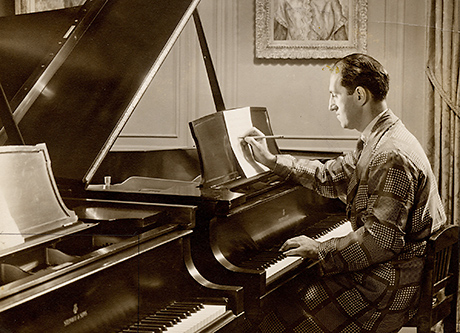
The Gershwin family donated the Steinway to the University as part of the George and Ira Gershwin initiative that is focused on research and study of the brothers’ music.
According to Marc Gershwin, George and Ira’s nephew, “I wanted the instrument to be accessible to the students and faculty who would be preserving the legacy of George and Ira Gershwin’s music… I’m delighted that the piano will once again be in regular use [by students and faculty], and am thrilled that it has been restored to performance condition.” [Two other Gershwin Steinways are in museums.]
From what I know of George he would have wanted it this way. Unlike some composers George was a gifted pianist. He had a rich social life and enjoyed playing his music for anyone who would listen.
There’s a lesson in that thought. If you have something valuable, sometimes it becomes more valuable – or at least more appreciated – when people can see it and use it. If you look at the piano as an instrument of technology that is it, then it makes sense that organizations give people access to technology – as well as resources – to do their work.
. 1714 ~ Carl Phillip Emanuel (C.P.E.) Bach, German composer
More information on C. P. E. Bach
. 1857 ~ Ruggero Leoncavallo, Italian composer
More information about Leoncavallo
. 1866 ~ “It is possible to be as much of a musician as Saint-Saëns; it is impossible to be more of one!” ~ Franz Liszt on meeting fellow composer Camille Saint-Saëns in Paris.
. 1869 ~ Hector Berlioz, French composer (Symphony Fantastic), died at the age of 65
. 1889 ~ John Thompson, Piano educator
. 1911 ~ Alan Hovhaness, American composer
More information about Hovhaness
. 1922 ~ Cyd Charisse, Dancer
. 1927 ~ Dick Hyman, Pianist and music director for Arthur Godfrey
. 1961 ~ Conductor, Sir Thomas Beecham died at the age of 81.
. 1962 ~ The Beatles performed for the first time on the BBC in Great Britain. John, Paul, George and … Pete Best sang Dream Baby on the show, “Teenager’s Turn” on ‘Auntie Beeb’ (as the BBC was known).
. 1993 ~ Billy Eckstine, jazz singer (Fools Rush In), died at the age of 78 of stroke
. 1983 ~ William T Walton, English composer (Belhazzar’s feast), died at the age of 80
. 2001 ~ Ballet Legend Dame Ninette De Valois died at the age of 102. She was the founder of Britain’s Royal Ballet who launched dancer Margot Fonteyn on the road to stardom. De Valois, a strict and demanding disciplinarian with her pupils, was a gifted and theatrical choreographer who almost single-handedly put British ballet on the international stage. The doyenne of dance helped to nurture the talents of unknowns like Fonteyn and courted controversy in the 1960’s at the height of the Cold War when she invited Russian dancer Rudolph Nureyev to appear with her company. De Valois always gave credit to Russian impresario Sergei Diaghilev for teaching her all she knew. “Everything,” she once said of the Ballet Russe legend. “Diaghilev just managed the whole company. He knew all about the different teachers. He knew the types of teachers he wanted, he knew the type of ballet he wanted. He was a musician.” Born Edris Stannus in 1898 in the Irish county of Wicklow, she graduated from Irish jig to the ballet, worked with the writer W.B. Yeats at Dublin’s Abbey Theater and then, almost single-handedly, brought ballet to the fore in Britain. The famed diva, who adopted her professional name from an ancestor who had married into a French family, was first inspired at the age of 11 when she watched Anna Pavlova dancing The Dying Swan. In 1923, she joined Diaghilev’s troupe in Monte Carlo and began to lay the foundations of her own ballet empire. She gave up dancing herself after discovering that she had been suffering for years from polio. “It was no tragedy. I wasn’t that great,” she once said. In 1926, she opened her own ballet school in London. From the tiniest beginnings, she built up the Sadlers Wells Ballet in less than a decade. At the end of World War II, the company moved triumphantly into the Royal Opera House. A ballet dynasty was born. De Valois retired in 1963 but remained intimately involved in the ballet school, forever the sharp-tongued martinet who could strike terror in tomorrow’s ballet hopefuls.
. 2001 ~ Maude Rutherford, a singer and dancer in the glory days of black theater during the 1920s, died. She was believed to have been 104. Rutherford was billed as the Slim Princess when she worked with entertainers such as Fats Waller, Josephine Baker and Pearl Bailey. She was a featured performer and favorite at Harlem’s Cotton Club. Rutherford’s theater credits include: “Dixie to Broadway,” (1924), “Chocolate Sandals,” (1927), and “Keep Shufflin”‘ (1928). She retired from show business in 1950 and worked as a switchboard operator at an Atlantic City hotel.
. 2003 ~ Adam Faith, a square-jawed British singer who was briefly a Cockney challenger to Elvis Presley’s rock ‘n’ roll crown, died of a heart attack. He was 62. Born Terry Nelhams in west London in 1940, Faith was a handsome teenager who was playing with a skiffle music group – a mixture of jug band, acoustic, folk, blues and country and western styles – when he was spotted by producers of a British Broadcasting Corp. music program. Adopting the stage name Adam Faith, he became – alongside Cliff Richard, Tommy Steele and Billy Fury – a pop star of the pre-Beatles era. Developing a hiccuping delivery reminiscent of Buddy Holly, Faith had more than 20 British hits, including the chart-topping What Do You Want? and Poor Me. Faith also was a versatile actor, appearing in films like Beat Girl,Mix Me A Person and 1975’s Stardust opposite David Essex. In the 1970s he played a Cockney ex-con in the TV series Budgie.
. 2015 ~ Lew Soloff, American jazz trumpeter (Blood, Sweat and Tears), died at the age of 71
. 1809 ~ Johann Georg Albrechtsberger passed away. He was was an Austrian musician.
. 1824 ~ “I am convinced that the soul and spirit of Mozart have passed into the body of young Liszt” ~ Review of a concert given on this day by Franz List in Paris.
. 1875 ~ Maurice Ravel, French composer
More information on Ravel
. 1907 ~ Victor Alphonse Duvernoy, French piano virtuoso, composer and professor of piano at the Conservatoire de Paris, died at the age of 64
. 1917 ~ In the United States, RCA released the first jazz record ever: The Dixie Jazz Band One Step by Nick LaRocca’s Original Dixieland Jazz Band.
. 1917 ~ Robert Erickson, American composer
. 1939 ~ Guy Lombardo and his Royal Canadians recorded one of the most popular songs of the century. The standard, “Auld Lang Syne”, was recorded for Decca Records.
. 1955 ~ “Peter Pan”, with Mary Martin as Peter and Cyril Richard as Captain Hook, was presented as a television special for the first time.
. 1969 ~ The Apollo astronauts began this day of their space voyage by singing Happy Birthday.
. 1985 ~ The song We Are the World, from the album of the same name, was played on the radio for the first time. Forty-five of pop music’s top stars gathered together to combine their talents to record the music of Lionel Richie and Michael Jackson. Richie and Jackson sang, too, while Quincy Jones did the producing of the USA for Africa record. The proceeds of the multimillion-selling recording went to aid African famine victims. The project, coordinated by Ken Kragen, was deemed a huge success.
. 2001 ~ Frankie Carle, a big-band leader best known for Sunrise Serenade, at the age of 97. Carle, who died in Mesa, Ariz., reached the high point of his popularity during World War II, when he was the focus of a bidding war among bands. His repertory was wide, ranging from classics like a revival of Stephen Foster’sSwanee River, to a World War II release that anticipated the Allied victory called I’m Going to See My Baby. Although Carle’s music did not rank high on record industry charts after the 1940s, he still toured and played concerts into the 1980s, some 70 years after he began his musical career.
. 2015 ~ Steve Zegree died. He was a legendary jazz educator and former Western Michigan University Gold Company director.
. 1930 ~ Lorin Maazel, American conductor
More information on Maazel
. 1941 ~ Les Hite and his orchestra recorded The World is Waiting for the Sunrise on Bluebird Records. The instrumental became Hite’s most popular work. A decade later, Les Paul and Mary Ford added a vocal to the tune, making it one of their biggest-selling hit songs.
. 1944 ~ Dame Kiri Te Kanawa, New Zealand soprano
More information on Te Kanawa
. 1962 ~ Frank Sinatra recorded his final session for Capitol Records in Hollywood. Sinatra had been recording for his own record label, Reprise, for two years. His final side on Capitol was I Gotta Right to Sing the Blues, with Skip Martin’s orchestra.
. 1966 ~ Richard Hageman, Dutch-born American pianist, composer and conductor, died at the age of 84
. 1967 ~ Nelson Eddy passed away
. 1967 ~ Zoltán Kodály, Hungarian composer died
. 1985 ~ Yul Brynner played his famous role as the king in “The King and I” in his 4,500th performance in the musical. The actor, age 64, opened the successful production on Broadway in 1951.
. 2001 ~ Michael Smith, the drummer for the 1960s rock band Paul Revere and the Raiders, died in Kona, Hawaii, of natural causes at the age of 58. Smith, who played the part of the madcap jokester on stage, joined the band in 1962. The Raiders were known for their tri-cornered hats, colonial costumes and wild stage act. The Raiders were signed by CBS’ Columbia Records in 1963, and in 1965 they were hired to host “Where the Action Is,” a daily afternoon television show on ABC produced by Dick Clark Productions. The Raiders’ hit singles included Just Like Me,Kicks,Good Thing and Indian Reservation.
. 2018 ~ Arthur Foote, American classical composer, and a member of the “Boston Six” (Suite for Strings in E), died at the age of 83
. 1887 ~ Heitor Villa-Lobos, Brazilian composer and collector of Brazilian folk songs
More information about Villa-Lobos
. 1917 ~ The first jazz recording for Victor Records was released. The Original Dixieland ‘Jass’ Band performed on the tune The Dixie Jass Band One Step. The word ‘Jass’ was later changed to ‘Jazz‘.
. 1928 ~ Lou Levy, Pianist with Supersax; recorded with Sinatra, Peggy Lee, Nancy Wilson and Anita O’Day
. 1931 ~ Barry Tuckwell, Austrian French-horn player
. 1931 ~ Without a Song was recorded by Lawrence Tibbett for Victor Records. This wonderful melody came from the film, “The Southerner” and has been a hit for many, including Willie Nelson, Frank Sinatra and Tony Bennett.
. 1947 ~ Eddie Hodges, Singer, actor
. 1948 ~ Eddy Grant, Singer, songwriter
. 1950 ~ Eugene Fodor, Violinist, made solo debut at age 10 with the Denver Symphony, won first national competition at age 12, won first prize in International Paganini Competition, won highest prize in International Tchaikovsky Competition
More information about Fodor
. 1958 ~ Andy (Andrew Roy) Gibb, Singer with the Bee Gees, host of TV’s Solid Gold
. 1960 ~ Elvis Presley returned to civilian life after a two-year hitch in the U.S. Army. Not since General Douglas MacArthur returned from battle has a soldier received such publicity. Elvis said he probably would not be growing his famous and long sideburns back, though he did relent in later years.
. 1963 ~ Patsy Cline, Cowboy (Lloyd) Copas and Hankshaw Hawkins were killed in a plane crash at Camden, TN, near Nashville. The famous country music stars were returning from a benefit performance. Cline, the ‘Queen of Country Music’ was elected to the Country Music Hall of Fame in 1973. Jessica Lange played Patsy in the 1985 biographical film, Sweet Dreams, named after one of Cline’s hugely popular songs. Willie Nelson wrote her biggest hit, Crazy, which become a number one country hit and a top 10 pop song in November, 1961.
. 1969 ~ The rock magazine, Creem, was published for the first time this day.
. 1973 ~ Roberta Flack, riding at #1 on the pop music charts with, Killing Me Softly with His Song, could hardly wait to rip into the fancy frame containing her brand new gold record. She flew to the stereo machine and set the needle down on the shiny surface, only to hear Come Softly to Me. She was so impressed by this unexpected turn of the table that she wound up humming the old Fleetwoods song for three days.
. 2016 ~ Nikolaus Harnoncourt, Austrian conductor, particularly known for his historically informed performances of music from the Classical era and earlier, died at the age of 86
. 1678 ~ Antonio Lucio Vivaldi, Italian Baroque composer. The creator of hundreds of spirited, extroverted instrumental works, Vivaldi is widely recognized as the master of the Baroque instrumental concerto, which he perfected and popularized perhaps more than any of his contemporaries. A group of four violin concerti from Vivaldi’s Op. 8, better known as “The Four Seasons”, may well be the most universally recognizable musical work from the Baroque period. Perhaps the most prolific of all the great European composers, he once boasted that he could compose a concerto faster than a copyist could ready the individual parts for the players in the orchestra.
More information about Vivaldi
(MaryO’Note: Spring from The Four Seasons is available in the Piano Maestro App for piano students)
. 1801 ~ The U.S. Marine Band performed for the first time at a presidential nomination. That president was Thomas Jefferson.
. 1839 ~ Ignace Antoine Ladurner, pianist/composer, died at the age of 72
. 1877 ~ The ballet of Swan Lake, composed by Peter Ilyich Tchaikovsky, was performed for the first time in the famous Bolshoi Theatre in Moscow, Russia
and
. 1915 ~ Carlos Surinac, Catalan Spanish-born composer and conductor
. 1918 ~ Frank Wigglesworth, American composer
. 1925 ~ Enzo Stuarti, Opera singer
. 1928 ~ Samuel Adler, German-born American composer
. 1929 ~ Bernard Haitink, Dutch conductor
. 1932 ~ Miriam (Zensile) Makeba, South African born singer who was the first black South African to attain international stardom.
. 1934 ~ Barbara McNair, Singer, TV hostess of The Barbara McNair Show, actress
. 1942 ~ Dick Jurgen’s orchestra recorded One Dozen Roses on Okeh Records in Chicago.
. 1942 ~ The Stage Door Canteen opened on West 44th Street in New York City. The canteen became widely known as a service club for men in the armed forces and a much-welcomed place to spend what would otherwise have been lonely hours. The USO, the United Service Organization, grew out of the ‘canteen’ operation, to provide entertainment for American troops around the world.
. 1943 ~ Irving Berlin picked up the Best Song Oscar for a little ditty he had written for the film, Holiday Inn: White Christmas at the 15th Academy Awards.
. 1944 ~ Bobby Womack, Songwriter, singer
. 1948 ~ Chris Squire, Bass with Yes
. 1948 ~ Shakin’ Stevens (Michael Barratt), Singer, actor
. 1951 ~ Chris Rea, Guitarist with these groups Chris Rea Band and Ambrosia; singer, songwriter
. 1969 ~ Chastity Bono, Singer, daughter of Sonny & Cher
. 1978 ~ Andy Gibb reached the top of the music charts as (Love is) Thicker Than Water reached #1 for a two-week stay. The Bee Gees also set a record on this day as their single, How Deep Is Your Love, from the Saturday Night Fever soundtrack stayed in the top 10 for an unprecedented 17 weeks.
. 1981 ~ Lyricist E.Y. ‘Yip’ Harburg died in an auto accident in Hollywood, CA at the age of 82. Two of his most successful hits were Over the Rainbow from The Wizard of Oz and It’s Only a Paper Moon, popularized by Nat King Cole and many others.
. 2001 ~ Glenn Hughes, a singer who performed as the mustachioed, leather-clad biker in the disco band the Village People, died at the age of 50. The group, which was the brainchild of producer Jacques Morali, featured men dressed as an Indian, a soldier, a construction worker, a police officer, a cowboy and Hughes’ character, a biker. The band released its first single, San Francisco (You’ve Got Me), in 1977. It followed the next year with its first hit, Macho Man. The band then produced a string of hits, including Y.M.C.A., In theNavy and Go West. Collectively the Village People sold 65 million albums and singles. Although disco fell out of fashion in the 1980s, Hughes stayed with the band until 1996, when he left to sing in Manhattan cabarets.
. 2003 ~ Fedora Barbieri, a mezzo-soprano whose passionate singing sometimes stole the scene from opera diva Maria Callas, died. She was 82. Born in Trieste in 1920, Barbieri performed on stages ranging from Milan’s La Scala to New York’s Metropolitan Opera House to London’s Covent Garden. Barbieri’s career started in 1940 and for her 80th birthday, she sang the role of Mamma Lucia in Pietro Mascagni’s “Cavalleria Rusticana” in Florence. Her repertoire included roles in operas by Giuseppe Verdi and Giacomo Puccini. Barbieri died in Florence, which she had adopted as her home and where she gave many performances.
. 2003 ~ Emilio Estefan Sr., father of the Latin music mogul, died at the age of 83. Estefan Sr. played the plump and comical ambassador in a music video for the Miami Sound Machine’s hit song Conga, which featured singer Gloria Estefan, wife of Estefan Jr. The Miami Sound Machine’s office was once located in Estefan Sr.’s garage. His son later built a home for his parents on his Star Island compound. Estefan Sr. was born in Santiago de Cuba and moved to Spain with Estefan Jr. in 1966. His wife and another son stayed in Cuba because the boy was of military draft age and couldn’t leave until 1980. Estefan Sr. came to Miami in 1968, a year after Estefan Jr., and opened a clothing business in Hialeah.
. 2009 ~ Joseph Bloch died. He was an American concert pianist and professor of piano literature at the Juilliard School in New York City. During a career at Juilliard that spanned five decades, Bloch’s students included Emanuel Ax, Van Cliburn, Misha Dichter, Garrick Ohlsson, Jeffrey Siegel and Jeffrey Swann.
. 2011 ~ Johnny Preston, American pop singer (Running Bear), died at the age of 71
Can it be that not much happened in the world of music today? I’ll be editing this post as I find items!
In the meantime, please enjoy this video:
.1875 ~ The Georges Bizet opera Carmen premiered in Paris.
.1931 ~ The “Star Spangled Banner” was adopted as the American national anthem. The song was originally known as “Defense of Fort McHenry.”
.1931 ~ The first jazz album to sell a million copies was recorded. It was “Minnie The Moocher” by Cab Calloway.
.1940 ~ Artie Shaw and his orchestra recorded “Frenesi”.
.1945 ~ Bing Crosby recorded “Temptation” with John Scott Trotter’s Orchestra. He had recorded it before on October 22, 1933, with Lennie Hayton’s orchestra.
.1957 ~ Samuel Cardinal Stritch banned rock ‘n’ roll from Chicago archdiocese Roman Catholic schools.
. 1917 ~ Desi Arnaz (Desiderio Alberto Arnez y De Acha III), Bandleader, singer, actor, married to Lucille Ball, co-owner of Desilu Productions, introduced 3-camera sitcom technique
. 1921 ~ Robert Simpson, English composer and long-serving BBC producer and broadcaster
. 1934 ~ Doug Watkins, Jazz musician, bass with these groups: Pepper-Knepper Quintet, Hank Mobley Quartet, Horace Silver and the Jazz Messengers
. 1938 ~ Ben Harney, American composer and pianist died (b. 1871)
. 1942 ~ Lou Reed (Lewis Alan Reed), Singer, songwriter, guitarist with Velvet Underground
. 1949 ~ Eddie Money (Mahoney), Singer
. 1950 ~ Karen Carpenter, Drummer, singer with Grammy Award-winning group, The Carpenters
. 1955 ~ Jay Osmond, Singer with The Osmond Brothers
. 1956 ~ John Cowsill, Singer with The Cowsills
. 1956 ~ Mark Evans, Bass with AC/DC
. 1962 ~ Jon Bon Jovi (John Francis Bongiovi), American rock singer, songwriter
. 1963 ~ Cowboy (Lloyd) Copas and singer, Patsy Cline, killed in a plane crash
. 1974 ~ Stevie Wonder got five Grammy Awards for his album, Innervisions and his hit songs, You Are The Sunshine of My Life and Superstition.
. 1985 ~ Country singer Gary Morris hit #1 on the country charts for the first time with Baby Bye Bye, from his album, Faded Blue.
. 2003 ~ Hank Ballard, 75, the singer and songwriter whose hit The Twist ushered in a nationwide dance craze in the 1960s, died. He wrote and recorded The Twist in 1958, but it was released only on the B-side of a record. In 1959, Chubby Checker debuted his own version of the song on Dick Clark’s Philadelphia television show. It soon topped the charts and launched a dance craze that prompted the creation of other Twist songs, including Twist and Shout by the Isley Brothers and Twistin’ the Night Away by Sam Cooke. Mr. Ballard was inducted into the Rock and Roll Hall of Fame in 1990. Mr. Ballard was discovered in the early 1950s by writer-producer Johnny Otis. He was lead singer for the Royals, which changed its name to the Midnighters. Mr. Ballard, who was born John H. Kendricks in Detroit, grew up singing in church in Bessemer, Ala. At 15, he returned to Detroit and set out to form a doo-wop group while working on a Ford Motor Co. assembly line.
. 2018 ~ Van McLain [McElvain], American rock guitarist (Shooting Star), died at the age of 62 from West Nile virus
. 1643 ~ Girolamo Frescobaldi, Italian composer/organist, died at the age of 59
More about Frescobaldi
. 1810 ~ Frédéric Chopin, Polish composer and pianist
Read quotes by and about Chopin
More information about Chopin Grammy winner
. 1826 ~ John Thomas, Welsh composer and harpist
. 1904 ~ Glenn Miller, American trombonist and bandleader
More information about Miller
. 1922 ~ Michael Flanders, Songwriter, comedian with the duo: Flanders and [Donald] Swann, made humorous mockery of English and American failings, died in 1975
. 1927 ~ Harry Belafonte, American calypso and folk singer, UNICEF goodwill ambassador, father of Shari Belafonte
. 1928 ~ Paul Whiteman and his orchestra recorded Ol´ Man River for Victor Records. The featured vocalist on the track was 29-year-old Paul Robeson. The song became an American classic.
. 1930 ~ Benny Powell, Jazz musician, trombone with the Ernie Fields band, Lionel Hampton, a Count Basie veteran
. 1941 ~ FM Radio began in the U.S. when station W47NV in Nashville, TN started operations on this day. W47NV was the first commercial FM radio station to receive a license, some 20 years after its AM radio counterpart, KDKA in Pittsburgh. FM stands for ‘frequency modulation´ as opposed to ‘amplitude modulation´.
. 1941 ~ Downbeat magazine scooped the entertainment world with news that Glenn Miller’s renewed contract with Chesterfield Cigarettes was worth $4,850 a week (for three 15-minute programs).
. 1944 ~ Roger Daltrey, Singer with The Who
. 1968 ~ Country music stars Johnny Cash and June Carter got married on this day. Johnny walked down the aisle knowing that his 1956 hit, Folsom Prison Blues, was about to be redone for a June release. Cash has a daughter, Rosanne, (previous marriage) who became a country star in her own right in the 1980s.
. 1968 ~ Elton John’s first record, I’ve BeenLoving You, was released by Philips Records in England. Philips, not realizing the potential of the soon-to-be superstar, released him in 1969, just prior to his teaming with lyricist Bernie Taupin. Elton then signed a contract with Uni Records and began to turn out what would become a string of more than 50 hits over the next 25 years.
. 1973 ~ The Robert Joffrey Dance Company opened with a unique presentation in New York City. The show featured music of the Beach Boys in “Deuce Coupe Ballet”. A clever show, even if it didn’t do much to bring the masses to ballet.
. 1985 ~ A Beatles song was used for the first time in a U.S. TV commercial. The rights for Lincoln-Mercury to use the song, HELP!, cost $100,000, helping boost the fortunes of the Ford Motor Company.
. 1985 ~ Eugene List, American concert pianist and teacher (Eastman School of Music), died at the age of 66. List performed internationally during the mid-to-late 1900s. He championed the works of the American pianist and composer Louis Moreau Gottschalk (1829-1869). Gottschalk played this piece, with all its fanfares and flourishes reminiscent of an imaginary band concert, at all his concerts.
. 2003 ~ Nadine Conner, a soprano who performed for nearly two decades at the Metropolitan Opera after singing on national radio, died. She was 96. Conner debuted at the Met in 1941 as Pamina in Mozart’s “The Magic Flute,” conducted by Bruno Walter. She performed there 249 times over 18 seasons. She won acclaim not only for her Mozart roles, including Zerlina in “Don Giovanni” and Susanna in “The Marriage of Figaro,” but also for her portrayals of Violetta in Verdi’s “La Traviata,” Mimi inPuccini’s “La Boheme,” Gilda in Verdi’s “Rigoletto,” and Rosina in Rossini’s “The Barber of Seville.” Conner began her career singing on national radio from Los Angeles, and appeared with such stars as Bing Crosby and Gordon MacRae and toured with film star Nelson Eddy. She joined a fledgling opera troupe in Los Angeles, making her debut as Marguerite in Gounod’s “Faust.” Her Met farewell, in 1960, also was in “Faust.”
. 1932 ~ Bing Crosby and the Mills Brothers teamed up to record Shine for Brunswick Records.
. 1936 ~ Fanny Brice brought her little girl character “Baby Snooks” to radio on “The Ziegfeld Follies of the Air” on CBS Radio. Miss Brice presented the character and later sang My Man on the program. She was 44 at the time, and was known as America’s “Funny Girl” long before Barbra Streisand brought her even greater fame and notoriety nearly 30 years later.
. 1964 ~ The United States was in the grip of Beatlemania! I Want to Hold Your Hand, by the lads from Liverpool, was in its 5th week at #1 on the pop charts. It stayed there until March 21, when it was replaced by She Loves You, which was replaced by Can’t Buy Me Love, which was finally replaced by Hello Dolly, by Louis Armstrong, on May 9, 1964. 14 straight weeks of #1 music by The Beatles!




 Grammy winner
 MaryO'Studio