December 8 ~ in Music History

today

Christmas Countdown: It Came Upon A Midnight Clear

• 1731 ~ Frantisek Xaver Dusek, Czech composer and one of the most important harpsichordists and pianists of his time.

OCMS 1865 ~ Jean (Johan) Julius Christian Sibelius, Finnish composer
Read quotes by and about Sibelius
More information about Sibelius

• 1882 ~ Manuel Maria Ponce, composer

• 1890 ~ Bohuslav Martinu, composer

• 1924 ~ Franz Xaver Scharwenka, German pianist/composer (Mataswintha), died at the age of 74

• 1925 ~ Jimmy Smith, Grammy Award-winning musician, modern jazz organist

• 1925 ~ Sammy Davis, Jr., American singer of popular music

OCMS 1939 ~ James Galway, Irish flutist
Read quotes by and about Galway
More information about Galway

• 1939 ~ Jerry Butler, Singer with The Impressions

• 1941 ~ Ray Eberle and The Modernaires teamed with the Glenn Miller Orchestra to record Moonlight Cocktail on Bluebird Records. By April, 1942, the song was a solid hit.

• 1942 ~ Bobby Elliott, Drummer with The Hollies

• 1943 ~ Jim (James Douglas) Morrison ‘The Lizard King’, Singer in the rock group The Doors

• 1946 ~ John Rubinstein, Tony Award-winning actor, composer

• 1947 ~ Gregg Allman, Keyboards, guitar, singer with Allman Brothers Band

• 1957 ~ Phil Collen, Guitarist with Def Leppard

• 1961 ~ Surfin’, The Beach Boys first record, was released on Candix Records. It became a local hit in Los Angeles but only made it to #75 nationally. The surfin’ music craze didn’t take hold across America for another year. By the time Surfin’ Safari entered the Top 40 (September, 1962), though, The Beach Boys were ridin’ a wave of popularity that continues today.

• 1963 ~ Florence Henderson and Jose Ferrer co-starred in The Girl Who Came to Supper on Broadway. The production, however, only lasted for 112 shows.

• 1963 ~ Frank Sinatra, Jr. was kidnapped in Lake Tahoe, Nevada. He was set free four days later. It was discovered that Sinatra, Jr. cooperated with his abductors in their plot. Dad was not proud, nor pleased. Frank, Jr. went on to conduct the big band for Frank, Sr. and all was well.

• 1966 ~ Sinead O’Connor, Singer

• 1980 ~ John Lennon was shot and killed on this day as he stood outside of his New York City apartment house, the Dakota. A deranged, obsessed ‘fan’ asked Lennon to autograph an album, then shot him as Lennon started to comply. The man was quickly apprehended by others gathered at the scene. A several-days vigil by hundreds of mourning fans is remembered as candles flickered and the song Give Peace a Chance was heard, a continuing tribute to the musician and songwriter of a generation. John Lennon’s wife, Yoko Ono, together with New York’s officials, set up a permanent memorial to her husband: a section of Central Park, opposite the Dakota, named Strawberry Fields.

• 1982 ~ Marty Robbins passed away

• 2003 ~ Lewis Allen, producer of the Broadway hit “Annie” and winner of three Tony Awards, died of pancreatic cancer, his wife said. He was 81. “Annie” opened in 1977 and ran for six years. Allen won a Tony for it and for two plays he produced: Herb Gardner’s “I’m Not Rappaport” in 1986 and Terrence McNally’s “Master Class” in 1996. Allen also produced several films, including Shirley Clarke’s “The Connection” (1961), Francois Truffaut’s “Fahrenheit 451” (1966) and both the 1963 and 1990 versions of “Lord of the Flies.” He was an early supporter of “Annie,” which started life at a regional theater in Connecticut. Although that production received lukewarm reviews, Allen got producer-director Mike Nichols to join him in backing the Broadway version, which spawned the 1982 film version that Allen did not produce. Allen was born in Berryville, Va., graduated from the University of Virginia and served with the American Field Service during World War II. His wife, Jay Presson Allen, wrote the screenplays for “Cabaret” (1972) and Alfred Hitchcock’s “Marnie”(1964).

• 2003 ~ Cuban pianist Ruben Gonzalez, who found new fame in the mid-1990s playing with Compay Segundo’s Buena Vista Social Club band, died. He was 84. Gonzalez’s keyboard gymnastics provided the heartbeat of the Buena Vista Social Club’s string of traditional Cuban “son” music albums beginning in 1997. The smallish man with grizzled hair and beard gained worldwide attention as the pianist on the opening album of the series, the Grammy-winning “Buena Vista Social Club.”
Christmas Countdown: Hark the Herald Angels Sing

hark

Charles Wesley (1707-1788),  the younger brother of John Wesley wrote the words to this Christmas Carol.

Charles was a hymn writer and a poet, also known as one of the people who began the Methodist movement in the Church of England. Hark the Herald Angels Sing appeared in 1739 in a book called Hymns and Sacred Poems.

Wesley envisioned this being sung to the same tune as his hymn, Christ the Lord Is Risen Today,  and in some hymnals it is included along with the more popular version.

This hymn was regarded as one of the Great Four Anglican Hymns and published as number 403 in “The Church Hymn Book” (New York and Chicago, USA, 1872).

To celebrate the invention of the printing press, Felix Mendelssohn composed a cantata in 1840 called Festgesang or “Festival Song”. The melody of Mendelssohn’s cantata was then used by William H. Cummings and adapted it to the lyrics of Wesley’s “Hark the Herald Angels Sing”.

Hark the herald angels sing
“Glory to the newborn King!
Peace on earth and mercy mild
God and sinners reconciled”
Joyful, all ye nations rise
Join the triumph of the skies
With the angelic host proclaim:
“Christ is born in Bethlehem”
Hark! The herald angels sing
“Glory to the newborn King!”

And, of course, no one can do it better than The Mormon Tabernacle Choir.


December 7 ~ in Music History

today


Pearl Harbor Day


Christmas Countdown: Hark the Herald Angels Sing

• 1637 ~ Bernardo Pasquini, Italian composer of operas, oratorios, cantatas and keyboard music.

• 1840 ~ Hermann Goetz, German Composer

• 1842 ~ The Philharmonic Society of New York, the first permanent orchestra in the U.S., held its first concert. Despite uncomfortable seating, the event was a huge success. They performed works of Beethoven.

OCMS 1863 ~ Pietro Mascagni, Italian composer and conductor
More information about Mascagni

• 1879 ~ Rudolf Friml, Musician, composer

• 1887 ~ Ernst Toch, Austrian-born American composer

• 1899 ~ Antoni de Kontski, Polish pianist and composer, died at the age of 82

• 1911 ~ Louis Prima, Trumpeter, bandleader with Louis Prima and His New Orleans Gang, Gleeby Rhythm Orchestra; songwriter, singer, married to Keely Smith

• 1931 ~ Bobby Osborne, Musician, mandolin, singer with the duo – Osborne Brothers

• 1942 ~ Harry Chapin, American folk-rock singer and songwriter, Recipient of Special Congressional Gold Medal, Worldwide Humanitarian for the Hungry, Needy and Homeless

• 1948 ~ NBC presented Horace Heidt’s Youth Opportunity Program for the first time. The talent show earned Dick Contino, an accordionist, the $5,000 prize as the program’s first national winner.

• 1949 ~ Tom Waits, Singer, songwriter, playwright, married to Kathleen Brennan

• 1954 ~ Mike Nolan, Singer with Bucks Fizz

• 1957 ~ Pat Boone was at the top of the pop charts for the first of six weeks with April Love. His other number one hits included Ain’t That a Shame, I Almost Lost My Mind, Don’t Forbid Me and Love Letters in the Sand.

• 1984 ~ Michael Jackson was in Chicago to testify that the song, The Girl is Mine, was exclusively his and he didn’t swipe the song, Please Love Me Now. It was a copyright infringement case worth five million dollars. He won.

• 1990 ~ Dee (Delectus) Clark passed away

• 2016 ~ Greg Lake, English rock vocalist and bassist (King Crimson, Emerson, Lake & Palmer), died of cancer at the age of 69

Christmas Countdown: Just In Time For Christmas

From RevKev, Pender’s Former Associate Pastor – “As it was, so it is, Christmas about Jesus. We are all distracted by the glitz and festivities, but let us hear the sound of Angels and the call to worship our Newborn King. Just in time for Christmas, a gift from God to you: A baby in a manger who would love us through and through..”

More from JC Reigns

December 6 ~ in Music History

today

Christmas Countdown: Just In Time For Christmas

• 1877 ~ Thomas Alva Edison made the first sound recording ever by reciting and recording the nursery rhyme, “Mary had a Little Lamb”. Edison recorded sound on a cylinder, which was then rotated against a needle. The needle moved up and down in the grooves of the cylinder, producing vibrations that were amplified by a conical horn. Edison assumed that this would be useful only for office dictation purposes and not much for recording music.

• 1887 ~ Joseph Lamb, American ragtime composer

• 1896 ~ Ira Gershwin (Israel Gershvin), American librettist and lyricist

OCMS 1920 ~ Dave Brubeck, American jazz pianist and composer
More information about Brubeck

• 1929 ~ Nikolaus Harnoncourt, German conductor, cellist and musicologist

• 1930 ~ Bobby Van (Bobby King Robert Stein), Actor, dancer

• 1939 ~ Steve Alaimo, Singer, actor

• 1941 ~ Helen Cornelius, Singer

• 1942 ~ Len Barry (Borrisoff), Singer, with The Dovells

• 1944 ~ Jonathan (Kenneth) King, Singer, songwriter, producer

• 1944 ~ Red Bank Boogie, Count Basie’s salute to his hometown, was recorded on Columbia Records. The tune is a tribute to Red Bank, New Jersey.

• 1948 ~ Arthur Godfrey’s Talent Scouts debuted on CBS-TV. The show ran for almost10 years and the redhead introduced such talent as Pat Boone, The Chordettes, Carmel Quinn, The McGuire Sisters, Rosemary Clooney, Tony Bennett, Connie Francis, Steve Lawrence and Al Martino.

• 1950 ~ Joe Hisaishi, Japanese composer

• 1956 ~ Peter Buck, Guitarist with R.E.M.

• 1956 ~ Rick (Paul) Buckler, Drummer, singer with The Jam

• 1960 ~ Eileen Farrell debuted at the Metropolitan Opera House in NYC in the title role of Gluck’s Alcestis.

• 1962 ~ Ben Watt, Guitarist, keyboard, singer with Everything but the Girl

• 1969 ~ Musician Cab Calloway turned actor as he was seen in the Hallmark Hall of Fame presentation of The Littlest Angel on NBC. The big band singer, known for such classics as Minnie the Moocher, became a movie star in The Blues Brothers (1980) with John Belushi and Dan Ackroyd.

• 1969 ~ Na Na Hey Hey Kiss Him Goodbye, by Steam, reached the #1 spot on the top 40. It stayed at the top for two weeks and was the only major hit for the group.

• 1984 ~ Two former Beatles debuted in two film releases this day. Paul McCartney’s Give My Regards to Broad Street and George Harrison’s A Private Function were finalized for theater audiences.

• 1988 ~ Roy Orbison, Singer, passed away

• 1989 ~ Sammy Fain passed away
More information about Fain

• 2000 ~ Werner Klemperer, a Jewish refugee from Nazi Germany who went on to play the inept German prison-camp commandant Col. Klink on TV’s “Hogan’s Heroes,” died of cancer at the age of 80. Klemperer fled Germany in 1935 with his father, Otto, a distinguished conductor and composer. He won two Emmy Awards for his portrayal of the monocled Col. Wilhelm Klink on the 1960s sitcom about World War II Allied prisoners of war. He was a gifted actor on both film and stage, receiving a Tony nomination in 1988 as a feature actor in a musical for his role in Hal Prince’s revival of “Cabaret.” Other Broadway roles included starring opposite Jose Ferrer in “The Insect Comedy,” and with Tallulah Bankhead in the 1955 production of “Dear Charles.” Most recently, he co-starred in Circle in the Square’s production of Chekhov’s “Uncle Vanya.” Klemperer also appeared as a narrator with nearly every major symphony orchestra in the United States. His repertoire included such works as Beethoven’s “Egmont” and “Fidelio,” Stravinsky’s “L’Histoire du Soldat” and “Oedipus Rex.” His narration of Mozart’s “The Impresario,” with the Mostly Mozart Festival Orchestra, aired on PBS’s “Live from Lincoln Center.” He also performed in various operas, including “The Sound of Music,” with the New York City Opera. He played Prince Orlofsky in “Die Fledermaus” with companies in Seattle and Cleveland.

• 2003 ~ Hans Hotter, the world’s leading Wagnerian bass-baritone of his time, died at the age of 94. The 6-foot-4 Hotter, whose career spanned half a century, was known for his booming, noble voice. He mastered such roles as Wotan in Wagner’s Ring Cycle, Gurnemanz in “Parsifal”, the title role in “The Flying Dutchman” and Hans Sachs in Die Meistersinger. He also won praise for Schubert lieder. Hotter started his operatic career in 1930, and sang in Prague and Hamburg and at the Munich Opera, where he became a leading singer in 1937. He remained with the company until 1972. He also was a member of the Vienna Opera from 1939 until 1970. Hotter created the role of Olivier in the world premiere of Richard Strauss “Capriccio” in 1942. According to the British newspaper The Guardian, the role of Jupiter in Strauss’s “Die Liebe der Danae” had been written for him but its premiere was disrupted when all theaters were closed after the assassination attempt on Adolf Hitler in August 1944. After the war, Hotter began a 12-year association with the Wagner family’s opera house at the Bayreuth festival in 1952. The same year, he made his Metropolitan Opera debut as the Dutchman. He also became a producer. His final production was in 1981 in Chicago of Beethoven’s “Fidelio”.

Christmas Countdown: Carol of the Bells


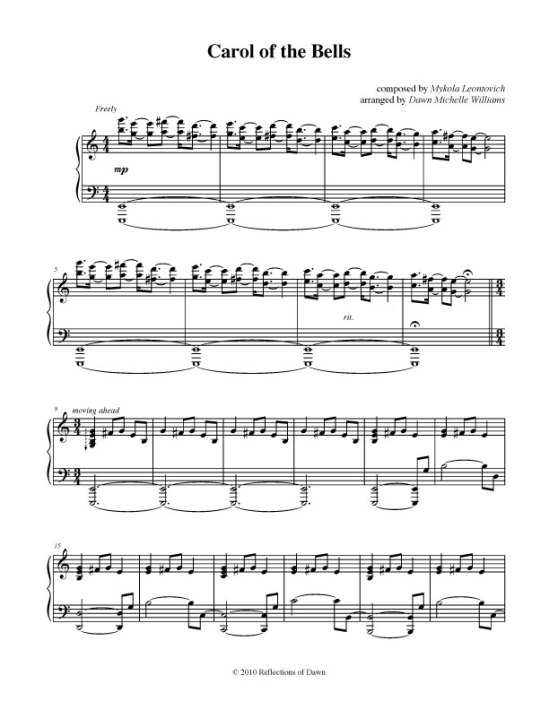
Carol of the Bells

Carol of the Bells was composed by Mykola Dmytrovych Leontovych (1877-1921) in 1916. Originally titled Shchedryk, this Ukrainian folk song is sometimes called Ukrainian Bell Carol. “Shchedryk” which was associated with the coming New Year, originally celebrated in April.

Leontovych used this tune in 1904 along with lyrics by Peter J. Wilhousky to create the version that everyone knows today. It gained popularity during the 1920s and 1930s, and was introduced to an even wider audience when it was used in the movie “Home Alone”.

It was first performed in the Ukraine on the night of January 13, 1916, on the Julian calendar this is considered New Year’s Eve. In the United States the song was first performed on October 5, 1921 at Carnegie Hall.

This video is from the Christmas special of the Mormon Tabernacle Choir, presented at the BYU channel. The orchestra and choir produce a very beautiful sound.

Not the standard version –

The O’Connor Music Studio has several versions of this Christmas Carol available for loan, including this version from the Mannheim Steamroller:


December 5 ~ in Music History

today

Christmas Countdown: Carol of the Bells

• 1687 ~ Francesco Xaverio Geminiani, Italian violinist, writer and composer

• 1791 ~ Wolfgang Amadeus Mozart, composer, died in Vienna, Austria at the age of 35. Mozart, the precocious child prodigy, composed several pieces that are deemed central to the classical era. Though he ranked as one of the greatest musical genius, he did not live a life of affluence as none of his compositions earned him a decent commission.

• 1870 ~ Vitezslav Novak, Czech composer and pedagogue

• 1901 ~ Walt Disney, Man behind many much-loved animated musicals

• 1922 ~ Don Robertson, Nashville Songwriters Association Hall of Famer, whistler

• 1930 ~ Larry Kert, Actor, singer, dancer in the West Side Story original cast, 1957

• 1932 ~ Little Richard (Pennimann), US rock ‘n roll artist, preacher

• 1936 ~ Chad Mitchell, Singer with Chad Mitchell trio

• 1936 ~ Bing Crosby took over as host of The Kraft Music Hall. Jimmy Dorsey (who would later be host, himself) led the Kraft Orchestra.

• 1945 ~ José Carreras, Spanish tenor with the New York Metropolitan Opera

• 1947 ~ Jim Messina, American rock guitarist and singer, duo of Loggins and Messina and groups: Buffalo Springfield and Poco

• 1960 ~ Les Nemes, Bass with Haircut 100

• 1960 ~ Jack Russell, Singer with Great White

• 1973 ~ Paul McCartney released Band On The Run, his fifth album since his departure from The Beatles. Two hit singles from the album – ‘Jet’ and ‘Band on the Run’ made it McCartney’s most successful album.

• 2003 ~ Avie Parton, mother of country music singer, songwriter and actress Dolly Parton, died after a long illness. She was 80. Parton was responsible for stitching the patchwork rag coat for young Dolly that the singer later recounted in the song, Coat of Many Colors. The song helped propel Dolly Parton to stardom and came to symbolize her climb from rags to riches. She also was the witness at Dolly’s secret marriage to Carl Dean in 1966 in Ringgold, Ga.

OCMS 2012 ~ Dave Brubeck, American jazz pianist and composer died from heart failure at the age of 91
More information about Brubeck

Christmas Countdown: Angels We Have Heard On High


Angels We Have Heard On High

Angels we have heard on high
Sweetly singing o’er the plains
And the mountains in reply
Echoing their joyous strains
CHORUS:
Gloria, in excelsis Deo!
Shepherds, why this jubilee?
Why your joyous strains prolong?
What the gladsome tidings be
Which inspire your heavenly song? ChorusCome to Bethlehem and see
Him Whose birth the angels sing;
Come, adore on bended knee,
Christ the Lord, the newborn King. ChorusSee Him in a manger laid
Jesus Lord of heaven and earth;
Mary, Joseph, lend your aid,
With us sing our Savior’s birth. Chorus

This is a traditional French carol (Les Anges dans nos Campagnes) that was translated into English by Bishop James Chadwick.

This carol commemorates the story of the birth of Jesus Christ found in the Gospel of Luke, in which shepherds outside Bethlehem encounter a multitude of angels singing and praising the newborn child.

In 2009, Andrea Bocelli and David Foster collaborated to produce a Christmas album with a number of other music legends. This is “Angels We Have Heard on High” with choir and orchestra.

The Piano Guys, Peter Hollens, David Archuleta, and The Mormon Tabernacle Choir get together to sing “Angels We Have Heard On High”

December 4 ~ in Music History

Christmas Countdown

• 1660 ~ André Campra, French composer

• 1667 ~ Michel Pignolet De Monteclair, French composer

• 1861 ~ Lillian Russell (Helen Louise Leonard), Singer, actress, burlesque

• 1879 ~ Sir Herbert Hamilton Harty, Irish composer, conductor, pianist and organist

• 1915 ~ Eddie Heywood, Jr., Pianist, composer

• 1927 ~ Duke Ellington’s big band opened the famed Cotton Club in Harlem. It was the first appearance of the Duke’s new and larger group. He played the club until 1932.

For part 2:

• 1934 ~ Ethel Merman recorded I Get a Kick Out of You, from Cole Porter’s musical, Anything Goes. She was backed by the Johnny Green Orchestra. The tune was recorded for Brunswick Records.

• 1934 ~ Wink (Winston Conrad) Martindale, TV host, singer

• 1938 ~ Yvonne Minton, Australian mezzo-soprano

• 1940 ~ John Cale, Bass, keyboard, viola, singer with The Velvet Underground

• 1942 ~ Bob Mosley, Bass with Moby Grape

• 1942 ~ Chris Hillman, Guitar, bass, mandolin with The Byrds

• 1944 ~ Dennis Wilson, American rock-and-roll singer and drummer

• 1948 ~ Southside Johnny (Lyon), Singer with Southside Johnny and The Asbury Dukes

• 1965 ~ Composer, lyricist, and singer, Jacques Brel made his American debut in concert at Carnegie Hall in New York City. Brel composed Jackie, You’re Not Alone, If You Go Away and more.

• 1972 ~ Billy Paul from Philadelphia received a gold record for his smash hit, Me and Mrs. Jones.

• 1976 ~ Baron (Edward) Benjamin Britten (of Aldeburgh) died in Aldeburgh. He was a British composer, conductor, and pianist.
More information about Britten

• 2002 ~ Emmy-nominated pianist George Gaffney, who accompanied such musicians as Peggy Lee, Engelbert Humperdink and Sarah Vaughan, died. He was 62. Born in New York City, Gaffney began studying the piano at age 10 but switched to the trombone. After serving in the U.S. Marine Corps from 1958 to 1961, Gaffney returned to New York, where he played piano and began arranging and accompanying singers. Gaffney moved to the Chicago area in the mid-1960s and was musical director of the Playboy Club in Lake Geneva, Wis., where he first met Vaughan. Gaffney came to California in the early 1970s and found work as a studio musician and accompanist. He worked on a number of television programs, including the TV series “Moonlighting,” and was nominated for an Emmy. From 1980 to 1990, he was Vaughan’s accompanist and musical director. He moved to Las Vegas in 1994 and worked as Humperdink’s musical director. In recent years, he also orchestrated tunes for Rita Moreno.

• 2002 ~ Mary Hansen, guitarist and vocalist with the ’90s alternative band Stereolab died. She was 36. Hansen, from Maryborough in Queensland, Australia, died in a cycling accident in London, The Independent newspaper reported Friday. Details of the accident were not available. Band spokesman Mick Houghton was quoted by The Independent as saying a truck might have backed into her, “but I really don’t know much more than that.” Hansen joined the band in 1992, two years after it was formed by Tim Gane, formerly of the band McCarthy, and his girlfriend Laetitia Sadier. Among hundreds of messages posted on the band Web site, one from a fan who identified himself as Louis called Hansen “the soul” of the band. Hansen, who played several instruments, first appeared on 1992’s LoFi single and all subsequent releases, including 1994’s Mars Audiac Quintet and 1996’s Emperor Tomato Ketchup. Stereolab had been working on a new album, expected to be released next year.

• 2003 ~ Barry Morell, a tenor who played leading roles at the Metropolitan Opera and internationally for more than two decades, died of esophageal cancer. He was 75. Morell began his career as a baritone, until he sought the guidance of former Metropolitan Opera baritone Giuseppe Danise, who told him he should be a tenor. He was best known for performing the operas of Puccini. He made his debut as Pinkerton in “Madame Butterfly” in 1955 with the New York City Center Opera Company. In 1958, he made his Met debut in the same role. He appeared in Berlin, Barcelona, Vienna and other opera houses in Europe, South America and across the United States. Among his more than 20 roles during 257 performances at the Met were Rodolfo in “La Boheme,” Enzo in “La Gioconda” and the title roles of “Don Carlo”and “Faust”.

Christmas Countdown: I Heard The Bells on Christmas Day


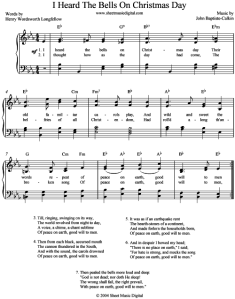
I Heard the Bells on Christmas Day


“I Heard the Bells on Christmas Day” is a Christmas carol based on the 1863 poem “Christmas Bells” by American poet Henry Wadsworth Longfellow. The song tells of the narrator’s despair, upon hearing Christmas bells, that “hate is strong and mocks the song of peace on earth, goodwill to men”. The carol concludes with the bells carrying renewed hope for peace among mankind.

This version is done by Casting Crowns.  I chose it because the Pender choir sang this on Christmas Eve with past-Associate Pastor Dan Elmore singing the solo…and I fell in love with this version.

As seen on 2008 TBN Christmas special. “I Heard The Bells On Christmas Day” is available on Casting Crowns’ Christmas album, Peace On Earth.

More traditionally, the Mormon Tabernacle Choir’s version:

I heard the bells on Christmas Day
Their old, familiar carols play,
and wild and sweet
The words repeat
Of peace on earth, good-will to men!

And thought how, as the day had come,
The belfries of all Christendom
Had rolled along
The unbroken song
Of peace on earth, good-will to men!

Till ringing, singing on its way,
The world revolved from night to day,
A voice, a chime,
A chant sublime
Of peace on earth, good-will to men!

Then from each black, accursed mouth
The cannon thundered in the South,
And with the sound
The carols drowned
Of peace on earth, good-will to men!

It was as if an earthquake rent
The hearth-stones of a continent,
And made forlorn
The households born
Of peace on earth, good-will to men!

And in despair I bowed my head;
“There is no peace on earth,” I said;
“For hate is strong,
And mocks the song
Of peace on earth, good-will to men!”

Then pealed the bells more loud and deep:
“God is not dead, nor doth He sleep;
The Wrong shall fail,
The Right prevail,
With peace on earth, good-will to men.”