• 1873 ~ Lee DeForest, Inventor of the triode vacuum tube, possibly the most significant invention that made radio possible.
More information about DeForest
• 1894 ~ Arthur Loesser, American pianist and writer
• 1915 ~ Humphrey Searle, British composer and writer
• 1928 ~ Peter Appleyard, British jazz vibraphonist and drummer
• 1939 ~ The radio program Arch Oboler’s Plays presented the NBC Symphony, for the first time, as the musical backdrop for the drama, This Lonely Heart.
• 1942 ~ Vic Dana, Singer
• 1949 ~ Bob Cowsill, Singer with The Cowsills
• 1957 ~ John O’Neill, Musician, guitar with That Petrol Emotion
• 1970 ~ Jimi Hendrix opened his recording studio in New York City. Because of its state-of-the-art 36-track recording capability, it attracted many top rock groups.
• 2000 ~ George Edmund Sandell, a noted violin and viola player, teacher and inventor died at the age of 88.
Sandell studied in New York under the viola virtuoso William Primrose and on scholarship at the Royal Swedish Conservatory in Stockholm.
Sandell moved to Los Angeles in 1938, where he played with the Los Angeles Philharmonic and the Pasadena and Santa Monica Symphonies.
Along with classical music, he performed pop, swing and Latin music, and played with the string sections of big band luminaries Harry James, Jimmy Dorsey and Xavier Cugat.
Sandell also played on some of Frank Sinatra’s recordings and worked for most of the big Hollywood studios on orchestral sound tracks, including the sound track for the movie Citizen Kane.
In 1947, he invented the Gee-Bee, a kitchen sponge with a plastic handle for washing dishes. He sold the company to DuPont in 1953.
• 2001 ~ Alix Williamson, the classical music publicist who suggested to Baroness Maria von Trapp that she write a book about her family’s experiences, died at the age of 85.
Williamson’s suggestion resulted in the Rodgers and Hammerstein musical “The Sound of Music.”
She represented artists such as André Watts and Frederica von Stade and helped the New York Grand Opera get a citation in the Guinness Book of World Records for its performances of a complete cycle of Verdi’s operas in Central Park. Williamson also ghostwrote books.
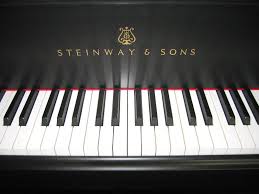
There will be $1.6 million worth of piano on stage at the City Recital Hall on Friday night. With their legs and lids removed for transport, eight Steinway grand pianos will be trucked to the venue.
There they will be reassembled on stage and tuned, ready for eight of Australia’s finest classical pianists.
In The Steinway Spectacular 16 hands and 80 fingers will play some of classical music’s greatest hits.
Conducted by Guy Noble, the pianists will work as an ensemble to perform works by composers such as Ravel, Saint-Saens and George Gershwin. ”It’s a very large affair,” says Noble. ”Logistically, it’s a nightmare.” The piano technician Ara Vartoukian will spend hours tuning the instruments.
For past concerts in Melbourne the process sometimes took all night. ”The pianos all, in essence, sound the same, so they have to be absolutely in tune with each other.”
Even after the most careful tuning, things can go awry.
The pianists – Anthony Halliday, Roger Heagney, Clemens Leske, Tamara Smolyar, Mikhail Solovei, Evgeny Ukhanov, Gerard Willems and Alexey Yemtsov – usually perform as soloists. Every now and again, Noble says, one of them ”goes rogue”.
”One will suddenly break out and play their own thing,” he says. ”I have to herd them back into the pride, glaring at them with eyes of death. It’s one of the hardest things I’ve ever had to conduct. It’s like herding cats.”
There is no repertoire for an ensemble of pianists, so Noble has created new arrangements.
His favourite is a rendition of the children’s staple Chopsticks. ”That just goes wild,” he says.
The segment titled So You Think You Can Play Scales is also a crowd pleaser. ”It’s like Piano Idol. People get voted off if they go off the rails.”
Other pieces will feature the organist Calvin Bowman and the soprano Shu-Cheen Yu. Bowman, who usually plays above the stage in a loft, will join the other performers on stage on an electronic organ.
”It’s a relief for him to be down on stage because he suffers terribly from vertigo,” Noble says. ”He’s been terrified in organ lofts all over Australia.”
More boisterous extravaganza than a recital for purists, the performance will appeal to an eclectic crowd.
”We get classical music lovers, as well as people who are just curious. It’s pure fun and enjoyment.”
The Steinway Spectacular is at the City Recital Hall on Friday.
• 1879 ~ New York’s Madison Square Garden displayed a real floating ship in a gigantic water tank as Gilbert and Sullivan’s operetta, H.M.S. Pinafore, was performed.
• 1902 ~ Stefan Wolpe, German-born American composer
1918 ~ Leonard Bernstein, American conductor, composer and pianist
Read quotes by and about Bernstein
Links to more information about Bernstein Grammy winner
• 1939 ~ Dorothy embarked on a journey down the yellow brick road with a lion, a tin man and a scarecrow in the classic film “The Wizard of Oz.”
• 1941 ~ Skinnay Ennis and his orchestra recorded the tune Don’t Let Julia Fool Ya.
• 1942 ~ Walter Williams, Singer with The O’Jays
• 1955 ~ Elvis Costello (Declan McManus), Musician, songwriter
• 1961 ~ Billy Ray Cyrus, Singer
• 1964 ~ The Beatles received a gold record for their hit single A Hard Day’s Night. It was the third gold record for the Fab Four. They would collect 18 more through 1970.
• 1971 ~ Ted Lewis passed away. He was an American entertainer, bandleader, singer, and musician.
• 1982 ~ The group, Fleetwood Mac, received a gold record for the album Mirage.
• 2001 ~ Aaliyah died at the age of 22. She was a R&B singer and budding actress who made her film debut in “Romeo Must Die” and was killed in a plane crash in the Bahamas.
• 2001 ~ Jazz musician John Nelson, the father of pop star Prince, died at the age of 85. Nelson was the model for a character in the 1984 Prince movie “Purple Rain.” He also co-wrote songs on several of his son’s hit albums.
In the 1950s, Nelson was a pianist in the jazz group Prince Rogers Trio featuring singer Mattie Shaw. Shaw and Nelson married, and they named their son Prince Roger Nelson.
Nelson left the household when Prince was about 10 and his sister Tyka was 8. The father and son reconciled after Prince began his climb to fame.
Nelson co-wrote Computer Blue on the Purple Rain album, The Ladder on Around the World in a Day; Christopher Tracy’s Parade and Under the Cherry Moon on Parade and Scandalous on the Batman soundtrack.
Beethoven’s first published works—his Opus No.1—were three trios for piano, violin and cello and already they show a marked advance on Haydn’s trios in the comparative interdependence of the three parts. Their freedom from Haydn’s oppressive formality looks forward to the first mature trios, the pair that comprises Opus 70, displaying all sorts of harmonic twists, thematic innovations and structural idiosyncrasies, these trios make much of the piano part and contain plenty of dramatic outbursts that are typical of Beethoven’s middle period.
Even more arresting is the first of the Opus 70 trios (1808) nicknamed ”The Ghost” because of its mysterious and haunting Largo. Its sibling boasts a cheerful bombastic finale that is the most entertaining music that Beethoven composed for this combination of instruments.
The “Archduke” Trio Opus 97 (1811) was Beethoven’s last full-scale work for piano trio and is typically conclusive. The third movement is its center of gravity, a highly moving set of variations with the cello dominating the thematic content. It opens with a hymn-like theme and progresses to a coda which magnificently sums up the movements ideas. The finale might be less powerful than that of Opus 70 No. 2, but it nevertheless has a sweeping rhythmic power. Again, it is beyond the shadow of a doubt that Beethoven defined the piano trio form that it retained throughout the 19th century by allowing the string instruments the status of genuinely equal partners in this superlative performance.
Steinway Place, Queens, New York, 11105. steinway.com or 718-721-2600.
It all begins with bare wood, rough and fragrant.
Skilled craftsmen then use muscle, fine motor skills and magic to transform simple planks into magnificent instruments. In the bridge-notching process, the “bellymen” use tools they’ve constructed themselves, the better to execute this highly skilled operation.
Alaskan Sitka Spruce becomes a soundboard, with ribs of Sugar Pine.
Eighty-eight keys, 88 hammers, more than 230 strings — all are carefully created, installed and tested in every piano.
All in all, it takes about 11 months to make a Steinway grand piano.
Steinway & Sons has been located in the same spot in the Astoria section of Queens since the early 1870s. Founded in 1853 in a loft on Varick Street in Manhattan, the company’s reputation grew quickly, and the company needed space to expand their operations.
Factory tours are offered from September through the end of June. (Factory tours are not available in July and August.) Tours are scheduled from 9:30 a.m. to noon on Tuesdays, for a maximum of 15 people.
Needless to say, tours fill up quickly and must be booked in advance. Steinway currently has no openings for the rest of 2017 and is not yet taking reservations for 2018. Plan way ahead, and check for updates by emailing tours@steinway.com or by calling 718-721-2600.
• 1854 ~ Moritz Moszkowski, Polish-born German pianist and composer
More information about Moszkowski
• 1900 ~ Ernst Krenek, Austrian-born American composer, conductor and pianist
• 1905 ~ Constant Lambert, British composer, conductor and writer
• 1912 ~ Gene (Eugene Curran) Kelly, Dancer, actor: Singin’ in the Rain, An American in Paris, Anchors Aweigh, The Three Musketeers, Marjorie Morningstar, Inherit the Wind, North and South Book I; director: Singin’ in the Rain, Hello, Dolly!, A Guide for the Married Man, The Cheyenne Social Club
• 1923 ~ Billy Jones and Ernie Hare, The Happiness Boys, were heard on radio for the first time. The two were billed as radio’s first comedians and were also credited with creating and performing the first singing commercial.
• 1936 ~ Rudy Lewis, Singer with Drifters
• 1942 ~ Patricia McBride, Ballerina: New York City Ballet. For many years she was Mikhail Baryshnikov’s only partner
• 1943 ~ LIFE magazine spotlighted a dance craze that was sweeping the U.S.A., the Lindy Hop
• 1947 ~ Keith Moon, Singer, drummer with The Who
• 1947 ~ Margaret Truman, daughter of U.S. President Harry S Truman, presented her first public concert. Margaret sang before 15,000 people at the Hollywood Bowl. The concert did not get great reviews. In fact, the critics didn’t like Margaret’s singing at all. And Margaret’s dad didn’t like the critics, and said so, from the White House.
• 1949 ~ Rick Springfield, Singer
• 1951 ~ Mark Hudson, Singer with The Hudson Brothers
• 1966 ~ The U.S. premiere of the motion picture Help!, starring The Beatles, was held for thousands of moviegoers wanting to see the group’s first, color, motion picture. Their first film, A Hard Day’s Night, had been produced in black and white.
• 2001 ~ Kathleen Freeman, a veteran character actress whose face if not her name was known to audiences from television sitcoms, the film classic “Singin’ in the Rain” and Broadway’s “The Full Monty,” died of lung cancer at the age of 82.
Freeman gave her final performance in “The Full Monty”. She played a sassy piano player in the hit musical and earned a Tony nomination in May 2001.
Big, brash and funny were Freeman’s trademarks in playing recalcitrant maids, demented nuns, mouthy housekeepers, battle-ax mothers, irate landladies and nosy neighbors.
Starting in the Golden Age of television, Freeman appeared in such shows as “Topper,” “The Donna Reed Show,” “The Beverly Hillbillies,” “The Dick Van Dyke Show,” “Hogan’s Heroes,” “The Lucy Show,” “The Golden Girls,” “Murphy Brown” and “Married … With Children.”
“This will sound very corny and I’m sorry,” Freeman said last year in an Associated Press interview, “but I have always had the sense I was put here to do this: I am somebody who is around to help the world laugh. I have always had that sense. Corny but absolutely true.”
In “Singin’ in the Rain,” considered by many to be the best movie musical ever made, she played Jean Hagen’s frustrated voice teacher. Among Freeman’s other films were the sci-fi thriller “The Fly,” “The Rounders” with Henry Fonda, “Far Country” with Jimmy Stewart, and “North to Alaska” starring John Wayne. More recently she appeared in “Dragnet,” “Gremlins II,” “Nutty Professor II: The Klumps” and both “Blues Brothers” comedies.
Freeman was born in Chicago and was propelled into show business at age 2. Her parents had a vaudeville act, Dixon and Freeman, in which their daughter did a little dance.
Freeman attended the University of California at Los Angeles, where she majored in music and was going to be a classical pianist. Then, she said, “A terrible thing happened. I got in a play and got a laugh. I just said a line and, `boom.”‘
Freeman then worked in many small theater groups, including the Circle Players, acting for such eminent directors – and actors – as Charles Laughton, Charlie Chaplin and Robert Morley.
At the same time, the early 1950s, the television explosion took over Los Angeles. From her first regular sitcom role, as the maid in “Topper,” Freeman went on to do just about every sitcom of the last 50 years.
For all her voluminous credits, Freeman’s stage credits were mostly on the road – touring as Miss Hannigan in “Annie” for 18 months, then in “Deathtrap” and later with Lauren Bacall in “Woman of the Year.”
Her only other Broadway appearance was for five months in the 1978 production of “13 Rue de l’Amore” starring Louis Jordan.
• 2001 ~ Frank Emilio Flynn, a blind pianist and Latin jazz pioneer who performed with many great American jazz artists, died at the age of 80.
Flynn lost his sight at age 13 but continued to study and perform classical works, transcribed into Braille, with the Symphonic Orchestra of Havana.
Flynn’s great passion was jazz, and in the 1950s he developed his own jazz-influenced ballad style, known in Cuba as “feeling.”
Performing with the Quinteto Cubana de Musica Moderno, or Cuban Quintet of Modern Music, he developed into one of the most important Cuban jazz musicians of his era.
More recently, he played at New York’s Lincoln Center in 1998 with trumpeters Alfredo Armenteros and Wynton Marsalis.
Picture a seven-foot grand piano in a studio. The lid’s missing, so you can see all the strings. Researchers suspend a rod embedded with 32 microphones over the piano’s body.
“We played this middle C at a very soft level, a medium level, and a very loud level,” says Agnieszka Roginska, a professor in NYU’s music technology program. She says using a pianist to play middle C over and over wouldn’t be scientific. So they’re using a disklavier, a fancy player piano triggered by electronics. “So we could hit the same note, with the same velocity, thousands of times,” she says.
They’d record the piano in one spot. Then move the microphones eight inches. Record the note. Move the mics again. Record the note. Over and over and over, until they reach the back of the piano. At the end, they get “what is basically a very dense acoustical scan of the radiation pattern of the grand piano,” Roginska says.
1862 ~ Claude Debussy, French composer. Along with Maurice Ravel, he was one of the most prominent figures associated with Impressionist music, though he himself disliked the term when applied to his compositions.
More information about Debussy
• 1906 ~ The Victor Talking Machine Company of Camden, New Jersey began to manufacture the Victrola (record player). The hand-cranked unit, with horn cabinet, sold for $200. Records sold separately.
• 1917 ~ John Lee Hooker, American blues guitarist and singer, born in Clarksdale, Miss. He began his career in Detroit in 1948 with the release of Boogie Chillun, the biggest of his several hit records and a staple of both the blues and rock repertoires. He toured continually, and among “deep blues” artists, enjoyed an unusually successful career, appearing in concerts and on recordings with many of the leading figures in rock. He was inducted into the Rock ‘n’ Roll Hall of Fame in 1991.
1928 ~ Karlheinz Stockhausen, German composer
More information about Stockhausen
Read quotes by and about Stockhausen
• 1926 ~ Bob Flanigan, Singer with The Four Freshmen
• 1932 ~ The British Broadcasting Corporation (BBC) began its first experimental TV broadcast in England.
• 1938 ~ Fred Astaire and Ginger Rogers appeared, dancing, on the cover of LIFE magazine, published on this day.
• 1938 ~ Count Basie recorded the classic swing tune, Jumpin’ at the Woodside, for Decca Records.
• 1942 ~ Joe Chambers, Musician: guitar, singer with The Chambers Brothers
• 1950 ~ Sam Neely, Singer
• 1960 ~ Debbi Peterson, Drummer, singer with Bangles
• 1961 ~ Roland Orzabal, Singer, guitarist
• 2002 ~ Frederick Selch, an advertising executive and magazine publisher who collected hundreds of antique musical instruments, died at the age of 72.
Selch began collecting almost 50 years ago and owned more than 300 musical instruments by 1977.
In that year, he founded the Federal Music Society, an organization dedicated to performing music from the Colonial-Federal period. The group’s 26 players used instruments in Selch’s collection to perform in more than 70 concerts.
Selch was also the owner, editor and publisher of Ovation, a monthly magazine about classical music, from 1983 to 1989. He produced the Broadway musical “Play Me a Country Song” in 1982, and in the past 10 years was involved in a series of American Music Festivals at Illinois Wesleyan University.
Selch, who received a master’s degree in radio-television production from Syracuse University, worked at the J. Walter Thompson advertising agency from 1955 to 1974.
He is to be awarded a posthumous doctorate from the American Studies program at New York University.
• 2002 ~ Richard Lippold, a sculptor whose abstract works are featured at New York’s Avery Fisher Hall and at Harvard University, died. He was 87. Lippold created giant metal abstractions, many of which are suspended by wires so they appear to be hovering or moving through space.
His piece World Tree, a 27-foot structure of straight and circular metal tubes that resembles a radio antenna, stands on the Harvard University campus.
He is also known for Ad Astra, a double spire that rises 115 feet in front of the National Air and Space Museum in Washington, and Orpheous and Apollo, a constellation of bronze bars connected by wires in the lobby of Avery Fisher Hall in Lincoln Center.
Lippold studied industrial design, piano and dance at the Art Institute of Chicago and the University of Chicago. He worked as a freelance industrial designer for several years before teaching art at the University of Michigan.
He later taught at Goddard College in Plainfield, Vt., and Hunter College in New York.


 1918 ~ Leonard Bernstein, American conductor, composer and pianist
 Grammy winner


 MaryO'Studio