Playing Mozart’s Piano Pieces as Mozart Did


Classical piano pieces by such composers as Beethoven, Mozart and Chopin likely sounded much different when the masters first performed those works than they do today. Pianos themselves have changed considerably — but so, too, has technique.

Over the past decade, a growing number of musicologists have begun to take a closer look at how technique shapes not just the sound of music, but also the audience’s emotional response to it.

“Music has one foot in physics and one foot in aesthetics,” said Rolf Inge Godoy, a professor of musicology at the University of Oslo. “Body motion is essential for shaping the outcome of the sound, both in terms of what you actually hear and in terms of the visual impact on an audience.”

Dr. Godoy uses optical motion capture — also employed by the animation industry — to study the physics of musical movement. Infrared cameras capture light from reflective markers placed on a cellist’s hands or a percussionist’s body, recording the performer’s motion at up to 500 frames per second and at an accuracy to one-third of a millimeter.

Computer algorithms then make associations between the motion data, what is heard and what listeners say they felt.

Recently Dr. Godoy turned the technology on a fascinating question: How were such classical pieces as Mozart’s Variation K. 500 and Hummel’s Etudes, Opus 125, originally played, and how might that have made a difference in sound and in audience reaction?

To find out, Dr. Godoy struck up a collaboration with Christina Kobb, a doctoral candidate at the Norwegian Academy of Music and head of theory at Barratt Due Institute of Music in Oslo. Ms. Kobb has developed an unusual expertise: She has learned how to play the piano according to techniques described nearly 200 years ago.

As a visiting student at Cornell University in 2010, she researched 19th-century pedagogical piano treatises — essentially, instruction manuals for piano playing. The techniques that they described, she realized, differed drastically from those she had been taught.

“I was not following even the most basic instructions given to beginners at the time,” Ms. Kobb said. “I wondered, ‘Would this make a difference in my playing?’ ”

For the next three years, she gradually replaced her modern way of playing with 19th-century technique, gleaned from around 20 treatises. Most were written in Vienna in the 1820s, while a few were published in France and England. Her primary source, however, was “A Complete Theoretical and Practical Course of Instructions on the Art of Playing the Piano Forte,” the seminal 465-page treatise published in 1827 by Johann Nepomuk Hummel, one of Mozart’s students.

“It’s hard enough learning how to play once,” she said. “I had to become conscious of every motion in my hands and fingers, things that normally I would do automatically, by habit.”

While modern players tend to hunch over the keys and hold their forearms nearly perpendicular to the keyboard, 19th-century style dictated that pianists sit bolt upright. The posture prevented players from bringing their weight to bear on the keyboard, instead forcing them to rely on smaller finger movements. The elbows were held firmly against the body, with forearms sloping down and hands askew.

As Ms. Kobb became more fluent in this approach, she found that certain movements — jumping quickly between disparate chords, for example — became swifter and more fluid. “The elbow against your body serves as a sort of GPS, so you always know where you are,” she said.

Chords and scales sound smoother and can be played faster, Ms. Kobb also found, and dramatic pauses between notes — often a matter of physical necessity rather than of style — are lessened. The old style also allows the performer to be more discriminatory and subtle in choosing which notes to stress, Ms. Kobb learned, producing a performance that is subdued by today’s standards.

“There’s a different physical feeling to playing, as well as a different outcome,” she said.

To identify the sources of those differences, Dr. Godoy and his colleagues recently attached 46 pieces of reflective material to Ms. Kobb’s fingers and arms, and then filmed her playing on an electric piano. After analyzing her movements, the researchers will be able to tell precisely which differences in technique account for each variation in the music as it is played in the old and modern styles.

“The correlation between bodily effort and sound output is really what we’re aiming to find out, but in order to do that we need to perform extensive statistical analysis, which is tremendously time-consuming,” Dr. Godoy said. He expects the results of the data analysis in three to four months.

“We are exploring those connections to get a better understanding of what music is,” Dr. Godoy added. “What is its power, and why do people respond so strongly to it?”

For her part, Ms. Kobb now plans to delve deeper into the repertoire of Romantic composers. “It’s time to restore the early techniques to try to bring us even closer to the way music sounded at the time of Beethoven,” she said.

A version of this article appears in print on July 21, 2015, on page D4 of the New York edition with the headline: Reviving Mozart’s Mozart via Playing Mozart’s Piano Pieces as Mozart Did – The New York Times.

July 26 ~ Today in Music History

today


OCMS1782 ~ John Field, Composer
More information about Field

• 1791 ~ Wolfgang Amadeus Franz Xavier Mozart, Mozart’s son. He didn’t give his first concert until he was 13 and never achieved his father’s fame

• 1874 ~ Serge Koussevitzky, Russian-born American conductor, double-bass player and music publisher, He was conductor of the Boston Symphony Orchestra and founder of the Tanglewood Music Festival.

• 1882 ~ Richard Wagner’s opera “Parsifal” was first performed, at Bayreuth, western Germany.

• 1914 ~ Erskine Hawkins, ’20th Century Gabriel’ Trumpeter bandleader, composer of Tuxedo Junction (with Julian Dash and Bill Johnson)

• 1919 ~ Eva (Evita) Peron

• 1924 ~ Louie Bellson (Balassoni), Drummer with the Duke Ellington Band, drum solo on Skin Deep, composer, music director for wife Pearl Bailey, played with Dorsey Brothers and Count Basie bands

• 1929 ~ Alexis Weissenberg, Bulgarian-born French pianist

• 1939 ~ Sixteen-year-old singer Kay Starr got a big break. She recorded Baby Me with Glenn Miller and his orchestra on Victor Records. Starr was filling in for Marion Hutton who, at the last minute, was unable to attend the recording session.

• 1941 ~ Bobby Hebb, Grammy Award-winning songwriter, singer, Grand Ole Opryat age 12

• 1943 ~ Dobie Gray (Leonard Ainsworth), Singer, songwriter

• 1943 ~ Mick Jagger, British rock singer and songwriter. 41 hits [1964 to 1989], 5 gold records, 8 number one hit, Rock and Roll Hall of Famer.   In 2003 he was knighted for his services to popular music and in early 2009 he joined the electric supergroup SuperHeavy.

• 1945 ~ Rick White, Singer

• 1949 ~ Roger Taylor (Meadows-Taylor), Drummer with Queen

• 1992 ~ Mary Wells passed away

• 2001 ~ Cleveland Johnson, a crusader for equality through his Tampa Bay-area newspaper, the Weekly Challenger, died of lung cancer. He was 73. Johnson wrote over the years about the need for social change, warning of the devastating effects of drugs on the black community and preaching the virtues of black economic power. Johnson, whose first love was music, studied at the Juilliard School and the Boston Conservatory. He operated a jewelry and dress store in Miami before moving to St. Petersburg in the mid-1960s and taking a job at the new Weekly Challenger, where he discovered that he had a talent for selling advertising. When founder M.C. Fountain died, Johnson kept the paper. Starting in the 1980s, he urged blacks to spend their money in black-owned businesses.

• 2002 ~ Buddy Baker, musical director for nearly 200 Disney movies and TV shows including “The Mickey Mouse Club,” died. He was 84. The composer penned incidental music and special songs sung by for “The Mickey Mouse Club” child stars and was responsible for music in the 1981 cartoon feature “The Fox and the Hound.” He was nominated for an Academy Award for the score to the 1972 children’s drama “Napoleon and Samantha.” He also scored incidental music for the Disney theme park attractions “Great Moments With Mr. Lincoln,” “It’s a Small World,” and “The Haunted Mansion.” Disney Studios hired him in 1954. He worked on arrangements for the TV show “Davy Crockett” and three “Winnie the Pooh” cartoons and composed original music for the 1975 film “The Apple Dumpling Gang” and 1976’s “The Shaggy D.A.”

• 2002 ~ Kenny Gardner, a tenor who sang with Guy Lombardo and His Royal Canadians, died. He was 89. Gardner, the featured crooner, was remembered for such songs as Enjoy Yourself, It’s Later Than You Think and Frankie and Johnny. The band, one of the most popular orchestras in American dance music, sold more than 100 million recordings and became known for its New Year’s Eve broadcasts of Auld Lang Syne. Gardner started singing for radio shows in Los Angeles. He joined the band after Elaine Lombardo heard him on the air in 1940. Gardner left the group to serve in the military, where he was wounded and received a Purple Heart. He returned to perform with the band until his retirement in 1978.

Piano Lessons Not Just For Kids

~~~

By Diana Greenburg 

When Paula Fay started taking piano lessons for the first time in her late fifties, it fulfilled a lifelong dream.

“I always wanted to learn how to play as a child, but my parents couldn’t afford it,” she said.

Today, four years later, Paula can play some of her favorite tunes. And she’s loving every minute of it.

Some adults may groan at childhood memories of lesson after lesson, practice after practice and a lot of teacher nagging, but many wish those days were back.

And more and more, these adults are turning wishful thinking into reality. According to the National Piano Foundation, adults ages 25-55 are the fastest-growing segment of people learning piano.

When Ruth Ann Laye started teaching an adult piano class at Mandarin’s Keyboard Connection, there was only one weekday class. Now, she’s up to seven classes. And of her own private practice of 28, 11 are adults.

One of her students is Belinda May from St. Augustine, who is in her 60s and in her second year of piano lessons.

Though her brothers played piano, she was more athletically inclined than musical. Then after years of “picking” at the pianos in her house, she recently resolved to start taking lessons. A beginner when she started, “now I’m playing Christmas carols,” she said.

“It tells me that you’re never too old to learn something new.”

Maureen Rhodes, a piano teacher on the Southside, would likely agree. She has more adults in her practice than she did 20 years ago.

“I think baby boomers are looking for ways to stay active,” she said. “Sometimes, kids come to me for lessons and then when they grow up and leave, their mother starts to take lessons,” says Rhodes. “Other adults have a specific goal in mind, like they want to play in church or accompany their grandson.”

Sandra Stewart, outgoing president of the Jacksonville Music Teachers Association and adjunct professor teaching a non-degree adult piano course at Florida State College, believes technology is a big part of the reason for the greater interest in piano among adults.

“Keyboards are more affordable, and that’s made all the difference,” she says.

But the piano is not always a succession of high notes for the adult student. Says Stewart: “Adults can have problems with finger dexterity. If they never played before, this can be frustrating. People who use computer a lot have an advantage. But if they don’t have this experience, they have to get over that hurdle.”

And some adults expect to transform into Mozart overnight.

“They may be symphony patrons or just love classical music and want to play instantly and do it like the pros,” Rhodes says. “But they have to develop the skills first, and it takes a lot of patience.”

But for adults committed to learning, it can be very satisfying for student and teacher alike.

“Adults are there for their own pleasure,” said Marc Hebda, president of the Florida State Music Teachers Association. “They have wonderful enthusiasm; it’s fun to see them get excited. It’s also interesting that with the economic downturn, they are not cutting back on lessons or buying instruments. Piano is a constant source of entertainment and personal development.”

The key to any student learning well, whether that student is an adult or child, is finding the right teacher. Hebda stresses the importance of taking lessons from a teacher with a music degree.

“Some people who took piano figure it’s easy to teach. But credentials are very important. You wouldn’t go to a doctor without certification or a lawyer who didn’t pass the bar. All our teachers have a music degree or demonstrate teaching ability.”

Hebda also notes that rapport between teacher and student is important.

“The student should interview the teacher, because not all students and teachers are a good match.”

For those who want to fast-track the learning process, there are alternatives. “The Piano Guy,” Scott Houston, has been teaching piano using a non-traditional method through his shows on public station WJCT.

“It seemed like there was a single path to the world of piano: this long process of taking lessons,” he said. “But people want to play the tunes they know.”

So Houston came up with a simple way for adults to learn quickly, based on the concept behind “lead sheets,” which are used by professional musicians. Houston’s technique is to teach adults a single line of notes on the treble clef with their right hand and chords with their left.

“My goal is not to teach adults to be the greatest players but to be able to play the tunes they want to play,” Houston says.

His approach has clearly struck a chord, as his book has sold 300,000 copies and he has taught many adults through his workshops in Indiana and master class “piano camp” from his beach home in Fort Myers.

There’s also a new trend gaining traction called “recreational music making” — RMM — which like Houston’s approach focuses on a simplified method to teaching music. The goal is not for a student to become accomplished at the piano and perform, but rather to just have fun making music. It is often taught to adults in group settings, such as music stores, churches and senior centers.

“Research has found that RMM is very helpful for seniors, promotes hand/eye coordination and keeps the brain working,” said Erin Bennett, assistant professor of piano and pedagogy at the University of North Florida. “Its asset is the ability to reach more people; it’s more inclusive and easier for the non-experienced.”

Whether learning piano through traditional or nontraditional means, its many benefits include boosting self-confidence.

“When I first started, I didn’t think I could do it,” Fay said. “And my friends and family were in disbelief that I was taking lessons. Then they wanted to hear a concert. In another year, I might just do it.”

She gets some measure of satisfaction in surprising those around her.

“Society puts restrictions on us as we get older that we stop learning,” she says. “But we are wiser, more patience and accept our limitations.”

Read more at Jacksonville.com: http://jacksonville.com/entertainment/music/2011-10-27/story/piano-lessons-not-just-kids#ixzz1l14hSFaV

July 25 ~ Today in Music History

today


• 1579 ~ Valerius Otto, Composer

• 1654 ~ Agostino Steffani, Composer

• 1657 ~ Philipp Heinrich Erlebach, Composer

• 1675 ~ Nicolas Saboly, Composer, died at the age of 61

• 1772 ~ Gottlob Benedikt Bierey, Composer

• 1759 ~ Johann C Altnikol, German organist, klavecinist and composer, died at the age of 39

• 1778 ~ Heinrich Gebhard, Composer

• 1780 ~ Christian Theodor Weinlig, Composer

• 1786 ~ Giacomo Cordella, Composer

• 1814 ~ Charles Dibdin, Composer, died at the age of 69

• 1832 ~ Simon Hassler, Composer

• 1855 ~ Edward Solomon, Composer

• 1857 ~ Joseph Napoleon Ney Moskova, Composer, died at the age of 54

• 1866 ~ Aloys Schmitt, German music theory, composer and royal pianist, died

• 1883 ~ Alfredo Casella, Italian composer, pianist, conductor and writer

• 1906 ~ Johnny Hodges, American jazz alto and soprano saxophonist

• 1911 ~ Filippo Capocci, Composer, died at the age of 71

• 1922 ~ Jarolslaw Zielinski, Composer, died at the age of 75

• 1930 ~ Maureen Forrester, Canadian contralto

• 1933 ~ Wayne Shorter, Jazz Musician

• 1934 ~ Don Ellis, Grammy Award-winning jazz musician, trumpet, composer

• 1939 ~ W2XBS TV in New York City presented the first musical comedy seen on TV. The show was Topsy and Eva.

• 1941 ~ Manuel Charlton, Musician, guitar, singer with Nazareth

• 1942 ~ Capitol Records first number one hit made it to the top this day. It was one of their first six records released on July 1. The new company’s hit was Cow Cow Boogie, by Ella Mae Morse and Freddy Slack.

• 1943 ~ Jim McCarty, Drummer with the Yardbirds and songwriter

• 1945 ~ Donna Theodore, Singer on Art Linkletter’s Hollywood Talent Scouts

• 1951 ~ Verdine White, Rock Musician, bass, singer with Earth, Wind and Fire

• 1952 ~ Herbert Murrill, Composer, died at the age of 43

• 1955 ~ Ilmari Hannikainen, Composer, died at the age of 62

• 1955 ~ Isaak Iosifovich Dunayevsky, Composer, died at the age of 55

• 1964 ~ “Here’s Love” closed at Shubert Theater New York City after 338 performances

• 1964 ~ The Beatles’ “Hard Day’s Night” album went #1 and stayed #1 for 14 weeks

https://youtu.be/rqbXyJ0Jctk

• 1965 ~ Bob Dylan appeared on stage at the Newport Folk Festival with an electric guitar. He was not well received, even with the classic folk song, Blowin’ in the Wind. The electrified “poet laureate of a generation” was booed and hissed by the audience for being amplified. He was, in fact, booed right off the stage.

• 1966 ~ Eric Clapton recorded guitar tracks for Harrison’s “While My Guitar…”

• 1966 ~ Supremes released “You Can’t Hurry Love”

• 1969 ~ Douglas Stuart Moore, Composer, died at the age of 75

• 1969 ~ First performance of Crosby, Stills, Nash and Young at Fillmore East, New York ~ 70,000 attended Seattle Pop Festival

• 1970 ~ “(They Long to Be) Close to You” reached #1

• 1971 ~ Leroy Robertson, Composer, died at the age of 74

• 1975 ~ “A Chorus Line,” longest-running Broadway show (6,137 performances), premiered

• 1983 ~ Jerome Moross, American composer of Frankie & Johnny, died at the age of 69

• 1990 ~ “Les Miserables,” opened at Princess Elizabeth Theatre in Vancouver

• 1994 ~ John M Dengler, Jazz Bass Sax/Trumpet/Trombone, died at the age of 67

• 1995 ~ Charlie Rich, Country singer, died at the age of 62.  Rich began as a Rockabilly artist for Sun Records in Memphis in 1958. He scored the 1974 US No.1 & UK No.2 single ‘The Most Beautiful Girl’ and ‘Behind Closed Doors’, was a No.1 country hit.

• 1995 ~ Osvaldo Pugliese, Musician and composer, died at the age of 89

Is This Beethoven’s Last Work for Piano?

Arts-SMH


IS THIS Beethoven’s last work for piano? The Sydney musicologist Peter McCallum believes it is.

The 32 bars of handwritten musical notation caught his eye when he was studying the composer’s last sketchbook in Berlin a couple of years ago. But it has required some detective work to determine what the great composer – whose handwriting was famously chaotic – intended.

“I didn’t know it was a piano piece until I actually sat down and tried to write it out,” says McCallum. “Beethoven almost never used clefs or key signatures so you have to think about it … but once you do crack the code it’s clear.”

McCallum, who is associate professor in musicology at the University of Sydney and the Herald’s classical music critic, believes the piece was written about October 1826, just a few months before the composer died in March 1827.

“Beethoven always jotted down ideas, it was almost compulsive,” he says. “The amount of paper he covered in the last three years of his life was quite amazing. There are a lot of little ideas that crop up that don’t go anywhere. But this was more than a little idea. It actually has a right hand and a left hand and it’s got phrasing marks and staccato marks in a few places. So it’s quite clear it was a complete piece.”

Now the pianist Stephanie McCallum has used her husband’s transcription to make the first recording of the piece. Bagatelle in F minor is just 54 seconds long and is the final piece on her CD Fur Elise, Bagatelles For Piano By Ludwig Van Beethoven.

Although most of Beethoven’s sketchbooks have been studied in detail, the final sketchbook – housed in Berlin’s State Library – has attracted little attention.

Although his later works are often seen as spiritual, the fragment has a different quality, says Peter McCallum. “It’s slightly melancholy. But it’s a pleasant little thing and it’s quite easy to play. What I like about it is that a child could enjoy playing it. We could give Fur Elise a rest for a while.”

From: http://www.smh.com.au/articles/2008/09/04/1220121428067.html

July 24 ~ Today in Music History

today


OCMS1803 ~ Adolphe Adam, Opera Composer, composer of Oh, Holy Night
More information about Adam

• 1849 ~ Georgetown University in Washington, DC, became the first college to offer a doctor of music degree. It was presented to Professor Henry Dielman.

• 1880 ~ Ernest Bloch, Swiss-born American composer and conductor
More information about Bloch

• 1908 ~ Cootie (Charles) Williams, Trumpeter with Echoes of Harlem born. He performed with Duke Ellington and Benny Goodman; band leader for Cootie Williams Sextet and Orchestra

• 1915 ~ Bob Eberly (Robert Eberle), Singer born. He performed with Kitty Kallen, sang with the Jimmy Dorsey Orchestra & on TV’s Top Tunes; brother of singer Ray Eberle

• 1921 ~ Billy Taylor, Jazz Piano. He was also the leader of the Billy Taylor Trio, Orchestra; coofounder of Jazzmobile ’65; the music director of The David Frost Show; and performed jazz segments on Sunday Morning with Charles Kuralt

• 1934 ~ Rudy Collins, Drummer with Dizzy Gillespie quintet

• 1938 ~ Clarinet virtuoso and big band leader Artie Shaw recorded his now-classic, Begin the Beguine, for Bluebird Records in New York City. Shaw was married to Ava Gardner at the time.

• 1941 ~ Barbara Jean Love, Singer with Friends of Distinction

• 1942 ~ Heinz Burt, Musician, bass with The Tornados

• 1947 ~ Mick Fleetwood, British rock drummer

• 1947 ~ Peter Serkin, American pianist

• 1951 ~ Lynval Golding, Musician, guitarist with The Specials

• 1956 – After a decade together as the country’s most popular comedy team, Dean Martin and Jerry Lewis called it quits this night. They did their last show at the Copacabana nightclub in New York City. The duo ended their relationship exactly 10 years after they had started it.

• 1958 ~ Pam Tillis, Country Singer

• 2000 ~ Violinist Oscar Shumsky, a brilliant performer who trained generations of successful younger artists, died at the ate of 83 from heart disease. Shumsky displayed his musical talent at an early age, first picking up a violin when he was 3 years old. His father, an amateur player who recognized his son’s brilliance, took him to the Curtis Institute of Music, where he was accepted as a student by violinist Leopold Auer and was later taught by Efrem Zimbalist. At the age of 9, Shumsky performed with the Philadelphia Orchestra, and after graduating from Curtis in 1936, he began playing around the world to widespread critical acclaim. He later branched into conducting. Shumsky was featured at Lincoln Center’s “Great Performer Series.” He trained generations of violinists at some of the nation’s most prestigious music schools, including the Curtis Institute, the Peabody Conservatory, Yale University and, for 25 years, at the Juilliard School.

• 2001 ~ Charles Henderson, editor of The American Organist, died at the age of 84. Henderson, who edited the journal for more than a decade, starting in 1973, conducted a production of Britten’s “Noye’s Fludde” broadcast nationally on CBS television in 1964. He was on the faculty of the Union Theological Seminary’s School of Sacred Music, and from 1976 to 1983 was the organist at the First Presbyterian Church in Milford, N.J. Born in West Chester, Pa., Henderson studied music at Bucknell University, the Juilliard School, Syracuse University and the Fontainebleau School in France.

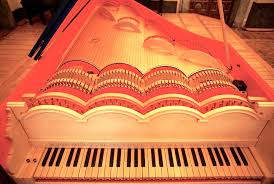
Listen to the instrument da Vinci invented but never got to hear

viola-organista

It’s startling to think of the multitude of objects Leonardo da Vinci conceptualized, and it’s a tad heartbreaking to realize he saw so few of them actualized.

But nearly 500 years after da Vinci sketched his plans for a musical instrument he dubbed the Viola Organista, Polish concert pianist Slawomir Zubrzycki spent more than 5,000 hours making da Vinci’s idea a reality.

In 2013, Zubryzcki debuted the instrument at the Academy of Music in the southern Polish city of Krakow. As reported in the Sydney Morning Herald, Zubryzcki said, “This instrument has the characteristics of three we know: the harpsichord, the organ and the viola da gamba.”

Watch the performance in the YouTube video below; you’ll recognize the pieces. And if you listen to the audio without watching Zubryzcki at the keyboard, you may think you’re hearing a small chamber ensemble rather than one person playing a single instrument.

via Listen to the instrument da Vinci invented but never got to hear | Classical MPR.

July 23 ~ Today in Music History

today


• 1757 ~ Domenico Scarlatti, Italian composer and harpsichordist, died. He composed over 500 keyboard sonatas, using new techniques and achieving brilliant effects.

• 1796 ~ Franz Adolf Berwald, Swedish composer and violinst

• 1916 ~ Ben Weber, American composer and winner of the Thorne Music Award in 1965

• 1925 ~ Gloria DeHaven, Singer

• 1928 ~ Leon Fleisher, American pianist and conductor

https://youtu.be/iBBVmlyHq48

• 1934 ~ Steve Lacy (Lackritz), Jazz musician, soprano sax

• 1941 ~ Sonny Dunham and his orchestra recorded the tune that was to become Mr. Dunham’s theme song. Memories of You was Bluebird record #11239.

• 1940 ~ Gary Stites, Singer

• 1943 ~ Tony Joe White, Country Singer

• 1945 ~ Dino Danelli, Musician, drummer with The (Young) Rascals

• 1946 ~ Andy Mackay, Musician, saxophone, woodwinds with Roxy Music

• 1947 ~ David Essex (Cook), Rock Singer

• 1940 ~ (John Donald) Don Imus, Radio DJ & talk-show host

• 1950 ~ Blair Thornton, Musician, guitar with Bachman-Turner Overdrive

• 1961 ~ Martin Gore, Musician with DePeche Mode

• 1966 ~ Frank Sinatra hit the top of the pop album chart with his Strangers in the Night. It was the first #1 Sinatra LP since 1960. The album’s title song had made it to number one on the pop singles chart on July 2nd.

https://youtu.be/s4fWMgoWrbE

• 1969 ~ Three Dog Night received a gold record for the single, One. It was the first of seven million-sellers for the pop-rock group.

• 1985 ~ Kaye Kyser, Bandleader, passed away
More information about Kyser

• 2000 ~ Yoshimi Takeda, a former director of the New Mexico Symphony Orchestra, died at the age of 67 of complications from cancer. He had been music director and resident conductor of the NMSO from 1974 to 1984, holding the post concurrently with that of the Kalamazoo Symphony Orchestra. Takeda made his debut with the Tokyo Symphony in 1958. He began his U.S. career in 1962 as a Kulas Fellow with the Cleveland Orchestra in a conductor advanced training program. He came to the NMSO in 1970 after six years as the Honolulu Symphony’s associate director.

• 2002 ~ Clark Gesner, who created the musical “You’re a Good Man Charlie Brown,” died of a heart attack while visiting the Princeton Club in Manhattan. He was 64. Gesner’s well-known musical, based on Charles Schulz’s Peanuts comic strip, opened in March 1967 in a New York theater and went on to tour nationally. The 14-song show featured Gary Burghoff as Charlie Brown and Bob Balaban as Linus. It made a monthlong leap to Broadway in the early 1970s, and was revived on Broadway in 1999. Gesner, who was born in Maine, attended Princeton and was active in the Triangle Club, the university’s theater troupe.

Piano Maintenance Tips

piano-old

Piano Maintenance Tips

by Gray Rollins

Did you know that a piano can have up to 12,000 moving parts? It’s true. Not only that, but many of those parts are moving parts. And if you want your piano to stay in good working order, it needs a little bit of maintenance to stay its best.

During the first year of a piano’s life it’s suggested to have it serviced two to four times. Then talk to your piano technician to decide what frequency to continue service at. Usually twice a year after the first year is recommended, but sometimes once a year is enough. Servicing includes having the piano tuned, regulated as needed, voiced as needed, and eventually having worn parts repaired or replaced as needed.

A piano has over 200 strings and when the technician starts tuning a piano, it’s the strings he’s going to work on. The technician wants all the strings to have the correct pitch.

How does a piano go out of tune in the first place? The most common cause is humidity changes. It’s recommended that you don’t get your piano tuned right after the humidity has changed or the tune will only hold a couple months.

When a piano is regulated, that means that mechanical parts of the piano are being worked on. There are no hard and fast rules to how often a piano needs to be regulated as it depends largely on the climate its being kept in.

When it comes to voicing the piano, we’re talking about adjusting the pianos quality of sound or tone. The frequency that voicing needs to be done depends largely on how much you use your piano – 1 to 5 years tends to be the typical range.

You’ll also want to make sure you take good care of the exterior of the piano too. Neglecting the exterior of your piano can, believe it or not, affect the sound quality of your piano. Keeping it clean is a pretty simple job, but one thing to remember is that you don’t want to use furniture polish.

Your piano will also need to be reconditioned occasionally. Some parts will get worn out from use and will need to be replaced.

If your piano has deteriorated severely then reconditioning it won’t be enough. You’ll have to get the piano completely rebuilt which involves completely disassembling the piano. As you might imagine it’s very labor intensive and quite expensive, but in some cases it’s the only way to restore the original performance level of your piano.

Keep in mind that a piano is an investment, and that a well maintained piano can actually increase in value over its life.

About the Author:

Gray Rollins is a featured writer for PianosCentral – a site that helps people learn how to play the piano. Learn more about Rocket Piano review and the Pure Pitch Method at his site.

From http://www.3×24.com/piano-maintenance-tips/801659

July 22 ~ Today in Music History

today

• 1597 ~ Virgilio Mazzocchi, Composer

• 1635 ~ Pietro Antonio Tamburini, Composer, died at the age of 45

• 1642 ~ Johann Quirsfeld, Composer

• 1651 ~ Ferdinand Tobias Richter, Composer

• 1721 ~ François-Joseph Krafft, Composer

• 1786 ~ Vaclav Kalous, Composer ~ died at the age of 71

• 1794 ~ Jean-Benjamin de La Borde, Composer ~ died at the age of 59

• 1830 ~ Herbert Stanley Oakeley, Composer

• 1833 ~ Benjamin Hanby, Composer

• 1848 ~ Lucien Fugère, French baritone

• 1871 ~ Akos Buttykai, Composer

• 1873 ~ Ettore Pozzoli, Composer

• 1878 ~ Ernest R. Ball, Composer

• 1879 ~ Gustaf Heintze, Composer

• 1889 ~ Frederick Preston Search, Composer

• 1893 ~ Katherine Lee Bates wrote America the Beautiful in Colorado

• 1913 ~ Licia Albanese, Italian-born American soprano. She is best remembered for her roles at New York’s Metropolitan Opera and for her recording of La Boheme conducted by Arturo Toscanini.

• 1919 ~ De Falla and Massine’s “Three-cornered Hat”, premiered in London

• 1924 ~ Margaret Whiting, Pop Singer

• 1932 ~ Florenz Ziegfeld, U.S. theatrical producer and impresario, died. He was famed for his “Follies” spectacular revues which ran every year from 1907 to 1931.

• 1933 ~ Caterina Jarboro became the first black prima donna of an opera company. The singer performed Verdi’s “Aida” with the Chicago Opera Company at the Hippodrome in New York City.

• 1937 ~ Chuck Jackson, Singer

• 1937 ~ Hal Kemp and his orchestra recorded the now-standard tune, Got a Date with an Angel, for Victor Records in Hollywood, California. The distinctive vocal on the tune is provided by Skinnay Ennis.

• 1940 ~ George Clinton, Singer

• 1941 ~ Thomas Wayne (Perkins), Singer

• 1944 ~ Estelle Bennett, Singer with The Ronettes

• 1944 ~ Richard Davies, Keyboards, singer with Supertramp

• 1945 ~ Bobby Sherman, Singer, actor and founder of TAC-5, a paramedics group

• 1947 ~ Don Henley, Drummer, singer with Shiloh; The Eagles, songwriter

• 1959 ~ Benjamin Britten’s “Missa Brevis” in D premiered

• 1963 ~ The Beatles released “Introducing the Beatles”

• 1967 ~ The Billboard singles chart showed that Windy, by The Association, was the most popular record in the U.S. for the fourth straight week. The Los Angeles~based sextet would make way for Jim Morrison and The Doors a week later when Light My Fire became the hottest record of the mid~summer.

• 1977 ~ Tony Orlando announced his retirement from show business. Orlando was performing in Cohasset, MA when he said that he had finally decided to call it quits. Orlando had two solo hits in 1961 (Halfway to Paradise and Bless You) and 14 hits with his backup singers,Telma Hopkins and Joyce Vincent, (known as Dawn) through the mid~1970s. He also hosted a weekly TV variety show with Dawn from 1974~1976.

• 1985 ~ Bruce Springsteen became the hottest ticket in the rock concert biz as 70,000 Cleveland fans lined up (in less than three hours) to grab tickets to see the ‘Boss’.

• 2001 ~ Bob Ferguson, who wrote the standard Wings of a Dove and produced records for Dolly Parton, Porter Wagoner and other country music stars, died at the age of 73. Ferguson, a native of Willow Springs, Mo., was hired in 1955 to produce films for the Tennessee Game & Fish Commission. He worked there until 1960, when he wrote and produced the No. 1 hit Wings of a Dove for Ferlin Husky. As a staff producer at RCA Records in the 1960s and early ’70s, Ferguson worked with artists like Parton, Connie Smith, Danny Davis and the Nashville Brass, Jim Ed Brown, George Hamilton IV and Archie Campbell. He wrote The Carroll County Accident, a No. 2 hit for Wagoner. It was named the best country song of 1969 by the Country Music Association.

• 2002 ~ Jazz singer Marion Montgomery, who frequently performed on British television and was known for her smooth, versatile voice, died. She was 67. Montgomery, was born in Natchez, Miss., and lived in England for more than 30 years. She was well-known to television audiences as a resident singer on the British Broadcasting Corp. talk show “Parkinson” through the 1970s and was widely praised for her smooth voice and intimate, relaxed singing style. Montgomery worked as a cabaret singer in Las Vegas, New York and Los Angeles before moving to Britain. She starred in the West End production of “Anything Goes” in 1969 and recorded a one-woman show for the BBC in 1975. Her albums included “Swings for Winners and Losers” (1963), “Let There Be Marion Montgomery,” (1963) and “Sometimes in the Night” (1989).