Ornette Coleman, one of jazz’s most influential and innovative musicians and composers, died Thursday, June 11, 2015 at 85.
Coleman, whose primary instrument was the alto saxophone, was a pioneer of the avant-garde movement of the ’50s and ’60s, helping to steer jazz away from bebop and taking both melodic and rhythmic interpretation in new directions.
The “free jazz” that Coleman spearheaded — a new approach to melody and harmony, essentially coined as a term by 1961’s Free Jazz: A Collective Improvisation, one of his landmark albums – was but one of the contributions that made his work both controversial and fundamental to the progress of his form.
“The whole notion of postmodern jazz is essentially his creation,” says veteran jazz critic and author Will Friedwald of Coleman. “But he is very different from other jazz innovators in one key aspect: Musicians influenced by Charlie Parker tend to play like Charlie Parker, but most of the musicians who were inspired by Coleman sound nothing like him.”
Coleman’s music continued to evolve through the decades, incorporating elements of funk and rock in the ’70s and ’80s when he worked intermittently with the group Prime Time. Coleman also teamed with artists from outside his genre, including Jerry Garcia and Lou Reed. In 2007, Coleman was awarded a Pulitzer Prize for his album Sound Grammar.
For Friedwald, Coleman was “easily the most important figure in jazz” since Parker. “Virtually everyone in the music, from Miles Davis to John Coltrane to Cecil Taylor to Wynton Marsalis to Keith Jarrett, owes a huge debt to him.”
Harriette Thompson, who is a classically trained musician, completed the Rock ’n’ Roll Marathon in San Diego in 7hr 24min 36sec.
She has performed at New York’s iconic Carnegie Hall three times and says she plays through old pieces in her head as she runs.
Thompson, who is a cancer survivor, started running marathons when she was in her 70s. “At that time I had lost several people in my family to cancer and I said, ‘Oh maybe I should do that.’ When I got out there the first year I just planned to walk it, but everybody else was running so I started to run with them.”
• 1864 ~ Richard Strauss, German composer and conductor. Strauss wrote in nearly every genre, but is best known for his tone poems and operas.
Read quotes by and about Strauss
More information about Richard Strauss
• 1874 ~ Richard Stohr, Composer
• 1896 ~ Friedrich Gottlieb Schwencke, Composer, died at the age of 72
• 1899 ~ George Frederick McKay, Composer
• 1900 ~ Charles Swinnerton Heap, Composer, died at the age of 53
• 1904 ~ Emil Frantisek Burian, Composer
• 1904 ~ Clarence “Pinetop” Smith, Jazz pianist and singer of Boogie Woogie Piano
• 1924 ~ Théodore Dubois, French organist and composer, died at the age of 86
• 1926 ~ Carlisle Floyd, American opera composer
• 1927 ~ Josef Anton Reidl, Composer
• 1928 ~ King Oliver and his band recorded Tin Roof Blues for Vocalion Records.
• 1939 ~ Wilma Burgess, Country singer
• 1940 ~ Joey Dee (Joseph DiNicola), Singer with Joey Dee and The Starliters
• 1940 ~ The Ink Spots recorded Maybe on Decca Records. By September, 1940, the song had climbed to the number two position on the nation’s pop music charts.
• 1946 ~ John Lawton, Singer
• 1949 ~ Hank Williams sang a show-stopper on the stage of the Grand Ole Opry at the Ryman Auditorium in Nashville. He sang the classic LovesickBlues, one of his most beloved songs. 1951 ~ Bonnie Pointer, Grammy Award-winning singer (with sister Anita) in the Pointer Sisters
• 1955 ~ Marcel Louis Auguste Samuel-Rousseau, Composer, died at the age of 72
• 1961 ~ Roy Orbison was wrapping up a week at number one on the Billboard record chart with Running Scared, his first number one hit. Orbison recorded 23 hits for the pop charts, but only one other song made it to number one: Oh Pretty Woman in 1964. He came close with a number two effort, Crying, number four with Dream Baby and number five with Mean Woman Blues. Orbison was inducted into the Rock and Roll Hall of Fame in 1987; but suffered a fatal heart attack just one year later.
• 1964 ~ The group, Manfred Mann, recorded Do Wah Diddy Diddy
• 1966 ~ Janis Joplin made her first onstage appearance — at the Avalon ballroom in San Francisco. She began her professional career at the age of 23 with Big Brother and The Holding Company. The group was a sensation at the Monterey Pop Festival in 1967. Piece of My Heart was the only hit to chart for the group in 1968. Big Brother and The Holding Company disbanded in 1972, though Joplin continued in a solo career with hits such as Down on Me and Me and Bobby McGee. Janis ‘Pearl’ Joplin died of a heroin overdose in Hollywood in October, 1970. The movie The Rose, starring Bette Midler, was inspired by the life of the rock star.
• 1966 ~ (I’m A) Road Runner by Jr Walker & The All-Stars peaked at #20
• 1990 ~ Clyde McCoy, Jazz trumpeter, died at the age of 86
• 1995 ~ Lovelace Watkins, Singer, died at the age of 58
• 2001 ~ Amalia Mendoza, one of Mexico’s most famous singers of mariachi and ranchera music, died at the age of 78. She was famous for songs such as Echame a mi la Culpa (Put the Blame onMe) and Amarga Navidad (Bitter Christmas). Born in the Michoacan town of San Juan Huetamo in 1923, she was part of a family of noted musicians. Ranchera music is a kind of Mexican country music that overlaps with Mariachi music.
• 2001 ~ Ponn Yinn, a flutist of traditional Cambodian music and dance who survived the Khmer Rouge purge and helped preserve his country’s culture, died of a stroke at the age of 82. Yinn was working under Prince Norodom Sihanouk, then Gen. Lon Nol, for the Classical Symphony of the Army for the Royal Ballet, when the Khmer Rouge overthrew Cambodia’s government in 1975. Khmer Rouge forces found Yinn during their campaign to uncover and eliminate Cambodia’s intellectuals and artists. He begged for his life and claimed to be a steel worker who enjoyed playing the flute. He was allowed to live, but was forced to play a makeshift flute nightly into loudspeakers to drown out the screams of people being slaughtered in fields nearby. In 1979, Yinn crossed through minefields and escaped to Thailand. In a border refugee camp, Yinn headed the Khmer Classical Dance Troupe. At a time when Cambodian culture was believed to have been almost eradicated – a result of the Khmer Rouge’s genocide of 1 million to 2 million people, the troupe was discovered by Western visitors. Yinn settled in Long Beach in 1984, where he taught music for more than 20 years and continued to perform.
• 2015 ~ Ornette Coleman died. He was an American jazz saxophonist, violinist, trumpeter and composer. He was one of the major innovators of the free jazz movement of the 1960s.
Antonei Sergejvitch Tartarov was a fictional Russian pianist whose real name was Jean-Jacques Hauser.
He had an exceptional gift for improvisation.
On April 16, 1968 Hauser fooled an audience of 2,000 people in Zurich into thinking not only that he was a little-known Russian virtuoso (Tartarov), but that much of the improvised material in his program was composed by Beethoven, Mozart, Prokofiev, and Liszt.
Imagine when it was announced that the music the audience had just applauded as works of genius had actually been improvised on the spot by a home-grown Swiss pianist.
• 1964 ~ Rolling Stones recorded their 12×5 album at Chess Studios Chicago
• 1966 ~ The BeatlesPaperback Writer was released in England
• 1966 ~ The Beatles recorded Rain, first to use reverse tapes
• 1966 ~ Janis Joplin’s first live concert in the Avalon Ballroom, San Francisco
• 1966 ~ The Mamas and The Papas won a gold record for Monday, Monday
• 1968 ~ Yury Sergeyevich Milyutin, Composer, died at the age of 65
• 1972 ~ Elvis Presley recorded a live album at NY’s Madison Square Garden
• 1972 ~ Sammy Davis, Jr. earned his place at the top of the popular music charts for the first time, after years in the entertainment business. His number one song, The Candy Man, stayed at the top for three consecutive weeks. The Candy Man was truly a song of fate for Sammy. He openly did not want to record the song, but did so as a favor to MGM Records head Mike Curb, since it was to be used in the film, Willy Wonka and the Chocolate Factory. Davis said he would give the tune one take, “and that’s it!” Sure enough, in that one-time recording, Sammy nailed it. The Candy Man stayed on the pop charts for 16 weeks. The best the legendary performer had done before was 12 weeks for Love Me or Leave Me in 1955 and 11 weeks for I’ve Gotta Be Me (from Golden Rainbow) in 1969. After TheCandy Man became a hit, Davis included it in his stage shows and concerts — and collected huge royalties from it.
• 1976 ~ Paul McCartney and Wings set a record for an indoor concert crowd as 67,100 fans gathered in Seattle, WA to hear the former Beatle and his new group.
• 1982 ~ Addie “Micki” Harris, American singer with the Shirelles, died at the age of 42
• 1985 ~ Nineteenth Music City News Country Awards: Statler Brothers, BarbaraMandrell
• 1990 ~ “Meet Me St Louis” closed at Gershwin Theater NYC after 253 performances
• 1992 ~ Hachidal Nakamura, Composer, died at the age of 61 of heart failure
• 1996 ~ Thirtyth Music City News Country Awards: Alan Jackson
• 2001 ~ Pianist Yaltah Menuhin, last of three famous siblings whose musical talents brought them fame at an early age, died at the age of 79. Yaltah, the youngest, and her sister Hepzibah, also a pianist, did not achieve the international renown of their brother, the violinist Yehudi Menuhin. But they often appeared with him in concerts around the world, including the Bath Festival in Britain, where Yehudi was artistic director in the 1960s. Yaltah Menuhin was born in San Francisco, to Russian-Jewish parents. Like her siblings, she began studying music as a child, and moved about the world performing. Her brother was astonishing audiences with his virtuosity by the age of 7. Yaltah Menuhin and her husband, pianist Joel Ryce, often performed together as a duo in the United States, and she also performed with violist Michael Mann.
• 2001 ~ Harold S. Grossbardt, a founder of Colony Records, the famed record collector’s store in Manhattan, died at the age of 85. Grossbardt founded the store in 1948 with his partner, Sidney Turk, and the shop quickly became popular with music lovers. Hundreds of musicians, including Frank Sinatra, John Lennon and Michael Jackson, shopped at the store. Grossbardt worked at Colony Records until his retirement in 1988.
• 1361 ~ Philippe de Vitry, French Composer and poet, died at the age of at 69
• 1656 ~ Thomas Tomkins, Composer, died
• 1717 ~ Louis Le Quointe, Composer, died at the age of 64
• 1810 ~ (Carl) Otto (Ehrenfried) Nicolai, Composer
More information about Nicolai
• 1828 ~ Carlo Marsili, Composer
• 1829 ~ Gaetano Braga, Composer
• 1832 ~ Manuel Garcia, Composer, died at the age of 57
• 1849 ~ Joseph Vezina, Composer
• 1849 ~ The term recital used for the first time to describe a solo performance by an instrumental player. The first recitalist was Franz Liszt
• 1865 ~ Carl Nielsen, Danish composer and conductor
More information about Nielsen
• 1865 ~ Alberic Magnard, Composer
• 1870 ~ Erik Drake, Composer, died at the age of 82
• 1879 ~ Oscar Back, Austrian-Dutch viola player
• 1886 ~ Kusaku Yamada, Composer
• 1888 ~ Hugo Kauder, Composer
• 1890 ~ The opera “Robin Hood” premiered in Chicago
• 1891 ~ Cole Porter, American composer and and lyricist for the musical theater. His many famous musicals include “Anything Goes”, “Kiss Me Kate” and “Can Can”.
More information about Porter
• 1892 ~ Friedrich Wilhelm Langhans, Composer, died at the age of 59
• 1900 ~ Fred Waring, Musician, conductor and inventor of the Waring Blender
• 1991 ~ Max van Praag, Dutch singer, died at the age of 77
• 1992 ~ Clarence Miller, Blues/jazz vocalist, died at the age of 69 of a heart attack
• 1993 ~ Arthur Alexander, Singer/songwriter, died at the age of 53
• 1995 ~ Frank Chacksfield, Conductor/arranger, died at the age of 81
• 2000 ~ Jazz bassist Burgher “Buddy” Jones, who played in big bands behind Peggy Lee and Frank Sinatra and toured with Harry James and Tommy Dorsey, died at the age of 76. A native of Hope, Ark., Jones was a childhood friend of the late Virginia Kelley, mother of President Clinton. At 17, Jones went to the University of Kansas City, where he met and befriended saxophonist Charlie Parker. Jones later introduced Parker to his wife, Chan. Jones played in the Elliot Lawrence band, when its arrangers included Al Cohn, Tiny Kahn and Johnny Mandel. As a staff musician for CBS in New York in the 1950s and 1960s, Jones played for the Jack Sterling radio show and in bands behind Lee and Sinatra. In 1996, Jones was inducted into the Arkansas Jazz Hall of Fame.
• 1612 ~ Hans Leo Hassler, Composer, died at the age of 49
• 1722 ~ Jakob Friedrich Kleinknecht, Composer
• 1740 ~ Gabriele Mario Piozzi, Composer
• 1742 ~ Omobono Stradivari, Italian viol maker, son of Antonio, died at the age of 62
• 1753 ~ Nicolas-Marie Dalayrac, Composer
• 1783 ~ Joseph Lincke, Composer
• 1796 ~ Felice de Giardini, Composer, died at the age of 80
• 1805 ~ Luigi Ricci, Composer
• 1810 ~ Robert Schumann, German composer best known for his song cycles and piano music.
Read quotes by and about Schumann
More information about Schumann
• 1812 ~ Spyridon Xyndas, Composer
• 1814 ~ Friedrich Heinrich Himmel, Composer, died at the age of 48
• 1834 ~ George Garrett, Composer
• 1837 ~ Jan Kleczynski, Composer
• 1856 ~ Natalia Janotha, Composer
• 1858 ~ Antonio Nicolau, Spanish Composer and conductor
• 1876 ~ George Sand (Armandine-Aurore-Lucile Dupin), French author and romantic companion of the composer of Chopin, died at the age of 71
• 1881 ~ Prospero Bisquertt, Composer
• 1884 ~ Henry Clay Work, Composer, died at the age of 51
• 1888 ~ Poul Julius Ouscher Schierbeck, Composer
• 1906 ~ Christian Frederik Emil Horneman, Composer, died at the age of 65
• 1908 ~ Johan Lindegren, Composer, died at the age of 66
• 1913 ~ Janos Jagamas, Composer
• 1919 ~ Jacob Fabricius, Composer, died at the age of 78
• 1923 ~ Karel Goeyvaerts, Flemish Composer of Summer Games
• 1926 ~ Anatol Vieru, Composer
• 1927 ~ Paul Whiteman and his orchestra recorded When Day is Done on Victor Records.
• 1928 ~ Jiri Dvoracek, Composer
• 1930 ~ Yannis Ioannidis, Composer
• 1932 ~ Hans Gunter Helms, Composer
• 1936 ~ James Darren (Ercolani), Singer
• 1940 ~ Frederick Shepherd Converse, American Composer, died at the age of 69
• 1940 ~ Sherman Garnes, Rock vocalist with Frankie Lymon and The Teenagers
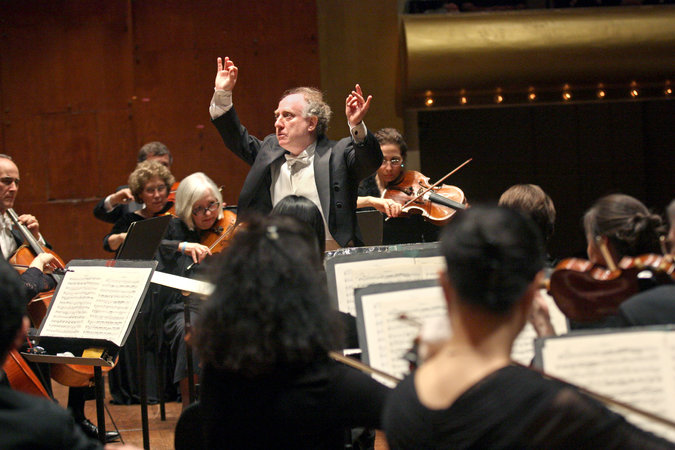
As the festival continues to evolve in directions that have less and less to do with its namesake, the Philharmonic, perhaps sensing an opportunity, offers a Mozart program of its own this week: the “Prague” Symphony and the Piano Concertos No. 20, in D minor, and No. 21, in C, with Jeffrey Kahane as guest conductor and soloist.
The “Prague” must be every opera lover’s favorite Mozart symphony. Composed in Vienna in 1786 and evidently given its premiere in Prague early the next year, it is a virtual caldron of tunes more or less shared with “Le Nozze di Figaro” (1786) and “Don Giovanni” (1787).
More than that, the symphony, played before intermission, evokes the moods and characters of those operas, especially “Don Giovanni.” Mr. Kahane treated all of that a bit matter-of-factly at Wednesday evening’s performance, with little lingering to search out lascivious byplay in dark recesses or to limn a bumbling Leporello.
So it came as a delightful surprise, after intermission, when Mr. Kahane injected the condemnatory sequence of rising and falling scales from “Don Giovanni” into his own cadenza for the first movement of the D minor Concerto. His playing was deft and virtuosic in both concertos, though his fast tempos in the outer movements of the C major resulted in some blurred scalar passages and a slightly hectic feel at times.
You might have feared a certain weightiness from the Philharmonic in Mozart, but Mr. Kahane generally drew stylish playing from a reduced band of 40 or so. The strings had a pliant quality, and the woodwinds were especially fine.
• 1926 ~ Dick Williams, Choral director of the Andy Williams Show
• 1926 ~ Henry Charles Tonking, Composer, died at the age of 63
• 1928 ~ Charles Strouse, American of popular music
• 1931 ~ Henry Weinberg, Composer
• 1932 ~ Emil Pauer, Composer, died at the age of 76
• 1934 ~ Phillip Entremont, Pianist
• 1934 ~ Samuel Lipman, Music critic
• 1934 ~ Wynn Stewart, Singer
• 1939 ~ Larry Clinton and his orchestra recorded In a Persian Market (by Ketelbey) on Victor Records.
• 1940 ~ Tom Jones, Grammy Award-winning singer
• 1941 ~ Jaime Laredo, Bolivian-born American violinist Clarence White (1944) Guitarist with the Byrds
• 1945 ~ Ruben Marcos Campos, Composer, died at the age of 69
• 1945 ~ The opera “Peter Grimes” by Benjamin Britten, premiered in London, at Sadler’s Wells Theater.
• 1948 ~ Georges Adolphe Hue, Composer, died at the age of 90
• 1949 ~ Due to an impending lawsuit that stemmed from Milton Berle’s TV show, comedienne Cathy Mastice held the first musical press conference. She sang her way into announcing the court action. Due to the publicity she received, Ms. Mastice became an overnight success.
• 1953 ~ Kukla, Fran (Allison) and Ollie, along with the Boston Pops Orchestra under the direction of Arthur Fiedler, were featured on the first network telecast in ‘compatible color’. The program was broadcast from Boston, MA.
• 1958 ~ Prince (Prince Rogers Nelson), Singer
• 1963 ~ First Rolling Stones TV appearance (Thank Your Lucky Stars)
• 1965 ~ Pierre Cardevielle, French Composer/conductor, died at the age of 59
• 1993 ~ Prince celebrated his birthday by changing his name to a symbol and calling himself The Artist Previously Known as Prince. He went back to “Prince” in 2000
• 1955 ~ Bill Haley and Comets, Rock Around the Clock hit #1
• 1958 ~ Lily Theresa Strickland, Composer, died at the age of 71
• 1962 ~ The Beatles met their producer George Martin for first time. After listening to a playback of the audition tapes, Martin said, “They’re pretty awful.” He changed his mind after meeting the group, however.
• 1966 ~ Claudette Orbison, wife of singer Roy, died in a motorcyle crash
• 1971 ~ Arnold Elston, Composer, died at the age of 63
• 1971 ~ John Lennon and Yoko Ono unannounced appearance at Fillmore East in NYC
• 1971 ~ For the last time, we saw Polish dancing bears, a little mouse named Topo Gigio, remembered The Beatles, The Dave Clark Five, the comedy of Jackie Mason, John Byner, Rich Little, Richard Pryor and so many more, as The Ed Sullivan Show left CBS-TV. Gladys Knight and The Pips and singer Jerry Vale appeared on the final show. The Ed Sullivan Show had been a showcase for more than 20 years for artists who ranged from Ethel Merman to Ella Fitzgerald, from Steve (Lawrence) andEydie (Gorme) to The Beatles. The Ed Sullivan Show was the longest running variety show on TV ~ a “rillly big sheeeew.”
• 1991 ~ Stan Getz, Jazz saxophonist (Girl from Impanima), died at the age of 64
• 1994 ~ Willie Humphrey, Jazz clarinetist, died at the age of 93
• 1995 ~ Imam Elissa, Singer, died at the age of 76


 MaryO'Studio