. 1710 ~ William Boyce, English organist/composer (Cathedral Music), born in London (d. 1779)
. 1818 ~ Henry Charles Litolff, piano virtuoso, composer of Romantic music and music publisher
. 1871 ~ Wilhelm Stenhammar [Carl Wilhelm Eugen Stenhammar], Swedish composer considered the finest Swedish pianist of his time, born in Stockholm, Sweden (d. 1927)
. 1883 ~ Herbert “Eubie” Blake, American jazz pianist, vaudevillian, songwriter and composer
More information about Blake
. 1920 ~ Oscar Brand, Folk singer, composer, music director of NBC-TV Sunday, host of Let’s Sing Out
. 1921 ~ Wilma Lee Cooper (Leary), Country singer with husband, Stoney and the group, Clinch Mountain Clan with her daughter, Carol Lee
. 1931 ~ The American opera, “Peter Ibbetson”, by Deems Taylor premiered at the Metropolitan Opera House in New York City.
. 1941 ~ The Tommy Dorsey Orchestra and Frank Sinatra teamed to record Everything Happens to Me for Victor Records in New York City.
. 1948 ~ Jimmy Greenspoon, Organist with Three Dog Night
. 1949 ~ Alan Lancaster, Bass with Status Quo
. 1959 ~ Brian Travers, Saxophone with UB40
. 1962 ~ (Troyal) Garth Brooks, American Grammy Award-winning singer: In Another’s Eyes (1998 with Trisha Yearwood), Friends in Low Places and The Thunder Rolls. His LP Ropin’ the Wind was the first LP in history to debut at #1 on Billboard’s pop and country charts, The Chase, In Pieces, Fresh Horses, Sevens, Double Live has sold over 80 million albums — second only to The Beatles.
. 1962 ~ David Bryan, Keyboards with Bon Jovi
. 1964 ~ 3,000+ fans crowded the JFK airport in New York to receive the four stars of the music sensation, The Beatles. One word summarizes the reaction to The Beatles on their first US tour: hysteria.
. 1969 ~ Tom Jones, ‘The Prince of Wales’, premiered on ABC-TV after the network acquired the rights to the singing sensation’s popular United Kingdom show. The network paid a British production company an estimated $20 million for those rights. And they cried in one of Tom’s hankies all the way to the bank.
. 1974 ~ Barry White’s Love Unlimited Orchestra received a gold record for the disco hit Love’s Theme.
. 1985 ~ New York, New York became the official anthem of the Big Apple. The announcement was made by then New York mayor, Ed “How’m I Doin’?” Koch. Frank Sinatra fans rejoiced at the honor.
. 2001 ~ Dale Evans died at the age of 88. She was an actress-singer who became “Queen of the West” by starring with husband Roy Rogers in 27 cowboy films and writing their theme song, Happy Trails.
. 2002 ~ Bert Conway, an actor and director whose 60-year career included theater, movies and television, died of heart failure. He was 87. The son of vaudeville performers, Conway was born in Orange, N.J. He had a walk-on part in the original 1937 Group Theater staging of Clifford Odets’ “Golden Boy” and later had the lead as a reform school youth in Lee Strasberg’s production of “Dance Night.” After serving in the Army in World War II, Conway went to Hollywood. He began directing plays in 1947. His work included the first interracial production of “Golden Boy” for the Negro Art Theater in Los Angeles. In 1950, he returned to New York to act in and direct plays. His work included an off-Broadway revival of “Deep Are the Roots” and appearances with Joseph Papp’s New York Shakespeare Festival. He also appeared in several road company productions, had small roles in the movies “The Three Musketeers,” “Little Big Man” and “The Arrangement,” and on TV’s “St. Elsewhere.”
. 2009 ~ Blossom Dearie, American jazz singer and pianist, died of natural causes at the age of 84
. 1736 ~ Johann Georg Albrechtsberger, Austrian musician
. 1809 ~ (Jacob Ludwig) Felix Bartholdy Mendelssohn, German composer
More information about Mendelssohn
. 1900 ~ Mabel Mercer, British-born American cabaret singer
. 1904 ~ Luigi Dallapiccola, Italian composer
More information about Dallapiccola
. 1911 ~ Jehan Alain, French organist and composer
. 1928 ~ Frankie Vaughn (Abelson), Singer
. 1929 ~ Russell Arms, Singer
. 1940 ~ Angelo D’Aleo, Singer with Dion and The Belmonts
. 1941 ~ Jimmy Dorsey and his orchestra recorded the classic, Amapola, on Decca Records. Helen O’Connell and Bob Eberly joined in a vocal duet on this very famous and popular song of the Big Band era.
. 1943 ~ Eric Haydock, Bass with The Hollies
. 1943 ~ Dennis Edwards, singer with the Temptations since 1968. He sang on a string of the group’s hits including “I Can’t Get Next to You,” “Ball of Confusion” and “Papa Was a Rollin’ Stone” in an initial tenure that stretched to 1977.
. 1947 ~ Melanie (Safka), Singer
. 1947 ~ Dave Davies, Singer, guitarist with The Kinks
. 1950 ~ Ed, Gene, Joe and Vic, The Ames Brothers, reached the #1 spot on the pop music charts for the first time, as Rag Mop became the most favorite song in the U.S. The brothers enjoyed many successes with their recording efforts.
.
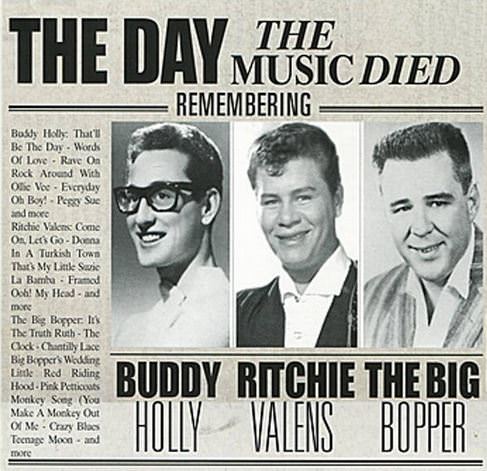
1959 ~ 22-year-old Buddy Holly, 28-year-old J.P. Richardson (The Big Bopper) and 17-year-old Ritchie Valens died in an airplane crash near Mason City, Iowa. February 3rd has been remembered as ‘The Day the Music Died’ since Don McLean made the line popular in his 1972 hit, “American Pie”. Buddy Holly, born Charles Hardin Holly in Lubbock, Texas, recorded That’ll Be the Day, Peggy Sue, Oh, Boy, Maybe Baby, and others, including It Doesn’tMatter Anymore (recorded just before his death, a smash in the U.K., non-top-10 in the U.S.). Buddy was inducted into the Rock and Roll Hall of Fame in 1986. A convincing portrait of the singer was portrayed by Gary Busey in The Buddy Holly Story, a made for TV movie. J.P. (Jiles Perry) Richardson was from Sabine Pass, TX. He held the record for longest, continuous broadcasting as a DJ at KTRM Radio in Beaumont, TX in 1956. He was on the air for 122 hours and eight minutes. In addition to his smash hit, Chantilly Lace, Richardson also penned Running Bear (a hit for Johnny Preston) plus White Lightning (a hit for country star, George Jones). Richard Valenzuela lived in Pacoima, CA (near LA) and had a role in the 1959 film, Go Johnny Go. Ritchie Valens’ two big hits were Donna and La Bamba … the last, the title of a 1987 film depiction of his life. La Bamba also represented the first fusion of Latin music and American rock. Of the three young stars who died in that plane crash, the loss of Buddy Holly reverberated the loudest over the years. But, fans of 1950s rock ‘n’ roll will agree, all three have been sorely missed.
. 1959 ~ Lol (Laurence) Tolhurst, Drummer, keyboard with The Cure
. 1964 ~ The British group, The Beatles, received its first gold record award for the single, I Want To Hold Your Hand. The group also won a gold LP award for “Meet The Beatles”. The album had been released in the United States only 14 days earlier.
. 1971 ~ Lynn Anderson received a gold record for the single, Rose Garden. The Grand Forks, ND country singer was raised in Sacramento, CA. In addition to being a singer, she was an accomplished equestrian and California Horse Show Queen in 1966.
. 1974 ~ “Pajama Game” closed at Lunt Fontanne Theater NYC after 65 performances
. 1979 ~ “YMCA“ by Village People peaked at #2 on the pop singles chart. It was fun to dance to!
. 2002 ~ Remo Palmier, a self-trained guitarist who was a fixture in the New York jazz scene in the 1940s, died at the age of 78, and had been suffering from leukemia and lymphoma, his wife said. Over the course of his career, Palmier played with jazz legends Charlie Parker, Billie Holiday and Dizzy Gillespie, among others. Born Remo Palmieri in the Bronx, Palmier achieved his greatest fame performing with broadcaster Arthur Godfrey on CBS, and taught Godfrey how to play the ukulele. After Godfrey retired, Palmier released his own albums, “Windflower and “Remo Palmier”.
. 1912 ~ Erich Leinsdorf, Austrian-born American conductor
. 1937 ~ Glen Gray and his Casa Loma Orchestra recorded A Study in Brown, on Decca Records.
. 1941 ~ John Steel, Singer, drummer with The Animals
. 1944 ~ Florence LaRue (Gordon), Singer with The Fifth Dimension
. 1962 ~ Clint Black, Singer, actor
. 2002 ~ Blues and jazz pianist Abie “Boogaloo” Ames died at the age of 83. Ames was born on Big Egypt Plantation in Cruger, Miss., on May 23, 1918. He began playing piano at the age of 5 and his style earned him the nickname “Boogaloo” in the 1940’s. Ames moved to Detroit as a teenager and started a band, touring Europe with Louis Armstrong in 1936. Ames worked at Motown Studio and befriended other great musicians like Nat King Cole and Erroll Garner. In 1980, Ames moved to Greenville, where he became a regular performer at local clubs and festivals. Cassandra Wilson’s forthcoming Blue Note CD tentatively titled “Belly of the Sun” is set to include Darkness in the Delta, a song written by Ames for the CD. Ames was named the 2001 winner of the Artist’s Achievement Award of the Governor’s Awards for Excellence in the Arts in the state of Mississippi. With his protege and 1990s musical partner Eden Brent, Ames performed at the Kennedy Center for Performing Arts in Washington, D.C., in 2000. Ames’ last public performance was in October 2001 at the E.E. Bass Cultural Center in Greenville with another former student, Mulgrew Miller.
. 2002 ~ David Stetler, a big band swing drummer who played with Benny Goodman and Spike Jones, died of pneumonia. He was 79. A Seattle native, Stetler was discovered in high school by Lunceford. With a style close to that of Gene Krupa and Jo Jones, Stetler toured the country in the 1940s but returned to Seattle after his first son was born. He backed up national acts in local performances, including many during the world’s fair in 1962.
. 2003 ~ Charlie Biddle, a leader of Montreal’s jazz scene in the 1950s and ’60s who played bass with Thelonious Monk and Charlie Parker, died after a battle with cancer. He was 76. Biddle was a native of Philadelphia who moved to Canada in 1948. Over the next five decades, the World War II veteran and former car salesman became synonymous with jazz in Montreal. Biddle opened his own club, Uncle Charlie’s Jazz Joint, in suburban Ste- Therese in 1958. He later performed in such legendary Montreal nightspots as The Black Bottom and the Penthouse, where he worked with the likes of Oscar Peterson, Art Tatum, Charlie Parker and Lionel Hampton. When there were no jobs in Montreal, Biddle played smaller Quebec cities with a group called Three Jacks and a Jill. Until recently, Biddle played four nights a week at Biddle’s Jazz and Ribs, a Montreal landmark for nearly 25 years. Coincidentally, the club closed Tuesday for planned renovations, which included erecting a wall of fame to honor Biddle and others who have played at the club. In 1979, he organized the three-day festival that some say paved the way for the renowned Montreal International Jazz Festival. News Item about Charlie Biddle
. 2003 ~ Jerome Hines, a bass vocalist who performed regularly at the Metropolitan Opera during a career that spanned more than six decades, died. He was 81. Hines spent 41 years performing at the Met, more than any other principal singer in its history. He was known for his timbral richness, as well as the research he conducted into the historical and psychological background of the roles he portrayed. During his career at the Met, he portrayed 45 characters in 39 works, including title roles in Mussorgsky’s “Boris Godunov” and Mozart’s “Don Giovanni,” and Colline in Puccini’s “La Boheme.” He gave a total of 868 performances at the Met, retiring in 1987. He went on to perform with regional opera companies and at benefits. Hines, who became a born-again Christian in the 1950s, composed his own opera, “I Am the Way,” about the life of Jesus. He sang the title role at the Met in 1968 and 93 times around the world.
. 2003 ~ Saxophonist Cornelius Bumpus, a former member of the Doobie Brothers who had performed with Steely Dan since 1993, died en route to a series of performances in California. He was 58. Bumpus began his career at age 10, playing alto saxophone in the school band in Santa Cruz, Calif. In 1966, he spent six months performing with Bobby Freeman, and joined Moby Grape in 1977, writing one tune for the “Live Grape” album. Bumpus also recorded two solo albums and toured with his own band. Since performing with The Doobie Brothers in the early 1980s, Bumpus played with a number of bands, most recently with Steely Dan, which won the “Album of the Year” Grammy for its 2000 “Two Against Nature” release. His relations with his former Doobies bandmates turned contentious in the late 1990s, when they sued him and several other musicians over their use of the Doobies name. A federal judge in 1999 ruled against Bumpus and the other musicians, ordering them not to use the name.
. 1722 ~ Johann Ernst Bach, German composer of the Bach family
. 1791 ~ Ferdinand Herold, French composer
. 1887 ~ Artur Rubinstein, Polish-born American pianist, played solo for the Berlin Symphony at the age of 12.
Read quotes by and about Rubinstein
More information about Rubinstein
. 1904 ~ Enrico Caruso signed his first contract with Victor Records. He had debuted at the Metropolitan Opera just two months before.
. 1927 ~ Ronnie Scott (Schatt), Jazz musician: tenor sax, bandleader, jazz club owner in London
. 1927 ~ Twenty years before the famous record by Art Mooney was recorded, Jean Goldkette and his dancing orchestra recorded, I’m Looking Over a Four-Leaf Clover. Though the name of the bandleader may not be so famous, two of his sidemen on this Victor recording session certainly were: Big band fans know Bix Beiderbecke and Joe Venuti.
. 1940 ~ “Beat the Band” made its debut on NBC radio. The band was that of Ted Weems and his 14-piece orchestra, who were joined by Elmo ‘The Whistling Troubadour’ Tanner, Harry Soskind and Country Washington. One other star of the show was a barber from Pittsburgh, PA (nearby Canonsburg, actually), who would record many hits for RCA Victor from 1943 right through the dawn of the 1970s. His name was Perry Como. Beat the Band was a funky show where listeners’ questions were selected in the hopes of stumping the band. If a listener’s question was chosen, he or she received $10. The questions were posed as riddles: What song title tells you what Cinderella might have said if she awoke one morning and found that her foot had grown too large for her glass slipper? If the band played the correct musical answer, Where Oh Where Has My Little Dog Gone?, the listener lost.
. 1943 ~ Dick Taylor, Bass, guitar with The Pretty Things
. 1944 ~ John Tavener, British avant-garde composer
More information about Tavener
. 1944 ~ Brian Keenan, Drummer with groups Manfred Mann and The Chambers Brothers
. 1956 ~ Elvis Presley made his first appearance on national television. No, he didn’t appear on some teenage dance show; but rather, “The Dorsey Brothers Show”, starring Tommy and Jimmy. Elvis sang Blue Suede Shoes and Heartbreak Hotel. He was backed by the instruments of the Dorsey band.
. 1968 ~ Sarah McLauchlan, Singer
. 1985 ~ 45 of the world’s top recording artists were invited to an all-night recording session at the A&M studios in Los Angeles. As each of the artists walked through the studio door, they were greeted by a hand-lettered sign — put there by Lionel Richie. It simply said, “Check your ego at the door.” The session started at 10 p.m. with producer Quincy Jones conducting. At 8 o’clock the following morning, the project, “USA for Africa”, spearheaded by promoter, Ken Kragen, was recorded and mixed. The resulting song, We Are the World, featuring Michael Jackson, Cyndi Lauper, Kenny Rogers, Dolly Parton, Sting, Harry Belafonte, Diana Ross, Paul Simon and many others became the top song in the U.S. on April 13, 1985.
. 2002 ~ Michael Hammond, who became chairman of the National Endowment for the Arts just a week earlier, died apparently of natural causes. He was 69. A native of Kenosha, Wis., the conductor and composer had been dean of the School of Music at Rice University in Houston when President Bush nominated him to lead the federal agency that decides grants for the arts. After being confirmed by the Senate on Dec. 20, 2001, Hammond had assumed the post-Jan. 22, 2002, and was still in the process of moving to Washington. A student of music and medicine, Hammond’s interests included music from Southeast Asia, the Renaissance and medieval times and the intersection between music and neuroscience. He received a Rhodes scholarship to study philosophy, psychology and physiology at Oxford University. He also studied Indian philosophy and music at Dehli University in India. In 1968, he left his post as director of the Wisconsin Conservatory of Music in Milwaukee to become the founding dean of music at the State University of New York at Purchase. He later served as president of the school, until he left for Rice’s Shepherd School of Music in 1986. All the while, he retained his interest in medicine, teaching neuroanatomy and physiology at Marquette Medical School and at the University of Wisconsin. Hammond also served as the founding rector of the Prague Mozart Academy in the Czech Republic, now the European Mozart Academy was on the board of the Houston Symphony, and was vice chairman of the board of Interlochen Center for the Arts in Michigan.
. 2002 ~ Steve Caldwell, who sang and played saxophone for the Swingin’ Medallions at the time of the band’s 1966 hit Double Shot (of My Baby’s Love), died of pancreatic cancer. He was 55. Caldwell was with the group from 1963 to 1969. After getting his master’s degree in chemistry at the University of South Carolina, he returned to his native Atlanta and ran the Norell temporary staffing agency until starting his own company in 1976. His wife, Lynn Caldwell, said he raised $1 million for charity through World Methodist Evangelism.
. 1885 ~ Jerome Kern, American songwriter and composer of musical comedies He was known as the father of the American musical, composing Show Boat, Ol’ Man River, Smoke Gets in Your Eyes, Lovely to Look At, The Way You Look Tonight and The Last Time I Saw Paris
. 1895 ~ Harry Ruby (Rubinstein), Musician and composer
. 1901 ~ Giuseppe Verdi, Italian composer, died at the age of 77. He was an Italian operatic composer, the leading figure of Italian music in the nineteenth century and made important contributions to the development of opera.
More information about Verdi
. 1905 ~ John Schaum, Pianist, composer and music educator. Schaum began his career as a piano teacher in the late 1920s. In 1933 he founded the Schaum Piano School in Milwaukee. About the same time he began to compose piano music for teaching purposes. He also founded the first company to produce award stickers specifically for music students. Always on the lookout for better materials for his students, Schaum eventually decided to create his own books, beginning in 1941 with Piano Fun for Boys and Girls, which he later revised as the first in a series of nine piano method books that became the Schaum Piano Course, completed in 1945. These books are still widely used today.
. 1918 ~ Skitch Henderson, Conductor of the Tulsa Symphony Orchestra, bandleader, musical director of NBC-TV’s The Tonight Show with Steve Allen and Johnny Carson
. 1948 ~ Mikhail Baryshnikov, Bolshoi ballet dancer, defected to the U.S.
. 1961 ~ Leontyne Price made her debut at the Metropolitan Opera House in New York City. She sang in the role of Leonora in “Il Trovatore”. Price was only the seventh black singer to make a debut at the Met. Marian Anderson was the first (1955).
. 1968 ~ The Bee Gees played their first American concert, as a group. They earned $50,000 to entertain at the Anaheim Convention Center in California. This is identical to what The Beatles were paid to perform at the Hollywood Bowl a few years earlier.
. 1968 ~ Otis Redding’s (Sittin’ On) The Dock of the Bay was released on this day, seven weeks after the singer’s death. It became #1 on March 16, 1968 and remained at the top spot for a month. Redding began his recording career in 1960 with Johnny Jenkins and The Pinetoppers (on Confederate Records). He sang a duet with Carla Thomas and had 11 chart hits. Redding of Dawson, GA was killed in a plane crash at Lake Monona near Madison, WI. Four members of the Bar-Kays were also killed in the crash. The Dock of the Bay, his only number one song, was recorded just three days before his death.
. 1973 ~ Mr and Mrs O got married 🙂
Read more here.
. 1982 ~ “Joseph & the Amazing Dreamcoat” opened at the Royale NYC for 747 performances
. 1984 ~ Michael Jackson’s hair caught on fire during the filming of a Pepsi commercial in Los Angeles. Pyrotechnics did not operate on cue, injuring the singer. Jackson was hospitalized for a few days and fans from around the world sent messages of concern.
. 2000 ~ Friedrich Gulda, Austrian pianist died at the age of 69.
. 2014 ~ Pete Seeger, American folk singer and activist, helped create the modern American folk music movement, died at 94
. 1759 ~ Burns Night commemorates the life of the Scottish bard (poet) Robert Burns, who was born on January 25, 1759. Burns’ best-known work is “Auld Lang Syne”.
. 1858 ~ Felix Mendelssohn’s overture to “A Midsummer Night’s Dream” was first used as a wedding march. The bride was Queen Victoria’s daughter, the groom was the Crown Prince of Prussia.
. 1886 ~ Wilhelm Furtwängler, German conductor and composer
. 1905 ~ Julia Smith, American composer, pianist, and author on musicology
. 1913 ~ Witold Lutoslawski, Polish composer
More information about Lutoslawski
. 1940 ~ Mary Martin recorded My Heart Belongs to Daddy — for Decca Records. The song was her signature song until she starred in “South Pacific” in 1949. Then, Larry Hagman’s mother had a new trademark: “I’m gonna wash that man right out of my hair…”
. 1945 ~ Richard Tucker debuted at the Metropolitan OperaHouse in New York City in the production of “La Gioconda”.
. 1964 ~ The Beatles reached the #1 spot on the music charts, as their hit single, I Want to Hold Your Hand, grabbed the top position in “Cash Box” magazine, as well as on the list of hits on scores of radio stations. It was the first #1 hit for The Beatles. “Billboard” listed the song as #1 on February 1. The group’s second #1 hit song, She Loves You, was also released this day – but not on Capitol Records. It was on Swan Records. Other songs by The Beatles were released on Vee Jay (Please, Please Me), M-G-M (My Bonnie with Tony Sheridan), Tollie (Twist and Shout), Atco (Ain’t She Sweet) and the group’s own label, Apple Records, as well as Capitol.
. 1999 ~ Robert Shaw passed away. Shaw was an American conductor most famous for his work with his namesake Chorale, with the Cleveland Orchestra and Chorus, and the Atlanta Symphony Orchestra and Chorus. Shaw received 14 Grammy awards, four ASCAP awards for service to contemporary music, the first Guggenheim Fellowship ever awarded to a conductor, the Alice M. Ditson Conductor’s Award for Service to American Music; the George Peabody Medal for outstanding contributions to music in America, the Gold Baton Award of the American Symphony Orchestra League for “distinguished service to music and the arts,” the American National Medal of Arts, France’s Officier des Arts et des Lettres, England’s Gramophone Award, and was a 1991 recipient of the Kennedy Center Honors.
. 2004 ~ Ronald Fredianelli, a co-founder of the 1950s pop vocal group the Gaylords, died in Las Vegas. He was 73. Fredianelli, who performed as Ronnie Gaylord teamed with Bonaldo Bonaldi and Don Rea in the early 1950s. Bonaldi performed as Burt Holiday. Their debut song, Tell Me You’re Mine, was a Top 10 hit in 1953. Other hits included From the Vine Came the Grape and The Little Shoemaker. Although the Gaylords formed in Detroit, Fredianelli and Bonaldi became a staple in Nevada showrooms, where they performed for decades as Gaylord and Holiday. Bonaldi and Rea live in Reno. One of Fredianelli’s sons, Anthony, is the guitarist for the rock group Third Eye Blind.
. 2015 ~ Artemios “Demis” Ventouris Roussos (June 15 1946-January 25, 2015) was a Greek singer and performer who had international hit records as a solo performer in the 1970s after having been a member of Aphrodite’s Child, a progressive rock group that also included Vangelis. He has sold over 60 million albums worldwide.
. 2018 ~ John Morris, American film and Broadway composer who commonly worked alongside Mel Gibson and Gene Wilder, died of a respiratory infection at the age of 91.
. 1889 ~ The Columbia Phonograph Company was formed in Washington, DC.
. 1901 ~ Hans Erich Apostel, German-born Austrian composer
. 1904 ~ George Balanchine (Georgi Balanchivadze), Choreographer of Apollo, Orpheus, Firebird, Swan Lake, The Nutcracker. He founded School of American Ballet and New York City Ballet. He was married to Tanaquil Le Clercq.
. 1907 ~ The Richard Strauss opera, “Salome”, was featured with the Dance of the Seven Veils. It was copied by vaudeville performers. Soon, performances of the opera were banned at the Metropolitan Opera House.
. 1916 ~ Henri Dutilleux, French composer
. 1920 ~ William Warfield, singer (Show Boat)
. 1924 ~ James Louis “J.J.” Johnson, Trombonist, composer and bandleader. He was one of first to use the trombone in modern jazz
. 1931 ~ Clyde McCoy and his orchestra recorded Sugar Blues. The tune became McCoy’s theme song, thanks to its popularity on Columbia Records, and later on Decca, selling over a million copies.
. 1935 ~ Sam Cooke, American rhythm-and-blues singer
. 1949 ~ Steve Perry, Drummer with Radio Stars
. 1953 ~ Myung-Whun Chung, Seoul South Korea, pianist/conductor (Chung Trio)
. 2002 ~ Pete Bardens, a keyboardist who played alongside such pop stars as Mick Fleetwood, Ray Davies, Rod Stewart and Van Morrison, died of lung cancer. He was 57. He was known for his progressive and New Age rock style on synthesizer, electric piano and organ. In the 1960s, the London-born Bardens played in the Blues Messengers with Davies, who later went on to form The Kinks; Shotgun Express with Stewart; Them with Morrison; and the group Cheynes with Fleetwood and Peter Green, who went on to form Fleetwood Mac. In 1972, Bardens formed the progressive rock band Camel and stayed with it through the late 1970s. In 1978, he began a successful solo career, releasing several well-received records, including “Speed of Light”, and also played on Morrison’s album “Wavelength” and accompanied him on a world tour. Barden continued to compose, produce and perform music through the 1990s, appearing in Europe with his group Mirage.
. 2004 ~ Milt Bernhart, a big band trombonist known for his solo on Frank Sinatra’s I’ve Got You Under My Skin, died. He was 77. During his three-decade career, Bernhart played in bands led by Benny Goodman, Henry Mancini and others. He was performing in Howard Rumsey’s Lighthouse All-Stars when Marlon Brando arranged for the band to play in the 1954 film The Wild One. Bernhart then became an in-studio musician for Columbia and other film and television studios, and in 1956 added a memorable solo to Sinatra’s I’ve Got You Under My Skin. Born in Valparaiso, Ind., Bernhart was drafted into the Army and was to be sent overseas during World War II before he was transferred to the service’s band. After his music career wound down in 1973, he bought Kelly Travel Service in Los Angeles. He created the Big Band Academy of America in 1986 and planned to retire as the organization’s founding president in March.
. 2004 ~ Ann Miller, a childhood dance prodigy who fast-tapped her way to movie stardom that peaked in 1940s musicals like “On the Town”, “Easter Parade” and“Kiss Me Kate”, died of lung cancer. She was 81. Miller’s film career peaked at MGM in the late 1940s and early ’50s, but she honed her chops into her 60s, earning millions for “Sugar Babies”, a razzmatazz tribute to the era of burlesque featuring Mickey Rooney. Miller’s legs, pretty face and fast tapping (she claimed the record of 500 taps a minute) earned her jobs in vaudeville and nightclubs when she first came to Hollywood. Her early film career included working as a child extra in films and as a chorus girl in a minor musical, “The Devil on Horseback”. An appearance at the popular Bal Tabarin in San Francisco won a contract at RKO studio, where her name was shortened to Ann. Her first film at RKO, “New Faces of 1937”, featured her dancing. She next played an acting hopeful in “Stage Door”, with Katharine Hepburn, Ginger Rogers, Lucille Ball and Eve Arden.
When Cyd Charisse broke a leg before starting “Easter Parade” at MGM with Fred Astaire, Miller replaced her. That led to an MGM contract and her most enduring work. She was teamed with Gene Kelly and Frank Sinatra in “On the Town”, Red Skelton in “Watch the Birdie”, and Bob Fosse in “Kiss Me Kate“. Other MGM films included: “Texas Carnival”, “Lovely to Look At”, “Small Town Girl”, “Deep in My Heart”, “Hit the Deck” and “The Opposite Sex.” The popularity of musicals declined in the 1950s, and her film career ended in 1956. Miller remained active in television and the theater, dancing and belting songs on Broadway in “Hello, Dolly” and “Mame”. In later years, she astounded audiences in New York, Las Vegas and on the road with her dynamic tapping in “Sugar Babies.” The show opened on Broadway in 1979 and toured for years. In 1990, she commented that “Sugar Babies” had made her financially independent. While her career in Hollywood prospered, Miller became a regular figure in the town’s nightlife, and she caught the eye of Louis B. Mayer, all-powerful head of MGM. After dating, she declined to marry him because her mother would not allow it. She later married and divorced steel heir Reese Milner and oilmen William Moss and Arthur Cameron.
. 2004 ~ Dick Rodgers, an insurance salesman known as the “Polka King” when he hosted a regional television show from the 1950s to the 1970s, died. He was 76. Rodgers’ television show was on the air from 1955-78, starting on WMBV in Marinette, which later moved to Green Bay and became WLUK-TV. The program was shown on 17 Midwestern stations at its height. Rodgers’ accomplishments included membership in the International Polka Music Hall of Fame (1976) and in the World Concertina Congress Hall of Fame (1996). He also was named Orchestra Leader of the Year by the Wisconsin Orchestra Leaders Association in 1967.
. 1835 ~ César Cui, Russian composer and music critic
More information about Cui
1841 ~ Alexis-Emmanuel Chabrier, French composer
More information about Chabrier
. 1913 ~ Danny Kaye (David Daniel Kaminski), Comedian, dancer, singer, actor, entertainer
. 1939 ~ Louis Armstrong and his orchestra recorded Jeepers Creepers on Decca Records. Satchmo lent his vocal talents to this classic jump tune.
. 1941 ~ Bobby Goldsboro, Singer
. 1941 ~ David Ruffin (Davis Eli Ruffin), Lead singer with The Temptations
. 1944 ~ ‘Legs’ Larry Smith, Drummer with The Bonzo Dog Doo-Dah Band and Bob Kerr’s Whoopee Band
. 1944 ~ The first jazz concert was held at the Metropolitan Opera House in New York City. The stars of the concert were Louis Armstrong, Benny Goodman, Lionel Hampton, Artie Shaw, Roy Eldridge and Jack Teagarden. What a ticket!
. 1948 ~ Ted Mack came to television as “The Original Amateur Hour” debuted on the DuMont network. The program continued on different networks for a 22-year run on the tube. Teresa Brewer and Pat Boone got their start on this program.
. 1953 ~ Brett Hudson, Singer, comedian with Hudson Brothers
. 1958 ~ Leonard Bernstein began presenting his television series What does music mean? The series ran for 53 programs.
. 1968 ~ Singer Eartha Kitt made headlines, as she got into a now-famous confrontation with Mrs. Lyndon B. Johnson, wife of the President of the United States, at a White House luncheon to discuss urban crime. Ms. Kitt told Lady Bird (the First Lady) that American youth were rebelling against the war in Vietnam, linking the crime rate with the war escalation. She had a lot to say and it definitely was not “C’est Si Bon”.
. 1986 ~ Dionne Warwick’s single for AID’s research, That’s What Friends are For, became her second #1 song on the music charts. Although Dionne had many hits in the 1960s, singing Burt Bacharach tunes like I Say a Little Prayer and Do You Know the Way to San Jose.
. 2017 ~ Roberta Peters, American operatic soprano (NY Met), died at the age of 86
. 1864 ~ Anton Schindler, German violinist and Beethoven’s biographer, died at the age of 68
. 1875 ~ First American performance of Johannes Brahms’“Hungarian Dances”
.
1886 ~ Death of Italian opera composer Amilcare Ponchielli, in Milan. He was 51.
. 1891 ~ French Composer Leo Delibes died at the age of 54
. 1905 ~ Ernesto Halffter, Spanish composer and conductor
. 1908 ~ Ethel Merman (Zimmerman), American singer of popular music, Tony Award-winning actress (musical), Musical Theater Hall of Fame. She is most famous for Call Me Madam in 1951, It’s a Mad, Mad, Mad, Mad World, There’s No Business Like Show Business and Alexander’s Ragtime Band
. 1929 ~ Marilyn Horne, American mezzo-soprano
. 1929 ~ G.T. (Granville) Hogan, Jazz drummer who played with Elmo Hope, Earl Bostic
. 1934 ~ Bob Bogle (Robert Lenard Bogle), Guitarist, bass with The Ventures
. 1938 ~ Béla Bartók and his wife, Ditta performed their first public concert featuring his Sonata for Two Pianos and Percussion
. 1938 ~ Benny Goodman and his band, plus a quartet, brought the sound of jazz to Carnegie Hall in New York City. When asked how long an intermission he wanted, he quipped, “I don’t know. How much does Toscanini get?”
. 1942 ~ Bill Francis, Keyboard, singer with Dr. Hook and the Medicine Show
. 1942 ~ Kay Kyser and the band recorded A Zoot Suit for Columbia Records. The tune is about the problems associated with wearing this garish, exaggerated ‘hep’ fashion.
. 1946 ~ Katia Ricciarelli, Italian soprano
. 1946 ~ Ronnie Milsap, Grammy Award-winning singer in 1976, CMA Male Vocalist of the Year (1974, 1976, 1977), CMA Entertainer of the Year (1977), blind since birth, he learned to play several instruments by age 12
. 1957 ~ Conductor Arturo Toscanini died in New York at the age of 89.
. 1957 ~ The Cavern Club opened for business in Liverpool, England. The rock club was just a hangout for commoners. Then, things changed — big time. It all started in the early 1960s when four kids from the neighborhood popped in to jam. They, of course, turned out to be The Beatles.
. 1962 ~ Paul Webb, Bass with Talk Talk
. 1964 ~ “Hello Dolly!” opened at the St. James Theatre in New York City. Carol Channing starred in the role of Mrs. Dolly Levi. The musical was an adaptation of Thornton Wilder’s play, “The Matchmaker”. The show, with an unforgettable title song, was hailed by critics as the “…possible hit of the season.” It was possible, all right. “Hello Dolly!” played for 2,844 performances. And, it returned to Broadway in the 1990s, again starring Carol Channing.
. 1972 ~ David Seville died on this day in Beverly Hills, CA. Born Ross Bagdasarian, the musician was the force, and artist, behind the Alvin and the Chipmunks novelty songs of the 1950s, ’60s and ’70s.
. 1973 ~ Clara Ward passed away. Ward was an American gospel artist who achieved great artistic and commercial success in the 1940s and 1950s.
. 1976 ~ The album, “Frampton Comes Alive”, was released by Herb Alpert’s A&M Records. The double LP soon reached the top spot of the album charts and stayed perched there for 17 weeks. It sold 19 million copies in its first year.
. 1980 ~ Lin Manuel Miranda, American actor, composer, lyricist (Hamilton)
. 1984 ~ Michael Jackson received eight awards at the 11th annual American Music Awards this night.
. 2001 ~ Eleanor Lawrence, a flutist who played often in chamber music performances and with several orchestras in New York City, died of brain cancer at the age of 64. She is credited with transforming a simple newsletter into an important source for flutists. Lawrence studied the flute at the New England Conservatory with the principal flutist of the Boston Symphony Orchestra, James Pappoutsakis. She later studied with flutists from the Philadelphia Orchestra and the Metropolitan Opera orchestra. She joined the American Symphony Orchestra and the Brooklyn Philharmonic after moving to New York in the 1960s. She played periodically with the New York Philharmonic and the Metropolitan Opera. Besides performing, Lawrence taught at the Manhattan School of Music. She served three times as the president of the New York Flute Club. She edited The National Flute Association Newsletter, now The Flutist Quarterly, from the mid-1970s to the early 1980s, expanding it from a brief information sheet to a publication with regular interviews.
. 1884 ~ Sophie Tucker (Abuza), Russian-born American burlesque and vaudeville singer
. 1904 ~ Richard Addinsell was born
More information about Addinsell
. 1909 ~ Quentin ‘Butter’ Jackson, Trombonist, played with Duke Ellington
. 1910 ~ Enrico Caruso and Emmy Destinn were heard via a telephone transmitter; rigged by DeForest Radio-Telephone Company to broadcast from the Metropolitan Opera House in New York City.
. 1930 ~ Robert ‘Squirrel’ Lester, Singer with The Chi-Lites
. 1938 ~ Singer Allan Jones recorded The Donkey Serenade for Victor Records. The song became the one most often associated with the singer. Allan sang and acted in several Marx Brothers films: “A Night at the Opera”, “A Day at theRaces”, but the film that catapulted him to stardom was the operetta, “Firefly”, with Jeanette MacDonald. Singer Jack Jones is the son of Allan and wife, actress Irene Hervey.
. 1941 ~ The four Modernaires joined to sing with the Glenn Miller Band on a permanent basis beginning this day. They had a ‘solo’ hit in 1946 with To Each His Own.
. 1957 ~ Elvis Presley recorded All Shook Up and That’s When Your Heartaches Begin for Victor Records in Hollywood. The former tune became Elvis’ ninth consecutive gold record.
. 1961 ~ Wayne Marshall, English pianist, organist and conductor
. 1962 ~ Singer Chubby Checker set a record, literally, with the hit, The Twist. The song reached the #1 position for an unprecedented second time – in two years. The Twist was also number one on September 26, 1960.
. 2001 ~ Kenneth Haas, the former general manager of the Boston Symphony Orchestra and the Cleveland Orchestra, died after a long illness at the age of 57. Haas was general manager of the Boston orchestra from 1987 to 1996 and was instrumental in appointing Keith Lockhart conductor of the Boston Pops Orchestra. Haas was general manager of the Cleveland Orchestra from 1976 to 1987 after performing the same job for the Cincinnati Symphony Orchestra in 1975. In Cleveland he established the orchestra’s chamber music and recital series.
. 2001 ~ Michael Cuccione, youngest of the five-member spoof boy band 2gether, died at age 16 from complications from Hodgkin’s disease. The teen played Jason “Q.T.” McKnight on the MTV show “2gether,” which poked fun at the boy band craze. His character had a fictional illness, “biliary thrombosis,” but Cuccione really had suffered from Hodgkin’s disease as a child and underwent five months of chemotherapy. The singer-actor set up a cancer research foundation co-wrote a book with his grandmother and appeared on “Baywatch” as a cancer victim.






 MaryO'Studio