. 1497 ~ Johannes Ockeghem, Flemish singer/composer, died at the age of 79
. 1843 ~ The first minstrel show in America, “The Virginia Minstrels”, opened at the Bowery Amphitheatre in New York City.
. 1903 ~ Claudio Arrau, Chilean pianist
. 1917 ~ Arthur Gold, pianist, born in Toronto, Ontario
. 1929 ~ Rudy Vallee and his orchestra recorded Deep Night. It says in the fine print, under the artist’s name, that the tune was written by Vallee, himself.
. 1943 ~ Fabian (Fabian Forte), Singer
. 1943 ~ Frank Sinatra made his debut as a vocalist on radio’s “Your Hit Parade” this night. Frankie had left the Tommy Dorsey Band just four months prior to beginning the radio program. He was described as, “…the biggest name in the business.”
. 1945 ~ Bob Marley, Jamaican reggae singer and songwriter
. 1947 ~ Alan Jones, Saxophone with Amen Corner
. 1950 ~ Natalie Cole, Grammy Award-winning singer, Best New Artist in 1975 with This Will Be, I’ve Got Love on My Mind. She is the daughter of Nat ‘King’ Cole.
. 1966 ~ Rick Astley, Singer, songwriter
. 1976 ~ Vince Guaraldi, jazz pianist and composer (Peanuts TV specials), died at the age of 43
. 1981 ~ Former Beatle, Paul McCartney, Ringo Starr and George Harrison teamed up once again to record a musical tribute to John Lennon. The result of that session became All Those Years Ago. The song went to #2 on the pop music charts for three weeks. It was recorded on Harrison’s own Dark Horse label.
. 2005 ~ Lazar Berman, Soviet Russian classical pianist. He was hailed for a huge, thunderous technique that made him a thrilling interpreter of Liszt and Rachmaninoff and a late representative of the grand school of Russian Romantic pianism.
. 2007 ~ Frankie Laine, Italian-American singer, songwriter, and actor (Frankie Laine Show, Rawhide), died of heart failure at the age of 93
. 2024 ~ Toby Keith, Country Singer-Songwriter died at the age of 62. He was battling stomach cancer,
. 1736 ~ Johann Georg Albrechtsberger, Austrian musician
. 1809 ~ (Jacob Ludwig) Felix Bartholdy Mendelssohn, German composer
More information about Mendelssohn
. 1900 ~ Mabel Mercer, British-born American cabaret singer
. 1904 ~ Luigi Dallapiccola, Italian composer
More information about Dallapiccola
. 1911 ~ Jehan Alain, French organist and composer
. 1928 ~ Frankie Vaughn (Abelson), Singer
. 1929 ~ Russell Arms, Singer
. 1940 ~ Angelo D’Aleo, Singer with Dion and The Belmonts
. 1941 ~ Jimmy Dorsey and his orchestra recorded the classic, Amapola, on Decca Records. Helen O’Connell and Bob Eberly joined in a vocal duet on this very famous and popular song of the Big Band era.
. 1943 ~ Eric Haydock, Bass with The Hollies
. 1943 ~ Dennis Edwards, singer with the Temptations since 1968. He sang on a string of the group’s hits including “I Can’t Get Next to You,” “Ball of Confusion” and “Papa Was a Rollin’ Stone” in an initial tenure that stretched to 1977.
. 1947 ~ Melanie (Safka), Singer
. 1947 ~ Dave Davies, Singer, guitarist with The Kinks
. 1950 ~ Ed, Gene, Joe and Vic, The Ames Brothers, reached the #1 spot on the pop music charts for the first time, as Rag Mop became the most favorite song in the U.S. The brothers enjoyed many successes with their recording efforts.
.
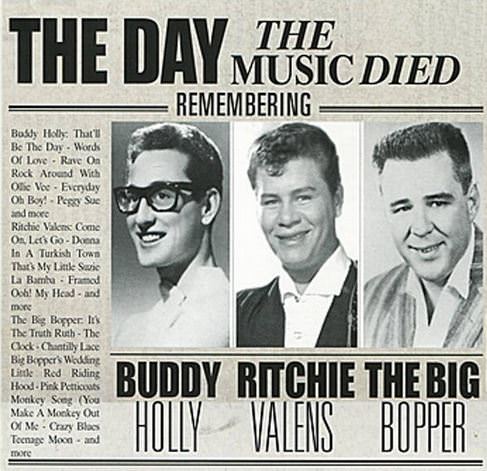
1959 ~ 22-year-old Buddy Holly, 28-year-old J.P. Richardson (The Big Bopper) and 17-year-old Ritchie Valens died in an airplane crash near Mason City, Iowa. February 3rd has been remembered as ‘The Day the Music Died’ since Don McLean made the line popular in his 1972 hit, “American Pie”. Buddy Holly, born Charles Hardin Holly in Lubbock, Texas, recorded That’ll Be the Day, Peggy Sue, Oh, Boy, Maybe Baby, and others, including It Doesn’tMatter Anymore (recorded just before his death, a smash in the U.K., non-top-10 in the U.S.). Buddy was inducted into the Rock and Roll Hall of Fame in 1986. A convincing portrait of the singer was portrayed by Gary Busey in The Buddy Holly Story, a made for TV movie. J.P. (Jiles Perry) Richardson was from Sabine Pass, TX. He held the record for longest, continuous broadcasting as a DJ at KTRM Radio in Beaumont, TX in 1956. He was on the air for 122 hours and eight minutes. In addition to his smash hit, Chantilly Lace, Richardson also penned Running Bear (a hit for Johnny Preston) plus White Lightning (a hit for country star, George Jones). Richard Valenzuela lived in Pacoima, CA (near LA) and had a role in the 1959 film, Go Johnny Go. Ritchie Valens’ two big hits were Donna and La Bamba … the last, the title of a 1987 film depiction of his life. La Bamba also represented the first fusion of Latin music and American rock. Of the three young stars who died in that plane crash, the loss of Buddy Holly reverberated the loudest over the years. But, fans of 1950s rock ‘n’ roll will agree, all three have been sorely missed.
. 1959 ~ Lol (Laurence) Tolhurst, Drummer, keyboard with The Cure
. 1964 ~ The British group, The Beatles, received its first gold record award for the single, I Want To Hold Your Hand. The group also won a gold LP award for “Meet The Beatles”. The album had been released in the United States only 14 days earlier.
. 1971 ~ Lynn Anderson received a gold record for the single, Rose Garden. The Grand Forks, ND country singer was raised in Sacramento, CA. In addition to being a singer, she was an accomplished equestrian and California Horse Show Queen in 1966.
. 1974 ~ “Pajama Game” closed at Lunt Fontanne Theater NYC after 65 performances
. 1979 ~ “YMCA“ by Village People peaked at #2 on the pop singles chart. It was fun to dance to!
. 2002 ~ Remo Palmier, a self-trained guitarist who was a fixture in the New York jazz scene in the 1940s, died at the age of 78, and had been suffering from leukemia and lymphoma, his wife said. Over the course of his career, Palmier played with jazz legends Charlie Parker, Billie Holiday and Dizzy Gillespie, among others. Born Remo Palmieri in the Bronx, Palmier achieved his greatest fame performing with broadcaster Arthur Godfrey on CBS, and taught Godfrey how to play the ukulele. After Godfrey retired, Palmier released his own albums, “Windflower and “Remo Palmier”.
. 1912 ~ Erich Leinsdorf, Austrian-born American conductor
. 1937 ~ Glen Gray and his Casa Loma Orchestra recorded A Study in Brown, on Decca Records.
. 1941 ~ John Steel, Singer, drummer with The Animals
. 1944 ~ Florence LaRue (Gordon), Singer with The Fifth Dimension
. 1962 ~ Clint Black, Singer, actor
. 2002 ~ Blues and jazz pianist Abie “Boogaloo” Ames died at the age of 83. Ames was born on Big Egypt Plantation in Cruger, Miss., on May 23, 1918. He began playing piano at the age of 5 and his style earned him the nickname “Boogaloo” in the 1940’s. Ames moved to Detroit as a teenager and started a band, touring Europe with Louis Armstrong in 1936. Ames worked at Motown Studio and befriended other great musicians like Nat King Cole and Erroll Garner. In 1980, Ames moved to Greenville, where he became a regular performer at local clubs and festivals. Cassandra Wilson’s forthcoming Blue Note CD tentatively titled “Belly of the Sun” is set to include Darkness in the Delta, a song written by Ames for the CD. Ames was named the 2001 winner of the Artist’s Achievement Award of the Governor’s Awards for Excellence in the Arts in the state of Mississippi. With his protege and 1990s musical partner Eden Brent, Ames performed at the Kennedy Center for Performing Arts in Washington, D.C., in 2000. Ames’ last public performance was in October 2001 at the E.E. Bass Cultural Center in Greenville with another former student, Mulgrew Miller.
. 2002 ~ David Stetler, a big band swing drummer who played with Benny Goodman and Spike Jones, died of pneumonia. He was 79. A Seattle native, Stetler was discovered in high school by Lunceford. With a style close to that of Gene Krupa and Jo Jones, Stetler toured the country in the 1940s but returned to Seattle after his first son was born. He backed up national acts in local performances, including many during the world’s fair in 1962.
. 2003 ~ Charlie Biddle, a leader of Montreal’s jazz scene in the 1950s and ’60s who played bass with Thelonious Monk and Charlie Parker, died after a battle with cancer. He was 76. Biddle was a native of Philadelphia who moved to Canada in 1948. Over the next five decades, the World War II veteran and former car salesman became synonymous with jazz in Montreal. Biddle opened his own club, Uncle Charlie’s Jazz Joint, in suburban Ste- Therese in 1958. He later performed in such legendary Montreal nightspots as The Black Bottom and the Penthouse, where he worked with the likes of Oscar Peterson, Art Tatum, Charlie Parker and Lionel Hampton. When there were no jobs in Montreal, Biddle played smaller Quebec cities with a group called Three Jacks and a Jill. Until recently, Biddle played four nights a week at Biddle’s Jazz and Ribs, a Montreal landmark for nearly 25 years. Coincidentally, the club closed Tuesday for planned renovations, which included erecting a wall of fame to honor Biddle and others who have played at the club. In 1979, he organized the three-day festival that some say paved the way for the renowned Montreal International Jazz Festival. News Item about Charlie Biddle
. 2003 ~ Jerome Hines, a bass vocalist who performed regularly at the Metropolitan Opera during a career that spanned more than six decades, died. He was 81. Hines spent 41 years performing at the Met, more than any other principal singer in its history. He was known for his timbral richness, as well as the research he conducted into the historical and psychological background of the roles he portrayed. During his career at the Met, he portrayed 45 characters in 39 works, including title roles in Mussorgsky’s “Boris Godunov” and Mozart’s “Don Giovanni,” and Colline in Puccini’s “La Boheme.” He gave a total of 868 performances at the Met, retiring in 1987. He went on to perform with regional opera companies and at benefits. Hines, who became a born-again Christian in the 1950s, composed his own opera, “I Am the Way,” about the life of Jesus. He sang the title role at the Met in 1968 and 93 times around the world.
. 2003 ~ Saxophonist Cornelius Bumpus, a former member of the Doobie Brothers who had performed with Steely Dan since 1993, died en route to a series of performances in California. He was 58. Bumpus began his career at age 10, playing alto saxophone in the school band in Santa Cruz, Calif. In 1966, he spent six months performing with Bobby Freeman, and joined Moby Grape in 1977, writing one tune for the “Live Grape” album. Bumpus also recorded two solo albums and toured with his own band. Since performing with The Doobie Brothers in the early 1980s, Bumpus played with a number of bands, most recently with Steely Dan, which won the “Album of the Year” Grammy for its 2000 “Two Against Nature” release. His relations with his former Doobies bandmates turned contentious in the late 1990s, when they sued him and several other musicians over their use of the Doobies name. A federal judge in 1999 ruled against Bumpus and the other musicians, ordering them not to use the name.
. 1566 ~ Alessandro Piccinini born. He was an Italian lutenist and composer who died sometime in 1638
. 1697 ~ Johann Joachim Quantz, German flutist, flute maker and composer
. 1861 ~ Charles Martin Tornow Loeffler, Alsatian-born American composer
. 1862 ~ Walter Johannes Damrosch, German conductor and composer
. 1911 ~ (David) Roy ‘Little Jazz’ Eldridge, Trumpeter and soloist with Gene Krupa’s Band, U.S. President Carter’s White House jazz party in 1978
. 1917 ~ The Original DixielandJazzBand recorded a classic for Columbia Records titled, The Darktown Strutters’ Ball. It was one of the first jazz compositions recorded.
. 1921 ~ Bernie Leighton, Jazz pianist
. 1928 ~ Ruth Brown, R&B and jazz singer
. 1928 ~ Harold Prince, Broadway producer and director of A Little Night Music and Sweeney Todd: The Demon Barber of Fleet Street
. 1936 ~ Horst Jankowski, Pianist, most famous work was A Walk In The Black Forest
. 1938 ~ Norma Jean (Beasler), Country singer
. 1941 ~ Joe Terranova, Singer with Danny and the Juniors
. 1943 ~ Marty Balin (Buchwald), Singer with Jefferson Airplane/Starship
. 1943 ~ The Nat King Cole Trio reached the top of the charts with the song “That Ain’t Right.” It stayed there for one week before dropping off the top spot.
. 1944 ~ Lynn Harrell, American cellist
. 1947 ~ Steve Marriott, Singer, songwriter, guitarist
. 1949 ~ William King, Trumpeter, keyboard with The Commodores
. 1951 ~ Phil Collins, English singer-songwriter, drummer, keyboard player with Genesis. As a solo performer he had a number of world wide singles to his credit including “You Can’t Hurry Love”, “Take a Look at Me Now)” “One More Night”, “A Groovy Kind of Love” and “Another Day in Paradise”. He is also remembered for his role in Live Aid 1985 when he performed at Wembley Stadium, England and JFK Stadium Philadelphia using the Concorde to fly from England to the US.
. 1969 ~ The Beatles made their last public appearance. It was at a free concert at their Apple corporate headquarters in London. The group recorded Get Back and also filmed the movie “Let It Be”.
. 2004 ~ Jazz bassist Malachi Favors, who played with such bandleaders as Dizzy Gillespie and Freddy Hubbard before beginning a 35-year association with the Art Ensemble of Chicago, died. After service in the Army during the Korean War, he studied with the bassists Wilbur Ware and Israel Crosby, and worked with the pianists Andrew Hill and King Fleming. After playing with Gillespie, Hubbard, and other members of the bebop revolution, Favors joined the band of Chicago saxophonist Roscoe Mitchell and played a major part on Mitchell’s influential free-jazz album, “Sound”, in 1966. Mitchell’s band soon evolved into the Art Ensemble of Chicago, which combined traditional elements of jazz and blues, West African music, chanting, ritual, abstract sound and silence. Although founded in Chicago, the group was based in Europe until 1971. In addition to his distinctive bass sound, Favors also added vocals and such folk instruments as banjo, zither and harmonica to group’s compositions. He also recorded a solo bass album, “Natural and the Spiritual”.
. 2011 ~ John Barry, English film score composer died at the age of 77
. 2013 ~ Patty Andrews, American singer (Andrews Sisters), died at the age of 94
. 1759 ~ Burns Night commemorates the life of the Scottish bard (poet) Robert Burns, who was born on January 25, 1759. Burns’ best-known work is “Auld Lang Syne”.
. 1858 ~ Felix Mendelssohn’s overture to “A Midsummer Night’s Dream” was first used as a wedding march. The bride was Queen Victoria’s daughter, the groom was the Crown Prince of Prussia.
. 1886 ~ Wilhelm Furtwängler, German conductor and composer
. 1905 ~ Julia Smith, American composer, pianist, and author on musicology
. 1913 ~ Witold Lutoslawski, Polish composer
More information about Lutoslawski
. 1940 ~ Mary Martin recorded My Heart Belongs to Daddy — for Decca Records. The song was her signature song until she starred in “South Pacific” in 1949. Then, Larry Hagman’s mother had a new trademark: “I’m gonna wash that man right out of my hair…”
. 1945 ~ Richard Tucker debuted at the Metropolitan OperaHouse in New York City in the production of “La Gioconda”.
. 1945 ~ Vaughn Moore made it to the top of the Billboard Pop Chart with his hit, “Let it Snow! Let it Snow! Let it Snow!” The song is still one of the most popular holiday songs to this day.
. 1964 ~ The Beatles reached the #1 spot on the music charts, as their hit single, I Want to Hold Your Hand, grabbed the top position in “Cash Box” magazine, as well as on the list of hits on scores of radio stations. It was the first #1 hit for The Beatles. “Billboard” listed the song as #1 on February 1. The group’s second #1 hit song, She Loves You, was also released this day – but not on Capitol Records. It was on Swan Records. Other songs by The Beatles were released on Vee Jay (Please, Please Me), M-G-M (My Bonnie with Tony Sheridan), Tollie (Twist and Shout), Atco (Ain’t She Sweet) and the group’s own label, Apple Records, as well as Capitol.
. 1981 ~ Alicia Keys is an American R&B and soul singer-songwriter, pianist and actress. She was born in one of the roughest areas on New York (Hell’s Kitchen) where it was known in earlier decades as the home of organized crime. Keys attended Professional Performing Arts School where a number of other notable artists have attended including Britney Spears, and graduated at sixteen. She has had a successful career as a solo artist winning eleven Grammy Awards, and 4 top selling albums Songs in A Minor, The Diary of Alicia Keys, Unplugged and As I Am . She has also had a number of singles that have not only topped the charts in the US but around the world including “Fallin'” and “No One”.
. 1999 ~ Robert Shaw passed away. Shaw was an American conductor most famous for his work with his namesake Chorale, with the Cleveland Orchestra and Chorus, and the Atlanta Symphony Orchestra and Chorus. Shaw received 14 Grammy awards, four ASCAP awards for service to contemporary music, the first Guggenheim Fellowship ever awarded to a conductor, the Alice M. Ditson Conductor’s Award for Service to American Music; the George Peabody Medal for outstanding contributions to music in America, the Gold Baton Award of the American Symphony Orchestra League for “distinguished service to music and the arts,” the American National Medal of Arts, France’s Officier des Arts et des Lettres, England’s Gramophone Award, and was a 1991 recipient of the Kennedy Center Honors.
. 2004 ~ Ronald Fredianelli, a co-founder of the 1950s pop vocal group the Gaylords, died in Las Vegas. He was 73. Fredianelli, who performed as Ronnie Gaylord teamed with Bonaldo Bonaldi and Don Rea in the early 1950s. Bonaldi performed as Burt Holiday. Their debut song, Tell Me You’re Mine, was a Top 10 hit in 1953. Other hits included From the Vine Came the Grape and The Little Shoemaker. Although the Gaylords formed in Detroit, Fredianelli and Bonaldi became a staple in Nevada showrooms, where they performed for decades as Gaylord and Holiday. Bonaldi and Rea live in Reno. One of Fredianelli’s sons, Anthony, is the guitarist for the rock group Third Eye Blind.
. 2015 ~ Artemios “Demis” Ventouris Roussos (June 15 1946-January 25, 2015) was a Greek singer and performer who had international hit records as a solo performer in the 1970s after having been a member of Aphrodite’s Child, a progressive rock group that also included Vangelis. He has sold over 60 million albums worldwide.
. 2018 ~ John Morris, American film and Broadway composer who commonly worked alongside Mel Gibson and Gene Wilder, died of a respiratory infection at the age of 91.
Lorin Maazel performed at the 1939 New York World’s Fair when he was only 9. He conducted two major symphonies before he was 13 and went on to a successful career as an adult conductor.
MacDowell
Edward MacDowell lived from 1860 until 1908. He was an American pianist and composer and was one of the first American composers to achieve any degree of international fame. He studied in Paris, eventually at the Conservatoire, before moving to study the piano with Carl Heymann at the Hoch Conservatory in Frankfurt, where he had composition lessons with Joachim Raff. There was encouragement from Liszt and further years spent in Europe until his return to the United States in 1888. There he succeeded in establishing himself as a teacher, pianist and composer, with appointment as the first Professor of Music at Columbia,a position he held until 1904. His last years were clouded by mental illness.
Piano music by MacDowell is effective if not innovative. It includes two piano concertos, four sonatas, the Tragica, Eroica, Norse and Keltic, studies and a quantity of genre pieces.
Machaut
Guillaume de Machaut was born sometime around 1300 in Rheims(?), France and died: April 13, 1377. Rheims, France He was a French poet and musician as well as a composer of monophonic and polyphonic music. He is also known as the leading representative of the Ars nova tradition.
Machaut lived his life in the higher ranks of service, first as secretary to John of Luxembourg, King of Bohemia, and then as a canon (a church official) at the Cathedral of Rheims. Like many in the fourteenth century, Machaut’s life and works reflect an equal measure of the sacred and secular. Most of his works were either secular (such as his many chansons) or a mix of sacred and ceremonial (including many of his motets and his hocket David, which was probably written for the coronation service of King Charles V in 1364). At the same time, he wrote what is probably the first full setting of the Mass Ordinary by a single composer (the Messe de Nostre Dame). He was a man of the cloth, having taken minor orders at an early age. Yet toward the end of his life he maintained a romantic/literary affair with a young woman named Perrone.
Much of Machaut’s polyphonic music reflects the interest that composers had in building complex structures based on the repetition and manipulation of borrowed melodies (a technique called isorhythm). In some of his works, these techniques are applied to all the voices. The harmonies found in Machaut’s pieces are built around the fifth and the octave, the primary consonances of the period. His secular music carries on the musical and textual traditions of the troubadours and trouv?res. Most are written in the fixed forms such as the virelei, rondeau and ballade.
Marchaut’s works include: Sacred/ceremonial music, including Messe de Nostre Dame, 23 motets, hocket “David” Secular music, including 42 ballades, 22 rondeaux, 33 virelais, 19 lais, 1 complainte, 1 chanson royale
Mahler
Gustav Mahler lived from 1860 until 1911. Like so many other musicians, Mahler started early, learning the piano at six and giving his first recital at the age of ten.
In 1909, he became conductor of the New York Philharmonic Orchestra and the Vienna Court Opera. Mahler, a Bohemian composer, used huge orchestras, the largest for his “Symphony for a Thousand”. He also completed nine symphonies and several song-cycles notably “Das Lied von der Erde.” Mahler’s music was used in the 1971 movie, Death in Venice.
Mancini
Henry Mancini (Enrico Nicola Mancini) lived from 1924 until 1994. He was an Academy Award-winning composer of movies such as Moon River in 1961, Days of Wine and Roses in 1962, Breakfast at Tiffany’s score in 1961, Victor/Victoria score in 1982. He also composed themes for The Pink Panther, Mr. Lucky, Peter Gunn, Charade, NBC Mystery Movie, NBC Nightly News, Love Theme from Romeo & Juliet and received 20 Grammy Awards.
Marriner
Sir Neville Marriner, born in 1924, is a British violinist and conductor. He was born in Lincoln, Lincolnshire, EC England, UK and he studied at the Royal College of Music and the Paris Conservatory. He first played violin with the London Philharmonia and the London Symphony Orchestra, then turned to conducting. He has held posts with the Los Angeles Chamber Orchestra from 1968 until 1977, the Minnesota Orchestra from 1979 until 1986, and the Stuttgart Radio Symphony Orchestra 1984 until 1989. Since 1956 he has been founder-director of the Academy of St Martin-in-the-Fields chamber ensemble. He was knighted in 1985.
Marsalis
The Marsalis clan of New Orleans is a large one. Ellis, the head of the family, plays piano, Jason plays drums. Wynton plays trumpet and Branford plays saxophone. Together and individually, this family has done quite a lot to inspire young musicians.
Massanet
Jules Emile Frederick Massenet lived from 1842 until 1912. He was a composer who was born in Montaud, France. He studied at the Paris Conservatoire, where he was professor from 1878 until 1896. He made his name with the comic opera Don Caesar de Bazan. Other operas followed, including Manon (1884), considered by many to be his masterpiece, Le Cid (1885), and Werther (1892). Among his other works are oratorios, orchestral suites, music for piano, and songs.
McCartney
Sir (James) Paul McCartney was born in 1942. He is a musician, songwriter, and composer who was born in Liverpool, Merseyside, NW England, UK. He was the Beatles’ bass guitarist, vocalist, and member of the Lennon-McCartney songwriting team, he made his debut as a soloist with the album McCartney (1970), heralding the break-up of the group. In 1971 he formed the band Wings (disbanded in 1981) with his wife Linda (1942–98). “Mull of Kintyre’ (1977) became the biggest-selling UK single (2.5 million). In 1979 he was declared the most successful composer of all time: by 1978 he had written or co-written 43 songs that sold over a million copies each.
His Liverpool Oratorio (written in association with Carl Davis) was performed by the Royal Liverpool Philharmonic Orchestra at Liverpool Cathedral in 1991, and he has since continued to develop his interests as a classical composer, notably in Standing Stone (1997). He collaborated with Harrison and Starr in the retrospective Beatles’ anthology in 1995.
He wrote the books All You Need Is Love (1968) and Paul McCartney In His Own Words (1976), and wrote, produced, and composed the music for a successful animated film, Rupert and the Frog Song in 1984.
He won a Grammy Award in 1990 and was inducted into the Rock and Roll Hall of Fame on March 15, 1999. He was knighted in 1997.
McPartland
Marian Turner McPartland was born in Windsor, England in 1920. She is a versatile pianist and jazz musician. She moved to America in 1945 and led a trio from 1951 and founded Halcyon Records. In 1973 she began an adjunct career as the host of jazz radio programs and National Public Radio show – Marian McPartand?s Piano Jazz.
Melba
Nellie Melba, whose birth name was Helen Porter Mitchell, was an Australian singer born in Melbourne, Australia in 1861. She was taught to sing by mother, educated at Presbyterian Ladies’ College, married 1881 and decided to sing professionally. She visited London and Paris in 1886 and debuted in Brussels as Gilda in Verdi’s “Rigoletto” in 1887.
First diva of the century as Nellie Melba (from her home town), she demanded a pound more than Caruso at his peak for her three-octave voice. Upset that Escoffier named a dessert Peach Melba without paying royalties, she patented her name in the US. For WWI fundraising concerts she was made a Dame Commander of the Order for the British Empire in 1918. Her career took her to London’s Covent Garden and New York’s Metropolitan opera houses. She gave her name to Melba Toast, Peach Melba and Melba Sauce. Melba died 1931 from and infection following an unsuccessful face lift.
Melchoir
Lauritz Lebrecht Hommel Melchior was a tenor who born in Copenhagen, Denmark in 1890. He died in 1973. Beginning as a baritone in 1913, he went on to become arguably the foremost Wagnerian tenor of the century. He sang in Bayreuth from 1924 until 1931 and regularly at the Metropolitan Opera from 1926 until 1950). In the late 1940s and early 1950s he appeared in several Hollywood movies.
Melchior was sometimes called ‘The Heroic Tenor’ or ‘The Premier Heldentenor of the 20th Century’.
Mendelssohn
Felix Bartholdy Mendelssohn lived between 1809 and 1847. He is considered to be a romantic composer and pianist best known for his symphonies and concert overtures. Mendelssohn played the piano in public by the age of nine, so he was often compared to Mozart.
He composed works for solo instruments and orchestra, and German songs. Some of his better known works are the “Wedding March”, “Elijah” and “Fingal’s Cave”. Felix Mendelssohn, along with Hector Berlioz was one of the first conductors of a large orchestra.
Mendelssohn harmonized the works of other composers, including Johann Cruger.
Menotti
Menotti’s “Amahl and the Night Visitors” was the first opera ever written for television and is the most frequently performed opera in the United States. He won a Pulitzer prize for his opera, The Consul, in 1950.
Menuhin
Yehudi Menuhin made his violin debut as a child prodigy by appearing with the San Francisco Orchestra at the age of 7 in 1923. He was wearing short pants, which were then fashionable for boys his age. He later became a music statesman by promoting music as a univeral peacemaker and as a means to realize greater global understanding. He was born in New York City in 1916 but became a British citizen in 1985.
Messiaen
Olivier (Eugène Prosper Charles) Messiaen lived from 1908 until 1992. He was a composer and organist, born in Avignon, France. He studied at the Paris Conservatoire, where his teachers included Paul Dukas.
His 20/21 earned him a Grammy
Meyerbeer
Giacomo Meyerbeer lived from 1791 until 1864. He was a German Grand opera composer. His most famous works are “Les Huguenots” and “L’Africaine”. His Hellish Waltz from Robert du Diable, transcribed by Liszt probably caused more public commotion than any other piano piece in history.
Midori
Midori (Mi Dori Goto) is a Japanese violin virtuoso who began lessons at age four.
Milhaud
arius Milhaud, 1892 to 1974, was born in the southern French city of Aix-en-Provence. Darius Milhaud was trained at the Paris Conservatoire, originally as a violinist, before turning to composition. He enjoyed a close association with the diplomat-poet Paul Claudel, whom he accompanied to Brazil as secretary, after Claudel’s appointment as Minister at the French delegation in Rio de Janeiro. On his return to Paris in 1918, after two years abroad, Milhaud was for a time in the circle of Jean Cocteau and a member of the diverse group of French composers known as Les Six. Extremely prolific as a composer in many genres, Milhaud spent the years of the 1939 war in the United States, where he taught, combining this position with a similar post at the Paris Conservatoire after 1947.
Two works in particular have proved attractive additions to repertoire. The first, Saudades do Brasil, a suite for piano, is based on music heard in Brazil during the composer’s stay there between 1916 and 1918. Scaramouche, arranged for two pianos from incidental music for Moli?re’s Le M?decin Volant, is a lively jeu d’esprit, in the spirit of the commedia dell’arte character of the title.
Darius Milhaud wrote a considerable amount of music for the theatre, operas, ballets and incidental music, as well as film and radio scores. Collaboration with Claudel brought the opera Christophe Colombe and a number of compositions of incidental music for plays ranging from those of Shakespeare to the work of contemporaries such as Brecht, Supervielle, Giraudoux and Anouilh. With Cocteau he wrote the ballets Le Boeuf sur le Toit (The Ox on the Roof) and the jazz La Cr?ation du Monde, for the Ballets n?gres. These represent only a small fraction of his dramatic work.
Milhaud was equally prolific as a composer of orchestral music of all kinds, including twelve symphonies and a variety of concertos, some of which reflect the influence of his native Provence.
Milhaud contributed widely also to the repertoire of French song both in choral settings and in songs for solo voice and piano, with texts chosen from a great variety of sources from Rabindranath Tagore and Andre Gide to the words of Pope John XXIII, the last in a choral symphony Pacem in terris.
In addition to eighteen string quartets and useful additions to duo sonata repertoire, not least for viola, an instrument used for the Quatre Visages of 1943, representations in music of four different kinds of girls, Milhaud provided for wind quintet the charming suite La cheminée du roi René and the attractive Pastorale of 1935 for oboe, clarinet and bassoon. He shows here, as elsewhere, a characteristically French adroitness in writing for woodwind instruments.
Miller
(Alton) Glenn Miller, lived from 1904 until 1944 and was born in Clarinda, Iowa. He was a trombonist who he attended the University of Colorado before joining Ben Pollack’s orchestra in Chicago in 1924. He moved to New York in 1928, where he free-lanced for the next nine years as a studio musician and worked as a sideman with a succession of bandleaders, including Red Nichols, the Dorsey Brothers, and Ray Noble. After his first band failed in 1937, he put together a second orchestra in 1938. For the next four years, with hits such as “Moonlight Serenade” and “In the Mood,” it was the most successful dance band of the period. In 1942, he joined the U.S. Air Force, for which he organized the Glenn Miller Army Air Force Band to entertain the troops. While stationed in Europe, he died on a flight from England to France in a plane that disappeared over the English Channel.
Minelli
Liza May Minnelli was born in 1946 in Los Angeles, California. She is a singer, dancer, stage and screen actress. Her parents are actress Judy Garland and director Vincente Minnelli and her half-sister is singer-actress Lorna Luft.
Minnelli was less than 3 years old when she made her screen debut in In the Good Old Summertime (1949), which co-starred her mother. She became the youngest-ever actress to win a Tony Award, for Flora, the Red Menace (1965), at age nineteen. She is the only singer in history to sell out Carnegie Hall for three weeks straight.
Monteverdi
Claudio Monteverdi lived from 1567 until 1643 and was considered to be a baroque composer. He was the first great composer of opera.
Monteverdi introduced the orchestral prelude, enlarged the orchestra, and improved its role by recognizing instrumental differences. His first opera “Orfeo” was performed in 1607.
Moog
Robert Moog was born in 1934. He invented the first music synthesizer in 1964.
Morley
Morton
Jelly Roll Morton, born Ferdinand Joseph La Menthe in 1885, was one of the most influential composers of the jazz era, bridging an important gap between ragtime, blues, and jazz. In a sense, he was the first great jazz composer.
His career began in New Orleans, where he began to experiment with a unique blend of blues, ragtime, Creole, and Spanish music in bordellows as a piano player. Along with being a musician, he also worked as a gambler, pool shark, vaudeville comedian, and was known for his flamboyant personality and diamond front tooth.
Morton became successful when he started making what would be some of the first jazz recordings in 1923 with “the New Orleans Rhythm Kings”. Whether he played on the West Coast, New Orleans, or in Chicago, his recordings were always very popular. He joined the group “the Red Hot Peppers” in 1924 and made several classic albums with the Victor label.
Nothing but success came to him until 1930, when “Hot Jazz” began to die out, and big bands began to take over. Morton died in 1941, claiming that a voodoo spell was the cause of his demise.
Moscheles
Ignaz Moscheles was a Bohemian composer and piano virtuoso.
Mouret
Jean Joseph Mouret’s Rondeau was the theme for many years of TV’s Masterpiece Theater Mouret wrote his music in Paris in the early 1700’s
Mozart
Wolfgang Amadeus Theophilus Mozart lived between 1756 and 1791. He is considered to be a classical composer. Mozart, born in Salzburg, Austria, began composing before most children go to kindergarten. By the time he was six he had played the piano and violin in public.
A Wunderkind, a prodigy of the first rank before the age of five, Mozart astounded the musical world with compositions of unsurpassed brilliance. His father Leopold had recognized his talent at the age of three and immediately set out to teach him to play the harpsichord, violin, and organ. Mozart and his sister made their debut in Munich when he was just six and traveled about Europe together, performing at courts and before royalty, always with success. While still a little child Mozart was inventing symphonies, sonatas, and his first opera. Legends abound about how Mozart could hear an entire work in his head and write everything down without making even one change.
As a child performer he was often treated as a freak. People would cover his hands as he played the piano, make him compose tunes on the spot and perform all sorts of other musical tricks.
In 1787 Mozart became court composer to Joseph II. He played for royalty, received commissions from aristocrats and in his short lifetime composed nearly a thousand masterpieces, including symphonies, operas, serenades, sonatas, concertos, masses, vocal works, and church works.
Mozart was a prolific composer writing masterpieces using every form of music, including his operas “The Marriage of Figaro” (based on a play by Pierre Beaumarchais), “Don Giovanni”, “Cosi fan tutte” and “The Magic Flute”. His mastery of instrumental and vocal forms, from symphony to concerto and opera, was unrivalled in his own time and perhaps in any other.
Composing the Requiem Mass commissioned for Count Walsegg, he felt he was writing his own requiem and he died before it was finished.
Wolfgang Amadeus Mozart, composer, died in Vienna Austria at the age of 35, penniless, on December 5th, 1791, of malignant typhus. Mozart, the precocious child prodigy, composed several pieces that are deemed central to the classical era. Though he ranked as one of the greatest musical genius, he did not live a life of affluence as none of his compositions earned him a decent commission but the world is forever enriched by such works as Eine Kleine Nachtmusik, the Symphonies No. 38 through 41 and the Coronation Mass. In the year 2000, there have been some new discoveries about Mozart’s death.
Munch
Charles Munch was a French composer who lived from 1891 until 1968. He was born in Strasbourg, France. After a long career as a violinist, he made his conducting debut in Paris in 1932 and three years later organized his own orchestra there. He became conductor of the Boston Symphony in 1949 and stayed until 1962. In the latter year he organized the Orchestre de Paris; he died on tour with that group in Virginia. Munch was known for allowing his players room to express themselves, producing warm and musical performances.
Mussorgsky
Modest Petrovich Mussorgsky lived from 1839 until 1881. This Russian composer, born in Karevo, Russia, was educated for the army, but resigned his commission in 1858 and began the serious study of music under Balakirev.
He is most known for his dramatic opera Boris Godunov, first performed in St Petersburg in 1874. In this opera, he emphasized that speech is made more poignant by the accompanying music.
His piano suite Pictures from an Exhibition (1874) has also kept a firm place in the concert repertoire. Other operas and large-scale works remained uncompleted as the composer sank into the chronic alcoholism which hastened his early death. His friend Rimsky-Korsakov undertook the task of musical executor, arranged or completed many of his unfinished works, and rearranged some of the finished ones.
Mussorgsky’s Night on Bald Mountain was featured in the Walt Disney movie Fantasia.
Mutter
Anne-Sophie Mutter’s remarkable career began at the age of 13 when she appeared as soloist with Herbert von Karajan and the Berlin Philharmonic at the 1977 Salzburg Whitsun Festival. Since then she has been in demand as both a soloist and chamber music partner in major music centers throughout Europe, the Americas and Asia.
Her long list of honors for recordings includes the Grand Prix du Disque, the Grammy Award in the United States, and Holland’s Edison Award. Her most recent releases have been “The Berlin Recital” with pianist Lambert Orkis and live recordings of Brahms’ Violin Concerto and Schumann’s “Fantasy” with the New York Philharmonic and Kurt Masur. Her recording of Penderecki’s Violin Concerto No. 2 with the London Symphony Orchestra conducted by the composer (coupled with Bartok’s Violin Sonata No. 2) was released in early 1998. All of Beethoven’s sonatas will be recorded live during her worldwide tour and released by the autumn of 1998.
An ardent champion of contemporary music, Miss Mutter has given premiere performances of several works written especially for her by composers such as Witold Lutoslawski, Norbert Moret, Krzysztof Penderecki, Wolfgang Rihm and Sebastian Currier. Over the next few years she will participate in premiere performances of works by contemporary composers whom she especially admires.
In 1987 Miss Mutter established the Rudolf Eberle Endowment which supports talented young string musicians throughout Europe. This endowment was recently incorporated into the Munich-based Anne-Sophie Mutter Foundation and Friends Circle which share the same objective.
Miss Mutter has a strong commitment to social and health problems of our time. She supports work in these fields through regular benefit concerts. The proceeds from one of her three Beethoven evenings in Munich will go to the Christiane-Herzog-Stiftung for sufferers of cystic fibrosis. In the same year she will perform a benefit concert for the German Red Cross with the proceeds going to an orphanage in Romania. In Philadelphia a concert for Temple University’s Esther Boyer College of Music will take place.
She is a holder of the Order of Merit of the Federal Republic of Germany.
. 1626 ~ John Dowland, English composer (In Darkness We Dwell), died at the age of 62
. 1899 ~ Alexander Tcherepnin, pianist and composer
. 1903 ~ First performance of “The Wizard of Oz” as a Broadway musical
. 1917 ~ Billy Maxted, Pianist, songwriter, arranger and bandleader
. 1927 ~ The first opera to be broadcast over a national radio network was presented in Chicago, IL. Listeners heard selections from “Faust” by Charles Gounod.
. 1932 ~ Annunzio Paolo Mantovani gave a memorable concert at Queen’s Hall in England to ‘glowing notices’. This was the beginning of the musician’s successful recording career that provided beautiful music to radio stations for nearly five decades. Better known as just Mantovani, his music still entertains us with hits like Red Sails in the Sunset, Serenade in the Night, Song from Moulin Rouge and Charmaine.
. 1939 ~ Wolfman Jack (Robert Smith), Disc jockey, icon of ’60s radio, broadcasting from XERF, then XERB in Mexico and heard throughout a major part of the U.S.; TV announcer: The Midnight Special; actor: American Graffiti; author: Have Mercy! Confessions of the Original Rock ‘n’ Roll Animal
. 1942 ~ Mac (Scott) Davis, Singer, actor, host of The Mac Davis Show, songwriter, ACM Entertainer of the Year in 1975
. 1942 ~ Nostalgia buffs will want to grab the greatest hits CD of Count Basie (on Verve) and crank up One O’Clock Jump. Just one of the many signature tunes by Bill Basie; the tune was originally recorded on Okeh Records this day.
. 1948 ~ Ermanno Wolf-Ferrari, Italian composer and teacher
. 1950 ~ Billy Ocean, Grammy Award-winning R&B Male Vocal in 1984
. 1957 ~ Singer Patsy Cline appeared on Arthur Godfrey’s nighttime TV show. She sang the classic, Walking After Midnight, which quickly launched her career.
. 1959 ~ The Kingston Trio (Bob Shane, Nick Reynolds and Dave Guard) received a gold record for Tom Dooley. The Kingston Trio recorded many hits, including Greenback Dollar, M.T.A., Reverend Mr. Black, Tijuana Jail, and the war protest song, Where Have All the Flowers Gone?.
. 1966 ~ George Harrison of The Beatles married Patricia (Patty) Anne Boyd in Surrey, England. The two met on the set of the movie, “A Hard Day’s Night”.
. 1970 ~ ABC-TV presented “The Johnny Cash Show” in prime time. Previously, the show had been a summer replacement. The regular season series was a big boost for country music. Johnny wore black in the all-color show, however, like he still does today.
. 1978 ~ The soundtrack of “Saturday Night Fever” reached #1 on the album charts — a position it held for the next six months.
. 1987 ~ Thirty years after its release, Jackie Wilson’s single, Reet Petite (written by Motown founder Berry Gordy), ended a month at the top of England’s music charts. Three years earlier, on this same date, Jackie Wilson died after being in a coma (following a heart attack) for eight and a half years.
. 2002 ~ Peggy Lee, the singer-composer whose smoky voice in such songs as Is That All There Is? and Fever made her a jazz and pop legend, died of a heart attack. She was 81. Lee battled injury and ill health, including heart trouble, throughout a spectacular career that brought her a Grammy, an Oscar nomination and sold- out houses worldwide. In more than 50 years in show business, which began during a troubled childhood and endured through four broken marriages, Lee recorded hit songs with the Benny Goodman band, wrote songs for a Disney movie and starred on Broadway in a short-lived autobiographical show, Peg. A string of hits, notably Why Don’t You Do Right?, made her a star. Then she fell in love with Goodman’s guitarist, Dave Barbour, and withdrew from the music world to be his wife and raise their daughter, Nicki. She returned to singing when the marriage fell apart. Lee’s other notable recordings included Why Don’t You Do Right?I’m a Woman,Lover,Pass Me By,Where or When,The Way You Look Tonight,I’m Gonna Go Fishin‘ and Big Spender. The hit Is That All There Is? won her a Grammy for best contemporary female vocal performance in 1969. She collaborated with Sonny Burke on the songs for Disney’s The Lady and the Tramp, and was the voice for the wayward canine who sang He’s a Tramp (But I Love Him).
. 2022 ~ Marvin Lee Aday (Meatloaf), died at age 74. He was a singer who appeared in several television shows and films, including the cult classic “The Rocky Horror Picture Show,” “Fight Club” and “Wayne’s World.”
. 1889 ~ Huddie “Leadbelly” Ledbetter, American blues guitarist, folk singer and songwriter
. 1891 ~ Mischa Elman, violinist
1894 ~ Walter Hamor Piston, American composer
More information about Piston
. 1899 ~ Alexander Tcherepnin, Composer
. 1922 ~ Ray Anthony (Antonini), Bandleader
. 1926 ~ David Tudor, American pianist and composer of experimental music
. 1935 ~ Buddy Blake (Buddy Cunningham), Recording artist: recorded for Sun Records as B.B. Cunningham and Buddy Blake; record executive: Cover Record Co., Sam Phillips’ Holiday Inn label
. 1941 ~ Ron Townson, Singer with The 5th Dimension
. 1942 ~ Harry Babbitt sang as Kay Kyser and his orchestra recorded, Who Wouldn’tLove You, on Columbia Records. The record went on to be a big hit for Kyser.
. 1947 ~ George Grantham, Drummer with Poco
. 1958 ~ The rock ‘n’ roll classic, Get a Job, by The Silhouettes, was released.
. 1958 ~ Elvis Presley got a little U.S. mail this day with greetings from Uncle Sam. The draft board in Memphis, TN ordered the King to report for duty; but allowed a 60-day deferment for him to finish the film, “King Creole”.
. 1964, The Beatles, a British rock group, released its first LP album, “Meet The Beatles“, in the US record stores. The album turned out to be a super hit and reached #1 position on music charts by early February.
. 1965 ~ John Michael Montgomery, Country singer
. 1965 ~ Alan Freed, the ‘Father of Rock ‘n’ Roll’, died in Palm Springs, CA. Freed was one of the first radio disc jockeys to program black music, or race music, as it was termed, for white audiences. In the 1950s, Freed, at WJW Radio in Cleveland, coined the phrase, “rock ‘n’ roll,” before moving to WABC in New York. He was fired by WABC for allegedly accepting payola (being paid to play records by certain artists and record companies). The 1959-1960 congressional investigation into payola made Freed the scapegoat for what was a widespread practice. Freed, not so incidentally, died nearly penniless after the scandal was exposed.
. 2002 ~ Actress, writer and musician Carrie Hamilton, daughter of actress Carol Burnett, died of cancer. She was 38. Hamilton, whose father was the late producer Joe Hamilton, appeared in the television series “Fame” and had guest roles on other shows, including “Murder She Wrote,” “Beverly Hills 90210” and “thirtysomething.” She also starred in television movies. She and her mother collaborated on a stage version of Burnett’s best-selling memoir “One More Time.” The resulting play, “Hollywood Arms,” will have its world premiere in Chicago in April, said Burnett’s publicist, Deborah Kelman. Hamilton spoke publicly in the ’80s about her struggles with addiction and her decision to go drug-free. She starred as Maureen in the first national touring version of the musical “Rent” and wrote and directed short films through the profit-sharing production company Namethkuf. She won “The Women in Film Award” at the 2001 Latino Film Festival for her short film “Lunchtime Thomas.”
. 2002 ~ John Jackson, who went from gravedigger to one of the pre-eminent blues musicians in the country, died from kidney failure. He was 77. During his long career, Jackson played for presidents and in 68 countries. Jackson earned a living as a cook, a butler, a chauffeur and a gravedigger before his music career took off. He was playing guitar for some friends at a gas station in Fairfax in 1964 when Charles L. Perdue, who teaches folklore at the University of Virginia, pulled in to get some gas. He listened as Jackson taught a song to a mailman he knew. He and Jackson became friends, and Perdue eventually helped launch Jackson’s career by introducing him to people in the music business. The seventh son of 14 children, Jackson had just three months’ education at the first-grade level. But he earned the admiration of fans from all walks of life around the world. B.B. King, Eric Clapton, Bob Dylan, Bonnie Raitt and Pete Seeger are among the performers he has played with and befriended. Among his numerous awards is the National Endowment for the Arts’ Heritage Fellowship Award, which he received in 1986.
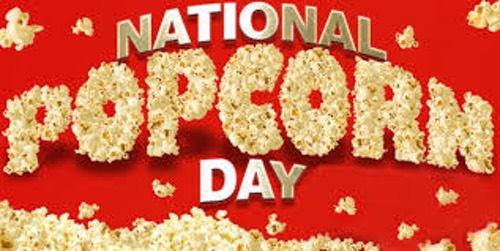
Join us on January 19 as we celebrate National Popcorn Day! Buttered, salted, kettled, drizzled with caramel, popcorn is one of those snacks perfect anytime, anywhere. It’s great on the go, in the theater, or in your living room! Just be prepared to dig some of it out of your teeth.
. 1908 ~ Merwyn Bogue, Comic singer, sang and played trumpet with Kay Kyser’s Kollege of Musical Knowledge, big bandleader
. 1939 ~ Phil Everly, American rock-and-roll singer and guitarist, The Everly Brothers with his brother Don
. 1942 ~ Michael Crawford, singer. Some of his best-known roles have been in The Phantom of the Opera, Condorman, Hello, Dolly!, A Funny Thing Happened on the Way to the Forum, The Knack
. 1943 ~ Janis Joplin, American blues-rock singer and songwriter with Big Brother and The Holding Company and formed Kozmic Blues Band
. 1946 ~ Dolly Parton, American country music singer and songwriter, ACM Entertainer of the Year in 1977 and CMA Entertainer of the year, 1978
. 1949 ~ Robert Palmer, Singer, guitarist
. 1952 ~ Dewey Bunnell, Singer, guitarist with America
. 1953 ~ Sixty-eight percent of all TV sets in the U.S. were tuned to CBS-TV this day, as Lucy Ricardo of I Love Lucy gave birth to a baby boy, just as she actually did in real life, following the script to the letter! The audience for the program was greater than that watching the inauguration of President Dwight D. Eisenhower the following day. The baby was Desi Arnaz, Jr., entertainer and singer with Dino, Desi and Billy
. 1970 ~ The soundtrack of the film, “Easy Rider”, the movie that made a star of Peter Fonda, became a gold record. It was the first pop-culture, film soundtrack to earn the gold award.
. 1971 ~ Ruby Keeler made her comeback in the play, “No, No Nanette”, which opened at the 46th Street Theatre in New York City. Keeler played the role of Sue Smith in the revival of the 1925 hit musical. The show played for 861 performances.
. 1976 ~ The Beatles turned down an offer of $30 million to play together again on the same stage. Rock promoter Bill Sargent still doesn’t understand why the group turned down his generous offer.
. 1980 ~ Richard Franko Goldman, composer, died at the age of 69
. 1993 ~ Fleetwood Mac reunited to play “Don’t Stop” at Bill Clinton’s first inaugural ball
. 1998 ~ Carl Perkins, singer/songwriter, died at the age of 65
. 2014 ~ Udo Kasemets (November 16, 1919 – January 19, 2014) was an Estonian-born Canadian composer of orchestral, chamber, vocal, piano and electroacoustic works. He was one of the first composers to adopt the methods of John Cage and was also a conductor, lecturer, pianist, organist, teacher and writer.
. 1864 ~ Anton Schindler, German violinist and Beethoven’s biographer, died at the age of 68
. 1875 ~ First American performance of Johannes Brahms’“Hungarian Dances”
.
1886 ~ Death of Italian opera composer Amilcare Ponchielli, in Milan. He was 51.
. 1891 ~ French Composer Leo Delibes died at the age of 54
. 1905 ~ Ernesto Halffter, Spanish composer and conductor
. 1908 ~ Ethel Merman (Zimmerman), American singer of popular music, Tony Award-winning actress (musical), Musical Theater Hall of Fame. She is most famous for Call Me Madam in 1951, It’s a Mad, Mad, Mad, Mad World, There’s No Business Like Show Business and Alexander’s Ragtime Band
. 1929 ~ Marilyn Horne, American mezzo-soprano
. 1929 ~ G.T. (Granville) Hogan, Jazz drummer who played with Elmo Hope, Earl Bostic
. 1934 ~ Bob Bogle (Robert Lenard Bogle), Guitarist, bass with The Ventures
. 1938 ~ Béla Bartók and his wife, Ditta performed their first public concert featuring his Sonata for Two Pianos and Percussion
. 1938 ~ Benny Goodman and his band, plus a quartet, brought the sound of jazz to Carnegie Hall in New York City. When asked how long an intermission he wanted, he quipped, “I don’t know. How much does Toscanini get?”
. 1942 ~ Bill Francis, Keyboard, singer with Dr. Hook and the Medicine Show
. 1942 ~ Kay Kyser and the band recorded A Zoot Suit for Columbia Records. The tune is about the problems associated with wearing this garish, exaggerated ‘hep’ fashion.
. 1946 ~ Katia Ricciarelli, Italian soprano
. 1946 ~ Ronnie Milsap, Grammy Award-winning singer in 1976, CMA Male Vocalist of the Year (1974, 1976, 1977), CMA Entertainer of the Year (1977), blind since birth, he learned to play several instruments by age 12
. 1957 ~ Conductor Arturo Toscanini died in New York at the age of 89.
. 1957 ~ The Cavern Club opened for business in Liverpool, England. The rock club was just a hangout for commoners. Then, things changed — big time. It all started in the early 1960s when four kids from the neighborhood popped in to jam. They, of course, turned out to be The Beatles.
. 1962 ~ Paul Webb, Bass with Talk Talk
. 1964 ~ “Hello Dolly!” opened at the St. James Theatre in New York City. Carol Channing starred in the role of Mrs. Dolly Levi. The musical was an adaptation of Thornton Wilder’s play, “The Matchmaker”. The show, with an unforgettable title song, was hailed by critics as the “…possible hit of the season.” It was possible, all right. “Hello Dolly!” played for 2,844 performances. And, it returned to Broadway in the 1990s, again starring Carol Channing.
. 1972 ~ David Seville died on this day in Beverly Hills, CA. Born Ross Bagdasarian, the musician was the force, and artist, behind the Alvin and the Chipmunks novelty songs of the 1950s, ’60s and ’70s.
. 1973 ~ Clara Ward passed away. Ward was an American gospel artist who achieved great artistic and commercial success in the 1940s and 1950s.
. 1975 ~ “Mandy” is Barry Manilow’s first #1 pop hit
. 1976 ~ The album, “Frampton Comes Alive”, was released by Herb Alpert’s A&M Records. The double LP soon reached the top spot of the album charts and stayed perched there for 17 weeks. It sold 19 million copies in its first year.
. 1980 ~ Lin Manuel Miranda, American actor, composer, lyricist (Hamilton)
. 1984 ~ Michael Jackson received eight awards at the 11th annual American Music Awards this night.
. 2001 ~ Eleanor Lawrence, a flutist who played often in chamber music performances and with several orchestras in New York City, died of brain cancer at the age of 64. She is credited with transforming a simple newsletter into an important source for flutists. Lawrence studied the flute at the New England Conservatory with the principal flutist of the Boston Symphony Orchestra, James Pappoutsakis. She later studied with flutists from the Philadelphia Orchestra and the Metropolitan Opera orchestra. She joined the American Symphony Orchestra and the Brooklyn Philharmonic after moving to New York in the 1960s. She played periodically with the New York Philharmonic and the Metropolitan Opera. Besides performing, Lawrence taught at the Manhattan School of Music. She served three times as the president of the New York Flute Club. She edited The National Flute Association Newsletter, now The Flutist Quarterly, from the mid-1970s to the early 1980s, expanding it from a brief information sheet to a publication with regular interviews.
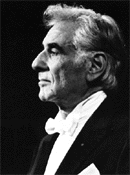
On January 18, 1958 Leonard Bernstein began presenting his television series What does music mean? The series ran for 53 programs. Some of the episodes can be found below:
Part 1 What is Classical Music?
Plot: Bernstein conducts Handel’s Water Music and cites it as an indisputable example of classical music. “Exact” is the word that best defines classical music, Bernstein says and he demonstrates with musical illustrations from Bach’s Fourth Brandenburg Concerto, Mozart’s Concerto No. 21 in C Major and The Marriage of Figaro, and Haydn’s Symphony No. 102.
The decline of classical music at the end of the eighteenth century is tied to Beethoven’s innovations and the Romantic movement, and Bernstein conducts Beethoven’s Egmont Overture.
Part 2 What is Melody?
Plot: Bernstein discusses the different forms melody can take, including tune, theme, motive, melodic line and musical phrase. He illustrates by conducting the orchestra in excerpts from Tchaikovsky, Wagner, Hindemith, and Brahms.
Part 3 What is a Mode?
Plot: Bernstein discusses scales, intervals, and tones, and analyzes several pieces, including Debussy’s Fêtes, Rimsky-Korsakov’s Scheherazade, and music from the Kinks and the Beatles, to illustrate different modes.
An excerpt from Bernstein’s ballet Fancy Free is also performed.




 Grammy winner

 MaryO'Studio