• 1940 ~ The Southland Shuffle was recorded on Bluebird Records by Charlie Barnet and his orchestra. A young trumpet player named Billy May was featured.
• 1945 ~ Stephen Stills born, American rock guitarist, singer and songwriter for Buffalo Springfield and also Crosby, Stills, Nash and Young
• 1946 ~ John Paul Jones (Baldwin), Bass with Led Zeppelin
• 1969 ~ 30,000 copies of the John Lennon, Yoko Ono album, “Two Virgins”, were confiscated by police in Newark, NJ. John and Yoko were nude on the cover.
• 1972 ~ Don McLean received a gold record for his 8-minute-plus hit, American Pie.
• 1974 ~ Following eight years of inactivity, Bob Dylan toured for 39 dates in 25 cities. His first stop was in Chicago, IL. The tour was recorded and later released as a double-LP set titled, “Before the Flood”.
• 1981 ~ John Lennon’s(Just Like) StartingOver and the album “Double Fantasy” topped the pop music charts just weeks after the death of the former Beatle.
• 1985 ~ Soprano Leontyne Price bid adieu to the Metropolitan Opera in New York. She sang the title role of “Aida”. Price had been part of the Met since 1961.
• 1724 ~ First Performance of J. S. Bach’s Sacred Cantata No. 26 Ach wie flüchtig, ach wie nichtig performed on the 24th Sunday following Trinity. A portion of Bach’s second annual Sacred Cantata cycle in Leipzig, 1724-25.
• 1736 ~ J. S. Bach named court composer by Poland’s King Agustus III.
• 1739 ~ First Performance of Jean-Philippe Rameau‘s opera Dardanus in Paris.
• 1826 ~ Composer Felix Mendelssohn and his sister Fanny performed his overture to “A Midsummer Night’s Dream” for the first time.
• 1828 ~ Death of Austrian composer Franz Schubert in Vienna, at the age of 31 from typhus. He is buried near Beethoven.
• 1859 ~ Mikhail Ippolitov-Ivanov, Russian composer and conductor
More information about Ippolitov-Ivanov
• 1874 ~ Birth of composer Karl Adrian Wohlfahrt.
• 1875 ~ First Performance of Tchaikovsky‘s Third Symphony, in Moscow.
• 1888 ~ Piano Debut in Boston of composer Edward MacDowell with the Kneisel Quartet.
• 1905 ~ Tommy Dorsey, American trombonist and bandleader
• 1923 ~ First Performances of Béla Bartók‘sFive Dances and Zoltán Kodály‘sPsalums Hungaricus in Budapest, marking the 50th anniversary of the union of cities Buda and Pest.
• 1936 ~ Birth of classical music commentator (Detroit Symphony broadcasts) Dick Cavett, in Kearney, Nebraska. ABC-TV talk show host (Dick Cavett Show).
• 1936 ~ First concert recorded on magnetic tape with the London Philharmonic orchestra conducted by Sir Thomas Beecham at BASF’s own concert hall in Ludwigshaven, Germany.
• 1937 ~ Ray Collins, Songwriter
• 1938 ~ Hank Medress, Singer with The Tokens, record producer
• 1943 ~ Fred Lipsius, Piano, sax with Blood Sweat & Tears
• 1943 ~ Stan Kenton and his orchestra recorded Artistry in Rhythm, the song that later become the Kenton theme. It was Capitol record number 159. The other side of the disk was titled, Eager Beaver.
• 1944 ~ Agnes Baltsa, Greek mezzo-soprano
• 1954 ~ Sammy Davis, Jr. was involved in a serious auto accident in San Bernardino, CA. Three days later, Davis lost the sight in his left eye. He later referred to the accident as the turning point of his career.
• 1957 ~ American conductor Leonard Bernstein named Music Director of the New York Philharmonic. First American-born and educated conductor named to head an important American Orchestra.
• 1961 ~ A year after Chubby Checker reached the #1 spot with The Twist, the singer appeared on The Ed Sullivan Show to sing the song again. The Twist became the first record to reach #1 a second time around, on January 13, 1962.
• 1962 ~ For the first time, a jazz concert was presented at the White House. Jazz had previously been served as background music only.
• 2000 ~ First Performance of Philip Glass‘ Double Concerto for Timpani and Orchestra, by the American Composers Orchestra. Lincoln Center in New York.
2004 ~ Composer Cy Coleman, who wrote the musical “Sweet Charity” and whose songs included such Frank Sinatra classics as Witchcraft, Big Spender and The Best is Yet to Come, died at the age 75
More information about Cy Coleman
• 1307 ~ The story of William Tell shooting the apple off of his young son’s head is said to have taken place on this day. Gioachino Rossini made this story into an opera.
• 1680 ~ Birth of French-Belgian composer and flutist Jean Baptiste Loeillet in Gent. d-London, 19 JUL 1730.
• 1736 ~ Birth of German composer Carl Friedrich Christian Fasch in Zerbst. d-Berlin, 3 AUG 1800.
• 1741 ~ George Frideric Handel arrived in Dublin at the invitation of the country of Ireland to attend current concert season. Presented numerous concerts in the Irish capital, including the first performance of his oratorio Messiah early in 1742.
• 1763 ~ Leopold Mozart and his two children, Wolfgang and Maria, arrive in Paris on their European concert tour.
• 1786 ~ Carl Maria von Weber, German composer, conductor and pianist, began the era of German romantic music
More information about von Weber
• 1838 ~ Sir William Schwenck Gilbert, British playright and librettist, best known for his comic operettas with Arthur Sullivan
• 1859 ~ Birth of Russian composer and pianist Sergei Mikhailovich Liapunov, in Yaroslavl. d-Paris, 1924.
• 1888 ~ First Performance of Peter Ilyich Tchaikovsky’s 5th Symphony, in St. Petersburg.
• 1889 ~ Amelita Galli-Curci, Opera soprano, “If not the greatest coloratura soprano of all time, she must surely be recognized as among the world’s finest examples of true operatic artistry.”
• 1891 ~ First Performance of Tchaikovsky‘s symphonic work The Voyevode in Moscow.
• 1892 ~ First concert at Carnegie Hall by the New York Philharmonic.
• 1936 ~ Hank Ballard, Singer, songwriter with The Midniters, wrote and recorded The Twist
More about Hank Ballard
• 1950 ~ Graham Parker, Singer with Graham Parker and The Rumour
• 1953 ~ Herman Rarebell, Drummer with Scorpions
• 1960 ~ Kim Wilde, Singer
• 1967 ~ Lulu’sTo Sir with Love, from the movie of the same name, started its fifth and final week at number one.
• 1974 ~ Frank Sinatra emerged from retirement to do a TV special with dancer Gene Kelly. The show was a smash hit and revived Sinatra’s career.
• 1975 ~ John Denver received a gold record for I’m Sorry.
• 1986 ~ The Roseland Ballroom reopened in New York City. The 67-year-old home for those wanting to dance cheek to cheek featured America’s dean of society music, LesterLanin. He played for patrons who wanted to cut a rug on the 112-by-55-foot, maple wood dance floor.
• 2003 ~ First Performance of John Corigliano‘s Snapshot: Circa 1909. Elements String Quartet at Merkin Concert Hall, NYC.
• 2003 ~ Oscar-nominated composer, conductor and arranger Michael Kamen, one of Hollywood’s most sought-after musicians, died at age 55 after suffering from multiple sclerosis for several years. The native New Yorker and Juilliard School of Music Graduate was one of Hollywood’s most successful composers who worked on music for the “Lethal Weapon” series and scored “Die Hard” among many other films. In the late 1960s, he helped found the New York Rock ‘n’ Roll Ensemble, a critically acclaimed group that fused classical with pop and recorded five albums before dissolving. In the 1970s, Kamen scored ballets, served as musical director for David Bowie’s “Diamond Dogs” tour and began writing scores for film. Although he began in Hollywood working on offbeat films like “Polyester” and “Brazil,” he turned more mainstream in the 1980s, working on the “Lethal Weapon” series, “Robin Hood: Prince of Thieves,” “Mr. Holland’s Opus” and “X-Men,” plus the HBO series “Band of Brothers.” In 1991, Kamen earned his first Academy Award nomination for “(Everything I Do) I Do It for You,” the Bryan Adams pop hit from the movie, “Robin Hood: Prince of Thieves.” Co-written with Adams and Robert John “Mutt” Lange, the song received two Grammys. The three united in 1993 for “All for Love.” In 1999, Kamen conducted the orchestra which backed Metallica on their S&M project.
Adapted from http://www.oconnormusic.org/month-nov.htm
• 1726 ~ The first performance of J. S. Bach‘s Sacred Cantata No. 55 Ich armer Mensch, ich Sündenknecht on the 22nd Sunday following Trinity. Was part of Bach’s third annual Sacred Cantata cycle in Leipzig 1725-27
• 1876~ The first performance of Peter Ilyich Tchaikovsky‘s March Slav in Moscow.
• 1877 ~ The first production of Gilbert and Sullivan’s opera, The Sorcerer, was presented, in London.
• 1888~ The first production of Tchaikovsky‘s Fifth Symphony in St. Petersburg.
• 1891 ~ Poland’s premier and premier ivory tickler, Ignace Jan Paderewski, made his American debut at Carnegie Hall in New York City. In later years, Paderewski, who suffered from arthritis, settled in Paso Robles, CA. The hot mineral baths located there eased his pain. He played only Steinway grand pianos custom-built to his specifications. In fact, five were made just for his use.
• 1925 ~ Sir Charles Mackerras, Australian conductor
• 1930 ~ David Amram, American composer and French-horn player
• 1938 ~ Gordon Lightfoot, Canadian folk singer, songwriter and guitarist
• 1938 ~ Orchestra leader Kay Kyser, speaking to an audience at the College of the City of New York (CCNY) told of the “inner workings and artistic features of swing music.” It marked the first of a series of lectures on swing music presented by Kyser, who went on to presentThe Kollege of Musical Knowledge on radio.
• 1941 ~ Gene Clark, Singer, guitar with The Byrds
• 1942 ~ Bob Gaudio, Singer with The Royal Teens; The Four Seasons
• 1946 ~ Martin Barre, Guitarist with Jethro Tull
• 1950 ~ Roberta Peters filled in for the lead in Mozart’s Don Giovanni, making her debut at the Metropolitan Opera in New York City. She would become one of the Met’s most famous stars.
• 1962 ~ The 4 Seasons, with Frankie Valli as lead singer, began a five-week run at the top of the tunedex with Big Girls Don’t Cry.
• 1967 ~ Ronald DeVoe, Singer with New Edition
• 1970 ~ Elton John recorded an album live, on what was WABC-FM in New York City. It marked the first time that a concert was aired live and recorded for release as aired. The LP was titled, 11/17/70.
• 2001 ~ Jerry Jerome, a tenor sax player who was a featured soloist with the bands of Glenn Miller and Benny Goodman, died of leukemia. He was 89. One of the big names in the Big Band era, Jerome was a featured soloist with the Glenn Miller, Benny Goodman, Red Norvo and Artie Shaw orchestras. He then became a successful musical director and conductor on radio and television. Jerome also established a music business, scoring and arranging commercial jingles. Three years ago, Arbors Records released Jerome’s “Something Old, Something New.” The sequel recording, “Something Borrowed, Something Blue,” will be released in December. Born in Brooklyn, N.Y., Jerome started playing the sax while in high school. He attended the University of Alabama and went on the medical school, playing gigs at jazz clubs to earn tuition money. He joined Goodman’s orchestra at the height of its popularity in 1938. When Goodman broke up his band in 1940, Jerome joined Shaw. While with Shaw, he appeared in the film “Second Chorus,” with Fred Astaire and Burgess Meredith.
• 2003 ~ Arthur Conley, a 1960s soul singer and protege of Otis Redding’s, died at his home in the town of Ruurlo, in the eastern Netherlands. He was 57. Conley was born in Atlanta and started his recording career in 1959 as leader of the group Arthur and the Corvets. He was best known for his 1967 hit, Sweet Soul Music, which he co-wrote with Redding based on a number by Sam Cooke. Conley had several minor hits in the following two years. He moved to Europe in the early 1970s after several tours of the continent, deciding that he was “fed up with the pressure” in the United States, said Giesen. In the Netherlands, Conley appeared on television and radio, and ran an independent record label. In the last five years he was an adviser to The Original Sixties R&B and Soul Show, which sought to reproduce the sound and look of the heyday of soul.
• 1905 ~ Mantovani, Orchestra leader, (1953 UK No.1 single ‘Moulin Rouge’, 1957 US No. 12 single ‘Around The World In Eighty Days’) was born. He died on 30th March 1980.
• 1914 ~ Jorge Bolet, Cuban-born American pianist was born
• 1926 ~ NBC broadcast its first music program. It featured the New York SymphonyOrchestra and many distinguished soloists. 24 stations carried the first broadcast. The program was a gala 4½-hour broadcast from the Waldorf-Astoria Hotel in New York City. Two remote pickups were also on the program. Opera star Mary Garden sang from Chicago and Will Rogers presented a humorous monologue from Independence, Kansas. Charles Lindbergh was among the luminaries who attended the broadcast.
• 1928 ~ C.W. McCall (William Fries), Singer, songwriter was born
• 1932 ~ Petula Clark, British pop singer (Downtown, My Love) was born
• 1954 ~ Studio One on CBS-TV featured Joan Weber singing Let Me Go, Lover. The song had enjoyed limited popularity before the TV show, but skyrocketed to fame immediately after.
• 1956 ~ Love Me Tender, the first Elvis Presley film, premiered.
• 1967 ~ Mari Fernandez, Singer with Sweet Sensation was born
• 1969 ~ The first album featuring Karen and Richard Carpenter was released by A&M Records. Offering would not be a big seller, but a single from the disc, a remake of The Beatles’Ticket to Ride, would gain national attention. Their next album, however, would establish them as major international stars (Close to You).
• 1974 ~ The most expensive 2-record album was released-on Casablanca Records. It was a comedy disc titled, Here’s Johnny – Magic Moments from the Tonight Show.
• 1974 ~ The group, Faces, released their tune with the longest title. You Can Make MeDance, Sing or Anything (Even Take the Dog for a Walk, Mend a Fuse, Fold Away theIroning Board, Or Any Other Domestic Shortcomings).
• 1980 ~ After years of success on the music charts with the New Christy Minstrels and the First Edition, Kenny Rogers got his first #1 song. Lady, written by LionelRichie, stayed at the top for six weeks.
• 1986 ~ The first major operetta written by Gian Carlo Menotti in over 20 years was presented at the Kennedy Center in Washington, DC. Starring tenor PlacidoDomingo, Goya was said by critics to be only “intermittently good.”
• 2003 ~ David Holt, a former child actor once touted by Paramount Pictures as its answer to Shirley Temple, has died. He was 76. Holt, who later became a successful jazz musician and songwriter, died of congestive heart failure. Although his career never rivaled Temple’s, Holt had his share of success as a child actor, playing Elizabeth Taylor’solder brother in “Courage of Lassie” in 1946 and appearing as bratty Sidney Sawyer in “The Adventures of Tom Sawyer” in 1938. He also played the crippled boy for whom New York Yankee great Lou Gehrig hit a home run in “Pride of the Yankees” and appeared in “The Big Broadcast of 1936.” Paramount signed Holt to a long-term contract after his 1934 role as a boy whose mother dies in “You Belong To me.” Holt eventually segued into music. He co-wrote the song The ChristmasBlues with Sammy Cahn and wrote the music for numerous jazz albums. He hosted the TV show “American Music Shop” in the 1990s.
Avery Gagliano is a commanding young pianist who attacks Chopin with the focused diligence of a master craftsman and the grace of a ballet dancer.
The prodigy, who just turned 13, was one of 12 musicians selected from across the globe to play at a prestigious event in Munich last year and has won competitions and headlined with orchestras nationwide.
But to the D.C. public school system, the eighth-grader from Mount Pleasant is also a truant. Yes, you read that right. Avery’s amazing talent and straight-A grades at Alice Deal Middle School earned her no slack from school officials, despite her parents’ begging and pleading for an exception.
Picture a seven-foot grand piano in a studio. The lid’s missing, so you can see all the strings. Researchers suspend a rod embedded with 32 microphones over the piano’s body.
“We played this middle C at a very soft level, a medium level, and a very loud level,” says Agnieszka Roginska, a professor in NYU’s music technology program. She says using a pianist to play middle C over and over wouldn’t be scientific. So they’re using a disklavier, a fancy player piano triggered by electronics. “So we could hit the same note, with the same velocity, thousands of times,” she says.
They’d record the piano in one spot. Then move the microphones eight inches. Record the note. Move the mics again. Record the note. Over and over and over, until they reach the back of the piano. At the end, they get “what is basically a very dense acoustical scan of the radiation pattern of the grand piano,” Roginska says.
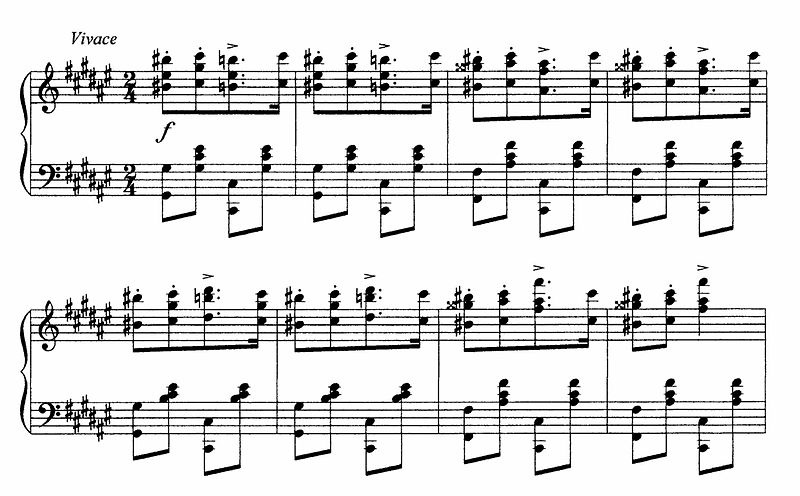
Hungarian Rhapsody No. 2, S.244/2, is the second in a set of 19 Hungarian Rhapsodies by composer Franz Liszt, and is by far the most famous of the set. Few other piano solos have achieved such widespread popularity, offering the pianist the opportunity to reveal exceptional skill as a virtuoso, while providing the listener with an immediate and irresistible musical appeal.
In both the original piano solo form and in the orchestrated version this composition has enjoyed widespread use in animated cartoons. Its themes have also served as the basis of several popular songs.
It is probable that you have heard this piece of music somewhere at one time or another because it is perhaps the most prominent piece of classical (romantic, actually) music featured in animated cartoons across the years.
Now, let the anvils fall and dynamite explode!
And, in real life, Valentina Lisitsa plays Liszt’s Hungarian Rhapsody No. 2
cdcovers/tchaikovsky/concerto no 1 van cliburn.jpg (Photo credit: exquisitur)
Van Cliburn was just a pianist much the way Neil Armstrong was merely an astronaut. Simply put, the tall Texan’s musical talent and successes were out of this world.
Cliburn, who died Wednesday February 27, 2013 at age 78 at his Fort Worth home due to complications from bone cancer, was 23 when he strode into Moscow for the inaugural International Tchaikovsky Competition, created to showcase Soviet cultural superiority.
Playing with unerring precision and sublime emotion, he took the top prize and was given a ticker-tape parade in Manhattan, the first and last time a pianist won such an honor.
“Imagine galvanizing the attention of the entire world in the pre-Internet, pre-global TV year of 1958,” says Howard Reich, who got to know the Texas-based pianist while researching his 1993 biography, Van Cliburn. “As a Texan, he was so emblematic of the United States. But the Russians fell in love with his romanticism.”
In many ways, however, that seminal performance both made his name and sealed his fate.
The pieces that won him the competition — Tchaikovsky’s Piano Concerto No. 1 and Rachmaninoff’s Piano Concerto No. 3 — sold countless records (his Tchaikovsky No. 1 was the first classical record to sell more than a million copies) and became required concert staples.
“Playing on that treadmill for the next 20 years led him to burn out, and by 1978 he looked terrible and bowed out of public life,” says Reich. “He was a gentle soul, and that harsh public spotlight had a negative effect on him.”
It would be nine years before Cliburn performed again, at the White House for Ronald Reagan and Soviet premier Mikhail Gorbachev. Although he made occasional appearances in the following decades, he spent most of his time overseeing his foundation and a quadrennial competition that bears his name.
“I can’t think of anyone who has done more to help promote the instrument and young performers than Van,” says Cliburn’s friend Yoheved Kaplinsky, chairman of the piano department at New York’s Juilliard School of Music, which Cliburn attended. “He was an icon in Fort Worth, and a person of great humility.”
Born Harvey Lavan Cliburn Jr. in Shreveport, La., Cliburn started piano lessons at age 3 and immediately showed prowess under the watchful eye of his mother, who had trained on the instrument under a teacher who had studied with Franz Liszt.
After moving to Texas, Cliburn played with Houston’s symphony at age 12, and at 17 entered Juilliard. At 20, he performed with the New York Philharmonic at Carnegie Hall, setting the stage for his triumphant coup in Russia.
No one can imagine a ticker-tape parade for a pianist in this era, but in Cliburn’s heyday he was as much an inevitable cultural icon as he was a reluctant political figure. In the late ’50s, the Cold War was raging, the Beatles were still practicing and classical music still held sway.
But what truly made Cliburn unique was the humble ease with which he went about seducing the alleged enemy.
“Van marched in full of the musical values of the Old World, full of tremendous sincerity and with a remarkable ability to connect with audiences,” says Kaplinsky. “He may have transcended the boundaries of the art world and breached into the political world, but foremost Van was a consummate artist.”
That artistry is on display in various YouTube clips of Cliburn reprising his competition-winning form in Moscow in 1962. The pianist’s eyes are often closed as massive hands fly across the length of the keyboard. Utterly lost in the music, Cliburn seems almost oblivious to his audience.
“He had more of everything,” says Reich. “More height, more smiles, more sweep on the piano.”
In his later years, Cliburn collected the usual array of awards accorded cultural heroes. A Kennedy Center Honors tribute in 2001, a Presidential Medal of Freedom in 2003, and in 2004 Russia’s equivalent, the Russian Order of Friendship. In 2004, there was a predictable Grammy Lifetime Achievement Award, and in 1994 a less-expected guest appearance as himself in the TV cartoon Iron Man.
On the personal front, Cliburn was a devout Baptist but also quietly gay; in the late ’90s, his longtime partner, Thomas Zaremba, unsuccessfully sued the pianist over compensation claims.
Ultimately, Cliburn will be remembered not just as a performer of startling skill, but also as a global cultural sensation in the age of shortwave radio.
“He did something that no one could have ever imagined back then,” says Reich. “He was ubiquitous.”